Horror Review: High Plains Drifter (dir. by Clint Eastwood)


“Don’t count on me to make you feel safe.” — The Stranger

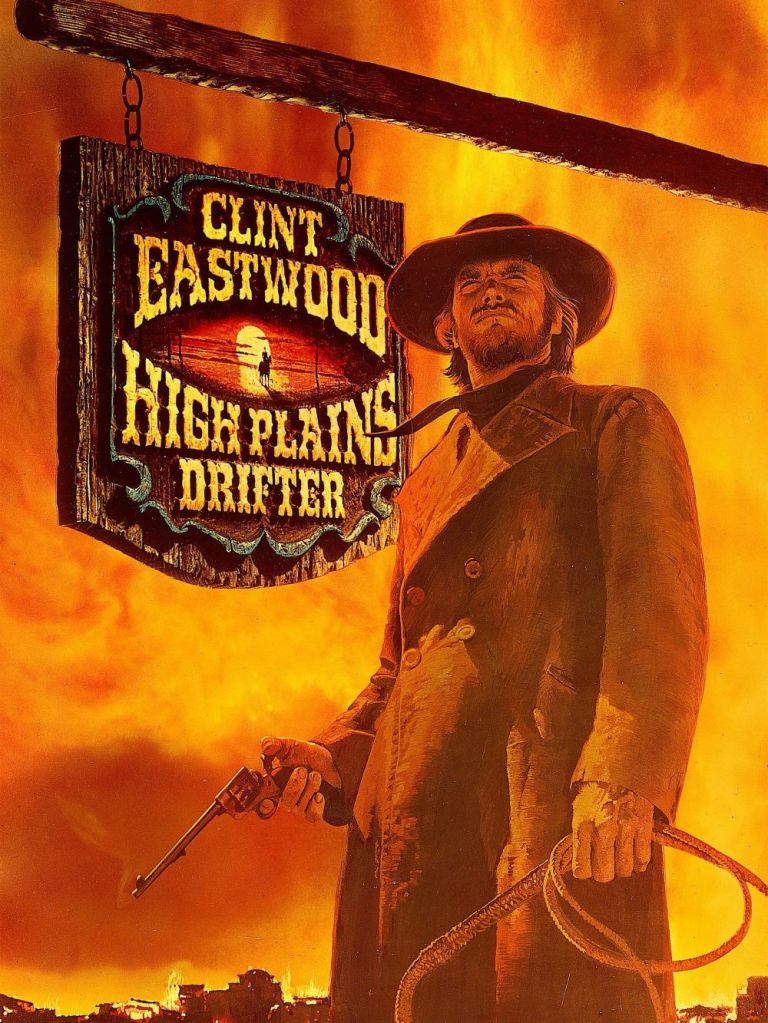
High Plains Drifter stands as one of the bleakest, most enigmatic entries in Clint Eastwood’s filmography—a Western that bleeds unmistakably into the realms of psychological and supernatural horror. This 1973 film is not just another dusty tale of lone gunfighters and frontier justice. It’s a nightmare set in broad daylight, a morality play whose hero is more monster than man.

Eastwood’s Stranger comes riding into the town of Lago from the shimmering desert, a silhouette both akin to and apart from his famed Man With No Name persona. The townsfolk are desperate, haunted by fear—less afraid of imminent violence, more of the sins they’ve half-buried. This is a place where a lawman was brutally murdered by outlaws while the townspeople looked away, their silence paid for with cowardice and greed. When the Stranger assumes command, he does so with often-gleeful sadism—kicking people out of their hotel rooms, replacing the mayor and sheriff with the dwarf Mordecai, and ordering that the entire town be painted red before putting “Hell” on its welcome sign.

There’s a surface plot: the Stranger is hired to protect Lago from the same three outlaws who once butchered its marshal. But he’s there for far more than that. The story unspools through dreamlike sequences, flashbacks that suggest the Stranger may well be an avenging spirit or a revenant—the dead lawman, spectral and merciless, returned to claim what the townsfolk owe to Hell itself.

The horror here isn’t about jump scares or gothic haunted houses. The supernatural lurks everywhere and yet nowhere. The Stranger moves with the implacable calm—and violence—of a slasher villain, transforming Lago into his personal stage for retribution. His nightmares, full of images of past atrocities, are painted with the same vivid brutality as the daytime violence. Eastwood’s use of silence, the squint of a face, the twitch of a pistol replaces musical cues in amplifying dread. The sound design evokes otherness—a howling wind, footsteps echoing across empty streets—that builds a shadow of terror around the Stranger’s presence.

This violence is hurried and brutal; its sexual politics unflinching. When the Stranger enacts revenge, he punishes not just the outlaws, but the townsfolk complicit in their crimes. There is little comfort in his sense of justice—the pleasures he takes border on sadistic. The film’s moral ambiguity cuts deeper than most Westerns or horrors: this is not a clear-cut tale of good versus evil, but a brutal reckoning of collective guilt, cowardice, and corruption.

Lago itself acts almost like a town stuck in purgatory—a holding pen between redemption and eternal damnation. The infamous “Welcome to Hell” sign the Stranger paints at the town’s entrance serves as a grim message. It’s no welcome to law and order, but a symbolic beacon to the very outlaws the Stranger is hired to confront, suggesting that Lago is a place where sin festers and punishes itself. The town’s dance with Hell is both literal and metaphorical. The inhabitants aren’t just awaiting judgment; they have invited it in their desperate attempts to hide their cowardice and greed under the guise of civilization.

This notion of Lago as purgatory stands in sharp contrast to other recent horror Westerns, which serve as prime examples of the genre’s thematic spectrum. These films tend to focus on the primal terror of nature barely held at bay by the fragile veneer of civilization the settlers claim. They pit human beings against the ancient, untamed forces of the wilderness—whether monstrous creatures or surreal phenomena—emphasizing that the supposed order and progress of the West remain fragile and constantly threatened. This dynamic symbolizes the uneasy balance between civilization’s reach and nature’s primal power, often revealing how thin and tenuous that barrier truly is.

Among these, Bone Tomahawk and Ravenous stand out as vivid examples. Bone Tomahawk confronts menacing cannibals lurking in the wild, reminding viewers that the West’s order is fragile and under perpetual threat from untamed wilderness. Ravenous uses cannibalism and survival horror as metaphors for nature’s savage predation hidden beneath the polite façade of civilization—nature’s horrors masked but not erased.

By contrast, High Plains Drifter directs its horror inward, exposing the corruption that manifest destiny imposed on settlers themselves. Instead of fearing nature as an external force, the film presents settlers as haunted by their own moral failures and complicity in violence and betrayal. The Stranger’s vengeance is a reckoning with the darkness festering inside the community, a brutal meditation on guilt, collective cowardice, and the price of greed disguised as progress.

Eastwood’s film strips away the mythic promises of the American West as a land of freedom and opportunity, revealing instead the brutal reality of communities locked in complicity, violence masquerading as justice, and the moral rot at the heart of manifest destiny. This moral ambiguity and psychological depth give High Plains Drifter a unique position in the horror Western subgenre, elevating it beyond simple scares to a profound exploration of American cultural myths.

The Stranger is not a traditional hero but a spectral judge, embodying divine or supernatural retribution. His calm yet ruthless punishment exposes the cruelty, cowardice, and malevolence within Lago’s population, meting out a justice that is neither neat nor forgiving. His supernatural aura and sadistic tendencies make him an unforgettable figure of terror and fate.

Visually, the film’s harsh daylight contrasts with the romanticized Western landscapes of earlier films. Instead of shadows hiding evil, blinding light exposes the town’s moral decay. Characters are reduced to symbols of greed, fear, and cruelty, highlighting that the true horror lies within human nature and the failure to uphold justice.

High Plains Drifter operates on multiple levels—a Western, a ghost story, a horror film, and a dark morality play. It is a relentless meditation on justice and punishment and a dismantling of the traditional Western hero myth. Through layered narrative, stark visuals, and Eastwood’s chilling performance, it remains an essential entry in the horror Western canon.

For those seeking a Western that doesn’t just entertain but unsettles and challenges, High Plains Drifter offers an unforgiving descent into darkness. It strips away the comforting myths of the frontier and exposes the raw, rotting core beneath. Unlike other modern horror Westerns such as Bone Tomahawk and Ravenous, which confront external terrors lurking in the wilderness, this film turns its gaze inward—on the moral decay, guilt, and violence festering within the settlers themselves. It’s a brutal, haunting reckoning, and Eastwood’s Stranger is the cold, relentless agent of that reckoning. This is a journey into a hell both literal and psychological, where justice is merciless and safety is a long-forgotten promise.


Horror On The Lens: Invitation to Hell (dir by Wes Craven)


There’s one rule in life that should never be forgotten.

Any movie that opens with Susan Lucci casting a hex that causes a man’s head to explode is going to be worth watching.

That’s certainly the case with Invitation to Hell, a 1984 made-for-TV movie that was directed by Wes Craven and which casts Lucci as Jessica Jones, an insurance agent who lives and works in an upper class suburb in Southern California. Jessica not only sells insurance but she also runs the ultra-exclusive Steaming Springs Country Club! Anyone who is anyone in town is a member of Steaming Springs!  That include Matt Winslow (Robert Urich) and his family.  Matt soon comes to suspect that something strange might be happening at the club.  Fortunately, Matt’s spacesuit comes with a flame thrower, a laser, and a built-in computer that can determine whether or not someone is actually a human being. (Wearing the space helmet means viewing the world like you’re the Terminator.) Soon, it’s science vs. magic as Matt dons the suit and tries to rescue his family from country club living!

Totally ludicrous and a lot of fun, this is a film that has a little bit for everyone — familiar television actors, flamethrowers, space suits, demonic possession, exploding cars, and even a little bit of social satire as the film suggests that living in the suburbs is a terror even without weird country clubs and chic spell casters.


What Lisa Watched Last Night #230: Match, Meet, Murder (dir by Nicholas Treeshin)


Last night, around 3 in the morning, I watched the Lifetime film, Match, Meet, Murder!

Why Was I Watching It?

It was late, I had insomnia, and the title just spoke to me.  What can I say?  I had many reasons for my decision and I don’t regret it for a minute.

What Was It About?

Ruby (Stephanie Sy) is a lingerie designer who has been in a dating slump ever since ending her long-term relationship with independent journalist Luke (Erik Athavale).  Ruby’s friend, photographer Ella (Amanda Austin), gives her a secret code for the very exclusive Rima dating app.  Soon, Ruby is matched with Dylan (Jacob Blair).

Dylan, it turns out, is a bit of celebrity.  He was the winning contestant on a reality show hosted by notorious matchmaker, Jules (Lisa Marie DiGiacinto).  The season may have ended with Dylan getting engaged but his new fiancée mysteriously vanished.  Now, Dylan is dating Ruby and he doesn’t seem to be quite stable.  He still has his ex’s clothes hanging in his bedroom closet.  Run, Ruby, run!

What Worked?

I absolutely loved the demented performance of Lisa Marie DiGiacinto, who played Jules the matchmaker.  I can’t say too much about it without spoiling the film but I will say that DiGiacinto fully understood the importance of embracing the melodrama in a film like this.

Some of Ruby’s lingerie designs were cute.  The black bralette was adorable.  Of course, I’d never be able to wear it because I actually have boobs.

What Did Not Work?

I’m usually willing to suspend my disbelief when it comes to a Lifetime film because the melodrama is usually the point.  That said, I had a hard time believing that any successful woman could be as clueless as Ruby.  She acted as if the concepts of both dating apps and reality TV were entirely new to her.  I could excuse her dating app confusion because her character was said to be coming out of a long term relationship.  But, seriously — not knowing about a reality television show?  The Bachelor and The Bachelorette are inescapable, whether you watch them or not.  I haven’t been able to really sit down and watch Love Island but it only takes a few minutes of me scrolling twitter before I feel as if I have.

As well, it took Ruby way too long to figure out that there might be something strange about Dylan’s previous girlfriend disappearing.  Discovering her clothes still hanging in his closet?  That’s a bit too obvious of a red flag to be shrugged off for as long as she did.

“Oh my God!  Just like me!” Moments

Lingerie designer is definitely one of my fallback options if the whole movie-watching writer thing doesn’t work out.  I will also say that I related to the shock of the assistant who introduced Ruby to reality television and was shocked to discover just how little Ruby apparently knew about pop culture.

Lessons Learned

If a guy you barely know has all of his ex’s clothes still hanging in his closet, run!  To be honest, you shouldn’t need a movie to learn that lesson.

Join #MondayMania For Psycho Party Planner!


Hi, everyone!  Tonight, on twitter, I will be hosting one of my favorite films for #MondayMania!  Join us for Psycho Party Planner!

You can find the movie on Prime and then you can join us on twitter at 9 pm central time!  (That’s 10 pm for you folks on the East Coast.)  See you then!

Monday Live Tweet Alert: Join Us for Children of the Corn!


As some of our regular readers undoubtedly know, I am involved in hosting a few weekly live tweets on twitter and occasionally Mastodon.  I host #FridayNightFlix every Friday, I co-host #ScarySocial on Saturday, and I am one of the five hosts of Mastodon’s #MondayActionMovie!  Every week, we get together.  We watch a movie.  We snark our way through it.

Tonight, for #MondayActionMovie, the film will be 1984’s Children of the Corn!

If you want to join this watch party, just hop onto Mastodon, pull up Children of the Corn on YouTube or Tubi, start the movie at 8 pm et, and use the #MondayActionMovie hashtag!

Enjoy!

October Positivity: Revelation Road: The Beginning of the End (dir by Gabriel Sabloff)


Eric Roberts is in the 2013 film, Revelation Road: The Beginning of the End.

Of course, he’s only in it for a few minutes.  In fact, if you blink, you will miss him.  He plays Sheriff Jenson, who is in charge of enforcing the law in a small desert community.  He appears long enough to tell salesman John McManus (David A.R. White) not to leave town.  McManus has just killed three armed men who were attempting to rob a general store.  The store’s owner (Ray Wise) invites him to dinner but the cops are curious as to how a salesman could be so proficient at killing people.

Revelation Road plays out over the course of one long night.  A group of bikers, led by the fearsome Hawg (Brian Bosworth), are seeking revenge for the death of their compatriots.  Meanwhile, Iran is pushing the world towards war.  In a motel, a woman asks John for money.  Lighting flashes.  Lights flicker on and off.  The Earth shakes.  It’s a fearful time, largely because the world itself is coming to an end.  A little over an hour into this 88 minute film, there’s a sudden blinding light and suddenly, a fourth of the cast vanishes.  One person who does not vanish runs into a kindly stranger, played by Bruce Marchiano.  Marchiano will be well-known to viewers of faith-based cinema for the number of times that he’s played Jesus.  So, you can probably guess what’s happened.

Revelation Road ends with the promise of a sequel, which means that the film also ends with a lot of unanswered questions.  It makes Revelation Road difficult to really review because it’s obviously meant to be a prologue to the actual story.  I will note that Revelation Road is a surprisingly violent movie, at least by the standards of most faith-based films.  Then again, most of the violence was in self-defense and the Bible itself is full of stories of violent men who found redemption.  In fact, you could probably argue that it’s impossible to do an apocalypse movie that isn’t violent.  We’ll just have to wait to see where this story is heading.

I’ll review the sequel tomorrow.

Previous Eric Roberts Films That We Have Reviewed:

  1. Paul’s Case (1980)
  2. Star 80 (1983)
  3. Runaway Train (1985)
  4. To Heal A Nation (1988)
  5. Best of the Best (1989)
  6. Blood Red (1989)
  7. The Ambulance (1990)
  8. The Lost Capone (1990)
  9. Best of the Best II (1993)
  10. Love, Cheat, & Steal (1993)
  11. Voyage (1993)
  12. Love Is A Gun (1994)
  13. Sensation (1994)
  14. Dark Angel (1996)
  15. Doctor Who (1996)
  16. Most Wanted (1997)
  17. Mercy Streets (2000)
  18. Raptor (2001)
  19. Rough Air: Danger on Flight 534 (2001)
  20. Strange Frequency (2001)
  21. Wolves of Wall Street (2002)
  22. Border Blues (2004)
  23. Mr. Brightside (2004)
  24. Six: The Mark Unleased (2004)
  25. We Belong Together (2005)
  26. Hey You (2006)
  27. Depth Charge (2008)
  28. Amazing Racer (2009)
  29. The Chaos Experiment (2009)
  30. In The Blink of an Eye (2009)
  31. Bed & Breakfast (2010)
  32. Enemies Among Us (2010)
  33. The Expendables (2010) 
  34. Sharktopus (2010)
  35. Beyond The Trophy (2012)
  36. The Dead Want Women (2012)
  37. Deadline (2012)
  38. The Mark (2012)
  39. Miss Atomic Bomb (2012)
  40. Assault on Wall Street (2013)
  41. Bonnie And Clyde: Justified (2013)
  42. Lovelace (2013)
  43. The Mark: Redemption (2013)
  44. The Perfect Summer (2013)
  45. Self-Storage (2013)
  46. Sink Hole (2013)
  47. A Talking Cat!?! (2013)
  48. This Is Our Time (2013)
  49. Bigfoot vs DB Cooper (2014)
  50. Doc Holliday’s Revenge (2014)
  51. Inherent Vice (2014)
  52. Road to the Open (2014)
  53. Rumors of War (2014)
  54. Amityville Death House (2015)
  55. Deadly Sanctuary (2015)
  56. A Fatal Obsession (2015)
  57. Las Vegas Story (2015)
  58. Sorority Slaughterhouse (2015)
  59. Stalked By My Doctor (2015)
  60. Enemy Within (2016)
  61. Hunting Season (2016)
  62. Joker’s Poltergeist (2016)
  63. Prayer Never Fails (2016)
  64. Stalked By My Doctor: The Return (2016)
  65. The Wrong Roommate (2016)
  66. Dark Image (2017)
  67. The Demonic Dead (2017)
  68. Black Wake (2018)
  69. Frank and Ava (2018)
  70. Stalked By My Doctor: Patient’s Revenge (2018)
  71. Clinton Island (2019)
  72. Monster Island (2019)
  73. The Reliant (2019)
  74. The Savant (2019)
  75. Seven Deadly Sins (2019)
  76. Stalked By My Doctor: A Sleepwalker’s Nightmare (2019)
  77. The Wrong Mommy (2019)
  78. Exodus of a Prodigal Son (2020)
  79. Free Lunch Express (2020)
  80. Her Deadly Groom (2020)
  81. Top Gunner (2020)
  82. Deadly Nightshade (2021)
  83. The Elevator (2021)
  84. Just What The Doctor Ordered (2021)
  85. Killer Advice (2021)
  86. Megaboa (2021)
  87. Night Night (2021)
  88. The Poltergeist Diaries (2021)
  89. The Rebels of PT-218 (2021)
  90. Red Prophecies (2021)
  91. A Town Called Parable (2021)
  92. Bleach (2022)
  93. Dawn (2022)
  94. My Dinner With Eric (2022)
  95. 69 Parts (2022)
  96. The Rideshare Killer (2022)
  97. The Company We Keep (2023)
  98. D.C. Down (2023)
  99. Aftermath (2024)
  100. Bad Substitute (2024)
  101. Devil’s Knight (2024)
  102. Insane Like Me? (2024)
  103. Space Sharks (2024)
  104. The Wrong Life Coach (2024)
  105. Broken Church (2025)
  106. When It Rains In L.A. (2025)

Late Night Retro Television Review: Degrassi: The Next Generation 1.11 “Friday Night”


Welcome to Late Night Retro Television Reviews, a feature where we review some of our favorite and least favorite shows of the past!  On Sunday, I will be reviewing the Canadian series, Degrassi: The Next Generation, which aired from 2001 to 2015!  The series can be streamed on YouTube and Tubi.

This week, we get glimpse of the future.

Episode 1.11 “Friday Night”

(Dir by Paul Fox, originally aired on June 3rd, 2002)

It’s a wild Friday night in Toronto!

Emma and Sean go on their first date.  It goes like this: Sean asks out Emma.  Emma says yes but isn’t sure whether or not Sean is asking her on a date or just asking her to hang out.  Sean is inarticulate because he’s a guy.  Emma gets mad.  In gym class, a game of dodgeball turns into a game of Emma throwing the ball exclusively at Sean.  Sean thinks that Emma hates him.  Emma says she doesn’t hate him.  Finally, Sean shows up at Emma’s house.  Before they leave on their date, Spike takes a picture.

They step outside of the house and a bird immediately defecates on Emma’s outfit.  Emma changes.  They decide to get something to eat before going to a movie.  Emma says that she ordered Sean a vegetarian burger.  Sean is cool with that because he doesn’t eat meat ever since he spent time on a ranch and saw how the animals are treated.  Emma is like, “Awwww!”  But then Emma realizes she can’t find her wallet and she fears that it’s accidentally been thrown away.  Sean spends the night searching through the dumpster behind the restaurant, until Emma realizes that she had her wallet with her all the time.  Whoops!  Emma runs off in tears.

How sad!  Of course, those of us who have watched this show know that one bad date isn’t going to keep Emma and Sean from having one of the most epic (if ultimately pointless) relationships in Degrassi history, one that will survive Sean going to jail but which won’t survive him joining the Army.  Of course, we also know that Emma is somehow going to end up married to Spinner despite saying barely ten words to him over the course of 8 seasons.

Speaking of Spinner, he and Jimmy spend Friday night tormenting Ms. Kwan.  Spinner has a grudge against Ms. Kwan because Ms. Kwan broke his “discman” while trying take it away from him when she discovered him listening to it in her class.

“My discman!” Spinner exclaimed.

“No, your fault!” Kwan snapped.

Spinner got detention.  Later, Jimmy also got detention for making fun of Shakespeare.  (Kwan also got annoyed with Jimmy for making out with Ashley in the hallway.  “You two may think you’re cute….”  Uhmm, it’s the hallway.  Calm down, Ms. Kwan.)  When Spinner and Jimmy learned that Ms. Kwan would be at the school late, teaching an ESL class, they broke into the principal’s office, broadcast the sound of Spinner chewing gum into her classroom, and then ordered several pizzas for her class.  Spinner then threw an entire carton of eggs at Kwan’s car.  Kwan came outside, saw her car, and broke down into tears while Spinner and Jimmy watched from afar.  Spinner was amused.  Jimmy felt guilty.

The next day, Mr. Raditch announces that Ms. Kwan has taken a leave of absence because her husband’s been sick.  The upcoming class field trip is canceled.  And Mr. Raditch will now be teaching Kwan’s class.  Spinner, you idiot!

That said, I blame Jimmy more.  Everyone knows that Spinner’s impulsive and out-of-control.  Jimmy’s supposed to be the voice of reason.

This episode is one of the better season one episodes, if just because it featured Emma being repeatedly humiliated (that may seem cruel but if you know some of the things that Emma’s going to do in the future, it is kind of satisfying to see) and it also features an early appearance of a recurring Degrassi theme: Spinner accidentally destroying someone’s life.  This episode represents the future of Degrassi.