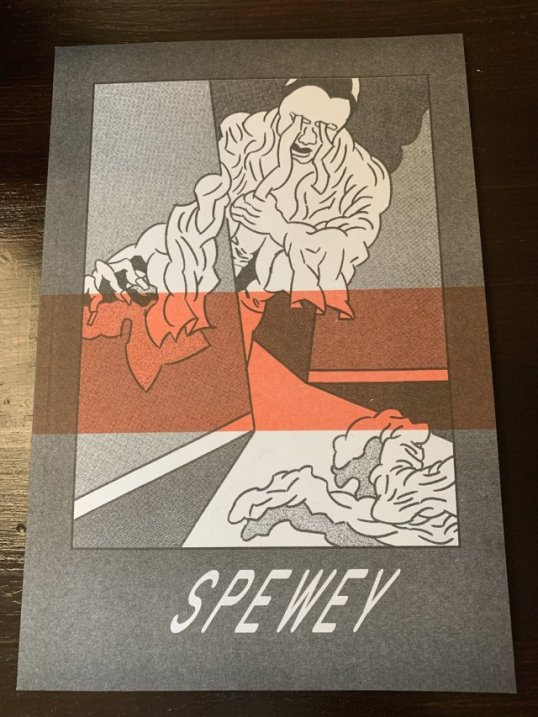
If there’s one thing you can say for the work of Seattle-based cartoonist Jason T. Miles, it’s that his art is consistently challenging. And surprising. And pretty near indescribable. At times even indecipherable. And, yeah, I realize that’s more than the promised “one thing.”
Still, in my own defense, if I only had one thing to say about it, that wouldn’t really make for much of a review, would it? And I actually have a fair amount to say about the retrospective collection Spewey, a 44-page assemblage of some of Miles’ more idiosyncratic work from the past decade published in late 2019 by “boutique” riso-printing house Cold Cube Press. It’s deciding how to say what you want to say that’s always the trickiest part of reviewing any of Miles’ comics, though, and that’s what makes the prospect of attempting to do so such an exciting proposition.
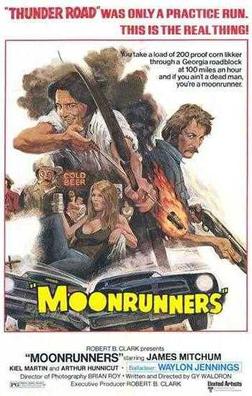
Grady and Bobby Lee Hagg (played by Kiel Martin and Jame Mitchum) are just some good ol’ boys, never meaning no harm, but they’ve still been in trouble with the law since they day they were born. They live in rural Georgia, on a farm owned by their Uncle Jesse (Arthur Hunnicutt). Uncle Jesse’s an expert on two things: the Bible and how to brew the best whiskey. Uncle Jesse is moonshiner with integrity. No one knows his formula and he won’t sell his moonshine to just anyone. He doesn’t want anything to do with the New York mob and their efforts to move in on the moonshine racket.
Uncle Jesse’s main rival is Jake Rainey (George Ellis), the corpulent county commissioner who used to be Jesse’s business partner but who now is in league with the Mafia. Jake and the Hagg boys have a rivalry that is sometimes friendly but still dangerous. Helping Jake control the county is a formerly honest lawman named Rosco P. Coltrane (Bruce Atkins).
The Hagg boys are on probation so they can’t leave the county and they can’t carry guns. Instead, they hunt with bow and arrow. They drive a fast car that they’ve named Traveller (after General Lee’s horse). Grady dreams of going to Nashville with Beth Anne Eubanks (Chris Forbes) and becoming a country music star. Bobby is a laid back race car driver who is having an affair with Jake Rainey’s wife.
The film follows the Hagg boys as they transport moonshine, outrun the police, and occasionally get into bar fights. The movie was shot on location on Georgia, features several car chases, and it’s narrated by country singer Waylon Jennings.
Moonrunners was filmed in 1973 but not released until 1975. It didn’t get much attention when it was released but it did go on to inspire a television series called The Dukes of Hazzard. Even considering the show’s popular success and current cult status, Moonrunners is still a largely unknown film. (It’s so obscure that Warner Bros. was reportedly shocked to discover that they were required to pay several million in royalties to the film’s producers before they could move ahead with their own film adaptation of The Dukes of Hazzard.) However, Moonrunners is superior to TheDukes of Hazzard in every way.
Of course, being better than The Dukes of Hazzard may seem like a low bar to clear but Moonrunners is still one of the better moonshiner films out there. The car chases are genuinely exciting and well-filmed and the cast feels authentic. Arthur Hunnicutt and George Ellis both seem like they naturally belong next to a still while James Mitchum and Kiel Martin are well-paired as Grady and Bobby Lee. Mitchum, in particular, channels the laconic charisma of his father, Robert. Not surprisingly, Moonracers is far rougher and has more of an edge than The Dukes of Hazzard. The TV show may have been for kids but the movie is not.
It’s a B-movie, of course. The soundtrack, which is full of outlaw country, is sometimes obtrusive. I burst out laughing at the film’s most dramatic moment because Waylon Jennings suddenly started singing a song called “Whiskey Man.” The DVD release appears to have been copied straight from a VHS tape so the images were often grainy. It’s not a perfect movie but I still enjoyed Moonrunners for what it was, a celebration of fast cars, pretty girls, and rebellious attitudes. Your collection of car chase films is incomplete without it!
4 Shots From 4 Films is just what it says it is, 4 shots from 4 of our favorite films. As opposed to the reviews and recaps that we usually post, 4 Shots From 4 Films lets the visuals do the talking!
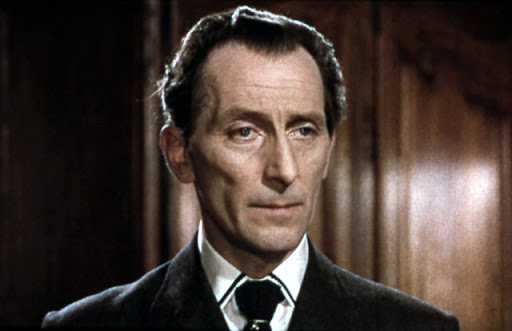
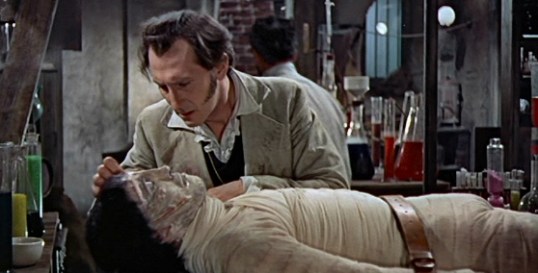
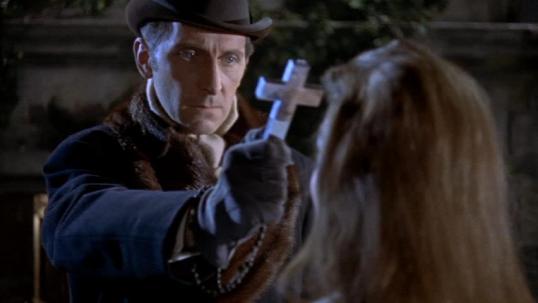
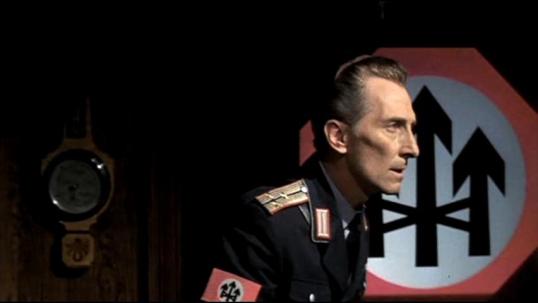
Today is a very special day for fans of horror cinema. It’s Peter Cushing’s birthday! Peter Cushing was born 107 years ago today, in Surrey. As an actor, Cushing appeared in a wide variety films but he’s probably destined to be forever remembered for playing Baron Frankenstein and Prof. Van Helsing in several Hammer films. (He also apparently played a villain in an obscure sci-fi film in the 70s.)
By most accounts, Cushing was the kindest of men and quite a contrast to the villains that he often played. My favorite Peter Cushing performance is his definitive interpretation of Van Helsing in The Horror of Dracula. Cushing brought so much authority to the role that he not only made you believe in vampires but he also made you believe that he was the only person who could possibly defeat them.
One final nice note: Cushing and Christopher Lee were often at odds on screen but they were the best of friends in real life. Lee, in fact, often said that he never recovered emotionally from Cushing’s death in 1994.
In honor of Peter Cushing, here are….
4 Shots From 4 Films
Hamlet (1948, dir by Laurence Olivier)
The Curse of Frankenstein (1957, dir by Terence Fisher)
The Horror of Dracula (1958, dir by Terence Fisher)
Scream and Scream Again (1970, dir by Gordon Hessler)
I am not a very good documentary reviewer, so, remember that going forward.
Second off:
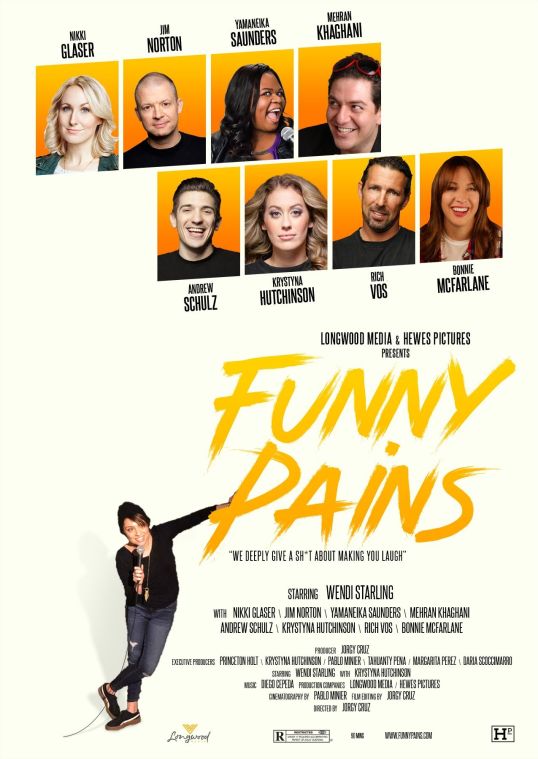
Here is the poster
Third Off:
Here is the trailer:
Review:
I got this screener thinking it would be all about Nikki Glasser and Jim Norton and comedy fun. Well, I was surprised. Jorge Cruz (Director) took his documentary in an entirely different direction (pun intended) than I anticipated.
I absolutely did not realize I was hooked.
Now, you are about to ask me why Wendi Starling is not the centerpiece of this documentary. Well, she is And you will just have to watch to find out why. I’m not going to tell you it broke my heart watching. It did! And I thank Jorge Cruz for taking me on that amazing ride!
Would I recommend this Documentary?
There is so much laughter and crying that I had watching it! So, absolutely, YES!
Where Can You Watch?
May, 26, 2020 check your VOD (And I definitely recommend you do!
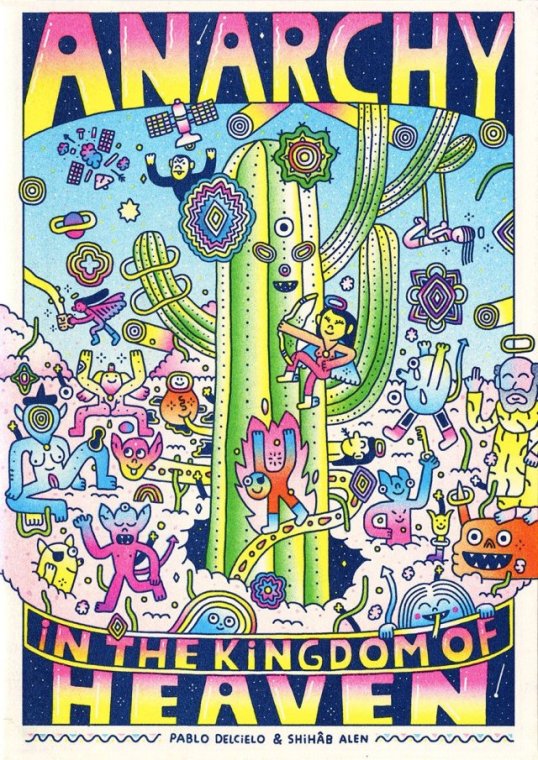
While Chilean cartoonist Pablo Delcielo and his writing partner Shihab Alen (a nom de plume, apparently, for one Raimundo Gunen) open their 2017 Perfectly Acceptable-published illustrated poetic essay Anarchy In The Kingdom Of Heaven with a reference to Philip K. Dick, in both tone and content their visionary (in the strictest sense of the term) project actually evokes the writings of spiritual anarchist authors ranging from Henry David Thoreau to Peter Lamborn Wilson/Hakim Bey, albeit with a distinctly, and entirely understandable, anti-imperialist streak ever-present in its suggestions and implications. It is, however, no less radical (again, in the strictest sense of that word) for that fact.
Heavily informed by the Latin American experience with colonialism both military and economic, this is a short-form thorough re-thinking of possible futures in the face and aftermath of Western exploitation, and as such is unafraid to call out the American empire as fascist…
Credit where it’s due : cartoonist Hiller Goodspeed’s 2018 Perfectly Acceptable release Simple Things makes perfectly clear what it is going in — from its title to its pared-down cover aesthetics, you know what you’re getting into with this one before you ever even open it up. Here’s the thing, though — as any seasoned reader of small press and self-published comics knows, there’s a whole lot out there that’s deceptive in its simplicity. Or, perhaps more accurately, complex in its simplicity.
John Porcellino is the first name that leaps to mind, of course, his legendary King-Cat Comix utilizing the most basic line art to communicate conceptual, emotional, and even physical depth with a wistful touch and wry sense of humor — but the distinguished Mr. Porcellino himself would be the fist to admit that there are those who preceded him on this particular path, the most notable probably being…
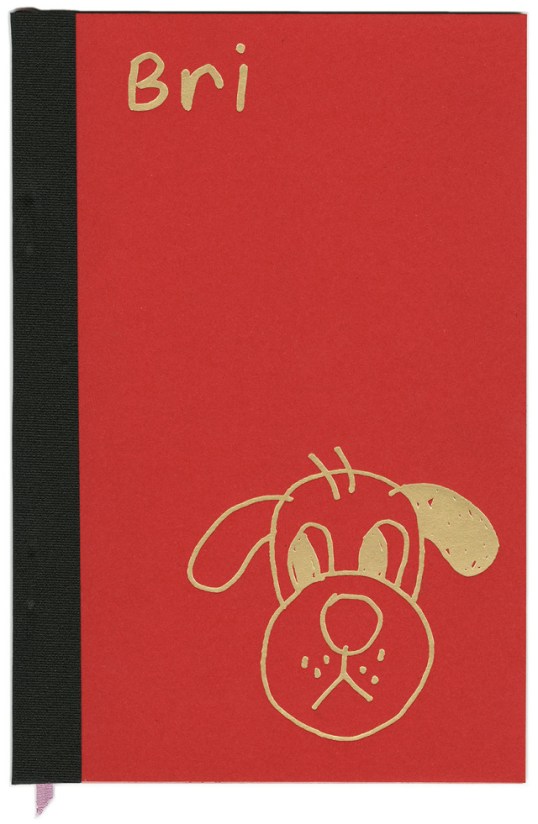
Sketchbooks always reveal something about an artist’s process — but Brianna Rose Brooks’ 2018 Perfectly Acceptable release, Oh My (Bri), goes a step further by revealing much of its author’s psyche. It’s an intimate glimpse at a remarkable talent — disarmingly intimate, in fact — but it’s also not necessarily for those who don’t appreciate a challenge when they’re “only” expecting to look at some amazing drawings.
Described by its publisher as dealing with “topics of intimacy, identity, and blackness” — truth in advertising, I assure you — it’s nevertheless a safe bet that readers will be at least occasionally taken aback by how far she goes in exploring these themes, visually and literally. And while the sketches and essay collected herein span a roughly three-year gamut, the cumulative effect of the work as a whole bears the conceptual weight of a liftetime having been spent not just…
During a reception on the steps of U.S. Capitol, an assassin kills Contra leader Col. Martinez (Geno Silva) and seriously wounds Sen. Terry Fallon (Harry Hamlin), an up-and-coming politician from Texas. An eager media catapults Fallon to national stardom and the beleagued President (James Whitmore), who is facing a tough reelection bid, is pressured to replace the current vice president (Mitchell Ryan) with Fallon.
The FBI only assigns two of their agents to investigate the assassination, a sure sign that someone wants the investigation to just go away. Nick Mancuso (Robert Loggia) is a crusty, hard-drinking veteran agent whose career is nearly at an end. David Ross (Lance Guest) is his young and idealistic partner. When Mancuso and Ross discover that Martinez was injected with the HIV virus just two days before the assassination, it becomes obvious that there is a bigger conspiracy afoot. It all links back to Sally Crain (Linda Kozlowski), who is Fallon’s legislative aide and also his lover. (Fallon has a wife but she’s locked away in a hospital.) Sally has an interest in bondage, as Ross soon finds out.
Favorite Son was originally aired as a 3-night, 4 and a half-hour miniseries. It was later reedited and, with a running time of less than two hours, released theatrically overseas as Target: Favorite Son. As a miniseries, Favorite Son is an exciting conspiracy-themed film that is full of scheming, plotting, interesting performances, and pungent dialogue. Target: Favorite Son, on the other hand, is disjointed and, unless you know the original’s plot, almost impossible to follow. If you’re going to watch Favorite Son, make sure you see the original miniseries. My mom taped it off of NBC when it originally aired. That was the only way that I was able to originally see the film the way that it meant to be seen. The entire miniseries has also been uploaded, in three parts, to YouTube.
Hopefully, the original miniseries will get an official release someday because it’s pretty damn entertaining. Harry Hamlin isn’t really dynamic enough for the role of Fallon but otherwise, the movie is perfectly cast. Robert Loggia is so perfect for the role of Nick Mancuso that it almost seems as if the character was written for him. (Loggia did later star in a one-season drama called Mancuso, FBI.) Linda Kozlowski seems to be destined to be forever known as Crocodile Dundee’s wife but her performance as Sally shows that she was a better actress than she was given credit for. The supporting cast also features good performances from Jason Alexander, Ronny Cox, Tony Goldwyn, John Mahoney, Kenneth McMillian, Richard Bradford, and Jon Cypher.
Favorite Son may be over 30 years old but it’s still relevant today. In the third part, John Mahoney gives a speech about how American voters are often willfully ignorant when it comes to what’s going on behind the scenes in Washington and it’s a killer moment. Melodramatic as Favorite Son may be, with its portrayal of political chicanery and an exploitative national media, it’s still got something to say that’s worth hearing.
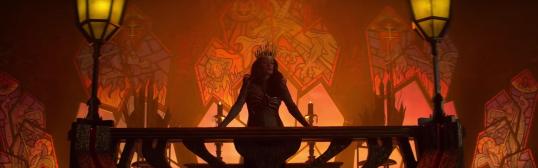
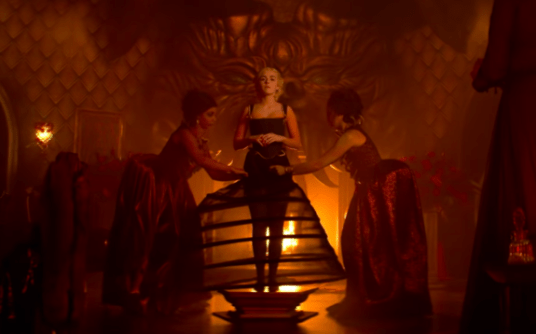
Good to see you all again. It has been a while, but it’s not my fault; the show is hard to watch sometimes. It lacks the first season pop, but moreover, I never thought Hell could be so boring, bureaucratic, and poorly decorated. The Hell Set looks like if a Middle School got into Dinner Theater:
Welcome to Hell and don’t forget to buy some lemon squares from Billy; he’s running a bake sale for our local little league soccer team – The Strikers.
Nick is going through withdrawal and has to go through spooky stuff and this is really on Sabrina’s mind. Not like Roz, who is now a statue. The Chilling Adventures of Sabrina the TOXIC FRIEND!
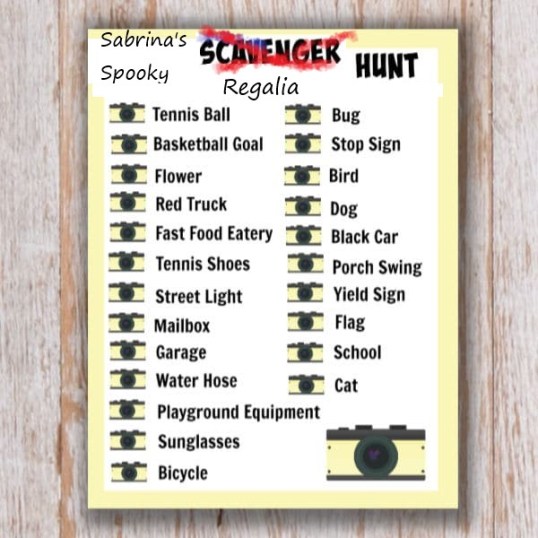
This episode is again a fetch quest episode about “Regalia”. Whatever! Let’s be honest- it’s a spooky scavenger hunt. Next week, Sabrina and Calaban will be feuding in the tacky Hell Set over the latest “Regalia”:
In this week’s Regalia Hunt, Sabrina has to get the stop sign next the Old Man Winters – the local druggist- who is notoriously cranky! Nah, she and Calaban have to head to a lovely Vancouver Beach, I mean Golgotha where she has to steal a bowl from Pontius Pilate. Let me explain: Jesus was crucified at Golgotha and Pontius Pilate “washes his hands” of the decision to crucify Jesus. This act, according to Sabrina, condemned Pontius Pilate, a skeleton Roman Soldier, and Barabbas (for some reason…really, why?! He was a criminal, but he didn’t lobby for the pardon). They all have to relive the Crucifixion for eternity.
This whole scene was just weird! I mean Sabrina barely bats an eye when she’s talking to Barabbas. He was there! Even if she’s all into Hell, this was the most critical moment of all Human history and she just talks to Barabbas like she’s meeting some rando at the Shake Shack. Pilate must re-enact the Crucifixion and in order to stop it – Barabbas must steal the bowl. Hmmm, why didn’t Barabbas think of this? He’s there for 2000 years. Really? There’s literally 3 people on the stage. That’s it. He knows someone has to take the bowl.
Calaban nobly offers to be crucified so Sabrina can get Barabbas to steal the bowl and hand it off to her. This all goes off well, but Calaban is left behind, which seemed pretty obvious that he would be. He has to spend 2000 years on a beach and then when he returns he’s all angry he was left behind and says something about him being…..MADE OF CLAY for the 1000th time. This guy’s more into dirt than Scott’s Lawn Care.
Sabrina won this part of the scavenger hunt! YAY! However, there’s still some weirdness afoot. Lucifer’s going around in Father Blackwood’s body and telling people to do dumb things. LuciBlackwood gets Harvey to get the jocks together and attack the carnival and a few of them get turned into pigs. By the by, yesterday, I braised a delicious pork tenderloin over pineapples, apples, and honey- BURRITOS ARE TONITE!!!
Hilda is turning into a large spider and NO ONE notices. Hilda if you stop going all arachnid, just move, change your name, get lifelock, and start fresh.
The episode ends with a bunch of outcast witches being summoned to help everyone fight the pagans. Will they win? Will Sabrina need to steal a mailbox? Who knows?
I can’t quite remember how I found out about 1988’s Who Framed Roger Rabbit. Growing up, most of my movie news came from four major sources – Entertainment Tonight, Siskel & Ebert, the occasional movie poster you’d see at a bus stop or cinema. If you were really lucky, the production company would sometimes create a “Behind the Scenes”/”Making of” showcase a little after the movie premiered. If possible, I would read the billing block of a poster to see if I could recognize anyone familiar, Just seeing Amblin Entertainment meant you’d have Steven Spielberg, Kathleen Kennedy and Frank Marshall involved. Nothing new there. I knew Robert Zemeckis and Alan Silvestri from Romancing the Stone and Back to the Future. Movies have had mixes of animation and live action – Bedrooms & Broomsticks, Mary Poppins, etc., but the big buzz here was the film planned to somehow involve both the Disney and Warner Bros. animation studios. It was an alien concept for me, because they couldn’t be more different from each other. Historically, animation on the WB side of things were edgy and almost dared to be even raunchy if they could get away with it. Disney, on the other hand, was pristine and extremely kid friendly. Bugs Bunny and Mickey Mouse? Daffy Duck vs. Donald Duck, all on the same screen? It was the 1980’s equivalent of asking Marvel (which ironically, is owned by Disney now) and DC (which the WB has owned for decades) to write a single Justice League / Avengers crossover story.
At the time, Steven Spielberg was already well known for blockbusters like the Indiana Jones films and E.T., but did he really have enough clout to bring two major companies together like that? It blew my 13 year old mind and I became completely obsessed.
Around the time Who Framed Roger Rabbit came out, I picked up anything I could find about it. I had Alan Silvestri’s soundtrack, a poster, a stuffed Roger doll, and the video game when it came out. I even read Gary Wolf’s novel. I begged my parents to let me see it, and it was one of the rare times where my Mom took my sis and I to the movies instead of my dad (the major movie buff, who took us to see Robocop twice the year before). I think she went in part to shut me up, and to give herself a break from my nearly 2 year old brother. It remains one of the two best movie related memories I have of her.
In the world of Who Framed Roger Rabbit, humans and cartoons share the same space in Los Angeles. Cartoons live in Toontown, owned by Marvin Acme (Stubby Kaye). It’s the story of Eddie Valiant (Bob Hoskins – Hook, Mermaids), a Los Angeles Private Eye with a bit of a grudge against toons. For a quick buck, Valiant is hired by R.K. Maroon (Alan Tilvern – Firefox, Little Shop of Horrors) to snoop on Acme. Valiant’s work puts him in the path of Roger Rabbit (Charles Fleischer, Back to the Future Part II), after Eddie takes some racy pictures of Acme playing patty cake with Roger’s wife, Jessica (Kathleen Turner, Romancing the Stone). Roger angrily swears they’re still a happy couple and that Acme somehow coerced her before running off into the night. The next morning, Eddie is informed that the Marvin Acme’s been killed overnight. To make things worse, Acme’s Will is missing, leaving the fate of Toontown up in the air. All of the evidence points to Roger, but Roger asks for Eddie’s assistance in clearing his name. Can Eddie save Roger before Judge Doom (Christopher Lloyd, Back to the Future) and his pack of weasels get their hands on him?
The production for the film required jumping over a number of hurdles. Zemeckis, himself a cartoon fan, wanted to bring some of the Warner Bros. characters along with Disney characters. Even better, he also wanted to add some of Tex Avery’s classic style to the film. Similar to what he did with Ready Player One, Spielberg negotiated with some of the studios, and while he couldn’t get everyone, he did manage to get Disney, WB and a few others to commit. With this in place, they had to somehow merge animation with live-action in a way that made it look like the cartoons were interacting with their environment.
This would require one really huge magic trick, made up from an assortment of parts.
Since it was around 1986-1987, there really was no CG, yet.. James Cameron made 6 stuntmen in Alien suits look like 600 through the use of Oscar Winning Editing, and the technology that gave us the paradigm shifting dinosaurs of Jurassic Park wouldn’t occur for another 3 or 4 years. For Who Framed Roger Rabbit, the approach was a mix of robotics, puppetry, sleight of hand gadgetry, and a lot of imagination.
The art was handled by Richard Williams and his team, who would go on to win a Special Achievement Oscar for his contribution to the film. They had to draw every cell/frame by hand, on paper and then have them inked. These would then go to Industrial Light & Magic, who would add shadow, highlights and special effects To make things harder, the artists had to work around Zemeckis’ filming style and figure out how to fit the characters into each scene.
Take Jessica Rabbit’s performance of “Why Don’t You Do Right?”, sung by Amy Irving (Carrie, The Fury). At first glance, it seems a really easy shot. Girl steps on the stage, performs and leaves, right? However, there are so many things happening here on an effects level that I still don’t fully understand how they did it after all these years. ILM handled the lighting, from the sparkles in the dress, the use of the handkerchief and the great moment where Jessica blocks the spotlight in her walk from Acme to Valiant. I had to later explain to my mom that the “Wow” I whispered in the theatre during that scene had little or nothing to do with puberty. It was because I hadn’t seen anything like that before with a cartoon, and I’d hate the Academy forever if the movie didn’t win an Oscar for that.
Having cartoons on screen is one thing, but making it feel like they were interacting with people is another. Hoskins was the anchor that tied most of it all together. Having to work with nearly nothing – not even a green screen – and perform the physical actions required of the role was quite a feat compared to what some actors do with the motion capture rooms and digital walls we use today. Near lifesize models of Roger were created to help Hoskins handle some of the physical “grab and move” sequences, and actor Charles Fleischer actually spent time dressed as Roger on set (but off camera, of course) to feed his side of the conversation to Hoskins when filming a scene.
Puppeteers were brought on for moments were toon characters needed to hold objects, such as guns or knives. There is a moment of the movie where you can see one of the holes for the guns that the weasels, but it’s a pretty minute hiccup with all of the great work that was done. For the car sequences with Benny the Cab (also Fleischer), they used a special mini-car with a driver in the back. The car and driver were painted over (still, frame for frame) by the animators.
And ff course, it wouldn’t be a Zemeckis film without Alan Silvestri at the helm, musically speaking. Silvestri’s score for was a mix of detective noir and cartoony antics, which made for a perfect fit for the film. Overall, Who Framed Roger Rabbit is one of those films I cherished growing up, and it’s almost impossible for me to avoid recommending it.






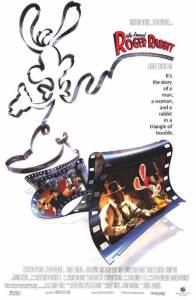 I can’t quite remember how I found out about 1988’s Who Framed Roger Rabbit. Growing up, most of my movie news came from four major sources – Entertainment Tonight, Siskel & Ebert, the occasional movie poster you’d see at a bus stop or cinema. If you were really lucky, the production company would sometimes create a “Behind the Scenes”/”Making of” showcase a little after the movie premiered. If possible, I would read the billing block of a poster to see if I could recognize anyone familiar, Just seeing Amblin Entertainment meant you’d have Steven Spielberg, Kathleen Kennedy and Frank Marshall involved. Nothing new there. I knew Robert Zemeckis and Alan Silvestri from Romancing the Stone and Back to the Future. Movies have had mixes of animation and live action – Bedrooms & Broomsticks, Mary Poppins, etc., but the big buzz here was the film planned to somehow involve both the Disney and Warner Bros. animation studios. It was an alien concept for me, because they couldn’t be more different from each other. Historically, animation on the WB side of things were edgy and almost dared to be even raunchy if they could get away with it. Disney, on the other hand, was pristine and extremely kid friendly. Bugs Bunny and Mickey Mouse? Daffy Duck vs. Donald Duck, all on the same screen? It was the 1980’s equivalent of asking Marvel (which ironically, is owned by Disney now) and DC (which the WB has owned for decades) to write a single Justice League / Avengers crossover story.
 Through the Shattered Lens