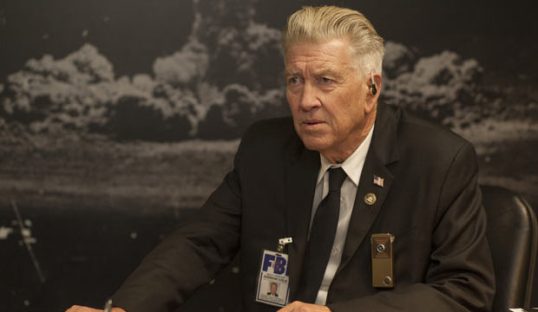
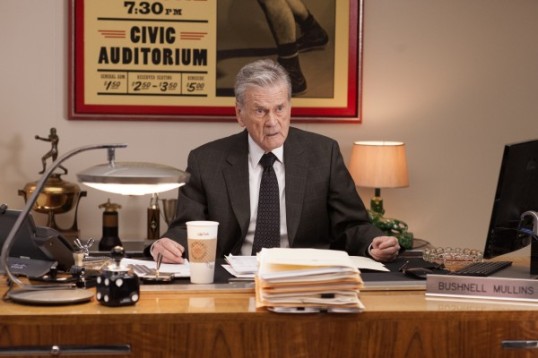
David Lynch as Gordon Cole
It seems appropriate that there should be a picture of David Lynch at the top of this recap. There’s a lot of good things to be said about the third and fourth “parts” of Twin Peaks but ultimately, these two hours are all about Lynch and his unique vision.
This is especially true of the first 20 minutes of Part 3. This is Lynch at his best. Unconcerned with the traditional rules of narrative, Lynch creates an extended nightmare, one that sticks in your head long after the show itself has moved on.
Much as how Eraserhead started in space, with a hideously scarred man pushing and pulling the levers that eventually created that film’s mutant baby, Part 3 opens with Dale Cooper (Kyle MacLachlan) falling through darkness, plunging into a purple cloud. When Cooper lands, it’s in a purple-tinted world that immediately made me think of the final scene in Lucio Fulci’s The Beyond.
Cooper is standing outside a house, looking out over what appears to be a purple ocean. When Cooper enters the house, he finds a woman. She is wearing a red dress and her eyes are sewn shut. The first time I saw this, I assumed that the woman was meant to be Ruth Davenport, mostly because Ruth was found without eyes. However, Ruth is not listed in the end credits. For that matter, neither is the eyeless woman.
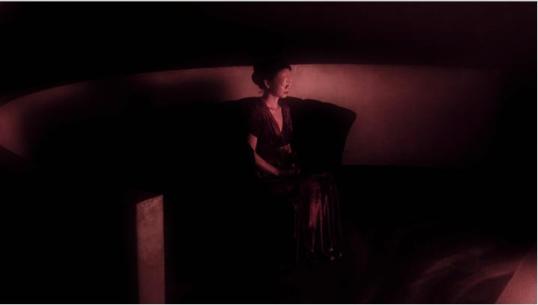
Cooper asks where they are but the woman cannot speak. Perhaps she has lost her tongue, as well as her eyes. Suddenly, someone starts to pound on the door. The woman holds her finger to her lips, telling Cooper to be silent.
Cooper sees what appears to be a safe on the wall but, when he tries to approach it, the blind woman steps in front of him and pushes him back. As the pounding continues, the woman leads Cooper to another door and then up a ladder.
And suddenly, Cooper and the woman are standing in outer space. The house has now become a satellite, hovering in the star-filled sky. As the pounding continues on the soundtrack, the woman tries to speak but Cooper cannot understand what she’s saying. Suddenly, the woman pulls down a lever, apparently electrocuting herself before falling off the satellite and disappearing into space.
Suddenly, Cooper sees the face of Major Garland Briggs (Don S. Davis) floating underneath him. “Blue Rose,” Briggs says.
(In Twin Peaks: Fire Walk With Me, it was suggested that the FBI refers to paranormal cases as being “Blue Rose cases.”)
Cooper reenters the satellite. He finds himself back in the house. There is now a second woman and those familiar with the show will recognize her as being played by Phoebe Augustine, the same actress who played Ronette Pulaski in the earlier seasons of the show. If Augustine playing Ronette here? It’s hard to say. Her character is listed as being “American Girl.” Cooper does not seem to recognize her but, then again, he also hesitated before recognizing Laura Palmer during Part One. Being in the Black Lodge for 25 years can’t be good for one’s memory.
Cut to Doppelganger Cooper, driving down a South Dakota highway. At the same time that the real Cooper is once again approaching the safe in the Space House, Doppelganger Cooper is having a seizure while driving.
In the Space House, American Girl/Ronette says, “When you get there, you will already be there.”
The pounding starts again.
“You better hurry,” American Girl/Ronette says, “my mother’s coming.”
Suddenly, Cooper is sucked into the safe, with only his shoes being left behind in the Space House.
In South Dakota, Doppelganger Cooper flips his car, crashing into a mountain. Doppelganger Cooper survives but suddenly, he starts to throw up. He puts his hand over his mouth and then sees the red curtains of the Black Lodge appearing before his car.
In an empty house located the Rancho Rosa development in Nevada, a dorky guy named Dougie Jones (Kyle MacLachlan) has just paid a prostitute named Jade (Nafessa Williams). While Jade takes a shower, Dougie puts on a mustard yellow suit jacket and, judging by how ugly it is, I’m guessing that Dougie must be in real estate. (Perhaps he works for Rancho Rosa, selling people suburban houses in the middle of the desert.) Suddenly, Dougie grabs his stomach and collapses to the floor.
What follows is one of the grossest scenes ever as we cut back and forth between Dougie and the Doppelganger vomiting. Seriously, this was one of the most grotesquely realistic vomiting scenes that I have ever seen. I averted my eyes and covered my ears! It was so gross.
At the same time that Dougie vanishes from the house, the red curtains in front of the Doppelganger’s car also vanishes. But the Doppelganger is too busy throwing up to notice. Again, I have to admit that I averted my eyes during most of this. (I also realize that both Dougie and the Doppelganger were throwing up their essences, the stuff that allowed them to pretend to be human. I don’t care. The only thing I hate more than vomiting is watching other people vomit.)
Dougie is in the Black Lodge. MIKE (Al Strobel) doesn’t appear to be too happy to see him. MIKE explains that someone manufactured Dougie. I’m assuming that the Doppelganger created Dougie so that, if Cooper ever escaped from the Black Lodge, he would take over Dougie’s existence instead of the Doppelganger’s. “That’s weird,” Dougie says, as he his hand wastes away. Then Dougie’s head vanishes, replaced by a black cloud of smoke.
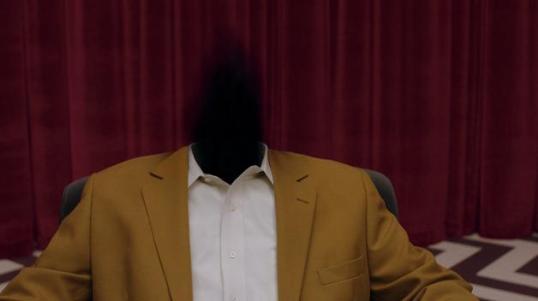
Back at the house, another black cloud comes out of an electrical outlet. Soon, the cloud forms into Cooper. Cooper lies on the floor, next to Dougie’s vomit (ewwww!) until Jade yells at him that they have to get out of the house.
Apparently in a state of shock, Cooper silently follows Jade out of the house. After being locked away in the Black Lodge, it appears that Cooper no longer quite remembers how to be human. Or maybe he’s not really human at all anymore. All I know is that he’s acting strange and, as brilliant as Kyle MacLachlan is, I do kind of hope the old Cooper returns at some point soon.
Because Dougie/Cooper doesn’t have his car keys (though he does still have his room key from the Great Northern), Jade gives him a ride into Vegas. Two gangster types watch as Jade drives off. One of them has a rifle. The other has a bomb. Apparently, they work for someone to whom Dougie’s owes money. Because Cooper leans down to pick up his room key, the one with the rifle does not spot him in Jade’s car. The other places the bomb under Dougie’s car, which is still sitting outside of the empty house.
While this happens, a woman — listed in the credits as being “Drugged-Up Mother” and played by Hailey Gates — is shouting “One one nine! One one nine!” while her son watches on the couch.
In South Dakota, two troopers approach the Doppelganger’s car. One of them catches whiff of the vomit and collapses to the ground, physically ill.
At the Twin Peaks Sheriff’s Department, Hawk (Michael Horse), Andy (Harry Goaz), and Lucy (Kimmy Robertson) look through all the evidence that was collected in the Palmer case. Andy says that he and Lucy can’t find out what’s missing. “If it’s here,” Hawk replies, “how can it be missing?”
As Hawk recites what the Log Lady told him — that something is missing and that the way he’ll find it has to do with his heritage — Lucy freaks out when she spots an empty box of chocolate bunnies. Many years ago, Lucy ate the bunny.
“Do chocolate bunnies have something to do with your heritage?” Andy earnest asks.
“IT’S NOT ABOUT BUNNIES!” Hawk snaps. Then, “Is it about the bunny? …. No, it’s not about the bunny.”
Meanwhile, off in the middle of nowhere, Dr. Jacoby (Russ Tamblyn) spray paints the ladders that were delivered to him at the start of Part One.
In Vegas, Jade drops Dougie/Cooper off at a casino. Dougie/Cooper has been reduced to just repeating back phrases that other people say to him but no one seems to notice. Still, when Jade tells Dougie/Cooper that he can “go now,” Dougie/Cooper has a flashback to Laura Palmer (Sheryl Lee) saying the same thing.

The casino, with its combination of glitz and the grotesque, brings out the best in Lynch. As Dougie/Cooper wanders through the casino — which is populated by typical Lynchian characters — he notices that he can see the red curtains of the Black Lodge floating over certain slot machines. Cooper pulls the levers, hitting jackpot after jackpot. As the coins flood out of the machines, Cooper announces, “HELLO!” Why? Because he heard another gambler do it. Dougie/Cooper is learning how to be human again.
When Dougie/Cooper walks away after having won another jackpot, leaving all of his coins on the floor, one old woman considers taking the coins for herself but then glances up at the camera on the ceiling — “and the eye in the sky watches us all,” to quote Casino — and thinks better of it. Instead, she just asks Cooper to tell her which machines are about to hit. She calls him Mr. Jackpot, which is kinda sweet.
Meanwhile, in Philadelphia, the FBI is meeting and — oh my God! It’s Gordon Cole (David Lynch), Albert Rosenfield (Miguel Ferrer), and Tamara Preston (Chrysta Bell). (Preston will be familiar to anyone who has read Mark Frost’s The Secret History of Twin Peaks.)
They start out discussing a senator who has been accused of murdering his wife. The senator says that he knows who did it but he can’t reveal the name because of “national security reasons.” (Since this is taking place in 2014, I’m going to continue the Casino theme and assume that the senator was creepy old Harry Reid.)
Cole is more interested in hearing about the murders of Sam and Tracey in New York City. It turns out that the cameras caught a picture of that demonic creature in the glass box.
Suddenly, a call comes in. Cooper has been found and he’s in a South Dakota prison and … oh shit! That’s not Cooper! We know that’s the Doppelganger! Regardless, Cole announces that he, Albert, and Tamara are going to South Dakota. Albert says he can’t wait to see Mount Rushmore.
“The absurd mystery of the strange forces of existence,” Albert tells Tamara. “How about a truck load of valium?”
Cut to The Cactus Blossoms, performing at the Roadhouse and announcing that Part Three is over.
Part Four opens with Dougie/Cooper still hitting jackpots and still chanting, “Hello!” When the old woman who has been following him around hits a jackpot of her own, a small smile comes to Cooper/Dougie’s lips.
A friend of Dougie’s, Bill Shaker (Ethan Suplee), approaches and he and Dougie have a thoroughly superficial conversation. Dougie/Cooper asks where his home is. Bill assures him that he lives at Lancelot Court, in a house with a red door. The house, Bill says, is near Merlin’s Market. As Cooper/Dougie leaves to get a cab, Bill says, “I hope he’s okay.”
“I don’t think he’s okay,” Bill’s wife, the wonderfully named Candy Shaker (Sara Paxton) says.
Before Dougie/Cooper can leave to find the house with the red door, he is dragged to the office of the vaguely threatening casino manager (David Dastmalchian). The manager gives Dougie/Cooper his winnings and then asks if he wants anything — like “companionship” — for the night. “Think of us as your home away from home,” he says. When Dougie/Cooper repeats that he wants to go home (his real home), the manager arranges for him to ride in a limo.
(It pays to be a winner.)
As the limo drives down Lancelot Court, the driver (Jay Larson) says that it might be hard to spot a red door at night. However, he then sees the door and oh my God, is it ever red! Dougie gets out of the limo and seems unsure what to do. Fortunately, his wife — Janey-E (Naomi Watts) — comes out of the house and starts hitting him. Apparently, Dougie has been missing for three days. He even misses his son’s birthday party! (Perhaps significantly, as everyone stands outside the house, an owl flies overhead.)
Fortunately, once they’re inside the house, Janey-E sees just how much money Dougie/Cooper won at the casino.
“Don’t tell me you hit the jackpot!” Janey-E says.
“Mr. Jackpot,” Dougie/Cooper says, pointing at himself.
“There’s enough here to pay them back!” Janey-E continues as she looks at the money, “This is the most wonderful day of my life!”
“Of my life,” Dougie/Cooper says.
“Yes,” Janey-E replies.
At FBI Headquarters, Cole has a meeting chief of staff Denise Bryson (David Duchovny). Cole tells Denise about finding Cooper and says he’s going to South Dakota. Denise is concerned about Cole traveling with Tamara. “I know your profile, Gordon,” Denise explains, “Female agent. Early 30s.”
“I’m old school,” Cole replies, “you know that.”
Cole reminds Denise that he defended her when she first transitioned. He told everyone who had a problem with her to “Fix their hearts — or die!”
At the Twin Peaks Sheriff’s Department, Sheriff Frank Truman (Robert Forster) enters the front lobby, which causes Lucy to scream and faint. Apparently, Lucy was confused because she has just been talking to Frank on the phone and she can’t understand how Frank could be in two places at once. Andy attempts to explain to her how cell phones work. “You’re so good at your job,” Andy says, “in every other way…”
At the Sheriff’s Department, we learn a few interesting things:
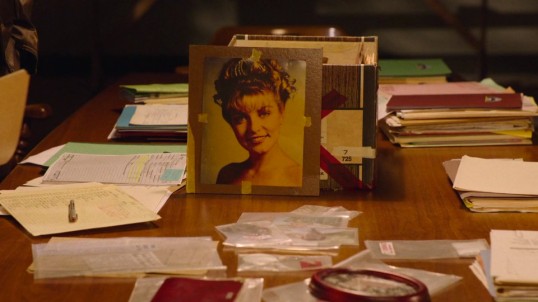
First off, Bobby Briggs (Dana Ashbrook), former drug dealer and murderer, is now a deputy, one who specializes in watching for drug dealers sneaking across the Canadian border. (That’s something that Bobby should know a bit about.) He also has gray hair and he cries when he sees a picture of Laura in the conference room.
Secondly, Major Garland Briggs died in a fire, a day after being the last person to see Dale Cooper. (Presumably, Major Briggs actually saw Doppelganger Cooper.)
Third, Lucy and Andy’s son has grown up to be Wally Brando (Michael Cera). Wally is a motorcycle enthusiast who has spent the last few years riding across the country. Wally dresses like Marlon Brando in The Wild One and delivers a hilariously nonsensical monologue that is largely made up of pretentious references to different Brando roles. What makes Wally’s scene so wonderful is the combination of Cera’s Brandoesque scenery chewing and Robert Forster’s deadpan reaction.
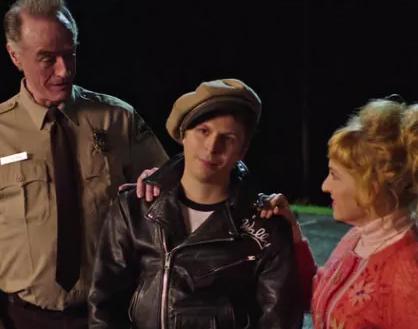
The next morning, in Vegas, Dougie/Cooper still can’t figure out how to do anything. After spending 25 years in limbo, even urination is a new and scary experience for him. Even when MIKE appears to tell him that he was tricked into leaving the Lodge and that either Dougie/Cooper and the Doppelganger must die, Dougie/Cooper looks confused. Still, his son — the oddly named Sonny Jim (Pierce Gagnon) — is amused when his father eats breakfast with a tie wrapped around his head.
In South Dakota, the police investigating the murder of Ruth Davenport are shocked to discover that they can not access the identity of the owner of the finger prints that they took off of the male Joe Doe. Apparently, it’s top secret. “Military authorization required.”
Meanwhile, Cole, Albert, and Tamara are driving out to the South Dakota prison. During the car ride, Cole complains that they’re not anywhere near Mount Rushmore but, luckily, Albert has brought a picture for him. Meanwhile, Tamara has to ride with her head leaning out of the window because she gets car sick.
(I sometimes get car sick too. That’s one reason why I never sit in the back seat. I share your struggle, Tamara!)
At the prison, Cole, Albert, and Tamara meet with Warden Murphy (James Morrison). When it is mentioned that the Doppelganger was throwing up poison, Murphy says, “Must have eaten locally.” I love that line!
Anyway, the meeting with the Doppelganger doesn’t go well. The Doppelganger, having thrown up whatever it was that allowed him to act human, is now speaking in a stiff and halting tone. The Doppelganger claims that he’s spent the last 25 years working undercover for Philip Jeffries. Haltingly, he says that he needs to be released so that Gordon can “debrief” him. Stiffly, the Doppelganger attempts to give Gordon the thumbs up sign.
After the meeting, Cole and Albert agree that something was off about “Cooper.” They agree that there’s one woman who can tell them if it’s really Cooper in prison. Cole asks if Albert still knows where she lives.
“I know where she drinks,” Albert replies.
Who could Albert be talking about? Audrey Horne? Or maybe Sarah Palmer? Sarah, after all, is psychic and appears to still have a drinking problem.
We’ll find out next week! Until then, Parts 3 and 4 — along with Parts 1 and 2 — will continue to haunt my thoughts and dreams.
Twin Peaks on TSL:
- Twin Peaks: In the Beginning by Jedadiah Leland
- TV Review: Twin Peaks 1.1 — The Pilot (dir by David Lynch) by Lisa Marie Bowman
- TV Review: Twin Peaks 1.2 — Traces To Nowhere (directed by Duwayne Dunham) by Jedadiah Leland
- TV Review: Twin Peaks 1.3 — Zen, or the Skill To Catch A Killer (dir by David Lynch) by Lisa Marie Bowman
- TV Review: Twin Peaks 1.4 “Rest in Pain” (dir by Tina Rathbone) by Leonard Wilson
- TV Review: Twin Peaks 1.5 “The One-Armed Man” (directed by Tim Hunter) by Jedadiah Leland
- TV Review: Twin Peaks 1.6 “Cooper’s Dreams” (directed by Lesli Linka Glatter) by Lisa Marie Bowman
- TV Review: Twin Peaks 1.7 “Realization Time” (directed by Caleb Deschanel) by Lisa Marie Bowman
- TV Review: Twin Peaks 1.8 “The Last Evening” (directed by Mark Frost) by Leonard Wilson
- TV Review: Twin Peaks 2.1 “May the Giant Be With You” (dir by David Lynch) by Leonard Wilson
- TV Review: Twin Peaks 2.2 “Coma” (directed by David Lynch) by Jedadiah Leland
- TV Review: Twin Peaks 2.3 “The Man Behind The Glass” (directed by Lesli Linka Glatter) by Jedadiah Leland
- TV Review: Twin Peaks 2.4 “Laura’s Secret Diary” (dir by Todd Holland) by Lisa Marie Bowman
- TV Review: Twin Peaks 2.5 “The Orchid’s Curse” (dir by Graeme Clifford) by Lisa Marie Bowman
- TV Review: Twin Peaks 2.6 “Demons” (dir by Lesli Linka Glatter) by Leonard Wilson
- TV Review: Twin Peaks 2.7 “Lonely Souls” (directed by David Lynch) by Jedadiah Leland
- TV Review: Twin Peaks 2.8 “Drive With A Dead Girl” (dir by Caleb Deschanel) by Lisa Marie Bowman
- TV Review: Twin Peaks 2.9 “Arbitrary Law” (dir by Tim Hunter) by Lisa Marie Bowman
- TV Review: Twin Peaks 2.10 “Dispute Between Brothers” (directed by Tina Rathbone) by Jedadiah Leland
- TV Review: Twin Peaks 2.11 “Masked Ball” (directed by Duwayne Dunham) by Leonard Wilson
- TV Review: Twin Peaks 2.12 “The Black Widow” (directed by Caleb Deschanel) by Leonard Wilson
- TV Review: Twin Peaks 2.13 “Checkmate” (directed by Todd Holland) by Jedadiah Leland
- TV Review: Twin Peaks 2.14 “Double Play” (directed by Uli Edel) by Jedadiah Leland
- TV Review: Twin Peaks 2.15 “Slaves and Masters” (directed by Diane Keaton) by Lisa Marie Bowman
- TV Review: Twin Peaks 2.16 “The Condemned Woman” (directed by Lesli Linka Glatter) by Leonard Wilson
- TV Review: Twin Peaks 2.17 “Wounds and Scars” (directed by James Foley) by Lisa Marie Bowman
- TV Review: Twin Peaks 2.18 “On The Wings of Love” (directed by Duwayne Dunham) by Jedadiah Leland
- TV Review: Twin Peaks 2.19 “Variations on Relations” (directed by Jonathan Sanger) by Lisa Marie Bowman
- TV Review: Twin Peaks 2.20 “The Path to the Black Lodge” (directed by Stephen Gyllenhaal) by Lisa Marie Bowman
- TV Review: Twin Peaks 2.21 “Miss Twin Peaks” (directed by Tim Hunter) by Leonard Wilson
- TV Review: Twin Peaks 22.2 “Beyond Life and Death” (directed by David Lynch) by Lisa Marie Bowman
- Film Review: Twin Peaks: Fire Walk With Me (dir by David Lynch) by Lisa Marie Bowman
- Here’s The Latest Teaser for Showtime’s Twin Peaks by Lisa Marie Bowman
- Here’s The Newest Teaser for Showtime’s Twin Peaks by Lisa Marie Bowman
- 12 Initial Thoughts About Twin Peaks: The Return Parts One and Two by Lisa Marie Bowman
- This Week’s Peaks: Parts One and Two by Ryan C. (trashfilm guru)
- TV Review: Twin Peaks: The Return Parts One and Two (dir by David Lynch) by Lisa Marie Bowman
- 4 Shots From 4 Films: Special Twin Peaks Edition by Lisa Marie Bowman
- This Week’s Peaks: Parts Three and Four by Ryan C. (trashfilm guru)
- 14 Initial Thoughts About Twin Peaks: The Return Part Three (dir by David Lynch)
- 10 Initial Thoughts About Twin Peaks: The Return Part Four (dir by David Lynch)



 Welcome to the Old West. Hannibal Heyes (Pete Duel) and Kid Curry (Ben Murphy) are two of the most wanted outlaws in the country, two cousins who may have robbed trains but who also never shot anyone. After being promised a pardon if they can stay out of trouble for a year, Heyes and Curry have been living under the names Joshua Smith and Thaddeus Jones.





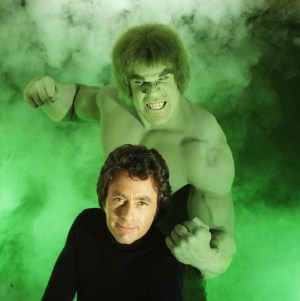 It may seem hard to believe now but there was a time when comic book adaptations were considered to be a risky bet at best. In 1977, Marvel Comics sold the television rights for four of their characters to Universal Productions. This led to three unsuccessful pilots (one for Dr. Strange and two for Captain America), a Spider-Man series that lasted for two seasons, and The Incredible Hulk. As opposed to the other Marvel adaptations, The Incredible Hulk series was popular with fans and (some) critics and ultimately lasted for four seasons.

