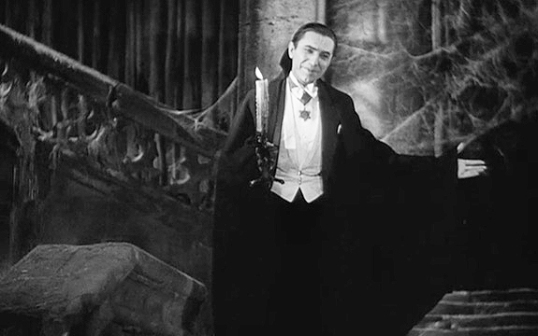
Scenes That I Love: Vampire Lucy Makes Her Presence Known In Horror of Dracula


Today is the 116th anniversary of the birth of the British director, Terence Fisher.

Though Fisher had a long career as both an editor and a director and he worked in almost every genre, he achieved immortality with the horror films that he directed for Hammer Films.  Fisher’s horror films took the monsters that had previously been made famous by Universal Studios and resurrected them with a pop art spin.  Regardless of whether the subject matter was Frankenstein, the Mummy, Dracula, or some other fearsome creature, Fisher brought a vibrant splash of color to their stories.  (Often that color was blood red.)  At a time when American horror films were still hobbled by the production code and tended to hide their themes under several heavy layers of subtext, Terence Fisher brought Hammer’s stories to life with explicit violence and unapologetic sexuality.  When Christopher Lee’s Dracula stared at a victim with lustful eyes, there was little doubt about what was actually happening.  Once Fisher started working for Hammer, he never left the horror genre.  Personally, I would have liked to have seen what he could have done with a Bond film.

Today’s scene that I love comes from one of the first of the Fisher-directed Hammer horror films, 1958’s Horror of Dracula.  (In the UK, it was simply know as Dracula.)  Christopher Lee may not appear in this scene but it’s still one of the creepiest moments in the film.  In this scene, Lucy (Carol Marsh) returns from the dead and, sporting a new set of fangs, attempts to get her former maid’s daughter, Tania, to come for a walk with her.  Thanks to both Fisher’s direction and Marsh’s unforgettable performance, this is a scene that sticks with you even after the film ends.   Whenever I see Lucy peeking out from behind that tree and calling out to little Tania, my mind flashes back to when I was in the 1st grade and a police officer stopped by the classroom to ask if we all knew what to do if an adult who we didn’t know tried to get us to go off with them.  This scene definitely gives off stranger danger vibes and it’s all the more creepy as a result.


Scenes That I Love: Cooper Says Goodbye In Twin Peaks: The Return (Happy Birthday, Kyle MacLachlan!)


Happy birthday, Kyle MacLachlan!

Kyle MacLachlan is 61 years old today.  While MacLachlan has appeared in a lot of different movies and tv shows and he’s also played a lot of different characters, he will probably always be best known for playing FBI Special Agent Dale Cooper on Twin Peaks.  MacLachlan, with his combination of earnestness and darkness, was the prefect choice to play Cooper and it’s impossible to imagine Twin Peaks without him.

Of course, MacLachlan didn’t just play Dale Cooper during the third season of Twin Peaks.  He also played Cooper’s evil Doppelganger and, for the majority of Twin Peaks: The Return, he played Dougie.  Dougie could barely speak and usually had no idea what was happening around him but he still thrived in Las Vegas.  MacLachlan’s performance as Dougie was both funny and poignant.  At the same time, I do think that every fan of Twin Peaks breathed a sigh of relief when Cooper finally woke up from that coma, stopped acting like Dougie, and started acting like himself.

Today’s scene that I love comes from Part 16 of Twin Peaks: The Return.  In this David Lynch-directed scene, Cooper — who has only recently reclaimed his identity — says goodbye to Dougie’s wife and son.  Like so much of Twin Peaks; The Return, this is a scene that could be unbelievably mawkish in the hands of another actor.  However, Kyle MacLachlan plays the scene with such sincerity that it’s actually very touching.

In honor of Kyle MacLachlan’s birthday, enjoy today’s scene that I love:


Scenes That I Love: The Opening Credits of Saturday Night Fever


Saturday Night Fever (1977, dir. John Badham)

Today is John Travolta’s birthday!

In honor of this day, here’s a scene that I love, the opening credits of Saturday Night Fever.  Watch as John Travolta, playing the role of Tony Manero, walks down the streets of Brooklyn, not letting the fact that he’s carrying two cans of paint do anything to lessen his strut.  Watch as Tony puts a down payment on a pair of shoes!  Thrill as Tony buys two slices of pizza!  Cringe as Tony bothers a woman who wants absolutely nothing to do with him!

This is one of the greatest introductions in film history.  Not only does it set Tony up as an exemplar of cool but it also subverts our expectations by revealing just how little being an exemplar of cool really means.  I always relate to the woman who gets annoyed with Tony and tells him to go away.  I know exactly how she feels, as does any woman who has ever been stopped in the middle of the street by some guy who thinks she has an obligation to talk him.  It doesn’t matter how handsome he is or how much time he obviously spent working on his hair.  He’s still just some guy carrying two buckets of paint and acting like she should be flattered that he spent half a minute staring at her ass before chasing after her.  For all of his carefully constructed attitude, Tony comes across as being a rather ludicrous figure in this introduction.  He carries those cans of paint like he’s going to war and you secretly get the feeling that he knows how silly he looks carrying them but he’s not going to allow anything to get in the way of his strut.

The rest of the film, of course, is about presenting who Tony actually is underneath the disco facade and it’s not always a pretty picture.  I actually discussed this with some friends this weekend while we were listening to combination of disco and punk music.  Saturday Night Fever has a reputation for being a fun dance movie but actually, it’s an extremely dark and rather depressing movie.  The opening song isn’t lying when it says that “I’m going nowhere.”  Tony is lost and, despite what happens in the sequel, he’s probably never going to escape his circumstances.  Even though he clearly wants to be a better person, you’re never quite convinced that he has what it takes to truly do that.  At least he can strut a little while waiting for the world to end.  It takes guts to give an honest performance when you’re playing as imperfect a character as Tony Manero but Travolta pulls it off.  (We won’t talk about some of the films that he made in the years immediately after this one.  Eventually, he did make a comeback with Pulp Fiction and spent several years again appearing in good films.  And then somehow, last year, he ended up starring in The Fanatic.  Oh well.  66 is not that old and I’m sure Travolta has more than one comeback within him.)

Anyway, happy birthday to John Travolta!  And here is today’s scene that I love:

Scenes That I Love: The Opening Of The Very First Televised Oscar Ceremony


Today, we take it for granted that the Oscars will always be on television in February or March of every year.  We know that they will be broadcast on ABC on Sunday night.  We also know that there’s a good chance that, every year, some clueless TV exec will try to do something to ruin our annual tradition.  Whether it’s the idea of introducing an award for Best Popular Film or maybe suggesting that some awards should be given off camera, we know better than to trust ABC.

However, for the first 25 years of the Academy’s existence, the Oscars were not televised.  In fact, for a while, they weren’t even broadcast on the radio because it was assumed that no one outside of Hollywood cared about them.  It really wasn’t until the mid-30s that the Oscars became an annual ritual for so many Americans.  At first, people listened to the ceremony on the radio and then eventually, the ceremony came to television.

The first Oscar telecast was on March 19th, 1953.  The ceremony was split between two locations, Hollywood and New York.  Bob Hope hosted in Hollywood while Conrad Nagel and Fredric March hosted in New York.  The ceremony didn’t start until 10:30 pm and it ran for two hours and 20 minutes.  Why the late start?  Several of the nominees were also appearing in Broadway shows and they had to finish their nightly performances before they could attend the ceremony.

As for why this ceremony was telecast — well, as always, it all comes down to money.  The Academy needed the money that came from selling the broadcast rights to NBC.  (NBC, to their credit, did not demand an award for Best Popular Film.)  The show was such a ratings success that it led to the annual tradition that we all know and love today.

What won at the first televised ceremony?  The Greatest Show On Earth won Best Picture while John Ford took home Best Director (for The Quiet Man) and Gary Cooper was named Best Actor for High Noon.  Shirley Booth was named Best Actress for Come Back, Little Sheba.  The supporting awards went to Anthony Quinn for Viva Zapata! and Gloria Grahame for The Bad and the Beautiful.

Here is the opening of the very first televised Oscar ceremony.  As you can tell, it was quite a bit different from what we’re used to today!


Scenes That I Love: Audrey’s Dance From Twin Peaks: The Return


So, today is Sherilyn Fenn’s birthday and I figured that this would be the perfect time to share a scene that I love from Twin Peaks: The Return.  It’s also one of the most controversial scenes from the entire 18-hour film (and make no mistake, Twin Peaks: The Return is a film).  That’s saying something, considering that just about every single minute of David Lynch’s masterpiece was, at the very least, a little bit controversial.

From Twin Peaks: The Return Part 16, it’s Audrey’s Dance!

So, what’s happening here?  That Audrey has undergone a great personal trauma is obvious to anyone who compares the Audrey in Twin Peaks: The Return to the Audrey in the original series.  The original series ended with Audrey in a coma.  In between the end of the first series and the start of the second, she was raped by the Doppelganger (apparently while she was still comatose) and she subsequently gave birth to the thoroughly evil Richard Horne.  There’s a lot of horrifying things in Twin Peaks but there’s nothing as horrific as what happened to Audrey.

Where things get murky is what happened to Audrey after the birth of Richard.  According to the books that Mark Frost wrote before and after Twin Peaks: The Return aired, Audrey later became a beautician and married her business manager.  For that reason, I think we can discount the theory that Audrey is still in the coma and having a dream in this scene.  Another popular theory is that Audrey is hallucinating in a mental hospital but again, I think we can discount that because, if she’s institutionalized, how could she become a beautician and marry her business manager?

I think a far more probable theory is that the Audrey who is living in Twin Peaks is another doppelganger and the real Audrey, like the original Cooper, is trapped in one of the lodges.  I also think that it can be argued that the Road House, where Audrey dances, is itself a portal.  It’s not an actual Lodge but it does seem to have a connection to the Black Lodge.  Perhaps the master of ceremonies is like emcee from Mulholland Drive, revealing that everything is an illusion.

Who knows, right?

As for Audrey’s dance in this scene, it’s a callback to a time when Audrey had her entire future ahead of her.  What Audrey once did playfully, she now does wistfully and with regret.  And yet, there’s a lot of hope to be found in her dance, or at least there is until reality intrudes in the form of two idiots getting into a fight.  That’s when Audrey (or Audrey’s doppelganger) is reminded that the world has changed and there’s no more room for happiness.

Hopefully, things have gotten better for Audrey since we last saw her.

Scene That I Love For Australia Day: The Chase Begins in Mad Max: Fury Road


Time zones really suck!

I’m in America right now and the date here is currently January 26th.  Now, I look at that date and I think to myself, “Hey, it’s Australia Day!  I’ve got friends in Australia and, according to our site stats, this site has got quite a few readers over there as well!  I definitely need to wish everyone a good holiday!”

Except, of course, I’m a day behind Australia.  In Australia, it’s currently January 27th.  Australia Day was yesterday.

So, what can I say?  I’m a day late in wishing everyone a happy Australia Day and the time zones are too blame.  I’ve never understood why we need time zones anyways.  Don’t even get me started on the International Date Line, which I think was only invented to leave people like me feeling confused.

Oh well.  Happy belated Australia Day!

Today’s scene of the day is from the second-most financially successful Australian film of all time, 2015’s Mad Max: Fury Road.  I don’t know if it’s possible to really describe just how exciting it was to see this film for the first time.  At a time when action films were typically unambitious and uninspired, Mad Max: Fury Road grabbed the world and said, “Wake up, dammit!”

Of course, the film itself is about more than just action.  It’s about empowerment and freedom and the environment and redemption.  It’s a film that seems to be taking place in another world.  That is, until you see all the cars and the spray paint and then you’re like, “Oh wait a minute.  This just humanity in the future.”  Mad Max: Fury Road was nominated for Best Picture and really, it should have won.  Does anyone remember which film beat it?  (The correct answer is Spotlight.)

In this scene below …. well, the chase begins!  And it’s an amazing scene, largely because there is no CGI.  There is no shaky cam designed to make things look more exciting than it actually was.  Those are actual cars, speeding through an actual desert and that’s an actual person playing a guitar that shoots out fire.  And you know what?  Give some credits to the drummers too.

This scene was, of course, directed by George Miller.  Check it all out below:

Scene That I Love: Linda Blair and Jim Bray’s Roller Skate Routine From Roller Boogie


Today is not only Jim Jarmusch’s birthday.  It’s also Linda Blair’s!

Now, of course, the first film that probably comes to mind when you hear the name “Linda Blair” is The Exorcist and that makes sense.  After all, it’s probably the best film in which Blair ever appeared.  Blair even received an Oscar nomination for playing the demonically possessed Regan MacNeil and for convincingly vomiting all over Jason Miller and Max von Sydow. If not for the fact that Mercedes McCambridge provided the voice of the demon, Blair probably would have won that Oscar as well.  Instead, the Oscar went to Tatum O’Neal.

Blair’s gone on to have an active career, though none of her subsequent films ever proven to be as popular with critics or audiences as The Exorcist.  In fact, the majority of her films have been received rather dismissively by the critics.  Of course, Blair’s subsequent films haven’t exactly been in the type of genres that are usually embraced by the critics.  Instead, Linda Blair appeared in several women-in-prison films.  She also appeared in several vigilante films, including Savage Streets.  She did several low-budget horror movies, like the classic Hell Night.  Blair also appeared in two bad-but-kind-of-fun sequels, Airport 1975 and Exorcist II: The Heretic.  (Airport 1975 features Linda Blair as the most perky seriously ill person ever.  Exorcist II, of course, featured Blair trying to keep a street face.)

And here’s the thing — the movies may have occasionally been bad but Linda Blair always kicked ass. In fact, she often literally did just that.  At her best, Blair was the type of exploitation heroine who would kick the bad guy in the balls and then taunt him for crying about it afterwards.  And good for her!

Now admittedly, today’s scene of the day does not feature Linda Blair kicking anyone or exacting violent revenge on the patriarchy.  But no matter.  The 1979 film Roller Boogie is a lot of fun, precisely because it’s a mix of disco, roller skating, and the mob.  Linda Blair and Jim Bray have to protect their favorite skating rink from the mafia.  They also have to win the annual Boogie contest.  Needless to say, that’s a lot to deal with but if anyone can handle it, it’s Linda Blair.

“It’s love on wheels!” the posters proclaimed, presumably because Skatetown U.S.A. was already using, “It’s the greatest story that ever rolled.”  Roller Boogie is a thoroughly silly movie and, not surprisingly, it’s also a very 70s movie.  Every single moment of the film screams out, “1979!”  You know how Saturday Night Fever used the disco scene as the backdrop for a rather melancholy story about a young person struggling to grow up and become a better person? Well, Roller Boogie‘s not like that at all but it does feature a lot of disco and a lot of skating and how can you go wrong with that?

Anyway, here is today’s scene that I love.  Here are Linda Blair and Jim Bray competing for the top prize in Roller Boogie!

Scenes That I Love: The Final Scene of Federico Fellini’s La Dolce Vita


100 years ago today, the great Federico Fellini was born in Rimini, Italy.  It seems appropriate that today’s scene of the day should come from my favorite Fellini film, 1960’s La Dolce Vita.

In this scene, which occurs at the end of the film, jaded journalist Marcello Rubini (Marcello Mastroianni) finds himself hung over on the beach, watching as a group of people pulls a dead sea serpent out of the ocean.  The serpent appears to be a giant squid of some sort.  Myself, I’ve always felt that it was the equivalent of the Biblical Leviathan and maybe the fish that swallowed Jonah.  Regardless of the fish’s history, it’s now dead but, as Marcello points out, its eyes continue to stare.  The people on the beach are less interested in what the fish is and instead more concerned with what they can do with the carcass.

Marcello looks away from them and sees a young woman named Paola (Valeria Ciangottini) standing at the other end of the beach, calling out and motioning to him.  Marcello attempts to hear what Paola is saying but he cannot hear her words over the sounds of the ocean.  For once, Marcello, the journalist and the high society insider, does not know what is being said.  Finally, Marcello walks away with another woman, leaving Paola’s message a mystery.

What was Paola saying?  Perhaps, in the end, that’s not as important as what we think she may have been saying.  (Sofia Coppola later played a sort of homage to this ending with the final scene of Lost In Translation.)  Marcello missed the message but the good life — La Dolce Vita — continues.

A Scene That I Love: “The Sword Has Been Drawn” from John Boorman’s Excalibur (1981)


Today is the 87th birthday of director John Boorman.

A former journalist and documentarian, Boorman got his start as a feature film director in 1965 when he was offered the chance to direct Catch Us If You Can, an enjoyable take on A Hard Day’s Night that starred the Dave Clark Five.  Boorman went on to establish himself as one of the most idiosyncratic and unique directors working in the British film industry.  Among the films that Boorman would direct: Zardoz, Deliverance, Point Blank, The General, Hope and Glory, and The Emerald Forest.  Among the films that Boorman was offered but turned down: The Exorcist, Fatal Attraction, Rocky, and Sharky’s Machine.  Few directors can claim a filmography as varied and unique as John Boorman’s.

During the 70s, Boorman made an unsuccessful attempt to put together a film version of Lord of the Rings.  Boorman intended to tell the entire story in just one film but he couldn’t find financial backing for his epic vision.  So, instead, Boorman directed Excalibur, an film about King Arthur which, thematically, has as much in common with Tolkein as it does with Malory.

Starring Nigel Terry, Nicol Williamson, Helen Mirren, Patrick Stewart, Gabriel Byrne, and Liam Neeson, Excalibur is my personal favorite of the many cinematic adaptations of the Arthurian legend.  (I like it even more than Monty Python and the Holy Grail, though it’s a close race.)  In the scene below, Arthur (Nigel Terry) first removes Excalibur from the stone.  By removing the sword, Arthur confirms that it his destiny to bring “the Land,” (as Britain is referred to as being in Excalibur) together.  Not everyone is convinced but Leondegrance knows a king when he sees on.  (That’s not surprising, considering that he’s played by Patrick Stewart.)

Scenes I Love: Goldie’s Panetarium From The Mack (Happy Birthday, Max Julien!)


Today, Max Julien is 75 yeas old.

This classically trained actor and veteran of Shakespeare in the Park achieved cult immortality when he starred in The Mack (1973), the definitive pimp film.  In the role of Goldie, Julien set the standard by which all other cinematic pimps would be judged.  Julien, who also starred in Thomasine and Bushrod and wrote the script for Cleopatra Jones, may have never become a mainstream film star but his performance in The Mack ensures that he will never be forgotten.

In the scene below, Goldie takes his “ladies” to a planetarium and goes full MK-Ultra on them.  This is the most ridiculous scene in the movie but Max Julien pulls it off like a champ.