New Zealand born, Canadian bred Gale Garnett sang her way to #4 on the Billboard charts during the summer of 1964 with a song that’s since become a summertime folk-rock classic, “We’ll Sing in the Sunshine”:
Gale herself penned the tune and performed it with her band The Gentle Reign. Folk music was still big in those early days of Beatlemania, and Gale’s song, with it’s liltingly lovely harmonica and whistling refrains, had young lovers swooning in the summer breeze. Gale and her group copped a Grammy for Best Traditional Folk Recording, and made the rounds of all the TV shows, but “We’ll Sing in the Sunshine” was their one and only hit record.
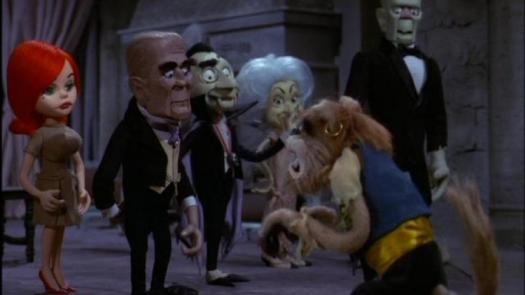
But that didn’t stop Gale Garnett! She was already a starlet of note, appearing on TV shows like HAWAIIAN EYE, 77 SUNSET STRIP, and BONANZA, and would soon be featured in animated form as the beautiful…
Robert De Niro might not seem as if he would be the most likely of subjects for a teenage love song but this song is hardly a traditional love song. The song was originally conceived as being sung from the point of view of a girl who deals with the trauma of being raped by escaping into a pretend world where Robert De Niro is her boyfriend. By the time the song was actually recorded, the rape angle had been dropped but this it’s still darker than your normal teen crush song.
Originally, the subject of the song was going to be Al Pacino, which might have made more sense. (Remember that while Robert De Niro was shooting pimps in Taxi Driver, posters of Al Pacino as Serpico were decorating dorm rooms.) However, it was decided that, musically, Robert De Niro sounded better than Al Pacino.
This video features the members of Bananarama being followed by two “gangsters” who could have stepped out of a De Niro film. It was directed by Duncan Gibbins, a talented director who tragically died in 1993. I wrote more about Gibbins and his career when I reviewed his video for Smuggler’s Blues.
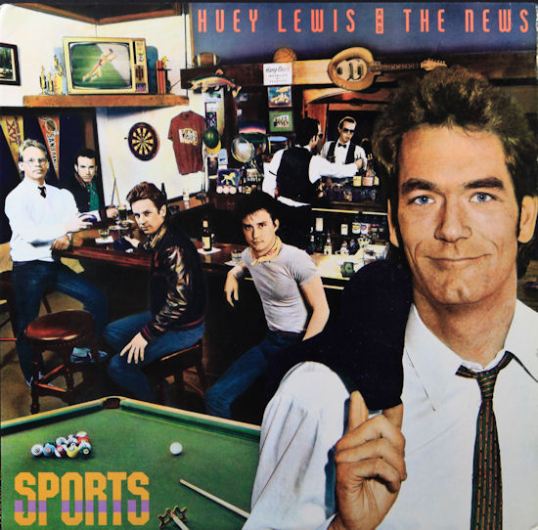
Despite what Patrick Bateman might try to tell you, Huey Lewis and the News has never been a band that most people would associate with drugs. Instead, Huey Lewis and the News wrote and performed the type of songs that you might expect to hear in a sports bar (albeit a sports bar with an 80s theme). If you need proof, just take a look at the cover of their third album, 1983’s Sports:
That cover sums up who Huey Lewis And The News were as a band. While only the members of the band can say for sure what they did behind closed doors, most people would look at this cover and say that these weren’t the guys you’d find smoking weed and debating philosophy or doing coke and going crazy on Wall Street. These were the guys who were waiting for you to come down to the local bar and shoot some pool, with the winner buying the next round.
Ironically, one of their biggest hits was so widely misinterpreted as being a pro-drug song that they actually made a music video with the expressed intent to show everyone that it wasn’t. I Want A New Drug wasn’t about wanting a new drug. It was about being so in love with a woman that the feeling was better than anything that any drug could provide.
The video features Huey waking up late and remembering that he has a show that night. He races across San Francisco and, noticeably, he doesn’t do a single drug during the journey. He does spot a woman played by Signy Coleman, whose mom was friends with Huey’s mom.
This video was directed by David Rathod, who also directed the videos for two other songs from Huey Lewis and the News, Heart and Soul and He Don’t Know.
As you can tell from watching this video, this from the period of time where KISS was performing without their trademark makeup. All Hell’s Breakin’ Loose was their second single from the album Lick It Up and, while the video itself got some airplay on MTV, the song failed to chart in the U.S. Compared to their success in the 70s, KISS struggled through the 80s and the early 90s. Taking off the makeup and essentially looking like every other hard rock band that was around at that time did not help.
Today, All Hell’s Breakin’ Loose is best-remembered as the song in which Paul Stanley raps. The majority of the song was written by KISS’s then drummer, the late Eric Carr and Carr was initially not happy with the decision to have Stanley rap one of the verses. However, later, Carr said that Stanley rapping was actually what the song needed to distinguish itself from the rest of the album and that the rap was probably the reason why All Hell’s Breakin’ Loose was eventually released as a single.
The video is a hard rock fantasy, with the members of KISS walking around a burned-out city and running into criminals, circus performers, and, of course, barely dressed women. This was probably a video that KISS could only have made during the period when they weren’t wearing their makeup. The Demon and the Starchild would have looked out-of-place wandering around the city but Gene Simmons, Paul Stanley, Eric Carr, and Vinny Vincent fit right in.
In retrospect, it’s hard not to be amused that, back in the 70s and 80s, so many parents groups viewed KISS as being a threat to young minds. (There are people who still believe that KISS stands for Knights In Satan’s Service.) I would guess that few of those concerned parents actually listened to any of the music that they were so concerned about. Instead, they just saw songs with titles like All Hell’s Breakin’ Loose and jumped to their conclusions.
Today’s music video of the day comes from 1985, the year when anyone with big hair could be a rock star.
It starts with two women running down a hallway in Philadelphia. Are they excited to see Cinderella, the generic glam rock band that had a few hits in the 80s just to be washed away, as so many similar bands were, by the arrival of grunge?
No, of course not!
The girls are excited because they’ve heard that Jon Bon Jovi and Richie Sambora are in the building! Bon Jovi and Sambora’s cameos are significant because Jon Bon Jovi was the person who initially discovered Cinderella and convinced PolyGram Records to sign them. So, basically, this is all Bon Jovi’s fault.
To be honest, this video would probably be totally forgotten if not for it’s appearance on an episode of Beavis and Butthead:
Not surprisingly, a lot of people have assumed that Julian Lennon was singing about his father, John Lennon, in this song. Julian, himself, has denied that interpretation, saying that this song was just his way of dealing with a breakup and nothing more.
Like yesterday’s video, Too Late For Goodbyes was directed by Sam Peckinpah, the notorious director behind The Wild Bunch, Straw Dogs, and Pat Garrett and Billy The Kid. It was directed at a time when Peckinpah’s Hollywood career was nearly over, having been sabotaged by too many fights with the studios and too many rumors about his drug and alcohol-intake. His two videos for Julian Lennnon would be Peckinpah’s final work as a director. He died just a few months after they were released.
In the UK, Too Late For Goodbyes was Julian Lennon’s first single and was followed by Valotte. In the United States, the order was reversed and Too Late For Goodbyes came out after Valotte. To date, Too Late For Goodbyes is the most successful single that Julian Lennon has ever released. It reached #1 on the U.S. Adult Contemporary Chart and stayed there for two weeks.
I am as shocked as anyone to discover that this sedate video was directed by the director who was known (affectionately or not) as Bloody Sam but indeed it was.
Valotte was the first U.S. single from Julian Lennon, a musician whose talent was often overshadowed by the fact that he was the son of John and Cynthia Lennon. John divorced Cynthia, leaving her for Yoko Ono, when Julian was only five years old and, by his own admission, Julian’s feelings towards his father have often been mixed. (Paul McCartney reportedly wrote what would become Hey Jude in an attempt to console Julian after the divorce.) When Julian Lennon pursued his own musical career, many reviewers spent more time discussing Julian’s physical and vocal resemblance to his father than his music.
As for the song, it was a ballad about finding love and not, as many have incorrectly assumed, a song about Julian’s relationship with John. The song was initially written at a French chateau known as the Manor de Valotte, which is how the song got its name. The single was subsequently recorded at Muscle Shoals Sound Studio in Alabama. The line, “Sitting on a pebble by the river playing guitar” is a reference to the location of the studio.
As for Sam Peckinpah, both his career and his health were in decline when he directed this video. Peckinpah made a huge impression in the late 60s and early 70s with films like The Wild Bunch and Straw Dogs but, by the time the 80s came around, the critics had turned on him and his abuse of drugs and alcohol had become so notorious that he couldn’t get a job in Hollywood. Peckinpah directed both this video and Lennon’s follow-up, Too Late For Goodbyes. His work on the videos was critically acclaimed but unfortunately, Peckinpah would pass away shortly after they were released.
From The Chemical Brothers, here’s the video for the lead track off of No Geography, Eve of Destruction!
Judging from what AURORA and Nene have to say on this track, it would appear that the world is on the verge of ending. Humans minds are simplified. Sacrifice is justified. We can’t afford the water. But maybe — just maybe — you can find a friend to dance with for the weekend.
And really, that’s the whole meaning of life, isn’t it? Things are frequently terrible but at least you can still dance. So, what are you going to do? Sit around and whine on twitter or are you going to get out there and dance and at least enjoy the eve of your destruction? Because seriously, if the whole world’s going to end anyway, you might as well have a good time before your turned into ash and wiped off of the face of history.
Fortunately, judging from this video, it does appear that we do have a plan in place in case the world gets attacked by vaguely goofy kaiju. So, there’s at least one reason to be optimistic.
Anyway, I love the Chemical Brothers, I love this track especially, and I am totally in love with this video. AURORA and the Chemical Brothers are exactly what the world needs right now!
“I’ll be honest with you, I love his music, I do, I’m a Michael Bolton fan. For my money, I don’t know if it gets any better than when he sings “When a Man Loves a Woman”.
— Bob (John C. McGinley) in Office Space (1999)
Yeeeesh!
I guess we can put this one in the “It Seemed Like A Good Idea At The Time” file. In 1985, your aunt’s favorite adult contemporary singer, Michael Bolton, tried to change his image by recording a hard rock album. The end result was Everybody’s Crazy and a title track that attempted to mix easy listening with hard rock.
It also led to this video, which starts with Michael Bolton telling his manager that “normal” is only something that people are until you get to know them. “Everybody’s crazy,” and I guess Michael Bolton is including himself in that. It’s not that Bolton doesn’t have an adequate voice as that there’s nothing dangerous about him and hard rock has to be dangerous. In this video, Bolton comes across as such a goof that he makes Kip Winger look like James Hetfield.
Bolton did at least bring in some talent for the video. For instance, he got Bruce Kulick, who was then with KISS, to play guitar on the song and he brought in Wayne Isham to direct the video. Wayne Isham’s one of the busiest music video directors around. If your favorite singer or band was around in the 80s or 90s, chances are that Wayne Isham directed one of their videos.
When Blister in the Sun was first released in 1983, there were no music video. In fact, there weren’t many listeners. While the song was an immediate hit on college radio, it wasn’t until the late 80s and the 1990s, when all of those people who worked at the college stations got jobs programming “alternative” and “modern rock” stations, that Blister in the Sun really became a radio mainstay.
It wasn’t until John Cusack decided that he wanted to use the song in Grosse Pointe Blank that Blister in the Sun finally got a music video. The video combines clips of John Cusack and Alan Arkin from the film with a totally new story involving the lead singer of Violent Femmes, Gordon Gano, attempting to assassinate Socks the Cat. Socks was the White House pet during the Clinton years and it says something about the difference between 1997 and 2019 that this video could be made at all. At the end of the video, Gano is arrested in a theater showing Grosse Pointe Blank, in much the same way that Lee Harvey Oswald was arrested in a theater that was showing War Is Hell.
As for the song’s lyrics, Gano has said that they were about drug abuse and not, as many listeners speculated, masturbation. The famous “Big Hands” line was a reference to Gano’s insecurity about his small hands and his fear that his girlfriend would leave him for someone who had bigger hands. As Gano once told the Village Voice, “I don’t think there’s a whole lot to understand with the lyrics.”

 Through the Shattered Lens