L.A. Guns is a band that has had a long and storied history, from their initial formation in 1983 to the brief moment when they joined with Axl Rose and became known as Guns N’ Roses to Tracii Guns leaving Guns N’ Roses after conflict with Rose and then forming a second version of L.A. Guns. At the same time that Guns N’ Roses were releasing their first music videos and making their mark on MTV, L.A. Guns released their video for One More Reason, one of the most apocalyptic looks at Los Angeles ever put on film.
Director Ralph Ziman also worked with Ozzy Osbourne, Toni Braxton, and Faith No More.
Produced by Gene Roddenberry and directed by Clive Donner, 1977’s Spectre was a pilot film for a television series about an occult detective (Robert Culp) who solved supernatural mysteries while dealing with a curse that had been put on him by the demon, Asmodeus.
In this film, Culp’s William Sebastian and his associate, Dr. Ham Hamilton (Gig Young) travel to the UK to investigate a supernatural case involving an old family. Despite the efforts of a succubus and a cursed airplane, Sebastian and Ham are determined to solve the mystery. John Hurt appears as a member of the cursed family.
This pilot was not picked up and developed into a series but it was popular enough that it was released as a theatrical film in Europe.
THE BRIDE WITH WHITE HAIR (1993), a Hong Kong fantasy film directed by Ronny Yu (THE BRIDE OF CHUCKY, Jet Li’s FEARLESS), follows Zhuo Yihang (Leslie Cheung), a master swordsman and reluctant young leader of the Wudang Sect, who is tasked with protecting his clan’s interests during a time of political turmoil and clan rivalries. The Ming Dynasty is weakening, and various factions vie for power, including an evil cult led by sinister conjoined twins, Gei Mou-Seung (Francis Ng and Elaine Lui). During a mission, Zhuo encounters Ni-Chang (Brigitte Lin), a fierce female warrior raised by the cult but disillusioned with their cruelty. Despite their opposing allegiances, Zhuo and Ni-Chang fall in love, drawn together by their unique senses of honor and a shared desire for freedom. Their romance faces intense opposition from both the Wudang Sect and the cult. A series of misunderstandings, betrayals, and tragic events, culminating in Zhuo’s hesitation to fully trust Ni-Chang, leads to her heart breaking. Will she be able to forgive Zhuo for breaking his promise to “always trust her” or will the pain of a broken heart transform her into the “Bride with White Hair,” where everyone else on Earth needs to watch TF out?!!
With its blend of fantasy action, romance and tragedy, THE BRIDE WITH WHITE HAIR is a visually spectacular and emotionally powerful masterpiece of Hong Kong cinema. In collaboration with cinematographer Peter Pau (Oscar winner for CROUCHING TIGER, HIDDEN DRAGON), director Ronny Yu creates a dreamlike atmosphere with surreal imagery that helps elevate the film into the unique awesomeness of early 90’s Hong Kong. The inventive choreography of the somewhat gory fight scenes, combined with flowing costumes and foggy landscapes, creates an exciting world for this film. This is bold visual and emotional storytelling, and I loved it. Brigitte Lin is amazing as Ni-Chang, balancing powerful strength with a surprising amount of vulnerability, which makes her ultimate transformation into the white-haired Bride both devastating and badass, cementing her as one of Hong Kong cinema’s most memorable heroines. Leslie Cheung is good as Zhuo Yihang, portraying a man who longs to be free, especially after he falls in love with Ni-Chang, but circumstances have a way of keeping him bound to his clan. The chemistry between Lin and Cheung drives this film, which makes the ultimate outcome of their romance very moving. Francis Ng and Elaine Lui are appropriately insane as the deadly and dangerous conjoined twins and cult leaders. The fact that Francis’ character is evil and in love with Ni-Chang himself ensures that our lovers are not going to get an easy path for flying off into the sunset together.
Ultimately, I consider THE BRIDE WITH WHITE HAIR to be a must-watch for fans of action-based fantasy films, or anyone drawn to stories of forbidden love and personal sacrifice. It’s one of the first “non-Chow Yun-Fat” Hong Kong movies I ever watched. The moving romance at the film’s center and the excellent performances from Lin and Cheung make it a standout of Hong Kong cinema.
When he was a young boy, Gregory Tudor was traumatized when he witnessed the gangland-style execution of the neighborhood ice cream man. He was retraumatized when he was sent to an insane asylum. Now, Gregory (Clint Howard) has grown up and he’s the ice cream man! Everyone in the neighborhood loves his ice cream but the local kids suspect that he’s using human body parts to get the flavor just right. It turns out that the kids know what they’re talking about.
Ice Cream Man almost feels like a zero-budget precursor to Stranger Things, with the kids knowing what’s happening in their town while the majority of the adults are too self-absorbed to notice. One of the kids is a Macauley Culkin look-alike known as Small Paul (Mikey LeBeau). He comes to admire Gregory and his murderous devotion to ice cream. The movie’s really stupid but it’s clearly not meant to be taken seriously and Clint Howard really throws himself into his role. One thing that makes Ice Cream Man enjoyable is that you know Ron Howard had to sit through it because his brother’s in it.
The most interesting thing about Ice Cream Man is the number of recognizable actors who appear in tiny roles. David Warner is the town’s reverend. David Naughton is a clueless father who is married to Sandahl Bergman. Jan-Michael Vincent is a detective. Olivia Hussey is Gregory’s former nurse. Former baseball player and future senatorial candidate Steve Garvey plays another parent. With the exception of Vincent, it’s hard not to believe that the members of the cast didn’t have anything better to do. Never underestimate the appeal of a quick paycheck.
Clint Howard has said that a sequel is in pre-production. The Ice Cream Man will return.
Today’s horror scene that I love is from George Romero’s 1978 zombie masterpiece, Dawn of the Dead.
The first time I saw this film, I was so upset when Roger died. Not only was Roger my favorite character but I also knew that if Roger — who was so funny and so charismatic and so competent — couldn’t survive then that meant that no one was going to survive.
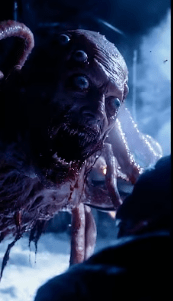
Ok, no title, but in the description it is In The Mountains of Madness. We are going to see some Cthulhu? Some revelations? Some Necronomicon? I’m not hopeful, but I’m also usually right. Is it a trailer?
There is a British Person telling us about the expedition to Antarctica. They uncover the structures of the Old Ones. The crew finds a laboratory of weird creatures and then they become one with the gross things. As a trailer, it would’ve been excellent. The imagery is quite good and it does capture what these creatures might look like and how they possess the expedition crew.
Is it a short? There is a beginning a middle, but there is not really a clear ending. It could just be that I’m so used to seeing the absolute worst garbage AI films that I’m unable to tell what is good or bad anymore because nothing matters. However, I think this short might be – ok. Not great, but it is ok and I suppose that you could do worse things with 90 seconds of your life.
This October, I’m going to be doing something a little bit different with my contribution to 4 Shots From 4 Films. I’m going to be taking a little chronological tour of the history of horror cinema, moving from decade to decade.
Originally broadcast in 1985, Into Thin Air is a made-for-TV movie that is based on a true story. It’s film that brings to life the horror of every family’s nightmare. Brian Walker (Tate Donavon) is an intelligent, soft-spoken, and somewhat naive college student in Ottawa. He’s been accepted into a summer writing program in Colorado. As he gets in the van that he will be driving to Colorado, he promises his mother, Joan (Ellen Burstyn), that he’ll call her when he reaches Nebraska and again when he reaches Colorado.
Brian drives away and that’s the last time that Joan ever sees her son. Brian calls from Nebraska and talks to his brother, Stephen (Sam Robards). Joan arrives home just as Stephen is saying goodbye. Brian never calls from Colorado. He has vanished, seemingly into thin air.
Joan, Stephen, and Joan’s ex-husband, Larry (played the great character actor Nicholas Pryor) travel to America to search for him. At one point, Stephen thinks that he’s spotted Brian’s van on the road and chase after it, just to discover that it’s a different van. Joan talks to cops in Nebraska and Colorado and discovers that different jurisdictions don’t work together or share information. As the days pass, Joan keeps hoping that Brian is somehow still alive….
I was about ten minutes into this film when I started sobbing. I pretty much cried through the entire film. Some of that was because I knew that they were never going to see Brian again. Some of that was because of the powerful, heartfelt performances of Ellen Burstyn, Nicholas Pryor, and Sam Robards. Most of it was because this film did such a good job of capturing the feeling of hopelessness and the dread that comes with not knowing what has happened to someone who you love. I found myself crying for Brian’s lost potential. He was a writer and he was engaging in a time-honored writing tradition. He was taking a road trip and he was discovering the world. He deserved better than whatever happened to him. He deserved see his novel sitting in a bookstore. Instead, he ran into the wrong people.
It’s the little details that really got to me. Stephen flies into a rage when he sees his younger brother wearing one of Brain’s sweaters. Joan momentarily gets her hopes up when she discovers that Brian reported some lost traveler’s checks, just to have that hope shot down when she’s told that the bank can’t reveal where Brian called them from unless Brian himself gives permission. When the van eventually turn up in Maine, it’s been totally trashed by whoever took it from Brian.
Eventually, Joan hires a private detective and Robert Prosky is well-cast as Jim Conway, a seemingly cynical ex-cop who dedicates himself to trying to provide closure for the Walkers. The scene where he finally discovers what happened to Brian is one of the strongest in the film and one of the most upsetting. So many people could have saved Brian if they only had the courage to speak up.
Into Thin Air is a powerful film. No one should ever be forgotten.
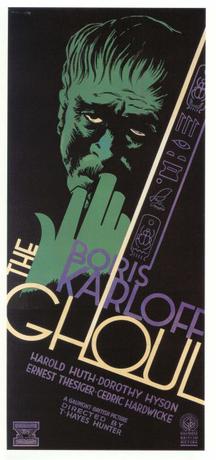
Some actors can make just about anything worth watching. That’s certainly the case with Boris Karloff and 1933’s The Ghoul.
In The Ghoul, Karloff plays Prof. Henry Moriant. The professor is an Egyptologist, a world-renowned expert on the dead. Moriant is now facing death himself, sick in bed and ranting about how he wants to be treated after he passes. Nigel Hartley (Ralph Richardson) stops by the mansion while pretending to be a vicar and offers to comfort Prof. Moriant in his last moments. The butler, Laing (Ernest Thesiger), explains that Moriant has never had much use for traditional religion. Instead, Moriant believes in the Gods of Egypt.
In death, Moriant wants to be buried with an Egyptian jewel in his hands. He believes that, after he dies, he will exchange the jewel with the Egyptian God Anubis and he will be reborn with amazing powers. However, when Moriant passes, Laing keeps the jewel for himself and attempts to hide it from the countess number of people who show up at the mansion, all seeking either the jewel or just information about Moriant’s estate. Moriant may not have been loved in life but everyone clearly loves his money.
Boris Karloff is not actually in that much of The Ghoul. He dominates the start of the film, ranting from his deathbed. And then, towards the end of the film, he rises from the dead and attacks those who he thinks have betrayed him and stolen the jewel. He’s only onscreen for a few minutes but he dominates those minutes. Karloff’s screen presence is undeniable. When he’s in a scene, he’s the only person that you watch. When he’s not in a scene, you find yourself wondering how long it’s going to take for Karloff to return.
That’s not to say that the other actors in The Ghoul aren’t good. The cast is full of distinguished names. Along with Richardson and Thesiger, Cedric Hardwicke, Anthony Bushnell, Dorothy Hyson, and Kathleen Harrison all wander through the mansion and try to avoid getting caught up in Karloff’s vengeance. Harrison provides the film’s comic relief and I actually enjoyed her flighty performance. The film itself is so darkly lit and full of so many greedy characters that it was nice to have someone on a totally different wavelength thrown into the mix. That said, the majority of the actors are stuck with paper-thin characters and aren’t really allowed the time to make much of an impression. This is Karloff’s film, from the beginning to end. And while the film itself is definitely a bit creaky, Karloff is always enjoyable to watch.
The Ghoul was made at a time when Karloff, having become a star with Frankenstein, was frustrated with the roles that he was being offered in America. He returned to his native UK and promptly discovered that he was just as typecast over there as he was in the United States. For a long time, The Ghoul was believed to be a lost film. However, in 1968, a copy was discovered in Egypt of all places. It’s unfortunate that the film itself isn’t better but there’s no denying the power of Karloff the performer.
1982’s Pink Floyd — The Wall is a film that I have mixed feelings about.
Some of that is due to my feelings about Pink Floyd. On the one hand, I can’t deny their talent and I do like quite a few of their songs, if they do all tend to be a bit on the portentous side. On the other hand …. Roger Waters! Bleh, Roger Waters. Waters was one of the founders of Pink Floyd and, for a while, the band’s de facto leader. He’s also a rabid anti-Semite and a defender of Vladimir Putin’s. That said, I’ve discovered that I can justify listening to Pink Floyd by remembering that the rest of the band hates Roger Waters as well and that Waters himself eventually left Pink Floyd. Waters’s bandmate, David Gilmour, has flat-out called Roger Waters an anti-Semite. Last year, when we had a total eclipse of the sun, I was happy to be able to play the last two tracks of Dark Side of the Moon while enjoying the early and temporary evening. It just felt appropriate.
Outside of Dark Side of the Moon, The Wall is probably Pink Floyd’s best-known work. (When I was younger, I can remember my Dad playing it whenever he was driving across the country.) A concept album about how much it sucks to be a wealthy Englishman, The Wall is one of those albums and films that are beloved by people who consider themselves to be alienated. Even more so than the average Pink Floyd album, The Wall was the brainchild of Roger Waters and, when the movie version was made in 1982, Waters wrote the screenplay. That said, I think you can argue that, much as with Tommy, The Wall was ultimately more about the vision of the film’s director than that of the man who wrote the songs.
The Wall is definitely an Alan Parker production. It’s big. It embraces the sordid. It’s stylish almost to the point of parody. Every image has been carefully constructed by a director who got his start doing commercials and whose main goal was to get an immediate audience reaction. Much like Parker’s Midnight Express or Evita, it’s a film that grabs your attention while you’re watching it and only afterwards do you stop consider that there really wasn’t much going on underneath the surface.
Pink (Bob Geldof) is a self-loathing rockstar who is haunted by his childhood in post-WWII Britain and whose marriage is failing. He’s building a wall, brick-by-brick, to keep himself separated from pain but the price of becoming comfortably numb is to be so alienated that you imagine becoming a neo-Nazi who orders his followers to follow the Worm. The imagery is powerful. The animated sequences by Gerald Scarfe still make quite an impression, especially the marching hammers. The score features songs like Another Brick In The Wall, Comfortably Numb, and Run Like Hell. The film is relentless, full of downbeat imagery that is often excessive but which Parker understood would appeal to the film’s target audience. Indeed, it’s such an overwhelming film that it’s easy to overlook the fact that, even before he transformed into a fascist, Pink is a drab character and his main problem seems to be that he can’t seem to find anything good to watch on television.
That said, I have to admit that, despite myself, I do like The Wall. It’s just so shameless that it’s hard not to enjoy the silliness of it all. Add to that, Comfortably Numb is a great song. (Another Brick In The Wall is also a great song though perhaps not for the reasons that Waters thought it was.) The Wall is a monument to the joys of cinematic excess.




 Through the Shattered Lens