Horror Film Review: C.H.U.D. (dir by Douglas Cheek)


There’s something living under the streets of New York City.

That’s the basic idea behind 1984’s C.H.U.D., a film that opens with an upper class woman and her little dog being dragged into the sewers by a creature the reaches out of a manhole.  People are disappearing all over the city but the authorities obviously aren’t revealing everything that they know.  Even after the wife of NYPD Captain Bosch (Christopher Curry) disappears, the city government doesn’t seem to be too eager to dig into what exactly is happening.

Instead, it falls to two activists.  Photographer George Cooper (John Heard) specializes in taking picture of the homeless, especially the one who live underground in the New York subways.  He’s like a well-groomed version of Larry Clark, I guess.  Social activist A.J. “The Reverend” Shepherd (Daniel Stern) runs a homeless shelter and is convinced that something is preying on the most vulnerable citizens of New York.  When the police won’t do their job, George and the Reverend step up!

So, what’s living in the sewers?  Could it be that there actually are cannibalistic humanoid underground dwellers out there?  Everyone in New York City has heard the legends but, much like stories of the alligators in the Chicago sewers, most people chose not to believe them.  Or could the disappearance have something to do with the cannisters labeled Contamination Hazard Urban Disposal that are being left in the sewers by the Nuclear Regulatory Commission?  Wilson (George Martin) of the NRC says that they would never purposefully mutate the people living underground but Wilson works for the government so who in their right mind is going to trust him?

C.H.U.D. is a horror film with a social conscience.  It’s very much an 80s films because, while you have Shepherd running around and attacking everyone for not taking care of the most vulnerable members of society, the true villain is ultimately revealed to be the members of a regulatory agency.  Instead of finding a safe way to get rid of their nuclear waste, they just found a sneaky way to abandon it all in New York and obviously, they assumed no one would care because …. well, it’s New York.  Everyone in the country knows that New York City isn’t safe so who is going to notice a few underground monsters, right?

The idea behind C.H.U.D. has a lot of potential but the execution is a bit lackluster.  For every good C.H.U.D. kill, there’s long passages where the story drags.  Considering that Heard spent most of his career typecast as the type of authority figure who would dump nuclear waste under New York City, it’s actually kind of interesting to see him playing a sympathetic role here.  Daniel Stern, on the other hand, is miscast and rather hyperactive as Shepherd.  You really do want someone to tell him to calm down for a few minutes.  Watching C.H.U.D., one gets the feeling that it’s a film with an identity crisis.  Is it a horror film, an action flick, a work of social commentary, or a dark comedy?  There’s no reason why it can’t be all four but C.H.U.D. just never really comes together.  It ultimately feels more like a mix of several different films instead of being a film made with one clear and coherent vision.

In the end, Death Line remains the film to see about underground cannibals.

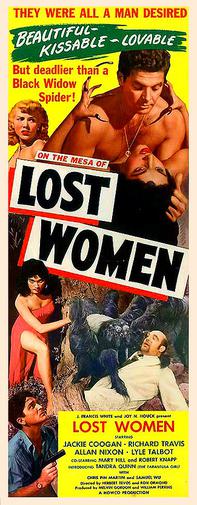
Horror Film Review: Mesa of Lost Women (dir by Herbert Tevos and Ron Ormond)


“Have you ever been kissed by a girl like this?” a disembodied voice asks at the start of 1953’s Mesa For Lost Women as a pair hands with claw-like fingernails caresses the face of someone who is later identified as being “Doc” Tucker (Allan Nixon).

Things get stranger from there.  A couple is found lost and dehydrated in the Mexican desert.  Grant Phillips (Robert Knapp) rambles about “super bugs” out in the desert and how they have to be destroyed.  American land surveyor Frank (John Martin) assumes that Grant must be delirious but Frank’s assistant, Pepe (Chris Pin Martin), knows differently.  We know that Pepe knows differently because the narrator tells us that Pepe had heard all about the monsters in the desert but Pepe keeps that information to himself….

Who is this narrator and why is he so condescending?  (For the record, he’s actor Lyle Talbot, who split his career between major, Oscar-winning productions and stuff like this.)  Have you ever noticed that a narrator usually just leaves you feeling even more confused by what you just watched?  There’s a trailer playing right now for a film called Ella McCay that opens with Julie Kavner saying, “Hi, I’m the narrator!” and whenever I hear that line, I’m just like, “Oh, this film is going to be so bad!”

I think it’s because most narrators are added after the fact, in an attempt to give some sort of uniformity to a badly constructed movie.  The narrator is there to tell us stuff that a good movie would be able to show us.  For instance, in the trailer for Ella McCay, Julie Kavner tells us that “I’m nuts about her,” as a way to assure us that Ella McCay is someone worth making a movie about.  Now, ideally, you wouldn’t have to have someone tell you that.  You would just watch the movie and say, “Hey, Ella McCay!  She deserves all the happiness in the world!”  But when your trailer is a bunch of scenes of Ella McCay acting a bit immature for someone who is destined to become “governor of the state you were born and raised in,” you need that narrator to say, “No, she’s likable, I promise!”

By that same logic, Mesa of Lost Women was apparently a mash-up of several different films, none of which had a complete script.  Narrator Lyle Talbot is here to tell us that, despite what we’re seeing, Mesa of Lost Women is an actual movie with an actual story as opposed to just a bunch of random scenes that were haphazardly crammed together.  We get a flashback of a scientist named Masterson (Harmon Stevens) traveling to the laboratory of Dr. Aranya (Jackie Coogan) and discovering that Aranya is creating giant tarantulas and transforming human women into mind-controlled slaves with the instincts of a spider.  Masterson doesn’t think that’s ethical so Aranya’s assistant, Tarantella (Tandra Quinn), gives him an injection that turns him into a simpleton.  Masterson ends up in a mental hospital, though he later escapes.  Meanwhile, an American businessman and his girlfriend (Mary Hill) come to Mexico and witness Tarantella dancing in a bar.  Masterson shows up and shoots Tarantella and then takes everyone hostage so that he can force Grant, who we now discover is a pilot, to fly him to the mesa of lost women …. or something.

Despite the best efforts of the narrator, the film is impossible to follow.  A big problem is that Dr. Aarnya’s plan never makes much sense.  How is creating a giant spider and a bunch of women who think that they’re spiders going to help him conquer the world?  The other problem is that the film had two directors, one of whom was an enigmatic German named Herbert Tevos who got the job by claiming to have directed Josef von Sternberg’s The Blue Angel.  Tevos’s footage of Dr. Aranya, the giant tarantula, and the “lost women” was not enough to secure the film distribution so a second director, Ron Ormond, was brought in to shoot a bunch of new footage to make the film more commercial.  Tevos’s film became an extended flashback in the middle of Ormond’s film and the whole thing is a big mess.

In fact, the film is such a mess that some people insist Ed Wood must have been involved.  It is true that narrator Lyle Talbot also appeared in Plan 9 From Outer Space and Glen or GlendaPlan 9‘s Mona McKinnon appears as a spider woman.  So does Dolores Fuller, who was Wood’s girlfriend at the time.  Wood later “borrowed” Mesa of Lost Women‘s score for Jail BaitMesa of Lost Women was definitely Wood-adjacent but, by all accounts, Wood didn’t actually do any work on the film.  This mess of a film belongs to Tevos and Ormond.

And it is a mess.  It’s a watchable mess, in much the same way that a nuclear meltdown would probably be watchable.  But, nonetheless, it’s still a mess and the incoherence of the plot really does get on one’s nerves, despite the best efforts of Lyle Talbot.  Talbot can’t sell the viewer on Mesa of Lost Women.  Maybe he would have had better luck with Ella McCay.

Horror On The Lens: Bride of the Monster (dir by Edward D. Wood, Jr.)


Oh, how I love Bride of the Monster.

First released in 1955 and directed by the legendary Ed Wood, Bride of the Monster is a classic mix of a haunted house, a mad scientist, a lumbering assistant, and a giant octopus.  The plot may be impossible to follow but it doesn’t matter when you’ve got Tor Johnson grunting and Bela Lugosi giving a surprisingly good performance as the persecuted Dr. Vornoff, a man who “tampered in God’s domain.”

A lot of people consider this to be Wood’s best film.  Personally, I would go with Plan 9 From Outer Space but Bride of the Monster is still an entertaining look at monsters and madmen.


Hell No: The Sensible Horror Film, Short Film Review by Case Wright


This is fun!!! Technically, this short film does not have an actual story, BUT it is still a well done and fun short film. But Case, you’re so hard on everyone and this year you’re being so lenient! Fair critique, but I argue that this is within the parody genre and is exempt from my usual rules. Attack of the Killer Tomatoes was one of the first films to do a feature length send up of many different movies and this short is in that vibe.

They go through the tropes: they stop at an abandoned cabin and say – F THAT!, a cop who WAITS for backup, and a boy who finds the Hellraiser puzzle and just plays with his iPhone instead and then does something hilarious to the box. If you want a quick laugh when you’re in line or anything other time you have about 3 minutes to kill, it is great choice. Life can be challenging and good laugh is better than a good cry.

Live Tweet Alert: Watch Creature From The Black Lagoon With #ScarySocial!


As some of our regular readers undoubtedly know, I am involved in a few weekly live tweets on twitter.  I host #FridayNightFlix every Friday, I co-host #ScarySocial on Saturday, and I am one of the five hosts of #MondayActionMovie!  Every week, we get together.  We watch a movie.  We tweet our way through it.

Tonight, for #ScarySocial, I will be hosting a true classic, Creature From The Black Lagoon!

If you want to join us on Saturday night, just hop onto twitter, start the film at 9 pm et, and use the #ScarySocial hashtag!  The film is available on Prime and Tubi!  I’ll be there co-hosting and I imagine some other members of the TSL Crew will be there as well.  It’s a friendly group and welcoming of newcomers so don’t be shy!


Music Video of the Day: Are You Ready For Freddy? by the Fat Boys (1988, directed by Harvey Keith)


I always assumed that this song was specifically written for one of the Nightmare on Elm Street movies but actually, the Fat Boys were just fans of the movies and they decided to put a song about them on one of their albums.  The song was included in The Freddy Krueger Special, which aired on CBS in 1988.

This video, which features several of Freddy’s victims and Robert Englund himself, was written by Wes Craven and directed by Harvey Keith.  Keith directed a few films, including 1988’s Mondo New York and 1990’s Jezebel’s Kiss.

Enjoy!

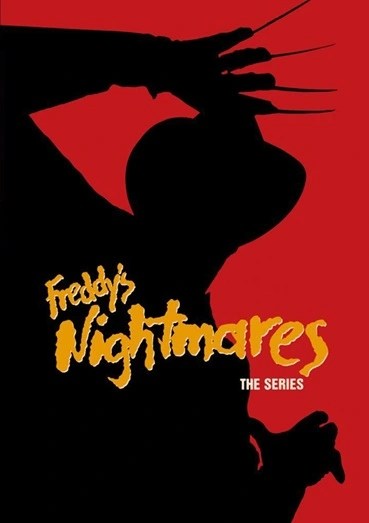
Late Night Retro Television Review: Freddy’s Nightmares 1.12 “The End of the World”


Welcome to Late Night Retro Television Reviews, a feature where we review some of our favorite and least favorite shows of the past! On Fridays, I will be reviewing Freddy’s Nightmares, a horror anthology show which ran in syndication from 1988 to 1990. The entire series can be found on Plex!

This week, dreaming saves the world.

Episode 1.12 “The End of the World”

(Dir by Jonathan R. Betuel, originally aired on January 15th, 1989)

Weird episode.

The first half of the episode featured Mary Kohnert as Amy Collins, a young woman who starts to have dreams about the past and discovers that she can change reality depending on what she does in her dream.  Most of the dreams center around the accidental death of her mother.  Amy sets about to save her mother’s life but she discovers that changing the past will always lead to unforeseen consequences.

Unfortunately, her psychiatrist (George Lazenby) rats her out to the CIA and Amy is soon being forced to work for the U.S. military.  When she senses that a soldier is planning on launching a nuclear attack and plunging the world into war, Amy is forced to do a mind-meld of sorts with him.  She watches as the army manages to break into his bunker and gun him down right before he launches the nukes.

I can’t complain about a show trying something different and I actually found it interesting how the two stories were totally different in style and tone.  The second story featured a dream about a nuclear war that was pretty disturbing.  On TV, Gumby and his horse melted from the atomic heat.  That said, this episode suffered from the same flaw as many of the episode of Freddy’s Nightmares, in that it really didn’t have the budget necessary to achieve what it was hoping to accomplish.

Still, who can forget the image of Freddy Krueger riding a nuclear missile in the style of Slim Pickens at the end of Dr. Strangelove?

Along with having an interesting premise, this one also had some interesting guest stars.  Along with George Lazenby and Gumby, Walter Gotell, Andrew Prine, and Albert Hall all made appearances.  I guess when Freddy Krueger invites you, you don’t say no.

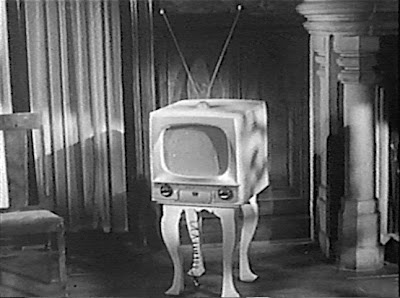
Horror On Television: Final Curtain (dir by Edward D. Wood, Jr.)


1957’s Final Curtain is a short, 22-minute film in which a mysterious man (Duke Moore) wanders around a creepy and seemingly abandoned theater.  While Dudley Manlove (who played Eros the Alien in Plan Nine From Outer Space) provides narration, the man sees many strange things in the theater.  What is real and what is merely a hallucination?  Watch to find out!

Final Curtain was envisioned, by director Edward D. Wood, as being the pilot for a horror anthology series.  Though none of the networks were interested in buying Wood’s proposed series, Wood considered Final Curtain to be his finest film and it certainly is a bit more atmospheric than the typical Wood film.  The role of the mysterious man was written for Bela Lugosi but, after Lugosi passed away, Duke Moore was cast in the role instead.

From 1957, here is Final Curtain.

The TSL Horror Grindhouse: The Sadist (dir by James Landis)


1963’s The Sadist opens with three teachers driving to a baseball game.

Ed (Richard Alden), Doris (Helen Hovey), and Carl (Don Russell) are planning on just having a nice night out but their plans change when they have car trouble out in the middle of nowhere.  They pull into a gas station/junkyard that happens to be sitting off the side of the road.  The teachers look for the owner of the gas station or at least someone who works there.  Instead, what they find is Charlie Tibbs (Arch Hall, Jr,) and bis girlfriend, Judy Bradshaw (Marilyn Manning).

Charlie is carrying a gun and he demands that the teachers repair their car and then give it to him so that he and Judy can continue their journey across the country.  Charlie has been switching cars frequently, largely because the cops are looking for him.  That’s because Charlie has been killing people all up and down the highway.  The intellectual teachers find themselves being held hostage by Charlie and Judy, two teenagers who may not be as smart as them but who have the killer instinct that the teachers lack.

It’s interesting to watch The Sadist after watching Eegah!  Arch Hall, Jr. and Marilyn Manning played boyfriend and girlfriend in that one as well but neither Hall nor Manning were particularly credible in their roles.  Hall seems uncomfortable with the whole teen idol angle of his role while Manning seemed a bit too mature for the role of a teenager.  In The Sadist, however, they’re both not only believable but they’re terrifying as well.

Charlie and Judy are almost feral in their ferocity, with both taking a disturbing glee in taunting the teachers.  Charlie kills without blinking and Judy enjoys every minute of it.  It’s easy to imagine Charlie and Judy at a drive-in showing of Eegah!, laughing at the sight of the caveman getting gunned down by the police and never considering that violence in real life is different from killing in the movies.  The teachers discover that it’s impossible to negotiate with Charlie and that Charlie’s promise not to try to kill them if they fix the car is ultimately an empty one.  And yet the teachers, dedicated to education and trying to reach even the most difficult of students, struggle to fight back.  They’re held back by their conscience, something that Charlie does not possess.  It’s intelligence vs instinct and this film suggests that often, intelligence does not win.

It’s a pretty intense and dark film, one that makes great use of that junkyard setting and which is notable for being the first film to feature the cinematography of Vilmos Zsigmond.  For those who appreciate B-movies, it’s memorable for showing that, when he wasn’t being pushed to be a squeaky-clean hero who sang sappy ballads in films directed by his father, Arch Hall, Jr. actually was capable of giving a very good performance.

The Sadist was based on the true-life crimes of Charlie Starkweather and Caryl Ann Fugate.  Interestingly enough, their crimes also inspired Terence Malick’s  Badlands.