Today is Bela Lugosi’s birthday!
This video was shot at Coachella in 2005.
Enjoy!
Today is Bela Lugosi’s birthday!
This video was shot at Coachella in 2005.
Enjoy!
I came across this old cartoon on YouTube. Apparently, it aired in October of 1983.
It’s about bears living in Bearbank. Halloween is approaching and they’re worried about getting invaded by the monsters who live on Monster Mountain. Well, that makes sense. My question is why would you buy a house near a location called Monster Mountain? And really, shouldn’t the monsters be in the houses and the bears in the mountains? This cartoon is weird.
Anyway, the bears are getting ready to feel the city but little Ted E. Bear sets out to confront his fears! Woo hoo!
I don’t know. It’s from 1983. That was a strange year, I guess.
Enjoy!

The TARDIS materializes in Victorian-era London. Accompanying the Fourth Doctor (Tom Baker) is his new companion, Leela (Louise Jameson). After returning Sarah Jane Smith to her own time (more or less) and saving the Time Lords from being destroyed by the Master, the Doctor meet Leela on an unnamed planet in the far future. Though Leela, with her short animal-skin outfit and her very large knife, seemed like a savage, she was actually the descendant of a group of Earth astronauts who had crashed on the planet centuries before. Leela insisted on traveling with the Doctor and the Doctor reluctantly decided to try to civilize Leela or, at the very least, get her to stop carrying that big knife around with her.

Hence, the trip to London. The Doctor wants her to see where her ancestors came from. The Doctor’s plan is to take her to the Palace Theater, owned by Henry Gordon Jago (Christopher Benjamin), so that they can see a performance by the magician Li Hi’sen Chang (John Bennett). Instead, they end up getting caught up in a series of murders that involving Chang, a giant rat in the London sewers, a miniature killer named Mr. Sin (Deep Roy) who snorts like a pig, and a 51st century war criminal named Magnus Greel (Michael Spice).

The Talons of Weng-Chiang is not only one of the best of the Fourth Doctor’s adventures but it’s also one of the best Doctor Who serials ever. Victoria London, with its foggy streets and its collection of eccentric rogues, proves to be a perfect fit for Tom Baker’s Doctor, allowing Baker to try out the Sherlock Holmes persona that he would later use when he played the great detective himself in a BBC production of Hound of the Baskervilles. Louise Jameson is also a delight in this story, with Leela’s naturally independent nature befuddling all of the very proper Victorians that she comes into contact with. Louise Jameson had the unenviable task of trying to follow in the footsteps of the beloved Elisabeth Sladen. (The show’s writers helped out by making Leela the opposite of Sarah Jane is almost every way.) Supposedly, Tom Baker had not wanted a new companion and initially treated Louise Jameson very coldly, though he eventually warmed up to her. With her performance in this serial, Louise Jameson proved that she definitely deserved to be a part of the Doctor’s adventures.

Of course, for many, the real highlight of this serial is the chemistry between Henry Gordon Jago and Professor Lightfoot (Trevor Baxter), the coroner who has been investigating a number of strange murders in London. The blustery Jago and the reserved Lightfoot are almost as important to defeating Magnus Greel than the Doctor and Leela and the scenes in which they become an unlikely detective team are so enjoyable that it’s not a surprise that the BBC considered giving them a series of their own. (From 2010 to 2017, the pair did star in an audio drama, one that imagined them investigating other mysteries and even teaming up with other Doctors.) Of course, when I first saw The Talons of Weng-Chiang, I was just happy that Jago and Lightfoot managed to survive all six chapters. After you watch enough Doctor Who, you learn not to get to attached to any of the supporting characters. That Jago and Lightfoot did not fall victim to Mr. Sin was cause for celebration.

The Talons of Weng-Chiang actually has a pretty interesting story, one that justified its 6-episode length. Magnus Greel is one of the great Doctor Who villains, a time traveling war criminal who pretended to be a God. For the most part, Michael Spice was convincing as Greel, though his over-the-top delivery of a threat to “rip your flesh,” is one of the serial’s few unintentionally funny moments. Another false step was the “giant rat,” which was clearly a normal-sized rat shot on a miniature set. The rat looked bored. When the rat has to interact with the Doctor and Leela, it becomes a giant rat dummy that looks very little like the normal rat. And finally, a stuntman had to do a few scenes inside a rat costume. All of the rat stuff doesn’t do much other than leave you wondering whether the story really needed a giant rat at all. Of course, it’s really not Doctor Who if there isn’t at least one notable case of special effects failure.

The rat aside, there is another thing that has to be discussed when it comes to The Talons of Weng-Chiang. When I was a kid, I didn’t really notice it because I was too busy enjoying the action set pieces, Tom Baker’s tongue-in-check performance, the Jago/Lightfoot team-up, and everything about Louise Jameson. Rewatching The Talons of Weng-Chiang as an adult, the thing I immediately noticed was that, for an episode that featured a lot of Chinese characters (the majority of whom were not presented in a particularly positive light), there weren’t many Chinese actors in the cast. The most prominent Chinese character was played by John Bennett, in full yellowface. Reading about the production of the serial, I was not surprised to see that one of the inspirations was Sax Rohmer’s notoriously racist Fu Manchu novels. While The Talons of Weng-Chiang may not be as flat-out racist as Rohmer’s novels, it still has its share of negative racial stereotypes. (Of course, the story’s main villain is not Chinese. Magnus Greel is described as being “the butcher of Brisbane,” make of that what you will.) The Talons of Weng-Chiang is well-acted, well-directed, and well-written and there’s no way it would be made today, at least not in the same way that it was made in the 70s. I’m not saying that’s a bad thing or a good thing. It just a reminder of how much things have changed since 1977.

The final serial of the 14th season, The Talons of Weng-Chiang was a triumph and also proof that the Doctor could still have worthwhile adventures, even if he was no longer traveling with Sarah Jane.

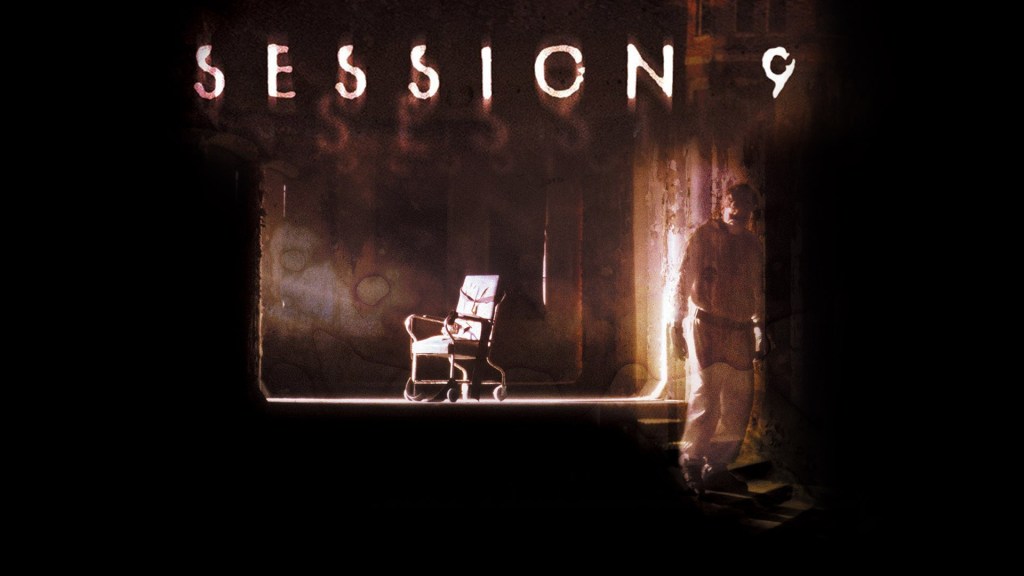
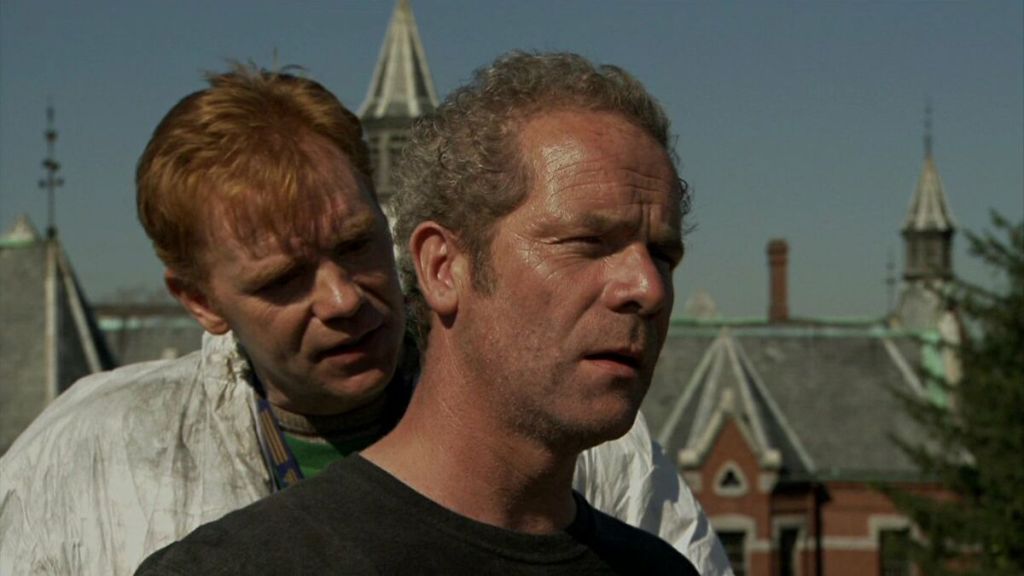
Gordon Fleming (Peter Mullan) the owner of a company that removes asbestos from old buildings, makes a bid for the work at the Danvers State Hospital in Massachusetts. In a desperate need for cash in his personal life, Gordon promises that his crew can complete the job in only one week, even though a job like this should normally take at least three weeks. His crew… Phil (David Caruso) is Gordon’s right hand man who tries to keep everyone else in line. This isn’t very easy these days considering that another member of the team is Hank (Josh Lucas), who’s currently “dating” (not the word Hank uses) Phil’s ex-girlfriend. The crew is rounded out by Mike (co-writer Stephen Gevedon), a law school dropout who seems to be way too smart to be doing this kind of work, and Jeff (Brendan Sexton III), Gordon’s nephew. As you might expect, once they begin the job, strange things start happening as the crew members find various items in the gigantic mental institution that once housed up to 2,400 people. Mike finds a box of tapes of nine therapy sessions detailing the case of Mary Hobbes, a patient with many personalities who may have murdered someone decades before. Meanwhile, Hank finds a stash of coins and other valuable items in one of the walls. A gambling addict, Hank goes back late that night when no one is around to collect his discovery. Things don’t go well and Hank doesn’t show up for work the next day. We’re led to believe that Hank has headed off to Florida for “casino school,” and this is where things start really getting weird as the pressure of the job and the strange events seem to be getting to the entire crew. When Jeff spots a very oddly acting Hank in the building a couple of days later, the sinister events at the Danvers State Hospital begin to completely unravel!
Director Brad Anderson’s SESSION 9 is a creepy, slow burn that’s best described as a psychological horror film. It’s one of those movies where you can’t trust what you’re seeing on screen because the story is about the disturbed and damaged human mind. In my opinion, this is the most haunting kind of horror film because there are so many examples in the real world of mentally disturbed people committing horrific acts of violence. My wife has spent the last decade of her nursing career in the area of forensic psychology where she takes care of mentally ill individuals who have committed these types of horrible atrocities, often against the very people in their lives who take care of them. This is real world stuff. And the film’s setting, the actual Danvers State Hospital, also known as the Danvers Lunatic Asylum, in Danvers, Massachusetts, which operated from 1878 to 1992, adds a lot to the atmospheric feel of dread in the film. The Neo Gothic architecture of the facility, and the labyrinth of tunnels connecting the various buildings are a perfect setting for the creepy elements of Anderson’s story, and he takes full advantage of the location. The story and the setting set the stage for what feels like true terror, and I have to admit that SESSION 9 has stayed with me after my initial viewing.

The cast of SESSION 9 is very effective. Though David Caruso receives top billing, the story really revolves around Gordon Fleming, portrayed by Peter Mullan. I primarily recognized Mullan from his interesting role as Jacob Snell in the excellent Netflix series OZARK, but he’s had quite a career as both an actor (TRAINSPOTTING, THE VANISHING) and director (THE MAGDALENE SISTERS). His quiet, internal performance is a solid anchor for the strange things going on around his crew. Caruso’s character is experiencing his own share of problems in his personal life, and the actor’s edgy intensity is a nice counterbalance to Mullan’s stillness. His life seems to be getting a little out of control and that dynamic works well for the moody paranoia of the film. Of the remaining performances, Josh Lucas seems to fair the best. His character isn’t really all that likable, but he does bring some humor to the role, and it’s ultimately the revelation of his character’s fate that begins to bring the story’s horrifying events to light.
As I mentioned earlier, SESSION 9 is a slow burn of a film. Brad Anderson takes his sweet time setting the story up by introducing us to the dynamic of the main characters and placing them in the spectacular environment of the institution’s decaying buildings. It takes a bit for the doom and gloom to really start kicking in, so it’s possible that impatient or distracted viewers could lose interest as not much seems to be happening. I also wasn’t very surprised when the revelations of the story finally came to light. If you’re paying attention, the end moments of the movie aren’t as big of a “gotcha” as they could have been. But that’s all okay, because the brilliance of SESSION 9 is ultimately the mood it creates and the impending sense of dread we feel for the final discovery of what some of our characters may be capable of. In those aspects, SESSION 9 is a resounding success.
We honor the birthday of Tor Johnson with today’s scene of the day.
Even though Tor Johnson is playing a character named Lobo, today’s scene that I love isn’t from Ed Wood’s 1955 film, Bride of the Monster. Instead, it’s from 1957’s The Unearthly. In this film, Lobo is now John Carradine’s servant. (Lobo made quite a career out of working for mad scientists.) The Unearthly was directed by Boris Peftroff, a friend of Wood’s, so it’s not improbable that this film’s Lobo was meant to be the same Lobo as the one who appeared in Bride of the Monster and Night of the Ghouls.
Anyway, in this scene, Tor does his usual Lobo stuff while John Carradine plays the piano. “Time for go to bed,” Lobo says at one point, a much-mocked line but one that is delivered with a bit of gentleness by Tor Johnson. My point is that Tor did the best that he could and bless him for it.

In this 1994 made-in-Canada movie, Anthony Denison plays John Gotti. We watch as he goes from being a street boss to Paul Castellano to assassinating Castellano so that he can take over the Gambino crime family. Gotti thinks that he’s the king of New York and he’s convinced that no one will ever bring him down. U.S. Attorney Diana Giacalone (Lorraine Bracco) is determined to prove him wrong. She becomes the first of many prosecutors to try to get Gotti and Gotti reacts by having his attorney launch a series of outrageously misogynistic attacks against her. Gotti doesn’t just want to defeat Diana. He also wants to humiliate her. Diane may have the evidence but Gotti’s got the money. Who will get Gotti?
Now, I guess I could argue here that the horror aspect of this film comes from the crimes that Gotti commits. And it is true that we see Gotti kill a number of people. He’s a sadistic killer, the type who will shoot someone twenty more times than he needs to. As the last of the truly flamboyant gangsters, Gotti would go on to become something of a pop cultural institution. But one should not overlook the fact that, for all of his charisma and bravado, John Gotti was not a nice guy. Of course, I should also point out that none of that charisma is really present in Anthony Denison’s performance as Gotti. As played by Denison, John Gotti — the so-called Teflon Don whose greatest strength was his shamelessness — comes across as being a little boring.
Actually, the scariest thing about this film is Lorraine Bracco’s performance as Diana Giacalone. Bracco does a lot of yelling as Giacalone. Sometimes, it’s understandable. Giacalone is portrayed as being someone who grew up on the same tough streets as Gotti and who resents people like Gotti and the Mafia giving a bad name to Italians in general. The problem is that Bracco yells her lines even when there’s no reason to be yelling. At one point, she discovers that someone screwed up her lunch order and she screams about it as if the world is ending. Visiting her mother (Ellen Burstyn) for the holidays, Giacalone yells at her family. When the verdict comes in, Giacalone yells some more. The yelling is pretty much nonstop and, as a result, one starts to feel that the other U.S. attorneys might have a point when they say that Giacalone is a loose cannon. The film tries to present her as being a strong, no-bullshit woman who is going up against an army of misogynists but there’s more to being strong than just yelling. It would be such a big deal if the film had given her a personality beyond yelling but it doesn’t. I blame the script more than I blame Lorraine Bracco, who can be a very good actress when cast in the right role.
Getting Gotti pretty much hits every Mafia cliche. Whenever anyone drives around the old neighborhood, Italian string music plays. There’s a moment where Giacalone yells that her goal is to make sure that people understand that the Mafia isn’t “Al Pacino looking soulful” in The Godfather. I had to wonder if Giacalone had ever actually watched The Godfather. Seriously, an Italian attacking The Godfather? Who does she think she is, Joe Columbo?
Gotti remains the Gotti film to watch.

A Few Classics
The original The Omen (1976) can currently be viewed on Tubi. The Omen is still the best of all of the 1970s apocalypse movies. Whereas later Omen films would increasingly get bogged down with overly elaborate death scenes, the first Omen still holds up as a genuinely scary movie. The scene with David Warner and that plate of glass …. agck! Damien Thorne was never creepier than he was in The Omen, perhaps because little Harvey Stephens didn’t know that he was playing a villain. Unfortunately, it doesn’t appear that the sequels are available to stream for free. I have a soft spot for the mess that is Damien: Omen II. The Omen can be viewed here.
Of the many film that were inspired by The Omen, my favorite remains The Visitor (1979). John Huston — yes, the director — plays a Polish angel who lives on a plant far away. Huston is sent to Earth to rescue 8 year-old Katy, who has psychic powers and who has apparently been picked to mate with her half-brother and give birth to the Antichrist. Lance Henriksen plays a Satanist who also owns a basketball team. Mel Ferrer, Shelley Winters, Glenn Ford, and director Sam Peckinpah all have small roles. Franco Nero plays Jesus! This is a visually stunning and narratively berserk film. The Visitor is on Tubi.
The Changeling (1980) is an absolutely brilliant horror film that should definitely be seen by more people. After a family tragedy, widower George C. Scott moves into a mansion that turns out to be haunted. It all links back to potential scandal involving a U.S. Senator, played by Melvyn Douglas. Well-acted, this film has tons of atmosphere and one of the best seance scenes that I’ve ever seen. The Changeling is on Tubi.
If The Changeling is an unusually intelligent haunted house film, Burnt Offerings (1976) is perhaps the opposite. It’s a remarkably dumb film but thanks to the performances of Karen Black and Oliver Reed and the no-holds barred direction of Dan Curtis, it’s still a pretty scary movie. Poor Bette Davis is wasted in one of her final roles. You’ll cheer when the chimney collapses. Burnt Offerings is on Tubi.
John Saxon later said that making Cannibal Apocalypse (1980) was one of the most depressing experiences of his career, just because he wasn’t prepared for how gory the film would get and he wasn’t particularly happy about the idea of playing a veteran-turned-cannibal. That feeling certainly comes through in his performance, which ironically is so authentic that it elevates Cannibal Apocalypse above the typical Italian zombie/cannibal film. Giovanni Lombardo Radice and Tony King give excellent performances as Saxon’s fellow cannibals and the entire film is far more emotionally effective than it has any right to be. Cannibal Apocalypse can be viewed on Tubi.
The Black Cat (1981) never gets as much attention as it deserves but it’s probably one of Lucio Fulci’s more accessible films. An adaptation of the Edgar Allan Poe short story, it features David Warbeck at his most likable, Patrick Magee at his most demented, and a killer cat with more than 9 lives. The Black Cat can be viewed on Shudder.
I, Madman (1989) is a personal favorite of mine, largely because I relate to the main character played by Jenny Wright. Wright plays an aspiring actress and bookstore employee who becomes obsessed with the horror novels of an obscure pulp fiction writer named Malcolm Brand. Suddenly, murders start to occur that seem to match the murders in the books. Both Jenny Wright and Clayton Rohner give likable performances in this film and Randall William Cook’s disfigured surgeon is a wonderful villain. I, Madman can be viewed on Tubi.
Time After Time (1979) provides viewers with the rare chance to see Malcolm McDowell play a gentle soul. McDowell plays H.G. Wells, whose time machine is used by Jack the Ripper (David Warner) to escape into the modern age. Wells pursues him. Time After Time is as much a love story as it is a thriller. (McDowell married his co-star Mary Steenburgen.) McDowell, Warner, and Steenburgen all give excellent performances. Time after Time is on Tubi.
Malcolm McDowell is far more sinister in Paul Schrader’s 1982 film, Cat People. Cat People was made at a time when cocaine was very popular in Hollywood and the film has all the excessive hallmarks of a production that was under the influence. It’s about thirty minutes too long, the plot makes little sense, and Schrader sometimes seems to be struggling with determining what it is he’s trying to say. That said, it’s also an atmospheric and stylish film and it has a killer soundtrack. The sequence where Annette O’Toole is menaced while jogging and then swimming still creeps me out. Cat People can be viewed on Prime.
Tombs of the Blind Dead (1972) was the first and the most effective of several Spanish horror films to feature Templar zombies wrecking havoc on the countryside. This film is atmospheric and creepy and features some of the most convincing zombies to ever appear in a movie. This film also actually manages to effectively use slow motion. The Blind Dead are pure nightmare fuel. Tombs of the Blind Dead can be viewed on Tubi.
Hack and Slash
Directed by Bill Rebane, Blood Harvest (1989) tells the story of a young woman who returns to her family home, just to discover that her parents are missing and the house has been vandalized. As the bodies are strung up in a nearby barn, viewers are left to try to figure out who the killer is. Is it the handsome and hunky Gary? Or is it his brother, Mervo? Mervo, who deals with stress by putting on clown makeup, is played by Tiny Tim, a notably eccentric singer. This is one of those odd films that everyone simply has to see once. It can be viewed on Tubi.
Directed by Joseph Zito, The Prowler (1981) is a notably gruesome but undeniably effective slasher film. The gore effects were provided by Tom Savini. Zito keeps the action moving, the cast is filled with actors who are likable enough to make up for the fact that none of the characters are written to have much depth, and the killer is truly frightening. The Prowler can be viewed on Tubi.
Terror Train (1980) is another classic slasher film that is perfect for Halloween viewing, as all of the victims are in costume and the killer is a master of disguise. The train makes for a wonderfully claustrophobic setting and the film owes as much to the Italian giallo genre as it does to the typical American slasher film. Jamie Lee Curtis, Hart Bochner, and Timothy Webber are amongst those being stalked. Ben Johnson is wonderful as a conductor. Even magician David Copperfield is put to good use. Terror Train can be viewed on Tubi.
Prom Night (1980) is another Canadian classic. This is film the mixes disco with slasher thrills. Jamie Lee Curtis rallies the school with her dance moves. Leslie Nielsen gives one of his final “serious” performances at the principal of the school. The kills are genuinely frightening and, given that most of the victims are either likable or determined to live, genuinely sad. The twist ending works a hundred times better than it should. Prom Night! Everything is alright! I love this movie. It can be viewed on Tubi.
The House on Sorority Row (1982) is a diabolically clever little slasher film about a prank gone wrong. One minute, you’re accidentally causing your house mother to have a heart attack after you pull a gun on her. The next minute, you’re getting tossed in a shallow grave. The main lesson here is don’t try anything like this when you’ve also got a big, end-of-the-year college bash to put together. Director Mark Rosman comes up with some truly inspired visuals. Eileen Davidson gives a great performance as the sorority sister who can’t believe how difficult it is to cover up a murder. It can be viewed on Tubi.
Finally, Mountaintop Motel Massacre (1983) is not as well-known as some of the other films that I’ve mentioned but it features a memorably isolated location and a few effective scares. It’s a good example of the rural slasher. It can be viewed on Tubi.
Odds and Ends
Zombie Nightmare (1987) features a long-haired zombie, an early performance from Tia Carrere, and an oddly serious performance from Adam West. The zombie is played a heavy metal musician named Jon-Mikl Thor. It’s a film so ludicrous that it becomes entertaining. It can be viewed on Tubi.
Ghost Story (1981) features a dead woman whose ghost returns, seeking vengeance on a group of elderly men who, decades before, covered up her death. Fred Astaire, John Houseman, Melvyn Douglas, and Douglas Fairbanks Jr. play the four men. Alice Krige is the ghost. Patricia Neal is Astaire’s wife. Craig Wasson plays twins. It’s a bit of an uneven film but it still has its moments. It can be viewed on Prime.
Night Terror (1977), which is also known as Night Drive, features Valerie Harper as a woman trying to drive from Phoenix to Denver over the course of the night and finding herself pursued by a mute psycho played by Richard Romanus. Clocking in at 74 minutes, Night Terror is suspenseful and features good performances from both Harper and Romanus. It can be viewed on Prime.
Finally, The Little Girl Who Lives Down The Lane (1977) is a creepy little film starring Jodie Foster as a child who will stop at nothing to keep people from figuring out that she’s living on her own. The true monster in this film is played, quite memorably, by Martin Sheen. It can be viewed on Prime.

“You are all my children now.”
Hey, does that voice sound familiar? Who would have thought you could dance to Freddy Krueger?
Some people have told me that they find the clown in this video to even scarier than Freddy.
This October, I’m going to be doing something a little bit different with my contribution to 4 Shots From 4 Films. I’m going to be taking a little chronological tour of the history of horror cinema, moving from decade to decade.
Today, we continue with the 70s!
4 Shots From 4 Horror Films

The Texas Chainsaw Massacre (1974, dir by Tobe Hooper)

Jaws (1975, dir by Steven Spielberg)

Carrie (1976, dir by Brian DePalma)

The Omen (1976, dir by Richard Donner)

Since today would have Tor Johnson’s birthday, it only seems appropriate to share a bonus Horror On The Lens. This is the one film in which Tor Johnson starred, 1961’s The Beast Of Yucca Flats.
The Beast of Yucca Flats is a thoroughly inept film that makes next to no sense and has massive continuity errors. It’s a film that also features Tor Johnson as a Russian scientist who gets mutated by radiation and becomes a monster, but not before taking off almost all of his clothes while walking through the desert. For that matter, it’s also a film about a family that comes together though adversity — namely, being shot at by the police after the family patriarch is somehow mistaken for Tor Johnson. And finally, it’s the story of how a dying monster can find comfort from a rabbit and that’s actually kind of a sweet message.
Here’s the thing — yes, The Beast of Yucca Flats is bad but you still owe it to yourself to watch it because you will literally never see anything else like it. Plus, maybe you’ll be able to figure out what the whole point of the opening scene is.
Because I’ve watched this film a few times and I still have no idea!
Enjoy!
 Through the Shattered Lens