Space Hulk


space-hulk-03

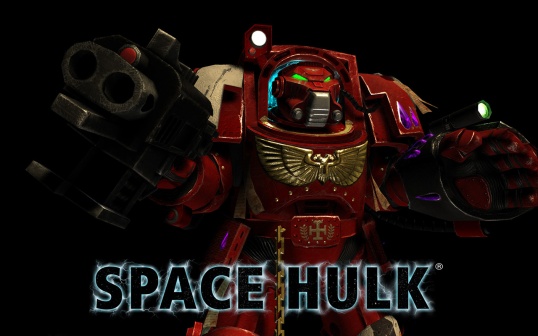
A long time ago, Games Workshop released a board game for their popular “Warhammer 40,000” game franchise. It featured a web of interlocking pieces that could be fashioned together to create the claustrophobic interior of a derelict spacecraft, adrift an unknowable period of time in the great beyond. Obstacles such as doors (both functional and not) populated the game board, and then one player took control of an incursion team of elite Space Marine Terminators as they attempt to secure the derelict. In the lore of the universe, this is done because such derelicts, or “Space Hulks”, have the awesome potential to harbor lost technologies from the distant past. Also, such ships could be full of random marauding Orks, or much worse… the Tyranid Genestealers controlled by Space Hulk’s second player.

You don’t need to know what all of that stuff is to understand that the game was fun. The Space Marine player deploys their squad of Terminators and attempts to achieve their objective, while the Genestealers spawn into the map after play begins as ‘radar blips’. Until visual contact is made, the Terminators can’t know how many Genestealers each blip represents… and even a single one of them is a mortally dangerous adversary at close quarters. Of course, the Terminators prefer to do most of their fighting at range, and have stormbolters (think assault rifles), assault cannons (think miniguns) and heavy flamers (think heavy flamers!) they can deploy to wipe out the Genestealers before they can close to close-combat range. Combat within the game is capriciously lethal, and the whole experience was half an hour or so of good, clean fun.

Fast forward to 2013. Space Hulk (even its re-issue!) has been out of print for a long time. It is now very expensive to acquire, and must be procured second-hand (‘new’ copies exist, but you’ll more than likely have to resort to various hobbying or miniatures sites on the Internet to find them). Enter Full Control Studios, a UK-based developer with several other turn-based strategy credits to their name, who on 15 August of this year dropped “Space Hulk”, a fully realized 3-D recreation of the board game experience that some of us will remember. You know, from a long time ago. Their stated goal was to faithfully recreate the board game experience. The tension of that game primarily came from the uncertainty facing both the Genestealer and Terminator players. The Terminators knew their objective and had prior knowledge of the spawn points for the Genestealers, but had no way of knowing which spawn location they might choose to use, and as I mentioned before… the Genestealers always ride single file, to hide their numbers. The Genestealers need these advantages to make up for their deficiencies in long-range firepower, which the Space Marines have brought in spades.

At the time of the game’s launch, it was met with very mixed reviews. I’ll get to some of the game’s high points in a moment, but it was rightly criticized at launch for an obscene number of bugs. I’m happy to report (in fact, it’s the reason that I’m doing this review now) that with the advent of the 1.3 version patch and the release of the new DLCs, that the game has been running smooth and bug free for me ever since I revisited it. I have not even noticed any jarring graphical anomalies, though they seem like an inevitability in modern game experiences. With the game now smoothly playable, I feel like I can much more authentically recommend it to the interested player. If you are interested… read on, I guess!

Couched in these terms, the video game experience is a very pleasing one. The 3-D graphics are pretty (maybe nothing awe-inspiring, but this is 2013, you’d have to work very hard to impress me with game graphics), and more importantly, the environments have been well constructed to recreate the claustrophobia of the original game. Because, my friends, the corridors aboard the space hulk are only one square wide. You can’t just have your marines spread out in a fire line and advance under a withering hail of machine gun bullets. Instead, the winning tactic tends to be advancing slowly using the ‘Overwatch’ command to fire at moving Genestealers off-turn, or to deploy the heavy flamer or the powerful psionics of the Terminator Librarians to deny certain passageways to the Genestealers completely. Otherwise, what tends to happen, is that a whole bunch of Genestealers charge your position, and your guys die one after another. Oh, and that’s one thing to keep in mind if you do try out Space Hulk: Some of your guys will die. Trying to prevent all friendly casualties? That way lies madness.

If some of this stuff sounds at least a little reminiscent of another recent release (specifically, 2012’s XCOM: Enemy Unknown) that’s because the interfaces share some similarities. Veterans of the new XCOM game will probably find that they have an upper hand in some respects, as you’ll understand what kind of tactics work against enemies that you don’t always know the position of, and who are hilariously deadly if approached in a cavalier fashion. Each of your Terminators, by default, has four ‘Action Points’ available in a turn. One AP allows your space marine to take a step, change his facing 90 degrees, or discharge his firearm (the Heavy Flamer requires 2 action points). You can also use 2 AP to enter Overwatch or Guard (Guard gives you a marginally better chance of success in melee, can be effective on units who already have a leg-up in melee combat)… AP is also used for things like opening doors, acquiring mission critical objects, and so on.

The Genestealer player’s traditional disadvantage, on the other hand, is that she does not know how many command points the Terminator squad has on a given turn, which (in the original version) allowed them to do certain things ‘out of turn’. In the 2013 video game release, command points are rolled at the start of turn (1-6, and you can re-roll them if your squad’s ‘Sergeant’ is still alive), and can be used (at a 1:1 exchange rate) to supplement a Terminator’s normal limit of 4 AP in a turn. In addition, when autofiring while on Overwatch, any roll of ‘doubles’ (1s, 2s, 3s, 4s, whatever) will jam the overwatching weapon…but your Terminator can automatically unjam at the cost of a leftover Command Point.

The game is entirely tactical, without any sort of overarching strategic framework. You enter each scenario (or multiplayer match) with the Terminator’s forces and objectives pre-determined. Only the tactical combat on the map is in play. For that, I find it to be both engaging and fun… in small doses. The game play deepens when you add in all of the game’s potential features, like the Genestealers being able to loose Broodlords into the hulk, and the full Terminator arsenal, including heavy melee weapons, assault cannons, heavy flamers, and psionic Librarians, rather than just the vanilla stormbolter guys…but still doesn’t really match the tactical depth of a game like XCOM, which has many varied enemy types, special unit skills, and a wider arsenal of weapons. An average scenario can clock in at 40 minutes or so, which is not at all disagreeable for me, and, unlike XCOM, Space Hulk is quite amenable to the idea of saving, taking a break, and coming back to your game later.

Oh, one more thing: Space Hulk normally retails at $29.99 from Steam, but is featured in the 2013 year-end sale at 50% off!

A Glorious Fantasy, Part Three: Final Fantasy III


Once again I return to this ongoing series, in which I attempt to play through every game in the Final Fantasy franchise that I can get my hands on, from FF1 through FF13-2, and a variety of the spinoffs and other titles not included in the ‘main series’.

For those who are unfamiliar with my premise (read: probably everyone), here’s an almost comically thorough recap:

Most people have already played many/most/all of the games that I’m going to write about in this series (weirdly, as I compiled the list of games, I personally have not played a fair number of them). I don’t care. I’m going to look at all (most? I’m bad with structure, we’ll see how long this lasts) of the following things from these games:

– Some objective data. What version of the game did I play, and why did I select that one. Since it is now obvious to me that I’m going to play a fair number of ‘remakes’ in the early Final Fantasy games, I’m also going to research the differences and try to note some of them here. This was a big part of my experience with FF1, which I am now intending to revisit as a part of this series later.
– Is the game any good? Seriously! I’m sure some of these games suck!
– Is the answer to that question, “It just doesn’t hold up”? Why? <– This question is not going to last into the more modern games, but I suspect it could affect games even as recent as FF7, the graphics of which I'm afraid will hurt my brain.
– How would I place this game in a historical context? I want to watch the series evolve, devolve, side-volve and revolve as I go.
– Did I enjoy this game? What were the emotions and insane facial expressions I went through while playing it?
– How many times I frantically Googled maps for enormous maze-like dungeons because I no longer have the patience to solve them on my own?
– Was it… challenging? Were these games ever hard? Does the challenge ebb and flow?
– No MMORPGs. Sorry FF14 fans, I don’t ‘do’ MMORPGs anymore. Plus, the plan here hopefully doesn't involve spending a bunch of money acquiring and (especially) subscribing to games.

I think all of this is extremely important knowledge, and that the human race will be improved by my research.

FF3

Version played: ‘Unofficial’ NES fan-translation by Alex W. Jackson and Neill Corlett.

This time, I played Final Fantasy III – not to be confused with Final Fantasy VI, which was originally brought to North America and Europe as “Final Fantasy III” on the Super Nintendo (as was done with Final Fantasy IV, brought over as Final Fantasy II). No, this was the original Final Fantasy III, another game in the series that I had never played before (this is becoming a thing with me! And here I always called myself a ‘fan’!). After my experience with a questionable remake of Final Fantasy I, and the relative ordeal of playing a long JRPG on my phone, with Final Fantasy II… I decided that with this installment I would try to get the ‘true’ experience.

Much like Final Fantasy II, it’s not particularly surprising that I, and presumably many others, have never played this particular installment in the series. It was never translated in its original form, leading (ultimately) to the confusing disparity in the main series’ numbering, which in English releases goes FF1, “FF2” (actually 4), “FF3” (actually 6)… then Final Fantasy 7. I think everyone is familiar with this by now, but it’s worth pointing out. The very first ‘official’ translated release of FF3 in North America was in late 2006 (it was originally going to be released on the WonderSwan Colour… a system presumably no one ever actually owned). The 2006 release was over 15 (!!) years after the game was originally released. This version was on the Nintendo DS, and was a full remake, using 3-D graphics. My research indicates that they also re-balanced classes, changed the relative power of individual enemies, and created backstories for the heroes of the piece. Well, screw that noise, am I right?

No, I played the original NES experience.

The Onion Kid is an iconic Final Fantasy image... from a game many people have never played!

The Onion Kid is an iconic Final Fantasy image… from a game many people have never played!

Like Final Fantasy 2, Final Fantasy 3 uses the basic connective tissue of a storyline to take us from place to place. As is the case in the first five main series games, the plot revolves around elemental crystals, which have a dramatic impact on the world. In this case, the crystals were used by an ancient civilization, which was both advanced and powerful. Unfortunately, they inadvertently created a ‘flood of light’ which washed over the land. In order to prevent this from destroying the world, four Warriors of Darkness arose, countering the effects, and bringing the world back into balance. Prophecy speaks of a time in the future when the world will be threatened instead by a wave of darkness, and that Warriors of Light will go ahead and take care of that nonsense.

However, unlike Final Fantasy II, which does not really advance the premise of the game beyond its initial shell (Palamecia has declared war on everyone, watch out!), but simply takes us through a series of events related to it, the basic premise of Final Fantasy 3 evolves as we go along. While the player characters are still just proxies or avatars of the player (for the last time, at least in the main series) and lack distinct personalities or backgrounds, other characters in the world are fleshed out well beyond the basics. This game is also the first one of the series where the motivations of the villain are explored in any detail (it’s not much detail, but it’s definitely there). Later Final Fantasy villains are often explored in a great deal of detail (not all of them, but many!), so this was definitely something that struck me.

Final Fantasy 3 is much more significant, however, because it introduces the famous ‘Job’ system. While Final Fantasy 1 contains many of the same classes, they are picked at the start, evolved once in the story, and otherwise cannot be changed. Final Fantasy 3 introduces the concept that characters can change jobs at almost any time outside of combat. Each character gains levels within the specific jobs in addition to advancing in character level. The ‘job levels’ don’t do as much in this game as they will in later ones (notably Final Fantasy V, and Final Fantasy Tactics, among others), seeming to determine mostly damage dealt or healing performed. More jobs are unlocked as the player progresses through the game, culminating in the ‘ultimate’ jobs, Ninja and Sage, which are capable of using all weapons and armor and casting all spells, respectively. Also introduced in this game is the Summoner job! Yes! It’s the dawn of Chocobo, Ifrit, Shiva, Ramuh, Titan, Odin, Leviathan, Bahamut, the mighty summons which can have a dramatic effect on the battle. Bahamut, in fact, seems clearly to be the strongest magical attack in the game!

I really enjoyed this one, guys! I will admit that the game can be quite difficult. I found a number of bosses throughout the game that I was forced to grind before I could realistically challenge. This was particularly true of the final boss, who could be the most (unfortunately, mindlessly) challenging final boss in the whole of the franchise. I think that honour is generally considered to reside with Zeromus, but I honestly found the battle with Cloud of Darkness to be much more frustrating. Other bosses, I felt like I defeated with little more than dumb luck.

Also, unfortunately, jobs just not that well balanced… later jobs are strictly better. To an extent, this is understandable: as your party’s level increases, it’s fitting to gain more powerful abilities, but it’s to the point where there’s little reason to overthink your party composition. Aside from a couple of very specific challenges which can be made easier with specific classes, I found it was generally best to adhere to three powerful physical attackers, and one healer, until the very end, when it made sense to have two Sages since they can both Summon and heal. At times, my party actually consisted of four physical attackers with one off-healer and Hi-Potions serving as my only means of recovery… and I honestly felt like I was better off that way. Magical attacks in particular seem pointless after the first third of the game or so (this logic does not apply to Summons, which become one of the most effective forms of attack later in the game, especially against groups of regular enemies).

I spent a fair amount of time on Google for this game, but I would say definitely less so compared to Final Fantasy II or (especially) Final Fantasy I. I guess I just don’t like big maze-dungeons anymore, if I ever did… I like to know where I’m going, avoid some random encounters, and keep progressing steadily. I already spent enough time grinding in this game, so I’ll make no apologies.

Oh, and as for the game holding up? Obviously, the graphics are totally primitive when you decide to play the original NES version! However, the parts of this game that really feel a little ‘primitive’ (not the right word, I need a better one, one thing I really liked about this game was being able to see the origin point for stuff like the job system, the focus on the villains and their sad/tortured motivations, etc., that are hallmarks of many later games) were more mechanical. The job system here just isn’t as good or as fun as it is in later games where it becomes much more customizeable, and Xande and the Cloud of Darkness are certainly not going to rank among the ‘great’ video game villains of all time. The game was good, clean, fun though… I’d probably recommend it to any true fan of the JRPG form.

And that’s it for FF3. Comment away. Join me next time, when this ongoing series will take on a true juggernaut of the Final Fantasy franchise… Final Fantasy IV!

Glorious Fantasy, Part Two: Final Fantasy II


And now for Part 2 of my recurring series in which I ambitiously try to play through every single game in the Final Fantasy franchise, from FF1 through FF13-2, with as many of the ‘side’ titles, spinoffs, and other games along the way as I can manage.

For those who are still unfamiliar with my premise (read: probably everyone), here’s a recap:

Most people have already played many/most/all of the games that I’m going to write about in this series (weirdly, as I compiled the list of games, I personally have not played a fair number of them). I don’t care. I’m going to look at all (most? I’m bad with structure, we’ll see how long this lasts) of the following things from these games:

– Some objective data. What version of the game did I play, and why did I select that one. Since it is now obvious to me that I’m going to play a fair number of ‘remakes’ in the early Final Fantasy games, I’m also going to research the differences and try to note some of them here. This was a big part of my experience with FF1, which I am now intending to revisit as a part of this series later.
– Is the game any good? Seriously! I’m sure some of these games suck!
– Is the answer to that question, “It just doesn’t hold up”? Why? <– This question is not going to last into the more modern games, but I suspect it could affect games even as recent as FF7, the graphics of which I'm afraid will hurt my brain.
– How would I place this game in a historical context? I want to watch the series evolve and devolve and side-volve as I go.
– Did I enjoy this game? What were the emotions and insane facial expressions I went through while playing it?
– How many times I frantically Googled maps for enormous maze-like dungeons because I no longer have the patience to solve them on my own?
– Was it… challenging? Were these games ever hard? Does the challenge ebb and flow?
– No MMORPGs. Sorry FF14 fans, I don’t ‘do’ MMORPGs anymore. Plus, the plan here hopefully doesn’t involve spending a bunch of money acquiring and (especially) subscribing to games.

I think all of this is extremely important knowledge, and that the human race will be improved by my research.

FF2logo

Now that that’s out of the way, let’s talk about the second game in the Final Fantasy series…another that I had never played before… Final Fantasy II.

It’s not surprising that I hadn’t played this game before, and it’s probably true for a lot of people, even now. FF2 was never translated into English on the NES system, and, indeed, was not widely available in other languages until the “Dawn of Souls” release (with FF1!) in late 2004 (exact date varying based on your nationality). The reasons for this are murky. I have heard that Square didn’t think FF2 and FF3 would sell well in the United States and other markets outside of Japan, as well as a handful of other explanations. Suffice to say, it hardly matters now, over 20 years later.

What version did I play? Why, oddly enough, I played the iOS version. I had purchased it as a game to play during downtime at work, so I already possessed the version. I had not gotten as far as I’d expected to during said downtime, but I hit the afterburner after I decided to take this series a little bit more seriously. The main differences from the original, according to my research, are the the graphics are much prettier (muuuuuuch prettier, and high res!), you can dash, and the game does away with the ‘ineffective hit’ if your target dies after you’ve input a command but before it is executed. I have also heard that in the original game, your HP only upgraded if your character took significant damage, whereas the version I played seemed to award an HP up to all characters every ten battles or so. I do not think I could have completed the game relying on just that HP-up.

FF2 is the first game in the series (well, it is only the second game…) to feature that story-connective-tissue I discussed in the original. In this case, the basic premise is that four youths were attacked by soldiers of the Palamecian Empire near the town of Fynn. Three of them later wake up in the city of Altair, having been saved by Rebel sympathizers. The three friends join the Rebellion and, frankly, do most of the heavy lifting themselves. Although the narrative certainly isn’t as comprehensive as some of the later titles (indeed, Final Fantasy IV is the first game that begins to look like a ‘modern’ JRPG title), it does do a little more to guide you from place to place. I will admit that I still used a world map to help me figure out what was where, but I found my overall need for outside assistance in making it through this game in a reasonable amount of time was much less than Final Fantasy.

Okay, now, let’s talk about the elephant in the room. The thing everyone either seems to tolerate or completely loathe about FF2… and that’s the leveling system. Unlike every other game in the series (at least, that I’ve played), you do not gain experience levels in FF2. At all. Instead, your stats raise when you use them, or need them. For example, attacking repeatedly with your weapons begins to raise your strength. Having a shield equipped and being attacked begins to raise your evasion. Using magical spells raises your intelligence (Black) or spirit (White). Suffering damage raises your max HP, but also your Stamina (which determines how much HP you gain when your HP goes up). Spending 30 minutes casing spells in one battle slowly may eke out some extra MP for you if you have the patience. Now, obviously, this makes some of your stats comparatively hard to raise (max MP, again, anyone?), and since you need some of everything to be successful in this game, I can see how it would cripple some parties, and make it unfun to play. I’m totally with you.

But I kind of secretly really enjoyed it.

If only because it gave me the freedom to turn the girl of the party, Maria (who as you might expect starts out fast and with good magic, and terrible physical stats) into a frenzied dual-sword-wielding dervish, while the typical FF hero, Firion, became a Red Wizard, standing in the back row and slinging spells. Of course, I could have mixed and matched those attributes any way I wanted, and, indeed, Maria also had some of the most formidable spells (such as Flare) at her command, and youth #3, the hulking Guy, was an excellent back-up White Mage. Balance can be hard to achieve in FF2, however, because once you’ve passed a certain point with Strength or Spirit or Intelligence, the magic stats begin to lower your strength, and vice versa. As a result, if you want to have a balanced character, you have to always be using a mix of abilities and never go into auto-battle mode or spend every turn curing wounds.

Fortunately, mixing abilities also has its benefits, as your spells and weapons gain ‘levels’ as well, as they are used, becoming more powerful (and in the case of spells, more expensive).

The plot of the game is still pretty rudimentary, but it does introduce a couple of key staples of later games: FF2 is the first title to feature chocobos, Cid as an airship commander, and the order of Dragoons. It was also the first game to use the MP system that would be a series staple for about fifteen years or so, though it would not reappear in the next title.

I should also note that FF2 can be quite difficult. I often felt the enemies were challenging during the early-mid part of the game, but I also think I hit kind of a critical mass with leveling up stats and eventually became overpowered. Because of the mechanics of the game, that condition never really changed; no matter how high my warrior woman’s strength got, it seemed that it could always get a little bit higher. I occasionally found it beneficial to grind out a couple levels of new spells (most of them are pretty ineffective at level 1) but this was a fairly painless process. The difficulty is also tempered by the easy availability of powerful items like HiPotions and Ethers, which are not as expensive as they should be given how much they alleviate the difficulty of the later dungeons.

I suppose my overall impression of the game was pleasant…but it’s not one of the series’ stronger entries in my mind. It stands as a bit of an odd duck; not really influential on later titles, except perhaps as a failed experiment. While it advances in some ways from the original game, these are not significant advances, and even the unique character sprites won’t be carried over into the next title… which I will write about soon.

Glorious Fantasy, Part One: Final Fantasy One


In the recent past, I decided that I was going to do some ‘series’ and write about my experiences. The first of these I devised was to finally make the commitment to read the ‘Wheel of Time’ series, which is unfortunately on hiatus after I couldn’t take it anymore. Later, I decided that one thing that I would almost certainly definitely have fun part of the time with… was playing every single title under the Final Fantasy brand that I could get my hands on. Like most gamers who enjoy RPGs, I was a consumer of the NA translations of these fine games when I was growing up. Unlike many people in my generation, I still enjoy even the most recent offerings in the series. So, something to write about, and a source of enjoyment for me? Sounds very win-win.

Most people have already played many/most/all of the games that I’m going to write about in this series (weirdly, as I compiled the list of games, I personally have not played a fair number of them). I don’t care. I’m going to look at all (most? I’m bad with structure, we’ll see how long this lasts) of the following things from these games:

– Some objective data. What version of the game did I play, and why did I select that one.
– Is the game any good?
– Is the answer to the first question, “It doesn’t hold up”? Why?
– How would I place this game in a historical context? I want to watch the series evolve and devolve and side-volve as I go.
– Did I enjoy this game? What were the emotions and insane facial expressions I went through while playing it?
– How many times I frantically Googled maps for enormous maze-like dungeons because I no longer have the patience to solve them on my own?
– Was it… challenging? Were these games ever hard? Does the challenge ebb and flow?
– No MMORPGs. Sorry FF14 fans, I don’t ‘do’ MMORPGs anymore. Plus, the plan here hopefully doesn’t involve spending a bunch of money acquiring games.

I think all of this is extremely important knowledge, and that the human race will be improved by my research.

That preamble having been dealt with, let us begin our odyssey at the very beginning. And with one of the core series games that I had never played before.

FF1

Version: Gameboy Advance, “Final Fantasy I & II, Dawn of Souls”

So, I already know, guys. I got jobbed. I knew it as soon as I fired up the GBA version of FF1 and found out that I had MP instead of spells per day. I made a terrible mistake! Unfortunately, while I do know a guy with an NES console in excellent working order, he does not have a working FF1 cartridge. Oh, and he probably doesn’t want me spending a week in his basement emitting 8-bit bloops and bleeps at him. I could have resorted to emulation (indeed, I may have to, for some of the more obscure titles on my list) but being totally ignorant of the gameplay changes going in, I already made a fatal mis-step.

Here’s the deal, for those who don’t know: In the original Final Fantasy release on the NES, your party was always poor and under-equipped, if you killed a monster and someone else was also targeting that monster, their turn was wasted with an ineffective hit, and your wizards gained spells per day, the system inspired by noted fantasy author Jack Vance, and also the inspiration for the system of magic used up through the 3.5 edition of “Dungeons & Dragons”. In “Dawn of Souls”, ineffective hits are gone, your casters now have the traditional Final Fantasy MP pool (and unbelievably cheap Ethers to boot), and the monster encounters are both more frequent and more lucrative. In short, the game is much easier on the GBA than in its original form.

And it is pretty easy, on the GBA. Even the content in the bonus dungeons included with the game did not pose much of a challenge for me in the game’s later stages, and while the final boss, Chaos, had a formidable quantity of HP…it really just delayed the inevitable. My party never seemed to run out of resources, and once I had reached a certain point, I achieved critical mass. I had too much gold, too many powerful items, and my entire party could cast useful spells to set up for boss encounters. Most of the regular mook encounters were just auto-battles by the end, which, really, can be seen one of two ways. I normally prefer the regular enemies to at least present the illusion of a challenge. It’s nice to have some enemy types who demand the use of a powerful spell to avoid some dangerous attack, and so forth. However, given the extremely high encounter rate present in Dawn of Souls, I didn’t mind the auto-battling too much.

The one aspect of the original game’s gameplay that very much remains intact in the Dawn of Souls remake is the fact that nobody tells you where to go next or what you have to do, aside from the basic instruction of ‘save the four crystals’. When I first conceived of this series, I had planned to have a ‘no frantically Googling answers’ policy. It has already eroded, as I’m honestly stunned that anyone had the patience to figure out how to beat this game when it first came out. I suppose that isn’t true: I remember spending a ton of time on equally murky NES and SNES games when I was a kid. We eventually managed to puzzle out countless secrets in ‘The Legend of Zelda’. Alas, it seems that my patience (or focus…?) just isn’t what it used to be. Several times, I sought basic instructions on what to do next, and I don’t even feel all that bad about it. It’s such an incredibly stark difference when compared to games even slightly later in the series, where the connective tissue of a story draws you from point to point, perhaps with a little wandering. Even a game like the classic “Chrono Trigger”, where several times the only way to proceed is to go to a time period and see if things have changed, you have a relatively small set of places to wander through before you’ll find your answer. Not so in FF1: once you’ve acquired even the simplest vehicle, a canoe, there’s a huge amount of space to explore, and if you pick the wrong direction, you’ll be in mortal danger.

I’m honestly not sure, on the other side, whether I really enjoyed the game or not. Certainly, it was diverting; it managed to hold my attention for twenty hours or so, despite possessing no story to speak of, and only a couple of characters worth mentioning (your entire party in FF1, for those coming very late to the party, consists of silent protagonists). It seems that I can’t really judge whether the game has held up properly because of the way in which it was remade for the GBA, which is a bummer. My first article, already smashing my expectations into dust! As a result, I’ve re-added FF1 to the master list, and next time, I’ll find some manner of replicating the experience of the original game. Humankind will be improved by my research.

BlizzCon 2013: World of Warcraft: Warlords of Draenor


After a one year hiatus, BlizzCon is back. As I watched the opening ceremonies and subsequent World of Warcraft panel yesterday, I couldn’t help but draw parallels to another RPG powerhouse all but forgotten in the western world today: Squaresoft. The series of marketing failures that sent Square spiraling towards bankruptcy in the early 2000s felt eerily close at hand as Blizzard Entertainment unrolled one new project announcement after another yesterday in Anaheim.

Square’s troubles from a western perspective began in 1999. They had, prior to that year, released a handful of non-RPG titles in North America–I remember purchasing shmup Einhänder and enjoying Kenichiro Fukui’s soundtrack if nothing else–but these were Easter eggs not marketed to Square’s traditional fan base. In 1999, Square ported and pushed Ehrgeiz. It was a fighting game marketed specifically for RPG fans, incorporating popular Square franchise characters such as Sephiroth and Cloud Strife, and it was the first Square release in North America that I knew about and did not buy. I thought the game was a really cool idea at the time, but that didn’t change my fundamental disinterest in fighting games.

Next came Final Fantasy VIII. The game was definitely a short term marketing success, but it divided Square’s fan base unlike ever before, because it focused on aspects of the game that fans were traditionally disinterested in. It was the first Final Fantasy title to feature really impressive graphics, it introduced a highly developed card-based mini-game, it reenvisioned a lot of elements of the battle system, and it replaced a traditionally heroic cast with none-too-glamorous introverts. These features drew an audience, but they dulled the interest of loyal series fans who loved the epic tragedies and encompassing global struggle-styled plots of games gone by.

Last came The Spirits Within. Square decided to release a movie geared towards their newer fan base. They had no experience in this field, their diehard fans had already lost interest, and their new fans had no loyalty to the company. It flopped, really badly, and whatever the financial statements of Square Enix say, they never fully recovered their foothold in the western market. They found themselves desperately grasping to reel in a fan base that was too broad to take interest in any single product, until they ultimately faded into obscurity in every market. This can be seen in the fact that most Final Fantasy IX fans disliked Final Fantasy X and vice versa.

I say all of this because it is painfully relevant today. Here are two obvious reasons:

BLIZZARD ANNOUNCED A FIGHTING GAME

This isn’t nearly as misguided as Ehrgeiz. As I understand it, Heroes of the Storm will be styled after DotA, not traditional fighters. (The BlizzCon feed for HotS is hopelessly lagging on me, so I can’t confirm much.) But the idea of duking it out with your favorite characters from Blizzard’s three major franchises is only going to succeed if the gameplay drastically outclasses other games of its genre. They aren’t going to draw fans by letting you play as Kerrigan or Thrall, because most Blizzard loyalists are not convinced by the company’s character development. I would also argue that, following the massive hype and disappointment of Diablo III, Blizzard fans aren’t going to be very compelled by a new title beyond their franchises of choice that is not a wholesale break from what we’re used to. Heroes of the Storm will be free, and that is a huge plus, but it is going to have to be really freakin good to make it off the ground. As was the case with Square’s Ehrgeiz, the franchise card isn’t going to hold much weight in this field of play.

BLIZZARD ANNOUNCED A MOVIE

Yes, Warcraft: The Movie is under production. More will be revealed about this project at 1pm PST Saturday on the Main Stage, but absolutely nothing good can possibly come of it. Like The Spirits Within for Final Fantasy, it will only interest a small portion of the Warcraft fan base and hardly anyone beyond. Blizzard has never been a promising plot engine, and their cinematics are hopelessly cliche. It’s not like there’s any precedent for failure along the console to cinema highway, but I give Blizzard’s shot at turning a profit here about one in zero.

WARLORDS OF DRAENOR OVERVIEW

Now, I’ve claimed that Blizzard does not keep fans based on plot and character development. Am I right? Well, I’ve certainly known WoW players who cared about the plot, but they form a minority in my experience. That’s not to say that I or any other WoW fan would not love to see a really awesome plot. It’s to say we won’t get one. This is something Blizzard is particularly bad at, and it’s not the reason we play their games. That is one of the reasons World of Warcraft: Warlords of Draenor concerns me. The hour and a half of feature coverage yesterday focused heavily on the game’s plot and characters. Blizzard staff went on at length about the progression forward from Mists of Pandaria and the various NPCs you will encounter. In a comically self-defeating slide, they summed it up like this:

That’s all the more a Blizzard plot has ever really amounted to, and it’s why no one cares. Looking beyond the attempted plot hype, what else does Warlords of Draenor have to offer?

SETTING

WoW 6.0 will take place in Outlands, utilizing another weak time-travel plot device to set the zone prior to its cataclysmic restructuring as experienced in The Burning Crusade. Shattrath will now be an independent Draenei city, and the alliance and horde will have their capitals in Shadowmoon Valley and western Blade’s Edge Mountains respectively. These will be known as Karabor for alliance and Bladspire Citadel for horde, and the Blade’s Edge Mountains themselves will not yet exist as such. Their memorable spikey peaks having formed during Draenor’s later destruction, they will be separated into a western, mountainous winter zone (Frostfire Ridge) and an eastern desert (Gorgrond). Shadowmoon Valley will here be a lush land of forests and meadows, not a desolate fel-ridden waste, and Karabor will be the site of what later becomes Black Temple. There will be seven zones in all: Nagrand, Shadowmoon Valley, Tanaan Jungle (Hellfire Penninsula), Talador (Terokkar Forest), Frostfire Ridge (western Blade’s Edge), Gorgrond (eastern Blade’s Edge), and a new zone–Spires of Arak. None of these seem, in my opinion, to offer much of a unique flavor. That is somewhat inevitable, since Outlands is not an unfamiliar world.

The world will loosely resemble Outlands, and like most WoW continents, it will form an image when viewed as a whole:

GARRISONS

Garrisons were described at BlizzCon as “the [Valley of the Four Winds] farm times one thousand“. A garrison is a full town which you can build inside any zone within Draenor, and which you can move from one location to the next. Like the farm, a garrison will involve setting actions into motion which will occur over night (anywhere from a few hours to a full week), but the payout will be much higher. You’ll gain NPC followers who quest and raid for you to bring home epic gear, you’ll be able to tap into other professions beyond your main ones, you can pick and choose what buildings are constructed (armory, stables, etc), and you’ll be able to customize the garrison’s appearance any way you like as it grows. You can even hang a boss’s head from your front gates!

Sounds pretty cool, right? I think it’s riddled with problems. First of all, Blizzard reps claim: “This isn’t a cottage in a far away instance corner that doesn’t actually exist in the world. This is your ability to actually build a base almost as you do in the RTS games, in the actual world, that you’ll be able to see as you fly through the zones. You’ll be able to see it as you go by it. You’ll be able to invite your friends to come and see it if you want to.”

That is horribly misleading. Under the current developmental scheme, your garrison will exist for you and you alone. It’s true, like they said, that it will be smack in the middle of any map you care to put it in, and that it will be visible from afar, but it will be entirely isolated from all other players. It is a solitary bastion in an MMO world. No one will be able to see it (unless you invite them, presumably to role play); no one will be able to attack it; no one will ever know it exists. As such, it’s not much different from the average farming game on your cellphone. The only real reward is the production payout, whatever that may be. Let’s look at a few:
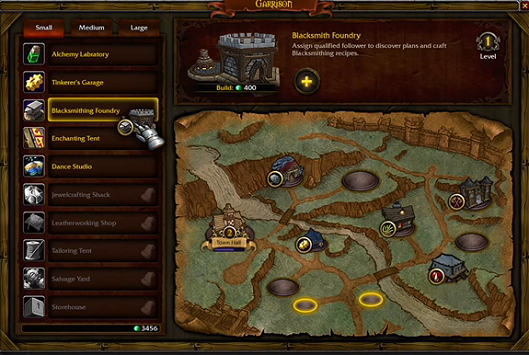
You can choose which buildings to include.

Ok, but what are buildings good for? An inn and stables aside, all buildings in WoW are used almost exclusively for profession and class trainers. But at level 100 you won’t need a class trainer, and Mists of Pandaria drastically nerfed the amount of time and energy necessary to max out a profession, so much so that grinds which once took a month or upwards of 100k gold can now be accomplished in an evening for petty change. (I think that was an awesome improvement in MoP. Don’t get me wrong.) Unless Blizzard invent new uses for these buildings, they will have none. Or if they add such features as transmog, upgrading, and reforging, then Karabor and Bladespire Citadel will be ghost towns. The screen shot Blizzard offered showed the blacksmith being used to learn new patterns. If that’s anything like the daily leatherworking and tailoring pattern rewards in MoP, it will be pretty useless.

It allows access to mats/It farms for you while you’re offline.

What does it farm? Blizzard have still yet to introduce any sort of access to solid gear outside of raiding or valor/conquest points. If this gear isn’t up to par, it will be a waste of time. Does it farm mats? If it’s anything like the Valley of the Four Winds farm in MoP, this will be a completely useless feature unless the mats are BoP. There is a reason you only farm Motes of Harmony in MoP: non-binding general profession mats always have and always will be the domain of bot farmers. You might not like them, but your auction house could not exist without them. They are what make ore and herbs affordable on your server, and the farm system alternative to gathering in MoP has never paid out in time spent to profit earned.

It gives you access to professions you don’t have.

MoP’s profession grind nerf still necessitates six toons at 85 to max everything out, so this could definitely come in handy, but at what cost? The more Blizzard takes away from the auction house, the more inflation will rise.

You can win trophies, and hang your enemies heads upon pikes at the castle wall! Yarrrgh!

The first note I jotted down while watching this BlizzCon session was “wtf is the point of building a castle in an mmo that is not mmo?” That pretty well sums it up. The whole purpose of a trophy case is to brag to other people about your accomplishments.

The bottom line is this: Blizzard couldn’t have given every player in the game a Garrison that existed out there in the real, massive multiplayer world, because it would have been a spam-ridden nightmare. But they could have given one to say, every level 25 guild with at least 20 exclusive active accounts, and they could have taken this in all sorts of promising directions, ranging from pvp sieges to player-made home cities instead of another Shattrath or Dalaran. But they didn’t. Instead, we all get a bigger farm.

GRAPHICS

This is actually pretty sweet. Blizzard is making a massive graphic overhaul to all races in the game, and will now offer visuals competitive with new MMOs on the market.

BOOST TO 90

In an attempt to lure back old players, Blizzard if giving every account a free boost to level 90 for one toon at any level. This is a pretty nice deal, but it could have some unintended consequences. I for one will be employing it as that long-awaited character transfer I was always unwilling to pay money for. By-by dying low population server, hello Sargeras, Kil’jaeden, or Kel’Thuzad. Expect this feature to increase urban migration and server balance polarization.

CROSS-SERVER ITEMS

Blizzard is increasing the types of items that will be available cross-server. In addition to mounts and battle pets, you will now be able to access BoA leveling gear heirlooms on any toon, anywhere. It’s about damn time, I think. They are also making tabards and toys account wide, which is just silly.

DUNGEONS & RAIDS

Warlords of Draenor will launch with 7 dungeons and 2 raids containing a total of 16 raid bosses. Only 4 of the 7 dungeons will be available below level 100, for maximum alt leveling boredom. Upper Blackrock Spire (UBRS) is getting a remake, and the level 100-only dungeons will have non-heroic versions in order to “help players prepare for heroic mode”. … Since no one would voluntarily run non-heroic dungeons at level cap, I interpret this to mean “expect more tedious grinding before you are eligible for real gear.” The reason behind this move is incomprehensible, as no one who is unready for heroic dungeons for reasons other than gear is any less unready for regular dungeons. They are called “noobs”, or “nubs” in some dialects, they are typically too disinterested in the finer details of the game to ever figure it out, and they will be carried by my epic hunter deeps. NEED that agi ring my DK friend! It will definitely help boost you over 10k dps!

Raids are getting a fourth tier. There will now be LFR, Normal, Heroic, and Mythic. LFR through Heroic will all be available under the relatively new and quite successful flex raiding system, and Mythic will be 20-man only. While this all sounds like a fine idea to me, the Blizzard reps did show once again how out of tune they were with the game they developed when they explained flex’s utility: We’ve all been in that annoying situation where a few dps or a healer bail in LFR right before a boss pull and we have to reenter queue and wait, they said. Flex will scale the LFR boss down so we can pull anyway!

Well, no, we haven’t. In fact, that never, ever, ever happens. DPS and healers are replaced in LFR in a matter of seconds. There is a 60 minute long queue line of them ffs. Long waits before boss pulls happen because TANKS leave, and you can’t rescale for that.

PVP

Blizzard is bringing back a world pvp zone, and it’s going to be a 24/7 battle rather than a timed instance. They compared it to classic Alterac Valley, and I’m pretty stoked about that. Unfortunately but necessarily, this is going to be a cross-server zone. That means that you’ll never form a collaborative relationship with your team mates, probably, but with a ton of servers reaching 90:10 faction polarization these days, I for one see no viable alternative.

In the world of arena, Blizzard is creating a separate ladder system called Trial of Gladiators. These ladder fights will only be available at certain dates and times, and they, rather than regular arena queues, will determine season champions. This was supposedly developed to eliminate late-night pairing exploitation, which I wholly intended to get in on to knock out some of my arena achievements, but I’m all for it. One really cool thing is that they’re eliminating gear for the event. You will be given the same premade gear set when you roll in, regardless of your ilevel or resilience, so victory will depend entirely on skill and class balance.

ODDS AND ENDS

Blizzard focused on a number of additional changes that Warlords of Draenor will offer, and most of them are complete rubbish that ought to just be quietly implemented on the next routine patch update.

* Battleground progression information — Blizzard are basically integrating PVP DBM into the game proper. But I’ve got an addon for that.

* Random favorite mount summoning — This will be an option. But I’ve got an addon for that.

* Enhanced bag sorting options — You will now be able to control which bags particular types of loot fall into. But I’ve got an addon for that.

* Battleground scores — You will now be able to see a conglomerate score of your performance in a battleground, incorporating traditional stats such as hks and damage done along with your involvement in objection completions. I am not very confident about Blizzard’s capacity to rate my performance, especially considering there are multiple strategies for winning just about any bg. This is also potentially really dangerous, because they suggested that there might be rewards for high scores. Does this mean that, even if you already have the Cap Five X achievement in a bg, you’re still encouraged to spam the hell out of the flag instead of fighting around it for a shot at the prize?

* Quest items will no longer be stored in bags — Yay!

* You can craft with items in your bank, not just your bag — Yay!

* Item stack caps raised from 20 to 100 — Yay!

But I fear that the few positive changes here and there aren’t going to make a difference in the big picture. Blizzard announced WoW 6 this BlizzCon, as expected, but they had very little to show for it. Plot and characters aren’t what keep us playing this particular game, the Garrison system is a single player entity isolated within an MMO world, and almost every other new thing they emphasized was astoundingly petty. There will be modest improvements here and there–to bag space, to raiding opportunities, to free server migration–but in previous expansions these would be afterthoughts. A lot of interface changes amount to nothing more than addon incorporation, but the players who don’t use say, a battleground objective addon, are probably oblivious to battleground objectives in the first place. The most depressing announcement towards this end was the ADVENTURE GUIDE. This is a menu like the Dungeon Guide, but designed for inexperienced players who don’t have a clue what’s going on. It will tell you what zone you ought to be questing in, where you can go for better gear (a dungeon. a raid. mmhmm…), what battlegrounds are available at your level, and so on. Did it ever cross Blizzard’s mind that the people who can’t figure out the dungeon finder or pvp menus aren’t going to figure out the adventure guide either? Obviously not, because the emphasis once again seems to be “hand more fine details to the players who don’t care and won’t read them.” I’m not trying to insult anybody here. My wife’s been happily bouncing around Eastern Kingdoms leveling gnome locks to 40 for a year now. There are players who want to “win” to the capacity that WoW allows, and there are players who just enjoy a little pew pew before they go to bed and have zero interest in learning more. Last I visited Blasted Lands, there was not a sea of confused level 60s unable to figure out how to walk into the Outlands portal. So just who do Blizzard think they’re helping with these improvements?

Has Blizzard lost touch with their fan base? Mists of Pandaria does not lead me to believe so, but the showcase for Warlords of Draenor looks bleak. With little more than a dime-a-dozen farming mini-game and new zones, dungeons, and raids to offer, I don’t know what I’m supposed to be looking forward to here. I don’t need a new class or a new race to keep me entertained–I’ll be a dwarf hunter until the day I quit–but I need something. Whatever that thing will be, it wasn’t revealed at BlizzCon.

But enough being a Negative Nancy. I’m off to watch Jaedong whoop ass in the Starcraft II World Championship Series Finals. For the swarm!

Horror Scenes I Love: Alan Wake


AlanWake

SPOILER ALERT

For those who have played the Xbox 360 exclusive game Alan Wake should remember this scene I have chosen. It comes right at the end of the game where the title character has finally figured out the secret of what happened to his missing wife and how to save her from the game’s main antagonist.

This antagonist is not some psycho killer or monomaniacal villain. It’s a villain that’s more akin to an evil entity. In fact, we learn throughout the game that the villain, known as the Dark Presence, is like something out of a Lovecraft story. It’s an evil intelligence that has spanned eons and yearns to free itself from it’s watery prison.

Alan Wake realizes that the only way to save his wife was to take her place and fight the Dark Presence from within and this is where the brief scene begins. It’s a scene that starts creepy enough until the very end when the real payoff arrives.

Bayonetta Game to Get Anime Film


bayonettabloodyfate

“Let’s dance boys!” — Bayonetta

One of the most entertaining and fun games of this current generation of consoles that I’ve ever played came out in the Spring of 2010. The game I speak of is the hack-and-slash title Bayonetta from Platinum Games. It’s a game that was born from the hyper-kinetic action game series Devil May Cry. In fact, the game’s designer was also the designer for the Devil May Cry series and it shows in this heroine-led title.

As I had mentioned on a very early review of the title, Bayonetta is quite the over-the-top game with unique-looking visuals and imagery that combined Judeo-Christian art designs with the anime-inspired aesthetics that has been the design staple of the Devil May Cry series.

I was actually surprised that the game didn’t get an anime series right away to complement it the way some Japanese games tend to get when they become popular. Yet, despite waiting over three years to get one fans of the game will finally have their wish.

Bayonetta: Bloody Fate is an anime series due out this November from studio house GONZO. It looks to be an adaptation of the game’s storyline and will have Fuminori Kizaki of Afro Samurai fame in the director’s chair. The art design of the series will lean heavily on the game’s original character designs by Mari Shimazaki which should be good news to Bayonetta fans everywhere.

The trailer for the anime already hints at using the fan service moments from the game that made the title so popular but at the same time so controversial within some of the gaming community. The anime will be shown in a limited release in Japan this November with no word yet on whether it will make it over to the West in one type of release or another. I bet on it becoming a video release down the line.

Source: Anime News Network

Artist Profile: Yoshitaka Amano


YoshitakaAmano01

Yoshitaka Amano, born 1952 in Shizuka, Japan, is one of Japan’s most-renowned artists and illustrators. He also began his career as a character designer for early anime shows like Speed Racer, Gatchaman and Tekkaman. He would continue to build on his portfolio of unique character designs for anime, video game franchises and Japanese pop culture art.

Amano-san has pointed out Western artists such as comic book artist Neal Adams as an inspiration in his own style which when combined with his knowledge and appreciation of the classic Japanese hard woodblock printing known as Ukiyo-e would lead to one of the most unique character styles in mainstream pop-culture.

Yet, Amano-san will forever be known for and continues to be popular for his work in helping design the characters for the the video game rpg franchise known the world over as Final Fantasy.

YoshitakaAmano02YoshitakaAmano03YoshitakaAmano04YoshitakaAmano05YoshitakaAmano06YoshitakaAmano07YoshitakaAmano08YoshitakaAmano09YoshitakaAmano10YoshitakaAmano11YoshitakaAmano12

Trailer: Titanfall “Gamescom Gameplay”


TitanfallReveal

Titanfall is really turning out to be one of my most-anticipated game titles of 2013.

It’s the very first title for Respawn Entertainment. A studio made up of the people who first created the Call of Duty studio, Infinity Ward, and who ended up being fired (or leaving to follow their fired leaders) by the powers-that-be who held sway over Activision. There was talk about whether Respawn Entertainment would ever get a chance to show Activision and it’s detractors that they still had what it takes to succeed in the first-person shooter market dominated by three titles (Call of Duty, Battlefield and Halo).

Titanfall looks to dispel such notions first with a triumphant return to this summer’s E3 where they revealed the title to everyone to much acclaim. Now we got to see more of the gameplay itself both in mechanics and graphics at this past week’s Gamescom 2013 over at Cologne, Germany.

The gameplay trailer pretty much dispelled whatever doubts I might have had about this title and now has my money ready to be exchanged for it when it comes out for the Xbox One (for some on the PC or Xbox 360) in early 2014.

Sneak Peek – Dying Light (Dev. by WB Games / Techland)


Like Daniel Craig’s character in Layer Cake, I had this plan of getting out of videogaming. I haven’t been amazed with the way the industry is moving, and there are only a few remaining games I know I want to play before finally hanging up my controller. Splinter Cell: Blacklist is next week. Grand Theft Auto V is next month, along with NHL 14. I felt that after these 3, I could walk.

And then this happens. Dying Light, under development by WB Games and Techland is a mixture of Zombie Survival and Freerunning. Using the first person design EA started with Mirror’s Edge (how I love that game), Dying Light puts you in a world with the infected. While this sounds a lot like many of the survival games of recent memory, this game adds an angle with it’s nighttime sequences that start to feel like I Am Legend. Zombies that normally shuffle and drag their feet during the daytime become parkour ninjas at night, running just as well as you can over obstacles and the like (from what I can tell). I’m not sure how the story is going to explain that one, but the dynamics of it feel good, and personally, I’m just happy that anyone was able to apply the freerunning system of Mirror’s Edge to a different environment. Let’s hope they’ve also dealt with the long load times that plagued that game. So much for getting out.


Dying Light is due out sometime in 2014.

This video was originally posted on IGN.com.