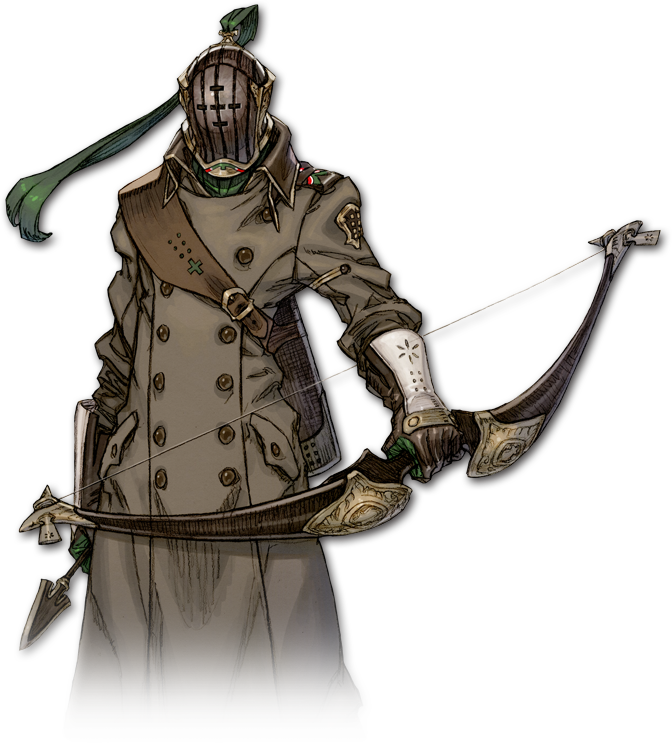
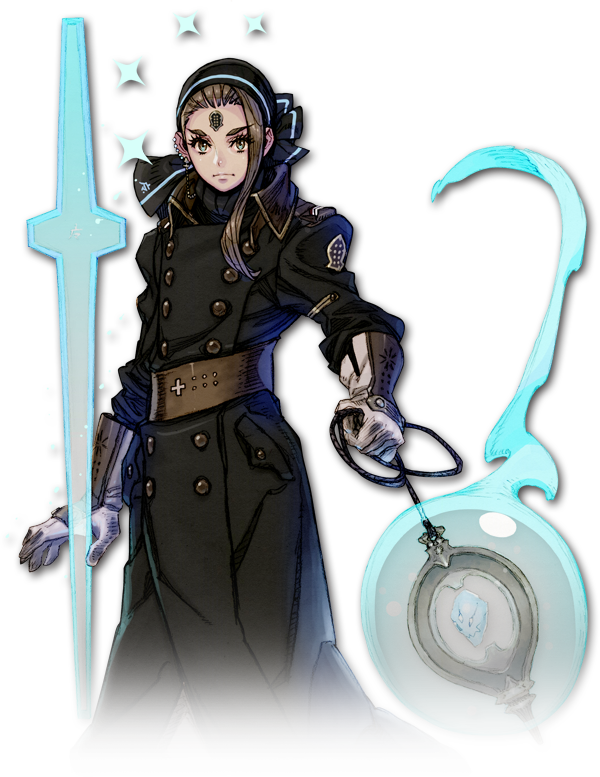
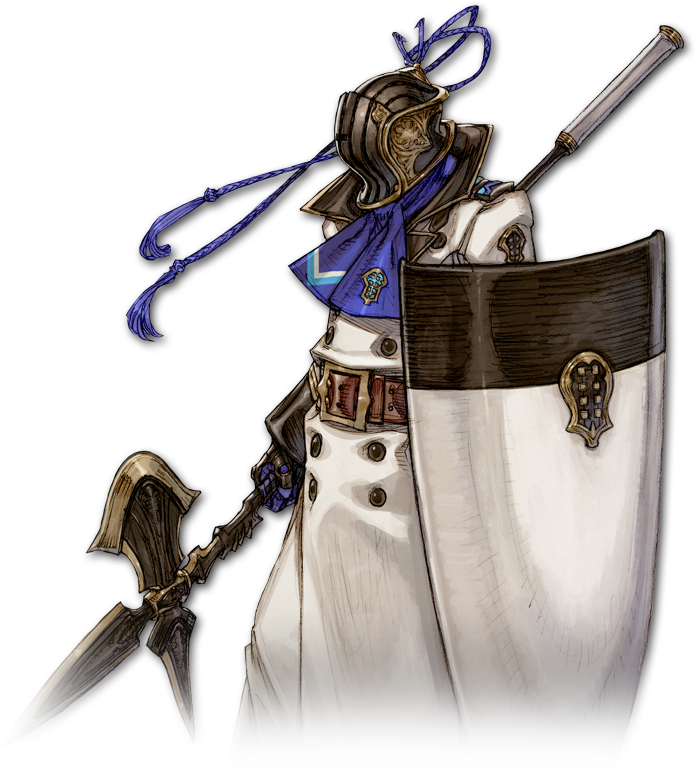
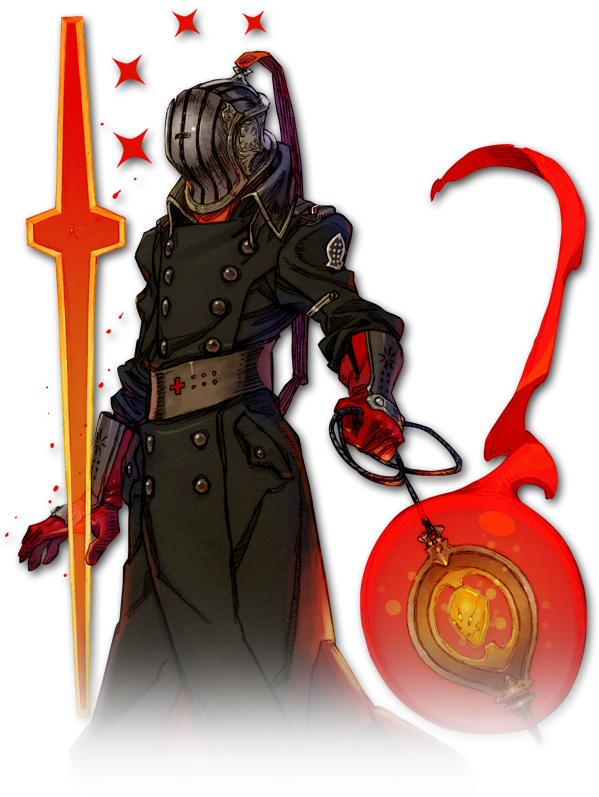
Terra Battle is an RPG mobile game available on Google Play. It has four races, human, lizardmen, beast folk, and stone folk. Standard job classes like archer, healer, mage, knight, and warrior are present. A mage can have affinity to the following elements: fire, ice, lightning, and darkness.
How is it a tactical fantasy?
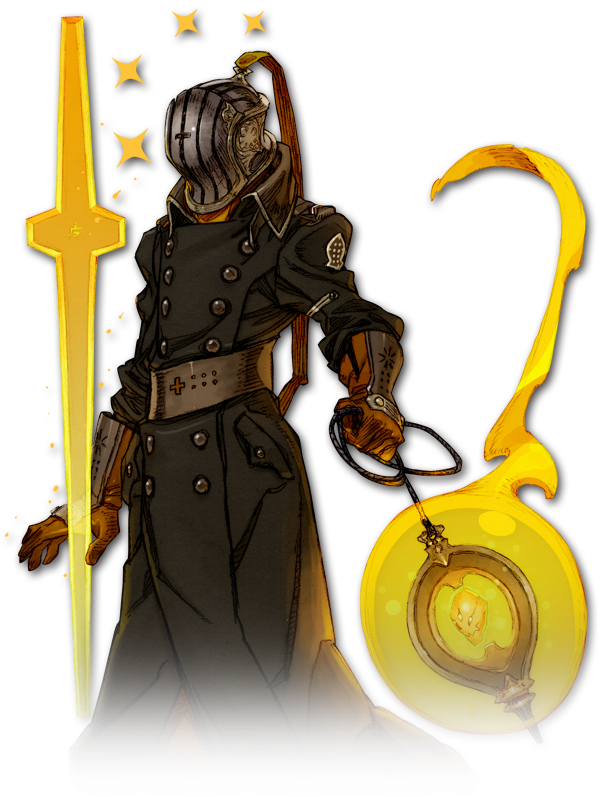
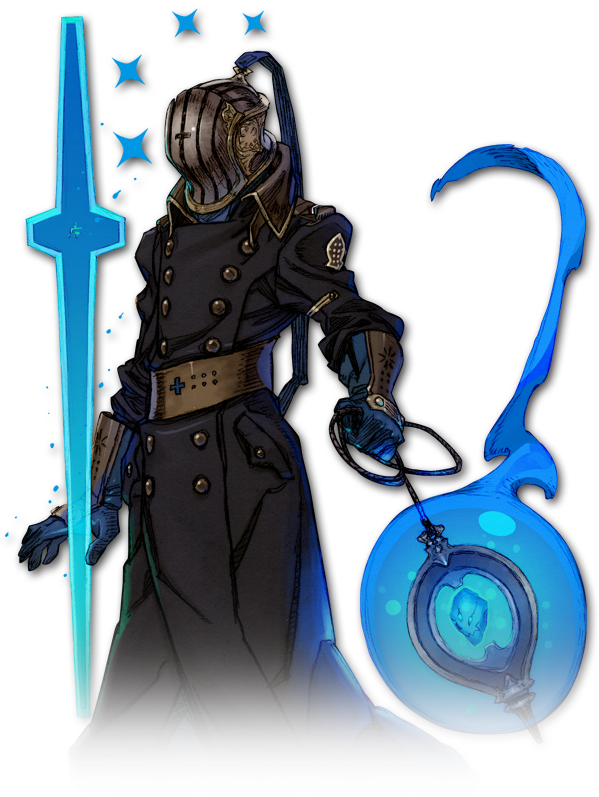
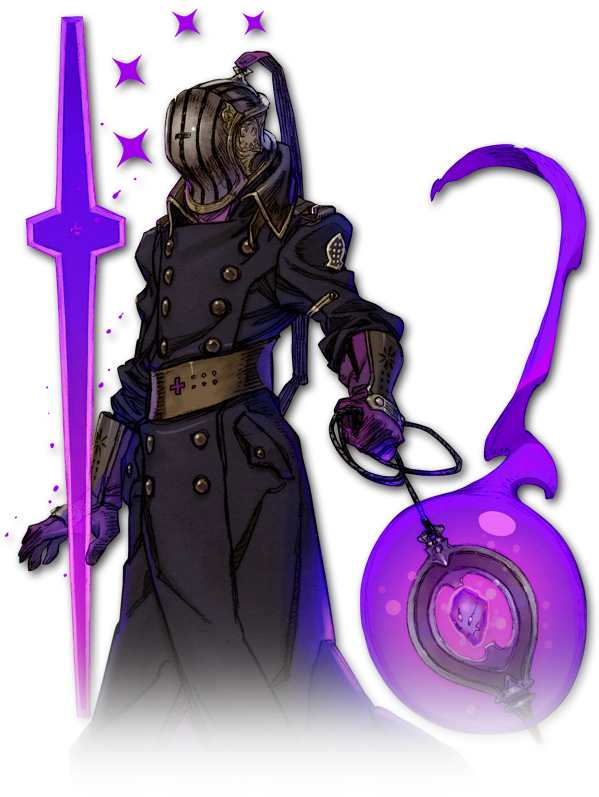
The human job classes wear similar attire and have a military aesthetic. The uniforms aren’t near Modern Warfare or Call of Duty level of advancement. They have a post Industrial Revolution flair that is reminiscent of the Order 1886.
I acquired Sunless Sea by impulse as soon as I heard it was a “story-driven roguelike”. I had heard of it before as a “lovecraftian ship navigation simulator”. So happens it attempts to be both, and executes its proposal with laudable competence. Sunless Sea is Uncharted Waters: New Horizons for the SNES meets Eternal Darkness for the Gamecube. It is Sid Meier’s Pirates with a Doctor Who, wacky kind of horror, eldritch and horrifying in its own right. It is fantastic, and scary and fascinating.
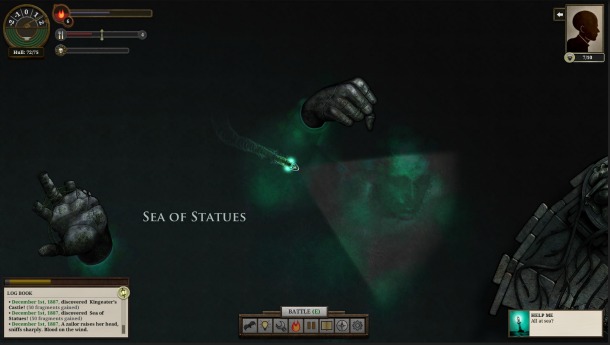
Sunless Sea evokes the mysteriousness of the oceans during the age of discoveries and displaces it into a fantasy, steampunk, victorian London to create a setting appropriately unknown. Your home port of Fallen London (Which as it implies, is London after falling into the earth. Get with the program.) is the only mostly safe place in the underground sea referred to as the Unterzee. As soon as you set sail from Fallen London, there’s no telling what you’ll find, with bat swarms, giant crabs and rat pirates being some of the most tame enemies you’ll encounter. The Unterzee is appropriately feared by those that dwell in it, and your own terror is only one of the things you must manage, lest despair drives you into joining the ghosts in the sea. Mind you, this is not a metaphor, there are actual sea ghosts who, on occasion, wail for you to join them. Your ship’s light brings some comfort at the cost of precious fuel. You must balance the intake of fear with the diminishing fuel and food supplies. It is a game of management. as well as exploration.
But most of all, it’s story-driven. There is no single story to speak, but all of them are superbly written. You travel from port to port, from tale to tale, every one of them as eerie as the previous and never the same as any other. The seas are ruled by the gods of Salt, of Stone and of Storm, and you seek their favour, only hoping not to displease any of them. Spider-silk and mushroom wine are common trading goods, while human souls and uncensored romantic novels are illegal commodities. Every island you visit is a story. Every game update is a new set of stories added. It is a fascinating, ever expanding world for the fantasy and horror writer and all its consumers.
If I had to describe Sunless Sea in one word, it would be “enigmatic”. More extensively I’d describe it as dashingly green and black. But it offers too much content; it’s too original to be summarized so briefly. As a roguelike, it is unconventional. As a horror story, it is promising, and as an indie game as a whole it is very successful. I can only hope the Unterzee becomes richer and richer with its programmed updates, and so should you.
Dying Light is an impressive Co-Op game that allows you and 3 other friends to take down Zombies in a spectacular fashion, while clambering up and over obstacles. Working together, it’s a lot of fun. You may find the game’s mechanics are a little too familiar, played a million times before in different renditions. If you can get by that, it’s a great experience. Even better, if you love those mechanics, it’s like Oreo’s and Ice Cream. The lighting effects – particularly the day and night cycles – may have you pausing your game to take in the sights, while of course keeping one eye on your watch or the horizon. Those expecting something entirely new may be a little disappointed, because the final product isn’t quite the same as what was first advertised. It’s very close, though.
The long of it:
“Okay, where to next?”, my Xbox Live friend, “Souless” asks me. We’re standing on the top of a large radio tower. With every passing second, the world around is growing darker. This is the city of Harran, devastated by a zombie infection. It’s also Techland and Warner Bros. new game, Dying Light.
“Well, we have that last area to check out to the North…”, I say, glancing over at the horizon. The sun is gone, the only lights around us coming from the city. A message appears, alerting us that Night is Coming, and strange screeching sounds can be heard in the distance.
“Or we can just go home.” I say. “Drop this stuff off.”
Suddenly, there’s a rumble sound, causing our controllers to shake.
“Airdrop!” Souless calls out. “Where?”
I catch sight of the plane as it banks and a box falls from it’s rear. The plane goes along its merry way and the box lands not too far from a zipline connected to our tower. A light blue flare shoots up into the sky from it’s location, and I mark a waypoint on our map that we both can see.
“Not too far from us, on my side. Waypoint set, let’s go!” I say, and ride the zipline down. Souless arrives near me a few seconds later, and we start running towards the package. On our radar, two blips appear near the drop site, complete with vision cones, pointed in the opposite direction of where we’re coming from.
“I’ve got two Night Hunters. One to our left, and another at our 2’o clock.” I say, our characters climbing up and over sheds, houses and finally arriving at the site. Before us are two large orange crates, illuminated in a blue light.
“Sweet! We got here first.” I say, opening one chest. Souless opens the other. If you take too much time getting to these drops, chances are you’ll have to fight others for their contents or come up empty-handed when you reach the packages. We’ve got medical supplies to fight the infection. The folks at our home base will pay us well to bring this back.
“Got a survival kit and some meds. I’m heading out.” Souless says, coming over to me and checking my crate. In Co-Op, Dying Light lets up to 4 players jump into the game. Whenever any chest is opened, it’s contents are available to everyone – meaning that I snatch some Coffee, I’m not taking it from any one player. They’ll all have their Coffee or item available in the box as well. I move to Souless’ crate and pick up some more goodies. I do notice his blip on the map move away from mine, and one of the vision cones turn toward me. A sharp scream cuts through the night.
“They’re on me, go, go, go!!” I say and I’m off. While running at full speed, I tap the “Y” button to look behind me, and there’s this weird muscle-bound creature sprinting on my tail, its appearance similar to Guillermo Del Toro’s vampires in Blade II and The Strain. A quick flash from my UV light disturbs the creature, giving me a few seconds to duck down an alley and break the line the sight. Thankfully, we’ve set up this online session so that we don’t have Zombie Invasions. With that feature enabled, other players can actually jump into Co-Op games as Night Hunters, chasing the rest of the crew with better mobility. We’re hustling up and over walls and eventually make it back home to the safety of our home base and it’s UV spotlights.
We decide to call it a night.
If you merged together the movement style of EA’s Mirror’s Edge, the Zombie Onslaught of Techland’s Dead Island, added the Outpost game mechanic of Ubisoft’s Farcry 3 & 4 and the randomization of weapons from Gearbox’s Borderlands series, you’d probably end up with Dying Light. All of it feels very familiar once you start playing it (though this isn’t entirely a bad thing).I’ll admit that at the first gameplay session, I was worried by the control system, especially having come from years of Mirror Edge. Additionally, the game picked up some controversy by not lifting the embargo for reviews until the last-minute, even though both companies stated that they’d avoid doing so. I’ve adjusted to it, and I’m really enjoying the game so far.
In the game, you play Kyle Crane, voiced by Roger Craig Smith (Resident Evil’s Chris Redfield and Assassin’s Creed’s Ezio Auditore), an agent dropped into the city of Harran to locate a missing official, requiring him to go undercover. The moment he parachutes into the city, he’s attacked both by an enemy raiders and is bit by a Zombie. Though infected, he and others have been able to keep the change at bay by the use of a medicine called Antizen. The Antizen is delivered to the town daily via airdrops. During the day, it’s a safe as an episode of the Walking Dead. You travel from place to place, scavenging parts from places and money from Zombies. When the sun sets, the Night Hunters rise. You’re given fair warning of the sunset by way of a Purge-like announcement. The game’s menu also comes with a clock to let you keep track (though this is only revealed after the tutorial missions).suppose they’ve studied Parkour as well, because when they chase you, it takes every skill you know to evade them and break the line of sight. It’s not as terrifying as I thought it would be, but you’ll die a lot if you’re not careful. The fear in Dying Light’s Nighttime sequences isn’t whether a Night Hunter will find you, but getting swarmed by them. Once one pursues you, they all pursue you. If you’re not ready for the night, you can sleep it off at any safe zone and handle your tasks in the daytime. The game does reward you for nighttime runs by automatically doubling the amount of experience you gain for your Agility and Power, letting you easily level up if you’ve the courage to do so.
The default controls in Dying Light are surprisingly simple. The right bumper is your best friend, allowing you to jump and vault. Where Mirror’s Edge had you flipping between your left and right fingers like a pinball machine, the single jump button of Dying Light lets you move with ease. As long as you hold the jump button and are looking at where you want to go, you’re guaranteed to grab a ledge. This is particularly important when descending ledges. What should be a drop and grab becomes a free fall if you don’t hold that button. More advanced moves, like sliding, tackling, drop kicking need to be unlocked as you gain experience. This was the element that bothered me in my first levels of the game. Part of me was under the impression that I’d be fully mobile, wall running doing all those crazy parkour moves right from the start.
The attack button is right below that, allowing you to swingsuch as pipes, sticks and knives with ease. The weapons you pick up do get damaged over time, so you’ll need to repair them (usually while running). Swinging on Zombies takes its toll on your player, and you only have so much stamina to work with before rushing back into the fray. Weapons can also be upgraded with electrical or fire damage, which the game seems to borrow from Borderlands. Eventually, you move up to guns, but I can’t say how well that factors into a game like where some of your enemies are rushing at you as the same speed you move.
Once the sun sets, the Night Hunters come out, and they’re hungry.
The skill tree system is wonderful. You’re given 3 types of skill trees – Survival (points awarded for crafting items and helping others), Agility (points awarded for climbing, vaulting and using other abilities), and Power ( points awarded through creatively kicking some zombie butt). These are really fun, and I can’t wait to unlock some of these features. For example, the Survival tree has the camouflage ability that allows one to rub dead guts all over themselves and walk among the infected without drawing attention, though attacking will kill the cloak. Other abilities include being able to slide and break an un-expecting zombie’s leg, or rig a car to explode a bunch of Zeds in one shot while you stand on a rooftop and laugh.
From a graphics standpoint, Dying Light is sweet. Harran (or what I’ve seen of it anyway), is more or less afavela (think of that first chase in The Incredible Hulk or Fast Five). I get the notion that the map may expand. I hope it does, because it’s rather small right now. Still, the city’s transition from Night to Day, along with the weather effects just add to the atmosphere of a place gone sour. Blood sprays are the norm, rendered at near 1080p on the Xbox One and at 1080p on the PS4. I’ve yet to run into any slowdown issues with all of the running that’s being done. Another standout is the loading time. Coming off Mirror’s Edge, which gave you these incredible load times while you stood in an elevator, Dying Light’s transitions between stages are a jaw dropping delight. Then again, I’ve only moved up to Next Gen recently, and that sense of power’s new to me. Others may disagree.
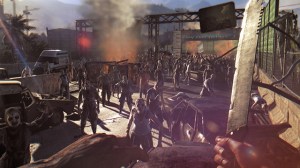
Dying Light will have you facing against hordes of zombies, but so far, I haven’t seen any that are this big.
Another feature I like is the “New Game” system. If you’ve played through part the game with a friend, but don’t wan’t to break that connection where you both left off, you can choose to make a brand new game that starts you at the end of the tutorial and lets you keep your skills progression. So, if your player is a level 9 in everything (the top is 25 in everything) in your original game, you can keep that. Your weapons, however, don’t come with you.
In terms of problems, the only thing I can tell with Dying Light is the connection for playing a Co-op game, and how it doesn’t exactly feel extremely innovative. In trying to join games, I’ve had a number of connection issues, even when both Xbox Live and Techland’s servers are running. Invites sent to me, or mine sent to others fail when the invited party try to join. The only way we’ve been able to successfully connect is by using the join feature within Live itself, and once it holds, it ties together very fast. Each player is given their own color mark so that they can be tracked on the map. Players can also separate and check whatever part of the map they choose. If they stumble upon a story marker, they won’t be able to play it until everyone joins them – easily done with the Quick Travel feature. Additionally, the tutorial for the game is long. You’re shown how to move, and are given some missions to how you the move from day to night. It’s like having to deal with that first mission in GTA Online when the game’s servers were first glitched.
If you’ve watched the early Alpha Footage, you kind of get the feeling that a bit of it was left out of the main game. This is normal though. Games change drastically between the Alpha and final versions. I’ve fought tons of zombies, but the game has yet to reach Dead Rising levels. Maybe this is because of the processing power, or because I’m still early on. I can’t say it’s bad, but I would like a moment where I look down off a roof and go…”Nope. Not landing in the middle of that.” There always seems to be good exit around.
So there you have it. Dying Light. If you like Freerunning, it’s worth a try. If you love zombies, take a look. If you love both, it might be just what you’re looking for. Just be sure to keep your eye on the clock.
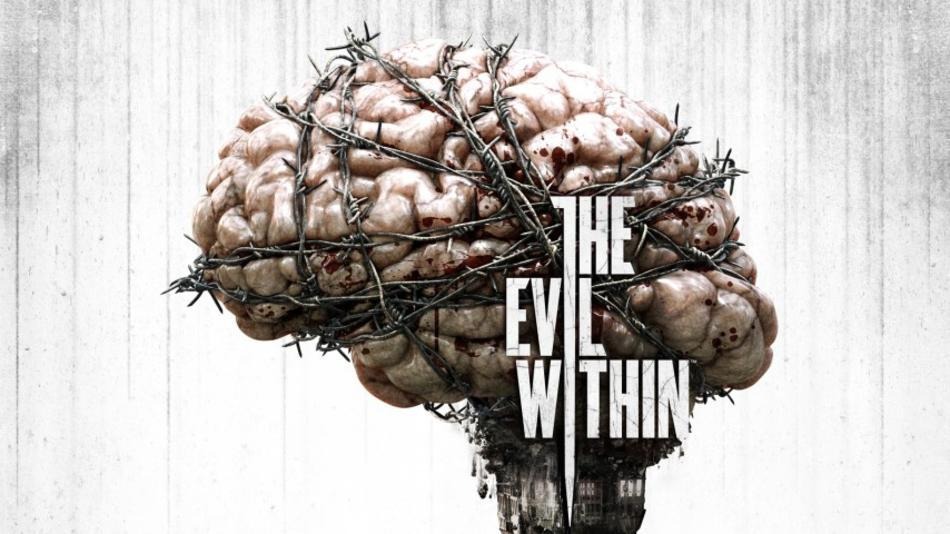
The Evil Within’s announcement was met with huge expectations for being an original horror title directed by Shinji Mikami, creator of Resident Evil, benchmark of modern horror videogames. Over the years he personally directed a few projects with very fluctuating results, but his leadership of the Resident Evil games was competent, and they only really squandered when he cut ties with the series after his involvement right after Resident Evil 4, which many regard as one of the best games of the last decade. No pressure in this new intellectual property then.
And I’ll just straight out say it. It’s a disappointment. It would be hard not to be one. But it’s not a normal disappointment. If it were I’d give it a passable review and say that people might enjoy it just for the effort. However, The Evil Within is, pardon me, utter piss. I realize negative reviews are very “in” nowadays and people do them just for the sake of it, but this one is sincere. I wouldn’t buy something on retail price crossing my fingers, HOPING, it would be such a mess. I spent cash on this shit. This money was invested. I wanted it to give some return in the form of entertainment. Which was wishful thinking, of course.
First of all let me talk about the technical issues. Full disclosure; I played the PC port; not a good option, apparently. To be honest I only had one issue with it, but I understand that “it is not a good port” because this piece of trivia was bombarded on me by my peers. So don’t buy the PC version, it’s bad (maybe until they release some patches). That being stated, we’re left with “the game”. The real horror.
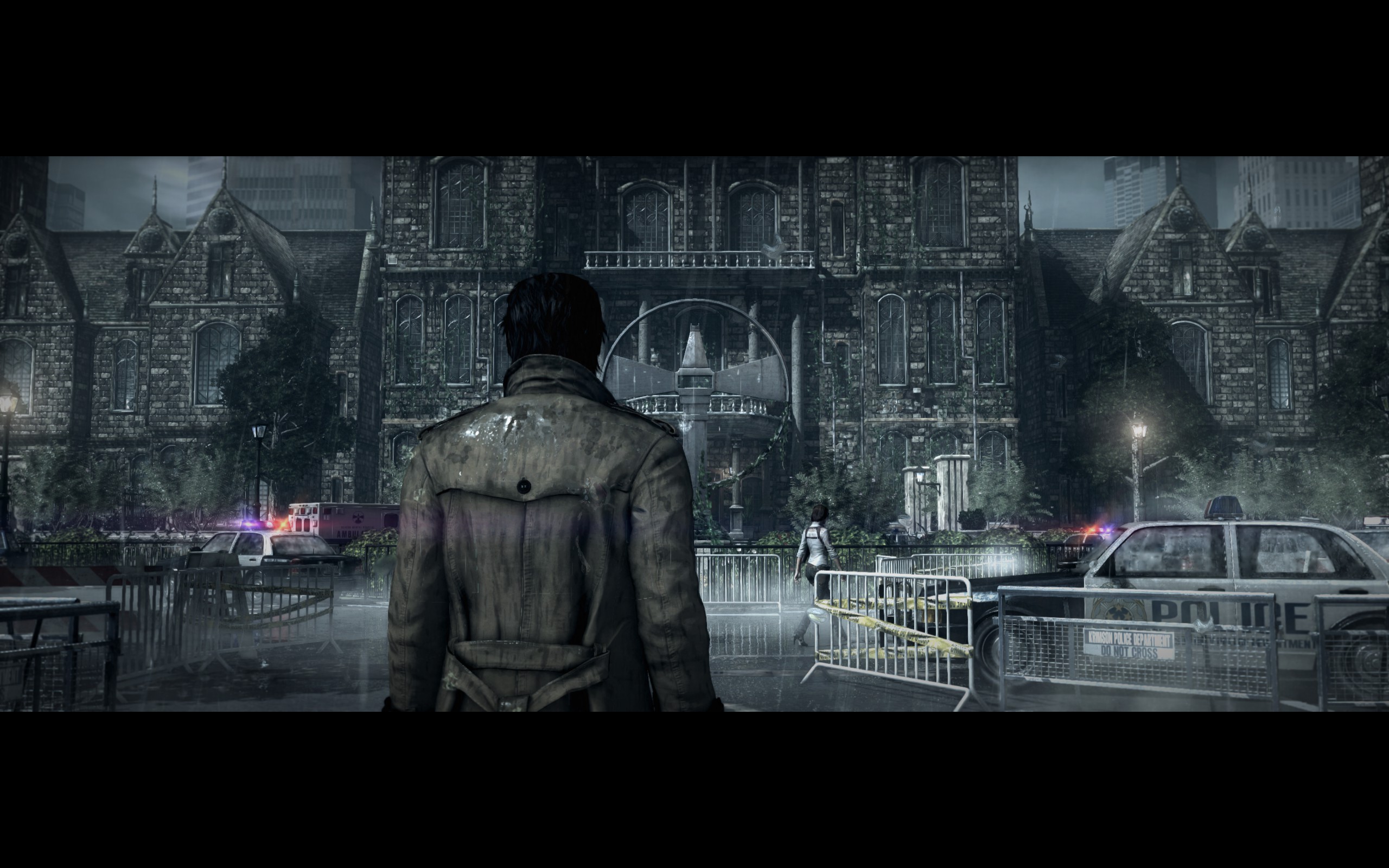
Probably under the pretense that this would make the game scarier, the development team decided that the camera just had to be forever stuck on letterbox view. This is not just pretentious, it is an OBSTACLE. It takes maybe a third of everything in your field of view. Your eyes are hindered by two monstrous gaps of black bars, top and bottom. And you need to actually look at stuff to be able to pick them, so you can only imagine how this is cumbersome on the playing experience (By items, I mean ammo, medicine, documents, same kind of thing that was in Resident Evil). Are you a fan of collecting stuff? A perfectionist maybe? You’ll either spend more time than you should inside one map to make sure you’ve gotten everything or you’ll forget that. Chances are you’ll miss items either way. This camera is out of this world. It is a monster incarnate full of spite toward you. Catching inbound enemies is an equally hard job, as the lack of proper vision of your immediate surroundings makes it hard to realize if you’re being chased, or to know exactly how many enemies are around you. This might lead to some unintentional scares if that fancies you, but fact of the matter is that it’s simply put, bad camera mechanics. And let’s not talk about the obtuse amount of film grain. That being said, this title is not entirely offensive on a visual scale. The art and graphics are quite nice, even if hamfisted on the gore. It’s just too bad it’s so hard to see it properly.
Actually, it seems to cover something closer to 45% of the screen
A document early on the playthrough makes a point of telling you that the protagonist, Sebastian Castellanos is one of the fastest ever policemen of Krimson City to rise to the rank of detective (I feel like the name of the city might have been suggested by me when I was 14 and thought I was really death metal) . You will quickly notice though that Detective Castellanos isn’t the physical marvel he is laid out to be. The act of sprinting in the beginning takes a full 3 seconds from top speed to complete exhaustion. At his best, Sebastian can run for ten seconds before needing to stop and breathe in the middle of a full herd of enemies (which he WILL do if you rely on sprinting too much). He’s not a very good shot either, even at ranges close to point blank he’ll miss often unless you upgrade his weapon. Walking is awkward, running away is awkward, shooting is awkward. Some of these can be improved by buying common sense into the game in the form upgrades for the character with green goop. Seriously, that’s their currency. I confess to maybe having missed something, but I don’t think that part was ever explained.
If you think objectively about it, Resident Evil was awkward. Even the fourth one. The controls were always strange at best. It comes to me that, while people were begging for a new, good Resident Evil, Mikami acknowledged their wants and needs. That’s what The Evil Within is. I mean, the zombies are there, the alien controls as well, and it’s ever so slightly scarier, which was another major complaint, since some viewed the Resident Evil series as having swayed from survival horror to mostly action with some horror elements. In this sense, people got just what they asked for: A survival horror made by Mikami that is very much like Resident Evil. However since Resident Evil 4, Mikami directed two titles, a four year gap between each of them (2006, 2010, and The Evil Within in this Gregorian year of 2014), and the other two were not even close to being horror games. So what we got is a newly released outdated survival horror with ten year old survival horror mechanics.
What happened!? I heard there was a good game in here!
The sad realization is that maybe Shinji Mikami isn’t a master of horror. The Evil Within isn’t very scary past the few initial chapters, where you’re completely powerless (and maybe this was this game’s real element, which in my opinion he failed to realize). Some of the more tense parts orchestrated by him come from trial and error, when some scripted event or other makes you face something new, something you’re totally willing to fight against. Then, upon closer inspection, you notice your head has just been pulverized by this new thing you perceive. So it occurs to you that you don’t fight this thing, you run from it. Of course, that’s after you died. Not very fair, honestly. The story is intriguing, but extends itself far too much. My interest was gradually lost on what could be a great mixture of body and psychological horror. It failed because while the art was on the right spot, the writing lost its way and somewhere it just became a zombie game. And I hoped it would pick up again. It never did.
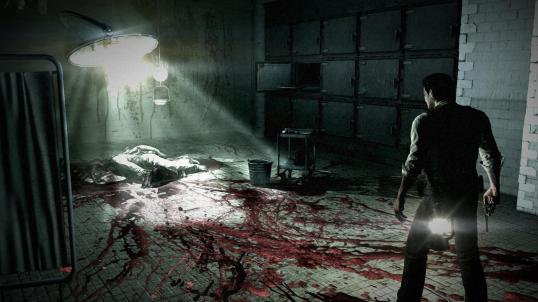
It seems The Evil Within has few redeeming features and is somewhat obsolete in a very weird way. The space reserved for its image projection is malevolent. The gameplay is unimpressive and clumsy. It is artistically well intentioned, but ultimately poor. It does have, however, a very nice character in the form of an otherworldly and cryptic nurse that helps you through the story during dreamlike sequences. Her personality and oddities make her seem like a character from a Suda51 game, maybe something learned by Mikami in his time working with Suda on Shadows of the Damned. Man, now that’s a good title. Suda is really good, isn’t he?
Role-playing games have been a major staple of console gamers since the days of the Super Nintendo console. It became even more popular with the release of the first Playstation which had as one of it’s biggest selling point the Japanese role-playing game Final Fantasy VII. This title from Squaresoft (now Square-Enix) introduced the role-playing game genre to many gamers who grew up on shooters and action titles.
Final Fantasy became synonymous with Japanese RPG, yet there were other rpg titles out there that were just as good if not better. One such title that flew under the radar, but definitely caught the attention of hardcore gamers during the early days of the PS2 was the Japanese rpg Shadow Hearts from Sacnoth. It didn’t have the polish and epic spectacle gamers were used to with the Final Fantasy titles, but it did bring a new take on the time-tested rpg genre. Sacnoth decided to use horror as the theme of it’s title instead of scifi or fantasy and it’s that artistic choice which made Shadow Hearts such a unique title and one still beloved by it’s many fans.
Set in an alternate reality during the early 1900’s, Shadow Hearts follows the adventures of Yuri Hyuga and Alice Elliott as they attempt to solve the mystery of why the latter was being pursued by the historical figure Roger Bacon (who history says wasn’t just a learned Franciscan friar but one of the preeminent philosophers of his time). The game takes Yuri and Alice through several cities in China and Europe and most of them somewhat heightened-versions of their real counterparts, but where mysticism, the supernatural and folklore have become somewhat accepted.
The game doesn’t flinch in portraying not just the horrors of war, but of the shadow world just bubbling beneath the surface that involves demons, vampires, sorcerers and zombies. the main protagonist, Yuri Hyuga, even unlocks greater abilities and powers by absorbing the souls of enemies he has killed and entering a sort of personal “Dream Realm (or Nightmare depending on one’s interpretation) where he must battle personal demons to gain their powers. It’s definitely not something that Final Fantasy players have been exposed to in the past and I think it’s one major reason why the game appealed to some gamers who wanted something new in the Japanese rpg scene that was becoming dominated and homogenized by the styles pushed Square-Enix’s Final Fantasy franchise.
Shadow Hearts had a unique way of doing combat during the game: The Justice Ring.
The Justice Ring combat system was a nice change of pace to the usual turn-based battle system used in most Japanese rpgs. This battle system was still turn-based, but every action outside of defending was affected on how well the player hits his mark on the rotating Justice Ring. This kept the player from just picking an action and seeing what happens, or even worse, just button mashing the attack action to try and win fights. The Justice Ring system kept the player involved throughout the whole battle. Sometimes perfect use of the Justice Ring was a must to fight and succeed against certain bosses and situations.
Shadow Hearts might not have the pedigree of the Final Fantasy series, but it was a nice change of pace from the the typical scifi-fantasy that series re-used over and over to the point that they became a video game trope that was seen by some as a negative rather than a positive. The game itself wasn’t perfect by any means and had more than it’s fair share of glaring flaws. The dialogue was pretty laughable at times though never to the point that it broke the game’s serious and ominous tone. The graphics, for a PS2 title, was very underwhelming especially when compared to the Final Fantasy franchise.
Yet, despite all its warts and flaws, Shadow Hearts remains one of the more unique rpg gaming experience of the early 2000’s and it became popular enough that it would spawn two more sequels that would explore the alternate reality the franchise was based on. I’m all for the scifi and fantasy worlds that most console rpgs have been using as their templates, but once in awhile I’m reminded that rpgs could also have fun in the horror realm and Shadow Hearts helped make that deviation from the norm happen.
On a sidenote, this game also had a great soundtrack from Japanese composer Yoshitaka Hirota
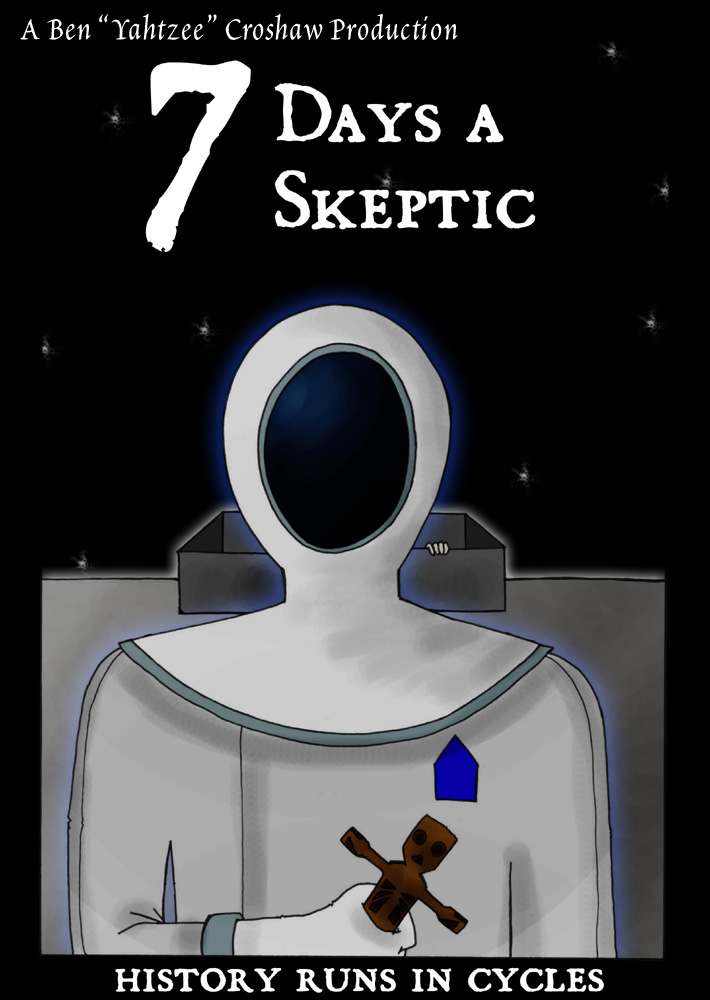
Following the success of 5 Days a Stranger, Yahtzee decided that, no! A one hit wonder just wouldn’t do! He had more horror tropes to nod to, more space to cover! And speaking of space that became the setting of the futuristic sequel 7 Days a Skeptic. Most flawed of the series from a narrative standpoint, it might be, however the most horrorific of them.
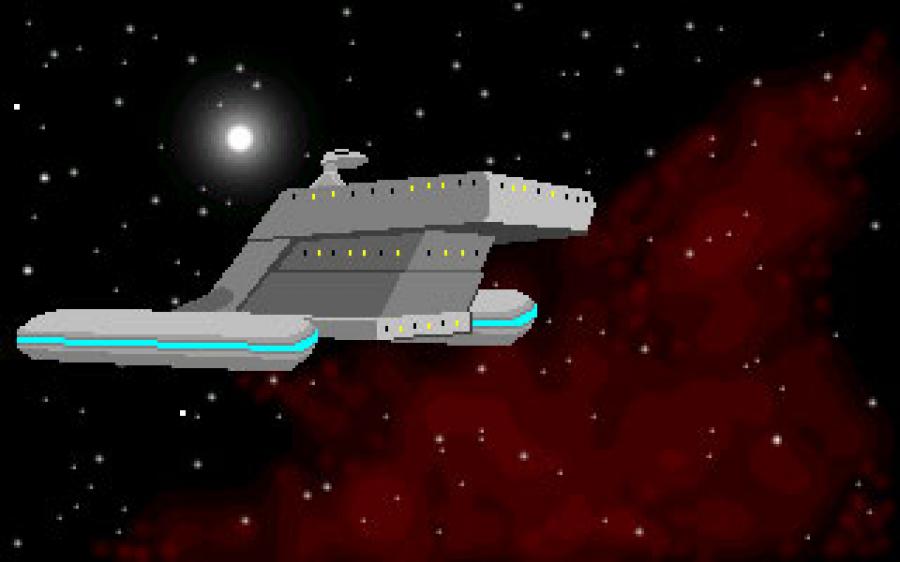
Skipping a few centuries right into the the year 2385, 7 Days (a game awfully ominous when referred to like this) is played through Jonathan Somerset, experienced psychiatrist of spaceship Mephistopheles. On exploration duty for the Earth Federation, the ship’s crew of Jonathan and five others find a sealed metal box adrift in space. Upon inspection, they find that it contains the remains of John DeFoe, character of some importance to the first game as players might recall. As the crew returns to their assigned duties, leaving the box unopened, Dr. Somerset realizes things start to grow veeeery eerieeee.
With a premise and aesthetical style reminiscent of sci-fi horror movies, particularly Alien, 7 Days is a nice shift while still retaining the characteristics that made its prequel scary. The isolation and inability to run away makes sense when away means out in the vacuum of outer space. Dream sequences still mix into reality, giving it an ethereal feel at times. And it further expands the tales of the series’ supernatural killer, giving him a more active role this time, which makes some parts really fucking scary.
It may sounds ridiculous and hamfisted at first to go from modern to futuristic in one game while still keeping the same themes, but it’s a title that does so unpretentiously. 7 Days a Skeptic is enjoyable and very very creepy and you should play it just for that. And if you don’t do it for the cold spike you feel while being chased by an insane murderer, play it for its sequels because, boy, it’s worth it. And I’ll get to that soon.
Some are not aware that Yahtzee Croshaw of The Escapist fame was somewhat famous as a developer before his venture into journalism. I myself am still a fan of his for his work making games instead of his deconstruction of them. And that’s mostly because of the Chzo Mythos Quadrilogy, a series that works as a homage to slasher horror films from the 70s and 80s, as well as an independent horror tale with firm Lovecraftian roots and damn good story.
In the first game, the more famous 5 Days a Stranger, you control Trilby, legendary gentleman thief named after a hat. Breaking into a mansion on top of a hill, a fine place to rob as horror tales go, Trilby finds that the window he entered through is inexplicably sealed. It is un-unlockable. It has become unbreakable. It is now thoroughly impassable. Even worse, he finds nothing of value, aside from four other prisoners of a strange house, equally confused with the situation.
Needless to say, people start getting murdered, it becomes a great deal of stress to the survivors as the mystery begins. Who is killing these people? How is this house so hermetically sealed? And we know why Trilby is there, but what about the others? Dream sequences start muddling into reality in-between the twists and reveals in this murder house. What they discover is strange enough to last for three other games.
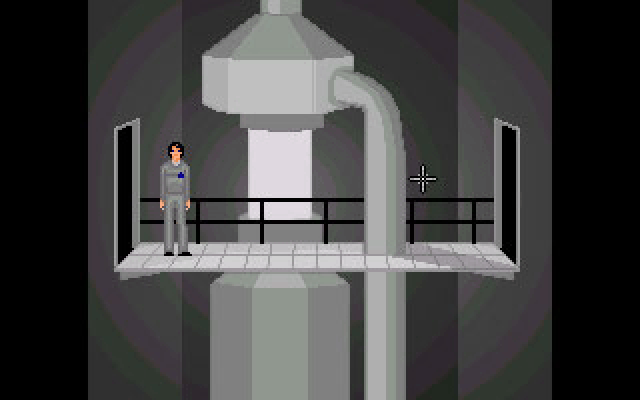
Made with AGS (Adventure Game Studio) in 2003, 5 Days a Stranger is a refreshing attempt of rescuing the genre, popularized by Sierra and LucasArts with titles such as Leisure Suit Larry and Monkey Island. It’s an excelent adventure game in its own right, being by the time of its release Yahtzee’s most competent game in terms of art, and from a game design standpoint, very well thought, aside from a few pixel hunt sequences which can annoy its player into resorting to a walkthrough, though that was long common in adventure games anyway. 5 Days a Stranger went on to win several awards as an indie adventure game. This, in 2003, was quite an achievement
Inspired by eerie hentai visual novel Nocturnal Illusion (very horrorific in its own right, pornography aside) and classic horror movies like Friday the 13th, 5 Days a Stranger is part of what ascended Yahtzee into internet fame. And besides all that, eleven years ago, it was evidence of how adventure games, which had fallen so high, could still thrive. An amateur game that served as an influence to many others adventure titles released in the last few years. Also, it’s free to play. A gem of the internet, indeed.
The Walking Dead by Telltale Games scarcely needs any introduction. Widely agreed to be one of the best games of 2012, its narrative dictated by your choices punched at the player’s gut with its strong emotional content in a subtle sidestory of atonement, fatherhood, and of course, survival, in the zombie universe of The Walking Dead.
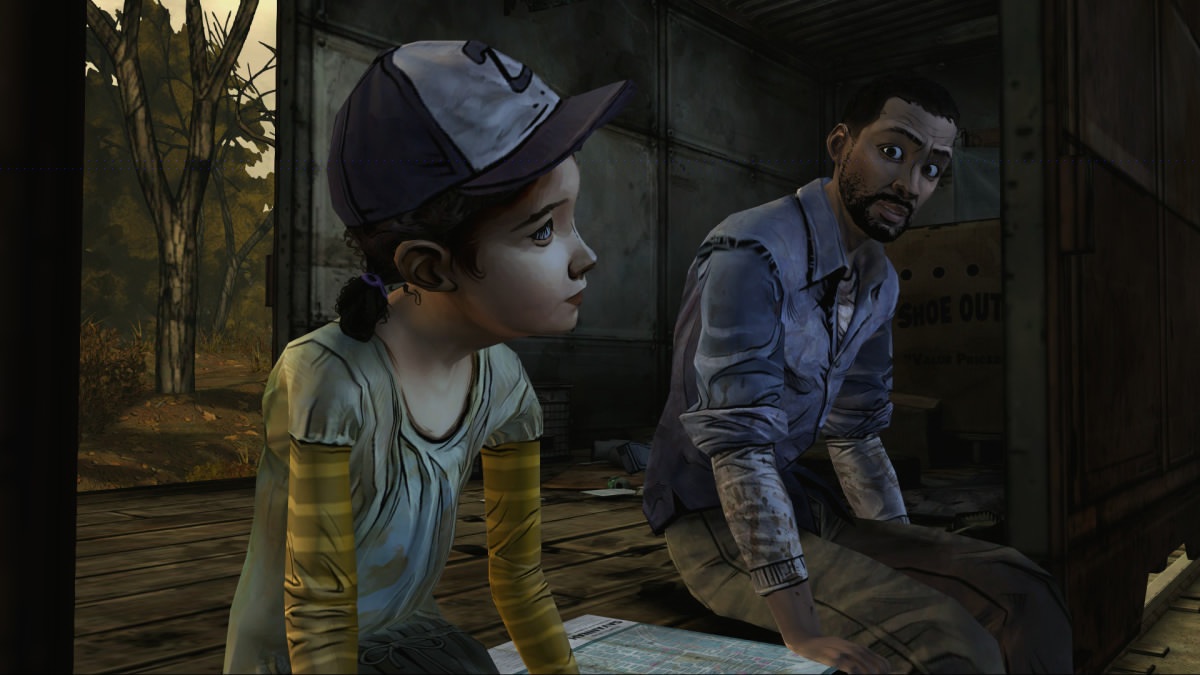
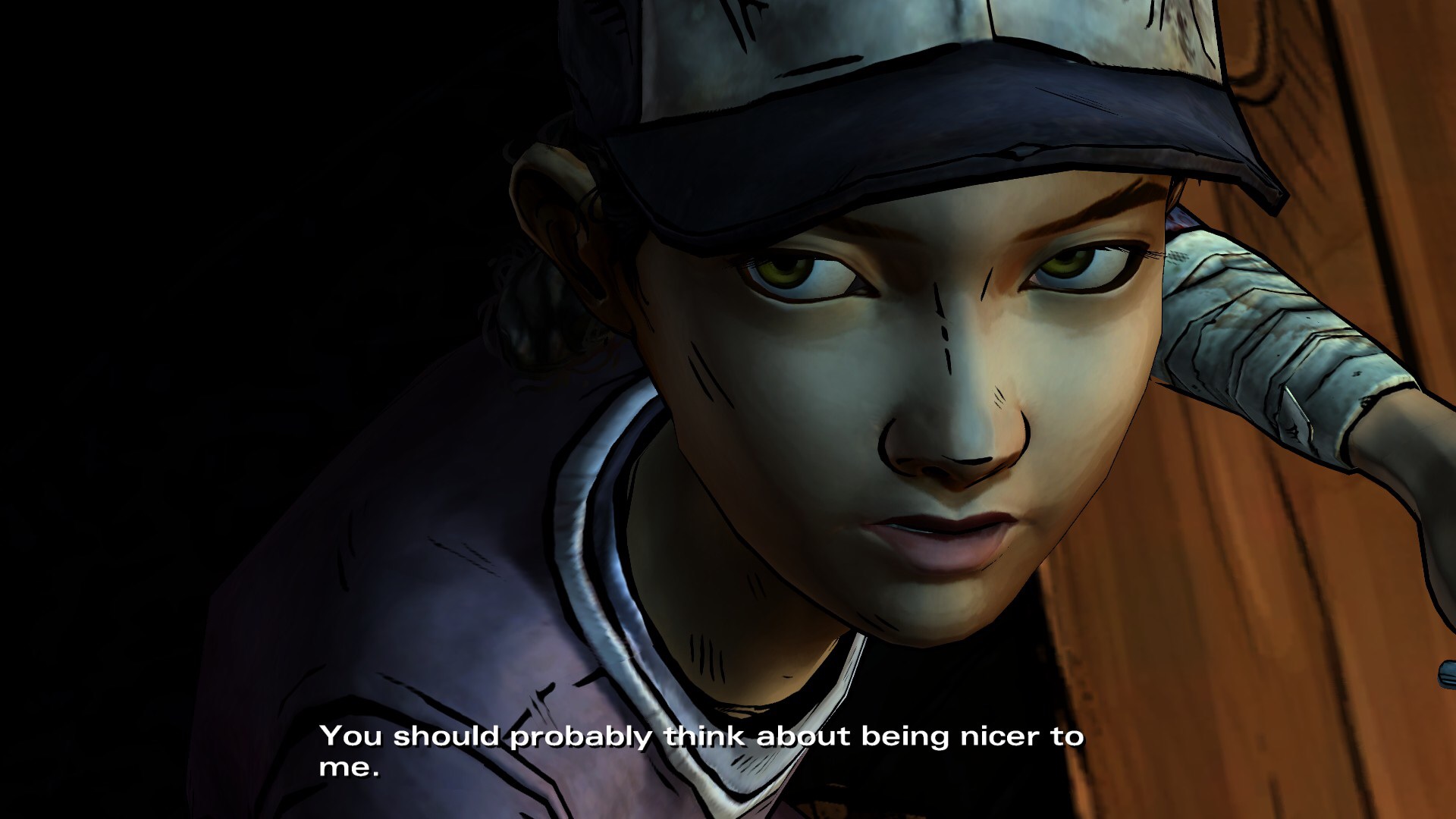
Clem does keep that hair short, whether you like it or not.
However, the gameplay and its difficult choices were an illusion. A magic trick. As long as you looked at the story you didn’t notice how much you didn’t make a dent at the course of the storytelling. Two playthroughs will prove that the story is almost exactly the same, even if you interpreted protagonist Lee Everett two polar opposite characters. Not that it mattered, since it was made to play once; to become emotionally involved and keep your little saved game until next time, for the next season, much like the TV Series.
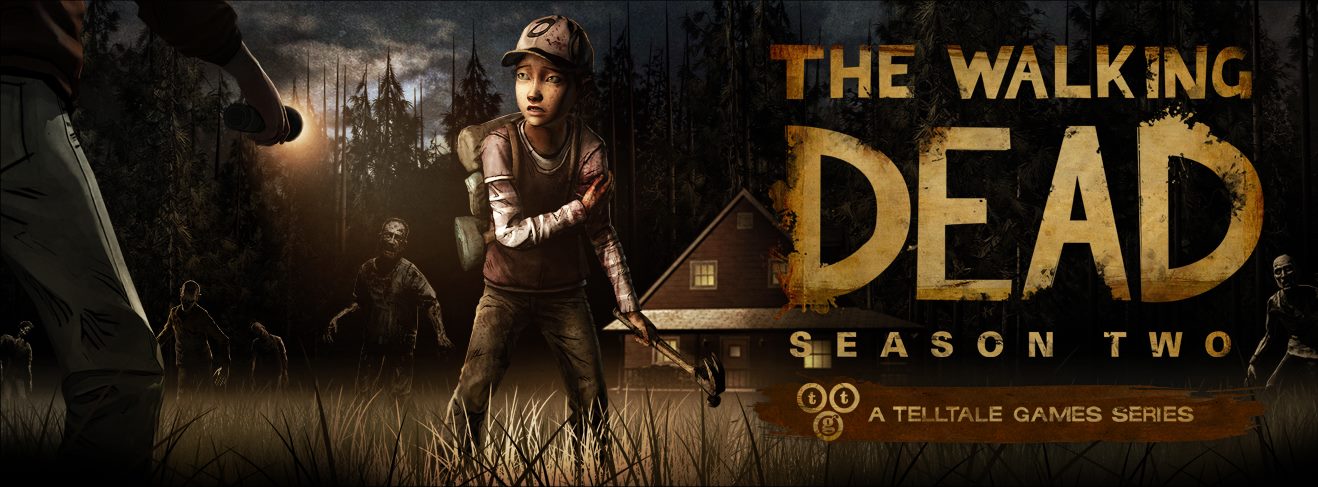
And so it came to pass that Season Two came out. Through the emotional roller coaster we go again, load your season one save for vaguely rewarding shoutouts to your playthrough of season one. This time the story is set two years after the its predecessor. You play as Clementine, Lee’s (now) eleven year old protegé. Having survived through the hell zombie apocalypses tend to dish out, young Clem is not the the little girl up in the treehouse anymore, having become sullen and untrusting, used to the bedouin life of scavenging and killing after society breaks.
The story does progress ostensibly slow at first. Episodes One and Two may appear as uninspired reflections of the original game and may be hard to tolerate for some, but it’s worth it. Seeing the full game, they are justified. The magic trick was being set up again, with more flair this time. As you start interpreting this little girl’s choices and behavior, you start to become emotionally involved again. Her persona becomes an extension of your own (Verily, in a way, you become an eleven-year old, which is super fucking weird). By episode three it’s all set, and you’re looking at the magic hand again, while the other supposedly weaves a defined scenario.
Reminder: Eleven years old.
This time is different though. If in the first game you (Lee) took the role of leadership, in Season Two, you (Clem) are the pivot character. People want to do what’s safer for the child, she is the motive of concern of every survivor group, and being forced to take sides ultimately creates different paths that don’t end the same way, in contrast to Season One. The multiple endings pay off. Enthralled by this story, you’re encouraged to follow through it as if you were a wildly different person, with feelings and thoughts. You feel the weight of being Clementine.
From the beggining of episode three to the end of five, the last one, Clem is swept in a crescendo of intrigue. The group is trying not to break and she is often encouraged to voice her opinions, except when she disagrees with someone, in which case it doesn’t matter because adults know better. But that may also mean that she’s agreeing with another person, and her opinion is defended as the most important because the weakest needs to feel safe. You can’t seem to fix this group, driving it further into discord in fact. You may take one side entirely or try to keep things nice and easy for everyone, and in the end you are responsible for Clem’s fate. For better or for worse. The subject “Clem” and the subject “you” are sort of interchangeable in this paragraph.
The new season is more emotionally complex and more morally ambiguous. Really, it’s about the evil that men do rather than zombies. Though not an entirely original concept, Season Two does create a very nice example of it. It’s difficult to say if it’s better or worse than the first one. It’s just different. However, it shows improvement in its immersion and narrative, and proves that Telltale is capable of carrying on the quality of their own version of The Walking Dead.
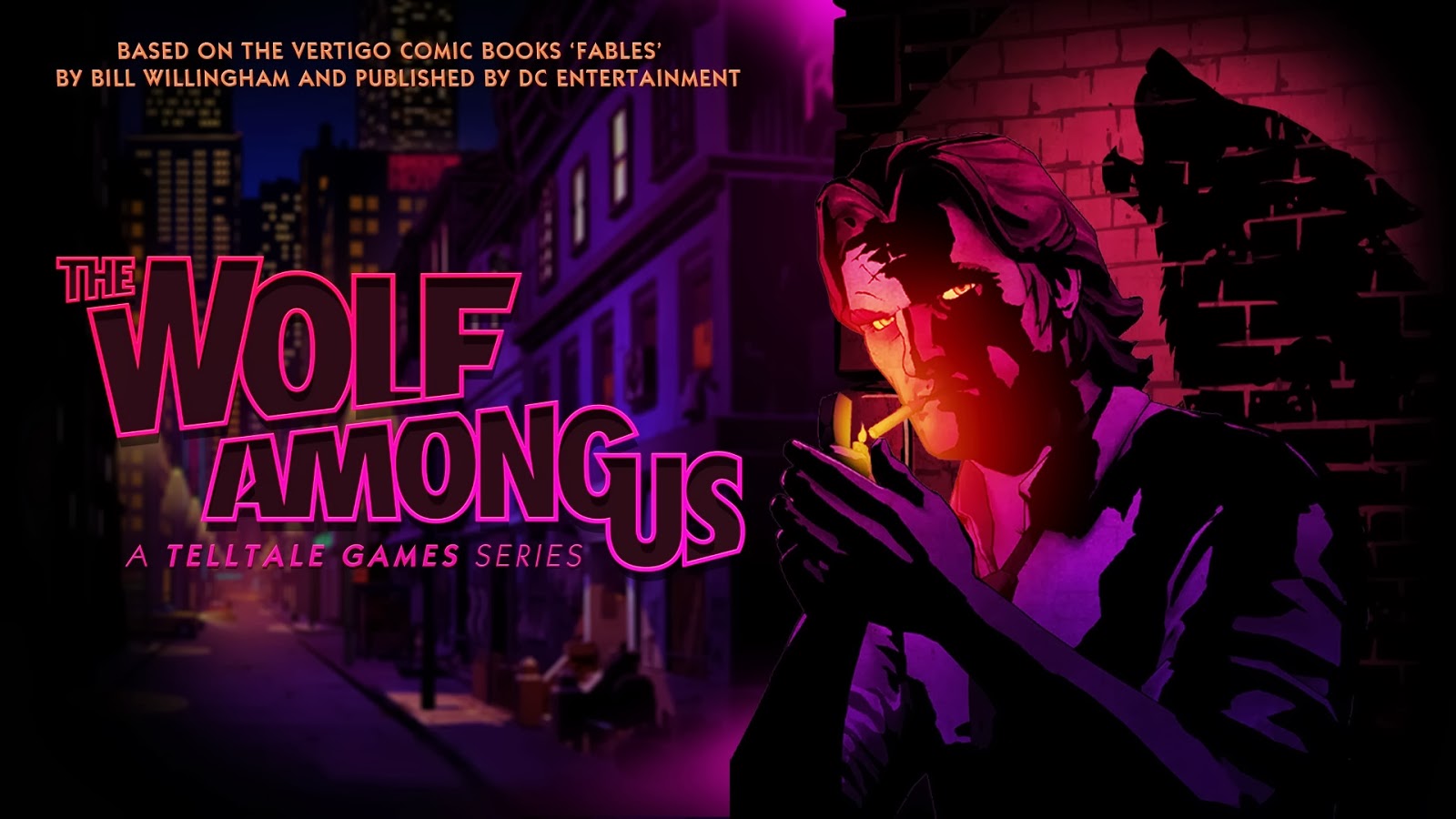
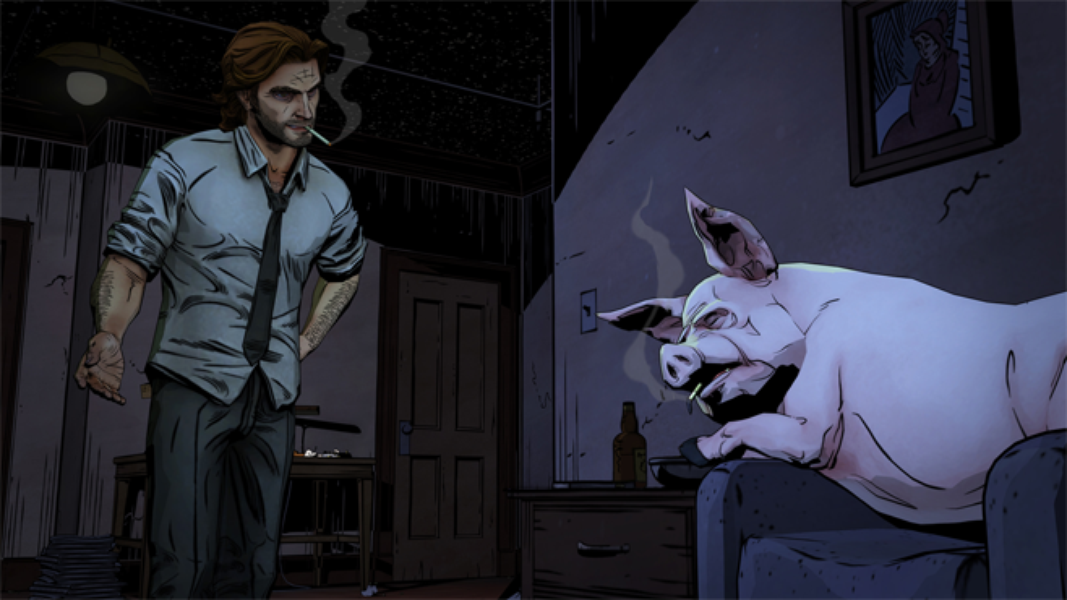
The Wolf Among Us was the first game released by Telltale after the extraordinary success of The Walking Dead. They had finally found their element, and decided (prudently) to stick with it. But how do you follow up a title based on a comic book series recognized by some as the best game of its year?
It’s simple. Make another title based on a comic.
Fables, the series Telltale’s following project was based upon, is about fairy tale characters we grew up reading about secretly living in our real world, in a real city, hiding their existence by creating their own society. None of that Once Upon A Time cutsey niceness. They are opressed and opressors, have severe flaws in their characters, vices and, in some cases, signs of antisocial personality disorder. That is to say, they’re often psychopaths.
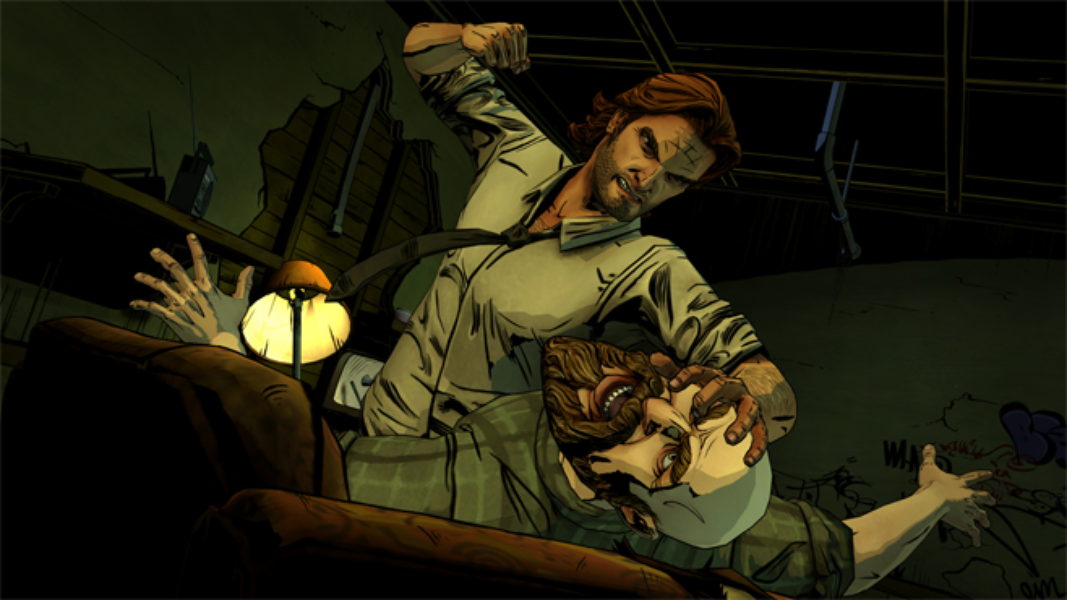
I’ll reconcile the shit out of you!
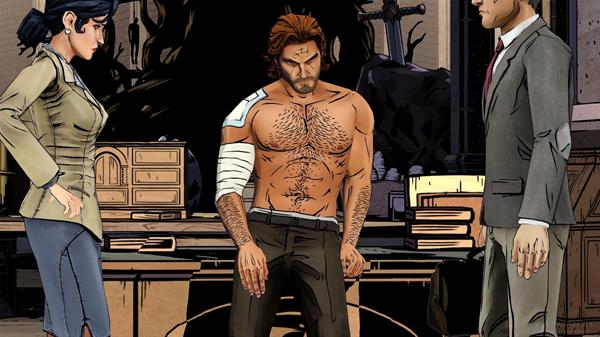
The game gives you control of Bigby Wolf, sheriff of the fables. As you might have guessed, previously known as the Big Bad Wolf of Little Red Riding Hood and Three Little Pigs fame. Reformed and willing to put his past behind him, Bigby tries to reconcile the poor and rebelious with the powerful and bureaucratic, in a very socially imbalanced society of mythical people.
Bigby is the most human of all characters, ironically. Given the task of upholding the law in this broken, small society where everyone knows everyone else, he lives a lonely life, being recognized and feared for doing his job, which frustrates him. His tendency to bend the rules makes the fables’ mayor office see him as a loose cannon. Bigby is a noir hero, chain smoking and full clad in trenchcoat. Bitter with having to raise his hand against unsatisfied citizens and with the impunity of guileful villains; forced against rebellion, but resentful towards the bureaucrats, he often passes his own kind of law. His humanity is revealed through conversations with the only people close to him. Colin, one of the three pigs he used to terrorize, and Snow White, secretary of the mayor office and object of his affections.
The amount of deviance from the path of justice in the game vary depending on your playing style. As you solve a series of murders during the span of the game, you decide how violent Bigby will be towards everyone, from the mostly innocent to the very guilty. However, this is not a story about choices like The Walking Dead, but about people leading double lifes. By taking fables, one of our most powerful cultural symbols of purity and innocence, and twisting and corrupting them, The Wolf Among Us is a modern and allegorical story with heavy noir influences, with fantasy and magic playing a part in the narrative.
It is not without flaws, however. It should be noted that, as the game needs a central story, the mystery of the series of murders obfuscate this amazing world, and one purely interested in the big picture; the unjust society of the fantastical, would be better served by reading the Fables comics. The Wolf Among Us has lots of ups far too early in the game and a few too many downs too late into it. It serves as a decent mystery thriller, and more importantly as an origin story for the comic book series, and it does have absolutely thrilling moments. However, it doesn’t bring much new to the table of longtime Fables fans other than focusing on one of the most interesting characters of its mythos.
As a standalone story, The Wolf Among Us has amazing action sequences and is a very exciting story up until the last quarter where it disappoints. As part of the Fables series, and possibly first chapter of others to come, it’s a perfect entry point and highly recommended. The complexity of its premise and excellence of some of its moments more than compensates for the lackluster closure of this first chapter. If that’s not enough to convince you, play it for Bigby Wolf, who might just be the coolest detective in videogame history.
Abbreviated boilerplate! Once again I return to this ongoing series, in which I attempt to play through every game in the Final Fantasy franchise that I can get my hands on, from FF1 through Lightning Returns, and a variety of the spinoffs and other titles not included in the ‘main series’. This list continues to undergo revision, and I seriously considered removing Final Fantasy 9 from it for personal reasons. In addition, no MMO titles will be played. Sorry, folks?
I think all of this is extremely important knowledge, and that the human race will be improved by my research. Let’s move on!
Version Played: Original PSX discs, played using a “slim” PS2 system
Final Fantasy IX is a game that for me, and mine, and my generation of gamers… feels more modern than it actually is. How many among us would be surprised to learn that Final Fantasy IX was released in November of 2000? We are approaching its 15th anniversary. It’s perhaps the newest of the old Final Fantasy games. Except, we don’t think of Final Fantasy VII as old, do we? It is, and we should. Some of us probably do. But that still seems odd to me. Truthfully, Final Fantasy XIII probably has more in common with VII than it does with I. Evolution is an ongoing process, and it’s one that ongoing fans have learned to accept.
But there’s a lot going on in Final Fantasy IX that would be both weirdly prescient and altogether ignorant of the future. It’s an interesting game in many ways.
The core conceit behind FFIX is that it’s a return to the “roots” of the Final Fantasy series. Superficially, there can be no argument about this at all. Final Fantasy IX brings back the saga of the four crystals that rule or shape the world (a premise which every game before Final Fantasy VI incorporates). It’s got airships, it’s got the ATB gauge, you buy and equip weapons and armor, and your abilities are gained as you level. After Final Fantasy V (with its variable Job System), and VI, VII, and VIII… which allowed total freedom of customization to the player given more or less application of effort… Final Fantasy IX has our characters locked into their classes, in a nod to Final Fantasy I and IV.
The designs of both the world elements and (particularly) the characters are also a deliberate reaction against VI, VII and (especially) VIII, which featured increasingly advanced technologies and settings that were undeniably darker than previous Final Fantasy realms. Final Fantasy IX’s – and this is important – surface tone is much goofier. The character designs reinforce that for the entire game. Of course, this game is actually full of some really messed up shit… way more than I remembered there being, in fact. Even in the darkest pits of this game’s soul though, the bobblehead characters work to lessen the impact. There’s nothing creepy about them, for the most part.
The unfortunate side-effect of your characters being “locked in” to their roles is that a certain party composition is virtually required to complete the game. With enough ability gimmickry, you might be able to pass the game’s challenges by overleveling significantly and abusing Auto-Potion, but in general, you will take one of the game’s White Mage characters, Eiko or Garnet. Neither provides any meaningful offense. Garnet has offensive Eidolons, but their MP cost remains prohibitive until perhaps the very end of the game, with a few notable exceptions. Physical fighters like Steiner, Zidane and Freya remain your bread and butter as always, though Black Mage Vivi can certainly contribute. Indeed, my own party for this entire playthrough consisted of Zidane, Garnet, Vivi, and Steiner.
The one nod to character customization available in this title are character “abilities” which are learned off of equipped weapons, armor and accessories. Calling this system “customization” is a bit of a stretch, as all unique character abilities are learned this way (i.e., Garnet’s weapons will teach her White Magic, which Zidane and others cannot learn), along with the same pool of generic abilities for each character. Some abilities are easier to come by than others on certain types of armor. For example, Zidane’s light armor and daggers have easy access to thief abilities, as well as physical combat abilities such as Bird Killer or Golemslayer. You have a limited number of points with which to “equip” learned abilities, and equipping the proper status resistances and combat proficiencies can mean the difference between victory and defeat in many of the game’s areas.
That’s about all there is too it, really.
I have trouble taking the main antagonist of this game seriously, and it turns some of the dramatic moments into silly ones for me. Aside from that, however, it would be difficult to earnestly argue that this game doesn’t live up to what the Final Fantasy brand represents. It’s even a little meatier than its predecessors in VII and VIII in terms of core story, taking a fair amount of time to work through. In addition, some of the battles in IX can be difficult unless you’ve substantially overleveled. Once you’ve identified the best abilities for each situation, you won’t have much of a problem, though this game’s final boss might be the most difficult one I’ve faced, other than the infamous Cloud of Darkness from FF3. As always, your own mileage may vary, but I have a hard time conceiving of ways to make a more infuriating storyline boss.
All of that goes triple for Final Fantasy IX’s superboss, the dreaded Ozma. Although there are many cheesy workarounds available to make him much easier to defeat, he will still feel completely impossible unless everything goes perfectly. I have defeated him, but elected not to do so during this playthrough. I did defeat the other optional boss, Hades, in Memoria, which gives access to the game’s most complete Synthesis Shop. Taking advantage of the items available there will make the game’s final challenges – and Ozma! – quite a bit easier to deal with, and Hades is nothing more than a fairly difficult boss.
On the whole, I found IX to be fairly uneven. Its plot is a bit on the ridiculous side, which I’ve come to realize is an appropriate thing to say about most of the Final Fantasy games. The only ones whose stories have stuck with me so far were IV, VI, and VII, and maybe a little bit of FFT. Will this improve? Hmmm! The gameplay is very straightforward, which is a mixed bag. Eventually you’ll reach a point where you’ll have your ‘strong’ party, and the occasional swap of abilities to protect against local status effects will be enough to find your way. Certainly, I did not find the system here to be nearly as engaging as the ones from VI, VII and VIII, but nor is it entirely without substance (such as in FF1). Still, probably the weakest system to be seen since FFIV’s similarly static model. When the game was fun and interesting, it was fun and interesting, but I did spend periods tiring of the random encounter rate, wishing the graphics were better, and hating the back of Zidane’s face with the scorching power of my brain. Him and his stupid tail.
But I knew going in that this one would be far from my favourite installment. I actually think I enjoyed it more this second, and probably final, time through. So there’s that.
One word of caution for anyone looking to play back through this title: I played on the physical PS2 plugged into my HDTV, and boy did this game look like shit. I highly recommend pretty much any solution but the one I chose. The text was mercifully still quite legible, and the cutscenes scaled nicely, but the in-game graphics… well. Let’s say that I was startled after having played through the nicely-upscaled Steam ports of VII and VIII, and the beautiful PSP version of FFT.
Oh, and join me next time when I discuss the jump to the Playstation 2 with Final Fantasy X!
This game’s soundtrack is far from one of my favourites. It took time just to pick two songs for this piece. Yikes.
 Warrior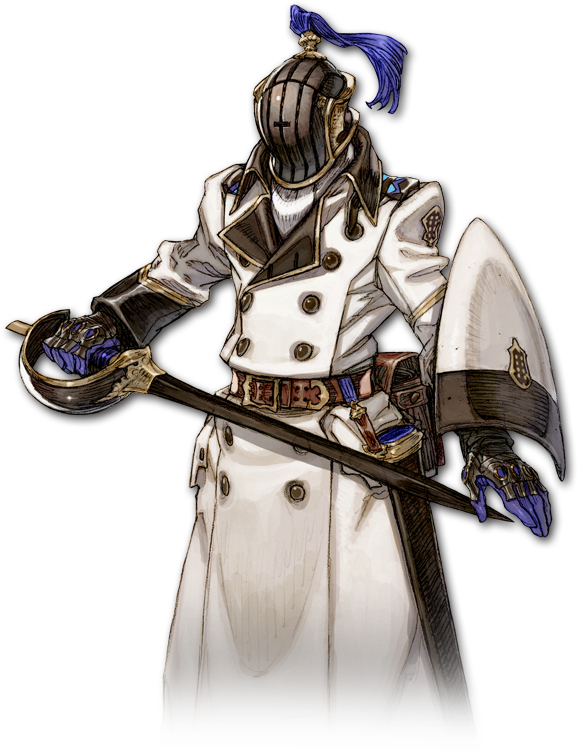

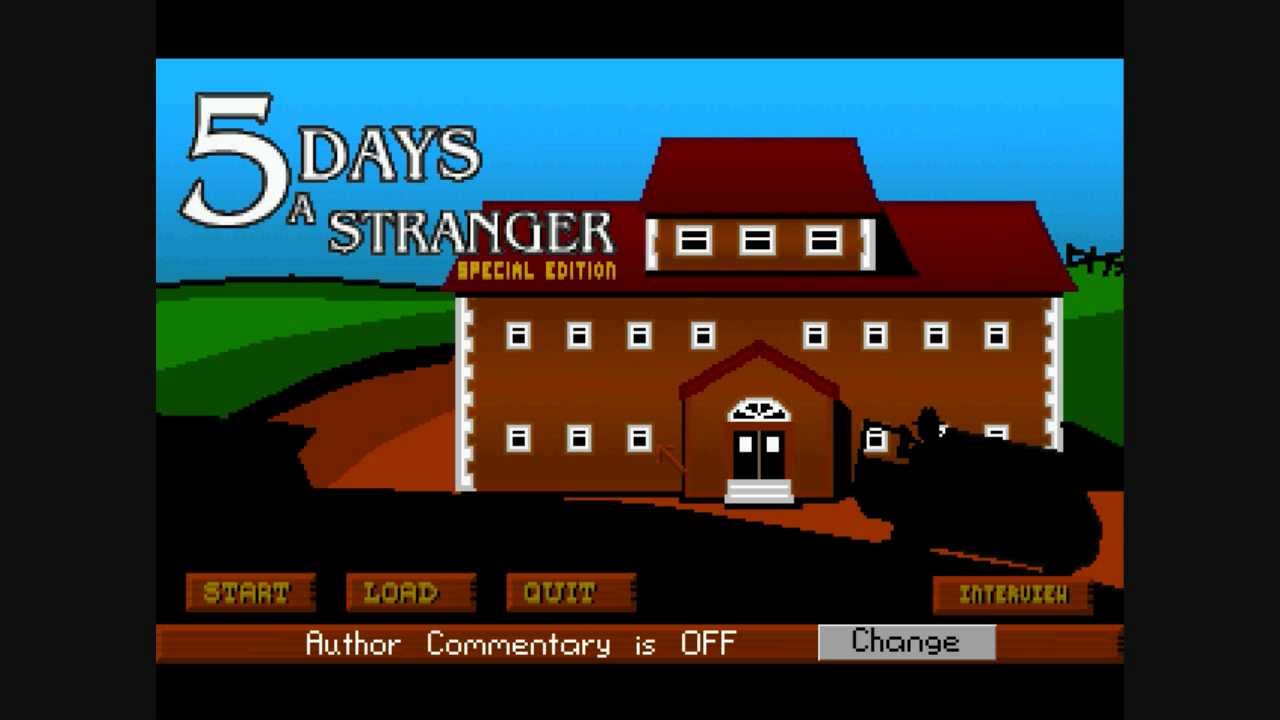
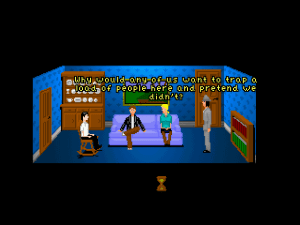 Made with AGS (Adventure Game Studio) in 2003, 5 Days a Stranger is a refreshing attempt of rescuing the genre, popularized by Sierra and LucasArts with titles such as Leisure Suit Larry and Monkey Island. It’s an excelent adventure game in its own right, being by the time of its release Yahtzee’s most competent game in terms of art, and from a game design standpoint, very well thought, aside from a few pixel hunt sequences which can annoy its player into resorting to a walkthrough, though that was long common in adventure games anyway. 5 Days a Stranger went on to win several awards as an indie adventure game. This, in 2003, was quite an achievement

 Through the Shattered Lens
