The TSL’s Grindhouse: Private Wars (dir by John Weidner)


The 1993 action film, Private Wars, tells the story of a neighborhood, a big evil businessman, and one drunk private investigator who likes to shoot things.

The big evil businessman is Alexander Winters (played by Stuart Whitman).  Winters is so evil that he probably spends at least three hours every night practicing his smirk.  He’s the type who will plot someone’s death and then laugh about it just to make sure that it’s understood that he’s totally evil.  Winters wants to build a new business complex but there’s a neighborhood sitting on the land that he wants to use and no one’s willing to move.

However, Winters has a plan to bring about change.  If the people in the neighborhood won’t move voluntarily, he’ll just make them flee for their lives.  Winters pays off some local gangs to create trouble in the neighborhood.  Soon, stores are exploding and windows are getting broken and obscene graffiti is showing up on walls.  Everyone in the neighborhood keeps going to the community center and debating what to do.  You have to wonder why the gangs are wasting their time vandalizing storefronts when they could have just blown up the community center and taken out every who was in their way.

Eventually, the community decides to hire someone to teach them how to defend themselves.  After auditioning a series of ninjas and other wannabe soldiers of fortune, the community hires Jack Manning (Steve Railsback).  Why do they hire Jack Manning?  Well, he’s a friend of one of the community leaders.  He’s also an alcoholic who shoots his car whenever the engine starts giving him trouble.  How exactly anyone could look at Jack — who is not only almost always drunk but also a bit on the short and scrawny side — and think that he could protect the neighborhood is an interesting question that the film doesn’t really explore.

Anyway, the community is soon fighting back, which turns out to be a lot easier than anyone imagined.  Eventually, Jack ends up in jail as a result of Winters’s corruption but fortunately, it’s while in jail that Jack meets a few guys who all have mullets and who all come back to the neighborhood to help Jack out when a bunch of ninjas try to take over the streets.  Winters may have ninjas but Jack has a bunch of petty criminals who look they’re all heading to a hockey game in Toronto.  It’s a fair fight.

To be honest, the main thing that I will always remember about Private Wars was just how unnecessary Jack eventually turned out to be.  For all the money that he was apparently being paid, he really doesn’t do much.  I guess he does teach people in the neighborhood the techniques of self-defense but the film is so haphazardly edited that it’s hard to be sure of that.  It’s entirely possible that everyone already knew how to fight but they were just hoping Jack would do it for them.  Watching the film, it’s easy to get the feeling that the folks in the community center took one look at Jack and said, “Well, shit …. I guess we gotta do this ourselves.”  Even the final confrontation between Jack and Winters is resolved by a third character.  Imagine Roadhouse if Patrick Swayze spent the whole movie sitting at the bar and you have an idea what Private Wars is like.

Private Wars is really silly but, possibly for that very reason, it’s also occasionally fun in its own stupid way.  If nothing else, Stuart Whitman and Steve Railsback appeared to be enjoying themselves.  The movie’s on YouTube.  I watched it last Monday as a part of the #MondayActionMovie live tweet and I enjoyed myself.

Film Review: Shelter (dir by Wrion Bowling and Adam C. Caudill)


The 2012 film, Shelter, opens in an ominous and sterile-looking room.  There are bunk beds.  There are shelves that appear to be full of supplies.  There’s a table where people could possibly sit down and talk or play cards.  There’s a shower stall, with a shower curtain providing a little bit of privacy.

There are also several people in the room.  One woman is asking what they’re going to do.  In the shower, another woman is crying.  We can tell by looking at the inhabitants of the room that they’ve been in the room for a while and that they’re all losing whatever grip they once had on sanity.

And really, even though we don’t know what’s going on, we can all relate.  We can probably relate better in 2020 than audiences could in 2012.  Most of us have, in one way or another, been sheltered in place since at least March and — surprise!  — it turns out that all of those “We’re all in this together” commercials didn’t make anyone feel any better about the idea of not even being able to go outside without having to first put on a mask.  It’s not just the feeling of claustrophobia or humanity’s natural inclination to resent being ordered around.  It’s also that it’s hard to be happy when you don’t have the freedom to live your own life.  When someone is continually told that what they want isn’t important and that their fate is in the hands of some unseen regulator, who can blame them for going a little crazy?  That certainly would appear to be the situation in which the characters in Shelter have found themselves.

The film flashes back to the day that five strangers first found themselves locked away in the shelter.  They entered the room because an alarm went off.  None of them knew what the room was but, shortly after entering, they heard an explosion and felt the ground shake.  On a monitor, they saw a bright flash of light apparently vaporize the city above them.  They also found a note that explained that the room was designed to provide safety from a nuclear attack.  According to the note, they had enough food to last for several years.  Of course, the note also stated that the shelter was built and stocked with two inhabitants in mind, as opposed to five.

We follow the five survivors as they get to know each other and as they adjust to life in the shelter.  It doesn’t take long for them to settle into their new routine.  There’s really nothing else for them to do but accept the situation.  The room is locked and the doors are not going to open until a computerized system determines that it’s safe for the inhabitants to leave.  They’re stuck together so they might as well play cards and just wait it out.

Of course, things don’t work that smoothly.  The hours turn into days and the days turn into months and soon, petty annoyances become major disagreements.  Some of the survivors seem to be content with the idea of staying in the shelter forever while others think about escape.  Some start to wonder if there’s even actually been a war….

Shelter is a good thriller about human nature and just how much isolation and claustrophobia someone can take before they snap.  The characters are all well-defined and well-acted and the film made good use of its low-budget, with that sterile bunker ultimately becoming as much of a character as the people trapped inside of it.  The film ends with a twist that, while not completely unexpected, was still satisfying nonetheless.

Shelter‘s on Prime so watch it the next time you’re feeling trapped.

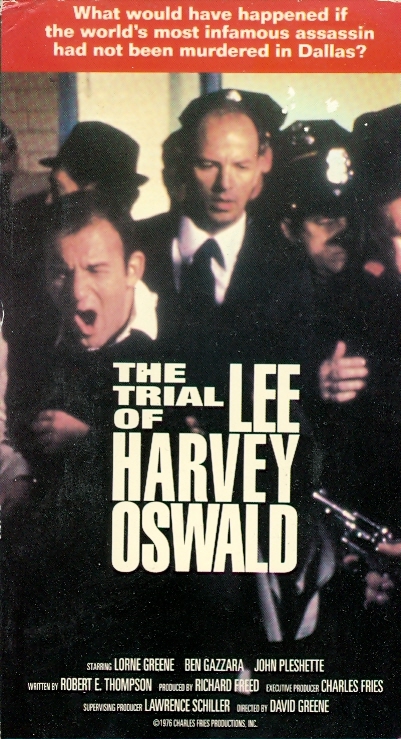
The Trial of Lee Harvey Oswald (1977, directed by David Greene and Gordon Davidson)


What if, instead of being shot by Jack Ruby, Lee Harvey Oswald had survived and been put on trial for the murder of President John F. Kennedy?

That’s the question asked by this television film.  John Pleshette plays Lee Harvey Oswald while Lorne Greene plays his attorney, Matt Weldon and Ben Gazzara plays the prosecutor, Kip Roberts.  The film imagines that the trial would have been moved to a small Texas town because Oswald presumably wouldn’t have been able to get a fair trial in Dallas.  While Roberts is forced to deal with his own doubts as to whether or not Oswald actually killed the President, Weldon is frustrated by Oswald’s paranoid and self-destructive behavior.  Oswald insists that he’s a patsy and that he was framed by “them” but he refuses to tell Weldon who they are.

With a running time of four hours, The Trial of Lee Harvey Oswald is a courtroom drama that tries to be fair to both sides and which ends with a frustrating cop-out.  While Weldon presents all of the evidence that real-life conspiracy theorists frequently cite in their attempts to prove Oswald’s innocence, Roberts makes the case that was presented in the Warren Commission.  Unfortunately, the film ends up trying too hard to avoid coming down on one side or the other and just proves that it’s impossible to be even-handed when it comes to conspiracy theories around the Kennedy assassination.  It’s either buy into the idea that it was all a huge conspiracy involving mobsters and intelligence agents or accept that it was just Oswald doing the shooting as a lone assassin.  Trying to come down in the middle, as this film does, just doesn’t work.

John Pleshette does a good job as Oswald and bears a passing resemblance to him.  Because the movie refuses to take a firm stand on whether or not Oswald’s guilty, the character is written as being a cipher who claims to be innocent but who, at the same time, also refuses to take part in his defense.  Pleshette plays up Oswald’s creepy arrogance, suggesting that Oswald was capable of trying to kill someone even if he didn’t actually assassinate JFK.  Both Greene and Gazzara are convincing as the two opposing attorneys, even if neither one of them really does much more than offer up a surface characterization.

The majority of the movie takes place in the courtroom, with a few flashbacks to Oswald’s past included to keep things from getting too stagnant.  When the film was made, people were still learning about the conspiracy theories surrounding the Kennedy assassination and The Trial of Lee Harvey Oswald might have had something new to tell them.  Seen today, the majority of the film’s evidence seems like old news.  The Trial of Lee Harvey Oswald never escapes the shadow of later films, like Oliver Stone’s JFK.

It’s hard not to regret that The Trial of Lee Harvey Oswald wasn’t willing to come definitively down on one side or the other.  Instead, it ends by telling us that we’re the jury and that the only verdict that matters is that one that we come up with.  They could have just told us that at the start of the movie and saved us all four hours.

Film Review: Miracle Mile (dir by Steve De Jarnatt)


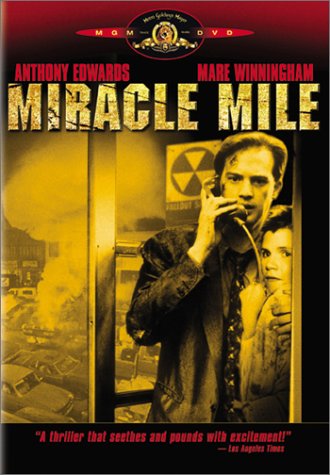
Last night, as I was watching the 1988 film, Miracle Mile, I found myself thinking about the fact that this film literally could not be made today.

No, it’s not because the film itself is about the treat of nuclear war.  Though nuclear war may no longer be as much of a cultural obsession as it apparently was back in the 80s, the fact of the matter is that the U.S., Russia, the UK, France, and China all still have nuclear weapons.  Pakistan, India, and North Korea all claim to have nuclear weapons.  It’s believed that Israel also has a few.  Iran is apparently working on developing an arsenal.  It’s estimated that there are currently 13,865 nuclear weapons in existence, 90% of which are divided between the U.S. and Russia.  That’s not even counting the threat of a terrorist group setting off a nuclear device.  In short, the threat of nuclear war is still very much a real one.

Instead, what truly makes Miracle Mile stand out as a film of its time, is the fact that almost the entire plot revolves around the character of Harry (played by Anthony Edwards) answering a Los Angeles pay phone at four in the morning.

Why is Harry answering a pay phone at 4 in the morning?  It’s because, earlier, he met Julie (Mare Winningham) at the La Brea Tar Pits and they fell instantly in love.  After spending most of the afternoon together, they made a date to meet at the local diner where Julie worked as a waitress.  Julie’s shift ended at midnight.  Harry went home to get a quick nap before picking her up.  Unfortunately, a power failure — one that was largely caused by Harry carelessly tossing away a cigarette — resulted in Harry’s alarm not going off.  At midnight, while Julie was standing outside the diner, Harry was asleep.

Harry doesn’t wake up until well-past 3 a.m.  After hastily getting dressed, Harry drives down to the diner.  When he arrives, he bumps into a tree and three rats fall off the branches and land on his car, which is a bit of an ominous omen.  (After watching the movie, I did a Google search and discovered that it’s actually not uncommon for rats to hang out in palm trees after dark.  I had no idea.  I’m glad I don’t live near any palm trees.)

By the time Harry arrives, Julie’s already gone.  From the payphone outside the diner, Harry calls Julie and leaves an apologetic message on her answering machine.  (Julie sleeps through it.)  Within minutes of Harry hanging up, the pay phone rings again.  Harry answers it, expecting to speak to Julie.  Instead, he finds himself talking to a panicked soldier who was trying to call his father but who dialed the wrong area code.  The soldier says that a war is about to break out and that everyone is going to die.  Suddenly, Harry hears what sounds like a gunshot.  Another voice gets on the phone and tells Harry to go back to sleep and forget about the call.

Of course, the reason why this story couldn’t take place in 2020 is pretty obvious to see.  No one uses pay phones anymore.  If the movie were made today. Harry would have just Julie on his own phone and then waited for her to call him back.  The soldier would never have misdialed his father’s area code.  Harry never would have gotten the message that the world was about to end and most of the subsequent events in Miracle Mile never would have happened.  Harry would have just sat in the diner and had a cup of coffee and waited for Julie to call until the inevitable happened.  In 2020, that would have been the movie.

So, let’s be happy that this film was made in 1988. during the time when pay phones were everywhere, because Miracle Mile is an excellent film.  Miracle Mile starts out as a romantic comedy, with Anthony Edwards and Mare Winningham making for an incredibly adorable couple.  Then, after Harry answers that pay phone, the movie grows increasingly grim as Harry desperately tries to make his way to Julie and arrange for the two of them to board a plane that a mysterious woman (Denise Crosby) has charted for Antarctica.  The problem, of course, is that in order to reach Julie, Harry is going to need the help of the type of people who are typically up and wandering around at 4 in the morning in Los Angeles.  Several people die as Harry tries to make it to Julie and, smartly, the film doesn’t just shrug off their deaths.  For the majority of the film, Harry isn’t even sure if there’s actually going to be an attack and it’s possible that he’s not only panicking over nothing but that he’s causing others to panic as well.  People are dying because of that phone call and Harry doesn’t even know whether it was real or not.  Even when full scale rioting breaks out, Harry doesn’t know if it’s because the world’s ending or because of a bad joke that he took seriously.  Transitioning from romantic comedy to dark comedy, Miracle Mile eventually becomes a nightmare as it becomes obvious that, even if Harry does reach Julie, escaping the city is not going to be easy.  The sun is rising and the truth is about that phone call is about to revealed….

Miracle Mile is a film that will get your heart racing.  On the one hand, Anthony Edwards and Mare Winningham have such a wonderful chemistry and they’re both just so damn likable that you want them to find each other and stay together.  Even if it means running the risk of being incinerated in a nuclear explosion, you want Harry and Julie to be with each other.  At the same time, you watch the movie with the knowledge that, even if they do manage to reunite, it might not matter because the world’s going to end.  Remarkably, almost everyone who Harry talks to about the phone call believes him when he says that a war is about break out.  Almost all of them have a plan to escape and, as a viewer, you get so wrapped up in the film that it’s only later that you realize that none of their plans made any sense.  Hiding out in Antarctica?  How exactly is that going to work?  Antarctica’s not exactly a place to which you impulsively move.  If there is truly no way to escape the inevitable, perhaps we should just be happy that Julie and Harry found love, even if it was right before the apocalypse.

White Rush (2003, directed by Mark L. Lester)


Five friends, while on their annual camping trip outside of Salt Lake City, stumble across a cocaine deal gone bad.  They think that all of the drug dealers have been killed and Chick (Louis Mandylor), who happens to be a police detective, suggests that they should take the cocaine for themselves and sell it to the local drug lord.  Everyone agree but Eva (Tricia Helfer), a former addict who is so disgusted by Chick’s plans that she runs away from the group.

While she’s stumbling through the wilderness, Eva runs into Brian Nathanson (Judd Nelson), the sole survivor of the drug deal.  Determined to get his cocaine back, Brian convinces Eva to help him out by explaining to her that there’s an even worse drug dealer than him who also wants the cocaine.  In fact, that even worse drug dealer has already sent a sexy assassin named Solange (Sandra Vidal) to kill everyone involved in the botched drug deal.  The obvious solution would be to just return the drugs to Brian and let him take the fall but Chick and his friends aren’t that smart.

A film starring Judd Nelson and directed by Mark L. Lester, the man behind such classics as Class of 1984 and Commando?  Sounds pretty good, right?  Actually, the film isn’t bad.  Or, at least, it’s better than you’d expect from a low budget, direct-to-video Judd Nelson movie.  Even though the plot may be full of holes that you could drive a semi-trailer truck through, Mark L. Lester doesn’t waste any time getting the story rolling and he keeps the action moving.  Lester knows better than to pretend that this movie is anything more than just a B-action movie.  Judd Nelson gives one of his better performances as Brian, playing him as if John Bender grew up and became a drug dealer.  (We all knew that was going to happen, no matter what happened at the end of The Breakfast Club.)  Finally, Sandra Vidal is sexy and convincingly lethal as Solange.

White Rush is currently available on Tubi and Prime.

Film Review: Massive Retaliation (dir by Thomas A. Cohen)


The 1984 film, Massive Retaliation, was made before I was even born but I still feel as if it was specifically designed to annoy me.

Consider this:

The movie begins with an endless folk song playing over the opening credits.  It’s one of those peace and love folks songs that goes on forever.  I recently did some research on the folk music of the 50s, 60s, and 70s and what I discovered is that folk singers were (and are) essentially the most self-important people on the planet.  (Pete Seeger apparently went to his grave convinced that he was single-handedly responsible for getting Lyndon B. Johnson to withdraw from the 1968 presidential election.)  When a film about nuclear war opens with a folk song, it’s never a good sign.

The film then cuts from the folk singers to a bunch of screaming kids in a van.   I mean, seriously …. AGCK!  The kids are on a road trip and the van is being driven by their older brother, Eric (Jason Gedrick).  Eric tries to keep the kids quiet but it doesn’t work, mostly because Eric is kind of a wimp.  Unfortunately, Eric picked the wrong time to go on a road trip because it looks like a nuclear war is about to break out and his parents and their friends are all heading up to a compound that they built up in the hills.

(It’s supposed to be a secret compound but it’s sitting right out in the open and there’s a paved road leading up to it so ….. yeah.  Good job.)

Anyway, the first half of the movie is divided between scenes of the adults and the kids heading to the compound.  This leads to the two groups encountering a lot of other people who are reacting to the threat of war.  This also leads to a lot of half-baked monologues about war and human nature.  The rednecks are excited about the prospect of the world ending.  Eric’s dad (Peter Donat) is looking forward to restarting civilization in the compound.  Every old person who shows up in the movie says something like, “There’s always been a war.”  The film tries way too hard to be profound, which is always an annoying trait.

Eventually, Bobcat Goldthwait shows up as a member of an evil redneck crew who wants to steal some gasoline.  Despite the fact that this is meant to be a serious film, Goldthwait uses a variation of his Bobcat voice in the role and it creates a weird effect.  Perhaps that’s the message of the film.  When society collapses, comedians will become warlords….

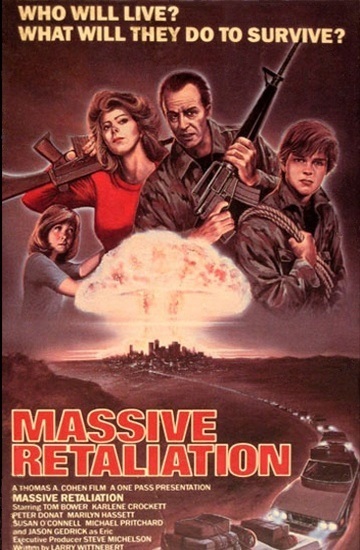
Anyway, Massive Retaliation is one of those self-righteously liberal and largely humorless films has a lot that it wants to say about war and humanity and society but …. eh.  Who cares?  I mean, I guess if I wanted to, I could make the argument that there are parallels to the film’s depiction of society collapsing over the possibility of war to the way some people are reacting to the COVID-19 pandemic but that would just be me trying to make this film sound more interesting than it actually is.  To be honest, the best thing about the film is the poster below, which looks like it was made for a different, better movie:

Massive Retaliation is nowhere as fun as this poster.  Instead, it’s a film that begins with folk music and ends with children forming a circle of peace.  Seriously, was this film just made to give me a migraine?

The Strangers in 7A (1972, directed by Paul Wendkos)


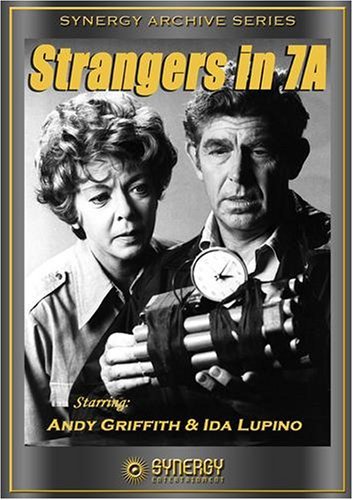
Artie Sawyer (Andy Griffith) is a man who no one respects.  Having recently been fired from his long-time job, he’s forced to take a job as a superintendent for an apartment building in New York.  The tenants don’t think much of him.  His wife, Iris (Ida Lupino), is getting tired of his self-pity.  The only person who seems to like Artie is Claudine (Susanne Benton).  The young and beautiful Claudine approaches Artie in a bar and, after flirting with him, reveals that she needs a place to stay.  Artie agrees to let Claudine check out Apartment 7A.  At the apartment, Claudine rolls around in the bed, dances seductively, and then reveals that she has three male friends who are going to be staying in the apartment with her.  Billy (Michael Brandon), Virgil (Tim McIntire), and Riff (James A. Watson, Jr.) all served in Vietnam together and now they need to crash at the apartment for a while.  Artie can either let them stay or they can reveal to his wife that he was at a bar, trying to pick up young women.

Led by the psychotic Billy, the three men are planning on robbing the bank next door.  When Artie, who is having doubts about whether or not it was a good idea to let four obviously unstable people live rent-free in his building, discovers their plans, he and Ida are taken hostage.  When the bank robbery goes wrong, Billy tries to use the hostages and a bomb as leverage for his escape from the police.

As far as films about bank robberies goes, The Strangers in 7A is no Dog Day Afternoon.  While it’s interesting to see the usually confident Andy Griffith play a loser, he never seems like enough of a loser that he would actually risk a job that he clearly needs just because Claudine flashed a little leg at him.  Even when he’s playing a character who is down on his luck, he’s still Andy Griffith.  Along with the lead role being miscast, the bank robbers are too generic to really be credible or threatening.  Susanne Benton is sexy as the femme fatale and Ida Lupino is sympathetic as Artie’s wife but otherwise, The Strangers in 7A is forgettable.

The Strangers in 7A was made for television.  At the time, Andy Griffith was still trying to escape being typecast as Mayberry’s amiable Sheriff Taylor.  Griffith was a convincing villain in movies like Pray For The Wildcats and Savages but he’s just not believable as a loser in this film.

Film Review: Countdown to Looking Glass (dir by Fred Barzyk)


“The world’s ending!  Let’s watch the news!”

That, in a nutshell, is the main theme of the 1984 film, Countdown to Looking Glass.  It’s a film that imagines the events leading up to an atomic war between the United States and Russia.  It’s designed to look like a newscast.  A distinguished anchorman named Dan Tobin (played by a real-life anchorman named Patrick Watson) gravely discusses the conflict between the two countries.  Another reporter (played, somewhat jarringly given the film’s attempt to come across as authentic, by Scott Glenn) reports from an aircraft carrier.  We see a lot of stock footage of planes taking off and world leaders meeting and people fleeing from cities.

There are a few scenes that take place outside of the newscast.  They involve a reporter named Dorian Waldorf (Helen Shaver) and her boyfriend Bob Calhoun (Michael Muprhy).  (If your name was Dorian Waldorf, you would kind of have to become a television news reporter, wouldn’t you?)  Bob works for the government and has evidence that the world is a lot closer to ending than anyone realizes.  Dorian tries to put the evidence on air but Dan tells her that they can’t run a story like that with just one source.  It would be irresponsible…. when was this film made?  I guess 1984 was a lot different from 2020 because I can guarantee you that CNN, Fox, and MSNBC would have had no problem running Dorian’s story and creating a mass panic.

(If Dan Tobin’s ethics didn’t already make this film seem dated, just watch the scene where Tobin announces that, because of the growing crisis, the networks will now be airing the news for 24 hours a day.  From the way its announced, it’s obvious that this must have been a radical and new idea in 1984.)

Still, despite those dramatic asides, Countdown to Looking Glass is largely set up to look like a real newscast.  We get stories about people naively singing up to serve in the army because they think war will be fun.  We get interviews with a group of experts playing themselves.  (The only one who I recognized was Newt Gingrich.)  Everyone discusses the dangers of nuclear war and also whether or not humanity could survive an exchange of nuclear weapons.  No one sounds particularly hopeful.  Dan Tobin says that he always believed that nuclear war was inevitable but that the sight of all of the destruction would cause the combatants to come to their senses.  That sounds a bit optimistic to me and the film suggests that Dan has no idea what he’s talking about.

In the end, Countdown to Looking Glass is a victim of its format.  The newscast itself is rather dull, as most newscasts tend to be.  Even the scenes that take place outside of the newscast tend to feel rather awkward, as if Murphy and Shaver were recruited for their roles at the last minute.  In the end, Countdown to Looking Glass works best as a historical artifact.  This is what a news report about the end of the world would have looked like in 1984.  Watch it and compare it to how the news is covered in 2020.

Speaking of watching it …. well, it’s not easy.  It’s never been released on video but you can watch it on YouTube.  The upload’s not great but that’s pretty much your only option.

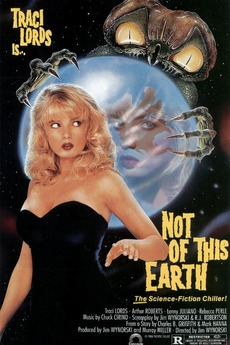
Cinemax Friday: Not Of This Earth (1988, directed by Jim Wynorski)


Since today is director Jim Wynorski’s birthday, I want to review one of his early films.

A remake of the Roger Corman classic, Wynorksi’s Not Of This Earth stars Traci Lords as Nadine Story, a nurse who works in the office of Dr. Rochelle (Ace Mask) and who has a boyfriend named Harry (Roger Lodge) who is also a cop.  (The leads to jokes like, “Harry called.  He said he left his nightstick with you last night.”)  Dr. Rochelle’s main patient is the mysterious Mr. Johnson (Arthur Roberts), who dresses in all black, always wears sunglasses, and who needs frequent blood transfusions.  When Dr. Rochelle takes a look at Mr. Johnson’s blood, he sees that Mr. Johnson has a strange blood disease that has apparently never been discovered before.  Dr. Rochelle sends Nadine over to work at Mr. Johnson’s home as his private nurse.  Of course, Mr. Johnson is not of this Earth.  His planet is dying and, as Nadine discovers, he is on Earth to search for a new supply of blood.

Wynorski’s version of Not Of This Earth follows the exact same plot of the Corman original, right down to having a door-to-door vacuum cleaner salesman fall victim to the alien’s bloodlust.  (In the original, the salesman was played by Dick Miller.  In the remake, he’s played by Michael Delano.  Miller does not even get a cameo in the remake of Not of this Earth, which is surprising considering it was still a Corman production and Wynorski previously cast Miller in Chopping Mall.)  They’re both enjoyable movies, especially if you’re in the mood for something that won’t require much thought.  The main difference between the the two versions of Not of this Earth is that the Wynorski version features a lot more nudity and that it makes no pretense towards being anything other than a comedy.

This was Traci Lords’s first role in a non-adult film and she knocks it out of the park.  The scandal surrounding her adult film career has always overshadowed the fact that, for all of her notoriety, Traci Lords was actually a pretty good actress who could handle comedy.  While the deliberately campy humor in Not of this Earth is no one’s definition of subtle, Lords shows good comedic timing and, most importantly, she delivers her lines with a straight face and without winking at the audience.

Wynorski later said that the movie was so popular on video that he was able to buy a house with his share of the profits.  Not of this Earth is a classic Wynorski production, featuring everything that made Jim Wynorski a late-night cable and direct-to-video favorite in the 90s.

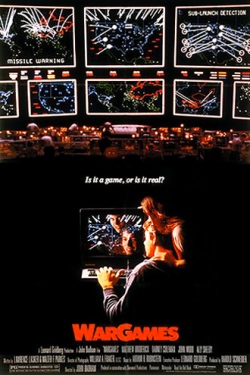
Film Review: Wargames (dir by John Badham)


If you thought Tom Cruise nearly started a war in Top Gun, you should see what Matthew Broderick did three years earlier in Wargames!

In Wargames, Broderick plays David Lighter, a dorky but likable teenager who loves to play video games and who spends his spare time hacking into other computer systems.  (Of course, since this movie was made in 1983, all the computers are these gigantic, boxy monstrosities.)  Sometimes, he puts his skills to good use.  For instance, when both he and Jennifer (Ally Sheedy) are running the risk of failing their biology class, he hacks into the school and changes their grades.  (At first, Jennifer demands that he change her grade back but then, a day later, she asks him to change it again.  It’s kind of a sweet moment and it’s also probably the way I would have reacted if someone had done that for me in high school.)  Sometime, David’s skills get him into trouble.  For instance, he nearly destroys the world.

Now, keep in mind, David really didn’t know what he was doing.  He was just looking for games to play online.  He didn’t realize that he had hacked into NORAD and that Global Thermonuclear War was actually a program set up to allow a gigantic computer named WOPR to figure out how to properly wage a thermonuclear war.  David also doesn’t know that, because humans have proven themselves to be too hesitant to launch nuclear missiles, WOPR has, more or less, been given complete control over America’s nuclear arsenal.

(Wargames actually starts out with a chilling little mini-movie, in which John Spencer and Michael Madsen play two missile technicians who go from joking around to pulling guns on each other during a drill.  Of course, Madsen’s the one ready to destroy the world.)

Of course, the military folks at NORAD freak out when it suddenly appears as if the Russians have launched a nuclear strike against Las Vegas and Seattle.  (Not Vegas!  Though really, who could blame anyone for wanting to nuke Seattle?)  In fact, the only thing that prevents them from launching a retaliatory strike is David’s father demanding that David turn off his computer and take out the trash.  However, WOPR is determined to play through its simulation, which pushes the world closer and closer to war.  (One of the more clever — and disturbing — aspects of the film is that, even after the military learns that the Russians aren’t planning the attack them, they still can’t go off alert because the Russians themselves are now on alert.   Once the war starts, it can’t be stopped even if everyone knows that the whole thing was the result of a mistake.)

With the FBI looking for him, David tries to track down the man who created WOPR, Dr. Stephen Falken (John Wood).  However, Falken is not easy to find and not as enthusiastic about saving the world as one might hope….

Watching Wargames was an interesting experience.  On the one hand, it’s definitely a dated film.  (Again, just look at the computers.)  At the same time, its story still feels relevant.  In Wargames, the problem really isn’t that WOPR wants to play a game.  It’s that men like Dr. John McKittrick (well-played by Dabney Coleman) have attempted to remove the human element and have instead put all of their faith in machines.  The appeal of a machine like WOPR is that it has no self-doubt and does whatever needs to be done without worrying about the cost.  But that’s also the reason why human beings are necessary because the world cannot be run on just algorithms and cold logic.  That’s a theme that’s probably even more relevant today than it was in 1983.

Wargames is also an exceptionally likable film.  In fact, it’s probably about as likable as any film about nuclear war could be.  On the one hand, you’ve got everyone at NORAD panicking about incoming missiles and then, on the other hand, you’ve got David and Jennifer having fun on his computer and trading flirty and silly quips.  Matthew Broderick and Ally Sheedy are both likable in the two main roles.  Broderick brings a lot of vulnerability to the role of David.  (David Lightner is a far more believable teenager than Ferris Bueller.)  He handles the comedic scenes well but he’s even better as David grows increasingly desperate in his attempts to get the stubborn adults around him to actually listen to what he has to say.  When it appears the only way to save the world is to swim across a bay, David is forced to admit that he’s never learned how to swim because he always figured there would be time in the future.  Yes, it’s a funny scene but the way Broderick delivers the line, you understand that David has finally figured out that there’s probably not going to be a future.  It’s not that he doesn’t know how to swim.  It’s that he’ll never get the chance to learn or do anything else for that matter.

Wargames is definitely a film of its time but its themes are universal enough that it’s a film of our time as well.