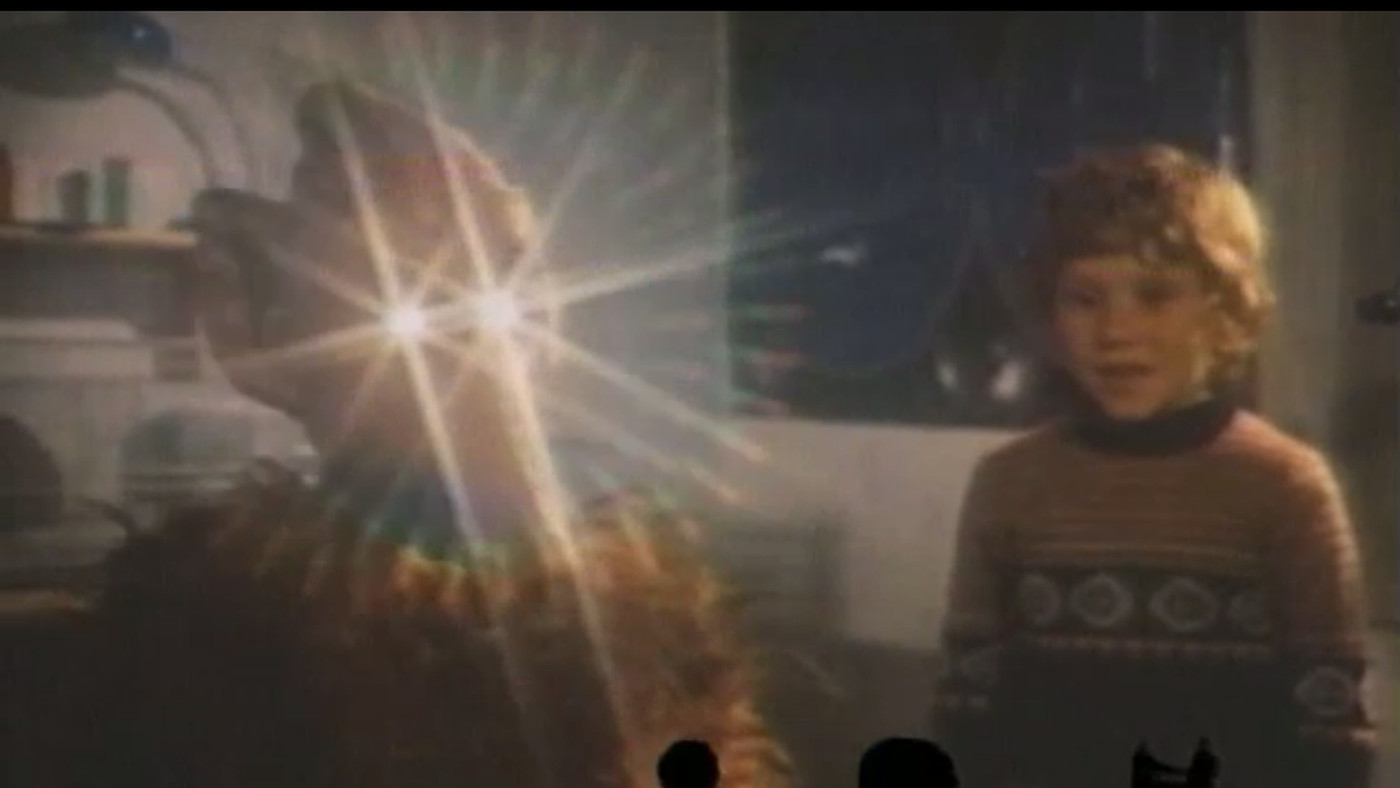
Everyone knows about Trumpy, the snorkel-nosed alien with telekinetic powers who befriend a lonely boy and a really bad band while his mother killed people in the forest. He was one of the stars of Pod People, which was famously lampooned by Mystery Science Theater 3000 in 1991. It became one of MST 3K’s most beloved episodes. Audiences loved the the attempts to by Joel and the Bots the decipher the song that the band is first seen performing. Was it Idiot Control Now or Tires Are Ready To Roll Now? They also loved Trumpy showing off his cool but ultimately useless powers. But why was Trumpy so good but Trumpy’s mom was so evil?
The reason is because Trumpy wasn’t originally supposed to be in the movie. Originally, the movie was just going to be about Trumpy’s mom killing poachers and stalking the band when their van broke down in the woods. But then a little movie called E.T. became a worldwide hit and the film’s backers decided that the movie needed a cute alien. Director Juan Piquer Simon, best known for the relentless gore fest that was Pieces, created Trumpy and had him befriend a child. The film became the only killer alien film made for a family audience. Families came for the cuteness of Trumpy and stayed for the scenes of Trumpy’s mom stalking a woman while she took a shower.
Weird, weird film. Have you ever tried to watch Pod People without Joel and the Bots to help you make you way through it? It’s not recommended but it can be done. A non-MST 3K version has been released on DVD under the film’s original title (Extra Terrestrial Visitor) but the movie is really boring without anyone making jokes. You can make your own jokes, I guess. You probably will.
No, Pod People is a film to watch with the Satellite of Love crew. With them, it’s a classic.
Jim Jarmusch’s The Dead Don’t Die is a film that has definitely grown on me. When I first watched it, I thought it was intriguing but perhaps a bit too cutesy and enamored with itself. However, I’ve subsequently come to realize that, actually, Jarmusch finds just the perfect tone for his look at our zombie-saturated culture.
In the scenes below, Bill Murray, Chloe Sevigny, and the wonderful Adam Driver all deal with the inevitability of doom that comes with being a character in a zombie film.
Watch today’s Horror on the Lens and find out! From 1959, it’s Teenagers From Outer Space! In this film, a bunch of teenage-looking aliens come to Earth so that they can raise lobsters. Things don’t really go as planned, of course. The teens have ray-guns that can transform anyone intto a perfectly preserved skeleton. It’s sad to think that they could come up with the technology to power their ray-guns and to pilot their spaceshiip but not to raise lobsters on their own planet.
It’s a damn shame.
Anyway, I hope you’re ready to cry because it’s time for …. TEENAGERS FROM OUTER SPACE!
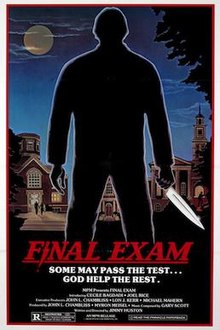
The 1981 slasher film, Final Exam, opens with a familiar scene. A couple is making out in a car. A man (played by Timothy L. Raynor) comes along and kills them both.
Why does the man do this? Is he an escaped mental patient, like the killer who always appear in the urban legend about the man with the hook? Is he an angry father, upset that students have been parking near his farm and corrupting his children with their sinful ways? Is he an occultist, hoping that a blood sacrifice will bring about the end of the world? Is he a jilted lover or an unemployed day laborer or a zombie or an international assassin or a former fat boy looking for vengeance on the students who pulled the prank that caused him to drop out of college? Seriously, what is this guy’s deal!?
We never find out. That, in itself, makes Final Exam unique. The Killer is not only not given a motive, he’s not even given a name! He’s just someone who shows up and starts killing. No one knows him and he doesn’t appear to know anyone that he kills. The fact that he’s so anonymous is actually a factor in the film’s favor. The flamboyant motivations that are given to most slasher villains tend to serve as a distancing device for the audience. It’s easy, for instance, to dismiss Jason Voorhees because we know that the idea of him drowning and then somehow showing up in the woods just doesn’t make any sense. The convoluted backstory of Michael Myers (or at least the Myers who was present in the original, pre-reboot Halloween films) eventually became so ludicrous that it made it easier for audiences to say, “Well, it’s just a move.” Final Exam‘s motiveless killer is actually far more true to life. In real life, it’s rare that we ever learn the motives behind the crimes. By making the Killer anonymous, Final Exam takes away one of the tools that the audience can use to assure themselves that it’s only a movie.
Unfortunately, the scenes following the opening murder are so inept that the audience is instantly reminded that they’re just watching a movie and not a particularly well-made one at that. It’s final exam time on campus but several students aren’t ready to take their Chemistry exam. So, a fraternity fakes a shooting spree — yes, you read that correctly — and manages to get the exam delayed for a day. That means that, while all of the other students have gone home, the chemistry students stay on campus so that they can study for their final exam. And, of course, the killer is on his way to the campus as well….
While the killer makes his way to campus, we sit through several scenes of campus hijinks. It’s a weird mix of horror and comedy. We meet a few students who are obviously destined to victims. Neurotic Radish (Joel S. Rice) is likably nerdy. Lisa (DeAnna Robbins) is having an affair with one of her professors, but at least she has a great first name. The frat boys are doing steroids and tying each other to trees. Apparently, spending the night tied to a tree is some sort of initiation ritual. That’s not a good situation to find yourself in when there’s a killer stalking the surrounding area.
Yes, the killer does eventually arrive on campus but it seems to take him forever. Once he does arrive, he starts killing everyone that he meets and, again, his lack of motivation makes him far more disturbing and frightening than he has any right to be. It really is the ultimate nightmare. Not only is someone trying to kill you but he’s doing it just because. There’s no reason for his actions and therefore, there’s no way to talk him out of it. There’s no secret to distracting or stopping him. You just have to run and hope you can escape. Cecile Bugdadi plays Courtney, who is pretty obviously destined to be the final girl. She gives a good performance and you definitely want her to escape but again, the film is so poorly paced that, by the time she gets her chance to face the Killer, the majority of the audience will probably have checked out, either mentally or physically.
Final Exam has a cult following, which I kind of understand. It really is the epitome of what people imagine when they imagine a typical, low-budget, early 80s slasher film. It represents an era. But for me, it’s just too uneven to work.
Enrique Monteverde (Jose Diaz) lives in a mansion in Guatemala. He’s an old man, one who look harmless on first glance. He always has an Oxygen tank nearby. His family says that he’s suffering from Alzheimer’s and, therefore, can’t always be held responsible for some of the things that he might say. He shamelessly leers at the younger woman who work in his home. His family says that he’s always been a flirt but he doesn’t mean any harm or offense. His family insists that he’s just an old man with dementia who is hoping to pass away peacefully while surrounded by his loved ones.
The protestors who gather daily outside of Enrique’s mansion have a different opinion of the man. They chant and hold up signs illustrated with the faces of their missing relatives. Before he retired, Enrique was a general. He fought the communist guerillas. Previously, he was convicted of committing genocide against the indigenous people of Guatemala but his conviction was overturned by a higher court. There are other retired generals who know that, if Enrique had gone to prison, it would not have been long until they followed him. Just because people are going on trial and even getting convicted, that’s not guarantee of justice.
Enrique’s wife, Carmen (Margarita Kenefic)m insists that Enrique is innocent and that all of his accusers are lying. Enrique’s daughter, Natalia (Sabrina De La Hoz), is less sure while his granddaughter, Sara (Ayla-Elea Hurtado), just thinks of Enrique as being her somewhat goofy grandfather. Meanwhile, his housekeeper, Valeriana (Maria Telon), remains strangely devoted to him. Even after a scared and confused Enrique fires a gun in the house because he swears he heard someone moving in the darkness, Valeriana stays. The rest of the household staff quits. Alma (María Mercedes Coroy), a young woman from Valeriana’s village, comes to the home to work as a maid.
Enrique continues to insist that some sort of curse has been placed over the mansion and that something evil has entered the house. Is he just suffering, as his family assumes, from dementia or is he correct? Even as the protests continue outside and the enigmatic Alma hints that she has a secret of her own, Carmen finds herself haunted by nightmares and visions of her husband’s crimes.
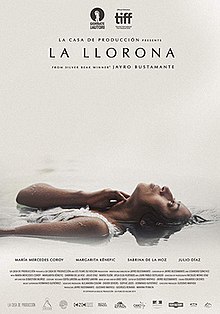
La Llorona is a film that combines two horrors, one legendary and one very real. There is, of course, the legend of the weeping woman. She is said to haunt the night, crying for her drowned children and, in some cases, killing anyone who tries to help her. And there’s the very real horror of the war crimes that were committed, by various military dictatorships, against the indigenous people of Central and South America. Though Enrique may be a fictional creation, the crimes that he and others committed were not. La Llorona is more than just a haunted house story. It’s a film about the crimes of the past and how those crimes continue to haunt the present. Like many prominent men, Enrique is protected not by the loyalty of those he worked with but instead by the knowledge that the minute one guilty war criminal actually pays for his crimes, they’ll all end of paying. The political and legal establishment will do what it has to do to protect itself by protecting men like Enrique. But, as this film demonstrates, the sins of the past cannot be escaped in present.
Unfortunately, the premise is a bit more interesting than the execution. The film’s deliberate pacing often lends La Llorona a dream-like feel but, in other scenes, the film just feels slow. The idea of the legendary weeping woman acting as a sort of vigiliante is an interesting one but the story itself is a bit predictable. That said, the cast all give strong and memorable performances and the film uses the horror genre to discuss disturbing truths that many would rather ignore. Flawed or not, La Llorona is a good example of how the horror genre can be used to comment on the past and the present.
La Llorna was a Guatemala’s submission for the 2020 Oscar for Best International Film. Though it deserved a nomination for ambition alone, it didn’t make it beyond the 15-film shortlist. Fortunately, nominated or not, the film can currently be viewed on Shudder.
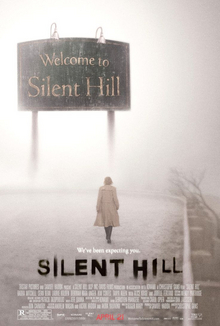
I first saw this movie way back in 2006, when it was first released into theaters. At the time, I knew nothing about Silent Hill, beyond the fact that it was based on a video game that a lot of my friends seemed to like. I have to admit that I had a really hard time following the plot and yet the film still totally creeped me out. The film was one of those movies that created such an atmosphere of impending doom that the real world looked and felt different when I left the theater. For the rest of that night, I found myself feeling paranoid about any sudden shadows.
I’ve watched Silent Hill or, at the very least, parts of Silent Hill a few more times over the years. The plot still makes little sense to me, though I am now a bit more familiar with the game that inspired the film. Over the years, a handful of the special effects have aged a bit poorly, with many of the once-fearsome monsters now looking somewhat cartoonish. And yet, when the film works, it really, really works. There are certain scenes in this film that still surprise and frighten me, even though I’ve already seen them. One character, for instance, is burned alive and I still have to look away when the fire consumes them. The thing is that, even if the CGI now looks a bit cartoonish, the atmosphere remains. That feeling dread continues to snake its way through every scene in the film and into the consciousness of the viewer.
I rewatched the film earlier today. I’m feeling nervous tonight. Maybe it’s just because I’ve got a lot of writing to do and we’ve got some home repair people coming by tomorrow to do some work. Or maybe, it’s because I’m worried that I’m suddenly going to find myself in some sort of shadow world, being menaced by blind but stabby nurses.
The film opens with Rose (Radha Mitchell) and her husband, Christopher (Sean Bean) trying to figure out why their adopted daughter, Sharon (Jodelle Ferland), is sleepwalking and having nightmares about a town called Silent Hill. Silent Hill is in West Virginia and was abandoned after a mysterious natural disaster. Rose decides that visiting the town is the best way to solve the mystery. However, after an automobile accident, Sharon disappears and Rose finds herself wandering around the town and getting attacked by monsters and occultists. Meanwhile, Christopher is also wandering around Silent Hill, accompanied by a helpful deputy (Kim Coates), but it’s hard not to notice that his Silent Hill seems to be signifcantly difficult from the Silent Hill that Sharon and motorcycle police officer Cybil (Laurie Holden) have found themselves in.
It’s a confusing plot but director Christopher Gans does such a good job of creating and maintaining the film’s creepy atmosphere that it doesn’t matter that you’re not always sure what’s going on. And while it’s true that there’s perhaps too many scenes of Sharon walking from place to place, there’s also some truly frightening scenes, like the one with all of those killer nurses. The film plays out like a dream and, as we all know, you don’t question dream logic. Instead, you just go with it.
And so, 15 years after the film was first released, I’m usually willing to just go with Silent Hill. I’m at peace with never quite understanding it. Instead, I appreciate it for what it is: a creepy and surreal experience that will make you think twice before stepping out into the fog.
Long ago, an adulterous couple was beaten to death by someone weilding a sledgehammer while one of the victm’s 8 year-old son watched. Ten years later, a bunch of stupid college kids decide that the farmhouse would be a great place to throw a party. Great idea! After a lot of filler, including a length foodfight, one of the partiers tells the story of the murder and then suggests holding a seance so that they can talk to “ghosts and goblins.” Everyone agrees. At first, it seems like the seance is just an extended practical joke but soon, a killer with a sledgehammer shows up.
Sledgehammer was an early direct-to-video slasher film. It was directed by David A. Prior, who later went on to become one of the buseist DTV directors of the 80s and 90s. Starring in the film was Ted Prior, brother of David. Ted plays Chuck, who is not sure whether or not he wants to marry his fiancee, Joni (Linda McGill). There’s a scene where Chuck and Joni walk through a fied in slow motion. It adds nothing to the plot but it did add to the running time, which I imagine was the intent. There are, in fact, several slow motion sequences in the film. There’s so much slow motion that it’s hard not to laugh whenever the frames start to slow down. It’s an 87 minute film but it feels like at least 20 minutes of that is due to the slow motion.
Sledgehammer is slow and dumb but it’s hard to really dislike it. The cast may be amateurish but they also appear to be having a good time and the decision to film almost the entire movie in what was then David Prior’s apartment is actually likable in a low-rent, anyone-can-make-a-movie way. The opening credits are written in generic 80s computer font and the movie ends with a lengthy “You have been watching” style montage of the cast. It’s like bad 80s synthesizer music, cheesy but impossible to hate. As for the killer, he’s stuck wearing a cheap mask but the sledgehammer is a good weapon and it actually makes him more threatening than many of his knife and axe wielding comrades.
Sledgehammer is not great. It’s not even the best thing from the 80s to be called Sledgehammer. (David Rasche rules!) But it’s better than many other direct-to-video slashers. What it lacks in creativity, it maes up for with ethusiasm.
The MLB regular season has come to an end and right now, I’m so thankful for the Orioles.
Why? Because I’m a Rangers fan and the Orioles 52-110 record is the only thing keeping my Rangers from havin the worst record in the American League. This season, the Rangers went 60-102. In all of major league baseball, only the Orioles and the Diamondbacks managed to do worse. The Rangers will not be going to the World Series this season. We won’t be anywhere close. The Astros might make it. They’re playing White Sox later today.
I’m a true baseball fan, though. True baseball fans have faith. It’s been a long since the Rangers had a winning season and many of my favorite players have been traded to other teams. (I’m still crying about Elvis playing for the Athetlics. ELVIS!) We’ve been struggling for a while but next season, we’ll turn things around. I have faith.
Faith is also the main theme of One Hit From Home, a baseball movie that I watched last night. One Hit From Home is about Jimmy Easton (David Aaron Stone), a baseball player who was the best curve ball hitter in the league until career was cut short by a knee injury. When Jimmy gets into a bar fight, he’s given two options. He can either go to jail or he can coach a college baseball team. Deciding to coach, Jimmy returns to his hometown, hooks up with his ex-girlfriend, mentors a troubled a player, deals with his part, and does a lot of praying.
One Hit From Home was really predictable and, because it was a Pureflix film, more into religion than baseball. I don’t mind religious films but it bothered me that One Hit From Home didn’t even seem to care much about the game. There was no strategy or talk about teamwork or anything else that makes baseball special. Jimmy never told anyone to bunt or to hit a sacrifice fly to bring another player home. After a rough start, the team goes on a winning streak but the movie never shows how Jimmy adjusted his coaching style or what he taught the players. Instead, Jimmy helps his star player get along better with his father and, after one of the movie’s many tragic car accidents, Jimmy goes to church. I watched One Hit From Home because I wanted to see a baseball movie and I felt cheated.
The worst part of the movie was when Jimmy’s ex-girlfriend stopped by to welcome him back to town and she got offended when she discovered that Jimmy had spent the night with another woman, despite the fact that she was the one who dropped by the house unannounced and it had been years since she and Jimmy had even seen each other. That made her seem very judgmental and hypocritical but the movie acted like Jimmy was the one who should apologize.
One Hit From Home wasn’t what I was looking for but it won’t make me give up on baseball movies. I have faith in them, just like I have fath in my Rangers.
Today’s Horror on the Lens is a silent German film from 1926. Based on the legend of the alchemist who sold his soul to the Devil, Faust was dismissed by European critics when it was intially released but it has since been recognized as one of the great cineamtic examples of German Expressionism.
It was after directing this film that Murnau traveled to Hollywood and directed his masterpice, Sunrise: A Story of Two Humans. (Murnau was also responsible, many years earlier, for directing Nosferatu.) The role of Fasut was played by Swedish actor Gosta Ekman, who tragicaly developed an addiction to cocaine while making the film and who would die as a result in 1938. Playing the role of Mephisto is German actor Emil Jannings, who would later go to win the very first Academy Award for Best Actor. Unfortunately, with the advent of sound, Jannings — who had no interest in learning English — returned to Germany and, after making some classic films with Marlene Dietrich, spent the rest of his career appearing in Nazi propaganda films. Whether or not Jannings was a committed Nazi or just an opportunist remains a point of cotention but it’s still undoubtedly not the career path that one would hope for one of the very first Oscar winners.
Here, for the first time on the Shattered Lens, is Faust:
In what we’re told is supposed to be the 1950s (even though everybody looks and dresses as if they’re from 1989, the year this film was shot), a group of bikers murder a young waitress named Josie (Abigail Wolcott). Josie’s father hacks the biker’s to death with an axe and, years later, uses a magic blue crystal to bring Josie back to life. However, Josie is inow a succubus who wanders along the highway and waits to be picked up by random travelers. She brings them back to a ghost town called Hellgate, where her father uses the gem to turn them into zombies or ghosts or something. Jose’s latest target is a college student named Matt (Ron Palillo), who is heading up to the mountains to meet up with his girlfriend and another couple. When Matt gets distracted by Josie, will he be able to escape or will he lose his mortal soul or whatever is that supposed to be going on in the town of Hellgate?
This is a confusing film. It actually feels like a hodgepodge of outtakes from several other films which were just put together in an attempt to salvage something and hopefully make some money from the undemanding direct-to-video market. That Hellgate still has a cult following despite being an incoherent mess is proof that the film’s producers were not totally clueless. People will watch almost anything if there’s a promise of nudity. Hellgate delivers that, though much of the nudity comes from Ron Pallilo so I can only imagine how the film’s target audience of teenage horror fans reacted to that back in 1989.
This movie does indeed star Ron Palillo, better known for playing Arnold Horseshack on Welcome Back, Kotter. (In the Gabe Kaplan stand-up routine that inspired the show, Arnold’s last name was actually Horseshit but they had to clean it up for network TV.) Pailillo was in his 40s when he was cast as a college student and he looked closer to 50. Still, every woman in the film falls all over herself at the sight of Ron Palillo, even the ones who aren’t trying to steal his soul or whatever it is that Josie is actually doing in this film. Ron Palillio tries really hard to convince us that he’s a college stud but it’s impossible to look at him without thinking, “That’s Horseshack with a few extra years on him.”
If the story and the acting aren’t bad enough for you, Hellgate was also filmed in South Africa in the late 80s, at a time when Apartheid was still the law of the land and Nelson Mandela was still imprisoned. Most of the supporting actors are South African. They try and struggle to sound like they live in the American southwest. It’s hard to see what the film got out of being filmed in South Africa, other than the fact that it was cheap.
Like most really bad movies, Hellgate has got a cult following but it’s not worth the trouble. Unless you’re the world biggest Ron Pallilo fan (no judgment here!), this is one you can skip.


 Through the Shattered Lens