International Horror Review: Robo Vampire (dir by Godfrey Ho)


Oh, hey, Robo Vampire!

Yeah, Robo Vampire.

Robo.  Vampire.

It gets less exciting every time you say or think it.  The first time you see a title like Robo Vampire, you’re all excited but then you think about it and you realize that there’s no reason for a robot to turn into a vampire because robots don’t need blood.  And the idea of a vampire becoming a robot …. I mean, how the Hell would that even work?

I watched Robo Vampire and I’m still not really sure how it all worked.  This film came out in 1988 and it was directed by Godfrey Ho, who is apparently known in some circles as being the Ed Wood of Hong Kong action cinema.  The film …. listen, I watched this thing and I don’t have the slightest idea what was actually happening for the majority of it.  The friends with whom I watched the film explained to me that Robo Vampire was actually a compilation film, compiled of scenes that were shot for several different Godfrey Ho movies.  That would explain why there was next to no continuity for scene to scene and why the plot was the most random hodgepodge of concepts that I’ve ever some across.

What little plot that there was in this mess dealt with Tom Wilde, a narcotics cop who gets blown away in the line of duty.  However, Tom’s superiors decided that they can salvage him by turning him into a robot with no memories of his past.  Before you can say “Wait a minute, what about Robocop?,” that’s exactly what they do.  Tom is now a cyborg.  For his first mission, he’s sent to the Golden Triangle to take down a drug lord who is holding another agent hostage.  

So far, we’ve got a robot.  But where are the vampires?

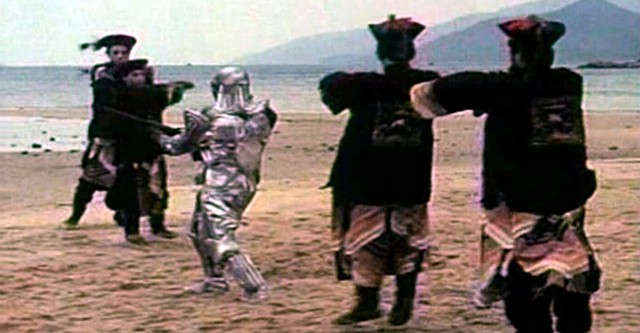
The vampires show up once the drug lord realizes that he’s going to need some help defeating a robot.  So, he has his people cast come magic and soon, there’s a bunch of zombie/vampires hopping around.  And when I say hopping, I mean that they literally hop around.  I noticed the same thing about the zombies in Kung Fu Zombie.  In the defense of that film, though, Kung Fu Zombie was kind of meant to be a comedy.  Robo Vampire seems to take itself pretty seriously.  (Watching the film, I thought I recognized a few shots that had apparently been lifted from Kung Fu Zombie but I haven’t been able to independently verify whether that’s really the case.  Some day, when I think I can handle the punishment, I’ll sit down and watch Kung Fu Zombie and then Robo Vampire and compare the two for myself.)

Eventually, Tom gets around to launching his rescue operation.  There’s a lot of shooting.  There’s a lot of scenes of Robot Tom wandering around robotically.  There’s a lot of hopping vampires or zombies or whatever they’re supposed to be.  But, as far as I can tell, there were no robot vampires.  Now, I say as far as I can tell because the film was edited so haphazardly that it wouldn’t surprise me to discover that there was like a hundred different versions of Robo Vampire floating around.  Who knows what have happened in the director’s cut?

Anyway, Robo Vampire is petty much impossible to follow and the film does itself no favors by inviting you to compare it to the original Robocop.  That said, the hopping vampires were kind of cute and this is truly a one of a kind movie.  You should watch it just so you can say that you did.
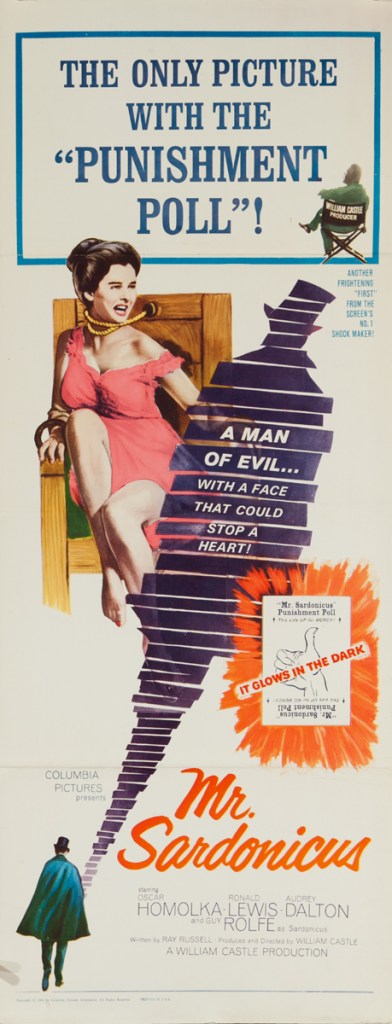
Horror Film Review: Mr. Sardonicus (dir by William Castle)


The next time that someone gives me a hard time for not being compassionate enough (and believe it or not, it does occasionally happen now that 90% of twitter has gone down the woke rabbit hole), I’m going to point out that I voted to show mercy to Mr. Sardonicus.

Played in villainous fashion by Guy Rolfe, Mr. Sardonicus was the title character of a 1961 film that was produced and directed by William Castle.  Castle was known for being the king of the gimmick.  His gimmick for Mr. Sardonicus was that, upon entering the theater, members of the audience were given two cards.  One card had a thumbs up.  One card had a thumbs down.  Towards the end of the film, the avuncular Mr. Castle appeared onscreen and announced that it was time for the audience to vote.  Should Mr. Sardonicus be punished for his sins or should he be shown mercy?  Thumbs up for mercy.  Thumbs down for punishment.  After taking the vote, Castle said, “Projectionist, play the reel.”

Now, of course, Castle only shot one ending and that was the ending where Mr. Sardonicus was punished.  To make sure the audience would vote the right way, Castle made Sardonicus into one of the most loathsome villains around.  Mr. Sardonicus — or Baron Sardonicus, as he preferred to be called — lived in a castle in the 1880s.  Not only did he torture his servants with leeches but he was also responsible for death of several dogs, all of which were killed as a part of his dastardly experiments.  To make it even worse, he wasn’t even a member of the nobility!  He stole his title!  It turned out that Mr. Sardonicus has once been a simple farmer who allowed his greed to get the better of him.  When his father was buried with a lottery ticket, Mr. Sardonicus dug up the old man to retrieve the ticket.  The shock of seeing his father’s skull caused Mr. Sardonicus’s face to freeze into a twisted grimace.  When the film begins, Mr. Sardonicus wears a mask and desperately wants to be cured of his affliction.

To try to convince Sir Robert Cargrave (Ronald Lewis) to cure his condition, Mr. Sardonicus is holding the woman that Sir Robert loves, Maude (Audrey Dalton), prisoner in a loveless marriage.  With the help of his evil servant, Krull (Oskar Homolka), Mr. Sardonicus torments the villagers and anyone else unlucky enough to come near the castle.

And yet, when I watched this movie last night with the Late Night Movie Gang, I voted to show compassion to Mr. Sardonicus because I’m a firm believer both in criminal justice reform and that almost anyone can be rehabilitated.  Perhaps Mr. Sardonicus just needed someone to say that they believed he could be a better man.  I was willing to do that.  However, the rest of the Late Night Movie Gang voted to punish him.  I think it was the dead dogs that sealed the deal.  So, sorry, Mr. Sardonicus.  I tried.

Even before William Castle tells everyone to vote, Mr. Sardonicus is enjoyably over-the-top and silly horror film.  It plays out like an extended episode of Twilight Zone, with every action that Mr. Sardonicus takes bringing him closer to karma’s judgment.  Guy Rolfe is properly evil and arrogant Sardonicus and Oskar Homolka gets many of the best lines as the servant who may not be as loyal as he seems.

Mr. Sardonicus is currently on YouTube.  Watch and vote for yourself!

Bats (1999, directed by Louis Morneau)


A scientist (Bob Gunton!) has genetically engineered the local population of bats in order to make them super intelligent and aggressive.  Though he says that he just wanted to make sure that the bats never went extinct, the ultimate result of his experiment is that the bats are now killing all of the citizens of a small town in Texas.  With the National Guard threatening to blow up the town, it’s up to Sheriff Emmett Kimsey (Lou Diamond Phillips!), Dr. Alexandra McCabe (Dina Meyer!), and assistant Jimmy Sands (Leon, so cool that he only needs one name!) to figure out how destroy the bats without destroying everyone’s home.

Now, this is how you make a killer bat movie!  There’s a lot of stupid things about Bats but it’s still a thousand times better than Nightwing.  I liked the idea of superintelligent bats more than the idea of just angry bats.  The bats are too clever for the humans, often seeing straight though their plans.  Nightwing took itself very seriously.  Bats does not and is therefore, better in every regard.  The bats are always on the attack, the good guys are always running from one place to another, and the National Guard just wants to blow everything up.  It’s a fun B-move, with the B standings for Bats.

You have to love that cast, too.  Any movie with Lou Diamond Phillips and Leon is going to be cooler than any movie without them.  I wouldn’t be surprised to learn that the two of them hunt bats in their spare time because they really seemed to know what they were doing.  Dina Meyer was obviously cast more because she looks like Dina Meyer than because she’s really a credible scientist but she still handles all the bat talk without embarrassing herself.  Bob Gunton is a great bad guy, as always.

Bats is dumb, silly, and terrifically entertaining.

Nightwing (1979, directed by Arthur Hiller)


Cattle and humans are dying in New Mexico at an alarming rate.  Scientist Phillip Payne (David Warner) thinks that the local bat population has become infected with the plague.  Deputy Youngman Duran (Nick Mancuso) thinks that the bats may be attacking because of a curse that was cast by a Hopi medicine man.  Meanwhile, the corrupt tribal chief (Stephen Macht) just wants to sell the land to an evil land developer (Ben Piazza) and be done with it.  Dr. Anne Dillion (Kathryn Harrold) tries to spread the word about the bats but the authorities don’t want the bad publicity.  They’ve never seen Jaws.  And, finally, a group of missionaries camp in the desert with no idea what’s about to swoop down on them.

I don’t know about you but I would never think of missing an Arthur Hiller horror movie!  While many directors in the 70s proudly wore the auteur and rebel label, Arthur Hiller went the opposite route.  He oversw conventional, Hollywood productions, the best known of which was Love Story.  Arthur Hiller was so mainstream that he eventually served as President of the Academy.  This is all to say that Arthur Hiller directed some good films and he directed some bad films but, with his total lack of any sort of personal vision, he was absolutely the wrong director to do a horror movie.  Hiller’s direction is flat.  He’s not mean-spirited enough to enjoy the bat attacks and instead, he focuses on the debate over whether white developers should be buying native land, as if the people watching this movie are going to be watching for the human drama.  By the end of the film, the bats have almost been abandoned and the movie turns into an action film, with a group of survivors fighting off Stephen Macht’s security force.

The most interesting thing about Nightwing is catching Strother Martin, the veteran western actor who memorably talked about a failure to communicate in Cool Hand Luke, as an ex-missionary.  Otherwise, the film pales in comparison to The Birds and Wolfen, the two films which it must resembles in theme and action.

Shiny Shiny, Review by Case Wright – HIDDEN GEM ALERT!


This is a true hidden gem. Both this filmmaker and his spouse NEED to be hired by EVERYONE! I review A LOT of garbage. It can get straight-up soul-crushing. However, when there’s a hit, there’s a hit. This is a hit!

The short opens with a woman tied up in a basement with a purported axe-murderer ready to make short work of her. Just as we are about to see something horrible- Shiny Shiny begins to play and the seeming axe murderer does something completely unexpected!!!! This is a must watch and Jeff and Sara are must hires! Please watch this!!! PLEASE!!!!

MUST WATCH!!!!

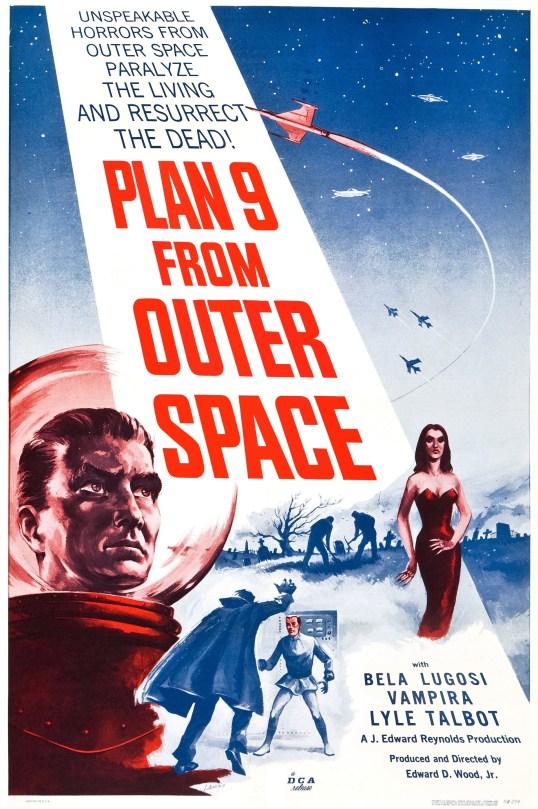
Horror on the Lens: Plan 9 From Outer Space (dir by Edward D. Wood, Jr.)


Viewing Plan 9 From Outer Space during October is a bit of a tradition around these parts and here at the Shattered Lens, we’re all about tradition.  And since today is the 97th anniversary of the birth of Ed Wood, Jr., it just seems appropriate to watch his best-known film.

Speaking of tradition, this 1959 sci-fi/horror flick is traditionally cited as the worst film ever made but I don’t quite agree.  For one thing, the film is way too low-budget to be fairly judged against other big budget fiascoes.  If I have to watch a bad movie, I’ll always go for the low budget, independent feature as opposed to the big studio production.  To attack Ed Wood for making a bad film is to let every other bad filmmaker off the hook.  Ed Wood had his problems but he also had a lot of ambition and a lot of determination and, eventually, a lot of addictions.  One thing that is often forgotten by those who mock Ed Wood is that he drank himself to death and died living in squalor.  The least we can do is cut the tragic figure some slack.

Plan 9 From Outer Space is a ludicrous film but it’s also a surprisingly ambitious one and it’s got an anti-war, anti-military message so all of you folks who have hopped down the progressive rabbit hole over the past few years should have a new appreciation for this film.  I mean, do you want the government to blow up a Solarnite bomb?  DO YOU!?

Also, Gregory Walcott actually did a pretty good job in the lead role.  He was one of the few members of the cast to have a mainstream film career after Plan 9.

Finally, Plan 9 is a tribute to one man’s determination to bring his vision to life.  Ed Wood tried and refused to surrender and made a film with a message that he believed in and, for that, he deserves to be remembered.

Now, sit back, and enjoy a little Halloween tradition.  Take it away, Criswell!

Can you prove it didn’t happen?

WELL, CAN YOU!?

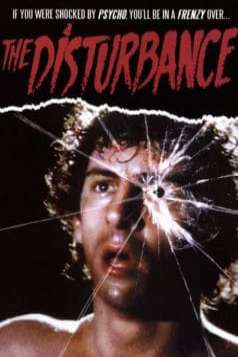
The TSL’s Grindhouse: The Disturbance (dir by Cliff Guest)


One of my pet peeves, as someone who has watched her share of movies about disturbed men driven by madness to kill, is that serial killers are often presented as being far more interesting than they actually are.  Whereas the typical serial killer is someone who has never been able to maintain a relationship and who can’t hold down a job and who, in many cases, barely even graduated high school, movie serial killers always tend to be portrayed as being handsome, charming, witty, and diabolically clever.  Blame it on Ted Bundy.  Blame it on the popularity of Hannibal Lecter.  Blame it on the film industry’s embrace of clichés.  Blame it on whoever. or whatever  It’s annoying and it encourages the tendency of the media to focus more on the killers than on their victims.

One good thing that you can say about the 1990 film The Disturbance is that it’s killer is no winner.  Clay Moyer (Timothy Greeson) is a schizophrenic who has just been released from a mental hospital and seems to be destined to soon return.  He’s someone who is haunted by hallucinations and violent fantasies.  At the same time, he’s also learned how to project enough superficial charm that he can actually interact with people.  When he meets Susan (Lisa Geoffrion) on the beach, he’s able to get a date and later, he’s even able to get a relationship.  But, as the film graphically shows, even when he’s making love to Susan, he’s fantasizing about killing her.  Even during the best moments of their relationship, he’s fantasizing about doing terrible things to the neighbor.  Because he’s extremely possessive while obviously hiding a huge part of his life from her, Susan eventually starts to pull away from him.  When he gets too pushy in his efforts to keep her around, she breaks it off.  Since the relationship was the only positive thing that Clay had in his life, he sinks further into madness and he eventually does some very bad things.  But, seeing as how Clay was having violent fantasies even while he was still dating Susan, it’s totally probable that his collapse was predestined.  If he hadn’t been triggered by the end of the relationship, he would have been triggered by something else.  There’s no hope for Clay, who was pretty much doomed from the minute he was born.

The budget of this Florida-shot indie is low and it’s obvious that most of the actors weren’t professionals.  And yet, the fact that the actors are occasionally stiff and awkward actually adds to the film’s authenticity.  If the film had been too slick, it wouldn’t have been as effective.  It would have felt like another overproduced Hollywood serial killer film.  Instead, The Disturbance feels like a journey into the mind of someone who actually is a ticking time bomb, reaching the end of his countdown.  It’s not a fun journey but then again, it shouldn’t be fun.  The mind of a sexual sadist is not going to be a pleasant place to visit.

The film works largely due to the lead performance of Timothy Greeson, who plays Clay as someone who desperately wants to be normal but who is very much aware that he never will be.  He’s a prisoner to his fantasies and, as much as he tries, he knows that he’s never going to escape his demons.  As an actor, Greeson is appealing enough that you can buy that Susan might go on a date with him while he also believably portrays the instability that leads to her dumping him.

It’s a well-done film, though a bit too disturbing to really be an entertaining viewing experience.  (On a personal level, there were several scenes involving a cat that I simply could not handle.)  I appreciated the film’s integrity far more than I enjoyed actually watching it but at least the movie refused to idealize its killer.

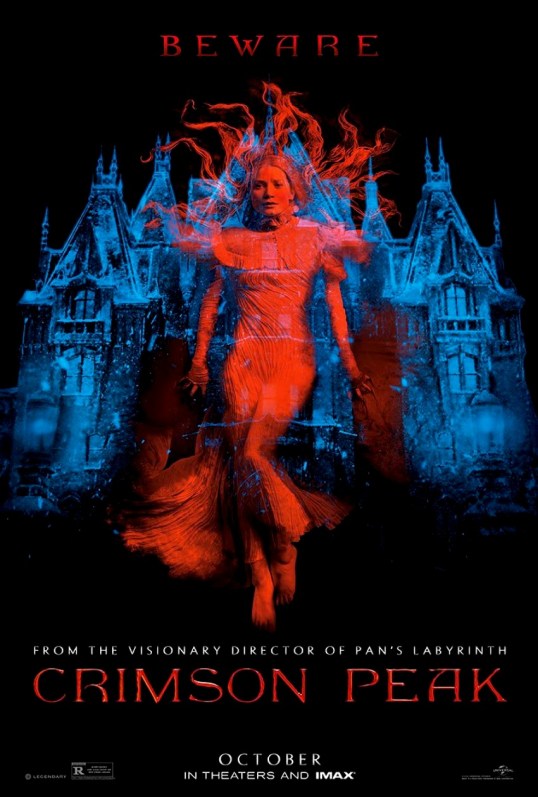
Horror Scenes I Love: The Arrival At Allerdale Hall in Crimson Peak


Since today is Guillermo del Toro’s birthday, it only seems appropriate that today’s scene that I love comes from my favorite del Toro film.

In this scene from Crimson Peak, Thomas bring Edith to Allerdale Hall for the first time and it’s both hauntingly beautiful and rather frightening at the same time.  The same thing can be said for this film itself and perhaps all of del Toro’s work.  I just love the gothic atmosphere of the location.  Edith is determined to see the positive.  Thomas’s personality is already starting to change as the weight of returning to Allerdale starts to push in on him.  The mansion has already started to sink back into the Earth.  It’s just a wonderfully put-together scene, one that sets the mood for the rest of this sadly underrated film.

International Horror Review: All the Colors of the Dark (dir by Sergio Martino)


It’s giallo time!

In this 1972 Italian film, Edwidge Fenech plays Jane Harrison.  Jane is haunted by both the murder of her mother and a more recent car accident, one that caused her to miscarry.  Jane has nightmares, featuring violent murders and lots of spilt blood.  Whenever Jane leaves her apartment, a mysterious man with piercing blue and perfect hair (played, of course, by the owner of the best head of hair in Italian cinema, Ivan Rassimov) follows her and threatens her.  Is the man real or is he just a figment of her imagination?  Her sister, Barbara (Susan Scott) insists that Jane see a psychiatrist.  Meanwhile, Jane’s boyfriend, Richard (the ruggedly handsome George Hilton) insists that the two of them can work through it.

However, Jane’s new neighbor, Mary (Marina Malfatti) has a suggestion that involves neither therapy nor love.  Mary suggests that Jane attend a black mass.  Jane agrees and …. wait, what?  A black mass?  Out of all the solutions that have been suggested, Jane decides to go with Satanism?  That seems like a bit of an extreme solution but then again, it was the 70s and it was Italy and maybe things were just different back then.  I’m just saying that I, personally, would not join a cult but obviously, some people do.  Maybe that’s how the Silent Hill cult got started.  Someone tried to be helpful by saying, “Let’s go to a black mass,” everyone said, “Sure!”  Who knows?

Anyway, Jane attends a few rituals, all of which will seem familiar to anyone who has seen Rosemary’s Baby.  She drinks the blood of a dog.  She takes part in an orgy.  Or does she?  The scenes are shot in such a fashion that we’re left to wonder whether they’re real or if they’re just taking place inside of Jane’s mind.  With her paranoia growing, Jane herself isn’t sure what’s really happening either.  All she knows is that it seems as if the members of the cult are everywhere and that the mysterious man still appears to be following her.  When people start dying in various gruesome ways, who is responsible?  Jane or the cult or someone else entirely?

All The Colors of the Dark is a favorite of mine, a stylish giallo with an insane plot, lots of sex and death, and killer performances from giallo regulars like Fenech, Hilton, and Rassimov.  The solution to this film’s mystery is actually pretty clever and — in a rarity for the giallo genre — it actually hold together when you think about it after the movie ends.  Visually, director Sergio Martino does a great job of creating an atmosphere of unease and suspicion and Jane’s dreams and visions are wonderfully executed.  My favorite moment is when Jane suddenly realizes that everyone around her is a member of the cult.  Are they really or is Jane just hallucinating?  Watch the movie to find out!

In October, it’s always nice to make some time for a good giallo, especially ones that feature George Hilton looking handsome and Ivan Rassimov looking dangerously intriguing.  All the Colors of the Dark is definitely one of the better ones.

Horror Film Review: Silent Hill: Revelation (dir by M. J. Bassett)


The 2012 video game adaptation, Silent Hill: Revelation, is gloriously silly.

It’s also a sequel to the first Silent Hill. While many members of the original cast do return and while the sequel’s plot does directly follow up on the first film, Silent Hill: Revelation still feels like an all-together different film. Whereas the first Silent Hill was atmospheric and, with its 2 hour plus running time, a bit ponderous, the sequel is short, direct, and …. well, I hate to use that word again, a bit silly. It’s also undeniably entertaining.

Sharon (Adelaide Clemens) is now 18 and is currently using the name Heather. With her father, Harry (Sean Bean), Sharon/Heather has spent the last several years of her life moving from place to place and trying to keep one step ahead of the Order, the Silent Hill cult. Heather — let’s just use that name — tries to make the best of her situation but she is 18 and she would like a chance to do normal teenager stuff as opposed to just spending her life on the run.

Good luck with that! When Harry mysteriously vanishes, Heather finds a message telling her to go to Silent Hill. Teaming up with her classmate, the enigmatic Vincent (Kit Harrington), Heather heads back to Silent Hill. She hopes to find both Harry and Rose (Radha Mitchell) but the Order has other plans. Soon, Heather and Vincent are back in the alternate dimension, dealing with monsters and stabby blind nurses.

As is typical of horror films about cults, there’s a lot of talk about sacrifices and using blood to bring about a new age and everyone worships some mysterious God who doesn’t sound all that pleasant. Whenever I watch a movie like this, I find myself wondering how the cult got started in the first place. Who woke up one day and said, “I’m going to follow the demon that regularly kills all of his followers. Now, let’s go alter some adoption records!” I also can’t help but notice that cults can never do anything the simple way. Instead, there’s always some alternate dimension or some extremely complex ritual that has to be performed and it all has to be done at a certain time of the year. Maybe if they just simplified things, they wouldn’t have so much trouble getting stuff done. Maybe instead of always trying to steal new souls, they could just be happy with the ones they have. I mean, it’s just common sense.

But anyway, back to Silent Hill: Revelation. Silent Hill: Revelation usually gets dismissed as an inadequate sequel but I was entertained. The plot moves quickly and the film features some memorably gory scenes. The scene where Heather suddenly hallucinates about Silent Hill while walking through a mall was enjoyably gruesome. At the same time, I couldn’t help but regret that Revelation never quite succeeded in duplicating that ominous atmosphere of the first film. If the first film felt like a nightmare-come-to-life, Revelation feels more like the season finale of a long-running, supernatural-themed television show. It’s fun to watch but it’s not particularly challenging. That said, Adelaide Clemens gave a sympathetic performance as Heather, Sean Bean’s natural gravitas was put to good use, and Malcolm McDowell made a brief appearance. The film kept me entertained.