Incident at Phantom Hill (1966, directed by Earl Bellamy)


During the final weeks of the Civil War, a group of Confederates, led by Joe Barlow (Dan Duryea,) hijacked a shipment of Union gold and buried it near Phantom Hill, Texas. Now that the war is over and Barlow is in custody, he makes an offer. He’ll lead the government to the gold in return for a pardon. Needing the money, the government agrees to Barlow’s conditions. A group of Cavalrymen, led by Matt Martin (Robert Fuller), are ordered to accompany Barlow to Phantom Hill and retrieve the gold. Because the gold itself is buried near Comanche territory, the men will be traveling undercover. If Martin and his men are captured or killed, the U.S. government will disavow any knowledge of the them. Cue the Mission Impossible theme.

It’s an eventful journey to Phantom Hill. When a local sheriff recognizes Barlow as a wanted criminal, Martin has to convince him not to kill Barlow. The sheriff agrees, on the condition that Martin and his men escort a prostitute named Memphis (Jocelyn Lane) out of town. When a group of outlaws discover that Martin and Barlow are heading for the gold, they take off after them. Meanwhile, Barlow has a few plans of his own.

Incident at Phantom Hill is a fast-moving B-western, the type that will be appreciated by fans of the genre. There are a few good shootouts. Jocelyn Lane is beautiful as Memphis, Robert Fuller is firm at Matt Martin, and Dan Duryea is dangerous as Joe Barlow. The outlaws are unusually cruel and the scene where the kill a comic relief character was probably shocking for 1966. The most interesting thing about the movie is its portrayal of Union officers working with former Confederates and the struggle to determine where everyone fits in now that the Civil War is over. Barlow is not to be trusted by the relationship between Memphis and Matt suggests that the country can come back together as long as everyone has a common enemy that needs to be defeated.
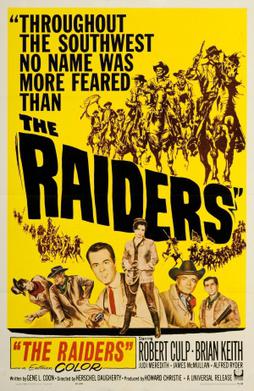
 

The Raiders (1963, directed by Herschel Daughtery)


In the years immediately following the Civil War, seven Texas cattleman, led by Col. John McElroy (Brian Keith), try to drive their cattle into Missouri.  The terrains proves treacherous and the local Pawnees refuse to allow the cattlemen to pass through their land without paying a hefty fee for the right.  McElroy and his followers go to Fort Hays and demands that the local railroad magnate, Huntingon Lawford (Addison Richards), extend his line into Texas.  When both Lawford and martinet Calvary officer Capt. Benton (Alfred Ryder) refuse to help, McElroy and his man start sabotaging the railroad’s western expansion.

This brings them into conflict with Wild Bill Hickok (Robert Culp), Buffalo Bill Cody (Jim McMullan), and Calamity Jane (Judi Meredith), all of whom are working for the railroad!  Hickok is an old friend of McElroy’s and Cody is sympathetic to McElroy’s cause but will they be able to broker a peace between the two sides?  When Captain Benton plans to lure McElroy into a trap where he and his friends will fired on with a Gatling gun, it’s up to Cody and Hickok to try to prevent a massacre.

The Raiders starts out as a downbeat look at a cattle drive in the years when America was still trying to rebuild from the devastation of the Civil War.  Brian Keith was one of those actors who was always ideally cast in westerns and war movies and he’s convincing as the tough but fair-minded McElroy.  If the film had just been about McElroy, it would have been a good B-western.  Instead, it brings heavily fictionalized versions of Wild Bill Hickock, Buffalo Bill Cody, and Calamity Jane into the story.  Robert Culp, Jim McMullan, and especially Judi Meredith all overact in their roles and a lot of time is wasted on subplots like Calamity Janes being in love with Wild Bill and Buffalo Bill trying to prove himself to the older man.

The Raiders started out as a made-for-TV movie and it appears that it was a pilot for a proposed TV show about Calamity Jane and the Bills.  (Brian Keith is even listed in the credits as being a “special guest star.”)  When the pilot wasn’t picked up, the film was given a theatrical release but The Raiders still has the flat look and unimaginative editing of a television show.  No matter how authentic Brian Keith’s performance might be, he can’t make up for the fact that the majority of the film was clearly shot on a studio backlot.

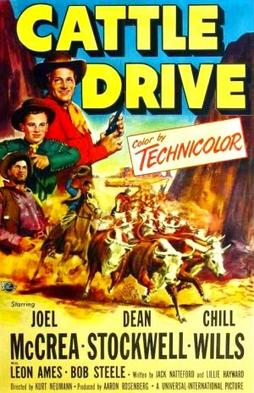
Cattle Drive (1951, directed by Kurt Neumann)


In this coming-of-age Western, Dean Stockwell plays Chester Graham, Jr., the spoiled and unruly son of a railroad owner (Leon Ames).  While riding on his father’s train and making trouble for the conductor, Chester overhears his father talking about sending him to a military school.  When the train makes as top, Chester impulsively runs away.  The train leaves without him and Chester finds himself stranded in the middle of the wilderness.  That’s when he sees cowboy Dan Matthews (Joel McCrea) trying to catch a wild stallion.

Dan is a part of a cattle drive.  Knowing that he can’t leave Chester to die in the wilderness, Dan brings him back to his camp.  The other members of the company aren’t too keen on having to look after a spoiled brat along with the cattle and Chester isn’t too happy to hear that he’ll be expected to work if he expects to get fed.  But with no choice but to work together, Chester, Dan, and the rest of the company make the journey to Santa Fe.  Chester finally drops his attitude enough to work with the company’s cook (Chill Wills) while Dan deals with a rival cowboy named Currie (Henry Brandon). Chester learns about responsibility and Dan finally finds the courage to consider settling down.

Of the many westerns that Joel McCrea made over the course of his career, he considered Cattle Drive to be his favorite and it’s easy to see why.  Cattle Drive features McCrea doing what he did best, playing a tough but good-hearted and down-to-earth cowboy who looked after an outsider.  If you were ever lost in the old west, Joel McCrea is precisely the type of cowboy that you would hope would come to your rescue.  The plot features almost every single cattle drive cliché that you could imagine but McCrea plays his role with a winning combination of grit and compassion and he and Dean Stockwell, who is also very good, make a good team.  Shot in Death Valley and Utah, Cattle Drive feels and look authentic and should be enjoyed by anyone looking for good, heartfelt western.

Wyoming Renegades (1955, directed by Fred F. Sears)


Brady Sutton (Philip Carey) used to be one of the most feared members of the Hole in the Wall Gang.  He robbed banks with Butch Cassidy (Gene Evans) and the Sundance Kid (William Bishop) and he developed a reputation for being a ruthless outlaw.  But that’s in the past.  Brady has spent three years in prison and now, he’s ready to return home, marry Nancy (Martha Hyer), and go straight.  Though most of the townspeople don’t trust Brady, he’s managed to find a sponsor in newcomer Charlie Veer (Douglas Kennedy), who has given Brady the money to open his own blacksmith shop.

Unfortunately, Brady might be done with the Hole in the Wall Gang but they’re not done with him.  When Brady spots some members of the gang in town, he realizes that they’re casing the bank.  Despite Brady’s attempts to warn the sheriff, the town assumes that Brady must be in on the plot.  Brady grows so frustrated that he finds himself tempted to go back to his old ways.  Meanwhile, Charlie is suddenly very interested in being introduced to the infamous Butch Cassidy himself.

Wyoming Renegades is a straight-forward, B-western.  The plot is nothing special but Philip Carey and Douglas Kennedy both give good Western performances and Gene Evans is memorably evil as Butch Cassidy.  For those who only know the characters as Paul Newman and Robert Redford’s performances in Butch Cassidy and the Sundance Kid, the most interesting thing about Wyoming Renegades will be seeing Cassidy and Sundance portrayed as being sadistic and humorless villains.  The truth about Cassidy and his gang is probably somewhere in-between the fun-loving rogues played by Newman and Redford and the unforgiving bastards presented in Wyoming Renegades.  In reality, it’s said that Butch Cassidy always tried to avoid killing people while Sundance rarely hesitated to draw his gun and start firing.

As for Wyoming Renegades, the ending does feature an unexpected twist, with Nancy proving herself to be more than just a docile love interest.  Fans of classic television will want to keep an eye out for a young Aaron Spelling, playing a loathsome outlaw named Petie Carver.

A Bonus Horror Scene That I Love: Conal Cochran’s Speech From Halloween III


With horrorthon coming to a close for another year, I figured why not allow Conal Cochran to get in a word or two.

This is from Halloween III: Season of the Witch.  Playing Conal Cochran, of course, is the great Dan O’Herlihy.

We hope you’ve all had a wonderful Halloween.

The TSL’s Grindhouse: Satan’s School For Girls (dir by David Lowell Rich)


Have you ever wanted to enroll in a private school so that you could investigate a murder and maybe uncover some sort of occult conspiracy?  Sure, we all have!  Well, don’t worry …. there’s a place for you!  Welcome to Salem Academy, an exclusive all-girl’s college where students learn all the basic subjects, along with taking courses in art and human sacrifice!

Salem Academy is overseen by the feared and intimidating Mrs. Williams (Jo Van Fleet), who keeps a close eye on her students and tries to make sure that they aren’t distracted or corrupted by any outside influences. However, not even Mrs. Williams can keep Martha Sayers (Terry Lumley) from fleeing the school and going to her sister’s house in Los Angeles. When Martha’s sister, Elizabeth (Pamela Franklin), returns home, she discovers that Martha has been hanged. The police say that it was suicide. Elizabeth believes that it’s something else.

So, Elizabeth does what any vengeance-seeking sister would do. Using an assumed name, she enrolls in Salem Academy herself. She meets and befriends three other students (played by Kate Jackson, Jamie Smith Jackson, and Cheryl Ladd). She gets to know two rather suspicious teachers, Prof. Delacroix (Lloyd Bochner) and Dr. Clampett (Roy Thinnes). She also manages to raise the concerns of Mrs. Williams, who doesn’t like the fact that the new girl keeps asking so many questions about why so many students at Salem Academy have died recently.

Still, Elizabeth continues to investigate. Perhaps the secret can be found in a mysterious painting that she comes across, one that appears to be of Martha? Perhaps the teachers and the students know more than they’re telling. But who can Elizabeth trust?

A made-for-television film from 1973, Satan’s School For Girls is frequently as silly as its name.  Fortunately, the film, which was produced by Aaron Spelling and directed David Lowell Rich, seems to understand just how ludicrous it is and it totally embraces both the melodrama and the silliness of its plot. This film is totally product of the time in which it was made, from the dialogue to the hairstyles to the fashions to the ending that you’ll see coming from a mile away. At the same time, that’s also why this film is a lot of fun. It’s such a product of its time that it doubles as a time capsule. Do you want to go back to 1973? Well, go over to YouTube and watch Satan’s School For Girls.  After you’ve watched it, step outside and ask anyone who the president is and they’ll probably say, “Richard Nixon.”  And if you ask them who they’re favorite Brady is, they’ll look at you like your crazy because everyone know that Marcia is the best Brady.  If you even have to ask, it’s obvious that you don’t really watch the show.  After that, you should probably try to find a way to get back to 2021 before you change the future or something.  You know how tricky time travel can be.

As for Satan’s School for Girls, it’s just a really fun movie so check it out and be sure not to be late for class!

Afraid of the Dark (1991, directed by Mark Peploe)


Lucas (Ben Keyworth) is an 11-year-old boy who lives in London and who enjoys watching the neighborhood through his telescope.  Because Lucas’s mother is blind, Lucas is concerned that there is a serial killer who is going around and attacking blind women.  Lucas is determined to help his father (James Fox), an inspector with Scotland Yard, capture the killer.  Lucas starts to sneak out of the house, visiting cemeteries and spying on the same blind women that the killer is stalking.  Investigating on his own, Lucas discovers who the killer might be.

Or does he?

Outside of the imaginary world where he spends most of his time, Lucas is a shy boy and his father is not a detective but instead a florist.  While Lucas’s mother actually is blind, Lucas himself is starting to lose his eyesight as well.  Lucas is scheduled to undergo an experimental surgery.  He’s due to go under the knife, just as surely as the victims of the serial killer that he thinks he’s hunting.  Meanwhile, his mother is pregnant and the increasingly unstable Lucas is both obsessed with his older stepsister and jealous of all the attention that his new baby sister is already getting.

Afraid of the Dark is a British psychological thriller that deserves to be better known.  Intelligently written and directed Mark Peploe, it’s both a poignant and a frightening look at a child who, due to being forced to deal with something that few others can understand, has retreated so far into his own imaginary world (where he can be the hero) that he can no longer tell what is real and what isn’t.  Lucas is both frightening and sympathetic and the movie will keep viewers guessing as to what is real and what isn’t.  James Fox and Fanny Ardant are perfectly cast as Lucas’s parents and David Thewlis, Paul McGann, and Robert Stephens all make an impression as the men who Lucas investigates in his search for the serial killer.  Tense, intelligent, and surprising, Afraid of the Dark is a film that is worth discovering.

Horror Scenes That I Love: The Finale of Dawn of the Dead


For our final horror scene that I love of the 2021 Horrorthon, how about the ending of George Romero’s 1978 masterpiece, Dawn of the Dead?

Keep an eye out Tom Savini, going over that railing.

Horror Film Review: War of the Colossal Beast (dir by Bert I. Gordon)


Look who’s back! He’s big. He’s bald. He’s now missing a bit of his face and an eye. He doesn’t look too good but still…. it’s Glenn Manning!

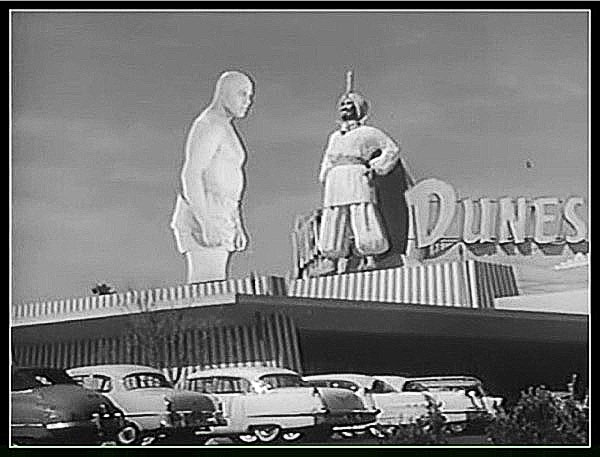
When we last saw Lt. Col. Glenn Manning in 1957’s The Amazing Colossal Man, he had grown to become a giant as the result of getting caught up in a nuclear blast. He had also gone totally mad and, after attempting to destroy America’s greatest city (Las Vegas, if you had to ask), he promptly fell off the Boulder Dam. Everyone assumed he was dead.

They assumed wrong.

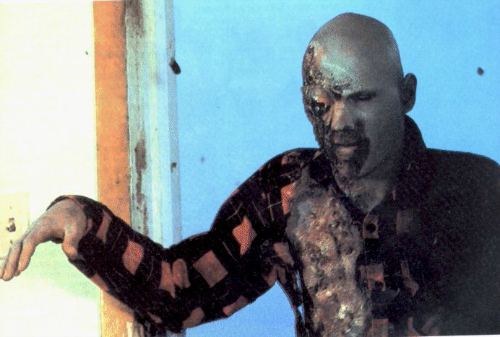
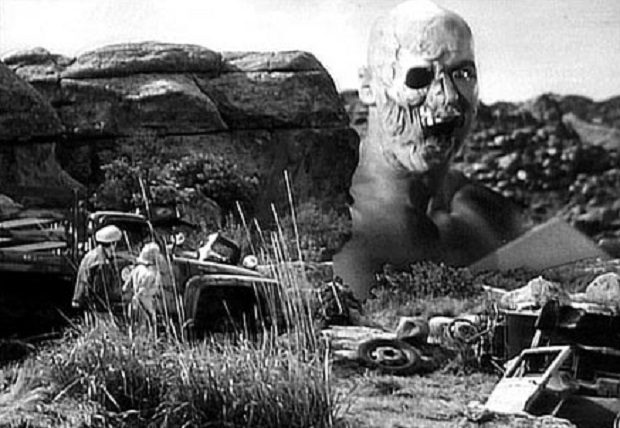
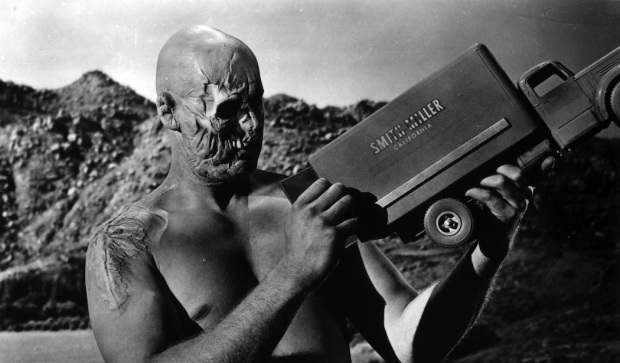
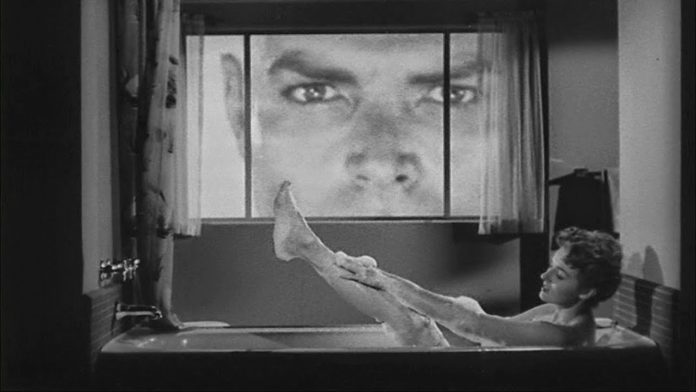
1958’s War of the Colossal Beast (which came out a year after The Amazing Colossal Man) opens with the discovery that Glenn is still alive and he’s still wandering around in the desert. Of course, as the title suggests, he’s no longer a man. Now, he’s a crazed beast! Not only is he missing an eye and several teeth but he can no longer speak in intelligible words. Whatever bit of mind he had left when he went over the side of Boulder Dam, he lost it all when he landed.

That’s not to say that the beast that was once Glenn doesn’t have memories. In fact, a good deal of this film’s 69 minute run time is made up of flashbacks to The Amazing Colossal Man. It’s just that Glenn can’t figure out what those flashbacks mean. Perhaps it’s because Glenn is now played by an actor named Dean Parkin while the flashbacks all feature a totally different actor in the role.

Anyway, Glenn is once again captured by the army and once again, he manages to escape. This time, Glenn leaves Vegas alone and instead attacks Los Angeles and Hollywood. Spare the film industry, Glenn! It’s up to the army and Glenn’s sister to once again try to convince Glenn to stop ripping the city apart. Of course, they could just try to convince him to fall off another dam….

Like the first film, War of the Colossal Beast was directed by Bert I. Gordon. War of the Colossal Beast isn’t as much fun of The Amazing Colossal Man, largely because Glenn can no longer speak so, other than in the flashbacks to the first film, we don’t get any tortured monologues about the unfairness of it all. That said, the Colossal Beast make-up is actually pretty effective and I’m sure many kids in the 50s had nightmares about having to escape from a one-eyed giant.

War of the Colossal Beast will be best appreciated by people who have seen the first film and who are looking for some sort of closure to Glenn’s tragic growth spurt. God knows that when I first watched The Amazing Colossal Man, I went outside after it was over and I shook my hands at the sky and I shouted, “DAMN YOU! I NEED MORE GLENN!” The main lesson of these films is that you should never try to rescue anyone in the desert. If Glenn hadn’t tried to save that pilot who crashed in the nuclear testing site, Vegas and Hollywood would never have been destroyed. It’s something to think about.

Horror Film Review: The Amazing Colossal Man (dir by Bert I. Gordon)


First released in 1957 and beloved by B-movie lovers ever since, The Amazing Colossal Man tells the story of Lt Col. Glenn Manning (Glenn Langan). It also tells the story of a country where bigger is automatically considered to be better but what happens when bigger leads to insanity?

In Nevada to observe the testing of America’s first plutonium bomb, Glenn panics when he sees that a small commercial plane has crashed in the test area. Glenn runs out to rescue the pilot and, not surprisingly, he ends up getting caught up in the bomb’s nuclear blast. Though he survives the initial explosion, he’s suffered severe burns and he’s not expected to live.

However, survive he does! Glenn Manning may now be totally bald but he still recovers from the burns. The only problem is that Glenn is growing now. He keeps getting bigger and bigger until eventually …. he’s colossal!

Unfortunately, becoming a giant doesn’t do much for Glenn’s overall mood. The film is rather unclear on what Glenn was like before he got dosed with radiation but afterwards, he’s kind of a jerk. He’s bitter about being so big. He’s upset that he has to live in a tent out in the middle of the desert. He resents being told that everything’s going to be okay. Worst of all, he’s reduced to wearing a really giant diaper which …. well, I don’t even what to think about it!

Eventually, Glenn gets so annoyed that he goes on a rampage, heading for Las Vegas! Realizing that America’s greatest city is in danger of being destroyed and that all the work of Bugsy Siegel will be wasted unless something can be done to stop Glenn, the military goes into action. While Glenn’s former friends try to inject him with a giant hypodermic needle (and seriously, the scene where a group of them charge at him with the needle simply has to be seen to be believed), the military tries to destroy him. As for Glenn, he just wants to visit the Boulder Dam….

As I watched the film, I couldn’t help but compare The Amazing Colossal Man to The Incredible Shrinking Man. One featured a man who became so big that he couldn’t be ignored. He got so big that he almost had no choice but to destroy everything smaller than him. Meanwhile, society had to conspire to keep him out of sight and to eventually destroy him before the rest of the world realized how small they were in comparison. Meanwhile, in The Incredible Shrinking Man, a man becomes so small that he’s forgotten and eventually, he vanishes from our world but, at the same time, he discovers a new existence and a new state of enlightenment? Is it perhaps better to be forgotten and unseen than to be known? Glenn Manning would probably think so.

Setting aside the quest for deeper meaning, The Amazing Colossal Man is pretty silly but it’s also undeniably enjoyable. It was directed by Bert I. Gordon (who was nicknamed Mr. Big because of the number of films that he made about giants) and there’s something undeniably charming about the sight of the giant Glenn towering over Vegas. Admittedly, if you’re looking for a film that realistically and sensitively explores what it would be like to be a mad giant, this isn’t the film for you. However, if you’re just looking for a short and silly movie with a giant bald man ripping up downtown Las Vegas, The Amazing Colossal Man is just what you need!