Film Review: American Siege (dir by Edward Drake)


For a few months, I’ve been going back and forth on whether or not I wanted to review American Siege.

On the one hand, I try to review every film that I see, regardless of how bad (or good) it might be.  I love movies.  I love talking about them.  I love writing about them.  I love sharing my opinions about them and hearing and reading the opinions of others.  That goes for all films, even really bad ones like American Siege.

On the other hand, American Siege is also one of the films that Bruce Willis made shortly before announcing his retirement from acting.  Since his retirement was announced, there have been a lot of stories that have suggested that Bruce’s condition led to him accepting a lot of roles that he normally would not have even considered and that Willis was not always fully aware of what was happening on the sets of the films in which he appeared.  Regardless of how much of that is true or not, it’s a heart-breaking story and it makes it difficult to watch Willis in a film like American Siege.

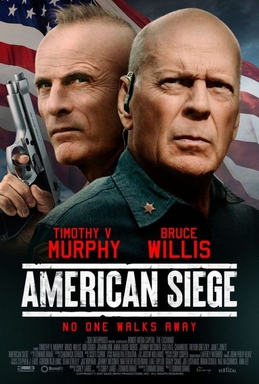
In American Siege, Willis plays a sheriff in a small Georgia town.  When a group of loud rednecks take a local pharmacist hostage, Willis and his deputies drive out to the man’s house.  However, Willis is ordered to stand down by the richest man in town, who is played by Timothy V. Murphy.  It turns out that the pharmacist has evidence that links Murphy to an unsolved crime.  The rednecks might be loud and stupid and self-destructive but it turns out that they’re not actually the worst people in town.

American Siege is 90 minutes of people shouting at each other and pointing guns out of windows.  There’s not much of a story to be found and even the unsolved mystery is a bit of a dud.  As was typical of his last few films, Bruce Willis is only on screen for a few minutes and he delivers his lines in a heart-breakingly flat monotone.  The rest of the cast is actually okay, even if they do go bit a overboard with the fake Southern accents.  The rednecks are convincingly redneck-y and Murphy is convincingly condescending as the rich man who has never had to face any consequences for his actions.  But the main reason anyone is going to watch this film is because of Bruce Willis and, sadly, there’s none of the swagger that made Willis in a superstar.

So, why am I reviewing American Siege?  Mostly it’s so I can recommend that, if you are really determined to watch one Bruce Willis’s later films, you skip American Siege and watch Gasoline AlleyGasoline Alley was made by the same director and it also features Bruce Willis but it’s a hundred times better than American Siege and it actually gives Willis a decent role to go out on.

Of course, my ultimate recommendation, as far as all this is concerned, is that you go and rewatch the first three Die Hards.  They’re not just for Christmas!
Film Review: Ambulance (dir by Michael Bay)


Ambulance is the ultimate Michael Bay movie.

Obviously, whether or not that’s a good thing for you personally will depend on how you feel about Michael Bay.  As a director, Bay specializes in kinetic thrill rides, the type of films where the camera never stops moving, the characters are attractive but shallow, and every plot development is an excuse for another action sequence.  Michael Bay is hardly the first, only, or last director to put action and spectacle above characterization and a coherent storyline.  However, he might very well be the most shameless about it.  Michael Bay’s approach has not made him a favorite of the critics but it has usually proved successful with audiences.  Personally, I’ve smirked at a lot of scenes in a lot of Michael Bay films.  (I still laugh whenever I remember the slow motion shot of the children playing in front of the faded JFK campaign poster in Armageddon.)  But, in this age of self-important filmmakers, it’s hard not to appreciate a director who just wants to have a good time.

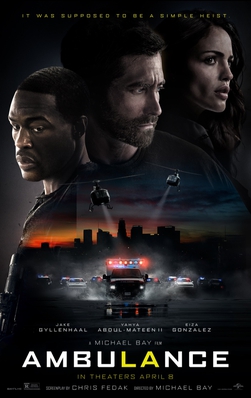
And, make no doubt about it, Ambulance is definitely a good time.  The film’s plot is simple.  Jake Gyllenhaal and Yahya Abdul-Mateen II rob a bank.  When the robbery goes wrong, they hijack an ambulance.  In the back of the ambulance is an EMT played by Eliza Gonzalez, who is desperately trying to keep a wounded cop (Jackson White) from dying.  Gyllenhaal and Abdul-Mateen also want to make sure that the cop doesn’t die because they know that, if they’re captured, the penalty for being a cop killer is considerably worse than the penalty for being a bad bank robber.  With the entire LAPD and the FBI in pursuit, the two men drive the ambulance through Los Angeles, trying to find a way to escape.  Essentially, Michael Bay said, “You know how everyone enjoys a chase scene?  What if we made the chase scene last for 136 minutes?”  And wisely, some people gave him money to do just that.

(Actually, that’s just the way that I like to imagine it.  Ambulance is actually a remake of a Danish film and Michael Bay originally passed on the project.  But, as they put it in The Man Who Shot Liberty Valance, print the legend.)

Jake Gyllenhaal may be top-billed but the star of Ambulance is definitely Michael Bay.  In many ways, there’s not much about Bay’s direction here that’s different from what he’s been doing since The Rock.  The camera moves a lot.  The images are sharp and clear.  The rapid-fire editing captures the chaos of the action scenes, occasionally at the cost of letting the audience know just who exactly is shooting at who.  But what sets apart Ambulance from other Bay films is that Michael Bay finally discovered his greatest collaborator, the drone.  Bay’s camera flies across Los Angeles, zooming over buildings and down streets and essentially making the viewer as much a part of the chase as Gyllenhaal and the cops pursuing him.  Ambulance moves with so much energy and confidence that it doesn’t matter that it’s a bit too long and that Gyllenhaal’s plan often doesn’t make much sense.  Ambulance is a thrill-ride, a film that rewards anyone who is willing to just go with it.  It’s an example of what Lucio Fulci called “pure cinema,” where the story itself is not as important as the way the director puts it all together.  I enjoyed it.  That ambulance barreling through the streets of Los Angeles was the 21st century equivalent of the speeding train that thrilled and terrified audiences during the silent era.

Unfortunately, Ambulance struggled a bit at the box office.  I’m a bit confused as to why, other than it wasn’t a part of a franchise or a sequel (like The Batman, Dr. Strange, and Top Gun: Maverick) and it didn’t have the mix of strong reviews and pop cultural cachet that led audiences to make Everything Everywhere All At Once into a hit.  Along with reviews that were more interested in criticizing Michael Bay in general as opposed to actually considering whether or not the film itslef worked, Ambulance was damaged by the fact that audiences were still getting used to the idea of leaving their homes for a night out.  I get the feeling that a lot of people looked at the commercials for Ambulance and said, “That’s something I can watch at home.”  (Admittedly, that’s what I did.)  It’s a shame that Michael Bay’s ultimate (and, I would say, best) film is also one of the few to be deemed a box office failure.  The film is currently on Peacock.  Try to watch it on the biggest screen you can find.

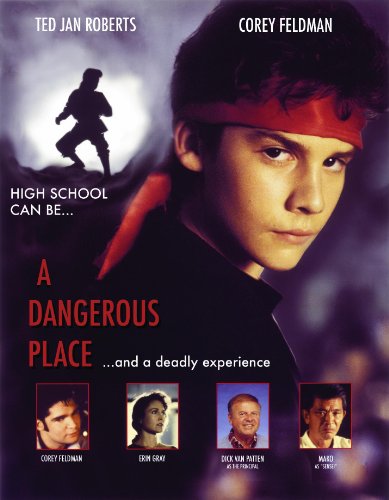
A Dangerous Place (1994, directed by Jerry P. Jacobs)


In A Dangerous Place, a young karate student avenges his brother’s death and Corey Feldman impersonates Christian Slater.

Greg (Dean Cochran) and his younger brother, Ethan (Ted Jan Roberts), are both students of a sensei (Mako) who teaches that sparing an enemy is the best way to make a friend and that true martial artists do not compete in tournaments.  Greg wants more out of karate so he starts hanging out with The Scorpions, a gang led by Taylor (Corey Feldman).  The Scorpions all belong to a dojo owned by Gavin (Marshall R. Teague), who teaches that mercy is a weakness.  When the Scorpions aren’t beating up people at the beach, they’re “scavenging.”  They break into houses and businesses, steal what they can, and claim that homeowners insurance means that they’re actually doing everyone a favor.  When one robbery goes wrong, Greg tries to stop Taylor from killing a homeowner.  Taylor fights back and the end result is Greg falling over a railing and dying.  

The Scorpions leave Greg hanging in the high school gym.  The police think that Greg committed suicide but Ethan knows that his brother would never end his own life.  Ethan knows that the Scorpions are responsible.  He leaves his old dojo and joins Gavin’s dojo.  Ethan now has an in with the Scorpions but, if Gavin and Taylor are going to trust him enough to reveal the truth about what happened to Greg, Ethan is going to have to betray his old sensei and set up a match between the two dojos.  Ethan is going to have to abandon his own peaceful principles about become as bad as the people he is trying to take down.

For a low-budget Karate Kid rip-off, A Dangerous Place is not as bad as it sounds.  Some of the fight scenes are exciting, Mako is a decent stand-in for Pat Morita, and Marshall R. Teague does a passable Martin Kove impersonation as the leader of the bad dojo.  Corey Feldman imitating Christian Slater imitating Jack Nicholson does eventually get old but, since Feldman is playing the bad guy here and we’re not supposed to like him, it actually works to the film’s advantage.  Finally, Dick Van Patten, of all people, has a small role as the high school’s principal.  Mako, Feldman, Van Patten, and karate?  A Dangerous Place is dumb but entertaining.

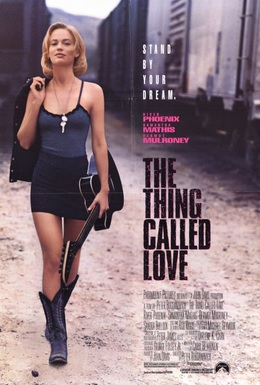
Film Review: The Thing Called Love (dir by Peter Bogdanovich)


First released in 1993 and directed by Peter Bogdanovich, The Thing Called Love takes place in Nashville, the city that, for many people, has come to define Americana.

Of course, for those who actually love movies, it’s difficult to watch any film about Nashville and the country music scene without being reminded of Robert Altman’s American epic, Nashville.  Much like Nashville, The Thing Called Love follows a group of wannabes, stars, writers, and performers.  However, whereas Robert Altman used the city and its residents as a way to paint an acidic portrait of a nation struggling to find its way in an uncertain new world, The Thing Called Love is far less ambitious.

The Thing Called Love centers around Miranda Presley (Samantha Mathis).  Miranda is from New York but she loves country music.  She comes to Nashville to try to sell her songs and become a star.  Instead, she ends up working as a waitress at the “legendary” Bluebird Cafe.  While she waits for her big break, she meets two other aspiring writer/performers, Linda Lu (Sandra Bullock) and Kyle Davidson (Dermot Mulroney).  Kyle falls in love with Miranda but Miranda falls in love with and marries James Wright (River Phoenix, brother of Joaquin).  Unfortunately, while James is talented, he’s also a bit of a jerk.

The Thing Called Love aired on TCM last year and I can still remember checking out the #TCMParty hashtag on twitter while the film was airing.  The majority of the comments were from people who loved TCM and who couldn’t understand why the channel was showing this rather forgettable movie.  The answer, of course, is that the film was directed by Peter Bogdanovich and Bogdanovich was one of the patron saints of TCM.  Along with being responsible for some genuinely good films (Targets, The Last Picture Show, Paper Moon, Saint Jack, Mask, The Cat’s Meow), Bogdanovich was also a very serious student of the history of film.  Up until he passed away in January, Bogdanovich was a familiar and welcome sight on TCM.  Listening to him talk about John Ford, Alfred Hitchcock, and especially Orson Welles was always a delight.

Unfortunately, as Bogdanovich himself often admitted, the majority of his later films failed to reach the heights of his earlier work and that’s certainly the case of The Thing Called Love.  It’s not so much that The Thing Called Love is bad as it’s just really forgettable.  There’s very little about the film that suggests that it was directed by cineaste who was responsible for The Last Picture Show.  Samantha Mathis is likable but a bit bland in the role of Miranda while River Phoenix plays James as being such a jerk that you really don’t care about whether or not he finds success.  From what I’ve read, Phoenix based his performance on watching Bob Dylan in the documentary Don’t Look Back.  Dylan is notably mercurial in that documentary but, it should be noted, that Dylan eventually abandoned that persona once he realized that it was a creative dead end.

To be honest, I think the film would have worked better if Samantha Mathis had switched roles with Sandra Bullock.  This was one of Bullock’s first films and she steals every scene in which she appears, giving an energetic and likable performance as someone who never allows herself a single moment of doubt or despair.  As opposed to the self-loathing Phoenix and the bland Mathis and Mulroney, Sandra Bullock represents the hope and optimism that Nashville is meant to symbolize.  In the end, her performance is the best thing about The Thing Called Love.

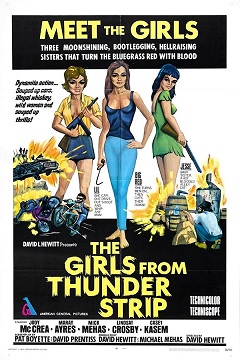
The Girls From Thunder Strip (1970, directed by David L. Hewitt)


This one is pretty bad.

A group of dirty, good-for-nothing bikers roll into a Southern town.  Led by Teach (Gary Kent), the bikers are obsessed with murder and rape, the latter of which opens the film and is treated in a fashion that is meant to be comedic.  When some pointless bullying of a gas station attendant leads to the gang’s only female member getting stabbed to death, the bikers are arrested and thrown in the county jail.

Meanwhile, three sisters (Maray Ayres, Megan Timothy, and Melinda MacHarg) are making their own moonshine and selling it to the local hillbillies.  A federal agent (played by Casey Kasem, the DJ who used to countdown the Top 40 songs in America and who voiced Scooby-Doo’s stoner friend, Shaggy) comes to town and insists that the local sheriff (Jack Starrett) arrest the three sisters.  However, only one of the sisters is taken to jail while the other two escape.  The federal agent manages to accidentally blow up the still but he only ends up with a face full of soot as a result.  That Kasem can survive getting blown up without getting so much of a scratch on him would make sense if the rest of The Girls From Thunder Strip were presented as being a live-action cartoon but it’s not so the entire Kasem storyline feels like it was lifted from another, more light-hearted moonshiner movie.

With the help of the bikers, the incarcerated sister is able to break out of the county jail.  But just because they helped each other, that doesn’t mean that the sisters trust the bikers, especially after the bikers murder a deputy who happened to be a cousin to the bootleggers.  The bikers try to take over the moonshine business while the sisters (and one convenient mountain lion) take on the bikers.

The movie is all over the place.  On the one hand, you’ve got the bikers raping and killing nearly everyone they meet.  On the other hand, you’ve got Casey Kasem, playing a federal agent and pursuing the sisters with all the panache of a cartoon cat chasing a mouse.  The action scenes are lousy.  The characters have no motivation.  With one exception, the actors are terrible and no, that exception is not Casey Kasem.  Instead, the one exception is Jack Starrett, who plays the sheriff.  Starrett, with his trademark gravelly voice, was a director who had sideline playing intimidating authority figures.  In First Blood, he played Galt, the worst member of Brian Dennehy’s police force.  (He was the one who laughed when he ordered the deputies to shave Rambo with a straight razor.  Later he fell out of a helicopter and Rambo was blamed for his death.)  Starrett gives the same performance in The Girls From Thunder Strip that he later gave in First Blood and since the sheriff is not actually given a name, I’ve decided that he and Galt are the same character and Girls From Thunder Strip takes place in the Rambo Cinematic Universe.

Other than providing a look at the early life of Art Galt, there’s not much else to recommend The Girls From Thunder Strip.  Even aficionados of the biker and moonshine genres will want to look elsewhere.

Film Review: The Manor (dir by Axelle Croyon)


In 2021’s The Manor, Barbara Hershey plays Judith Albright.  Once a professional dancer, Judith now works as a dance instructor.  Or, at least, she does until she has a sudden stroke at her 70th birthday party.  Judith survives the stroke but it’s discovered that she has Parkinson’s disease.  Judith decides that it’s time to move into a nursing home.  Her grandson, Josh (Nicholas Alexander), disagrees but the rest of Judith’s family thinks that Judith is making the right decision.

At first, the nursing home seems ideal for Judith.  The nurses seem to be friendly.  The home is actually in a stately old manor and Judith has a nice view of the nearby woods from her room.  It’s true that Judith’s roommate seems to think that there’s something sinister happening but Judith (and everyone else) chalks that up to senility.  Judith moves into the Manor and even befriends some of the other residents, including Roland (Bruce Davison).

However, it’s not long before Judith starts to suspect that something strange is happening at the Manor.  She hears strange noises.  There are mysterious deaths.  It turns out that not all of the nurses are as friendly as the originally seem.  Judith starts to have visions of a strange tree-like creature in her room.  When Judith tries to talk to the nursing home’s staff, they dismiss her concerns and condescendingly tell her that she’s just confused.  Some of them even threaten her to keep her from making too much trouble.  Are they just bad nurses or is there something even worse motivating them?  And can Judith discover the Manor’s secret before she becomes the latest victim?

The Manor was the eighth and the last entry in the Welcome to the Blumhouse horror anthology series.  Each of the films premiered on Prime, with The Manor dropping on October 8th, 2021.  For the most part, the quality of the films featured as a part of Welcome to the Blumhouse were uneven.  However, The Manor actually works fairly well.  What the film lacks in budget, it makes up for in atmosphere.  The nursing home is a truly creepy location and director Axelle Croyon does a good job of creating the feeling that there could be something lurking in every shadow.  The scenes were Judith is woken in the night are well-done and the scenes where Judith is told that she is simply confused because she’s elderly are properly infuriating.  Barbara Hershey is well-cast as Judith, giving a good performance as someone who is at peace with being in her twilight years but who still isn’t quite ready to give up on life.  She is well-matched by Bruce Davison, playing a more ambiguous resident of the nursing home.  The ending of The Manor is also a bit unexpected, with Judith making a choice that’s unexpected but which makes sense if you look back over what we’ve learned about her over the course of the film.

In the end, The Manor feels like a modern version of one of those old episodes of The Twilight Zone or The Outer Limits.  Yes, the film does teach an important lesson about aging and respecting our elders but, even more importantly, it adds a slightly unexpected twist to give the story a properly macabre conclusion.  The Manor is an effective little horror tale and one that gives Barbara Hershey a chance to shine.

Max Knight: Ultra Spy (2000, directed by Colin Budds)


Max Knight (Michael Landes) used to be the world’s greatest hacker but now he’s a spy who is more machine than man.  He can turn invisible at will but he also has a computerized heart that has to regularly be recharged to keep him alive and functioning.  I know it sound like he’s Iron Man but he’s not.  He’s Max Knight: Ultra  Spy.  He works out of a futuristic office and he has a virtual assistant who might be in love with him.

When teenage genius Lindsay (Brooke Harman) is kidnapped by a Mark McGrath look-alike named Zach (Christopher Morris), Max is hired by Lindsay’s sister, Ricki (Rachel Blakely).  Zach, who really does look like the lead singer of Sugar Ray, has a cult of followers who are all obsessed with living the rest of their lives online.  (If they had just waited a few years, they could have all gotten twitter accounts and the problem would have been solved.)  Zach knows that Lindsay has come up with the formula that will allow them all to become a part of the Internet and to destroy the rest of the world.  (Because everywhere Zach goes, all around the world, statues crumble for him.)  Eventually, Max and Zach enter the internet and battle it out, via some CGI that makes the entire movie look like an advanced level of Castle Wolfenstein.

Max Knight: Ultra Spy was originally a pilot for a television series and it very much wears its influences for all to see.  Max borrows his look and his general attitude from The Matrix while the special effects owe much to The Lawnmower Man and Doom.  The film’s obsession with the power of the net is, appropriately, taken from The Net.  The first scene is even a recreation of the scene in Entrapment where Catherine Zeta-Jones shows off her agility by avoiding the laser beams that would set off an alarm if she made one wrong move.  Entrapment is one of those films that has been forgotten today but back in 2000, everyone was obsessed with Catherine Zeta-Jones playing an FBI agent who pretends to be a thief to take down Sean Connery.  Sadly, it’s not as much fun to watch Max Knight avoid detection than it was to watch Catherine Zeta-Jones.

There’s a lot of technobabble but it doesn’t add up too much.  Don’t even try to figure out what exactly it is that Lindsay has discovered that will allow Zach to pull off his scheme.  Even without Lindsay being the key, Zach’s plan never makes any sense to begin with.  Michael Landes is a decent hero and Christopher Morris is an annoying villain.  Rachel Blakely and Brooke Harman were cute so the film has that going for it.  Max Knight is mostly interesting as a throw-back to the time when people were still fascinated with the possibilities of the Internet instead of just taking it for granted as one of life’s annoying necessities.  In 2000, Zach was portrayed as being a dangerous madman for wanting to live the rest of his life online.  Today, he would just be a normal Starbucks shift manager.

I Watched Pitching Love And Catching Faith (2015, dir. by Randy, Randolph, and Rebecca Sternberg)


I watched Pitching Love and Catching Faith on Tubi because I will always take a chance on a baseball movie.

Heather (Lala Kent) and Tyler (Derek Boone) are both students at the same college.  Heather is a softball pitcher.  Tyler plays baseball and has a chance to play in the majors.  They meet and date but it turns out that they have different approaches to life.  Tyler thinks that a purity ring is romantic gift and he’s never even kissed a girl because he made a pledge to wait until he met “the one.”  Heather has kissed a lot of people because Heather is a normal human being.

One big problem with this movie is that Tyler’s not just weird but also awfully judgmental of anyone who doesn’t agree with him.  There are a lot of people who, for various and understandable reasons, hold off on having sex until they’re married or at least in a committed relationship but Tyler takes it one step further by declaring that he won’t even kiss anyone until he’s sure that he’s in love.  And it’s not just that Tyler won’t kiss anyone.  It’s also that he’ll judge anyone else who kisses someone without marrying them first.  It’s not just kissing, though.  Tyler even judges Heather for flirting with him and then he gives her a purity ring without even finding out if that’s something that she believes in.  I never miss Sunday Mass and even I thought Tyler was being overbearing.  Tyler’s not that much of a catch but every woman in the movie is swooning over him.  I wanted someone to tell Heather that she could do better.

The other big problem is that there wasn’t enough baseball.  There wasn’t even enough softball.  Heather got to pitch once.  Tyler swung the bat once.  But if your movie has the words “pitching” and “catching” in the title, it better have more baseball than this movie!

Final verdict on this movie: Go Rangers!  The whole time I was watching the movie, I was thinking about how much I’d rather see the Rangers have a winning season for once.

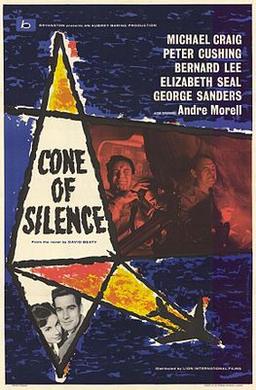
Cone of Silence (1960, directed by Charles Frend)


Cone of Silence is a very British film about aviation.

George Sanders plays an investigator who is looking into a crash of a “Phoenix” jetliner.  The crash has been blamed on the pilot, Captain George Gort (Bernard Lee).  Because Gort was killed in the crash, he is not around to defend himself.  Gort had a previous crash on his record and had also been reprimanded for flying to low when he landed a flight in Calcutta.  To Phoenix Airlines, Gort is the perfect scapegoat but a series of flashbacks reveals that Gort was a good pilot and that the cowardly Captain Clive Judd (Peter Cushing) was responsible for the incident in Calcutta.  Captain Hugh Dallas (Michael Craig) tries to exonerate Gort’s name before another crash occurs.

Cone of Silence is named not for the famed listening device from Get Smart but instead for a key part of Gort’s certification process, where he has to fly a plane without being able to hear anyone or anything else around him.  That Gort manages to do so is one of the things that leads to Dallas believing the Gort couldn’t have been responsible for the later crash.  Bernard Lee is best-known for playing James Bond’s unflappable superior, M, and it’s interesting to see him playing a much more neurotic character in Cone of Silence.  Gort is a good pilot but he knows that, after his first crash, no one trusts his judgment and everyone is expecting him to fail and it gets to him.  It does not help that he has to deal with the weaselly Captain Judd, who is looking to blame anything that happens on Gort.  Cushing does a good job of playing Judd as someone who is outwardly friendly but who is ultimately only looking out for himself.

Cone of Silence was released at a time when jet travel was still considered to be a luxury and pilots were viewed as being the men who could do the impossible.  Not surprisingly, the film is full of lengthy scenes in which Captain Dallas and others explain every step that goes into flying a jet.  Great care was taken to get every detail right, even if it meant limiting the film’s dramatic potential.  This may have been fascinating to audiences in 1960, many of whom had never traveled on a plane, but today, Cone of Silence can feel dry and overly talky.  It’s good to see Sanders, Lee, and Cushing all in the same film but Cone of Silence is never as compelling as its cast.

Film Review: The Princess (dir by Le-Van Kiet)


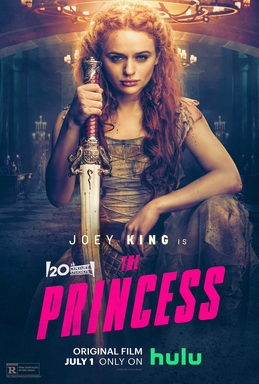
An unnamed Princess (Joey King) has been taken prisoner by the evil Julius (Dominic Cooper).  Julius wants to take control of the kingdom and the best way to do that is to force the Princess to marry him.  The morning of what is planned to be her forced wedding, the Princess wakes up handcuffed and trapped in one of those huge towers that always seem to turn up in movies like this.  The Princess takes one look out the window and is confronted by some cartoonish CGI that lets the viewer know that she’s really up high.

Fortunately, this Princess has spent most of her life training to be a warrior.  Under the tutelage of Linh (Veronica Ngo) and Khai (Kristofer Kamiyasu), the Princess has learned how to fight and defeat almost any enemy.  (“Fight from you heart,” Linh tells her.)  As such, the Princess has no fear of breaking her wrist so that she can remove the handcuffs.  Soon, she is running through the tower, fighting every man that she comes across.

The first few fight scenes are cool and I appreciated the scene where the Princess shot a man with a crossbow just as he started to yell the C-word because, seriously, you boys have been going overboard with that word lately.  Ultimately, though, there’s so many fight scenes that eventually, the viewer can’t help but notice that the fight choreography itself is rather simplistic.  The Princess spends a lot of time jumping and spinning around in slow motion.  She’s good at sliding across the floor while ducking her head to avoid swinging swords and flying arrows.  It’s enjoyable the first few times but, as the film progresses, it all gets a bit repetitive.  A huge part of the problem is that none of Julius’s henchmen appear to be particularly competent.  They keep making the same stupid mistakes over and over again and, as such, it’s not really empowering to watch The Princess defeat them because they’re all so clumsy that it seems anyone could defeat them.  Even Julius commits the cardinal sin of talking when he should be fighting.  A great hero needs a great villain and unfortunately, The Princess doesn’t provide that.  Still, the fight scenes are preferable to any scene that involves dialogue as the script sometimes seems to have been written by an AI programmed to include every cliché possible.  On the one hand, the Princess is smashing the patriarchy.  On the other hand, good intentions do not make up for clunky dialogue.

To be honest, there’s a certain cynicism at the heart of The Princess that’s a bit off-putting.  Written by two men and directed by another, The Princess is so proud of itself for featuring a young woman kicking ass that one has to wonder if the people responsible are seriously not aware that the action girl is one of the leading pop culture clichés of the past 20 years.  The main complaint about the action girl trope is that the character is often not given any personality or motivation beyond the fact that she can beat people up and look good while doing it.  The Princess doesn’t even bother to give its main character a name.  For all the talk about the fate of the kingdom, we never learn how the Princess feels about any of it.

As for the cast, neither Joey King nor Dominic Cooper are well-served by a script that doesn’t offer any sort of real depth to the characters.  Both deserve better.