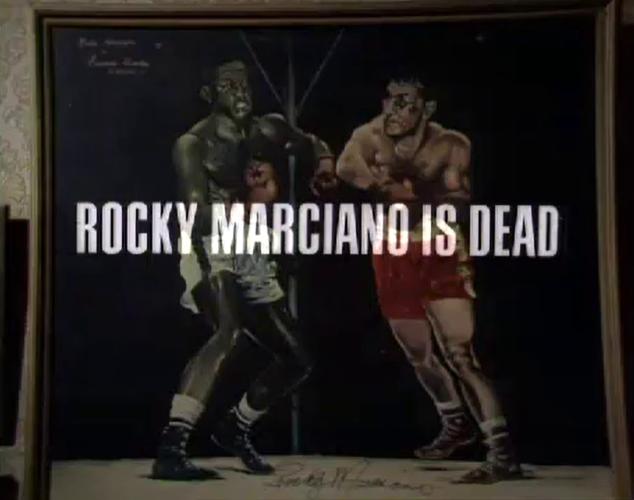
Rocky Marciano Is Dead (1976, directed by Graham Evans)


Harry Marcus (Ron Moody) was once a welterweight boxing champion but that was a long time ago.  Now, Harry is an old man who lives in small London apartment.  His daughter (Yvonne Bonnamy) visits him weekly.  Sometimes, he talks to Sonny (Jeffrey Kissoon), the squatter who is living in the abandoned apartment next to his.  Harry still likes to go back to his old gym and relive the glory days of both boxing and England.  Harry feels that those days are long gone but after he witnesses Sonny fight off a group of muggers, Harry becomes convinced that Sonny could be the next great boxer.

Harry wants to train Sonny but Sonny and his wife (Lesley Dunlop) both think boxing is barbaric.  It’s not until Harry explains that, historically, boxing has been used by the oppressed and marginalized to pull themselves out of poverty that Sonny steps into the ring.  Sonny has the talent but does Harry still have the connections to get Sonny a fight?

Rocky Marciano Is Dead was aired as a part of the BBC’s Play For Today anthology series.  It aired at the same time that Rocky was first setting box office records in the States.  Harry has a lot in common with Mickey Goldmill, the trainer played by Burgess Meredith in the first three Rocky films.  Like Mickey, he’s a former boxer who is trying to make a champ out of someone who is not sure if he has what it takes.  Rocky took place in the slums of Philadelphia while Rocky Marciano Is Dead takes place in a London that is full of abandoned buildings, gangs, and angry graffiti.  This is the London that, one year later, would inspire Johnny Rotten to sing that there was “no future in England’s dreaming.”  Not surprisingly, Rocky Marciano Is Dead is a much darker and cynical look at boxing than Rocky.  Harry is trying to recapture a past that may have never existed.

Along with providing a look at London on the cusp of the Punk Revolution, Rocky Marciano Is Dead is an acting showcase for Ron Moody.  Moody is in almost every scene, as Harry goes from being bitter to hopeful to disillusioned.  Moody makes it clear that Harry sees Sonny as something more than just a good boxer.  To Harry, Sonny is a chance to return to the time when both England and boxing were great.  If he can make Sonny a champ, Harry will be a champ too.  Harry’s mistake is not considering that Sonny might have plans of his own.  Moody was a born performer, as effective on television as in film.  He was also a perennial contender for the role of the Doctor on Doctor Who.  He was even offered the part in 1969 but turned it down, a move that he always said he regretted.  After a long career full of memorable performances in dramas, comedies, and musicals, he died in 2015 at the age of 91.  He gives a good performance in Rocky Marciano Is Dead, making Harry into something more than just an angry old man.

Rocky Marciano Is Dead can be viewed on YouTube.

The TSL’s Grindhouse: Polk County Pot Plane (dir by Jim West)


Oosh and Doosh, the stars of Polk County Pot Plane

First released in 1977, Polk County Pot Plane tells the story of Oosh (Don Watson) and Doosh (Bobby Watson), two brothers who have the long hair, country accents, and full beards of two guys who made most of their life decisions at a Lynard Skynard concert and who haven’t looked back since.

Oosh and Doosh spend most of their time hanging out in the mountains of Northern Georgia.  They pass the time drinking beer, smoking weed, and driving too fast.  Oosh and Doosh do have a job, of course.  The Dixie Mafia pays them to help unload all of the marijuana that is transported on a plane that regularly lands in the mountains.  The plane is nicknamed Big Bird and it even gets its own credit at the start of the film.

The opening credits also inform us that the pilot of Big Bird was played by an actor named Big Jim.

At the start of the film, Oosh and Doosh are unloading the plane but, unbeknownst to them, the cops have followed them out to the landing area.  When the cops finally make their presence known, Big Jim and the plane are able to escape but Oosh, Doosh, and two other hippies are arrested (and their RV practically destroyed) after a long chase.

With Oosh and Doosh in the county jail, the word goes out to all the drug kingpins, which is to say that there is a lengthy montage of people picking up the phone and explaining the situation over and over again.  Eventually, a helicopter lands on top of the jail and Oosh and Doosh are able to make their escape.  The helicopter flies over Georgia with Oosh and Doosh literally clinging onto the bottom of it.

This scene was filmed without stunt people.  That really is Don and Bobby Watson hanging onto that helicopter and the scene is also makes it clear that the helicopter really was flying high above a small town with the two actors dangling underneath.  If either Don and Bobby Watson had lost their grip, they would have basically plunged to their death.  On the one hand, you might wonder how the Watsons were convinced to risk their lives for a film called Polk County Pot Plane.  On the other hand, the scene is a hundred times more effective than one might expect precisely because the risk was real.

In fact, not a single professional stunt person was used in Polk Count Pot Plane.  All of the stunts were done by the members of the cast, the majority of whom appear to have been amateurs.  The sheriff who locks up Oosh and Doosh apparently was an actual sheriff.  Big Jim actually was a pilot.  While there isn’t much information available about the Watson brothers, their country stoner vibe feels authentic from the start.  For almost the entire cast, this was their first and only film.  What they lacked in experience, they made up for in authenticity.

There’s not much of a plot to Polk County Pot Plane, though it was reportedly based on a true story.  Oosh and Doosh get out of jail and find themselves being ordered to transport more drugs.  They also rip-off their bosses and, in the end, there’s an attempt to steal the plane itself.  For the most part, the film exists so that the police can chase Oosh and Doosh and several cars can be destroyed in the process.  The minute that we see a group of people trying to transport a house from one location to another, we know that someone’s going to end driving through it and destroying the whole thing.  That’s the type of movie that Polk County Pot Plane is.  It’s low-budget, it doesn’t always make a lot of sense, and it’s definitely amateurish.

And yet, it’s also entertaining and rather likeable.  The amateur vibe helps.  Because the Watson brothers appears to have essentially been playing themselves, the film at times has a documentary vibe.  For all of the silly comedy and the mumbled lines (with the Watsons especially sounding like King of the Hill‘s Boomhauer at times), it’s hard not to feel that this film probably gets close to the truth of what it was like to smuggle marijuana in the Deep South during the 1970s.  The combination of car crashes and the film’ s stoner vibe becomes rather fascinating.

Polk County Pot Plane was also released under the title In Hot Pursuit.  It can be found in several Mill Creek box sets and on YouTube!

Cleaning Out The DVR: Charlie Says (dir by Mary Harron)


Why does one join a cult?

That’s a question that’s been raised by a lot of different people over the past few years.  Some people claim that MAGA is a cult.  Others claim that Wokeism is a cult.  One need only go on twitter to discover cults devoted to celebrities.  There was a crazy woman named Emma who literally spent 8 years searching twitter for any critical reference to Garrett Hedlund so that she could personally attack whoever made the comment.  I once made a rather mild joke about Jennifer Lawrence’s habit of falling at award shows and, almost immediately, I started getting angry replies from people who had J Law as their profile pick.  Once upon a time, the Beliebers ruled the twitter wastelands.  Then it was the One Direction stans.  Now, people have to be very careful about what they say about Taylor Swift and Timothee Chalamet.  What makes people devote their lives to blindly defending celebrities and politicians who don’t even know (or care) that they’re alive?

In the HBO docuseries, The Vow, Mark Vicente (a former leader of the NXIVM cult) declared that “Nobody joins a cult!”  His point was that no one willingly joins a cult.  Instead, they get involved because they’re looking for something that is missing in their lives and, sometimes, this leaves them vulnerable to being manipulated by whoever is in charge of the cult.  Vicente’s argument was that it could happen to anyone.  The subtext, of course, was that Vicente was saying, “It even happened to me and look how smart I am!”

(It’s the same thing that one tends to hear from former members of Scientology.  “Sure, all of the stuff about Xenu didn’t make any sense and the average child would have seen through it but I fell for it so that means anyone could have fallen for it!”)

My own personal opinion is that most people join cults because they’re incredibly dumb and don’t have the confidence necessary to think for themselves.  That may sound harsh but I really do think that this is a case where it’s helpful to remember the law of parsimony.  It’s tempting to come up with all sorts of complex theories to try to explain why people join cults but the simplest answer is that people joins cult because they’re dumb.  I think sometimes we spend so much time exploring the lives of those who join cults that we tend to forget that the majority of people are smart enough not to.

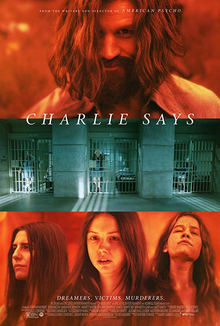
This was something that I found myself thinking about as I watched the 2018 film, Charlie SaysCharlie Says is one of the many recent films to explore how a grubby ex-con named Charles Manson (Matt Smith) was able to brainwash a group of hippies and turn them into his own personal army of murderers.  Charlie Says opens with Leslie Van Houten (Hannah Murray), Patricia Krenwinkel (Sosie Bacon), and Susan Atkins (Marianne Rendon) already in prison for the Tate-LaBianca murders.  A social worker named Karlene Faith (Merritt Weavers) is assigned to teach them college classes but Karlene is more concerned with trying to break the mental-hold that Manson continues to have over the three women.

The film is full of flashbacks to life at the Spahn Ranch with Charles Manson.  All of the expected details are included.  Charles Manson plays his guitar and talks about letting go of one’s ego.  A dazed Tex Watson (Chace Crawford) wanders around in the background, eager to prove that he truly is a member of the Family.  Blind George Spahn gets a handjob from Squeaky Fromme.  The women search through dumpsters for food.  The orgies give way to violence as Manson realizes that he’s never going to be a rock star.  Everyone at Spahn Ranch is happy until they aren’t.

Both the film and Karlene speculate as to how Charles Manson managed to brainwash the women who lived at the Ranch.  The film suggests that it was a combination of drugs, Manson’s own skills as a con man, and the fact that most of Manson’s followers were so eager to escape the patriarchal system under which they grew up that they didn’t realize that they had wandered right into another.  Of course, it could also be that Manson’s followers were just extremely stupid.  One thing that I have discovered from reading about Manson is that, while there was many people who decided to follow him, there were even more who took one look at him and Spahn ranch and who, much like Brad Pitt in Once Upon A Time In Hollywood, left as quickly as they could.

(One of the more interesting things about the online reaction to Once Upon A Time In Hollywood were the complaints that the film’s finale was misogynistic due to the violent deaths of the Manson followers.  Personally, I’m against the death penalty.  I view it as a classic example of putting too much trust in the government.  However, knowing what was done to Sharon Tate, I had no problem with Leonardo DiCaprio setting Susan Atkins on fire with his flame thrower.)

Mary Harron has directed many good films, including I Shot Andy Warhol, American Psycho, The Notorious Bettie Page, and The Anna Nicole Story.  Unfortunately, Charlie Says often feels like it’s meant to be a parody of all the other films about Charles Manson.  Some of that may have been unavoidable.  The horrific nature of their crimes has often overshadowed the fact that Manson and the Family were a ludicrous group of people.  Take out the crimes and they were essentially the real-life version of those dumbass commune dwellers in Easy Rider, the one who were trying to grow food in the desert.  Indeed, one of the smartest thing that Tarantino did with Once Upon A Time In Hollywood was that he used Manson and the Family sparingly.  As Charlie Says shows, the more time that a film spends with Manson, the more difficult it is to feel that the members of the Family are worth much consideration.  For the most part, the film follows Leslie Van Houten as she goes from being an insecure teenager to being a brainwashed murderer but, despite a strong performance from Hannah Murray, it doesn’t offer up much insight (beyond her own stupidity) as to how and why Leslie was so easily seduced into life at the ranch.

On the plus side, Matt Smith does a good job as Charles Manson, playing him as being a natural born con man.  As played by Smith, Manson is someone who knows how to use his hippie image to his advantage and who also knows how to read people.  The question about Manson has always been whether he believed all of his Helter Skelter nonsense or if he was just a criminal mercenary.  (The author Ed Sanders, who wrote The Family and spent years researching Manson, was of the opinion that Manson was far more well-connected with the leaders of Los Angeles’s organized crime scene that his hippie image might have suggested.)  Charlie Says suggests that Manson was a con man who ultimately made the mistake of believing his own con.

As far as Manson films go, Charlie Says doesn’t add much that hasn’t already been said.  Personally, I could do without anymore Manson films.  There’s nothing left to be learned from his horrific crimes.  Allow Once Upon A Time In Hollywood to be the last word on what the Family was and how they deserved to go out.

Film Review: Drive, He Said (dir by Jack Nicholson)


First released in 1971, Drive, He Said tells the story of two college roommates.

Hector (William Tepper) is a star basketball player who everyone expects to turn pro.  His intense coach (Bruce Dern) is always yelling at him to stop fooling around on the court but Hector is more interested in fooling around elsewhere as he’s having an affair with Olive (Karen Black), the wife of a self-styled “hip” philosophy professor named Richard (Robert Towne).

Gabriel (Michael Margotta) is Hector’s best friend.  They live together, even though Hector’s coach thinks that Gabriel is a bad influence.  Gabriel is a self-styled campus radical.  He has a devoted group of followers who will do just about anything that he tells them to do.  Gabriel is big into guerilla theater and symbolic protests.  Nothing he does seems to add up too much but, unlike Hector, he’s good at giving speeches.

Together, they worry about the draft!

Of course, they’re both worrying about two different types of drafts.  Hector is worried about the NBA draft and whether he should enter it.  He’s been playing basketball for as long as he can remember.  The only thing that he’s really good at is playing basketball.  And yet, Hector isn’t sure if he wants to spend the rest of his life taking orders from his coaches and devoting every minute to playing the game.  However, Hector’s worked himself into a corner.  When one NBA official asks him what he’s going to do if he’s not drafted, Hector admits that he doesn’t know.  When asked what his major is, Hector replies, “Greek.”

Gabriel, on the other hand, is worried about being drafted into the military and being sent to Vietnam.  Gabriel considers himself to be a revolutionary but it soon becomes clear that he really doesn’t have much of a plan for how to start his revolution.  Indeed, the film suggests that his activism is more about his own insecurity over his own sexuality than anything else.  Gabriel particularly seems to be obsessed with Hector’s affair with Olive.  While Hector reaches new highs on the court, Gabriel comes closer and closer to having a psychotic break.

Director Jack Nicholson found a way to work in shout out to his friend, Harry Dean Stanton

Drive, He Said was one of the many “campus rebellion” films that were released in the early 70s and, much like Getting Straight, it’s definitely a product of its time.  Today, it it’s known for anything, it’s for being the directorial debut of actor Jack Nicholson.  (Nicholson has said that, before he was cast in Easy Rider, he was actually planning on abandoning acting and pursuing a career as a director.)  The film features many of the flaws the are typically present in directorial debuts.  The pacing is terrible, with some scenes ending too quickly while others seem to go on forever.  At times, the film feels a bit overstylized as Nicholson mixes jump cuts, odd camera angles, and slow motion to little effect. It’s very much a film about men, so much so that the film’s ultra-masculinity almost verges on self-parody.

And yet, there are moments of isolated brilliance to be found in Drive, He Said.  Some of the shots are genuinely impressive and the army induction scene shows that Nicholson could direct comedy, even if he does let the scene drag on for a bit too long.  Though Nicholson doesn’t appear in the film, his approach to the story features his trademark cynicism and sense of fatalism.  Though he was often associated with the counterculture, Nicholson was more a member of the Beat generation than of the hippies.  As such, Drive, He Said has more in common with Jack Kerouac than Abbie Hoffman.  Drive, He Said is definitely an anti-establishment film but, at the same time, it doesn’t make the mistake of glorifying Gabriel or his followers.  Gabriel, with his constant demand that everyone join him in his ill-defined revolution, is almost as overbearing as basketball coach and, towards the end of the film, he commits an act of violence that leaves no doubt that his “revolution” is all about his own self-gratification.  The film is less a polemic and more a portrait of people trying to find their identity during a time of political and cultural upheaval.

The film’s biggest flaw is that neither William Tepper or Michael Margotta really have the charisma necessary to carry a movie, especially one in which even the main characters often do unlikable things.  Tepper is dull while Margotta overacts and, at times, comes across as if he’s trying too hard to imitate his director.  It falls to the film’s supporting cast to provide the energy that Tepper and Margotta lack.  Fortunately, Bruce Dern and Karen Black are both perfectly cast.  Bruce Dern seems to be having a blast as the fanatical basketball coach while Karen Black brings a fierce intelligence to the role of Oliva, an intelligence that one gets the feeling wasn’t really in the original script.  Considering how misogynistic every other character in the film is, it’s impossible not to cheer when Olive announces, “I’m not going with anybody, anywhere.”

(For whatever reason, there was a definite strain of misogyny that seemed to run through the majority of the late 60s and early 70s counterculture films.  Just consider the amount of time Getting Straight devoted to Elliott Gould shouting at Candice Bergen.)

Drive, He Said is flawed but interesting.  As a director, Nicholson understood how to frame a shot but he wasn’t quite sure how to tell a cohesive story.  That said, the film itself is a definite time capsule of a very specific cultural moment.

Film Review: Long Arm of the Godfather (dir by Nardo Bonomi)


Like all good Italian crime films, 1972’s Long Arm of the Godfather opens with an absurdly over-the-top act of violence.  In this case, a young gangster names Vincenzo (Peter Lee Lawrence) masterminds the hijacking of a delivery of Italian army weapons.  It’s gangsters versus soldiers as a ludicrous amount of bullets are fired and even a few grenades are tossed through the air.  The violence goes on for so long that actually starts to feel as if the film has become self-aware and is parodying the expectations of the audience.  The film seems to be saying, “You want violence?  Take this!”

That said, Vincenzo eventually does get away with a truck of weapons.  He’s suppose to deliver the truck to Don Carmelo (Adolfo Celi, who is probably best-known for playing James Bond’s nemesis in Thunderball) but Vincenzo has other ideas.  After running Carmelo off the road, Vincenzo drives off on his own.  His plan is to sell the weapons and use the money to start a new life with prostitute girlfriend, Sabina (Erika Blanc).  Unfortunately, because Vincenzo doesn’t have any money, he can’t pay anyone to help him unload the truck.  Eventually, he deals with that problem by stealing and selling Sabina’s jewelry.  Understandably, Sabina is not happy about this but Vincenzo has an even bigger problem to deal with.

It turns out that Don Carmelo is still alive.  Even when Vincenzo and Sabina leave Italy for North Africa and attempt to make a deal to sell the weapons to a group of terrorists, Don Carmelo and his men are following close behind.  It all leads to even more violence and an appropriately fatalistic ending.  The film’s ultimate message is that there is no escape from a life of crime.  There is no way to avoid the long of arm of the godfather.

Perhaps the most interesting thing about the film is that all of the characters pretty much hate each other even before the inevitable betrayals begin.  Don Carmelo appears to dislike all of his men and most of his men appear to dislike him to.  Even the people who help Vincenzo make little secret of the fact that they can’t stand to be around him.  The main exception to all of this mutual dislike is Vincenzo himself.  Vincenzo appears to sincerely like (if not quite love) Sabina.  Sabina, on the other hand, spends the majority of the film talking about how everything is Vincenzo’s fault.  She knows that Vincenzo is in over his head but, at the same time, she also knows that there’s a chance Vincenzo could make a lot of money so she sticks with him.  As for Vincenzo, he’s an eternal optimist, trying to find hope even when its clear that there’s none left.  Vincenzo may be clever but he’s not particularly smart and that is destined to be his eventual downfall.

Long Arm of the Godfather is an unapologetically pulpy thriller, one in which both the violence and the melodrama are frequently over the top.  It’s a film that will be appreciated by fans of hard-boiled crime fiction and Italian exploitation films.  Celi is properly intimidating as Don Carmelo while Peter Lee Lawrence gives a charismatic performance as Vincenzo.  Tragically, Lawrence would die two years after starring in Long Arm of the Godfather, a victim of a brain tumor that went undetected until it was too late.  He was 30 years old and, had he lived, he undoubtedly would have been a big star in European cinema.  Fortuntely, one can still watch him in a film like this and see hints of what could have been.

Film Review: Mr. Mean (dir by Fred Williamson)


In the 1977 film, Mr. Mean, Fred Williamson plays the title role.

He’s a former employee of the Cosa Nostra who now works as a sort of private investigator.  He’s cool.  He’s hip.  He’s sexy.  He’s Fred Williamson!  But the best thing about him is that his name actually is Mr. Mean.  Everyone in the film literally calls him “Mr. Mean.”  He introduces himself as being “Mr. Mean.”  The people who are closest to him occasionally leave out the “Mister” and just call him “Mean.”

The film begins with a woman approaching Fred Williamson on a basketball court and saying to him, “Hey, is your name Mr. Mean?”

Later, when he calls his office to check his messages, he tells his secretary, “This is Mr. Mean.”

When he goes to his favorite bar, he’s approached by two members of Ohio Players, the band behind Fire and Love Rollercoaster.  They tell him that they are such big fans of him and his reputation that they’ve actually written a song about him.  The song is called “Mr. Mean.”  They proceed to play the song over the opening credits.  For his part, Mr. Mean does not appear to be impressed.  That said, I imagine the Ohio Players were probably happier to be playing for Mr. Mean and than for the Brady Bunch.

Mr. Mean is summoned to Italy by a mob boss who wants Mr. Mean to do one last job.  He wants Mr. Mean to assassinate a rival gangster, Huberto (Lou Castel).  Mr. Mean explains that he may be a fighter and lover but he’s not a killer.  However, Mr. Mean then learns that Huberto has been running a scam charity, stealing money that people are donating to help fight hunger in Africa.  Mr. Mean takes on the contract.  However, Huberto knows that Mr. Mean is in Italy to take him out so Huberto hires an assassin named Rommell (Raimund Harmstorf) to take out Mr. Mean first.

Judging from the endless shots of Mr. Mean casually walking through Rome, it doesn’t appear that either man is in much of a hurry to get the job done.  Mr. Mean even takes time to pursue a romance with the mysterious Rene (Crippy Yocard).  What little action there is comes to a complete halt so the film can give us a lengthy scene of Mr. Mean and Rene walking along the beach.  Eventually, it turns out that Rene has a secret of her own and, for a few minutes, it seems like Mr. Mean might become yet another Fred Williamson film to feature a sudden downbeat finale.  But no worries!  Mr. Mean may be mean but he’s also clever!

(Actually, Mr. Mean turns out to be a surprisingly nice guy so I’m not really sure how he got that nickname.)

The film’s plot is next to impossible to really summarize because the plot doesn’t make any sense.  The story feels like it was made up on the spot, probably because it was.  Reportedly, Fred Williamson shot this film while he was in Italy to make Inglorious Bastards.  He would spend the week working on Bastards and then, on the weekend, he would borrow the film’s equipment and crew and secretly work on Mr. Mean.  He wrote the script while filming.  The result is a film that meanders without adding up to much.  The main theme of Mr. Mean appears to be that Fred Williamson was Fred Williamson’s biggest fan.

Mr. Mean is one of Fred Williamson’s lesser films.  Though he didn’t necessarily have a wide range as an actor, Fred Williamson had charisma and a lot of style and confidence.  All of that is on display in Mr. Mean but the film itself is impossible to follow and ultimately just feels like an extended home movie.  Mr. Mean just isn’t mean enough to be memorable.

Film Review: Fire on the Amazon (dir by Luis Llosa)


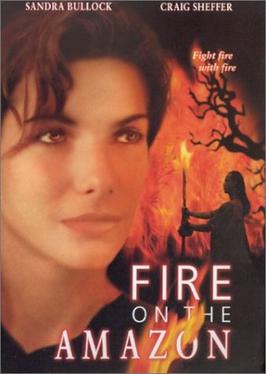
Released in 1993 and produced by none other than Roger Corman, Fire on the Amazon takes place in Bolivia.  Despite the protests of the indigenous population and the environmental activists who have flown down to support them, the Rain Forest is being destroyed by corporations, cattle ranchers, and military units.  After an activist named Rafael Santos (Eduardo Cesti) is assassinated, photojournalist R.J. O’Brien (Craig Sheffer) comes down to document the accused assassin’s trial.

R.J. tries to remain detached from the injustices that he sees around him.  Much like Robert Forster in Medium Cool, R.J. claims to be an observer and not a participant.  But then he meets an environmentalist named Alyssa Rothman (a pre-stardom Sandra Bullock) and he comes to realize that the Bolivian government is covering up the details of Santos’s death.  R.J. and Alyssa go deep into the Rain Forest, searching for evidence that can prove that the military was behind the assassination.  The military, of course, is determined to keep them from doing that.

Fire on the Amazon is a Roger Corman films with a social conscience.  It features several speeches about the importance of the Rain Forest and it ends with a title card informing viewers of how much of the Rain Forest was destroyed on a daily basis in 1993.  Whatever else one might have to say about the films that Corman has either produced or directed, he has always seemed very sincere when it comes to his messages.  That said, Corman has also always been very sincere in his belief that movies should make money and Fire on the Amazon doesn’t allow its environmental message to get in the way of the sex and violence that most of the film’s viewers were probably looking for.  The film actually feels a bit like a companion piece to The Forbidden Dance.  Yes, saving the Rain Forest is importance but so is doing the Lambada.

Today, if Fire on the Amazon is known for anything, it’s probably for the rather random sex scene featuring Sandra Bullock and Craig Sheffer.  To be honest, while the scene is graphic and lengthy, the only thing that sets it apart from other low-budget sex scenes is the fact that it features a future Oscar winner.  A huge problem with the scene is that there are next to no romantic sparks between Bullock and Craig Sheffer.  Indeed, Sheffer gives such a lifeless performance that, at one point, it appears that he’s actually fallen asleep during the big sex scene.  Fortunately, Sheffer sticks out his tongue long enough to let us know that he’s still alive.

Make no mistake about it, while Sandra Bullock may be the name that’s highlighted whenever this film shows up on a streaming site, Craig Sheffer is the star of the film.  The majority of the film focuses on him as he wanders around Bolivia and whines about having to do his job.  Though he’s certainly not helped by the film’s script, Sheffer gives a performance that alternates between sleep-walking and histrionic shouting.  The problem is that the only time Sheffer shows any emotion is when his character has been inconvenienced.  He can watch the police beat up a man without barely lifting an eyebrow but, as soon as he’s arrested and put in a cell, the audience is subjected to over a minute of Sheffer shrilly screaming, “Call the embassy!”

It would be nice to say that Sandra Bullock gives a performance that transcends the material but, unfortunately, she’s miscast as a somber activist and, worst of all, she gets stuck with the film’s worst line when she tells Sheffer to write about what “you feel and not what you see.”  It seems like better advice would be to do both but what do I know?  I mean, as of right now, it seems like people focusing on what they feel as opposed to what they see has led to a lot of problems but maybe the 90s were a simpler time.

Just a year after this film was released, Sandra Bullock would star in Speed and become a star.  This meant that Bullock would no longer be filming sex scenes in Roger Corman-produced eco-thrillers.  It also meant that Fire on the Amazon would forever be promoted on DVD and Blu-ray as being a “Sandra Bullock film” while Craig Sheffer would often go unmentioned.  (In Sheffer’s defense, he’s still acting and has given many performances that are a hundred times better than his work in Fire on the Amazon.)  If you want to see a good film about Sandra Bullock in the jungle, check out The Lost City.  If you want to see an entertaining environmentally-themed thriller from director Luis Llosa, check out Anaconda.  Worthy intentions aside, Fire on the Amazon is best avoided.

Film Review: The Mad Bomber (dir by Bert I. Gordon)


Haunted by the death of his teenage daughter and the subsequent collapse of his marriage, William Dorn (Chuck Conners) feels that society is changing too quickly.  He misses the days when people were polite and followed the law.  Now, he’s upset that he can’t even walk around Los Angeles without seeing people littering.  The waitress at the local diner has forgotten the importance of smiling while taking her customer’s order.  Hospitals are full of doctors who don’t care about their patients.  The colleges are full of long-haired drug pushers.  His ex-wife is attending a consciousness raising seminar.  William has had it with the 1970s so he decides to start blowing stuff up.

William starts to wander around Los Angeles.  Usually, he’s carrying a brown paper sack and, inside the sack, he’s got a ticking time bomb.  He always wears the same suit and thick glasses and yet, somehow, no one ever seems to notice or remember him.  Even though all of his bombs are timebombs, they still go off within seconds of him planting them, which means that he’s usually only standing a few feet away with they explode.  William also sends the police tape-recorded manifestos without making any effort to disguise his voice.  William may not be the smartest criminal around but that still doesn’t stop him from terrorizing the city.

Detective Geronimo Minelli (Vince Edwards) is determined to track down the mad bomber, even if it means yelling at everyone that he meets.  Minelli is one of those intense detectives who doesn’t care about what the Supreme Court has to say about the rights of suspects and the accused.  Unfortunately, the only witness who can identify the bomb is George Fromley (Neville Brand), a sex offender who doesn’t want to admit that he saw the bomber blow up a hospital because he was busy assaulting one of the patients at the time.  Can Minelli convince Fromley to provide a physical description of the bomber?  And will William Dorn ever realize that it’s probably not a good idea to store a bunch of ticking time bombs in his basement?

First released in 1972 and also known as The Police Connection, Bert I. Gordon’s The Mad Bomber is unique amongst Gordon’s films in that it doesn’t feature any giant animals or killer bugs.  In this film, the monsters are all human and don’t have any convenient excuses for their behavior.  Though Neville Brand does a good job with the role, George Fromley is still probably one of the most unlikable and despicable characters to ever appear in the movie.  Meanwhile. Vince Edwards plays Minelli as being the type of cop who is one bad day away from massively violating someone’s civil rights during a traffic stop.  The film does build up some sympathy for William Dorn, with still shots of his daughter used to show us what’s going through Dorn’s mind as he plants his bombs.  But then it tosses all that sympathy away by having him target a meeting of feminists, apparently because he blames them for his wife leaving him.

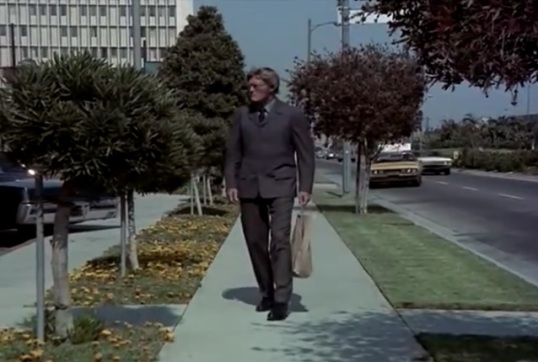
The main problem with the film is that we’re expected to believe that someone who looks like this would be able to walk around Los Angeles and plant bombs without anyone noticing.

That’s nothing against Chuck Conners, who does a good job of portraying William’s frustration with the world.  But still, it’s hard to believe that no one is going to notice a dude who is nearly seven feet tall and who is carrying a ticking shopping bag.

Flaws and all, The Mad Bomber is a watchable and occasionally even an engrossing film.  It’s certainly one Gordon’s better efforts and Gordon does a good job of creating and maintaining a properly ominous atmosphere, even if it sometimes hard to take seriously the sight of Chuck Conners, lumbering around in his suit and trying to discreetly drop off bombs.  In many ways, it’s a film that still feels relevant today. William, like so many. is trying to forcefully stop the world from changing around him.  He’s a man who has lost anything and has decided that it’s the fault of everyone else.  (In many ways, he’s like Rainn Wilson in Super, ragefully reacting to a world is not as simple as he believes it should be.)  The Mad Bomber may not be as much fun as Gordon’s giant monster films but it’s still a film that has something to say.

Film Review: The Black Godfather (dir by John Evans)


The 1974 film, The Black Godfather, opens with two black men attempting to break into the house of a white drug dealer.  Unfortunately, the drug dealer happens to be home.  Both of the men are shot.  One dies in the alley.  The other, J.J. (Rod Perry), is shot in the arm but survives.

J.J. may not have been able to rob the dealer but his bravery impresses Nate Williams (Jimmy Whitherspoon), a powerful neighborhood crime lord.  Nate allows J.J. to hide out at his place and, while J.J. heals, Nate offers up some advice on how to survive on the streets.  J.J. says that he’s only interested in making some “bread,” but Nate thinks that J.J. has what it takes to become one of the top men in his organization.

One opening credits montage later and J.J. has indeed become a powerful man on the streets.  Though he may sell drugs, J.J. is a gangster with a conscience.  As he explains to his old friend, Diablo (Damu King), there’s no way to create change unless you make some money beforehand.  Diablo is a political militant who has no interest in working with J.J. until he discovers that J.J. is planning on running Tony (Don Chastain) out of the neighborhood.  Tony is a white gangster who has made a fortune by destroying black communities with heroin.  Diablo and his followers become J.J.’s enforcers as he wages war against Tony.

Unfortunately, the always pragmatic Nate doesn’t want J.J. to wage war against Tony.  Nate believes that it is important to keep the peace.  That Nate is tying to prevent a war doesn’t matter to Tony, of course.  As soon as Tony finds out that J.J. has been seeing Nate’s daughter, Yvonne (Diane Sommerfeld), he makes his move.

Made at the height of the Blaxploitation era, The Black Godfather‘s title brings to mind memories of Don Corleone, Michael, Sonny, and Tom Hagen.  And it is true that the wise and patient Nate does, in many ways, come across like a black version of Don Corleone.  Nate is pragmatic and cautious almost to a fault.  Just as Don Corleone resisted going to the war with the Tattaglias, Nate resists going to war with Tony.  (And, much like the Tattaglias, Tony proves himself to be unworthy of Nate’s generosity.)  However, J.J. has far more in common with Sonny than with Michael.  Unlike the  calculating and patient Michael, J.J. is in a hurry to prove that he’s the most powerful gangster in the community.  Like Sonny, J.J. doesn’t hesitate before striking back at his enemies.

Unfortunately, despite having an intriguing premise, The Black Godfather is a bit of a chore to sit through.  The story moves slowly and even the scenes of gangster violence feel rather rudimentary.  Rod Perry projects a confident charisma and Jimmy Witherspoon does a good job as the wise Nate but otherwise, the cast is stiff and unconvincing.  It’s a shame.  The mix of crime and militant politics had potential.  Early on, Diablo and J.J. debate whether or not good can come out of bad, with J.J. arguing that money can get a lot more done than idealism.  It’s a debate that’s still relevant today but it’s also an issue that the film abandons fairly quickly.  Based on the film’s title, I had some hope for The Black Godfather but, in the end, it’s just too slow and amateurish to really be memorable.

Retro Television Review: Roll, Freddy, Roll (Dir by Bill Persky)


Welcome to Retro Television Reviews, a feature where we review some of our favorite and least favorite shows of the past!  On Sundays, I will be reviewing the made-for-television movies that used to be a primetime mainstay.  Today’s film is 1974’s Roll, Freddy, Roll!  It  can be viewed on YouTube!

Poor Freddy Menlo!

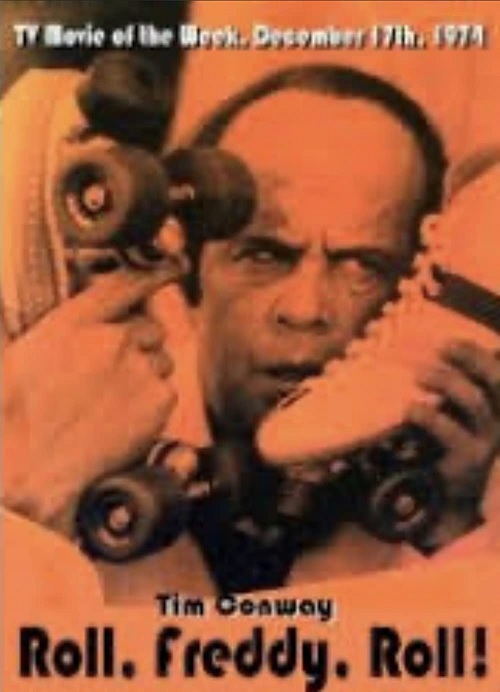
Played by Tim Conway, Freddy is a well-meaning guy who gets absolutely zero respect from the rest of the world.  He works as a computer programmer but his boss (Henry Jones) doesn’t think much of him and an attempt to score a contract with the U.S. Navy falls through when Admiral Norton (Scott Brady) announces that he doesn’t think much of computers.  Meanwhile, his ex-wife (Ruta Lee) has fallen in love with and married “Big Sid” Kane (Jan Murray).  Big Sid is a millionaire who made his fortune selling used cars.  Big Sid is seen every day on television.  And, due to catching the biggest bluefish tuna on record while on his honeymoon, Big Sid Kane is now in the Guinness Book of the World Records.

A lesser engineer would crack under the pressure and go on a rampage through Los Angeles, Falling Down-style.  But Freddy just wants to be a good father.  He just wants his son, Tommy (Moosie Drier), to look up to him the way that he now looks up to Big Sid.  Freddy takes Tommy to a roller skating rink and awkwardly skates around while Tommy talks about how much he enjoys going to Big Sid’s car lot.  When it’s time to leave the rink, Freddy is informed that his shoes have been lost.  An angry Freddy refuses to return the rink’s skates until he gets back his shoes.  Freddy then takes Tommy down to Big Sid’s used car lot, where Big Sid has invited other people to come and try to set world records of their own.  A local news reporter sees that Freddy is on roller skates and announces that Freddy is seeking to set the world record for the most time spent rolling around!  Finally, Freddy has found a way to impress his son!

Excuse me while I catch my breath.  That was a lot of plot to cram into just two paragraphs.

Roll, Freddy, Roll is not a particularly complicated movie.  For the most part, it exists solely so that Tim Conway can do some mild physical comedy while trying to balance himself on roller skates.  It only has a 73-minute run time and it basically feels like an extended episode of an old sitcom.  With all that in mind, it still seems like it takes forever to actually get Freddy into those roller skates and once he does put them on, the movie keeps up coming with implausible excuses to keep him from taking them off until he finally decides to go for the world record.  The story would have been stronger if Freddy has been the one to look at his feet and say, “I’m going to set a world record,” as opposed to him just being bullied into it by a news reporter.  Tim Conway’s likable but there’s only so many times you can watch someone fall on roller skates before the joke starts to wear thin.

It would not surprise me if Roll, Freddy, Roll was meant to be a pilot for a sitcom.  It’s easy to imagine Tim Conway trying to impress his son and win back his wife by doing something stupid on a weekly basis.  As far as I know, Roll, Freddy, Roll did not lead to a television series and that’s probably a good thing.  Freddy had a hard enough time just rolling around Los Angeles for two days!  Who knows what would have happened if he had tried to do it on a weekly basis!?