Radical Jack (1999, directed by James Allen Bradley)


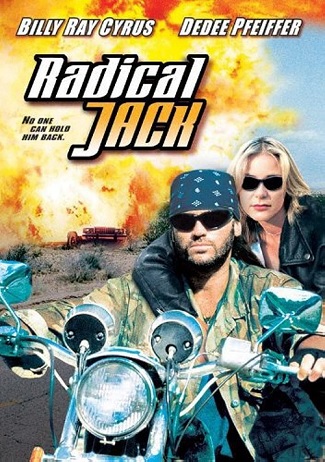
Billy Ray Cyrus is Jack, a tough-as-nails former CIA agent who is still traumatized by his actions during Desert Storm and the murder of his wife by the international terrorist, Riotti (Benny Nieves).

Stop laughing.

I’ll admit that the idea of Billy Ray Cyrus, the most mild and unthreatening of mullet-headed country music stars, playing a CIA burnout who has killed countless men may sound like something to laugh about but … forget it, I’ve got nothing.  Laugh all you want because it is ridiculous casting and, throughout the film, Billy Ray looks increasingly uncomfortable with the character’s R-rated antics.  Sometimes, you have to do what you have to do, though.  When this movie was made, it’d been seven years since Achy Breaky Heart and even one-hit wonders need to pay the bills.  In 1999, reinventing Billy Ray Cyrus as a second-tier action star probably seemed like a good idea.  Billy Ray may not be the most convincing CIA agent but he’s still more likable than Steven Seagal.

Billy Ray is sent undercover to a small town in Vermont.  Somehow, by working as a bouncer at the local roadhouse, Billy Ray Cyrus is supposed to find a way to expose two local arms dealers, Lloyd (George “Buck” Flower) and Lloyd’s good for nothing son, Rolland (Noah Blake).  Lloyd and Rolland are selling weapons to Riotti so this is personal for Billy Ray.  But Billy Ray is also romancing Rolland’s ex-girlfriend, Kate (Deedee Pfeiffer) so it is personal for Rolland too.

As both an action hero and a film, Radical Jack isn’t all that radical and Billy Ray Cyrus never looks comfortable in any of the action scenes or the scenes where he makes out with Deedee Pfieffer but there are still plenty of explosions, fights, and chase scenes.  Though she doesn’t have much romantic chemistry with Billy Ray, Deedee Pfieffer gives the best performance in the film, playing Kate as someone who knows that she deserves better than what life has given her.  Radical Jack was produced by the same people who did Time Chasers and fans of that film will be happy to visit the exact same landing strip and hangar that was featured so heavily in that sci-fi epic.  There’s also a twist at the end, which you’ll see coming from miles away and Billy Ray does something unexpectedly cruel with a hand grenade.  Radical Jack did not make an action star out of Billy Ray Cyrus but, two years later, he showed an unexpected talent for comedy with his small role in Mulholland Drive.  Seven years after playing a burned-out CIA assassin, Bill Ray Cyrus found new fame as Miley Cyrus’s father and Radical Jack would never ride again.
Film Review: Rumble in the Bronx (dir by Stanley Tong)


First released in 1995, Rumble in the Bronx is known for two things.

First off, it’s the film that finally made Jackie Chan a star in America.  Chan had been an international star for two decades before starring in this film but he had initially struggled to break into the American film industry.  Before Rumble in the Bronx, no one in Hollywood was quite sure what to do with an actor who was both skilled at martial arts and who also had perfect comedic timing.  Indeed, the very title of  Rumble in the Bronx seems to designed to make Americans feel comfortable with the film.  Jackie Chan may have been from Hong Kong and the film itself may have been dubbed and it may have been released internationally before New Line got around to releasing it in the States but it was a film about the Bronx!  And what’s more American than the Bronx?

Except, of course, Rumble in the Bronx wasn’t filmed in the Bronx.  The other thing for which this film is remembered was that it may have taken place in the Bronx but it was filmed in Vancouver.  From the minute the audience sees Jackie walking through this film’s version of the Bronx, it’s pretty obvious that he’s in Canada.  All of the extras are very polite.  The city streets are surprisingly clean.  Even the graffiti is rather mild in tone.  (Reportedly, the production spray-painted the locations every morning and then cleaned up all the graffiti at night.)  When the film shows us its version of an NYPD stationhouse, the building is so neat and clean that it seems like it should be in a Canadian tourism brochure.  New York has never looked more inviting than when it was played by Vancouver.

Of course, the main giveaway that this film was shot in Canada was that there are mountains in the background.  Majestic mountain ranges are one of the few things that you cannot find in New York City.  When the bad guys drive someone out of the city so that they can threaten him, they end up in front of an absolutely gorgeous mountain stream.  Seriously, I’m sure I’m not the only person who wanted to travel to Canada after watching Rumble in the Bronx.

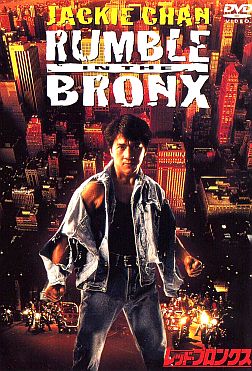
But, hey …. it’s a Jackie Chan movie!  If you can’t suspend your disbelief while watching a Jackie Chan movie then when can you suspend it?  The film’s plot is not terribly complex.  Jackie plays a Hong Kong cop who comes to New York for his uncle’s wedding.  While his uncle is on his honeymoon, Jackie looks over his uncle’s store and protects it from the local gang.  Jackie also befriends Nancy (Francoise Yip) and her wheelchair-bound brother, Danny (Morgan Lam).  Both Nancy and Danny need someone to look out for them and to encourage both of them to reject the seedier temptations of the Bronx.  They also need Jackie to protect them from the golf-loving crime lord, White Tiger (Kris Lord).

The plot is mostly an excuse for a series of increasingly elaborate fights and stunts.  As always, it’s fun to not only watch Jackie Chan in action but to also try to spot all the moments in which he nearly killed himself performing his own stunts.  Rumble in the Bronx is the film in which Jackie Chan broke his ankle while jumping onto a hoverboat.  One can actually see the ankle bending at an extremely awkward angle.  I actually covered my eyes when I realized what was happening because it was obviously very painful.  If anyone had any doubt of how painful it was, Jackie included footage of him howling in pain during the end credits.  That said, as painful as it was to watch Jackie’s ankle snap, it doesn’t change the fact that this film’s finale actually involves a hovercraft!  Even without Jackie’s stunts, the action in this film’s finale would be enjoyably and shamelessly over the top.  But knowing that Jackie was out there risking his life to make the film makes it all the more enjoyable.  And it also helps that Jackie Chan is a legitimately good actor, one who gets a lot of laughs out of the fact that the characters that he plays are often as shocked by some of the things that he does (and survives) as the audience is.

Myself and a few others watched Rumble in the Bronx on Friday as a part of our weekly #FridayNightFlix get-together.  We had a blast.  Another film that we recently watched for #FridayNightFlix, Escape From The Bronx, is famous for its line of “It is time to leave the Bronx”  but you know what?  Why would anyone ever want to leave beautiful Vancouver?

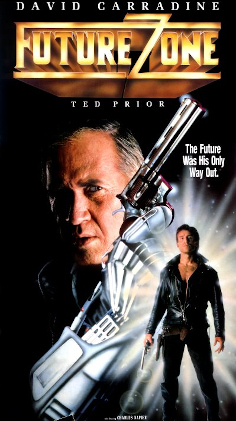
Future Zone (1990, directed by David Prior)


David Carradine is back as super glove-wearing bounty hunter John Tucker in this sequel to Future Force!

Once again, it’s the future.  In the future, everyone drives a car that was made in the 70s and spends most of their time in the abandoned warehouses that are meant to represent their places of business.  Hard-drinking John Tucker meets and starts to work with the newest C.O.P.S. recruit, Billy (Ted Prior).  Billy can shoot just as fast as Tucker and seems to know all about Tucker and his wife, Marion (Gail Jensen).  That’s because Billy is from the future.  As he explains it, some “friends of mine built a time portal,” and Billy used it to come back to the past and save Tucker from being killed by a bunch of criminals.  Why is Billy so concerned about saving John Tucker?  Did I mention that Marion is pregnant?

Future Zone is just as dumb as Future Force but it is set apart from the first film by its use of time travel.  The best part of the movie is that neither John nor Marion are surprised to hear that Billy’s friends just happened to build a time portal.  Nobody asks why they built a time portal or even how they built a time portal.  The time portal is the most important thing about the movie but everyone shrugs off its existence.  Are time portals a common thing in the future?  Does everyone have a time portal?  How does the time portal work?  How is Billy able to go into the past at exactly the right moment?  When it is time for him to go back to his time, how does he let his friends know?  These are all good questions that no one asks.

The other thing that no one asks is why Tucker doesn’t wear his super glove all the time.  His super glove can do anything, from shooting lasers to blocking bullets.  If I had a super glove, I would wear it all the time.  Tucker keeps it in the trunk of his car and only summons it at the last possible moment.  Why even have a super glove if you’re not going to use it?

Retro Television Reviews: We’re Fighting Back (dir by Lou Antonio)


Welcome to Retro Television Reviews, a feature where we review some of our favorite and least favorite shows of the past!  On Sundays, I will be reviewing the made-for-television movies that used to be a primetime mainstay.  Today’s film is 1981’s We’re Fighting Back!  It  can be viewed on YouTube!

We’re Fighting Back opens with a title card informing the viewer that the film that they are about to see is based on a true story and that the characters are based on the Guardian Angels, a group of New Yorkers who took it upon themselves to patrol neighborhoods and the subways.  However, the film’s plot is fictionalized and all of the names have been changed and basically, the entire story is made up.  It gets the film off to a strange start.  This film is based on a true story, except that it’s not.

Morgan “Case” Casey (Kevin Mahon) is a young man living in New York with his father.  When his father is mugged in the subway and ends up in the hospital, Case decides to take it upon himself to patrol the trains.  He recruits his co-workers at the local hamburger place.  Benny (Ramon Franco) says he is streetwise.  Ling (Brian Tochi) claims that he’s good at fighting.  Preacher (Paul McCrane) …. well, I’m not sure what Preacher’s special skill is but he’s recently moved to New York from Alabama.  Case and his friends lose their first big fight against a gang of muggers, which leads to Case yelling at all of them and announcing that they need to recruit more members and get trained up on how to fight.  Preacher thinks that Case is putting everyone’s life in danger but Case is determined to clean up the neighborhood.

Teaming up with some former gang members, Case forms the organization that will become the Guardian Angels.  Among those who join are a tough waitress named Chris Capoletti (a young Ellen Barkin) and a Hungarian immigrant named Janos (an equally young Stephen Lang).  At first, attorney Elgin Jones (Joe Morton) thinks that Case and his organization are going to be a bunch of lawless vigilantes but, after meeting Case and seeing Case refuse to allow an obvious psychopath to join the group, Elgin decides to become a part of Case’s anti-crime crusade.

And …. well, that’s pretty much it.  There’s not much of a plot here.  Case and Preacher are briefly estranged but they are friends again by the end of the movie.  Eventually, Case faces off with Tony (John Snyder), the gang leader who mugged his father.  For the most part, though, this is a film without much real conflict.  In this film’s portrayal of urban crime, it turns out to be remarkably easy to clean up a neighborhood.  Apparently, you just need to get a bunch of people to give a damn.  One watches the movie and wonders why no one ever came up with this extremely simple solution in the past.  The film goes out of its way to tell us that Case is not some sort of Charles Bronson-style vigilante but Case never has to face any muggers as dangerous as The Giggler.  If Case lived in the Death Wish 3 neighborhood, who knows what type of approach he would have gone with.

Under the best of circumstances, this film would seem simplistic.  Watching this film after the past few years, in which we’ve seen an increasing number of unarmed people getting hurt and killed by self-appointed vigilantes who felt that they shouldn’t have been in their neighborhood or train car, it’s hard not to feel that We’re Fighting Back is incredibly naïve and rather irresponsible.  (The Death Wish films are so shameless and over the top that they’re difficult to take seriously as any sort of manifesto.  We’re Fighting Back plays out with all the earnestness of a call to action.)  Need to clean up your neighborhood?  Just do it yourself!  Just fight back!  Obviously, that’s an idea that appeals to a lot of people but, in reality, it rarely seems to work out the way that it should.

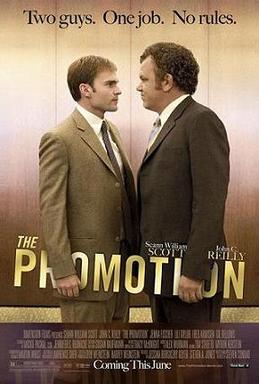
I Watched The Promotion (2008, dir. by Steven Conrad)


Yesterday, after I got home from voting in my town’s city council elections, I wanted to unwind with a tennis movie.  When I did a search for “tennis,” Tubi recommended that I watch The Promotion.

I don’t know why because there is no tennis in The Promotion.  No one plays a game or even talks about tennis in The Promotion.  Instead, the movie is about two men who work for a grocery store and who are both hoping to get promoted.  The narrator is Doug (Seann William Scott), who is married to Jen (Jenna Fischer), a nurse.  Doug wants to get promoted so that he and Jen can move into a new house and so that he can be the sole breadwinner.  Doug also has to get the promotion because he has already lied to Jen and told her that he got it.  Doug was feeling insecure because Jen’s boss, Dr. Timm (Bobby Cannavale) saves lives for a living while Doug just spends all day dealing with angry customers and the gang members who hang out in the store’s parking lot.  Doug’s rival for the promotion is Richard (John C. Reilly), a recovering drug addict who listens to self-help tapes.  Each of them tries to sabotage the other.  Doug tries to make Richard look stupid at a company retreat and Richard files a false injury report after Doug hits him with a bag of frozen tater tots.

I think the movie was trying to make a point about how desperate people are for status and money that they’ll do anything to get it but I didn’t care because I didn’t find Doug or Richard to be in any way likable and I didn’t want either one of them to get the promotion.  I would not shop at any store where they worked because grocery shopping is bad enough without having to deal with all of that extra drama.  Both Richard and Doug were terrible as assistant managers so as far I was concerned, neither one of them deserved to be promoted.  Jen should have left Doug for Dr. Timm.

Plus, there wasn’t any tennis.

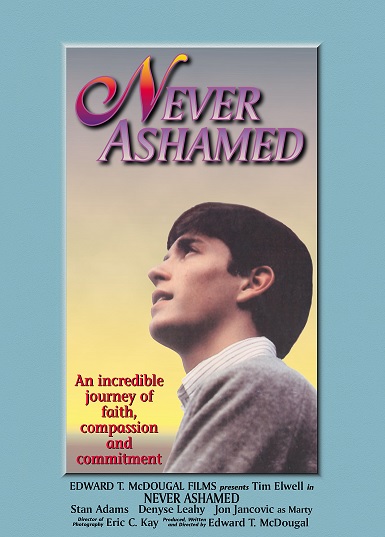
May Positivity: Never Ashamed (dir by Edward T. McDougal)


The 1984 film, Never Ashamed, gets off to a lawles start with two teenagers, Tim Hughes (Tim Elwell) and Marty Sullivan (Jon Jacovic) stealing an ice cream truck.  Even though the ice cream man yells at them that he owns the truck and that he needs it for his job, Tim and Marty take off with it.  They speed down the street.  They play the ice crea, music.  They toss out the ice cream.  And, eventually, they get stopped by the police.

Tim’s father, a liberal talk show host named Sid Hughes (Stan Adams), thinks that Tim is just being a normal, out-of-control teenager.  Tim’s mother (Denyse Leahy) is far more concerned and she suggests that perhaps Tim should attend a special summer camp for juvenile delinquents.  Sid is not happy to hear that it’s a Christian summer camp.  (At one point, we see Sid getting upset when Ronald Reagan gives a speech about prayer in school so we know how Sid feels about religion.)  However, Sid finally gives in.

This is followed by a montage of Tim doing summer camp stuff.  For me, not being a camp-type of person, the montage was horrifying.  I cringed at all of the canoeing, the playing, the laughing, the singing, and all the rest.  It was a montage of happiness but all of the smiles seemed a bit too wide and calculated.  To be honest, it reminded me of the type of activities that were used to brainwash Nick Mancuso in Ticket to Heaven and Michael O’Keefe in Split Image. 

Still, Tim has a great time and, when his parents pick him up from camp, Tim announces that he’s now a Christian.  Sid is horrified and starts talking about Jim Jones and the People’s Temple.  Tim’s old friends are astonished, especially Marty.  Marty is not happy when Tim starts hanging out with a new crowd at school.

Here’s the thing.  We’re supposed to like Tim’s new friends but, honestly, Marty does kind of have a point.  Tim’s new friends are so bright and cheery and perfect and well-behaved that they really do come across as being a little creepy.  And when Marty says that he wants to be able to spend some time with his oldest friend without having a bunch of strangers following them around, Marty again has a point.  At times, it seems as if Tim’s new friends really do expect him to spend every waking moment with them.  If Tim’s not going to their study group, then he’s going to the “Christian car wash.”  When Marty says, at one point, that he really needs to talk to Tim about some problems that he’s having in his life, Tim’s response to tell him to come to church with Tim and his new friends.  Marty gets upset about that and again, it’s hard not to feel that he has a point.  Marty needs someone to talk to and it wouldn’t kill Tim to have a sincere, one-on-one conversation with Marty.  If Tim wants to invite Marty to church after that conversation, there’s nothing wrong with that.  But, at that moment, it was obvious that Marty needed to feel that he was more to Tim than just another invitee.

Marty feels that he has a lot to be upset about.  He runs for junior class president on a platform of parties and drugs but he loses to the nerdy and boring Wayne, who is one of Tim’s new friends.  Marty doesn’t feel close to his family.  His grades are slipping.  His best friend is pretty much ignoring him.  Marty is supposedly a drug dealer who regularly goes down to Mexico to pick up cocaine.  While Marty is definitely a bit cocky and irresponsible, there’s absolutely nothing about him that suggests he’s the type to sneak across the borders with bricks of cocaine in a duffel bag and I was shocked when I discovered that the movie was actually being serious about that.  In a surprisingly well-directed sequence, Marty has his friends toss firecrackers at the Christian car wash while he sneaks into the church and steals some money.

Never Ashamed is only 64 minutes long.  It’s obviously one of those films that was made specifically to be viewed by church youth groups.  It’s definitely a product of its time and, in the end, it is perhaps most interesting as a time capsule.  I imagine that watching this film is the equivalent of stepping into a time machine and setting the destination for 1984.  (“You look like Scott Baio!” one of Tim’s new friends excitedly tells him.)  It’s a sincere film but, at the same time, it’s also a film that is very much about preaching to the choir.  As happy as Tim and his new friends are, I think most people would feel that Marty seems like he would be more fun to hang out with.

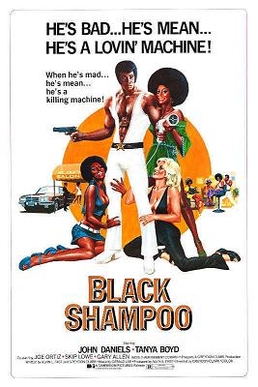
The TSL Grindhouse: Black Shampoo (dir by Greydon Clark)


The 1976 film, Black Shampoo, tells the story of Mr, Jonathan (played by an expressionless actor named John Daniels).  Mr. Jonathan is the hottest hairstylist on the Sunset Strip.  Rich women flock to his salon so that Mr. Jonathan can do their hair and, as the first scene in the film makes clear, do a lot more as well.  Black Shampoo begins with a wash and rinse that soon leads to Mr. Jonathan’s client saying, “It is bigger and better!” while the singers on the film’s funk-heavy soundtrack tell us that, “He’s a real man.”

Mr. Jonathan is so popular that the women who come into his salon are visibly upset if they’re told that their hair will be done by Mr. Jonathan’s two associates, Artie and Richard.  “Artie doesn’t have the right equipment!” one woman exclaims while another complains, “My hair’s a mess …. I haven’t had my hair done in over a month.”  Fortunately, helping to keep the place running is Mr. Jonathan’s new administrative assistant, Brenda St. John (Tanya Boyd).  In fact, Mr. Jonathan could even see himself settling down with Brenda.

Unfortunately, Brenda is the ex-girlfriend of a white gangster named Mr. Wilson (Joe Ortiz).  And Mr. Wilson is determined to get Brenda back, even if it means sending two of his thugs down to Mr. Jonathan’s and messing the place up.  It’s easy for them to vandalize the salon and to harass Artie and Richard because Mr. Jonathan hardly ever seems to be there.  He’s always either visiting a client at home or taking part in a falling in love montage with Brenda.  When Brenda is kidnapped, Mr. Jonathan falls into a deep depression.  Eventually, though, Mr. Jonathan realizes that he has to rescue Brenda and retrieve the black book that proves that Mr. Wilson is a crime lord.  Fortunately, Mr. Jonathan is as handy with a chainsaw as he is with a hair blower.

Ugh.  This film …. I mean, to be honest, the movie seems like it’s going to be fun when it starts.  Yes, the acting is terrible and the dialogue is risible but it’s such a 70s film that I assumed it would be kind of fun.  And there are some enjoyably silly moments, like the whole falling in love montage.  But, as the film progresses, the violence and the film’s overall tone just gets uglier and uglier.  That, in itself, is not a problem.  In fact, you could argue that violence should be ugly because it’s violence.  But, in the case of Black Shampoo, too much of that ugly violence is played for titillation.  When Mr. Wilson threatens to sodomize a character with a curling iron, the film seems to take a certain delight in Mr. Wilson’s sadism.  The film is certainly not on the side of the poor guy who is being threatened.  Instead, it feels like the film is saying, “Do you think will show this happen or do you think will cut to another scene?  Keep watching to find out!”  It’s gross.

It would help if Mr. Jonathan were himself an engaging character but John Daniels’s performance in painfully dull.  He has a definite physical presence, though he definitely looks a lot better on the film’s poster than he does in the actual movie.  But, when he has to deliver dialogue or show emotion, he’s so awkward that it’s like staring at a brick wall and waiting for it to do something.  As a character, Mr. Jonathan should be someone who moves with a certain confidence and swagger.  John Daniels usually seems like he’s more busy trying not to look straight at the camera.

On the plus side, everyone’s hair looks beautiful.

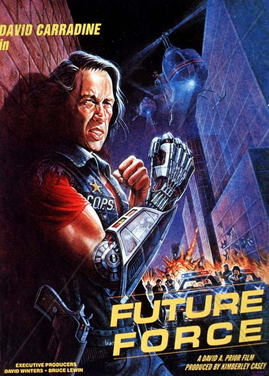
Future Force (1989, directed by David Prior)


The time is the future, which looks a lot like 1990s Los Angeles.  Because of out of control crime, the police have been deemed useless and have been defunded.  (Like that could ever happen in real life!)  Seeing a need and a decent profit margin, private enterprise has stepped up.  The law is enforced by C.O.P.S., which stands for Civilian Operated Police Systems.  Not held back by the Constitution or any oversight at all, C.O.P.S. has become just as corrupt and dangerous as the criminals that it battles.  When a reporter named Marion (Anna Rapagna) threatens to do a story about the out of control C.O.P.S., the head of the company hacks the justice system and puts out a warrant for Marion on the charge of treason.  Because of the seriousness of the charge, the bounty hunters of C.O.P.S. don’t have to bring her in alive to get paid.  In fact, they are encouraged to bring her in dead.

Tucker (David Carradine) is weary and disillusioned member of C.O.P.S. but he is still enough of an idealist that he wants to arrest Marion without killing her.  When he discovers that Marion is being set up, Tucker goes out of his way to protect her from the evil Becker (Robert Tessier) and all the other C.O.P.S.  It turns out to be pretty easy because Tucker is apparently the only members of C.O.P.S. who isn’t terrible at his job.   Helping Tucker out is a wheelchair-bound hacker named Billy (D.C. Douglas) and a robotic glove that can shoot laser beams.

A Robocop rip-off that lacks that film’s satiric bite, Future Force takes place in a future where everyone drives cars from the 70s and where every bar is a strip club that looks like it could have been used in the type of movies that used to show up on late night Cinemax.  It’s a future of empty warehouses, deserted streets, and fires in trash cans.  Robot glove aside, the movie’s future is unconvincing even by the standards of 1989.  There’s a lot of car chases and strange gunfights where no one seems to be aiming at each other but there’s also many scenes that were added to pad out the movie’s running time.  Marion gets upset when Tucker ruthlessly kills two people who were trying to kill her but she barely shrugs when she later discovers that the bad guys have killed her sister.  As bad the movie is, give some respect, though, to David Carradine whose general air of “I don’t want to be here, just give me my paycheck so I can go home,” fits his character like a glove.

Mutant Hunt (1987, directed by Tim Kincaid)


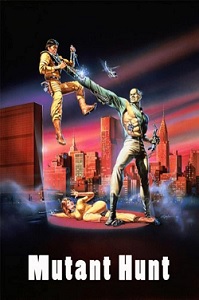
The time is the near future.  Paul Haynes (Mark Umile) has invented the Delta 7 cyborgs, who are supposed to help humanity.  However, the evil Z (Bill Peterson) has somehow gotten the cyborgs addicted to a drug that causes them to commit a murder every six hours.  When Paul objects his cyborgs being turned into killing machines, Z takes him hostage.  Paul’s sister, Darla (Mary Fahey), runs from two of the cyborgs and they all end up in the apartment of Matt Riker (Rick Gianasi), a mercenary who is an old acquaintance of Paul’s.  Riker defeats the two cyborgs in his apartment, though his own pleasure droid is sadly sacrificed in the battle.  Riker then gets together with his friends Johnny Felix (Ron Reynaldi) and Elaine Eliot (Traunie Vrenon) so that they can destroy the remaining Delta 7s and rescue Paul.  Johnny knows martial arts and has come up with a way to track the remaining cyborgs.  Elaine is a stripper who is also one of the world’s best fighters.  They’re about as strong a group as I guess society could hope for.  What they don’t know is that Z and his associate, Domina (Stormy Spill), have got a Delta 8 waiting to meet them.  What Z does not know is that Riker is a pyromaniac who, unlike the typical movie hero, doesn’t worry about fighting with honor.  What the audience never knows is why Z corrupted the cyborgs to begin with or why he took Paul hostage instead of just having the cyborgs kill him.  It’s an evil plan but it’s not one that appears to really be about accomplishing anything.

Mutant Hunt is a low-budget science fiction film that has a plot that is impossible to follow.  Again, even though I sat through the entire movie, I am still not sure what Z was actually trying to accomplish with his murderous cyborgs.  This is one of those films where the future is represented by empty warehouses and plenty of neon signage.  Because the film is so low budget and the acting is so unconvincing, Mutant Hunt has developed a cult following among those who think that the film is so good that it’s bad.  Actually, despite some impressive makeup work with the mangled cyborgs, Mutant Hunt is just bad.  It takes a little from The Terminator and a little from Blade Runner and then mashes it all together with a plot that feels like dystopian mad libs.  The end result is an incoherent movie that feels much longer than just 77 minutes.

Midnight Ride (1990, directed by Bob Bralver)


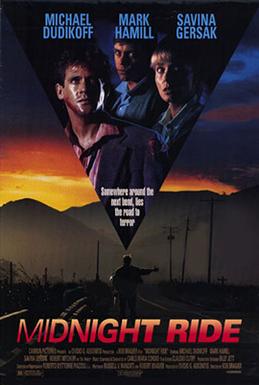
Driving to a friend’s house after getting into a late night argument with her husband, Lara (Savina Gersak) makes the mistake of picking up a hitchhiker.  At first, Justin McKay (Mark Hamill) seems like a nice guy but he quickly reveals himself to be a serial killer.  Haunted by his terrible childhood and the abuse he suffered at the hands of his mother, Justin has decided to get revenge on the world by going on a killing spree.  He’s even got a polaroid camera with him so that he can have a souvenir of every murder that he commits over the night.  Holding Lara hostage, Justin forces her to drive him to his ultimate destination, the hospital where he was once the patient of Dr. Hardy (Robert Mitchum).  Following behind Lara and her murderous passenger is Lara’s husband, Lawson (Michael Dudikoff).  Lawson is a former military policeman turned civilian cop and has experience taking down the bad guys.  But Lawson’s leg is also in a cast and not even he is prepared for how savage and dangerous clever Justin turns out to be.

What is Midnight Ride like?  Think of The Hitcher, just without that film’s subtext of an unacknowledged attraction between the driver and the hitcher.  Also replace Rutger Hauer giving a smooth, menacing, and seemingly indestructible performance with Mark Hamill sweating, bulging his eyes, and fidgeting throughout the entire film.  Midnight Ride is a competent thriller and Michael Dudikoff is a good working class hero but the main reason to see Midnight Ride is to watch Mark Hamill chew the scenery and play a character who is so evil and destructive that not even Luke Skywalker would have risked going anywhere near him.  Justin McKay has much more in common with The Joker than with Luke Skywalker.  Justin is the type of killer who, after murdering a hotel clerk, steals her glass eye and wears it as a necklace.  Hamill really throws himself into the role, savoring every crazy moment.  Dudikoff is stolid and dependable while Hamill often seems like he might be trying to burn the entire movie to the ground.  While Hamill chews up the scenery, Robert Mitchum barely seem to notice the scenery at all.  Hamill gives a masterclass in overacting while Mitchum gives a masterclass in barely bothering to act at all.  Mitchum was famous for saying that he didn’t give a damn and I can’t think of any film where he gave less of a damn than Midnight Ride.  Dudikoff may be top-billed but this is a Hamill/Mitchum joint all the way.