Concert Film Review: ABBA: The Movie (dir by Lasse Hallstrom)


The 1977 film, Abba: The Movie, is really two movies in one.

One of the movies, and the one that will probably most appeal to fans of the group, is a cinema verité-style look at ABBA touring Australia.  This part of the movie not only features the band playing their best-known songs in concert but it also features some behind-the-scenes footage of the members of ABBA trying to enjoy their time Australia.  They struggle to adjust to Australian culture and the English language.  Agnetha Fältskog complains about the way the tabloids focus on her body as opposed to her singing.  The emphasis is on the members of ABBA being down-to-Earth and friendly professionals who love making music but who, even more importantly, love hanging out together and making their fans happy.

The second movie is about an Australian DJ named Ashley Wallace (Robert Hughes) who is ordered to get an interview with ABBA before they leave the continent.  It won’t prove easy.  For one thing, Ashley really isn’t sure who ABBA is, beyond knowing that they’re a famous pop band.  (Ashley’s musical tastes seem to learn towards country and western.)  Secondly, ABBA is always surrounded by a mob of fans and bodyguards and it’s very difficult to get close enough to even ask them for an interview.  Third, ABBA distrusts reporters, especially after the tabloids print a bunch of salacious articles about Agnetha.  Fourth, Ashley is an idiot.

Seriously, Ashley is his own worst enemy.  If ABBA heads to the west, you can be sure that Ashley will catch the next train heading east.  Even when Ashley does finally manage to talk to ABBA’s manager and schedule an interview, he ends up oversleeping and missing his appointment!  Seriously, just think about this.  Ashley has been told that his entire future depends on getting an interview with ABBA, a task that soon proves to be nearly impossible.  Then, when Ashley finally manages to get a chance to conduct this all-important interview, it doesn’t occur to him to set his alarm to wake him up early.  There’s a word for that type of behavior and that word is “stupidity.”

As he struggles to get some time with ABBA, Ashley also takes time to interview people on the street about the opinion of ABBA.  Surprise!  Almost everyone loves ABBA!  I guess that’s to be expected, considering that the movie is named after them.  It would probably be counter-productive to have Ashley interview a bunch of people who can’t stand ABBA and would rather be listening to Led Zeppelin.  (There are a few people who tell Ashley that they don’t like ABBA but they’re all losers.)  Ashley spends so much time talking to people who love ABBA that he soon comes to love ABBA and appreciate their music as well.  He even has a series of fantasy and daydreams.  He imagines that the two men in ABBA are his best friends.  He dreams of being loved by the two women in ABBA.  Through Ashley, the audience is provided a view of how one goes from being indifferent to being a fan.

But most viewers won’t care about Ashley.  They’ll be watching for ABBA.  The performances are strong.  The members of the band seem to truly enjoy being on stage and interacting with their fans.  Interestingly, the members of ABBA are likable but a bit bland off-stage.  They’re people who truly come alive when they’re performing but who are much more subdued and down-to-Earth offstage.  Indeed, it almost seems as if Ashley is wasting his time trying to get an interview.  In this film, to watch ABBA perform on stage is to know all that you need to know.
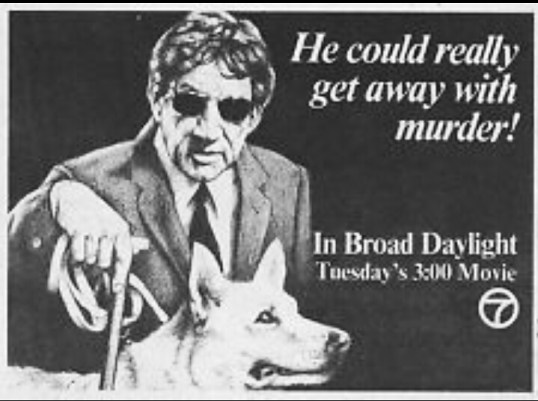
Retro Television Review: In Broad Daylight (dir by Robert Day)


Welcome to Retro Television Reviews, a feature where we review some of our favorite and least favorite shows of the past!  On Sundays, I will be reviewing the made-for-television movies that used to be a primetime mainstay.  Today’s film is 1971’s In Broad Daylight!  It  can be viewed on YouTube.

Tony Chappel (Richard Boone) is an actor who has just recently lost his sight as a result of an accident.  Released from the hospital, Tony struggles to adjust to living in a world without his vision.  When one cab driver says to him, “Didn’t you used to be Tony Chappel?,” he flinches as he realizes that his career as a famous actor is now considered to be over.  One day, he comes home early and overhears his wife (Stella Stevens) fooling around with his lawyer and “best friend” (Fred Beir).  Tony promptly decides to murder his wife and frame his friend for the crime.

Tony decides to use his acting skills to his advantage.  He memorizes the the area around him so that he can make his way through it by memory.  He puts on a fake beard, speaks with Greek accent, and makes a point of carrying a camera with him.  He starts taking public transportation and going out of his way to be talkative and social  Everyone that he meets, he tells them about how he’s been taking pictures of the city and how he can’t wait to see how they come out.  When his wife is eventually murdered, the police receive a reports of a mysterious Greek man, one who was definitely not blind, in the area.  However, Lt. Bergman (John Marley) has his doubts and comes to suspect that Tony is the killer.

In Broad Daylight was made from an early script written by Larry Cohen, who would later go on to direct films like God Told Me To.  It’s a clever script, one that sets up an intriguing premise and which ends on a properly twisty and satisfactory note.  The film works because it is as much of a character study as a thriller.  Tony’s wife not only cheats on him but also betrays him at the moment when he needs her and his friends the most.  Tony has gone from being a movie star to being a man who can barely walk from one room to another.  He’s already angry.  Discovering that his wife is laughing at him behind his back is the last straw.

Larry Cohen reportedly felt that Richard Boone was miscast as Tony.  I felt that Boone did a pretty good job, even if he did overact a bit while Tony was trying to convince everyone that he was a Greek tourist.  Stella Stevens is perfectly cast as his wife and Suzanne Pleshette is sympathetic as his nurse.  Godfather fans will be happy to see John Marley not having to deal with a horse’s head but instead playing the clever detective who attempts to solve the murder.

In Broad Daylight is a clever and entertaining thriller and character study.

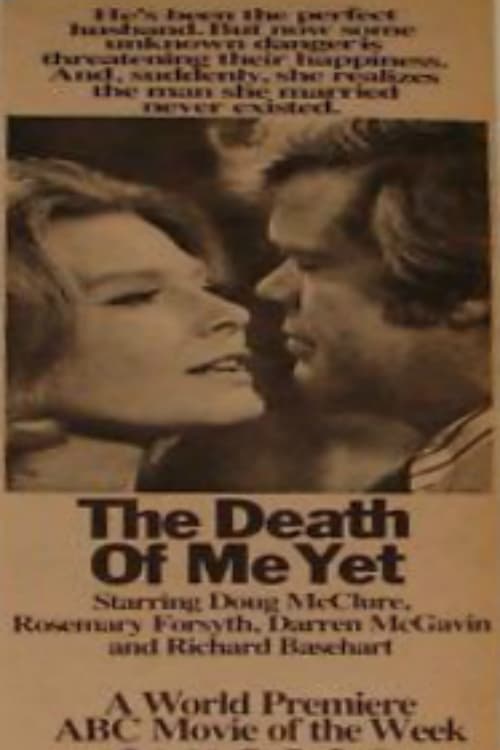
Retro Television Review: The Death Of Me Yet (dir by John Llewellyn Moxey)


Welcome to Retro Television Reviews, a feature where we review some of our favorite and least favorite shows of the past!  On Sundays, I will be reviewing the made-for-television movies that used to be a primetime mainstay.  Today’s film is 1971’s The Death Of Me Yet!  It  can be viewed on YouTube.

Welcome to Middletown!

Middletown is a nice, comfy, and friendly little town.  As you might guess from the name, it seems just like the type of town that you would expect to find in the middle of the country.  Edward Young (Doug McClure) is a friendly and popular citizen of the town.  Everyone loves to see Edward walking around Middletown with his girlfriend, Alice (Meg Foster, of the otherworldly eyes).  But one day, Edward comes home to find a message waiting for him.  He has been “activated” and it’s time for him to leave Middletown and head to …. THE UNITED STATES!

You see, Middletown is in the middle of a country.  It’s in the middle of Russia, to be exact.  It’s a KGB training center, where sleeper agents learn how to pass for Americans.

Edward heads to America, where he takes on the name of Paul Towers.  Over the years, Paul settles in a town that looks a lot like Middletown.  Paul becomes a newspaper publisher and he comes to love America.  He also marries Sibby (Rosemary Forsyth), the sister of defense contract Hank Keller (Dana Elcar).  When one of Hank’s executives dies under mysterious circumstances, Hank offers to bring Paul into the business.

Paul is reluctant, both because he doesn’t know if he could pass the background check that the FBI is going to run on him and also because he suspects that someone is trying to kill him!  When he sees Alice and his former KGB handler (Richard Basehart) in town, Paul realizes that he’s going to have to pick a side and face the consequences of all of his actions.

The Death of Me Yet is an enjoyably twisty thriller, one that embraces the melodrama while having some fun with the idea of a bunch of sleeper agents doing business in a generic American town.  Doug McClure’s natural earnestness makes him an odd choice for the role of a lifelong spy but the casting works in that it explains why no one has ever suspected Paul in the past.  As always, Darren McGavin is a welcome presence as the FBI agent who assures Paul that he will be doing a thorough background check.  Richard Basehart makes for a good villain and Meg Foster’s enigmatic screen presence keeps the viewer guessing as to what her ultimate goal may be.

The film ends with the hint of continued adventures for Paul.  It wouldn’t surprise me if this movie was made with an eye on turning it into a weekly series.  As far as I know, that series never happened, though The Americans would later feature many of the same themes and ideas found in The Death of Me YetThe Death of Me Yet holds up as an entertaining espionage thriller.

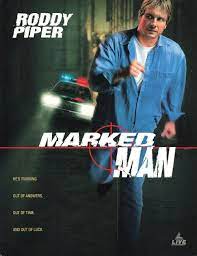
Marked Man (1997, directed by Marc F. Voizard)


How much keeffe is in this film?

Miles O’Keeffe!  But that’s still not enough.

Not even the presence of Roddy Piper is enough to make Marked Man work.  Piper plays an auto mechanic who kills the drunk driver who ran over his girlfriend.  Piper is sent to prison where he learns how to kickbox because why wouldn’t the authorities teach a prisoner foot-to-foot combat?  After ten years as a model prisoner, he is forced to run for his life after he witnesses a murder committed by two corrupt guards.  Piper jumps over the fence and, after finding a clue while breaking into one of the guard’s house, heads to Albany.  Miles O’Keeffe is the mercenary who is hired by the bad guys to track Piper down.  Piper not only has O’Keeffe after him but also every cop in the northeast.

When a movie has got both Roddy Piper and Miles O’Keeffe in the cast, there’s no excuse for it to be as boring as Marked Man.  Roddy Piper gets to kickbox and show off his wrestling moves but he spends most of the movie hiding in the back of pickup trucks and running away from prison guards.  For some reason, instead of just heading for the border and freedom, Piper sticks around America and tries to prove that the dead prisoner was killed by corrupt guards.  The final confrontation between Piper and O’Keeffe is as anti-climatic as everything else in the movie.  Maybe it would have been more effective if there had been a shared history between Piper’s prisoner and O’Keeffe’s bounty hunter but instead, they confront each other as strangers and their final confrontation feels impersonal.

Considering the cast and the story’s B-movie potential, Marked Man is a definite missed opportunity.

Spring Break On The Lens: The Squad (dir by Rick Walker)


Years ago, three girls were rescued from their abusive foster parents.  Under the direction of the enigmatic Alpha (Jennifer Ferguson), Gina (Meghan Carrasquillo), Dani (Grace Evans), and Bella (Alea Hansinger) have made a lot of money and they only have to work one week out of the year.  That week is Spring Break, when they hit the beach and sell drugs to all the visiting college students.

Unfortunately, a bigtime gangster known as Frosty the Snowman (Shawnee Brittan) does not want Alpha and the Squad moving in on his business.  So, along with targeting Alpha for assassination, he also sends his people down to the beach to take out the members of the Squad.  It all leads to a lot of violence, death, and bikini shots.  Everyone has their own agenda and no one can be trusted, perhaps not even Alpha.  Can the Squad survive or will they end up being dunked in acid?

Just from reading the plot description, you might think that this was a subversive, satirical film in the style of Harmony Korine’s Spring Breakers and certainly, there are moments of deliberate humor.  The three Squad members spend a lot of time talking between jobs and making fun of the faux tough guys that they have to deal with.  There’s a slightly funny bit where one of the girls will make a snarky comment and someone else will reply by accusing them of being a very particular type of bully.  “You’re a spray tan bully,” made me laugh more than it probably should have.  (That’s probably because, as a redhead, I can’t tan to save my life.)

That said, The Squad takes itself way too seriously at certain points.  There’s all sorts of twists and turns and scenes of criminals talking about all of the unpleasant tortures that they intend to inflict until they hear what they want to hear.  This is one of those films where all the camera movements are jittery and most of the scense are so underlit that you end up straining eyes just trying to figure out who is talking to who.  For a 78-minute film, there’s a lot going on in The Squad and the plot is almost impossible to follow.  The film makes the mistake of assuming that we’ll automatically care so much about The Squad that we won’t care that their actions rarely make sense.  But since we really don’t get to know either The Squad or Alpha, it’s difficult to get emotionally involved in their attempts to corner the drug market.

For the most part, the acting is poor.  The actresses playing the members of the Squad are naturalistic and likable when they’re just lying around and gently giving each other a hard time but the minute they have to start shooting or talking tough, everyone starts trying too hard to act as if they’re in an early Tarantino film and the whole thing just feels awkward.  As Frosty, Shawnee Brittan is convincingly evil and some of the actors playing his toothless henchmen are properly creepy.  Otherwise, one would be better served by rewatching Spring Breakers.

The Unnominated: The Long Riders (Dir by Walter Hill)


Though the Academy of Motion Picture Arts and Sciences claim that the Oscars honor the best of the year, we all know that there are always worthy films and performances that end up getting overlooked.  Sometimes, it’s because the competition too fierce.  Sometimes, it’s because the film itself was too controversial.  Often, it’s just a case of a film’s quality not being fully recognized until years after its initial released.  This series of reviews takes a look at the films and performances that should have been nominated but were, for whatever reason, overlooked.  These are the Unnominated.

First released in 1980, The Long Riders is one of the many films to tell the story of the James/Younger Gang.

A group of former Confederate guerillas who became some of the most notorious bank robbers to roam post-Civil War America and who were based in Missouri, the brothers who made up the James/Younger Gang were hunted by the Pinkertons and beloved by the citizens who viewed them as being 19th Century Robin Hoods.  Following a disastrous attempt to rob a bank in Northfield, Minnesota, the Younger brothers were captured by the government while Jesse and Frank James made it back to Missouri.  Jesse was shot in the back by Bob Ford while Frank subsequently surrendered to authorities and made a good living on the lecture circuit.

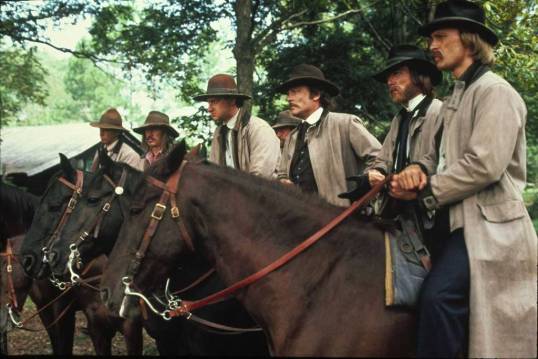
The Long Riders tells the story of the gang, from their first encounter with the heavy-handed Pinkertons to the Northfield raid to Frank’s eventual surrender.  Director Walter Hill both celebrates the legend of the James/Younger Gang while also emphasizing that all the members of the gang were also individual humans who had their strengths and their flaws.  Hill emphasizes the idea of the gang being a group of post-war rebels, still fighting a war against a government that is more interested in protecting banks than looking after people.  The Long Riders deconstructs the legend while also celebrating it.

The main thing that sets The Long Riders apart from other films about the James/Younger Gang is the fact that the brothers are played by actual brothers.  David, Keith, and Robert Carradine plays the Youngers.  Randy Quaid plays Clell Miller while Dennis Quaid assumes the role of the cowardly Ed Miller.  Nicholas and Christopher Guest make a memorably creepy impression as Charley and Bob Ford.  And finally, Jesse and Frank James are played by James and Stacy Keach.  (The Keaches also worked on the film’s script).  And while Stacy is definitely the more charismatic of the Keach brothers, the film makes good use of James’s rather stoic screen presence.  While the rest of the gang enjoys the outlaw life, James Keach’s Jesse is rigid, serious, and ultimately too stubborn and obsessive for his own good.

Now, the casting might sound like a gimmick but it works wonderfully.  When Clell chooses the gang over Ed, it carries an emotional weight because we’re watching real brothers reject each other.  The comradery between the Carradines carries over to the comradery between the Youngers and it also informs their occasional rivalry with the better known James brothers.  While it is Stacy Keach and David Carradine who ultimately dominate the film, every brother in the cast makes a strong impression.  Also giving a memorable performance is Pamela Reed as a defiantly independent Belle Starr, who loves David Carradine’s Cole Younger but marries Sam Starr (James Remar).  The knife fight between Carradine and Remar is one of the film’s highlights, as is the violent and disastrous attempt to rob the bank in Northfield.

The Long Riders is an exciting and ultimately poignant western but sadly, it received not a single Oscar nomination, not even for the stunning cinematography or Ry Cooder’s elegiac score.  Fortunately, just like the legend of the James/Younger Gang, The Long Riders lives on.

Previous entries in The Unnominated:

  1. Auto Focus 
  2. Star 80
  3. Monty Python and The Holy Grail
  4. Johnny Got His Gun
  5. Saint Jack
  6. Office Space
  7. Play Misty For Me

Lisa Reviews An Oscar Winner: CODA (dir by Sian Heder)


Remember CODA?

I ask that because this 2021 film often seems to be forgotten about when people discuss the films that have won the Oscar for Best Picture. Indeed, when the Oscar nominations were first announced for that year, many commentators treated the film’s nomination as an afterthought.  It was pointed out that CODA only had a total of three nominations, for Picture, Adapted Screenplay, and Best Supporting Actor.  It was expected that Troy Kostur would win Best Supporting Actor but it was also felt that Best Picture would be won by one of the big nominees, like The Power of the Dog, Belfast, or West Side Story.

But, interestingly enough, the momentum began to shift shortly after the nominations were announced.  The nomination brought the film to an entirely new audience, all of whom could stream the movie on Apple TV+.  The members of the Academy who hadn’t seen the film before the nominations were announced watched the film and many reportedly fell in love with the simple but touching story of a teenage girl who must decide whether to go to music school or to stay at home with her deaf parents and older brother.  By the time the Academy Awards were held, CODA had become the new front runner.

How did this happen?  A lot of it had to do with the fact that CODA was an unabashedly emotional story, one that was specifically made to bring tears to the eyes of the audience.  CODA was more humanistic than the remote and cold Power of the Dog.  Whereas both West Side Story and Belfast were obviously made with Oscar glory in mind, the low-budget CODA felt as if it simply wanted to tell a good story.  Unlike Dune, CODA was not made to launch a franchise and, unlike King Richard, it was about more than just one performance.  Its straight-forward approach provided quite a contrast to the stylized flourishes of Nightmare Alley and Licorice Pizza.  (Incidentally, Nightmare Alley and Licorice Pizza were my two favorite films of the year.)  It should also be remembered that CODA, like the previous year’s Nomadland, was watched while many people were still hiding their faces behind masks, terrified of catching COVID.  It was a time when many people were yearning for something that would just make them feel good.

And whatever else one might say about CODA, it’s definitely a feel good movie.  From the wonderful moments when Ruby (Emilia Jones) discovers her love for singing to the slyly humorous and emotionally honest performances of Troy Kostur, Marlee Matlin, and Daniel Durant as Ruby’s parents and brother, CODA is a film that will make you smile and think about the people who you consider to be your family.  It’s a sweet movie, one that reminds us that it’s okay to get emotional and that it’s okay to tell people that you love them and that, as an artform, film can be used for something other than just comic book adaptations.

That’s not say it’s a perfect film, of course.  Those who complained that CODA had the flat look of a made-for-TV movie were not incorrect and the fact that most people ended up watching the movie on TV (or, in my case, on a laptop) did not help with the issue.  As Ruby’s music teacher, Eugenio Derbez gives a rather broad performance that often fells at odd with the more realistic work of the rest of the cast.  The film had its flaws but it also made me smile and the end brought real tears to my mismatched eyes and there’s something to be said for that.  During a year when many people were still afraid to get close to anyone else, CODA was a film that celebrated love, family, and community.

Did CODA deserve to win Best Picture?  Like I said, I would have given the Oscar to either Nightmare Alley or Licorice Pizza but I liked CODA and, looking back, I certainly prefer its positive vibes to the well-made emptiness of Power of the Dog.  The low-key CODA is probably destined to join The Artist and Argo as one of the best picture winners that people tend to forget but no matter.  It’s a film that holds up well and, in 2021, it was exactly the film that a lot of people needed.

February Positivity: Always A Winner (dir by Dave Christiano)


In this 2023 film, teenage golf champion Emily (Evangeline Griffin) transfers from one private Christian academy to another.  At her new school, the golf coach, Coach Kelly (Jenn Cooke), tells her two best players, Madison (Amelia Still) and Hannah (Ashley Brant), to befriend Emily and gauge whether or not she plans on continuing to play golf in high school.

When they approach Emily in the school’s cafeteria, they are shocked when Emily says that she’s a pretty good golf player and she plans to be state champion again.  They are scandalized when Emily mentions that she broke all of Coach Kelly’s old records at her previous school.  They are stunned when Emily suggests that she’s a better golfer than Coach Kelly ever was.

“Are you a Christian?” Madison asks.

Yes, this is another one of those films.  This is another Dave Christiano-directed film in which high school athletics (in this case, golf) are used as a metaphor for faith.  Emily may say she’s a Christian but first she’s going to have to learn that being a Christian means always doing what your coach tells you to do (even if that means hitting with a seven when you’d rather use your nine) and, of course, being a humble winner and a gracious loser.  As Coach Kelly explains it, Emily could be the best player in the world but God might have plans for her that don’t include winning the state championship.  To me, that’s an odd way to look at things.  I mean, if God is the one who is deciding who is going to win the tournament, why waste all that time with practicing your swing and learning how to putt?  It takes Emily a while to listen to Coach Kelly so we end up with a lot of scenes of Madison and Hannah sucking up to the coach while Emily rolls her eyes in the background.  One wonders if Christiano realized that Madison and Hannah are both the type of people who everyone hated in school, the snitches who followed the rules and called out anyone who didn’t.  Emily may be arrogant but at least she seems like she gets some sort of enjoyment out of winning.  At least she acts like a human being as opposed to a Sim, waiting to be told what to do.

Meanwhile, Madison is freaking out over whether or not she’ll be able to afford to attend Zion College.  She has applied for all of the scholarships and she’s been working part-time and saving her money and her father is willing to contribute a little as well but Madison is still short $5,000.  Madison suggests that she could take out a student loan but her mother says, “No, your father doesn’t want you borrowing any money.”

On the one hand, that’s good advice.

On the other hand, Madison’s the one who is paying for most of her tuition so shouldn’t she be the one to decide whether or not to apply for a student loan?  I mean, Madison is going to be a legal adult by the time she starts college.  And it’s not like Dad is helping out all that much so who cares what he thinks?  Still, Madison’s mother tells her that it might just be God’s plan for Madison to go to a community college.  And again, with all due respect, you have to wonder if we’re supposed to take comfort in the idea of a God who micromanages ever aspect of our lives.

Finally, Hannah learns that a friend is pregnant and thinking about getting an abortion.  Hannah tells her friend that she can’t get an abortion because the Bible says, “Do unto others.”  As Hannah explains it, how would her friend feel if she had been aborted?  Her friend takes Hannah’s words to heart and tells her father that she’s pregnant.  This leads to a montage of her father yelling at her but we don’t hear what he’s saying because a very mid Christian rock is playing over the soundtrack.  Everything works out in the end, of course.  Speaking as someone who has never been comfortable with the extremes of either side of the abortion debate , this whole scene really irked me, as it was very heavy-handed and poorly written.  It’s easy to win an argument when the other side isn’t allowed to present its case.  Just because pro-abortion writers tend to caricature pro-life arguments, that still doesn’t make it any less strident when pro-life writers do the same thing to the other side.

In the end, everything works out.  Emily learns to be humble.  Madison goes to college.  Hannah is hopefully prepared to babysit.  The film ends with one golfer getting disqualified for making a technical mistake, just for Emily to beg that the rules be suspended so that the other golfer can get the trophy she’s earned.  Amazingly, the rules are suspended which really isn’t the way rules are supposed to work.  Apparently, the message is that God’s rules cannot be broken but UIL’s rules are fair game.

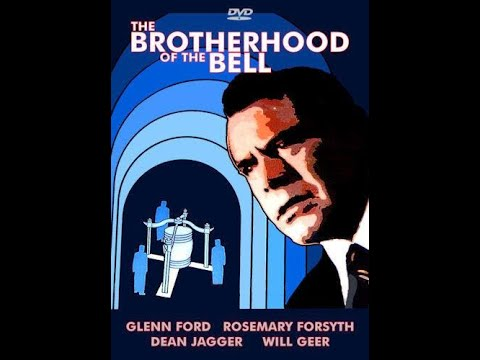
14 Days of Paranoia #10: The Brotherhood of the Bell (dir by Paul Wendkos)


First aired on television in 1970, The Brotherhood of the Bell tells the story of Andrew Patterson (Glenn Ford).

Andrew Patterson is a widely respected economics professor.  He is an influential academic, one who has a nice house, a beautiful wife (Rosemary Forsyth), and a father-in-law (Maurice Evans) who owns a very successful business.  Patterson is also a member the Brotherhood of the Bell, a secret society made up of successful men who all graduated from the prestigious College of St. George in San Francisco.  Patterson has been a member of the society for 22 years and he’s never really taken it that seriously.  He thinks of it as just being a collection of influential men who enjoy getting together and discussing their vision for the world.

That all changes when the man who brought Andrew to the Society, Chad Harmon (Dean Jagger), gives Andrew an assignment.  The Society wants him to deliver an envelope to his friend, Dr. Konstantin Horvathy (Eduard Franz).  Horvathy is up for a deanship that another member of the Society desires for himself.  Inside the envelope is damaging information that the Society has gathered about the people who helped Horvathy defect to the United States, information that will be made public unless Horvathy withdraws as a candidate.  Reluctantly, Andrew shows Horvathy the envelope.  Horvathy responds by committing suicide.

Stricken with guilt, Andrew decides to expose the existence of the Society but he discovers that won’t be easy.  Almost overnight, Andrew’s perfect life starts to collapse.  He loses his job.  The IRS launches an investigation of his father (Will Geer).  As Chad explains it, the Society is responsible for everything that Andrew has and, therefore, the Society can take everything away.  When Andrew goes public, he’s dismissed as just being paranoid and soon, Andrew truly is paranoid.  With his marriage in ruins, Andrew goes on a talk show and can only watch helplessly as his claims are dismissed by the host (William Conrad) and as the audience argues about whether or not the Society is a white plot, a communist plot, a Jewish plot, a Catholic plot, or a government plot.  Even the people who believe Andrew are too busy fighting amongst themselves to provide any help for him or to stand up to the unified power of the Brotherhood.  The host repeatedly rings a bell during the show, the better to mock everyone’s fears.  The film makes a good point.  Crazed theorists are often a conspiracy’s best friend.

An intelligently written and well-acted film, The Brotherhood of the Bell‘s main strength is the direction of Paul Wendkos.  The lighting gets darker and the camera angles become increasingly more skewed as Andrew’s paranoia grows.  In fact, Wendkos does such a good job of visualizing Andrew’s deteriorating mental state that it’s easy to wonder if maybe everyone is right and all of this really is just happening in Andrew’s head.  Though the film ends on a slightly triumphant note, it’s hard not to feel that it’s a temporary victory at best.  The Brotherhood of the Bell (which I imagine was based on Yales’s Skull and Crossbones) will always be there.

14 Days of Paranoia:

  1. Fast Money (1996)
  2. Deep Throat II (1974)
  3. The Passover Plot (1976)
  4. The Believers (1987)
  5. Payback (1999)
  6. Lockdown 2025 (2021)
  7. No Way Out (1987)
  8. Reality (2023)
  9. Chappaquiddick (2017)

Retro Television Review: The Judge and Jake Wyler (dir by David Lowell Rich)


Welcome to Retro Television Reviews, a feature where we review some of our favorite and least favorite shows of the past!  On Sundays, I will be reviewing the made-for-television movies that used to be a primetime mainstay.  Today’s film is 1972’s The Judge and Jake Wyler!  It  can be viewed on YouTube.

Judge Meredith (Bette Davis) is a retired criminal court judge who has developed a severe case of hypochondria.  She lives in a mansion that she never leaves.  Anyone who comes to see her must be personally vacuumed by her butler before they can be allowed to stand in her presence.  She hates people who take too long to get to the point and she also has little use for people who are rude on the phone.  She especially dislikes cigarettes and refuses to have even an unlit one in her presence.

Jake Wyler (Doug McClure) is an ex-con who is currently on supervised probation.  Despite his criminal past, he’s a likable and amiable guy and, every morning, he wakes up with a new woman in his bed.  Jake enjoys tweaking authority and he always has a pack of cigarettes on him somewhere.

Together, they solve crimes!

They actually do!  The judge is dealing with retirement by running her own detective agency, one that is exclusively staffed by people that she previously sentenced to prison.  Jake does most of the leg work as far as the agency is concerned.  The Judge calls him every morning and demands to know why he’s not working harder.  Jake would rather just sleep-in but working for the judge is a part of his parole.  She could easily send him and everyone else working for her back to prison.  This sounds like a pretty unfair situation to me and the Judge is so demanding that I think it could be argued that she’s an abusive boss.  But, because this is a pilot for a TV show and the Judge is played by Bette Davis, everyone is very loyal to her.

At the start of the film, Jake reveals to Robert Dodd (Kent Smith) that his wife, Caroline (Lisabeth Hush), has been cheating on him with Frank Morrison (Gary Conway).  When Robert is later found dead in a hospital room, the official verdict is that he committed suicide.  However, his daughter, Alicia (Joan Van Ark), claims that her father was murdered.  At first, both Jake and the Judge suspect that Alicia just wants to collect a bigger life insurance settlement but it turns out that Dodd’s beneficiary wasn’t even Alicia.  The money is going to his second wife, the one who was cheating on him.  While the Judge yells at people on the phone, Jake investigates the death of Robert Dodd.

The Judge and Jake Wyler is a mix of comedy and mystery.  Jake has a way with a quip and the majority of the suspects, including John Randolph and Eric Braeden, all have their own eccentricities.  Director David Lowell Rich does a good job of keeping the action moving and the mystery itself is actually pretty interesting.  Surprisingly, the show’s only real flaw is Bette Davis, who seems to be rather bored in the role of Judge Meredith.  Even though the character seems to have been specifically written for her trademark caustic line delivery, Davis delivers her lines with little enthusiasm.  One gets the feeling that she wasn’t particularly happy about the idea of having to do a television pilot.

Davis need not have worried.  The Judge and Jake Wyler did not turn into a series.  That said, the movie is an entertaining and diverting murder mystery.