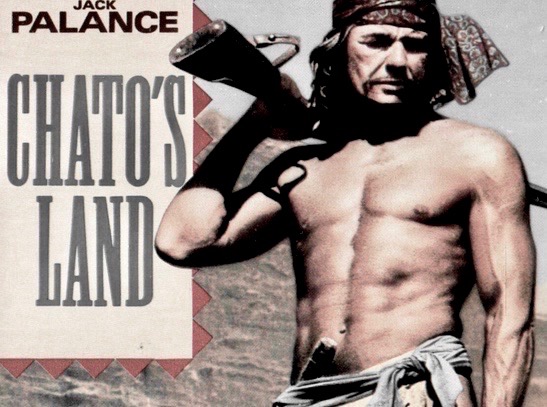
CHATO’S LAND (1972) – Jack Palance leads a posse after Charles Bronson!


One of the most enjoyable things about being a dad is introducing your favorite things to your kids. I taught my son Hank the sports of basketball, baseball, and golf, and even now there’s nothing we enjoy doing more together than playing a round of golf. Of course, as one of the world’s biggest Charles Bronson fans, I’ve introduced him to many films starring my cinematic hero. It seems that two movies have stood the test of time and have gone on to become two of his favorite movies. The fact that THE DIRTY DOZEN (1967) is one of his favorites isn’t a big surprise as he’s always enjoyed playing video games set during World War II. The other, CHATO’S LAND (1972), was more of a surprise. A few years ago, when Hank was home from college, I asked him if there was a movie he wanted to watch. It could have been any movie in the world, and I was honestly a little surprised when he said he’d been wanting to watch CHATO’S LAND again. Needless to say, this dad was very proud. 

Charles Bronson is Pardon Chato, a half breed Apache who’s minding his own business and having a drink in the saloon, when a small-town sheriff decides to give him hell just for being a “breed.” Forced to kill the racist POS in self-defense, Chato heads out of town a day ahead of the posse led by the former confederate Captain Quincey Whitmore (Jack Palance). Whitmore may be leading the posse, but the Hooker Brothers (played by Simon Oakland, Ralph Waite, and Richard Jordan) are just as bigoted as the sheriff who was killed, and they set about bullying their neighbors into joining their hunt for Chato. A couple of the guys who go along because it’s “expected of them” are Joshua Everette (James Whitmore) and Gavin Malechie (Roddy McMillan). When the posse comes across Chato’s home and woman, some of the members decide the wise thing to do is rape her and tie her up as bait. This is clearly not going to work out well for the posse, even those who tried to stop the rape. Using his sneaky Indian skills and the help of a fellow Indian, Chato is able to create a diversion and rescue his woman, but his friend is killed in the process. With his friend murdered and his woman brutalized and raped, Chato is no longer willing to just run away. From this point forward, the hunters will become the hunted as he leads them all further into CHATO’S LAND. 

There are several things that I find interesting about CHATO’S LAND. This is the first of six films that director Michael Winner and Charles Bronson would make together. They would all be financially successful films with THE MECHANIC (1972) and the original DEATH WISH (1974) standing out as true 70’s classics. Charles Bronson’s last number one box office hit would be DEATH WISH 3 (1985), which would also be his final film with Winner. It should also be noted that the character of Chato would be an early precursor of the kind of character Bronson would go on to embody almost exclusively throughout the rest of his career, that of the quiet but deadly man of action. Chato only says 13 lines in the entire movie and most of those are in a Native American dialect. Chato doesn’t have that much actual screen time either, but his presence dominates every scene. He’s like the angel of death hanging over the entire proceedings waiting to strike, and Winner continues to build on this tension as the film moves towards its inevitable conclusion. It’s an incredible, physical performance that can only be delivered by an actor like Bronson. Finally, the film has an outstanding cast, a cast that Winner himself would call “as good a cast as I ever assembled.” In addition to Bronson, Jack Palance is excellent as the confederate captain who’s never gotten over losing the war, and who now finds himself losing the battle to control the men in the posse. James Whitmore and Roddy McMillan are solid as a couple of decent men who went along because they felt it was their duty to their neighbors, who now find themselves caught up in a bad situation with even worse men. And finally, Simon Oakland, Ralph Waite & Richard Jordan are the kind of men you love to hate as the ignorant and bigoted Hooker brothers. It doesn’t hurt your feelings at all to see those guys get what’s coming to them.

Overall, CHATO’S LAND is a very good western, dominated by Bronson’s presence in the same way that JAWS (1975) is dominated by a giant killer shark. It was also a hugely profitable film upon its initial release, guaranteeing that Bronson would continue to get starring roles in films backed by American studios. Bronson liked to work with the same directors once he felt comfortable with them, and his collaboration with Winner would prove to be extremely fruitful and help turn him into one of the biggest box office stars in America. Thanks, Michael! 
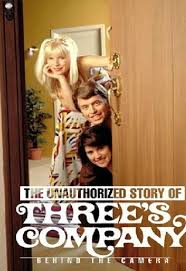
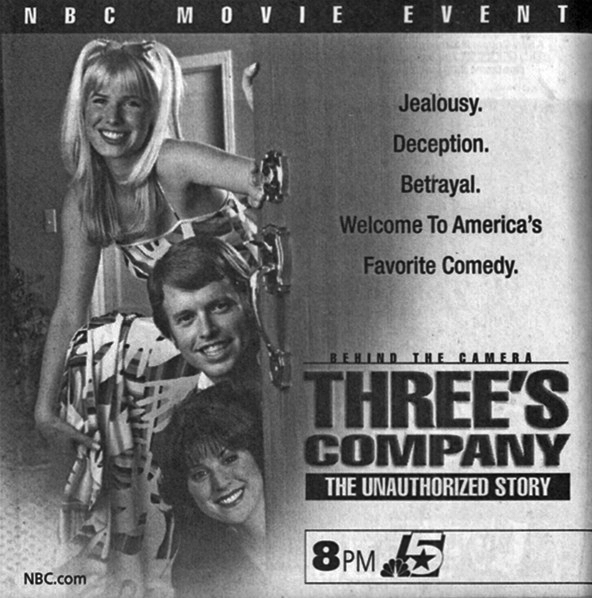
Behind the Camera: The Unauthorized Story of Three’s Company (2003, directed by Jason Ensler)


Do you remember Three’s Company?

The sitcom was a big hit when it aired in the 70s and 80s and it still gets a lot of play in syndication today.  Based on a British sitcom (and you would really be surprised to how closely the first season followed the original series), Three’s Company starred John Ritter as Jack Tripper, an aspiring chef who moved in with two single women, Janet (Joyce DeWitt) and Chrissy (Suzanne Somers).  Because their impotent landlord (Norman Fell) didn’t want people of the opposite sex living with each other unless they were married, Jack pretended to be gay.  Every episode centered around a misunderstanding, though it was Suzanne Somers’s performance as the perpetually bouncy and braless Chrissy Snow that made the show a hit.  The show fell apart when Somers asked for more money, Ritter and DeWitt got angry with her, and the studio bosses lied to everyone.  Today, the show is legendary as an example of how backstage tension can end even a popular series.

Behind The Camera: The Unauthorized Story of Three’s Company attempts to dramatize the success and eventual downfall of Three’s Company.  Joyce DeWitt appears at the beginning and the end to talk about how important she thinks the show was.  In the movie, she is played by Melanie Paxson.  John Ritter is played by a lookalike actor named Bret Anthony while an actress named Jud Taylor plays Somers.  Brian Dennehy plays ABC president Fred Silverman and other executives are played by Daniel Roebuck, Wallace Langham, Gary Hudson, and Christopher Shyer.  The movie recreates all of the drama that went on during Three’s Company without offering much insight or really anything new to the story.  Even though the movie was co-produced and hosted by Joyce DeWitt, Suzanne Somers is really the only sympathetic character in the movie.  DeWitt comes across as being jealous while Anthony plays John Ritter as being a bland nonentity who chooses his own success over being honest with his costars.  The network executives are more interesting, just because watching them provides a glimpse into how real producers and showrunners picture themselves.  They just wanted to make a good show about a sex addict pretending to be gay so he could live with two attractive, single women but the agents and the network presidents just keep getting in the way!  Won’t someone please think of the mid-level network executives?

Bland though this recreation was, it was enough of a rating hits that NBC went on to produce several more Behind The Camera films.  Three’s Company was only the beginning.

Searching For Babe Ruth


Because today is Babe Ruth’s birthday, I wanted to watch a movie about the player who is still considered to be one of the best to ever play the game of baseball.  Specifically. I wanted to watch a film that was made about him while he was still alive, The Babe Ruth Story (1948). in which the very presence of Babe Ruth on a baseball field causes a previously crippled child to walk again.

I couldn’t find that movie streaming anywhere online but I did watch two other Babe Ruth movies.  First, I watched Babe Ruth Story: That Ever Livin’ Babe (1962).  It’s available on Prime and it’s a documentary that was made about Babe Ruth.  Actor Pat O’Brien narrates the life of Babe Ruth, from his start at a school for wayward boys all the way through the end of his career.  It was a good good documentary and one thing that I found interesting is that the documentary didn’t try to sugarcoat any of Babe Ruth’s later problems with gambling or that he liked to live large.  (That was the reason why, despite his success on the field and his popularity off the field, Babe Ruth was one of the few former stars not be offered a management position after he retired from playing,)  The documentary even admits that, having grown up so poor that his own family sent him away, Babe Ruth was determined to enjoy his fame.  More importantly, the documentary also featured a lot of footage of Babe Ruth both on and off the field, including his first game at Yankee Stadium and also he and his wife selling liberty bonds during World War I.

Then, on YouTube, I found Just Pals (1932), a nine-minute film starring the Babe himself.  Babe Ruth returns to the “orphanage” where he grew up and watches a group of boys play baseball.  When one of the boys strikes out and walks away dejected, Babe Ruth takes the time to teach the boy how to properly hold and swing a bat.  That’s not quite as good as magically curing a cripple but Babe Ruth still offers some good advice and an important lesson.  He teaches the kid how to hit a ball like Babe Ruth.  The team wins the next game and Babe Ruth is there to see it.  Then he drives away with one of the orphans stowing away in the trunk of his car.

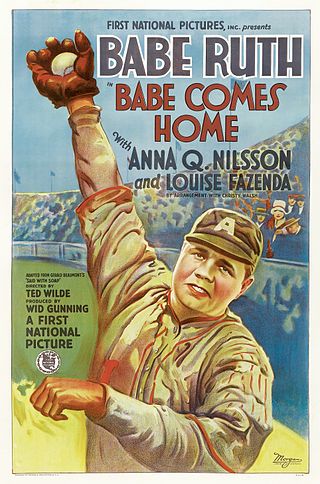
What I’d really like to see is Babe Comes Home (1927), a silent movie starring Babe Ruth that supposedly featured a lot of footage from Babe Ruth’s games.  Unfortunately, it’s believed to be a lost film.

Artist Unknown

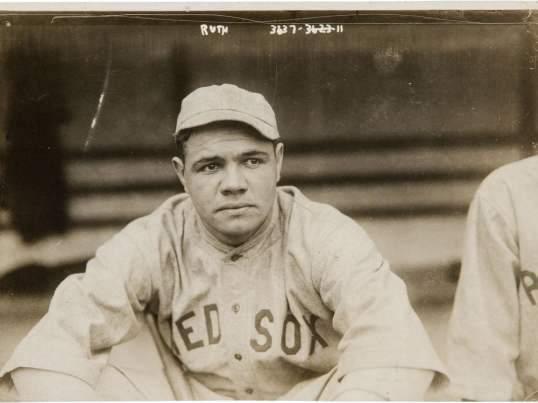
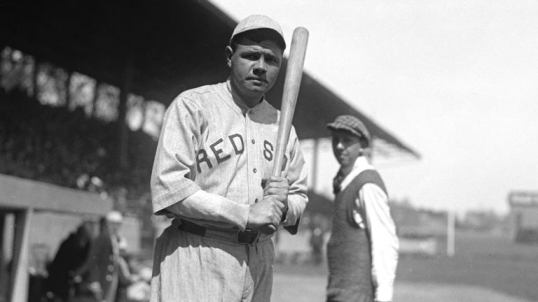
Babe Ruth was born 130 years ago and he played his last game 90 years ago.  He was the first baseball player and one of the first athletes to become a celebrity in America and he’s still considered to be one of the best to ever play the game.  I don’t know if he actually called his shot at the 1932 World Series but I like to think he did.

Happy birthday to Babe Ruth, the man who epitomized the the spirit of baseball!  As for the rest of us, Spring Training begins on February 20th, the Dodgers and the Club will play in Japan in March 18th and 19th, and then the Regular Season runs from March 27th to September 28th!  Go Rangers!


Madhouse (1990, directed by Tom Ropelewski)


Mark (John Larroquette) and Jessa Bannister (Kirstie Alley) have a perfect yuppie lifestyle going until their respective family members show up at their California home and refuse to leave.  First, it’s Mark cousin (John Diehl) and his wife (Jessica Lundy).  Then it’s Jessa’s sister, Claudia (Alison LaPlaca), who has just left her husband and now has to find a new man to support her lifestyle.  Mark and Jessa just want some time alone but instead, they have to deal with a cat who is frequently mistaken for dead, broken marriages, a shipment of cocaine, and a neighbor (Robert Ginty) who builds weird bed frames.  Mark has a big contract to land and Jessa is trying to succeed as a television news reporter but it’s not easy when you’re living in a madhouse.

There are some films that you just like despite yourself and that’s the way I feel about Madhouse.  It’s very much an 80s film, with its emphasis on material goods and achieving the perfect lifestyle.  (The appearance of Dennis Miller as Mark’s co-worker only reminds us of just how much a product of its era that Madhouse is.)  There are a lot of jokes that don’t work and some, like the cat that is continually mistaken for dead, that shouldn’t work but do.  It’s a sitcom transferred to the movies and the humor rarely rises above that level.  It ever stars two of the decade’s biggest sitcom stars, John Larroquette and Kirstie Alley.  Larroquette shows us why he was better suited for television while Alley shows how tragic it was that she didn’t have a bigger film career.  Kirstie Alley gives such a dedicated and fearless performance as someone who has been driven to the end of her rope that it keeps you interested in the film.  Alley, like the great comedic actresses of Hollywood’s golden age, was an actress who could mix physical comedy with barbed one-liners and who was undeniably appealing as she moved from one disaster to the next.  In Madhouse, she was beautiful, frantic, sexy, neurotic, relatable, and funny all at the same time.  By the end of this movie, you really do wish she had gotten more and better opportunities to show off her talents in the years after Cheers went off the air.

Madhouse is nothing special.  It’s a generic comedy about unwanted family guests.  But I’ll always appreciate it for Kirstie Alley.

Funny Money (2006, directed by Leslie Greif)


Henry Perkins (Chevy Chase), the most boring man alive, has a job making wax fruit while his wife (Penelope Ann Miller) wants to make a living through drawing naked men.  (I guess that’s fair considering how many men make their living by drawing naked women.)  On Henry’s birthday, Henry spots a briefcase just like his and decides to swap them.  At home, Henry discovers that his new briefcase contains five million dollars!

Henry wants to move to Europe immediately.  But every time he and his wife try to leave their home, something occurs.  A menacing cop (Armanda Assante) shows up.  Henry’s friends drop by to celebrate his birthday.  The Romanian mob makes an appearance, looking for their money.  All Henry and his wife want to do is steal the money but instead, they spend a night dealing with false identities, physical comedy, and slapstick humor.

Funny Money was based on a stage play and it seems like the sort of thing that would have been hilarious if viewed live, with everyone running on and off the stage and some genuine suspense about who was going to show up next.  It does not translate well to film.  This would have been a good vehicle for Chase in the 80s or even the 90s but, by the time the movie was made, Chase seemed old and tired.  Penelope Ann Miller is never convincing as Chase’s wife.  (Someone should have tried to reunite Chase with Beverly D’Angelo or even Goldie Hawn for this movie.)  The main problem is that the supporting characters are never as funny or as quick-on-their-feet as the film needs them to be.  Armand Assante doesn’t seem to know he’s in a comedy.  Even a reliable actor like Christopher McDonald is let down by the film’s script and direction.  That’s too bad because the material had potential.  While it’s not a disaster like Cops and Robbersons, Funny Money is still never funny enough.

The Godson (1998, directed by Bob Hoge)


After the violent death of his son Sonny Calzone, the Oddfather (Dom DeLuise) announces that his other son, Guppy Calzone (Kevin McDonald, of the Kids In The Hall), will be taking over the family business.  Guppy is sent to Mafia University, where he learns how to garrote a traitor and dismember a body.  Guppy falls in love with Don Na (Fabiana Udenio), the daughter of the Rodfather (Rodney Dangerfield), the leader of a rival family.

The Godson tries to do to gangster movies what Airplane! did to disaster movies.  Dom DeLuise does a good Brando impersonation and there’s a funny moment where Guppy stops the action and tries to convince people in the audience to buy a Guppy action figure.  Otherwise, this is a poorly-done parody film.  Good comedy is all about timing and The Godson flunks that test.  Jokes are either too long or too short but hardly any of them stick.  The idea of Mafia University is funnier than the, if you’ll excuse the phrase, execution.  Even worse, the movie doesn’t make much use of Rodney Dangerfield.  When one of the funniest men who ever lived appears in your movie, it’s cinematic malpractice not to give him a chance to shine.

If the film has a highlight, it’s Lou Ferrigno as a member of the Oddfather’s crew.  Otherwise, this is a missed opportunity.

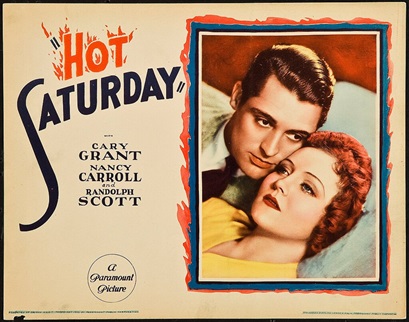
Love On The Shattered Lens: Hot Saturday (dir by William A. Seiter)


First released in 1932 and featuring Cary Grant in his first leading role, Hot Saturday is a film about gossip and love.

Ruth Brock (Nancy Carroll) is a young bank teller living in a small town.  It’s the type of town where everyone knows everyone else.  For instance, everyone knows that every man in town wants to date Ruth but that Ruth, for her part, is not in any hurry to settle down and get married.  She’s having too much fun going to dances, drinking with her friends, and enjoying life.  Everyone knows that playboy Romer Sheffield (Cary Grant) is interested in Ruth but then again, Romer appears to be interested in everyone.  Romer has scandalized the town by allowing a woman named Camille (Rita LaRoy) to live at his mansion.

Ruth has a date with one of her coworkers, Conny Billop (Edward Woods), but, when Conny refuses to take no for an answer, she gets away from him and ends up at Romer’s estate.  Ruth and Romer spend the night together, just talking.  Still, thanks to Conny and Eva (Lillian Bond), the daughter of Ruth’s boss, the whole town is soon convinced that Ruth is Romer’s lover.  The town is so scandalized that Ruth even loses her job.

Fortunately, Bill Fadden (Randolph Scott) has returned to town.  Bill is a geologist.  He grew up in town, with Ruth.  He’s spent the last seven years on a surveying expedition but now he’s back and he wants to marry Ruth.  How lucky is Ruth?  She not only has two good men in love with her but one of them looks like Cary Grant and the other one looks like Randolph Scott!  However, when Bill hears the rumors, will he continue to love her or will he be yet another person who gives in to the curse of small town gossip?

Hot Saturday is a film that truly took me by surprise.  It’s a pre-code film and it’s one that has all of the usual tropes that one usually associates with the pre-code era.  Everyone’s obsessed with sex.  There’s a lot of kissing.  There’s a lot of drinking.  There’s an emphasis on legs and lingerie.  There’s even a scene where Ruth gets into a wrestling match with her younger sister when she discovers that her sister has taken her new panties.  I’m one of four sisters so I could certainly relate but it’s still not the sort of thing that one necessarily expects to find in a film from the 1930s.  But that’s one reason why I love the Pre-Code era.  Allowed to police itself, pre-code Hollywood made films that were more realistic and open about their subject matter than the films made under the production code but which also still had their own unique innocence to them.  Hot Saturday has an ending that would have never been allowed during the Code era, one that is, dare I say it, rather empowering.

But, beyond all that, Hot Saturday is an intelligently written film that strikes a good balance between drama and character-driven comedy.  Nancy Carroll is beautiful and likable in the lead role.  Cary Grant and Randolph Scott are both as handsome and charming as can be.  Hot Saturday is both a look at the reality and dangers of small town gossip and a touching love story.  I enjoyed it.

America is Sinking (2023, directed by Mario N. Bonassin)


“This place is about to get real wet!” Captain Pierce (Paul Logan) declares and he’s not kidding.

Remember how you always told yourself that you would do more to protect the environment and reduce your carbon footprint?  Well, you didn’t and now the glaciers are melting at a record pace and the extra water is loosening up all of the Earth’s plates.  We’re talking earthquakes and tsunamis!  Dog and cats living together!  Biblical proportions!  Florida and Washington are already underwater!  What can save the world?  Massive sinkholes!  But can the military and the scientists sink enough in two days to drain all the excess water?  And will the main scientist’s wife and daughter ever get their car to work before the floods come in?

America Is Sinking deserves an award for its title but the rest of the movie is all wet.  It’s low budget so there’s some cheap CGI and some stock footage but not enough to make us believe that America is actually sinking.  Watch it to discover whatever happened to Michael Pare.  (He ended up playing generals in movies like this.)  Former Secretary of Labor Robert Reich plays a Navy SEA.  I guess they’ll let anyone join now.


EUREKA (1983) – Gene Hackman strikes gold and tries to strike Rutger Hauer with a meat cleaver in the same move!


I’ve been thinking a lot about Gene Hackman as he recently celebrated his 95th birthday. He’s an incredible actor who has been a part of my life since I first really discovered my love of movies beginning in the mid-80’s. I’ve also been writing about Rutger Hauer every Sunday here on the Shattered Lens. Hackman and Hauer made a movie together back in 1983 called EUREKA, and to be honest, I almost forgot about it. It’s a movie I watched a long time ago and hadn’t watched again until today. It seemed like the perfect time for a revisit.

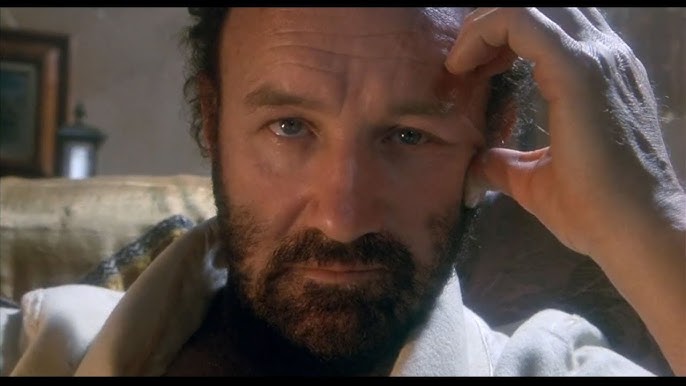
EUREKA opens with a stunning aerial shot that descends upon obsessed gold prospector Jack McCann (Gene Hackman) who’s fighting with a man on a snow-covered mountain in the Yukon territory. The man has asked Jack to partner with him in their search for gold, and Jack makes it clear that he will never “make a nickel on another man’s sweat.” Next, we see Jack as he’s walking through a nearly deserted town. In another unforgettable shot, Jack watches a man, who’s clearly gone mad, commit suicide just outside of the local “Claims office.” Before watching again today, that was the only scene that I could remember from my initial viewings of the film so many years ago. Next, we see Jack lying down below a tree at night, in windy, frigid temperatures, just about to freeze to death. Three hungry wolves have even approached ready for dinner. And this is where things get strange. Out of the blue, this clairvoyant madam (Helena Kallianiotes) from a local brothel sees him in her crystal ball, as a mysterious stone falls right next to him, starting a fire that warms him and drives away the wolves. He goes to see the madam at the brothel where she tells him that he will strike gold, but he “will be alone now.” Jack leaves the next morning and finds gold, rivers of gold. It’s another stunning sequence showing the obsessed man, who’s been searching for gold for 15 long and hard years, finally finding the object of his obsession. 

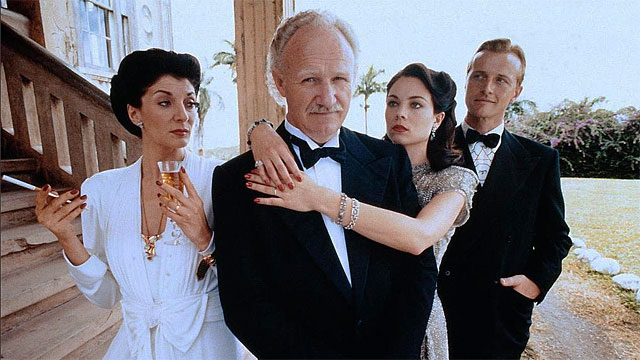
Cut to 20 years in the future, where Jack is now the richest man on earth, living on his own Caribbean island. It also appears he may also be the unhappiest man on earth. He has all the money in the world, but there is no peace in his heart or soul. His wife Helen (Jane Lapotaire), who he was once deeply in love with, is now detached and addicted to alcohol. His daughter Tracy (Theresa Russell) has fallen in love and married Claude Maillot Van Horn (Rutger Hauer). Jack cannot stand Claude as he suspects that he seduced and married Tracy so he could get to his money. His best friend Charles (Ed Lauter) has somehow gotten mixed in with Miami mobsters, led by a guy named Mayakofsky (Joe Pesci) and his lawyer Aurelio D’Amato (Mickey Rourke), who want to force Jack to sell them land on his island so they can build a casino. Jack feels like everybody just wants a piece of him and his money. He has lost the joy in his life. The rest of the film plays out against this backdrop as Jack tries to separate Tracy from Claude, and as the mobsters try to force Jack to sell to them by any means necessary.

EUREKA is not a film that everyone will love, but I enjoyed watching it again after so many years. Director Nicolas Roeg, who also directed PERFORMANCE (1970), DON’T LOOK NOW (1973) and FULL BODY MASSAGE (1995), creates some truly amazing and brutal images that once seen are not easily forgotten. The scene where Jack McCann finds his huge vein of gold is so beautiful, but there are alternatively horrific scenes of brutal violence that play out almost to the point of overkill. The movie also takes some surprising twists and turns in the third act that you may not see coming. I always like it when a movie surprises me. It’s a melodramatic film that doesn’t have a lot of likable characters, but with a cast this good, I’m willing to go along with the filmmakers. In addition to the excellent work of Gene Hackman and Rutger Hauer, Theresa Russell has the important role as the daughter stuck between the man she loves and the dad who adores her. Her acting style exemplifies the melodrama of Roeg’s vision, so it works well in the context of this film. Jane Lapotaire has a couple of strong moments as Hackman’s alcoholic wife who yearns for days long gone when they were so in love. We were quite spoiled in the early 80’s when a movie could round out its already impressive cast with actors like Joe Pesci, Mickey Rourke, Ed Lauter, Corin Redgrave and Joe Spinell.

Nicolas Roeg appears to be trying to make deep statements about the meaning of life in EUREKA. I’m not a person who generally consumes films for deep meaning, but I thought it might be fun to at least take a surface-level view of some of the items I noticed while watching the movie. Jack spouts a lot of profound things throughout the movie, things that he feels describe him as a person. I mentioned one earlier when Jack tells the competing prospector prior to finding gold that, “I’ll never make a nickel off of another man’s sweat.” He will continue to use this saying throughout the film, even after he’s a rich, jaded, older man. The truth is that he would not have found the gold without the help of the clairvoyant madam, with her even passing away right after he hits the jackpot. In another scene at an extremely awkward dinner party, Jack tells his guests that the only rule that matters is the Golden Rule, “Do unto others as you would have them do unto you.” While I agree with the importance of this rule, Jack does not seem to follow the Golden Rule in any way that helps others or gives him any sense of peace or connection. Jack does not seem to understand the contradictions in his use of these phrases as played out in his own life, but I also think that his lack of understanding helps to illustrate a truth that plays out at times in many of our own lives. So often we’ll claim certain beliefs and values, but our lives as lived will be much more complex and often hypocritical. We can see them in Jack, but can we always see them in ourselves?

EUREKA also seems to be a movie that’s open to different interpretations based on who’s viewing the movie and where they are in life at that specific time. In a moment of clarity with his wife, Jack seems to recognize the hypocrisy in his life when he tells her “I once had it all… now I just have everything.” Jack is finally reflecting on the important things in his life, rather than dwelling on his current distrust of everyone around him. This final quote got me to thinking about my own life and just how different I am as a man in my early 50’s compared that naïve 20-year-old who first watched this film. I didn’t know what it was like to chase my dreams, catch them, and then try to figure out how to keep striving with a purpose. I didn’t know what it was like to be married with the responsibility of loving my wife and genuinely caring about her needs, through both the good times and the bad times. I didn’t know what it was like to be a dad who wanted nothing but true happiness for his children. Jack has lived through these specific opportunities in life, and we can see how he’s dealt with them. Each of these things have now played out in my own life. There have been times that I’ve failed, and there have been times that I’ve succeeded. I just keep reminding myself to try to focus on the things that matter and not get distracted by the things that don’t. Even now, it’s not always easy to do.    

I’ve included the trailer for EUREKA below:

Film Review: Groundhog Day (dir by Harold Ramis)


Happy Groundhog Day!  For the record, Punxsutawney Phil saw his shadow today so get ready for six more weeks of winter!

Oh, how I love Groundhog Day.  I really do.  It’s perhaps the silliest holiday that we have in America and I absolutely adore the whole thing.  I love the fact that people get dressed up for it.  I love that there are people who plan their entire weekend around seeing what the groundhog predicts.  I love that we all know there’s no way a groundhog can reasonably predict the weather but, for one day, we pretend like it can.  And while Groundhog Day itself had its beginning in Germany, the holiday really has become pure Americana.  It’s such an innocent holiday, or at least it is now that Bill de Blasio is no longer in a position to kill the magic groundhog.

(Boo de Blasio!  Boo!)

Of course, no Groundhog Day is complete without watching the 1993 comedy of the same name.  The film has become such a major part of American culture that even people who haven’t watched it know what it’s about.  (It’s a bit like It’s A Wonderful Life in that way.)  Bill Murray plays Phil Connors, a cynical weatherman who is sent to cover Groundhog Day in Punxsutawney and finds himself reliving the same day over and over again.  Every morning, it’s once again February 2nd.  Sonny and Cher’s I Got You Babe plays on the radio.  Phil is approached by Ned Ryerson (Stephen Tobolowsky), an annoying former classmate turned insurance salesman.  Phil steps in the same puddle.  He finds himself covering the same story and, again and again, he’s stranded by the same blizzard.  At first, Phil is angry.  Even multiple suicides can’t stop the cycle.  Kidnapping the groundhog can’t stop the cycle.  Then, he decides to take advantage of living the same day over and over again.  He gets to know the people in the town and realizes that they’re not so bad.  He saves the mayor (Brian Doyle-Murray) from choking at dinner but, in the film’s most poignant moment, realizes that an old homeless man is going to die regardless of how many times he tries to save him.  Phil learns how to learn the piano.  He learns how to speak French.  And, most importantly, he falls in love with Rita (Andie MacDowell).  Of course, when he tells Rita this, she assumes he’s just trying to take advantage of her.  Rita says that they barely know each other but what she doesn’t realize is that Phil has been spending day-after-day with her.

As you might have guessed I relate to Rita.  She loves the silliness of the holiday and so do I.  I also relate to Nancy Taylor (Marita Geraghty), just because of her determination to enjoy the day no matter what.  That said, this is totally Bill Murray’s film and this is one of his best performances, one in which he expertly mixes his trademark comedy with some very poignant drama.  One thing I like about this film is that Phil becomes a better man as a result of living the same day over and over again but it doesn’t totally change his personality.  At the end, he’s still the same sarcastic smartass that he was at the start of the film but he’s no longer a cynic.  He’s learned how to appreciate other people.  He’s fallen in love.  Much like George Bailey, he’s become the richest man in town.  This is a rare film where the main character is as interesting after he’s reformed as before.

It always breaks my heart a little to read that Bill Murray and director Harold Ramis had a difficult time working together while making this film.  It’s truly a perfect film and that’s due to both Murray’s performance and Ramis’s heartfelt direction.  I’m also glad that Ramis and Murray made up before Ramis passed away.  Life’s too short and sadly, unlike in the movies, we don’t always get a chance to go back and correct the past.

Groundhog Day is a holiday classic and may it continue to be watched for decades to come.