Pop Jones (Morris Ankurm) and his daughter Sierra Nevada (Barbara Stanwyck) leave their ranch in Texas and head up to Montana to take over some land that Pop has inherited. Evil Tom McCord (Gene Evans) wants the land for himself and conspires with a member of the local Blackfoot tribe, Natchakoa (Tony Caruso), to take it over. After a surprise attack leaves Pop dead, Sierra is nursed back to health by Colorados (Lance Fuller), the son of the Blackfoot chief. Sierra tries to reclaim her land from McCord, with the eventual help of the mysterious gunslinger Farrell (Ronald Reagan).
There are a lot of reasons why this B-western doesn’t really work, a huge one of them being that Barbara Stanwyck was several years too old to be playing Morris Ankrum’s innocent daughter. The biggest problem though was casting Ronald Reagan as a mysterious gunslinger. Farrell is a character who is supposed to keep us guessing. We’re not supposed to know if he’s a good guy or a bad guy. But as soon as Ronald Reagan shows up and starts to speak, we know everything we need to know about Farrell. There was nothing enigmatic or even dangerous about Ronald Reagan’s screen persona. He came across as being more open and honest as just about any other actor from Hollywood’s Golden Age. For the role of Farrell, it appears that he went a day without shaving and he tried not to smile while on-camera but he’s still good old dependable Ronald Reagan. That pleasantness and lack of danger may have kept him from becoming an enduring movie star but it did serve him very well when he moved into the political arena.
Cattle Queen of Montana was one of the 200 westerns that Allan Dwan directed over his long career. It’s not one of his more interesting films, though he does manage a few good action sequences. A far better Dwan/Reagan collaboration was Tennessee’s Partner, which was released four years after this film.
Wil Hunter (James Maslow) wanted to be a painter in New York but instead, he ended up working for his Dad’s storage unit business with his brother, aspiring filmmaker Orrie (Jesse Pepe). When Wil’s ex-girlfriend, Susan (Lillian Solange Beaudoin), arranges for Wil to have a tent at a local art show, it revives Wil’s dreams of making his living as an artist. While Orrie films a documentary about what’s goes on behind-the-scenes at an art show, Wil gets to know fellow artists like Chief (Robert Wilson Seymone) and Vic (Jason Kypros). He also falls in love with the owner of tent-next-door, Rachel (Ella Lentini).
Art Show Bingo is a sweet movie, a love story with an edge of authenticity. I get the feeling that it was made by people who actually have experience with art fairs and “starving artist” shows because all of the little details feel true, like the customers who try to set their own prices, the kids who don’t often understand that are should be looked at but not touched, and the snooty judges who dislike everything they see. I’ve been to enough amateur art fairs that I immediately recognized a lot of the situations and the characters in Art Show Bingo. (After seeing this movie, I’m definitely going to be nicer the next time I go to one.) Personally, I was not really that impressed by Wil’s paintings but art is often in the eye of beholder and his work did get better as the movie went on. Orrie got on my nerves but I liked both Wil and Rachel and I really wanted to see them get together.
I liked Art Show Bingo a lot more than I thought I would. It wasn’t perfect but it still left me smiling.
A group of American soldiers are searching for militants. Amongst them is the grim-faced William “Spooky” MacPherson (Val Kilmer). When an adorable little girl with a teddy bear approaches the soldiers, MacPherson barely notices. His mind is on adult threats. But when the girl reveals that she has a bomb in her backpack, the majority of the soldiers are blown up with her. MacPherson survives, though he loses a leg and ends up with such severe PTSD that he can no longer carry a gun or even make a fist. Helping him recover from his wounds is his best friend and fellow soldier, Miguel (Greg Serano).
A year or so later, MacPherson is back home. He lives in a run-down apartment in New York and spends most of his time with a naked woman who speaks Russian. (Whether she was meant to be his girlfriend or just someone he hired is unclear.) Miguel continually calls him up and asks him to come down to New Mexico and work on his ranch. MacPherson refuses at first. He wants to remain isolated from the world. But when his flashbacks of the explosion become too intense, MacPherson finally decides to accept Miguel’s offer. MacPherson pawns a gun so that he’ll have enough money to get a bus ticket. And then, he heads for New Mexico.
The only problem is that, once MacPherson arrives in New Mexico, Miguel is nowhere to be seen. Walking through a town that appears to have recently been constructed, MacPherson meets a lot of people who insist that they’ve never heard of Miguel and that there is no ranch at the address that Miguel gave MacPherson. The police carefully watch MacPherson as he makes his way from business to business, searching for his friend. No one in town is friendly. No one seems to want MacPherson around. Eventually, MacPherson is approached by Rhodes (Gary Cole), the businessman who is building the town and who apparently controls everything that happens within the town limits. Rhodes is friendly. Rhodes says that MacPherson, with his white skin and blonde hair, is exactly the type of person that he likes to see in his town. Can you tell where this is going?
You probably already guessed that Rhodes is an evil businessman who is involved in human trafficking and who smuggles Mexicans across the border to work for his company before then sending back to their home country with next to no money. You’ve also probably figured out that Miguel was killed by the corrupt police force. If you haven’t figured that out, you’ve never seen a movie before. MacPherson teams up with the only kind person in town, Joanna (Jennifer Esposito), and they try to stop Rhodes’s operation. The entire movie seems to be building up to a scene where MacPherson and Joanna take on the whole town but instead, somewhat anticlimactically, everyone just stands around and watches Rhodes battle MacPherson. Conspiracy promises a lot but it doesn’t really deliver.
This was one of Val Kilmer’s first straight-to-video roles and he gives a rather detached performance, which is a shame because an actor of Kilmer’s talent could have really done something with this role if he had been in the mood to do so. But I don’t blame Kilmer for not seeming to be that invested in Conspiracy. It’s not a very interesting film. Even the usually dependable Gary Cole just seems to be going through the motions. The film’s attempt to comment on the pressing political issues of 2008 — illegal immigration, the war in Iraq, the burst of the housing bubble, the recession — only serve to reinforce how shallow and heavy-handed the film actually is. Watching Conspiracy in 2025, the most interesting about it is that the issues it deals with are the issues that, 17 years later, Americans are still dealing with.
With its portrayal of an isolated town and a scarred war veteran looking for a missing friend, Conspiracy has a lot in common with the classic 1955 film, Bad Day At Black Rock. Now, that’s a film that is definitely worth seeing!
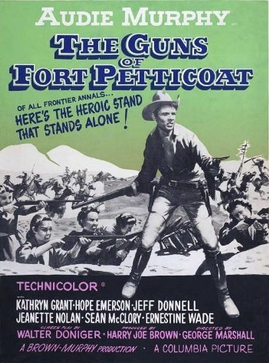
During the waning days of the Civil War, Lt. Frank Hewitt (Audie Murphy) is a man without a country. A Texan, he joined the Union Army even as his home state was voting to secede from the United States. In the Army, Hewitt is viewed with distrust by his autocratic superior, Col. John Chivington (Ainslie Pryor). When Hewitt learns that Chivington has ordered a surprise attack on an unarmed local Indian tribe in order to drive them into Texas where they will attack the nearest settlement for revenge, Hewitt deserts the Army to warn the people left in his hometown.
When Hewitt arrives, he discovers that all of the men in town have left to join the Confederate Army. Only their wives, mothers, and sisters remain. Though Hewitt is, at first, accused of being a traitor, he sticks around and trains the women on how to fight not only the incoming Comanches but also any outlaws who ride into town looking to take advantage of the situation.
The Guns of Fort Petticoat is an interesting B-western that holds up well today. Even though the film ends with a Comanche attack, it’s made clear that the attack would not have happened if not for the actions Col. Chivington. Chivington, who doesn’t care that the victims of his actions would not be Confederate soldiers but instead just helpless woman and children, is the film’s true villain, even if he only appears in the first and final scenes. Audie Murphy, who was America’s most decorated World War II veteran, not only starred in but produced the movie. Murphy was a stiff actor but he looked believable in uniform and obviously knew how to convincingly shoot a rifle and that’s all this role really demands of him. Kathryn Grant plays the woman who goes from distrusting Hewitt to falling in love with him and she and Murphy work well together. The final battle between the women and the Comanches is exciting and well-shot by veteran western director George Marshall. The movie’s final scene may not be totally believable but it’s still very satisfying.
Fans of the western genre and Audie Murphy will find much to enjoy about The Guns of Fort Petticoat.
I’m guessing it started with JAWS (1975) and JAWS 2 (1978) since they played often on Fox-16 out of Little Rock when I was a kid, but I’ve been a fan of actor Roy Scheider for as long as I can remember. He’s one of those actors who has his own section in my massive collection of physical movie media. I’ve read about every film he’s ever made, and I’ve watched most of them. Surprisingly, THE SEVEN-UPS is the first Roy Scheider film I’ve written about on The Shattered Lens.
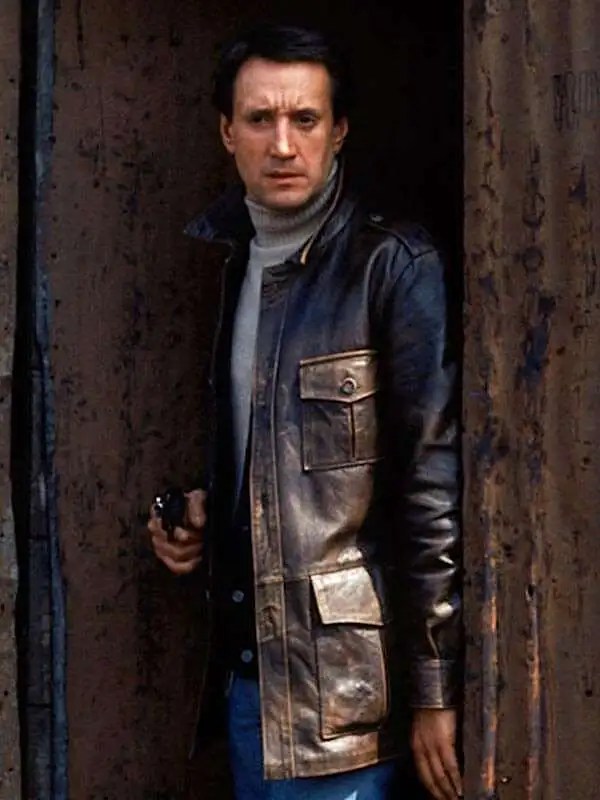
NYPD detective Buddy Manucci (Roy Scheider) leads a team of elite cops, known as the “seven-ups.” They’ve acquired this nickname because most of the criminals they arrest receive sentences that are 7 years and longer, which makes their superiors on the force very happy. Granted, the team does use a variety of unorthodox methods to find and arrest the criminals, which can also rub their superiors and some of their fellow cops the wrong way. Buddy’s childhood friend Vito Lucia (Tony Lo Bianco), an undertaker by trade who has his finger on the pulse of the criminal activities in his community, serves as an important snitch for the team, with his information often leading to major busts. Unbeknownst to Buddy, prominent members of various organized crime families and other white-collar criminals start getting kidnapped and held for ransom in the community. Buddy’s unaware of the full extent of the kidnappings, but he asks his old friend / snitch Vito about this when he actually witnesses the abduction of a crooked bail bondsman he’s following named Festa. We know that Vito is the mastermind behind all of the kidnappings, and his two main henchmen, Moon (Richard Lynch) and Bo (Bill Hickman), are impersonating cops just long enough to confuse and abduct the various criminals. When the Seven-Ups stake out a funeral meeting of various mobsters in the area, squad member Ansel (Ken Kercheval) is killed as part of a screwed-up abduction attempt. Buddy spots Moon and Bo trying to flee the area and tries to chase them down in an incredible car chase that ends when Buddy is almost decapitated in a violent collision with a parked 18-wheeler. With one of their own dead and with the wild chases through the streets, the members of the team are placed on suspension and even investigated as suspects for the kidnappings. Not content to just lay low during their suspensions, the seven-ups continue to try to figure out what’s going on, doing whatever it takes to get the information they need. When Buddy and his group start applying incredible pressure to some of the local mobsters about who shot Ansel, he gets information that ties the killing and the kidnappings to his friend Vito. This time when he meets with Vito, Buddy feeds him false information, thus setting a trap to bring the whole operation down.
After viewing THE SEVEN-UPS again for the first time in a while, it continues to be my opinion that this movie is severely underrated. It’s a great cop film from the early 70’s, anchored by an excellent lead performance from Roy Scheider, who’s wearing one of the coolest leather jackets in the history of cinema. Coming in hot off the heels of THE FRENCH CONNECTION (1971), and with many connections to the Oscar winner, it seems that somehow this great film has fallen through the cracks over the years. I mean, how often do you hear people talk about this movie? THE SEVEN-UPS is directed by Philip D’Antoni, his only directorial credit, although he did serve as the Producer for both BULLITT (1968) and THE FRENCH CONNECTION. D’Antoni clearly values a good car chase sequence. THE SEVEN-UPS contains a thrilling car chase, which really isn’t that big of a surprise when you learn that stunt coordinator Bill Hickman, who plays the bad guy Bo in this film, coordinated the car chase sequences in BULLITT and THE FRENCH CONNECTION. This film features my personal favorite car chase sequence from any film that I’ve seen to date. Don Ellis composed the memorable musical score, a service that he also provided in THE FRENCH CONNECTION. I point out all of these ties to THE FRENCH CONNECTION because, in my humble opinion, the talent behind that film created another classic in THE SEVEN-UPS.
Complimenting Roy Scheider’s lead performance, THE SEVEN-UPS has a strong supporting cast. Tony Lo Bianco, Ken Kercheval (of DALLAS fame), Bill Hickman, and Richard Lynch are all quite memorable in their respective roles. I also like the 1973 New York City setting for the film. In movies like this and the following year’s DEATH WISH, we get to see a New York that no longer exists. To me, this only adds to the gritty realism of the film.
Overall, THE SEVEN-UPS is a movie I recommend without any reservations. If you’re a fan of 70’s cop thrillers, you simply can’t go wrong with this one.
When it comes to conspiracy theories involving presidential assassinations, the theories surrounding JFK may get all the attention but it’s the theories surrounding the death of Abraham Lincoln are usually far more plausible.
Unless, of course, it’s the theories that are pushed in the 1977 docudrama, The Lincoln Conspiracy.
A mix of documentary-style narration and really cheap-looking historical reenactments, The Lincoln Conspiracy essentially indicts almost everyone who was alive in 1865 as being a part of either the conspiracy or the subsequent cover-up. Really, it’s remarkable how many historical figures are implicated in this film.
With the Civil War coming to a close, President Lincoln (John Anderson) hopes to pursue a generous reconstruction policy for the former Confederate States. Secretary of War Edwin Stanton (Robert Middleton), Senator Ben Wade (Dick Callinan), and a host of other are all opposed to this plan, both because they want vengeance and they also want to make as much money as possible off of the Southern cotton fields. They come up with a plan to impeach Lincoln but, in order to draw up the articles, they have to make sure that Lincoln is not seen for a few days. When Col. Lafayette Baker (John Dehner) discovers that an actor named John Wilkes Booth (Bradford Dillman) is planning on kidnapping Lincoln, Stanton and his conspirators decide to give Booth their unofficial support. However, when the plan changes at the last minute and Stanton decides that it would actually be a bad idea to kidnap Lincoln, an angry Booth decides to just kill Lincoln, Andrew Johnson, and William Seward.
Booth succeeds in shooting Lincoln and making his escape. The other members of Booth’s group all fail in their assignments. Andrew Johnson becomes president. Though grievously wounded, William Seward survives. Booth flees to Canada and …. oh, you thought Booth died? No, that was just a look alike who was shot by a bizarre soldier named Boston Corbett. By allowing everyone to believe that Booth was killed, Stanton is able to cover up any role he and his allies played in inspiring the assassination. Unfortunately, Col. Baker keeps a diary and it seems like he might be planning on revealing the truth but he dies mysteriously before he can.
(And, to give the film some credit, Col. Baker’s sudden death at 41 was an odd one. And, though it’s not really explored in the film, Boston Corbett, the man who shoot Booth, really was a weirdo who was described by contemporaries as being a religious fanatic who castrated himself and claimed to hear the voice of God.)
It’s a big conspiracy theory that is presented in The Lincoln Conspiracy. In fact, it’s a bit too big to really be taken seriously. The film pretty much accuses everyone in Washington of having a part in the assassination. The film itself has the cheap look of a community theater production and the use of Dr. Samuel Mudd as a narrator only adds to the film’s silliness. If you’re a fan of gigantic and thoroughly implausible conspiracy theories, as I am, the film is entertaining in its way. If nothing else, Bradford Dillman certainly looks like how most people probably imagine John Wilkes Booth to have looked. Otherwise, The Lincoln Conspiracy is far-fetched and not at all realistic, which is why I assume that a lot of people in 1977 probably believed every word of it.
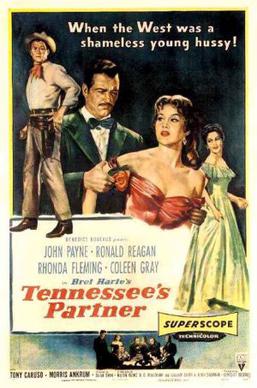
Tennesse (John Payne) is an old west gambler who co-owns a saloon (and bordello) with Elizabeth Farnham (Rhonda Fleming). When Tennessee is ambushed after a poker game, he’s saved by a local man who goes by the name of Cowpoke (Ronald Reagan). Tennessee and Cowpoke become fast friends but when Tennessee realizes that Cowpoke is about to marry a golddigger (Coleen Gray), Tennessee puts the woman on the next boat out of town. Cowpoke vows to get vengeance but Tennessee has bigger things to worry about. Rival businessman Turner (Tony Caruso) has framed Tennessee for the murder of a local prospector, Grubstake McNiven (Chubby Johnson).
Very loosely based on a short story by Bret Harte, Tennessee’s Partner has surprisingly high production values for a B-western. Director Allan Dwan started his career in the 1910s and directed over 200 westerns. He knew how to keep the action moving. Tennessee’s Partner is also the only film that old friends John Payne and Ronald Reagan made together. Reagan, whose days as a major studio leading man had ended by the time he made this film, gives one of his better performances in the role of the simple but honest Cowpoke and shows the likability that he was later able to translate into a political career. Reagan could be a stiff actor but his naturally amiable manner made him perfect for best friend and sidekick roles, like in this movie. Payne also gives a good performance as the gambler with a moral code. However, the best thing about the film is Rhonda Fleming, giving a tough and sexy performance as Elizabeth. Because this film came out in 1955, it couldn’t really come out and say that Elizabeth was a madam and the saloon was a bordello but Fleming’s performance and a few lines of innuendo left little doubt about what was actually going on upstairs from the bar. Keep an eye out for Angie Dickinson, playing one of Elizabeth’s girls.
The performance elevate Tennessee’s Partner, making it a B-western that can be enjoyed even by people who aren’t necessarily into westerns.
Drayton Lahey (Noah Beck) is a high school quarterback who is being pressured by his father (James Van Der Beek) to accept a football scholarship to “Waco.” (I guess that’s supposed to be Baylor.) Drayton has the talent to turn pro and he’ll be a starter if he goes to Waco, despite being only a freshman. (Maybe it isn’t Baylor. Baylor football coaches aren’t that dumb.) But Drayton likes a cheerleader named Dallas Bryan (Sienna Agudong), who is the sister of his coach (Drew Ray Tanner) and who wants to go to California after she graduates so that she can pursue her dream of being a professional dancer.
It’s a slickly-made high school football movie and, even worse, it’s a Wattpad movie so there’s no surprises to be found here. I was able to predict every line of dialogue before the characters said it. The plot was old-fashioned but the actors said stuff like, “I’m tired of your main character energy,” just to make sure that we all knew the movie was made in 2024. I was a cheerleader in high school but no one on our football team was offered a scholarship anywhere. I could still relate to some parts of the movie, though. It was always awkward after the games when the parents would yell at the players because they dropped a pass or threw an interception. Even our bad players were put under a lot of pressure and, as cheerleaders, a big part of our job was to make everyone felt like a winner even when they were losing. We were good at our job but, by the end of the year, we still had a losing season and no scholarships.
Sienna Agudong was believable in the lead role but I had a hard time buying TikTok star Noah Beck as a quarterback with the talent to be a freshman starter or to even go pro. The big “star” in this movie was James Van Der Beek, playing the type of humorless father figure that he used to rebel against in his teen idol days. If you can remember Dawson standing in that rowboat, this movie will make you feel old.
In this 1993 film, Lou Diamond Phillips stars as Jeff Powers. Who is Jeff Powers? He’s a cop! He wants to keep the street safe! Sometimes, he knows that you have to be willing to break the rules! He’s a cop who does things his way!
Okay, is that enough exclamation points? I’m not just using them to be obnoxious. The film is pretty much just one big exclamation point. The action is hyperintense and the film is full of characters who always seem like they’re just one step away from exploding. No one in this film is particularly calm or laid back. From the start, everything is dialed to eleven and it just keeps going higher and higher.
After Jeff is put on probation for roughing up a suspect, he receives an invitation to join an elite squad of detective. Led by the charismatic Detective Dan Vaughn (Scott Glenn, giving a performance that is so over-the-top that he yells straight at the camera at one point), the Special Investigative Section is the best of the bed. Upon joining, Jeff finds himself a member of a sacred fraternity of law enforcers. Working with men like the always amused Detective Larson (Yaphet Kotto) and the somewhat paranoid Angel (Andrew Divoff), Jeff finds himself tracking some of the biggest criminals in the city.
What Jeff also discovers is that SIS does more than just arrest criminals. The SIS has been given an unofficial license to kill and they end up executing as many people as they take to jail. Often times, Vaughn will tells the men to allow a crime to be committed so that they can then dispense their own brand of justice. In the film’s most disturbing scene, the members of SIS wait until after a woman has been raped in an alley before they move to neutralize her attackers. When Jeff finally decides that he can’t be a part of all this and tries to reveal what’s going on, he discovers that the SIS has some support in some very high places. Who cares if the SIS is allowing crimes to be committed or if an innocent person occasionally gets caught in the crossfire? At least they’re taking care of the criminals!
Extreme Justice is a crude and energetic film and one that is based on some of the stories that spread about the LAPD’s RAMPART division in the 90s. That the film works is a testament to the performances of Phillips, Kotto, and Glenn and also the direction of Mark L. Lester. An exploitation vet who occassionally made big studio action films as well, Lester keeps the pace moving at breakneck speed and, even more importantly, he allows both sides to have their say. While Jeff is upset about SIS’s methods, Detective Vaughn is correct when he says that his unit is targeting the worst of the worst. It makes for an unusually intelligent exploitation film, one that leaves the audience with a lot to consider. How far would you go to keep your neighborhood safe?
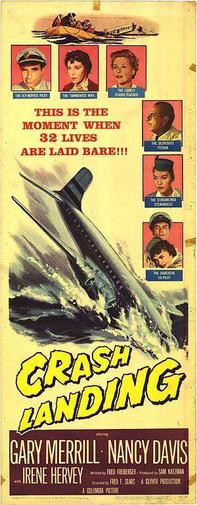
Flying from Lisbon to New York City, a commercial airline is flying over the ocean when two of its engines fail. When the propellers fail to restart, Captain Steve Williams (Gary Merrill) realizes that he will have to land the plane in the ocean. The Navy is standing by to rescue the passengers. It’s just a question of whether or not Steve and his crew can land the plane without injuring the passengers or causing the plan to break in half.
This is a disaster film that doesn’t really have a disaster. The members of the crew all work professionally and efficiently to make sure that the landing is a success, even though none of them have ever had to ditch a plane before. The Navy shows up on time and ready to help. With one exception, the passengers react calmly and do what they’re told. An Orthodox priest prays for the plane. The flight attendants neatly pack all of the kitchen utensils. The only drama comes from a boy who is traveling with his dog Wilbur and is upset to hear that Wilbur will have to stay in the back of the plane, where he will probably drown. The boy’s father says, “I’ll buy you a new dog,” and the boy asks that his baseball cap be placed by Wilbur’s cage so that Wilbur knows his owner was thinking of him. Don’t worry kid! Steve Williams isn’t going to let your dog die.
It’s strange to see a disaster film without any real drama. The crew thinks that Williams can be overbearing but it turns out he knows what he’s doing. At home, his wife (Nancy Davis, in her final film role) thinks that Steve is too hard on their son. Their son is going to grow up knowing how to land airplanes in water. This is almost the Sully origin story. Otherwise, the film emphasizes the way that everyone works together and doesn’t panic. The scene where the plane lands in the water features some good special effects but otherwise, the movie is pretty dull. It could have used Leslie Nielsen and Peter Graves.
Actress Nancy Davis retired from movies after this one but she remained in the public eye as the wife of future President Ronald Reagan.
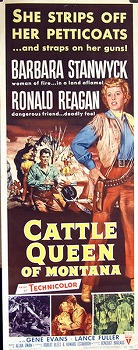 Pop Jones (Morris Ankurm) and his daughter Sierra Nevada (Barbara Stanwyck) leave their ranch in Texas and head up to Montana to take over some land that Pop has inherited. Evil Tom McCord (Gene Evans) wants the land for himself and conspires with a member of the local Blackfoot tribe, Natchakoa (Tony Caruso), to take it over. After a surprise attack leaves Pop dead, Sierra is nursed back to health by Colorados (Lance Fuller), the son of the Blackfoot chief. Sierra tries to reclaim her land from McCord, with the eventual help of the mysterious gunslinger Farrell (Ronald Reagan).

 Through the Shattered Lens