Musical Film Review: Heartbeat (dir by John Nicolella)


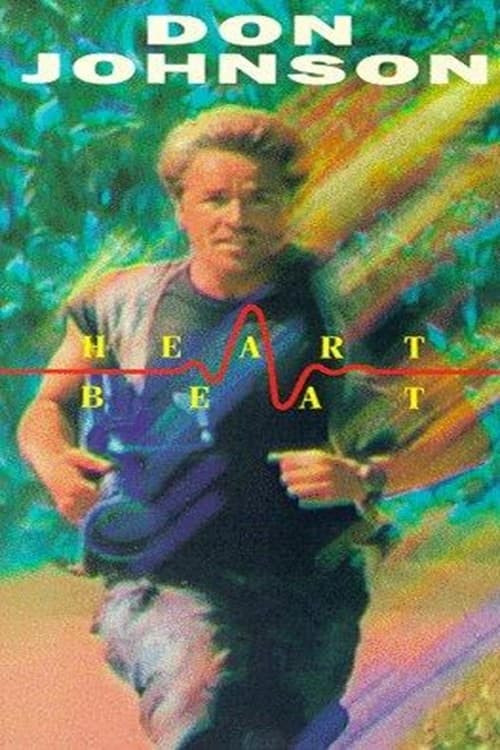
1987’s Heartbeat opens with Don Johnson in an unidentified Central American country.

Rebels are moving through the jungles.  Helicopters are flying over villages and firing off missiles.  In the middle of it all is Don Johnson, playing a character identified as being “The Documentary Filmmaker.”  Johnson carries a large movie camera with him, recording all of the violence and the carnage.  Is Johnson trying to expose the evils of the government?  Is he trying to expose the rebels?  Is he just an adrenaline junkie who can’t help but go to the most dangerous places in the world?  I have no idea and I’m not sure that the film does either.

A bomb explodes.  Johnson is thrown back.  Soon, Don Johnson is being carried into a dark room on a stretcher.  It appears that he might be dying but, even as his heartbeat is slowing down, his spirit is still hanging around and having flashbacks to the attack on the village, which we just saw less than a minute ago.  Eventually, Johnson’s spirit has other flashbacks.  He remembers talking to Paul Shaffer.  He remembers his strained marriage to an unnamed woman played by Lori Singer.  He remembers his youth as the son of a Las Vegas showgirl who is played by Sandahl Bergman.  (Bergman also played a showgirl in Bob Fosse’s All That Jazz and her scenes in this film often feel as if they’ve been directly lifted from Fosse’s classic film.)  David Carradine shows up as someone who might be Johnson’s father or who might just be some random guy rolling dice in the backroom of a strip club.  Johnson remembers his friendship with a graffiti artist (Giancarlo Esposito), who has a sister (Angela Alvarado) who was a prostitute.  The main message seems to be that the Documentary Filmmaker recorded the dangers of the world while also trying to remain emotionally detached, much like Robert Forster in Medium Cool.  Now that he’s dying, he’s left to wonder whether he made the right choice in refusing to get personally involved.

Oh, and did I mention that this film is basically a 65-minute music video?  Don Johnson sings through the entire movie, in a style that does its best to imitate the tough growl and soulful yearning of Southern rock and roll but which ultimately only serves to show that Johnson made the right decision in focusing on acting instead of singing?

After I came across this film on Lettrboxd and then watched it on YouTube, I did a bit of research (which is a fancy way of saying that I spent a minute reading a Wikipedia entry) and I discovered that, at the height of his Miami Vice success, Johnson released his debut country rock album, Heartbeat.  Heartbeat the film was something that Johnson made in order to promote Heartbeat the album.  Directed by frequent Miami Vice director John Nicollela, Heartbeat the film is so self-indulgent and determined to prove that Don Johnson is a soulful artist that it becomes oddly fascinating to watch.  Johnson’s Documentary Filmmaker is a bit of a cad but the film seems to argue that 1) it’s not really his fault because women find him to be irresistible, 2) it’s really his mom’s fault for getting a job, and 3) it ultimately doesn’t matter because the Filmmaker is a great artist whose work will live on even after he dies.  It’s a vanity film for a vanity album and it’s all so vain that it becomes hard to look away from.

In the end, both the music from the album and the promotional film leave one feeling that, in 1987, Don Johnson might have had an unreasonably high opinion of his musical abilities.  That said, as anyone who has seen Cold In July can tell you, Don Johnson eventually did become a very good actor.
At Close Range (1986, directed by James Foley)


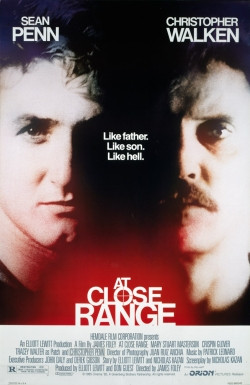
Brad Whitewood, Sr. (Christopher Walken) is known as Big Brad, a rural crime lord who rules the backwoods of Pennsylvania.  When his son, Little Brad (Sean Penn, trying too hard to be James Dean), comes to live with him, Big Brad goes out of his way to try to bring the teenager into his criminal lifestyle.  At first, Little Brad loves being a part of the family business but witnessing a murder and falling in love with Terry (Mary Stuart Masterson) caused Little Brad to start to move away from his father.  With the FBI closing in on the Whitewood family, Brad Sr. starts to eliminate everyone who he considers to be a threat, including the members of his own family.

Based on a true story, this neo-noir features a great cast, including Chris Penn, Millie Perkins, Kiefer Sutherland, Crispin Glover, David Strathairn, Tracey Walter, and Mary Stuart Masterson.  Unfortunately, the movie itself moves at a plodding pace.  There are some good and disturbing scenes, like the montage where Big Brad starts to eliminate the members of his gang.  The film does a good job of showing how seductive Big Brad’s criminal lifestyle can be to a bunch of kids who have basically been written-off by society.  But the story itself is so bleak that most people will end up tuning out long before Little Brad finally turns against his father.

Whatever other flaws it may have, At Close Range does feature one of Christopher Walken’s best performances.  Walken is chillingly evil as Big Brad.  He’s got enough charisma to be believable as someone who could bring a gang together but he’s also frightening as he starts killing anyone who he thinks might talk to the police or the FBI.  Big Brad is a remorseless killer and Walken plays him as being a classic sociopath, someone who cannot understand why the members of his gang and family would get upset when he starts killing some of them.  To Big Brad, that just goes with the territory.  It’s a part of doing business.  With his distinct way of speaking and his trademark tics, Walken is someone who has inspired many impersonators and it can be easy to forget that he’s also a damn good actor.  Films like At Close Range remind us of just how talented Walken actually is.

A Blast From The Past: Testing Dirty (dir by Lynn Hamrick)


Our regularly scheduled review of Degrassi High will not be posted tonight so that we can bring you this special presentation.

My Retro Television Reviews will return on Monday but for now, check out this 1990 program called Testing Dirty!  In this short film, Christopher Daniel Barnes (best known for playing Greg Brady in The Brady Bunch Movie) is a high school athlete who tests positive for drugs despite not using them.  As he tries to clear his name, the adults in his community debate whether or not random drug tests are actually fighting or helping the problem.  That’s an important topic but, for the most part, this film is best-known for a cameo appearance by Adam Sandler as a drug dealer.

And now, without further ado …. it’s time for Testing Dirty!

The Only Game In Town (1970, directed by George Stevens)


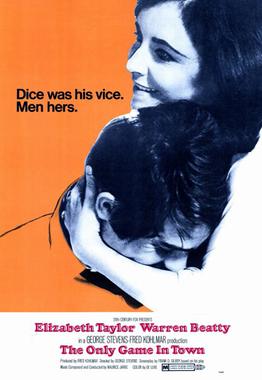
Fran Walker (Elizabeth Taylor) is an aging Vegas showgirl who has been abandoned by her married lover (Charles Braswell).  A trip to a piano bar leads to her meeting pianist and gambling addict Joe Grady (Warren Beatty).  Frank brings Joe home with her.  Joe is trying to win $5,000 so he can leave Las Vegas and go to New York.  Fran needs someone to keep her from going to back to her go-nowhere relationship.  The two talk and talk.  And talk.

Based on a play that closed after 16 performances, The Only Game In Town is memorable for being one of the most expensive theatrical adaptations ever produced.  That’s because Taylor insisted on filming in Paris instead of Las Vegas.  A set representing Fran’s tiny apartment (which is supposed to look cheap) was built on a Paris soundstage and the budget ballooned to a then unheard of $11,000,000.  (By today’s standards, that would be a $90,461,391 budget for a film with two stars and only a handful of locations.)   The Only Game In Town is also memorable for being the only film to feature both Elizabeth Taylor and Warren Beatty.  Taylor and Beatty were actually close in age but Fran still seems to be several decades older than Joe.  It was not the script’s intention but, due to the age difference, Joe comes across as being a gigolo.  (Originally, Frank Sinatra was cast as Joe but he left while the sets were being made in France.)  Finally, this was the final film to be directed by George Stevens, one of the great Golden Age directors who found himself struggling to keep up in a changing Hollywood.  With its stagey set-up and it’s dialogue-heavy script, this film does not features Stevens’s best work.

The Only Game In Town was a huge flop when released, damaging Taylor’s already floundering career and making Beatty even more determined to eventually direct his own films.  Seen today, Warren Beatty is actually pretty good in his role, even if he does come across as being too young.  Elizabeth Taylor is not served well by any element of the film, from her matronly (but expensive) costumes or a script the encourages her to be shrill.  The Only Game In Town was not one that anyone won.

A Blast From The Past: The Human Voice (dir by Ted Kotcheff)


Our regular review of Homicide will not be posted today so that we may bring you this special presentation….

My retro television review will return tomorrow.  For now, check out 1966’s The Human Voice.  In this 55-minute stage adaptation, Ingrid Bergman plays a woman having a phone conversation with her lover of five years on the night before he’s meant to marry another.  Written by Jean Cocteau, this monologue was also filmed by Pedro Almodovar in 2020, with Tilda Swinton giving a performance that cannot hope to compare to Bergman’s.

And now, without further ado, here is The Human Voice!


A Blast From The Past: The Gymnast (dir by Larry Elikann)


Our regular review of Check It Out! will not be posted tonight so that we might bring you this special program….

My retro television reviews will return next week.  For now, we present you with The Gymnast, a short film from 1980 about a teenage girl named Jenny who wants to be the best gymnast in the world but who is going to have to learn some important lessons about hard work and humility beforehand.  I could relate to this film because I was the same way about dancing when I was a teen.  Of course, I never learned any lessons about hard work or humility and I’m all the better for it.

That said, this isn’t a bad little film.  Zina Bethune gives a good performance as the hard-pushing coach and there’s plenty of gymnastic action as well.  I’m going to guess this was probably made to appeal to teens who would presumably have found a bunch of new heroes watching the 1980 Summer Olympics.  Jimmy Carter, however, had other plans.

Now, without any further ado, here is …. The Gymnast!

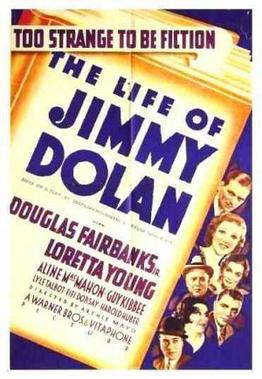
The Life of Jimmy Dolan (1933, directed by Archie Mayo)


Jimmy Dolan (Douglas Fairbanks Jr.), the light heavyweight champion of the world, goes out of his way to present himself as being a wholesome boxer who loves his mom and is as saintly outside the ring as he’s fearsome inside.  Instead, in private, Jimmy is a hard-drinking cynic with a corrupt manager (Lyle Talbot) and a wild girlfriend (Shirley Grey).  When a reporter (George Meeker) threatens to reveal the truth, Jimmy’s manager punches him and accidentally kill him.  The manager frames Jimmy for the crime and then flees with Jimmy’s girlfriend, just to suffer a fiery end in a car accident.

Everyone except for weary Inspector Phalanxer (Guy Kibbee) thinks that Jimmy is dead.  Jimmy goes on the run, hitching rides on freight trains and nearly starving to death before he stumbles over a home for orphans.  Peggy (Loretta Young) takes Jimmy in and gives him food and a place to live.  Jimmy helps with the kids (including Mickey Rooney).  When Jimmy learns that the orphanage might be shut down, he agrees to fight in a charity boxing match against the fearsome King Cobra (Sammy Stein).  King Cobra is so tough that even John Wayne (playing a boxer named Smith) is scared to get in the ring with him.  Jimmy risks his life and his freedom for the orphanage.

This is a good pre-code melodrama.  Because this was a pre-code film, it doesn’t have to shy away from portraying Jimmy’s decadent lifestyle outside of the ring.  Douglas Fairbanks, Jr. was a likable actor and easy to root for.  He was athletic enough to be convincing as someone who could handle himself in a fight.  When he finds himself down-and-out, he’s standing in for everyone who was struggling during the Depression.  The great character actor Guy Kibbee also has some great moments as the inspector, especially towards the end of the film.  Fans of John Wayne won’t see much of him here but it’s still interesting to see Wayne play a character who is frightened of something.

All in all, The Life of Jimmy Dolan is a good, pre-code boxing movie.

A Blast From The Past: Barefoot In The Park (dir by Harvey Medelinsky)


Our regularly scheduled review of Welcome Back Kotter will not be posted this week so that we may bring you this special presentation….

From 1982 and filmed for HBO, it’s a stage production of Barefoot In The Park!  I’ve always loved the Robert Redford/Jane Fonda film version but I also enjoy this recording of one of the play’s periodic Broadway revivals.  Richard Thomas and Bess Armstrong play the newlyweds and they really bring Neil Simon’s dialogue to life.

Without further ado, here is Barefoot In The Park!

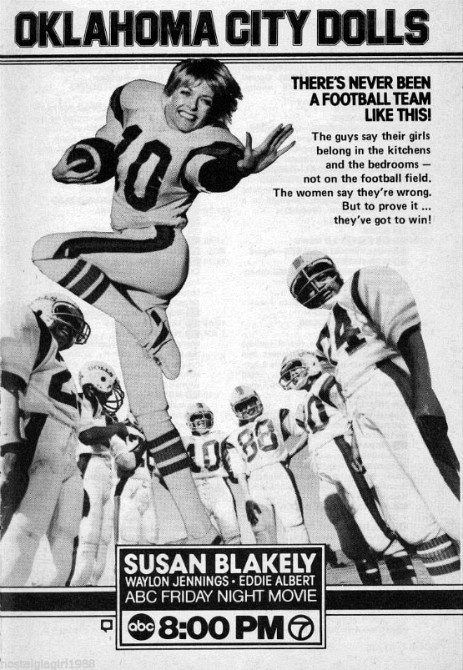
The Oklahoma City Dolls (1981, directed by E.W. Swackhamer)


At an Oklahoma manufacturing plant, the women are always expected to put in extra hours while their male co-workers practice as a part of the company’s football team.  Shop steward Sally Jo (Susan Blakely) files a complaint with the EEOC.  John Miller (Robert Hooks) pays a visit to the plant and says that the women have to be given the same opportunities and benefits as the man, including recreation time.  The plant’s foreman, J.D. Hines (David Huddleston), agrees.  The woman can have recreation time as long as they’re doing what the men are doing and that’s playing football.  Determined to show up Hines and all of her sexist co-workers (and her boyfriend, played by Waylon Jennings), Sally Jo puts together a football team and even gets a broken-down former NFL coach (Eddie Albert) to serve as their trainer.

There actually was a woman’s football team called The Oklahoma City Dolls.  They played in the National Women’s Football League and they won the league’s championship three times.  However, they don’t appear to have anything to do with this movie, which is as much about Sally Jo trying to get a fair treatment for the workers as it is about hitting the field and running it in for a touchdown.  There are some parts of the movie that work.  I liked Eddie Albert’s performance as the alcoholic coach and the scene where he discovered that his community service would include coaching a group of women who had never played football before.  Folk singer Ronee Blakley was good as the team’s emotionally fragile wide receiver.  I even liked that the women didn’t all automatically become the world’s best football players.  The movie’s main weakness was that Susan Blakely just wasn’t believable as someone who lived in a trailer park, used “ain’t” in every sentence, and spent her time organizing a union.  She was too glamorous for the role and her scenes with Waylon Jennings all felt overwritten and overacted.  The story couldn’t decide if it wanted to be a drama about working in a factory or a football comedy and it was pretty uneven as a result.  The good thing is that the movie’s heart was in the right place, even if it didn’t always score a touchdown.

As for the real life Oklahoma City Dolls, they were active from 1976 to 1979.  An attempt to revive the team in 1982 failed when their financial backers pulled out at the last seconds.  The National Women’s Football League folded in 1988.

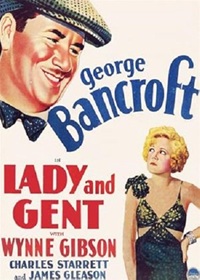
Lady and Gent (1932, directed by Stephen Roberts)


When veteran prize fighter Stag Bailey (George Bancroft) gets cocky and doesn’t bother to properly train for the big fight, he is knocked out by a young up-and-comer named Buzz Kinney (John Wayne).  Stag’s manager, Pin (James Gleason), had all of his money riding on Stag winning.  Now broke and with the mob after him, Pin tries to steal the cash from the boxing arena and ends up getting shot by a security guard.  Stag and his girlfriend, Puff (Wynne Gibson), take in Pin’s young son, Ted, and they devote themselves to raising him.  Years later, Ted (Charles Starrett) wants to become a prizefighter but Stag and Puff, who know what years of getting punched in the head can do to someone, try to convince him to go to college instead.

This boxing film is of interest to western fans because of some of the faces in the cast.  This was an early John Wayne role and he’s only seen in the ring and then in one brief scene where he confronts Stag and Puff in a bar.  Wayne still plays an important role, though, because Buzz’s transformation from being a fresh-faced boxer to being a bitter, punch-drunk bully serves as a warning for what waits for Ted if his adoptive parents can’t keep him out of the fight game.  Charles Starrett, of course, would go on to find greater fame as the Durango Kid.

Otherwise, Lady and Gent is a standard pre-code melodrama.  It’s a little more realistic than some of the other boxing films that came out in the 30s.  Boxing is portrayed as a dirty business that leaves its participants with struggles that all of the prize money in the world can’t make up for.  Puff sacrifices her carefree life to raise Ted but it’s worth it in the end.  You can tell this was a pre-code film because Stag and Puff are a couple but they only decide to get married so they can adopt Ted.

George Bancroft was a star in the late 20s and early 30s but eventually, he transitioned to character parts.  He retired from acting 1942 and became a full-time rancher.  One of his final films was 1939’s Stagecoach, starring his Lady and Gent co-star, John Wayne.