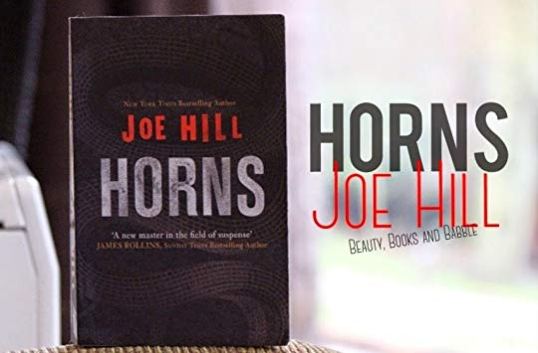
Horns, Book Review, By Case Wright


horns

Horns.  What if you woke up and realized? Gee Whiz, I’m a demon! Well, that’s exactly how it was for Ig Perrish in Horns.  One day he was the pariah of his town because everyone believed he murdered his girlfriend and the next day he’s got budding horns with magical demon powers!

Ig is loathed by everyone for being a rapist and murderer.  There was only one problem: he didn’t do it.  The lab that would’ve exonerated him with DNA evidence caught fire, leaving him as the likely suspect, but no physical evidence to convict or exculpate.  His town and greater world hates him forever.

The horns start growing out of his head and give him powers to cause people to indulge and confess their darkest desires.  When he uses the horns, people can see the horns, when he’s done, they’re no longer visible. He goes through the town getting people indulge and confess.  He slowly realizes that xxxxxxxx was the killer.  Ha! No spoilers! The killer figures out that Ig has discovered his identity so they begin a cat and mouse game that goes all the way to the climax.

The book elicits a visceral response because it deals with the key concepts of human existence: Betrayal, love, revenge, and envy.  There are quite a few of the other deadly sins on display in the book as well.  The only knock that I give the book is that it really obvious very early on who the real killer is.  Nope, still not spoiling!

Is it worth reading? Yes. There is also a very fine audiobook with a voice actor  who does a very good job.  I highly recommend that as well.  You can check out the trailer review for Horns by Arleigh here!

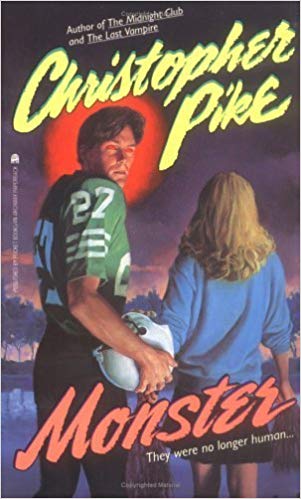
Horror Book Review: Monster by Christopher Pike


“They were no longer human…” the cover of 1992 first edition of Christopher Pike’s Monster announces and indeed, they’re not!  That cover, I should add, makes the book look a lot more light-hearted than it is.  It makes it look like it’s some sort of sci-fi comedy about a demonically possessed football player when there’s actually very little about this book that could be considered light-hearted.

This book is dark.  Like, seriously, dark.

It opens with popular high school student Mary Carlson walking into a party while carrying a shotgun.  She blows away a football player named Todd and then a cheerleader named Kathy and then she points the gun at her own boyfriend, Jim.  Fortunately, the new girl at school, Angela, manages to distract Kathy just long enough for Jim to take off running into the woods.  Mary goes chasing after him but she gets arrested before she guns him down as well.  It’s probably a good thing that Jim survived because, without him, how would the football team ever win another game?  After all, the team sucked just last season before all of the players and the cheerleaders suddenly got super strong!

Anyway, Mary says that she was shooting her friends because they were no longer human and, according to her, the three of them have been picking up people and killing them in a warehouse.  Police Lt. Nguyen doesn’t believe her but Angela feels a bit of an obligation to investigate Mary’s story.  And really, it’s the least she can do considering that she promptly starts flirting with Jim right after Mary’s arrested.

It quickly becomes obvious that something strange has happened to all of the school’s athletes and cheerleaders.  Maybe it has something to do with the mysterious crater from which the town gets its drinking water.  Angela notices that Jim tends to eat everything in sight, including a raw hamburger.  After she and Jim make out and she ends up getting some of his blood on her, she soon finds that she’s eating everything in sight.  Is it possible that some sort of monster has not only taken over Jim but is now taking over Angela as well!?

Yes, it is.  That’s bad news for Kevin, who is Angela’s BFF and who is totally in love with her even though she only views him as being a very good friend.  Oh, poor Kevin!  Kevin is one of the few wholly sympathetic characters in the book and he still ends up with a broken neck.  Like I said, this book is dark!

It all ends on an appropriately dark note and I guess that’s the important thing.  This book was written in 1992 and, at the time it was written, it was probably meant to be a metaphor about the dangers of having unsafe sex, as Angela is infected after fooling around with Jim.  Reading it today, though, it feels more like a commentary on just unsafe school has become over the past decade.  Mary Carlson, blowing away her friends because they’re “not human,” brings to mind so many recent gun-related tragedies.  It’s a bit difficult to read.

Anyway, Monster is a seriously dark book but still an effectively macabre story.  Nobody was as skilled at traumatizing young readers as Christopher Pike!

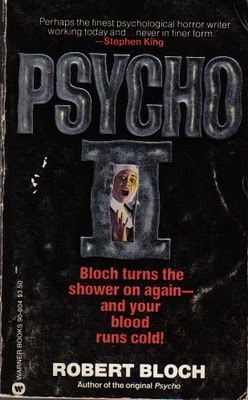
Horror Book Review: Psycho II by Robert Bloch


So, first things first.

This 1982 novel by Robert Bloch is indeed a sequel to the novel that inspired Alfred Hitchcock’s legendary horror film.  Yes, Norman Bates does return.  For that matter, so do Lila and Sam Loomis.  However, this novel should not be mistaken for Richard Franklin’s film, Psycho II, which came out a year later.  In fact, according to a later interview with Robert Bloch, Universal actually pressured him not to release this novel because they disliked the story Bloch had come up with and they also felt it would harm the financial prospects of their sequel.  Bloch, of course, did what he wanted to and was subsequently not invited to any screenings of Franklin’s film.

As for Bloch’s novel, it’s easy to see why Universal wasn’t enthusiastic about it.  It’s perhaps one of the most anti-Hollywood books ever written.  When Norman Bates escapes from a mental asylum and goes on another rampage, his doctor, Adam Claiborne, is convinced that Norman is heading to Hollywood to try to stop production of a movie called Crazy Lady, a movie that’s based on Norman’s crimes.  Even though everyone else is convinced that Norman’s been killed, Claiborne remains convinced that Norman faked his own death and is still out there.

Needless to say, the book’s Norman is considerably different from the vulnerable manchild that Anthony Perkins played in the films.  However, Norman is off-stage for the majority of Bloch’s sequel, the better to keep you wondering whether or not he actually is dead.  The majority of the book is dedicated to Claiborne getting to know the cast and crew of Crazy Lady, the majority of whom turn out to be sleazy Hollywood stereotypes.  Reading the book, it’s easy to see why Universal didn’t care much for it but, at times, Bloch occasionally comes across as if he think he’s the first person to ever be critical of Hollywood.

Another reason why Universal may have balked at adapting Bloch’s novel was because of a surreal chapter in which Paul Morgan, the actor who has been cast to play Norman, goes undercover at a brothel where all of the escorts look like then-Hollywood stars.  Since each escort is referred to by his star’s name, the entire chapter is basically Robert Redford, Clint Eastwood, and John Travolta making bitchy comments about Hollywood and religion.  It’s an odd chapter that doesn’t advance the story but, at the same time, it’s also Bloch at his most subversive.

Though the book’s take on Hollywood was hardly revolutionary, Bloch was a born storyteller and the story moves at a good pace.  It all ends with an effective twist, one that provides a proper ending to Bloch’s version of the Norman Bates story.  For Psycho and Bloch fans, it’s a must read.

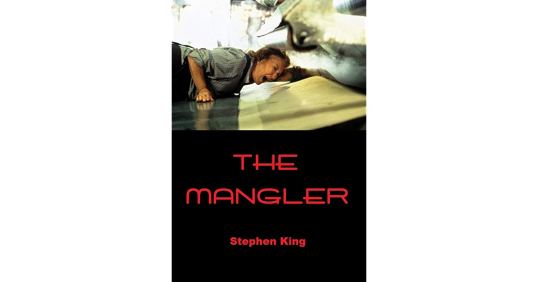
The Mangler, Story Review by Case Wright


mangler.jpg

Sometimes you just can’t win! You need to make a few bucks and you take a job at a cleaners, but the laundry press is possessed by a demon and starts killing everyone and the Christmas party is BYOB. This is the premise of The Mangler.  This laundry press gets exposed to a bunch of different bloods – animal and virgin human, which summons a demon to possess the laundry press. The laundry machine goes a killing spree, but my collars have never looked crisper!  I always liked this story because it’s so awesomely bad. It’s really corny and silly, but unintentionally so.  It would be great as a Rifftrax.

As I was reading, I couldn’t help thinking, Self, it really is EASY to summon demons in Maine.  It makes you wonder why anyone visits or lives there?  Sure, the fall foliage is nice, but you’re always knee deep in clowns, werewolves, vampires, large rats, ghosts, creepy college students, aliens, more ghosts, the devil (kinda), cultists, creepy rednecks, slime beasts, and pederasts.  I’ve been to A LOT of Maine and I will attest that the above villains are truly a nuisance and they are all close talkers!

The Mangler is a fun read because it turns into a quick-paced detective story.  The cops Hunton and Jackson become ghost busters and try to get the demon out of the machine. I know it’s a short story, but they really embrace the whole – it’s a demon laundry machine really fast.  There’s no time where people are like, What? This is stupid! Really stupid!  It starts getting really goofy when the machine chases its victims down a gnaws them to death.

At the end, I know it’s not supposed to be a comedy, but it chases the cops around and eats one of them.  It’s just kinda silly.  Of course, this story is really needed as unintentional comic relief because some of the other stories are just so depressing in Night Shift like “The Last Rung on the Ladder” ….ughhh- best cure for a happy thought.  Really, if you think you’re a bad sibling, read “The Last Rung on the Ladder” and you’ll feel waaaaay better about yourself.

The Mangler is not his best story- it’s actually really dumb, but it reads like a fun bad movie.  It’s the Sharknado 1 of Stephen King if not ALL literature. In short, it IS entertaining. You have a big iron up to no good and two incompetent policemen trying to save the day.  It needs a SYFY run desperately! Happy Horrorthon!

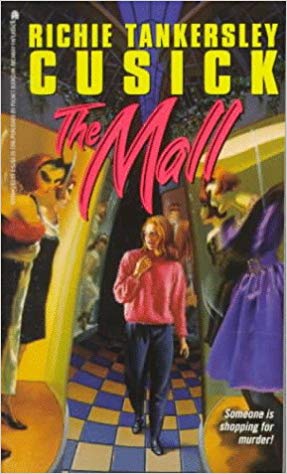
Horror Book Review: The Mall by Richie Tankersley Cusick


The Mall was first published in 1992 and really, it’s a story that could only have taken place in the early 90s.  Why is that?  Well, there’s a couple of reasons:

First off, it not only takes place in a mall but it also takes place during a time when everyone’s life revolved around the mall.  You can’t just order stuff online in this book.  Nope, you have to physically walk from store to store.  Sometimes, you even have to ride an elevator.  If you suggested to anyone in this book that they should just order something off of Amazon, they’d probably complain about having the pay the international shipping.

Secondly, this is a book in which characters regularly find themselves in situations where 1) there’s no escape and 2) there’s no one around to call for help.  Today, of course, anyone who gets stuck on an elevator can just call the cops on their phone.  By that some token, if you’ve got some weird stalker constantly calling you, you can just block him.  But, in the world of The Mall, there’s no way to block (or trace) a caller who uses a pay phone.  And, if you’re stuck on an elevator …. well, you’re just stuck there until your stalker decides to toss a dead body in there with you.

Anyway, this is one of those books that opens with a prologue in which a stalker stares at the object of his lust and spends a lot of time thinking about how she will eventually be his, though only when the circumstances are just right.  Apparently, because he’s obsessed with a teenage girl who works at the mall, the stalker spends a lot of time pretending to be a mannequin which …. agck!  I mean, c’mon, that is definitely a creepy image.

Trish Somerfeld works at the mall, with her best friend Nita.  Trish is employed at …. I kid you not, Muffin Madness.  Nita works at a clothing store called The Latest Trend (no seriously).  Nita is a little bit creeped out by the fact that another girl who worked at the mall recently disappeared.  The rumor is that the girl was murdered though it’s possible that she might just be out of town.  Trish, on the other hand, is disturbed by the fact that she keeps getting calls from someone who has a “womanish voice” and who says things like, “I’m eating your muffin right now.”  The stalker soon becomes known as the — *ahem* — Muffin Man.

Who is the Muffin Man?  Could he possibly be the cute guy who is always hanging out the mall and seems to be particularly interested in Trish?  (I mean, he winked at her!)  His name is Storm Reynolds and …. what?  THAT IS TOO HIS NAME!  DO YOU THINK I’D MAKE UP A NAME LIKE THAT!?

Where was I?  Oh yeah.  So anyway, Trish is totally being stalked and she knows it but, at the same time, she doesn’t really do much about it.  Even when she comes across a dead body with an ice pick in its head, she declines to let anyone know because she doesn’t want to get one of the mall security guards in trouble.  Anyway, Trish eventually is forced to deal with her stalker and the revelation of his identity is not really that much of a surprise.

It’s a dumb book but it’s also a fun book, largely because Richie Tankersley Cusick takes so much delight in describing life in the mall.  Because it’s a book that was written for 90s teenagers, the lead character can get away with doing a lot of dumb stuff and, as dense as Trish might be, at least she has two good friends, Nita and her twin sister, Imogene, who have always got her back.  Storm Reynolds is a bit of a jerk and you cringe when he’s set up as a love interest but, at the same time, his name is Storm so I always giggled whenever anyone talked about him.

Plus, how can you not enjoy a book where the main villain is known as the Muffin Man?  Seriously….

As far I know, Lifetime never did a film version of The Mall.  That’s a missed opportunity on their part, if you ask me.
Horror Book Review: Fevre Dream by George R. R. Martin


First published in 1982, George R. R. Martin’s Fevre Dream is a novel that centers on two men.  Captain Abner Marsh may be considered physically unattractive and lacking in certain social graces but he’s also known as one of the best steamboat captains in pre-Civil War Mississippi.  Joshua York may be wealthy and charming (if a bit pale and fond of a strange-tasting red liquor) but he knows little about how to actually run a steamboat.  That said, as York explains it to Marsh, he wants to build the fastest and most luxurious steamboat ever made.  Marsh may initially be weary of the seemingly eccentric York but he needs the money.

When the steamboat (which is christened the Fevre Dream) is eventually constructed, it turns out to be everything that York said it would be.  Soon, Marsh is sailing the boat up and down the Mississippi River.  The command of the boat and its passengers is largely left in Marsh’s hands.  York requests is that he and his friends be left alone in their cabins.  York doesn’t particularly enjoy coming out during the day….

Could York be a vampire?  Of course, he is!  But he’s not the type of vampire that everyone’s read about.  Instead, York is a visionary vampire.  His dream is to set his people free from their compulsive blood-drinking.  However, there’s another vampire moving up and down the river.  His name is Damon Julian and he has plans of his own for the Fevre Dream….

A vampire novel by George R. R. Martin!?  Indeed, it is!  Of course, since this is a Martin book, the vampires of Fevre Dream aren’t like the traditional vampires that we all know and love.  These vampires are a totally different species of being and one of the key points of the book is that humans cannot be transformed into vampires.  Indeed, the vampires view human as being mere “cattle,” being bred for their hunger.  York’s concern is that, if the vampires continue to feed on humans, the humans will eventually rise up and destroy them.  Damon, of course, is far less concerned about that.  Just as how the white slave owners arrogantly assume that their slaves have no desire to free, Damon and his followers arrogantly assume that the humans will always stay in their place.  Damon even has a human servant, Billy Tipton, who has been fooled into thinking that he might someday become a vampire as long as he does everything that Damon orders him to do.

It’s an interesting novel, one that does a good job of incorporating it’s paranormal story into an authentic, historical background.  If you’re really into vampires and steamboats, there’s a lot of both to be found in this book.  Unfortunately, I get the feeling that the people reading for the vampires will probably get bored with all pages devoted to steamboats while steamboat enthusiasts might not care much for the vampires.  Myself, I’m a history nerd and a lover of all things vampiric so there’s no way I wouldn’t appreciate a novel about vampires in 19th century Mississippi.

It may not be for everyone but Fevre Dream is a well-written and compulsively readable historical vampire epic.

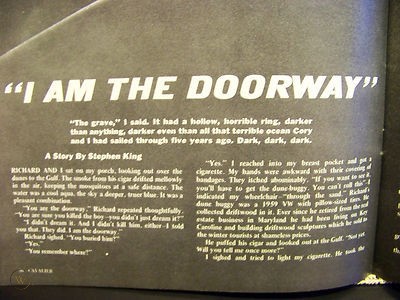
“I Am The Doorway”, Story Review by Case Wright


Cavlier

How free are we?  “I am the doorway” by Stephen King is an early work. It was published in 1971, when he was just 24. For context, we’d just gotten back from the moon 2 years prior.  The stories in Night Shift were gathered from this time period.  “I am the doorway” was published by Cavalier (see above).  I always thought that was odd not that Stephen King was getting published, but Cavalier?  Cavalier was a “Men’s” magazine.  I always thought that was strange and must be unique to the 1960s and early 1970s where people paired their Men’s magazines with literature and poetry.  Shel Silverstein wrote poetry for Playboy.  I guess that’s where The Sidewalk really ended?

The stories in Night Shift, and “I am the doorway” revolve around free will and how free we actually are by outside influence.   The occult is present of course, but that’s tangential.  The real meat of Stephen’s stories are always about the people living with the monsters.  In these early stories, it’s the people who are the monsters.  Either people are pulling their strings, life is pulling their strings, or monsters because this was his life.  He was newly married, he had kids on the way, and he was working jobs from substitute teaching and doing laundry to meet the bills.  Very few of us are free and if you think you are one of the Select, stop paying your credit card or student loan for a couple of cycles and get back to me.

The will once given up can’t be retrieved, you’re trapped like Richard in Quitters Inc..  Blood called to blood in Jerusalem’s Lot from generations forward, poking free will right in the eye. In Salem’s Lot, Ben Mears described his oddly fortuitous meeting of Susan Norton – Ben Mears’ love interest- as if the “universe were making some sort of cosmic bread.” When the will is taken away, it can be retrieved with a cost like in Jerusalem’s Lot or in this story “I am the Doorway”. The main point is that if we give into the darkness like the teenagers did in Night Surf, we are gone for good.  The will itself is like origami beautiful, fragile, and unique to the individual.  The will is cajoled, stolen, sold, and bought back.  The will for King appears to be akin to the soul.  Perhaps that’s why giving up one’s will to a higher power is so challenging and difficult to do?

“I am the doorway” is told as a first person narrative by Arthur who was an astronaut to Venus.  He gets exposed to alien cooties and starts to morph…grossly.  He develops eyes on his hands, which allows the aliens from Venus to see into our world.  Although he is disabled, when he falls asleep, the Venusians hijack his body and make him kill with lightning bolt powers.  The first victim is a child.  He understands that the Venutians will invade using him as a portal somehow.  Maybe he could try Atkins and get really small? To stop the invasion, he tries to burn the eyes off of his hands with Kerosene, but 7 years later, eyes open on his chest or as Stephen King would write “Sometimes They Come Back”.

Arthur can get his will back and stop the murders and the invasion, but the price will be the highest he can pay.  Like Arthur, we have these external forces in our lives.  Whether we are really free or not, I don’t really think so.  However, I know that some will is meant to be abdicated.  You give some freedom for the best moments in your life: marriage and children.  Both take up time and limit your freedom (no spur of the moment Vegas Trips and getting out the door can be interminable), but they complete a part of yourself that was missing and desperately needed to be found and they kinda look you and act like you, or the UPS man. Maybe giving up some of our will is the only way we can grow? Perhaps the doorway for us is to wisdom.

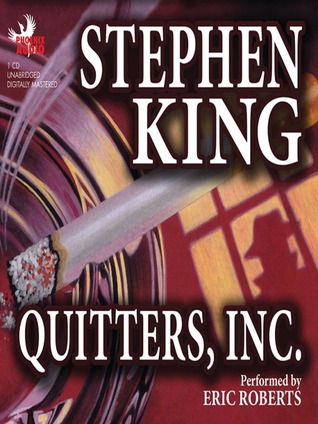
Quitters Inc, Story Review, by Case Wright


quitters.jpg

Smoking is a nasty habit.  I did smoke for 10 years and quit.  I didn’t do it any other way than to stop altogether.  To this day, when I smell one, I want one- except for Dorals because they’re gross.  Don’t let anyone tell you different; it is an addiction.  Richard Morrison, the protagonist, is a advertising man who shared my addiction.  Richard is in nadir of his life.  His son is severely mentally disabled and lives at an inpatient school, his wife nags him constantly, his overweight, and Rick smokes.

He smokes until he meets Jimmy McCann who tells him about Quitters Inc.  It’s strictly word of mouth and free.  Richard attends Quitters Inc.  Once you commit, you can’t leave.  It’s free because the founder, a mobster, bequeathed his fortune to get people to stop smoking the way the mob does they threaten you, your family, harm you, harm your family, or all or some of the above.

Richard learns that he will be under surveillance and if he smokes they will beat his wife. If he smokes again, they will beat his son and do escalating harm to his family and himself.  They even go beyond smoking and threaten to cut off his wife’s finger if he doesn’t lose weight.  Quitters Inc. runs life choices.

This is one of Stephen King’s early works and it’s written very tight. There’s no extra words or passages.  It reads like it went through many edits to purposefully ratchet up the tension.  You feel for Richard because he’s trying to succeed, but like all of us, he comes close to failure.  Every time Richard fails, you feel it in the pit of your stomach because you know the retribution is coming for his family.

The odd part of the story is that his life improves when Quitter’s Inc takes over.  You wonder if maybe free will is not for everyone.  In Richard’s case, free will destroyed his health and free will got him to accept unknown entity into his life that harms his family.  Freedom isn’t free, but giving up free will isn’t free either.

Jerusalem’s Lot, Book Review, By Case Wright


JL.jpg

Jerusalem’s Lot is a short story by Stephen King that is a prequel to Salem’s Lot. Salem Lot was reviewed by Lisa! Lisa’s Salem Lot Review is Right Here! REALLY!  I want to make another thing clear: I didn’t read the story this time. I listened to the Audiobook … again. The performance is by John Glover and it’s really like a radio show.  John brings it! It’s a one-man-show with different voices and gravitas.  John Glover is truly a national treasure!!!

The story takes place in Jerusalem’s Lot, Maine in 1850 and is told as a series of journal entries by Charles Boone and few by Boone’s manservant/pal Calvin McCann.  Boone inherits his ancestral home in Chapelwaite, Maine just two miles from the eponymous Jerusalem’s Lot. After he moves in, he starts to hear what he believes are large rats crawling in the walls. It turns out they’re not rats, but ghosts of the damned!  The longer that Boone is in the house, the stronger the ghosts become.  People acting as a doorway to evil is common in Stephen King’s early works.  In “The Shining”, Danny Torrence’s ESP abilities acted as a battery that charged up the ghosts of the Overlook Hotel so that they could interface with our reality.  It was weird that the ghosts wanted to kill Danny; they surmised that his death would give them permanent entry into our world; so, why kill Danny? Wouldn’t Danny’s Death remove the energy production?

As Charles stays, the Ghosts leave him and Calvin maps and notes guiding them to the nearby town of Jerusalem’s Lot.  It is revealed that Jerusalem’s Lot was a town founded by Charles’ distant ancestor John Boone who became a devil worshiping sex pervert.  I used to visit Maine a lot in my younger days and sure there isn’t always a lot to do, but who knew that these Maine residents were only a missed Red Sox game away from creating an inbred demonic sex cult?!  Sex cults are in now check out Lisa’s NXIVM Lifetime movie  HERE!

John’s demonic sex cult set out to manifest a gigantic intergalactic demon worm to the Jerusalem Lot Chapel by reading from an evil book called “Mysteries of the Worm” by Nicolas Sparks, then have red punch, and Bundt cake. They were apparently successful because the town is deserted. Boone discovers that Boone’s descendants act as a doorway for the inbred demonic sex cult to return because blood calls to blood! Bwhahaha.  You can inherit the evil deeds of your ancestors. Oh well, as an Italian, Sorry Celts… Whoopsie.

Charles sets out to destroy the book because he doesn’t want the world to end or have a “Notebook” sequel in circulation.  Does Boone save the day? Buy the audiobook!

Night Shift as a whole is a brilliant collection of short stories from a time when Stephen King had just been able to support himself and his family with his writing.  His stories are leaner and heavily edited, making them a lot of fun to read because there’s no extraneous elements.  I will likely review many more short stories from this book and this period because they are some of his best work.  Happy Horrorthon!

Book Review: The Hell Candidate by Graham Masterton


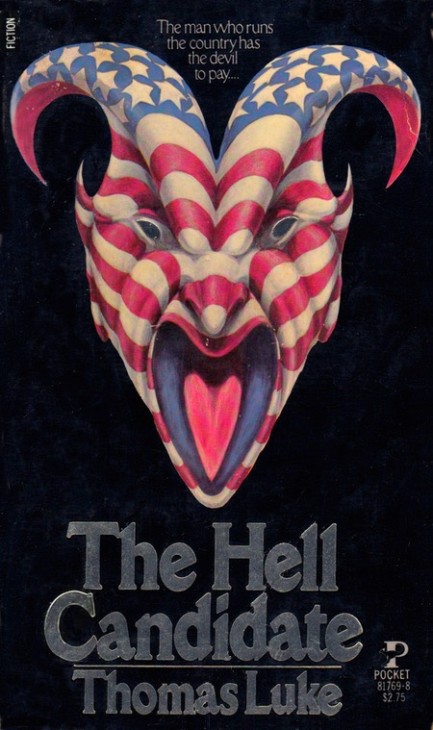
First off, ignore the fact that the cover for the 1981 first edition of The Hell Candidate credits Thomas Luke as being the author.  This book was written by Graham Masterton and, with its combination of sex, violence, and transgressive political commentary, it’s easily identifiable as being a Masterton novel.  Why was it published under the name Thomas Luke?  Perhaps, at the time it was published, it was felt that the British Graham Masterton wasn’t a well-enough known name in the United States.  Or maybe it was felt that the book would prove to be so controversial that it had to be published under a pseudonym.  Who knows?  All subsequent editions of the book have credited Graham Masterton as being the author so, obviously, it’s no longer controversial (or even outlandish) to suggest that an American politician might be in league with the devil.

The Hell Candidate is told from the point of view of Jack Russo, a PR man who has been hired to work on the presidential campaign of Hunter Peal.  At the start of his campaign, Peal is a calm and rather even-handed candidate, advocating common sense solutions for America’s problems.  Everyone acknowledges that he’s a good man but no one gives him a chance of actually winning his party’s nomination.  That all changes when Peal’s personality suddenly changes, seemingly overnight.  Suddenly, Peal is loud, profane, and angry, a candidate who promises to destroy America’s enemies and make everyone at home rich.  His managers worry that Peal has gone insane and prepare themselves for a disaster on the campaign trail.

Instead, it turns out that the voters really like this new, profane and insane Hunter Peal.  No matter what Peal says or does, the crowds love him and soon, Hunter Peal is moving into the White House.  Is it because the people truly love this aspiring dictator or is it because Hunter Peal made a deal with the devil?

The Hell Candidate is an effective novel, precisely because we know that most politicians would gladly make a deal with the devil if it meant a chance to set up residence in the White House.  Indeed, what was presumably meant to be shocking when this novel was written is rather common place now.  I mean, seriously — profanity on the campaign trail?  Oh my!  Bragging about your ability to destroy your enemies?  Horror!  Cynically abusing the power of the office of the presidency?  OH MY GOD!  What makes the book memorable, though, is its suggestion that the voters don’t necessarily need to be influenced by the devil to vote for a candidate like Hunter Peal.  Instead, the book suggests that a dictator is secretly what most voters desire.

In the end, the book suggests that the Vatican might be able to help us deal with a Satanically-possessed president but who can save the American people from themselves?