Horror Book Review: Who Killed The Homecoming Queen? by R.L. Stine


This 1997 YA novel from R.L. Stine tells the story Tania, Eva, and all of their friends at Shadyside High!

Tania, as we learn in the book’s opening pages, is having the best year of her life! She’s got a hunky stepbrother. She’s got a football player boyfriend. Her movie career is about to be launched because she’s been cast in a high school student film. (Yeah, that didn’t make sense to me either but just go with it.) And, at the big pep rally that starts the book, it’s announced that she’s going to be the homecoming queen! Meanwhile, Eva apparently has psychic abilities that allow her to know if something bad is going to happen. That may sound impressive but the book doesn’t really do much with it.

Of course, life is never as perfect as it seems. Tania may be the most popular girl in school but that doesn’t mean that everyone likes her. In fact, Leslie, one of the defeated homecoming queen finalists, even attempts to push Tania down some stairs! OH MY GOD! Leslie says it was an accident but was it? Later on, when Tania mysteriously disappears, Eva and her friends wonder …. who killed the homecoming queen!? (Of course, that’s assuming Tania is dead. She’s actually just missing so it could be that Eva is getting ahead of herself.) Leslie seems like the obvious suspect but …. OH MY GOD AGAIN, is that Cherise Colby making out with Tania’s boyfriend!? And seriously, why would anyone trust their boyfriend with someone named Cherise Colby?

I love the old R.L. Stine and Christopher Pike books and I’m planning on reading and reviewing a lot of them for October. The main reason I read this particular book was because of the title. I mean, Who Killed The Homecoming Queen is the type of title that you would come up with if you were challenged to come up with the perfect R.L. Stine title. That said, the book itself is pretty anti-climatic. There’s only one death in the book and — surprise! (and spoiler alert, I suppose) — it’s not the homecoming queen! So, as perfect as the title is, it’s kind of a lie. Stine used the title but he didn’t actually use it as the plot of the book, which is strange.

To be honest, though, this book feels like R.L. Stine on autopilot. This is one of the last of the original Fear Street books (though Fear Street itself is not really mentioned in the book) so one gets the feeling that Stine was a bit bored when he wrote it. I was a bit bored when I read it, though I did have to laugh at the obnoxious student filmmakers who insisted on making Eva’s life awkward. Never have a group of supporting characters felt more true to life.

Anyway, fear not! This particular R.L. Stine book may be disappointing but he wrote a lot of books and I’m planning on reading and reviewing a few of the better ones this October!

I mean, who can resist a trip to Fear Street, right?

Titans S3 Ep5, “Lazarus”, Review by Case Wright


What is family? “Lazarus” (Dir. Boris Majsovski- 1st Time directing) and written by Bryan Hill (Ash vs Evil Dead) attempts to answer this and it’s more fluid than we might be comfortable with. We all have our “Significant Others”: those whom we count on for identity and love. We lose them, we have nothing. “Lazarus” forces us to look at this truth as a shifting entity driven by pride, ambition, and revenge.

Jason Todd (Curran Walters) is the best anti-hero television has seen in a decade. This episode is the full origin story of a rebirth of Jason to Red Hood and the shift of family from Jason Todd as the adoptive son of Bruce Wayne to Red Hood whose father is Jonathan Crane.

We begin at the last episode, seeing that Jonathan Crane is manipulating Jason/Red Hood as part of his plan of revenge against Batman and Gotham herself. What brought Jason to be Red Hood and abandon all the family that he ever knew and valued? Jason lost the faith of the one man whom he needed: Bruce Wayne. As we found out later, Bruce was already in the process of replacing Jason because Jason had succumbed to fear. After Deathstroke defenestrated him, Jason was hesitant and afraid. This was most evident when Jason tried to intimidate one of Joker’s henchmen who’d been recruiting kids for his Joker gang and Jason got a thorough beat down.

Jason knew that Bruce had lost faith in him as Robin. Bruce benched Jason unless he could go to a therapist to help him deal with his fear. Well, it didn’t work the way Jason wanted it. Bruce declared to Jason that he thought of him as a son, but fired him from being Robin. In that instant, Jason gained family, but Robin lost it. For these heroes, their truest selves are when they wear the cape, losing Robin was Jason’s Total Loss.

Bruce’s firing, sends Jason to Dr Jonathan Crane AKA Scarecrow because he wanted a chemical cure for his fear. Jason trades all knowledge of Batman and the promise of freeing Crane from Arkham in exchange for a formula that would free him of all fear. Jason rents out a lab and Breaks Bad! The formula works….too well. It caused him to face the Joker alone and get killed.

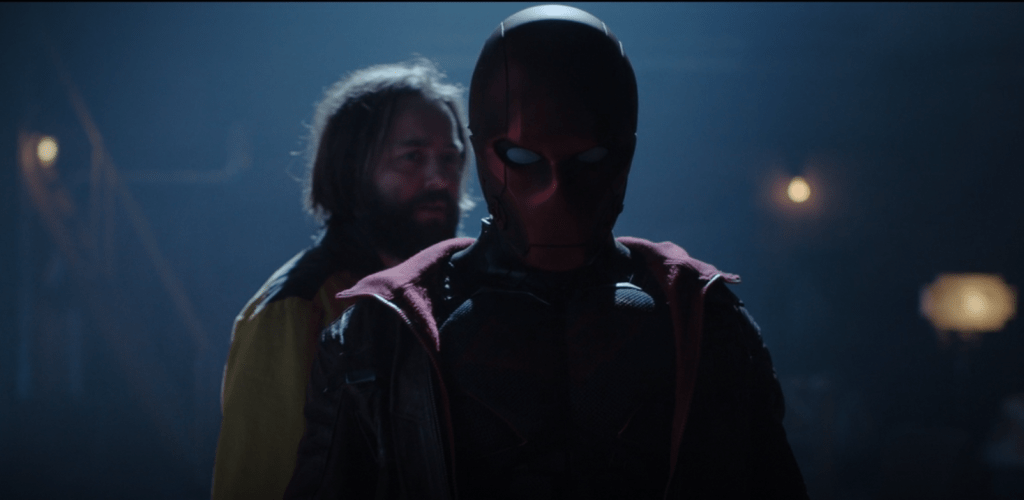
Apparently, death can take holiday because Crane knows a mini-Lazarus pit and tosses Dead Jason into it, bringing him back to life fully the son of Jonathan Crane. Jonathan, unlike Bruce and Dick, who failed him spectacularly – delivers. He gives him the anti-fear super juice and sends him out to run amuck in Gotham. Like the photo below, Jason has a new father at his back. Some critics have assailed Lazarus as humanizing Jason; No, the fact that we can empathize with Jason’s grudge and his subsequent choices is OUR Rorschach test and reflects our own humanity and self-image.

This is what makes the show so great. It’s not just action or source material. They bring you into the dark world where heroes exist and like Watchmen, it’s not such a great place. The heroes are flawed and, in reality, the most honest cape was Red Hood; well, until he killed Hank. I still miss him and I think I know why. He’s the most like myself. Oh well, maybe I’m like Jason Todd and could use some couch time for 150/hour with a 15 buck co-pay?

Book Review: Saturday Night Fever by H.B. Gilmour


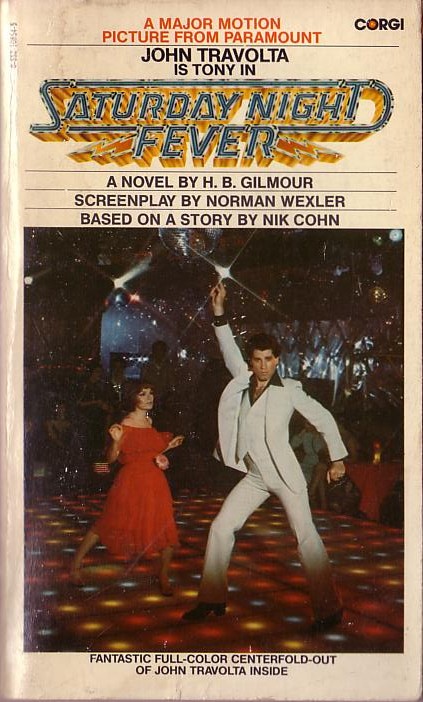
About two years ago, I came across a paperback sitting on the shelf of a Goodwill in Dallas. It was the novelization of the 1978 film, Saturday Night Fever. Naturally, as soon as I saw it, I knew that I had to buy it.

Novelizations of popular films are always an interesting read. Since they’re usually based on the early drafts of a film’s screenplay, the novelization will often include extra scenes or details that may have not been apparent in the film itself. Often, things that may have been left unclear in the completed film will be cleared up in the novelization. At the same time, as a writer, I always find it interesting to see whether or not the author of a novelization can succeed at putting their own spin on familiar material.

Take the Saturday Night Fever novelization. There are two things that everyone automatically thinks about whenever they think about Saturday Night Fever as a film. They think about the Bee Gees soundtrack and they think about the scenes of John Travolta dancing. Obviously, with the novelization, there is no soundtrack. The Bee Gees aren’t even mentioned in the book. As for Travolta’s dancing, the book doesn’t go into a great deal of detail beyond acknowledging that Tony Manero is a good dancer and that everyone wants to join him out on the dance floor. But Gilmour wisely doesn’t try to describe any of Tony’s dance moves. Instead, he focuses on how Tony feels when he’s the center of attention.

Indeed, the entire novelization focuses on Tony as a character. We spend a lot of time inside of Tony’s head and it’s not always a pleasant place to explore. At the same time, we also discover that Tony isn’t quite as clueless as he sometimes comes across as being in the movie. From the start, he knows that he’s going nowhere and he knows that his friends are losers. Without Travolta’s charismatic performance or Staying Alive playing as he struts across New York, Tony often comes across as being an even bigger jerk in the novel than he does in the movie. And yet, we still sympathize with him because the novel makes clear that Tony understands, more than his family and his friends, that he’s trapped in a life that doesn’t provide much hope. Saturday Night Fever is a dark film, even with the music. In novel form, it becomes downright existential in its portrait of Brooklyn as being a Hellish prison, both a location and state-of-mind from which there is little chance of escape.

Tony’s family is a bit more abusive in the novel, which makes the film’s famous “watch the hair” dinner scene a bit more difficult to laugh at. The novelization spends a lot of time on Tony’s brother and his decision to leave the priesthood. In the movie, Frank, Jr. just kind of vanishes. In the book, it’s explained that he went to a sort of halfway house for former priests. I assume this was all stuff that was in the screenplay but cut from the actual film. One can see why it was cut but, at the same time, it was still interesting to learn a bit more about Tony and his family.

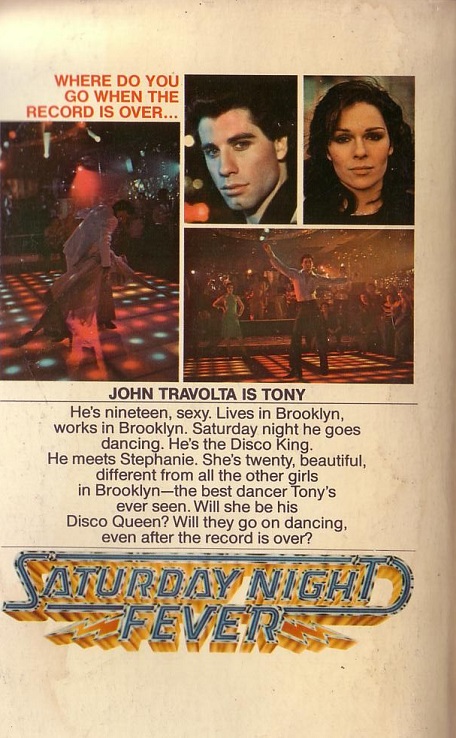
In the end, it’s not a bad novelization. At 182 pages, it’s a quick read and it not only does a good job of showing what exactly Tony is escaping from when he gets out on the dance floor but it also provides some new insight into the story. (Of course, the majority of that insight deals with Tony being a misogynistic homophobe but, then again, that’s pretty much who he was in the film too. The book just makes it even clearer, as well as showing that Tony’s prejudices are largely due to where he’s from and how he’s been raised.) It’s a good companion piece to the film and a good collector’s item. The copy that I found still had a pull-out poster of John Travolta in the middle of it!

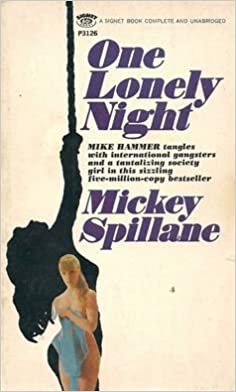
Book Review: One Lonely Night by Mickey Spillane


As you may have heard, we’ve had a bit of inclement weather down here in Texas.  Tuesday morning, around one a.m., the house was surrounded by six inches of snow.  The temperature outside was 3 degrees.  Because the power was down (not due to the rolling blackouts that had paralyzed the rest of the state but instead because some idiot drove into a substation) it was about 40 degrees inside of the house.  It was cold, I was shivering, and I couldn’t sleep.  So, I decided to sit in bed and read a book.  Even though I had a flashlight with me, I quickly discovered that I didn’t need it.  The snow outside was so bright that it actually generated enough light that I was able to read by it.  That was actually kind of nice.

As for the book that I decided to read, it was an old paperback detective novel that I purchased at Half-Price Books a few years ago.  (Half-Price Books has a wonderful vintage section.)  Originally published in 1951, Mickey Spilliane’s One Lonely Night is one of the many books that Spillane wrote about the adventures of a tough New York-based private investigator named Mike Hammer. Many of those books were later adapted into films.  1955’s Kiss Me Deadly is probably the best-known.  (And, of course, the much-missed Gary Loggins was quite a fan of Mike Hammer and the author who created him.)

One Lonely Night opens at night and with Mike Hammer in a bad mood.  Earlier in the day, a judge scolded Hammer for being too quick to kill people, leaving Hammer to feel as if he was being portrayed as being some sort of blood-thirsty monster.  When night comes, Hammer is still wandering around Manhattan and obsessing on the fact that he’s somehow developed a reputation for being violent and quick to kill.  It’s interesting because, on the one hand, it’s hard not to feel bad for Hammer.  His feelings have obviously been hurt and, as he explains in his hard-boiled narration, he only kills people who have to be killed.  He doesn’t necessarily do it for fun though, at the same time, he doesn’t make any apologies for doing what he feels needs to be done.  On the other hand, as you read the book, you can’t help but notice that Hammer really does kill a lot of people.  When he’s not killing, he’s thinking about killing.  He’s obsessed with violence and, even if he’s found a way to justify that to himself, it’s still hard not to be slightly disturbed by such a one-track mind.  Hammer knows that he will never be able to escape his fearsome reputation and he also know that most people will never see him as being anything more than a murderer.  But, at the same time, he also understands that important role that he, in his own ruthless way, plays in maintaining the proper balance between good and evil.  He’s a former soldier, a World War II vet who one took as much pleasure in killing Nazis as he now takes in killing criminals.  He’s frightening but he’s necessary.

As for the book’s plot — well, it’s hard to know where to even begin.  It all starts with Hammer wandering around Manhattan and running into a mysterious woman being pursued by a male assassin.  The woman, apparently thinking that Hammer is another assassin, jumps off a bridge rather than accept Hammer’s help.  Hammer, who has just told us in glorious detail about how much he resents being called a killer, proceeds to kill the other man and then toss his body off the bridge as well.  Before Hammer throws away the dead man, he uses the pavement to scrape off the man’s fingerprints because …. well, he’s Mike Hammer and he does stuff like that.  (What’s interesting is that Hammer informs us about destroying the man’s fingerprints rather casually, as if it’s something that anyone would do under the circumstances.)  Through a convoluted series of events, this all leads to Hammer investigating a politician who is being blackmailed by his twin brother and also uncovering a secret communist spy ring and a plot to steal a lot of very sensitive documents.  Everything’s connected in its own strange way.  Hammer seduced two communists, kills a lot of people, and spends a lot of time talking about how much he hates the weaklings who, in his opinion, are destroying American society.  Hammer may not believe in much but he definitely believes in America.

The story is next to impossible to follow.  One gets the feeling that Spillane simply made it up as he was writing it, without really worrying about whether or not everything really added up.  When Spillane can’t come up with a logical way to connect the various elements of the story, he resorts to coincidence.  Mike Hammer has a talent for being in the wrong place at the wrong time.  And yet, the story’s incoherence is actually one of the reasons why One Lonely Night works.  The narrative messiness, mixed with Hammer’s unapologetically over-the-top tough guy narration, makes the story feel like almost a fever dream.  Hammer walks through an increasingly surreal version of New York and only he seems to understand just how ludicrous the world has become.  He’s neither as idealistic as his allies nor as cynical as his opponents.  Instead, he’s an untouchable avenger, moving through the chaos and simply accepting that nothing makes sense beyond his own primal instincts.  Hammer is the ultimate individualist, worrying only about himself and occasionally his secretary, Velda.

One Lonely Night is definitely a product of its time.  One can only imagine the howls of rage that would greet the book if it were written today.  In 1951, one could presumably get away with writing a novel about a private detective ruthlessly killing a bunch of political subversives.  Today, of course, the book’s storyline would probably lead to an angry twitter hashtag campaign.  Of course, what those readers would probably miss is that Spillane clearly doesn’t mean for us to take Mike Hammer all that seriously.  At it’s best, the book is almost a parody of the classic tough guy posturing that we associate with pulp fiction.  Hammer is so ruthlessly determined and his enemies are so incredibly weasely that it’s obvious that Spillane was having a bit of fun with both his readers and at the expense of his critics.  Just as Hammer spends the book complaining about a judge who accused him of being too quick to kill, Spillane seems to saying to the critics of his style of writing, “You think pulp detective stories are sordid?  I’ll show you sordid!”

I enjoyed One Lonely Night.  It kept me entertained during one very cold night.

Lisa Marie’s Top 8 Novels of 2020


As I said earlier today when I posted my top 8 non-fiction books of the year, I’m disappointed in myself.  Considering how much time that I spent at home in 2020, I should have read more books.  I should have read every book that I have in the house.  That was certainly what I was expecting to happen but, as the lockdown went on and on, a combination of frustration and depressing kicked in and I basically totally lost focus.

So, I didn’t read as much as I should have.  But, at least I can say that I did read.  To be honest, I imagine that’s more than a lot of other people did.  Language is a wonderful thing and it’s dying.  Though I may not have read as much as I wanted to, I still read some very good novels over the course of 2020.  Listed below are eight of my favorites.

  1. Mexican Gothic by Silvia Moreno-Garcia — This was a wonderfully atmospheric book, one that took all of the traditional gothic elements and imagined them through the prism of Mexican culture and history.  This was a wonderful read, both entertaining and thought-provoking.  Apparently, it’s being turned into a miniseries for Hulu and I’ll definitely be watching.
  2. The Swap by Robyn Harding — Swapping partners leads to chaos!  (Well, yeah.)  This is an enjoyable thriller about a drunken night and the drama that follows. The characters are all sharply etched, especially Low, a the manipulative teenager who you’ll kind of sympathize with even when you know you shouldn’t.
  3. The House on Fripp Island by Rebecca Kauffman — Two families share a vacation house on Fripp Island.  One family is rich and one family is poor and both families are full of secrets and lies.  The House on Fripp Island is the literary equivalent of a good Lifetime film and, if you know how I feel about Lifetime films, then you know that’s a huge compliment.  I will also admit that I another reason why I liked this book was because it featured a character named Lisa.
  4. The Sister-in-Law by Sue Watson — Speaking of books that would make a good Lifetime film, The Sister-in-Law is another book about a family at a vacation home.  Once again, it’s all about secrets and lies and melodrama and it’s an incredibly fun read.
  5. Regretting You by Colleen Hoover — This book is an examination of the relationship between a overprotective mom and a rebellious daughter.  It rang true in all the best ways.  I could relate.
  6. The Midnight Library by Matt Haig — Nora is given a chance to see how her life would have turned out if she had made a few different choices.  This book made me laugh, it made me cry, and it made me think.  This is a perfect read for anyone struggling with regret.
  7. Wild Child by Audrey Carlan — What happens when you combine a serial killer thriller with a romance?  You get this well-written and fast-paced book about how Simone goes from nearly being a victim to falling in love with a handsome FBI agent.
  8. Plain Bad Heroines by Emily M. Danforth — Though this book may be a bit overlong at 640 pages, this epic and sprawling novel about love, history, and yellow jackets still held my interest.  It’s a challenging and well-written book by the author of The Miseducation of Cameron Post.

TSL Looks Back at 2020:

  1. Lisa Marie’s Top 8 Non-Fiction Books of 2020 (Lisa Marie Bowman)
  2. Lisa Marie’s 20 Favorite Songs of 2020 (Lisa Marie Bowman)
  3. Lisa Marie’s 16 Worst Films of 2020 (Lisa Marie Bowman)
  4. My Top 20 Albums of 2020 (Necromoonyeti)
  5. 25 Best, Worst, and Gems That I Saw In 2020 (Valerie Troutman)
  6. Top 10 Vintage Collections (Ryan C)
  7. Top 10 Contemporary Collections (Ryan C)
  8. Top 10 Original Graphic Novels (Ryan C)
  9. Top 10 Ongoing Series (Ryan C.)
  10. Top 10 Special Mentions (Ryan C.)
  11. Top Ten Single Issues (Ryan C)

Horror Novel Review: Bad Moonlight by R. L. Stine


Before I say anything else, I have a confession to make.  I read this book really quickly.  I mean, I basically sat down, and skimmed over every page and didn’t write out a single note about the book.

Why was I reading it so quickly?  Bad Moonlight is a book that I ordered off of Amazon last month with the intention of reviewing it for October but then I changed my mind.  As often happens, I ended up running behind and, with Halloween approaching, I decided to set aside all of the Stine books that I hadn’t yet read and reviewed because I wanted to review a different (and, to be perfectly honest, adult) horror novel for Halloween.

Unfortunately, the book that I was planning on reivewing turned out to be really bad, despite the fact that it was co-written by one of my favorite filmmakers.  I didn’t feel like getting all negative on Halloween, especially when it would involve being negative about a filmmaker who I adore and who is no longer with us and whose legacy pretty much defines modern horror.  So I decided to put off reviewing that book (I’ll write about it in November).  Needing something for today, I grabbed R.L. Stine’s Bad Moonlight and I quickly read it.  Fortunately, R.L. Stine wrote books that are pretty much designed to be a quick read.

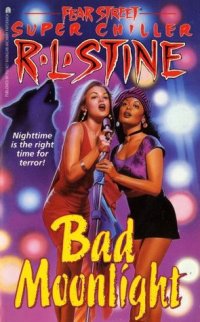
Bad Moonlight was first published in 1994.  It tells the story of Danielle.  Danielle is 18 but, in a rather creepy aside, we’re told that she looks like she’s closer to 12 because she’s not as developed as the typical 18 year-old.  She’s the lead singer in a band.  The band’s struggling but at least they have a totally hot roadie named Kit.  Anyway, one night, Danielle is inspired to write a song called Bad Moonlight and then she bites Kit’s lower lip until it bleeds.  The band’s fans love the new song and Danielle goes onto write several other songs that all deal with moonlight.  She also writes a song that may or may not be about the death of Joey, “the sound guy.”  Joey was murdered but who killed him?  Everyone thinks it was Danielle, mostly because Danielle is always having these weird hallucinations.  Since this is a Stine book, Danielle is also an orphan with a mysterious background.  She lives with her Aunt Margaret and she sees a psychiatrist named Dr. Moore.  Dr. Moore likes to hypnotize her.  That’s never a good sign.

Anyway, you can probably guess, just based on the title, that this book has to do with werewolves and a big conspiracy to make Danielle into a werewolf bride.  It’s actually kind of a fun book, because you can tell that Stine actually wanted to focus on all of the band melodrama but, because he’s R. L. Stine, he also had to toss in a bunch of werewolves.  The effort to bring the band drama and the werewolf mythos together is a valiant one and it kind of comes out of nowhere and you have to appreciate just how weird Stine allows things to get.  It’s an entertainingly silly book.

If nothing else, it shows how strange the world can look when it’s illuminated by …. BAD MOONLIGHT!

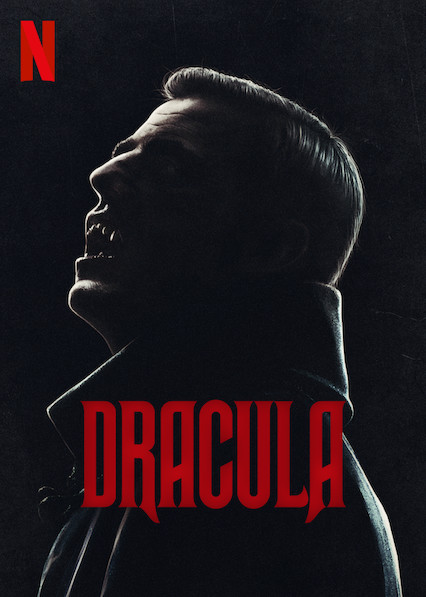
Dracula (Netflix) Review By Case Wright


Happy Horrorthon fellow travelers. It’s been a awhile. I’ve been struggling with engineering classes and it’s been hard to set time aside for this essential part of my life. How does this relate to Dracula? Dracula at its core is an unrequited love story. It drips with sanguine hopes and failed dreams (pun intended). Really, we’ve all that relationship that we really wanted, but it was always doomed, doomed, doomed.

I got to enjoy this mini-series the best way possible: a live tweet with the TSL staff. Back to Dracula, this series was originally broadcast on the BBC. It took Dracula from the past to the present. I have read most of Bram Stoker’s Dracula. It’s kinda boring, which is why the first episode was uneven in terms of excitement because it held close to the book, which was b o r i n g. Part I established Dracula at home. As in the book, he wanted to see the World, meet new and interesting people in England, and eat them.

To whet his appetite and get waaaaay younger, he decided to feast on a lawyer- Jonathan Harker. This Dracula gets all the memories and knowledge from the people he feeds on, which begs the question: Why travel anywhere? Just hang out at a train station and snack on people. Come on, Drac! I did like how the first episode set up the Courtly Love Interest – Agatha Van Helsing; she’s a Nun with ice water in her veins.

Sister Agatha (Van Helsing) gets a visitor at her convent – Jonathan Harker. He looks dead…well undead. He even has a fly crawl across his eyeball without him noticing. Flies buzzing and crawling about eyeballs is a big theme in this mini-series; you just have to get used to it.

Jonathan describes meeting the Count under the presumption of a land holding trans… sorry I dozed off there. The book was a lot like that too. It would have exciting moments and then BAM… Back to the real estate transactions! As Jonathan stays at the Count’s castle, the Count gets younger and he gets older. His lifeforce is drained away. In fact, all of his memories get drained away as well to the Count after one feeding ah ah ah and then two feedings ah ah ah.. Jonathan appears to succumb to the Count and feel nothing, but his resignation is all an act. DUN DUN DUN!

Jonathan is searching for a way out of the castle and it works….kinda. I mean he ends up at a convent and we learn that he’s undead and under the power of Dracula. This is gleaned from Sister Agatha who relentlessly interrogates …well everyone. I wish she were my best friend. She attracts a lot of monsters, but nobody’s perfect.

Unfortunately, Dracula can sense Jonathan and he has pursued him to the convent. This is where Dracula meets the true love of his life Sister Agatha. She’s fearless, smart, and scientific; the opposite of everyone else whom Dracula encounters. Agatha is a force of reason like Dracula is a force of nature. He represents feudalism and magic, she enlightenment and technocratic future. She is what he aspires to be, but cannot. She hopes that in solving the mystery of Dracula she will understand the mystical and develop her elusive affinity with God.

Of course, by getting close to understand Dracula, Agatha inadvertently allows Dracula to enter the convent and eat everyone, including……her and he does it by wearing a dead man’s face. That was awesome! Gotta see it again!

Two and three will post tomorrow!!!!

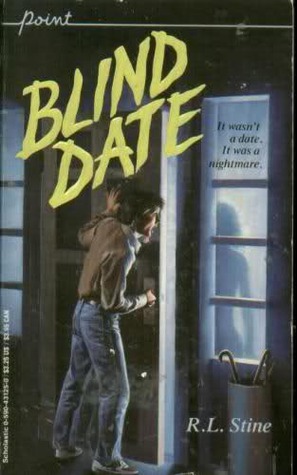
Horror Novel Review: Blind Date by R.L. Stine


First published way back in 1986, Blind Date represents a significant moment in YA horror literature.  This is the first “horror” novel to be written by R.L. Stine!

Blind Date tells the story of Kerry, who is a teenager who has a lot of problems.  A year ago, he was in a really serious car accident.  He doesn’t remember much about the accident but he does know that, as a result of the accident, his older brother is now in a mental institution and his father doesn’t talk to him much.  Poor Kerry.  One thing that I’ve noticed from reading all of these Stine and Christopher Pike books over the course of this month is that both of them always seemed to come up with plots that featured car accidents.  I guess it makes sense.  When you’re a teenager, you can’t wait to get your first car but you’re also aware that you’re eventually going to have your first accident.

Anyway, Kerry is kind of a loser but he is on the football team.  Unfortunately, he apparently injured the school’s star quarterback during practice so now he has the entire team wanting to kill him.  Perhaps the only good thing going on in Kerry’s life is that he’s been set up on a blind date with a mysterious girl named Amanda….

Except, when Kerry goes to Amanda’s house, he’s met by two bereaved parents who explain that Amanda’s dead!  OH MY GOD, IS KERRY’S DATE A GHOST!?  No, actually, it turns out Kerry’s date is actually named Mandy and apparently, Kerry misheard.  Or something.  Who knows?  The important thing is that Kerry has a girlfriend who can comfort him whenever he gets his ass kicked by the football team, which is something that is definitely going to happen because Kerry goes to a school that’s ruled by mob justice..

Mandy is a little bit vague about her past, which should be a huge red flag but Kerry has something else to worry about.  His brother, Donald, has escaped from the mental hospital!  And apparently, he has a history of trying to kill Kerry!  Can Kerry pursue a successful relationship, mend fences with the football team, and avoid getting killed by his brother?  Or is the story going to end with Kerry getting beaten over the head with a stuffed moose?

(Yes, you read that right.)

Actually, the story ends with a twist that I’m pretty sure Stine came up with at the last minute.  To be honest, the whole book kind of reads as if someone said to Stine, “We need two hundred pages and we don’t really care what’s on them.”  The story goes from one strange development to another.  It makes for a kind of weird story that doesn’t always make sense but it is compulsively readable.

And really, that’s the thing with the work of both Christopher Pike and R.L. Stine.  You don’t reread these books because they’re particularly scary or even that well-written.  You read them because they’re just so damn strange.  It’s never enough to have just one twist.  Instead, there has to be a dozen twists and if they don’t really seem to make sense or go together …. well, so what?  That’s what life’s like when you’re a teenager, right?  It may not always make sense.  It may not always turn out the way you want.  But it’s still something you miss once it’s gone.

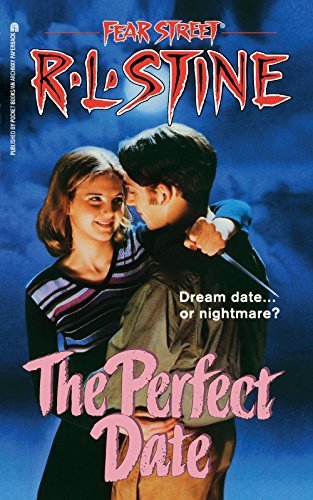
Book Review: The Perfect Date by R.L. Stine


In this YA novel from 1996, Brady Karlin is one of the most popular boys at school.  Everyone knows him.  Everyone likes him.  He’s got a likable best friend named Jon.  He’s got a beautiful and popular girlfriend named Allie.  The only problem that Brady has is that he’s still haunted by the death of his former girlfriend, Sharon Noles.

And really, he should be haunted considering that it was all his fault!  Sharon told him that she wasn’t ready to go sledding down that hill lat summer.  Brady, however, insisted and Sharon went hurtling down the hill and eventually ended up dead and without a face.  Honestly, I don’t care how good-looking or charming you are.  If your last girlfriend lost her face because of your stupidity, you’re simply not going to be attractive to me.  Sorry.

Anyway, it’s winter again and Brady is already thinking about ending things with Allie.  There’s only so many basketball games and pizza parties that he can go to.  However, instead of just breaking up with Allie, Brady instead starts to secretly a date a new girl named Rosha Nelson.  Brady soon finds himself growing obsessed with the mysterious Rosha, who refuses to tell him anything about her past and who seems to really have a talent for getting Brady involved in dangerous, potentially life-threatening situations.

Meanwhile, there’s a mysterious “scarred girl” following Brady and Rosha around.  Soon, people are mysteriously dying and the entire books leads to a climatic fight in which bodies are literally dismembered!

So, I liked The Perfect Date.  It was as grotesque and morbid as a Christopher Pike book without any of the pretentious philosophizing that occasionally turns up in Pike’s work.  While Rosha’s secret is pretty easy to figure out, Stine deserves a lot of credit for following the story to it’s natural conclusion.  The book ends with a scene so weird that I had to read it twice.  Really, what more can you ask for?

All in all, this book made me happy that I live in Texas.  No snow equals no tragic sled accidents.  This book made me appreciate our 60-degree winters.

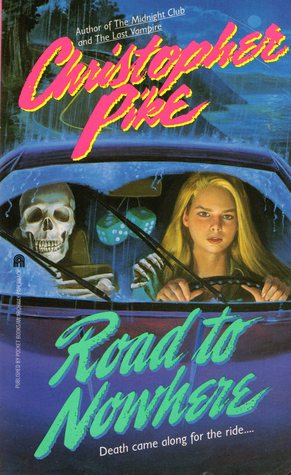
Horror Book Review: Road to Nowhere by Christopher Pike


To be honest, I ordered a copy of this 1993 YA novel from Half-Price Books strictly because of the cover.  I mean, there were several old Christopher Pike books to chose from but that image of the young woman driving her car with the skeleton sitting beside her just leaped out at me.  I think a lot of it had to do with the fuzzy dice hanging from the rear view mirror.  I’ve got a St. Patrick medal hanging from my mirror but if I wasn’t half-Irish and if I hadn’t been raised Catholic, I definitely would have the dice….

Well, actually, I probably wouldn’t have anything hanging from my mirror.  Seriously, those big dice look like they’re going to get in the way.  I mean, she’s already driving in the rain and she’s got a skeleton sitting next to her.  Does she need the distraction of giant dice?  No wonder death is coming along the ride….

Anyway, the book itself is about an 18 year-old named Teresa.  Teresa is an aspiring songwriter and singer.  She just broke up with her boyfriend Bill.  The book takes place on the night that she was planning to lose her virginity to Bill but now that she’s single and miserable, she figures that she might as well just drive to the Bay area.  Teresa also decides to pick up two hitchhikers because apparently, she’s never read a scary book or seen a horror movie before.

The hitchhikers are named — look, I’m not joking — Freedom Jack and Poppy Corn.  Freedom Jack and Poppy Corn are also heading to the Bay and they have all sorts of interesting stories to tell about yet another couple, John and Candy.  Now, to be honest, I wouldn’t pick up hitchhikers in the first place.  I don’t care how lonely I am.  I don’t care how much its raining.  I don’t care how late at night it is.  I’m not picking you if you’re standing on the side of the road.  But even if I did pick up a pair of hitchhikers, I would probably kick them out of the car as soon as they started telling me a story about a doomed couple who are obviously the hitchhikers in a past life.  Somehow, Teresa doesn’t immediately catch onto the fact that Freedom Jack and Poppy Fresh are actually John and Candy despite the fact that it’s incredibly obvious.  (John = Jack.  Candy = Poppy Corn.  I mean, come on….)  Then again, Teresa doesn’t seem to be the smart in general.

Anyway, Teresa’s journey with the two hitchhikers leads to her stopping off at both a castle and a church and losing her virginity.  The journey continues without anywhere seeming to get anywhere because they’re on a road to nowhere and this is one of those Christopher Pike books where nothing is what it actually seems to be.  There’s a lot of twists but they’re all somewhat predictable twists.  If you’ve read any of Christopher Pike’s other books, you’ll be able to guess what’s going on in The Road to Nowhere.  In the end, everyone has come to peace with their past and chosen their future.  While the stories of Teresa and Bill and John and Candy contain moments of deep darkness, Road to Nowhere , especially when compared to Pike books like The Immortal and Die Softly, is actually rather optimistic about the ability of people to move on and find some sort of peace.

Finally, let’s give the book some credit for coming up with names like Freedom Jack and Poppy Corn.  That, in itself, is an accomplishment worth celebrating.  Still, I wish the cover had more accurately reflected the content of the book.