“I Am The Doorway”, Story Review by Case Wright


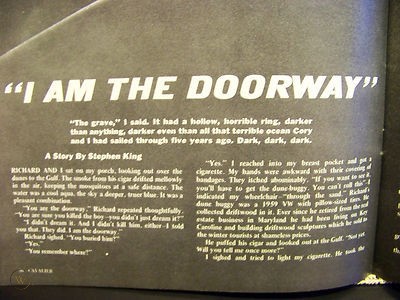
Cavlier

How free are we?  “I am the doorway” by Stephen King is an early work. It was published in 1971, when he was just 24. For context, we’d just gotten back from the moon 2 years prior.  The stories in Night Shift were gathered from this time period.  “I am the doorway” was published by Cavalier (see above).  I always thought that was odd not that Stephen King was getting published, but Cavalier?  Cavalier was a “Men’s” magazine.  I always thought that was strange and must be unique to the 1960s and early 1970s where people paired their Men’s magazines with literature and poetry.  Shel Silverstein wrote poetry for Playboy.  I guess that’s where The Sidewalk really ended?

The stories in Night Shift, and “I am the doorway” revolve around free will and how free we actually are by outside influence.   The occult is present of course, but that’s tangential.  The real meat of Stephen’s stories are always about the people living with the monsters.  In these early stories, it’s the people who are the monsters.  Either people are pulling their strings, life is pulling their strings, or monsters because this was his life.  He was newly married, he had kids on the way, and he was working jobs from substitute teaching and doing laundry to meet the bills.  Very few of us are free and if you think you are one of the Select, stop paying your credit card or student loan for a couple of cycles and get back to me.

The will once given up can’t be retrieved, you’re trapped like Richard in Quitters Inc..  Blood called to blood in Jerusalem’s Lot from generations forward, poking free will right in the eye. In Salem’s Lot, Ben Mears described his oddly fortuitous meeting of Susan Norton – Ben Mears’ love interest- as if the “universe were making some sort of cosmic bread.” When the will is taken away, it can be retrieved with a cost like in Jerusalem’s Lot or in this story “I am the Doorway”. The main point is that if we give into the darkness like the teenagers did in Night Surf, we are gone for good.  The will itself is like origami beautiful, fragile, and unique to the individual.  The will is cajoled, stolen, sold, and bought back.  The will for King appears to be akin to the soul.  Perhaps that’s why giving up one’s will to a higher power is so challenging and difficult to do?

“I am the doorway” is told as a first person narrative by Arthur who was an astronaut to Venus.  He gets exposed to alien cooties and starts to morph…grossly.  He develops eyes on his hands, which allows the aliens from Venus to see into our world.  Although he is disabled, when he falls asleep, the Venusians hijack his body and make him kill with lightning bolt powers.  The first victim is a child.  He understands that the Venutians will invade using him as a portal somehow.  Maybe he could try Atkins and get really small? To stop the invasion, he tries to burn the eyes off of his hands with Kerosene, but 7 years later, eyes open on his chest or as Stephen King would write “Sometimes They Come Back”.

Arthur can get his will back and stop the murders and the invasion, but the price will be the highest he can pay.  Like Arthur, we have these external forces in our lives.  Whether we are really free or not, I don’t really think so.  However, I know that some will is meant to be abdicated.  You give some freedom for the best moments in your life: marriage and children.  Both take up time and limit your freedom (no spur of the moment Vegas Trips and getting out the door can be interminable), but they complete a part of yourself that was missing and desperately needed to be found and they kinda look you and act like you, or the UPS man. Maybe giving up some of our will is the only way we can grow? Perhaps the doorway for us is to wisdom.

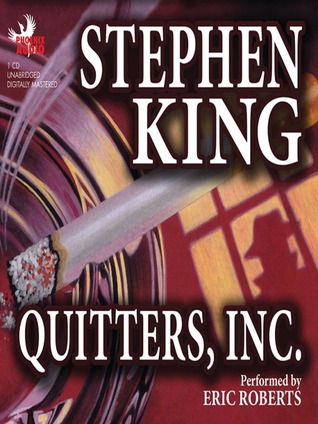
Quitters Inc, Story Review, by Case Wright


quitters.jpg

Smoking is a nasty habit.  I did smoke for 10 years and quit.  I didn’t do it any other way than to stop altogether.  To this day, when I smell one, I want one- except for Dorals because they’re gross.  Don’t let anyone tell you different; it is an addiction.  Richard Morrison, the protagonist, is a advertising man who shared my addiction.  Richard is in nadir of his life.  His son is severely mentally disabled and lives at an inpatient school, his wife nags him constantly, his overweight, and Rick smokes.

He smokes until he meets Jimmy McCann who tells him about Quitters Inc.  It’s strictly word of mouth and free.  Richard attends Quitters Inc.  Once you commit, you can’t leave.  It’s free because the founder, a mobster, bequeathed his fortune to get people to stop smoking the way the mob does they threaten you, your family, harm you, harm your family, or all or some of the above.

Richard learns that he will be under surveillance and if he smokes they will beat his wife. If he smokes again, they will beat his son and do escalating harm to his family and himself.  They even go beyond smoking and threaten to cut off his wife’s finger if he doesn’t lose weight.  Quitters Inc. runs life choices.

This is one of Stephen King’s early works and it’s written very tight. There’s no extra words or passages.  It reads like it went through many edits to purposefully ratchet up the tension.  You feel for Richard because he’s trying to succeed, but like all of us, he comes close to failure.  Every time Richard fails, you feel it in the pit of your stomach because you know the retribution is coming for his family.

The odd part of the story is that his life improves when Quitter’s Inc takes over.  You wonder if maybe free will is not for everyone.  In Richard’s case, free will destroyed his health and free will got him to accept unknown entity into his life that harms his family.  Freedom isn’t free, but giving up free will isn’t free either.

Jerusalem’s Lot, Book Review, By Case Wright


JL.jpg

Jerusalem’s Lot is a short story by Stephen King that is a prequel to Salem’s Lot. Salem Lot was reviewed by Lisa! Lisa’s Salem Lot Review is Right Here! REALLY!  I want to make another thing clear: I didn’t read the story this time. I listened to the Audiobook … again. The performance is by John Glover and it’s really like a radio show.  John brings it! It’s a one-man-show with different voices and gravitas.  John Glover is truly a national treasure!!!

The story takes place in Jerusalem’s Lot, Maine in 1850 and is told as a series of journal entries by Charles Boone and few by Boone’s manservant/pal Calvin McCann.  Boone inherits his ancestral home in Chapelwaite, Maine just two miles from the eponymous Jerusalem’s Lot. After he moves in, he starts to hear what he believes are large rats crawling in the walls. It turns out they’re not rats, but ghosts of the damned!  The longer that Boone is in the house, the stronger the ghosts become.  People acting as a doorway to evil is common in Stephen King’s early works.  In “The Shining”, Danny Torrence’s ESP abilities acted as a battery that charged up the ghosts of the Overlook Hotel so that they could interface with our reality.  It was weird that the ghosts wanted to kill Danny; they surmised that his death would give them permanent entry into our world; so, why kill Danny? Wouldn’t Danny’s Death remove the energy production?

As Charles stays, the Ghosts leave him and Calvin maps and notes guiding them to the nearby town of Jerusalem’s Lot.  It is revealed that Jerusalem’s Lot was a town founded by Charles’ distant ancestor John Boone who became a devil worshiping sex pervert.  I used to visit Maine a lot in my younger days and sure there isn’t always a lot to do, but who knew that these Maine residents were only a missed Red Sox game away from creating an inbred demonic sex cult?!  Sex cults are in now check out Lisa’s NXIVM Lifetime movie  HERE!

John’s demonic sex cult set out to manifest a gigantic intergalactic demon worm to the Jerusalem Lot Chapel by reading from an evil book called “Mysteries of the Worm” by Nicolas Sparks, then have red punch, and Bundt cake. They were apparently successful because the town is deserted. Boone discovers that Boone’s descendants act as a doorway for the inbred demonic sex cult to return because blood calls to blood! Bwhahaha.  You can inherit the evil deeds of your ancestors. Oh well, as an Italian, Sorry Celts… Whoopsie.

Charles sets out to destroy the book because he doesn’t want the world to end or have a “Notebook” sequel in circulation.  Does Boone save the day? Buy the audiobook!

Night Shift as a whole is a brilliant collection of short stories from a time when Stephen King had just been able to support himself and his family with his writing.  His stories are leaner and heavily edited, making them a lot of fun to read because there’s no extraneous elements.  I will likely review many more short stories from this book and this period because they are some of his best work.  Happy Horrorthon!

Joker, Book Review, By Case Wright


IMG_1908

Happy Horrorthon! 2008 – Barack Obama was becoming a household name, I still had some hair, and Heath Ledger’s Joker brought the absolute evil of clowns to the silver screen.  I understand that some of you might think that the comic Joker is not a horror comic, but guys it’s got a clown right there on the cover; they are ALL trying to kill you. IT COUNTS!

Brian Azzarello and Lee Bermejo sought to bring Ledger’s Joker into a comic form and dig a little deeper into the psychology of Joker and why someone would follow him.  The story is narrated by Jonny Frost – a small time gangster- who wanted to be big.  Jonny figures that he himself is not larger than life, but by being near bright evil, he too could shine like the moon does with the earth.  He picks the Joker.

Christopher Nolan described the Joker as an absolute. He is an id of Corruption and destruction.  In this story, the Joker has gotten out of Arkham….again.  SIDE NOTE: what’s with Gotham?! They must have the single party liberal governing that we have in Seattle because you’d think they’d have a Three Strikes Rule or the Death Penalty by now.  I mean, why let the Joker continue to keep breathing? I get how Batman has this weird code- he wears rubber, cape, lives in a cave, and is all kinds of weirdo, but why do the rest of Gotham’s citizens have it? Do they not vote? Do they have only one ballot choice? So, the Joker meets Jonny Frost the second that he leaves Arkham and Jonny works as a toady and hanger on for the majority of the book.

Jonny narrates the Joker’s return to power as he reaps through the underworld, but he burns most of his possessions down and kills all of his own henchmen and even shoots Jonny at the end.  Really, the story depicted the Joker as a force of Anti-Creation.  While it was a deeper dive into this Super Villain, it left me wanting because it was told through the lens of this mediocrity Jonny Frost.  It says Joker right there on the cover so you’d think it would be all about the Clown Prince of Crime, but instead it was this tangential view of him.  I would’ve been more captivated by a story just about the Joker without a go-between.

The story was strong and depicting LOTS AND LOTS of gore.  In fact, the Joker kills more people than the Spanish Flu.  He’s Lucifer and Death combined to cause havoc.  In the end, we get the obvious conclusion that he’s just this disease of evil and that Batman is really just a treatment, but not a cure.  It seems that Gotham’s real disease is a soft on crime public policy.

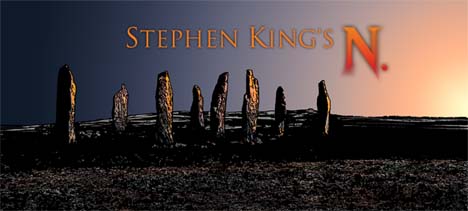
N. By Stephen King; Review By Case Wright


kingsnhere

What if you’re not crazy?  What if you’re finally seeing the truth that everyone else is too afraid to see?  Is the revelation too much for your mind?  Could your mind be both the doorway to hell and the gate keeping the evil old ones at bay?  Most importantly, can a person’s mental illness infect another person?  Stephen King’s “N” is a hybrid of Lovecraft and Modern Psychology where we are forced to learn the answers to these questions.

The story was both a novella and adapted as a comic book/olde-timey radio-show.  Confused?  Let me explain.  N was first published as a novella, but instead of getting made into a comic book or as is typical of King’s work- a movie or miniseries, it became something else.  Marc Guggenheim adapted the work as an all dialogue webseries similar to the serials of the 1930s and 40s and presented the story as a series of hyper-detailed comic illustrations.  You can see it in its entirety below.

I have also read the novella several times.  Honestly, sometimes I’m not sure why I like a particular Stephen King story more than another, but it seems to be when the characters are so real that they could be you or your neighbor.  Yes, the monsters are spooky, but it’s the people, their story, their lives, who just happen to have to also deal with a monster or four.

The story begins with Sheila Bonsaint who is in mourning from her brother’s suicide.  She is calling her friend who is reminiscent of Anderson Cooper to look into why her brother John killed himself.  She believes it’s because of his contact with a patient named N.  The story shifts to John’s perspective describing a patient N who suffers from extreme OCD.  N believes his OCD rituals keep the portals between our world and the hell world closed.

N describes how he encountered a field with rocks similar to Stonehenge in Maine and that by viewing the structure, he caused the structure to activate and potentially release an ancient evil that will consume mankind.  He begins to do OCD rituals to keep the portal closed, but realizes that he must sacrifice his life in order to shut the gate forever.  Unfortunately, John becomes infected by N’s mental disorder and becomes overcome with the need to investigate the structure, which activates it again and causes him to spiral into the same OCD as N.

This story struck a very strong chord with me.  Last year, I began to take a long road into facing my own PTSD experiences in the Army.  When I would tell the medical professionals in the VA about what happened, one cried.  My stories had infected them and left them different afterwards.  The world was less clean, less safe, and much darker.  Now, like N, if I have to tell a person the stories, I begin by saying that I am sorry because what I will tell you, will change you.  I suppose that is what humanity does; we share our burdens and our curses.  Maybe that’s how we keep the gate to hell closed?

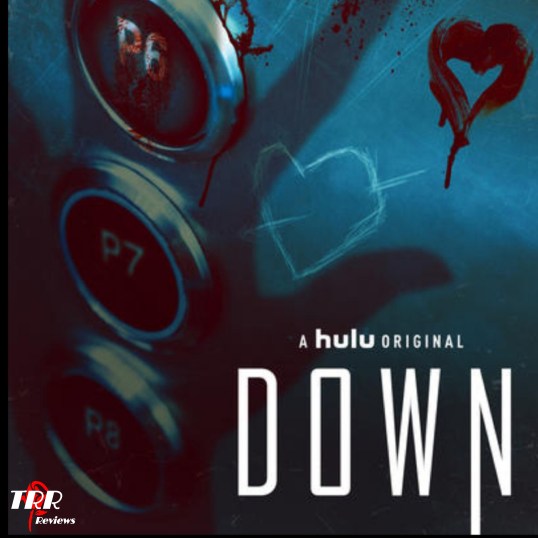
Into the Dark, “Down”, Dir. Daniel Stamm, Review By Case Wright


Down

Happy Horrorthon!!!!

Should some people embrace their creative mediocrity? YES! Yes, they should.  I don’t mean that what they write or direct is bad. It’s simply unoriginal, predictable, with characters who make obviously bad decisions REPEATEDLY, and still are amazingly fun! I never thought I’d get into Lifetime movies until Lisa got me into them. I discovered how fun Hallmark movies are these past few years.  Law & Order embraced its predictability so much that their main sponsor Listerine would break the show down in the Commercials: Body discovery, Wisecrack, Investigation and Arrest, Prosecution, and Verdict. Law & Order lasted 19 years.  Case, what’s your point?  My point is that mediocrity can be fun…a LOT of fun.

Hulu’s “Into the Dark” series is the fun trash that is great to watch and nothing more (accept for the episodes that are hamfisted, political, and preachy) ; it’s like the Jack in the Box Munchie Meals…yeah, they’ll give you a bit of diarrhea, but come on, sometimes you just gotta have a Sriracha Curly Fry Burger.  That’s just science!

“Down” is awesomely bad.  The actors mug, the character decisions are stupid, and it’s great for the elliptical or exercise bike and probably safer to watch as you’re burning those last Lbs.  The plot is simple and doesn’t try to go into a supernatural direction. It’s fun because it never tries.  Jennifer Robbins ( Natalie Martinez) is trapped in an elevator on a holiday weekend with Guy (Matt Luria), BUT is Guy hiding something sinister? Yes…yes, he is and you can tell because he mugs A LOT!

If Lifetime went down the horror route, this would be the premiere.  Guy is in fact Jennifer’s stalker and manipulates her into having sex like the Lifetime movies with the Single Moms and the Predator Next Door.  Lifetime movies are better than “Down” because with Lifetime movies once the heroine realizes she has to fight; it’s to the death.  Here, when Jennifer realizes Guy is a Psycho Killer she doesn’t Run….Run…Away.  In fact, he tries to kill her a lot and then she gets the upper hand, but does she finish him off? Nooooope.  She fails to deliver the Coup de Gras not once, not twice…no, we’re talking six times here when she could’ve finished the movie and literally had a smoke after the 45 minute mark, but 45 minutes of filler was fine for my physical therapy time.

I know that this reads harsh, but these movies have their place; they’re fun.  If the pacing and plot points matched with a Lifetime MOW, it would’ve been that much better, but you can’t have everything, nor should you! Will I review a bunch more of these Into the Dark quasi-episodes? YES, Yes I will!

Happy Horrorthon!

The Christmas Chronicles (Dir: Clay Kaytis), Review by Case Wright


Netflix is known for taking risks and “The Christmas Chronicles” is no exception. There are six felonies in this film: 2 Grand Theft Autos, a kidnapping, money laundering, attempted murder, and whatever they did to that partridge in the pear tree.  Yet, it worked! I will admit that I am of the Y-Generation and Kurt Russell remains forever cool in my book, but this movie had some good story writing, great acting from veterans like Kurt Russell and Stevie Van Zandt, but great performances by up and comers Judah Lewis (The Babysitter) and Darby Camp (Big Little Lies) as well.

Clay Kaytis had his directorial debut with this film.  He is famous for being an animator for a panoply of films that you have taken your daughters to see: Frozen, Tangled, and Mulan…etc.  Clay was a pretty good choice considering the amount of animation that is in this film.  Honestly, it was a family movie that would have been a HUGE box office draw.

The film begins with a series of home movies featuring a classic nuclear family enjoying Christmas over the years…until 2017.  We learn that the father was a fireman who lost his life saving a family, leaving his family grieving and without the spirit of Christmas.  The mom is now taking extra shifts as a nurse, the daughter is REALLY into Santa, and the son is now a no-kidding degenerate car thief.  There are enough dark scenes in this film to classify it as Film Noir.

The family is trying to live as best they can and the daughter Kate is trying to reconnect with the memory of her late father by watching old home movies.  In one of the films, she sees a mystery arm delivering a package.  She convinces her brother that it could be Santa in the film and they decide to set a trap for him…..and IT WORKS!!! Not only do they catch Santa on film, they stow away onto his sleigh and cause Santa to crash.  He loses his sleigh, reindeer, bag of toys, and his magic hat.  The main ticking clock for the film is that Santa needs to get his presents delivered before christmas is up or christmas spirit will tick down to zero and it will be like the Hills Have Eyes or something.  The rest of the film is spent helping Santa retrieve these lost items and busting Santa out of jail to prevent the After Times.

And yes, Santa ends up in jail, charged with multiple felonies, and does a pretty amazing blues number with the E Street Band.  Yes, the E Street Band.  I know that a lot of this movie is starting to sound like a Christmas fever dream, but it works and my 7 and 9 year old girls were riveted and didn’t hurt each other for the duration of the film.  Thank you, Clay Kaytis…THANK YOU!

I would recommend this film and for you to subscribe to Netflix.  Otherwise, how will you understand half of my reviews?!!!!!

Merry Christmas!


Night Surf, Review By Case Wright


NS

Where do stories come from? Not important or interesting.  Why are some stories shot out like a cannonball from an artist’s brain in a matter of days like Kerouac’s “On The Road” and even written on a scroll; whereas, some stories take a decade or more of developing until they are born like Stephen King’s The Stand?  Very Important and Very Interesting!  I will not be discussing King’s opus The Stand, but rather how it evolved from Night Surf.

Night Surf was written for the University of Maine literary magazine in 1969 when King was twenty-two.   Night Surf introduces us to the plague that kills off mankind and how people can be pulled to darkness when no one is looking. The disease is even called “A6” just as it was called in The Stand, but The Stand didn’t get published until 1978.  Why did it take so long for The Stand to incubate and his other stories seem to shoot from him like they are on a sluice?

I see this dichotomy in my own writing.  For some stories, I’ll get pieces of dialogue and scenes in my head that kick around for years, but I don’t know how they fit together like a jigsaw puzzle with too many smooth edges.  I can’t speak for Stephen King, but for me the longer developing stories occur when I’m picking at something personal like an emotional wound that’s been puffed out by pus, but not yet ready to drain.  I guess I just want to hold onto the pain; maybe, King does too?

Night Surf takes place on the New England coastline when summer’s ending, but it’s not just the leaves dying on the trees; humanity is blowing out from a massive viral extinction event.  The disease is called A6- a superflu.  In The Stand, he refers to the virus also as Tube Neck and Captain Trips.  The world is not quite dead yet, but it’s getting there.  The story is narrated by Bernie who is spending humanity’s last days at a beach town.  At first, the group believes that they are immune from the disease and demonstrate their superior immunity with the most primitive act of all: Human Sacrifice.  A man who’s dying from the flu comes to their town and, instead of caring for him and helping him die, they burn him to death in a bonfire.

Why burn him?  They describe it almost like a sacrifice to the beach itself.  The act seemed to me to be more like a line in the stand between the dying world and themselves.  The mere mortals are simply cord wood and can be used for fuel.  Their perception as the kings of humanity is vindicated by their health because they are immune and the rest of humanity perished.  It harkens to the idea of the Puritans where the Select were touched by God and were guaranteed success in life and VIP treatment on the ethereal plane.  Of course, the Puritans would balk at using lesser people as a duraflame.

Soon after burning the flu victim alive, Bernie realizes that one of his comrades has A6 symptoms and will soon die, indicating all of them might expire soon.  The story forces us to look at what allows us to be moral.  Are we only good because society will punish us if we are bad?  It could be argued that they looked at the immolation as a last hurrah, but I think that is wrong because at the time in the story, they believed they were immune.  If their friend had developed symptoms before the unlucky traveler arrived, would they see him as their brother or would they have burned them both to adamantly declare their superiority?

The theme of people being seduced to darkness is throughout The Stand, but in this story, they don’t get the devil made me do it excuse; the group murdered because they could and felt like doing it.  After the immolation, we return to Bernie’s backstory, humanizing him even more.  It seems King is saying that this horrendous act was just another act in a number of countless acts that Bernie did from birth to his upcoming demise.  Maybe doing evil is just as common as getting the paper? I hope not, but as the great philosopher Bobby Dylan said, It’s not dark yet, but it’s getting there.

This story is more relevant to me today than when I first read it years ago.  What makes it more difficult for me is that the people in the story are just so normal.  I hope none of my readers will ever have to do this, but I’ve looked right into the face of evil once and the man looked like he could have been a cousin.  When I remember the encounter, it still chills me to the bone.  I met a Bernie once; maybe, you have too, but you didn’t know it.

The Lawnmower Man, Review by Case Wright


LMW

The “Lawnmower Man” by Stephen King really makes me understand the power of peyote.  Stephen King has is very open about his drug and alcohol addiction and in the 1970s even regular folks were dabbling in the Yayo.  In fact, he has said that he doesn’t remember writing The Shining.  In those days, he would use cotton balls up his nose from the constant nose bleeds from his cocaine use.  The Lawnmower Man  has to be seen in this context.

Harold Parkette is a typical suburban man.  He’s lawn obsessed and needs to make it purdy.

Sidenote: This story takes me back to me youth.  In my football and track days, I would mow lawns and split wood to make extra cash.  I would never wear a shirt because I would get hot.  I never understood until later why only the wives would call me to do the yard work, would make really odd excuses to give me extra lemonade, and cash. A lot of times they’d just sit on their porch, watch, and occasionally wave. 

The Lawnmower Man is not that kind of story.  Harold gets an odd landscaper who starts working and then Harold takes a nap.  When Harold wakes, he sees that the lawnmower is moving on its own and the lawnmower man is eating the clippings.  The image that stuck with me the most is that grass was growing on the lawnmower man’s teeth- yuck. The Lawnmower Man reveals himself to be the Greek God Pan and proceeds to eat Harold.

This story is just plain weird.  Pan was into wine and sex, not landscaping.  Also, I get the economy can be tough, but if you’re a god wouldn’t you do better than a solo landscaping biz? All around, I’m very confused.

Strawberry Spring – The Youtube Video!!!, Review By Case Wright


ss2

Sometimes films are done poorly.  Sometimes films stay true to the source material. Sometimes they are just kinda fun.

This adaptation of Stephen King’s- “Strawberry Spring” is just kinda neat.  I was looking for Strawberry Spring images online for my post and here this was.  It’s a High School student film of Strawberry Spring.  It’s just straight up fun. All of his friends are obviously in the film and the director did a pretty good job.

The story of Strawberry Spring is that a serial killer slasher is on the loose at a New England liberal arts school in the 60s.  The narrator is more than unreliable; he is a possible suspect.  The Strawberry Spring refers to a false spring that occurs in New England similar to a blackberry winter where warm weather occurs and then a severe nor’easter hits.  The book makes a point that a mist appears before the murders and that the mist itself is likely sapient who infects the narrator, causing him to kill.  The campus is terrorized by a series of murders and then when the Strawberry Spring ceases, so do the murders.

This student film tries to dramatize the story and although there a bit of overused fog machine sequences, it deserves a lot of credit.  There was obviously a lot of effort put in and I give a tip of the hat to these young artists.

You can watch it here and if you have 15 minutes to definitely check it out!!!