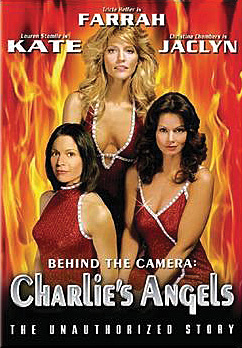
Behind The Camera: The Unauthorized Story of Charlie’s Angel (2004, directed by Francine McDougall)


Looking for a new hit, television producer Aaron Spelling (Dan Castellanata) comes up with the story of “three little girls who went to the police academy and who were assigned very hazardous duties” but who were taken away from all that by the mysterious Charlie.  The show is conceived as a star vehicle for Kate Jackson (Lauren Stamile), with fashion model Jaclyn Smith (Christina Chambers) and actress Farrah Fawcett-Majors (Tricia Helfer) playing her partners in investigating and solving crimes.  Kate wants to make a feminist statement.  Jaclyn wants to be a good role model to the little girls who sneak out of their room to watch the show.  Farrah wants to be a star without losing her possessive husband, Lee Majors (Ben Browder).  The critics hate the show.  Studio president Fred Silverman (Dan Lauria) and showrunner Barney Rozenweig (Michael Tomlinson) are embarrassed by it.  But Spelling has a hit and the actresses become stars.  But when Farrah decides she wants to leave after one season, the show’s future is put in doubt.

This was one of NBC’s Behind The Camera films and the only one to take us behind the scenes of a “drama” program.  (The other films looked at Diff’Rent Strokes, Mork and Mindy, and Three’s Company.)  This is probably the best of them, though “good” and “best” are both relative terms when it comes to these movies.  As with all of the films, there’s too many inside jokes about the network execs, with Dan Lauria stepping into the shoes of Brian Dennehy and Saul Rubinek as Fred Silverman.  But Dan Castellanata did a surprisingly good job as Aaron Spelling and the three actresses playing the Angels were all convincing, especially Christina Chambers.  The film’s main villain is Lee Majors, who is blamed for forcing Farrah to leave the show and who is portrayed as yelling, “Her name is Farrah Fawcett-Majors!”  It’s low-budget and doesn’t offer much that isn’t already known but at the cast keeps the story interesting.


MacGruber (2010, directed by Jorma Taccone)


A nuclear warhead has been stolen and Captain Jim Faith (Powers Boothe) knows just who to recruit to track it down.  Former CIA agent MacGruber (Will Forte) agrees to come out of retirement, so he can save the world from Dieter Von Cunth (Val Kilmer), the man who blew up MacGruber’s fiancée (Maya Rudolph) on the day of their wedding.

MacGruber re-assembles his old team.  Sure, Vicki St. Elmo (Kristen Wiig) no longer wants to be a part of the adventure and MacGruber refuses work with Lt. Dixon Piper (Ryan Phillippe) but he still brings together a collection of men who look like they eat carburetors for breakfast.  And then he accidentally blows them up.  MacGruber’s assembling a new team!  While mentoring Dixon and falling in love with Vicki, MacGruber seeks his revenge on Cunth.  He also makes peace with his past by having sex with his fiancée’s ghost on her tombstone.

Based on the SNL skit that was itself based on a one-joke premise, MacGruber is a surprisingly entertaining action comedy, mixing frequently crude humor with heartfelt pathos.  MacGruber works because, even while it makes fun of action movies, it still respects the rules of the genre.  The jokes and the bullets fly with equal power.  MacGruber is an idiot but he’s also the only man who can save Washington from Cunth’s plot and Will Forte does an admirable job of delivering every bizarre line of dialogue with a fully committed straight face..  Val Kilmer plays Cunth as being a classic action villain, right down to his dismissive attitude and his long-winded speeches.  Kristen Wiig is both sexy and adorably awkward as the love interest.  And Ryan Phillippe does a surprisingly good job as the the one person who seems to understand how crazy MacGruber really is.  Every good comedy needs a good straight man and Ryan Phillippe proves himself to be more than up to the task.

MacGruber is full of quotable lines and scenes that are so out-there that you might need to rewind and confirm that you actually saw what you just did.  There have been a lot of bad Saturday Night Live movies.  MacGruber is one of the good ones.

The Eagles Soar Over The Chiefs


I am stunned!  I thought there was no way they were going to win that thing but the Eagles not only won by they won easily.  Normally, I don’t like the Eagles and I’ve had enough bad Philadelphia experiences to not like the city too but I have to respect the game the team played tonight.  They were never behind.  They never struggled.  And from their first touchdown, I think we all knew who was going to win.

Final score:

Eagles — 40

Chiefs — 22

And it wasn’t even close!

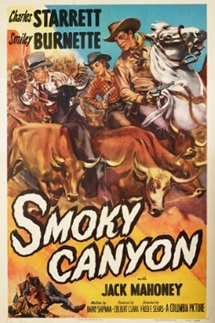
Smoky Canyon (1952, directed by Fred Sears)


There’s a $2500 dollar reward out for the masked bandit known as the Durango Kid but little do the residents of Timber Rock know that the Kid is actually Steve Brent (Charles Starrett), a Treasury agent who puts on a mask whenever he needs to go undercover and discover what the bad guys are doing.

A range war has broken out between the sheep farmers led by Jack Mahoney (Jock Mahoney) and the cattlemen led by Carl Buckley (Tristram Coffin).  To broker a peace and discover which side is the most to blame, Brent works for the cattlemen while the Durango Kid sides with the sheepmen.  It turns out that Buckley’s to blame here.  He’s using the war to thin out his cattle so that an Eastern beef syndicate can keep prices high.  When Mahoney gets too close to the truth, he is framed for the murder of Mr. Woodstock and it’s up to the Durango Kid to prove that Mahoney is innocent.  Meanwhile, Carl wants to blow up an entire mountain so that it will really thin out his cattle herd.

This is a typical Durango Kid movie, entertaining if you like B-westerns and probably boring if they’re not your thing.  It has all the usual gunfights, horse chases, and dynamite explosions that are promised by every Durango Kid film.  Starrett was always one of the most convincing cowboys on screen, even if his use of the Durango Kid alter ego didn’t always make sense.  All the usual members of the Durango stock company show up, all playing different characters than they did in the previous Durango Kid film.  Mahoney gets to play one of the good guys for once and his spirited girlfriend is played by the lovely Dani Sue Nolan.  Smiley Burnett shows up to provide comic relief.  This time, he’s a singing tour guide.  He sings a song called It’s Got To Get Better.  Let’s hope so.

My 2025 Super Bowl Predictions


I’m torn.  I don’t want either team to win.

I don’t want the Chiefs to win because they’ve had the referees on their side for the entire season and I think its debatable whether the Chiefs would have even made it to the Super Bowl if the refs hadn’t rigged things for them.  The NFL views Taylor Swift as being good for their ratings.  When people talk about Taylor Swift cheering for Travis Kelce, they aren’t talking about concussions, the off-field behavior of the players, or anything else that could reflect negatively on the league.  I feel like a Chiefs victory would be a victory for the rigging of a once great sport and, in future years, it will be seen as a significant moment in the downfall of the NFL.

I don’t want the Eagles to win because they’re the Eagles.

I’m going to predict a score that’s not as close as many are expecting.

Kansas City Chiefs 41

Philadelphia Eagles 21

I won’t be happy that Chiefs won but I will be happy that Philadelphia did not.

Renegade Girl (1946, directed by William Berke)


Missouri in 1864.  The Civil War is raging and the state is divided between those who support the Union and those secretly support the Confederate guerillas led by Willian Quantrill (Ray Corrigan).  The Union’s Major Baker (Jack Holt) is determined to track down rebel Bob Shelby (Jimmie Martin) and he enlists the Native American Chief Whitecloud (played by Chief Thundercloud) to help find him.  Whitecloud has a personal vendetta against the Shelby family and, when he finds Bob, he executes him in cold blood.  Bob’s sister, Jean Shelby (Ann Savage), is also a Confederate sympathizer and she seeks revenge.  Complicating things is that Jean has fallen in love with Union Captain Fred Raymond (Alan Curtis).

One of the many B-westerns produced by Robert L. Lippert and directed by William Berke, Renegade Girl packs a lot of plot into just 65 minutes.  The action is nonstop and fans of westerns will find all of the horse chases, gunfights, and threats of hanging that they could want.  The main thing that distinguishes Renegade Girl from other B-westerns is the fierce performance of Ann Savage as Jean Shelby, a woman who will not stop until she gets her revenge.  While the film’s portrayal of the Quantrill and Chief Whitecloud definitely goes against modern sensibilities, Ann Savage’s performance feels ahead of her time.  No one is going to stand in Jean Shelby’s way.

Chief Thundercloud’s real name was reportedly Victor Daniels, though his past is shrouded in mystery.  He claimed to be a Cherokee from Arizona, though he was listed as being Mexican on a marriage record that was filed before he started his film career.  As Chief Thundercloud, he was a mainstay in westerns from the 30s to the time of his death in 1955.  He was the first actor to play the Lone Ranger’s Tonto and he also played Geronimo in a 1939 Paramount film of the same name.  His final film role was a posthumous appearance in John Ford’s The Searchers.

Behind the Camera: The Unauthorized Story of ‘Diff’rent Strokes’ (2006, dir by Robert Iscove)


Norman Lear has television superstar Conrad Bain under contract and Fred Silverman wants to build a show around Bain and a talented black child actor named Gary Coleman.  Entitled Diff’rent Strokes and featuring Todd Bridges and Dana Plato as Coleman’s brother and stepsister, the show is a hit.  The three young actors briefly become superstars, much like the amazing Conrad Bain.  And then, when the show is finally canceled after ten years, it all goes downhill as Todd Bridges and Dana Plato run into trouble with drugs and the law and Gary Coleman, once one of the highest paid stars on television, discovers that he’s now flat broke.  All three of them learn how quickly the world can turn on you when you’re no longer considered to be a success.

Behind the Camera: The Unauthorized Story of ‘Diff’rent Strokes’ was another one NBC’s cheap movies about the behind-the-scenes drama of a popular sitcom.  (They also did Three’s Company and Mork & Mindy).  Like all of NBC’s Behind the Camera movies, it makes the mistake of thinking that everyone is as interested in the habits of network executives as the people who work for them are.  (This time, it’s Saul Rubinek who gets to play Fred Silverman.)  The actors who plays Bridges, Coleman, and Plato are convincing enough but the storytelling is shallow, featuring the same information that you would expect to find in an episode of the E! True Hollywood Story.  I was disappointed that we didn’t get any scenes of Alan Thicke recording the theme song.

Todd Bridges and the late Gary Coleman both appear as themselves, talking about their experiences with the show and the difficulties of navigating life after Diff’rent Strokes was canceled.  Bridges is down-to-Earth while Coleman rambles like someone who was still trying to figure out how his life had led up to this moment.  The ending, in which Bridges and Coleman stand at Dana Plato’s grave and Coleman delivers a nearly incoherent monologue, is the one time that the film really captures any feeling of emotional honesty.  It is obvious that both Bridges and Coleman are still haunted by what happened to Plato after the show ended.  Knowing that Coleman himself would die just four years after the airing of this movie makes the scene more poignant when viewed today.


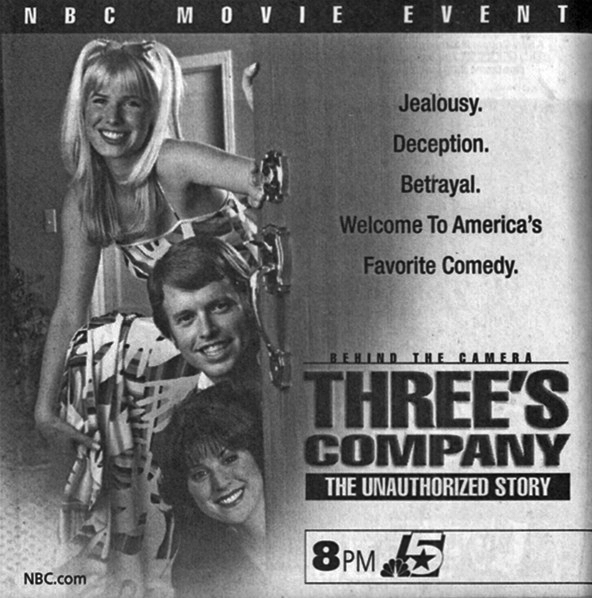
Behind the Camera: The Unauthorized Story of Three’s Company (2003, directed by Jason Ensler)


Do you remember Three’s Company?

The sitcom was a big hit when it aired in the 70s and 80s and it still gets a lot of play in syndication today.  Based on a British sitcom (and you would really be surprised to how closely the first season followed the original series), Three’s Company starred John Ritter as Jack Tripper, an aspiring chef who moved in with two single women, Janet (Joyce DeWitt) and Chrissy (Suzanne Somers).  Because their impotent landlord (Norman Fell) didn’t want people of the opposite sex living with each other unless they were married, Jack pretended to be gay.  Every episode centered around a misunderstanding, though it was Suzanne Somers’s performance as the perpetually bouncy and braless Chrissy Snow that made the show a hit.  The show fell apart when Somers asked for more money, Ritter and DeWitt got angry with her, and the studio bosses lied to everyone.  Today, the show is legendary as an example of how backstage tension can end even a popular series.

Behind The Camera: The Unauthorized Story of Three’s Company attempts to dramatize the success and eventual downfall of Three’s Company.  Joyce DeWitt appears at the beginning and the end to talk about how important she thinks the show was.  In the movie, she is played by Melanie Paxson.  John Ritter is played by a lookalike actor named Bret Anthony while an actress named Jud Taylor plays Somers.  Brian Dennehy plays ABC president Fred Silverman and other executives are played by Daniel Roebuck, Wallace Langham, Gary Hudson, and Christopher Shyer.  The movie recreates all of the drama that went on during Three’s Company without offering much insight or really anything new to the story.  Even though the movie was co-produced and hosted by Joyce DeWitt, Suzanne Somers is really the only sympathetic character in the movie.  DeWitt comes across as being jealous while Anthony plays John Ritter as being a bland nonentity who chooses his own success over being honest with his costars.  The network executives are more interesting, just because watching them provides a glimpse into how real producers and showrunners picture themselves.  They just wanted to make a good show about a sex addict pretending to be gay so he could live with two attractive, single women but the agents and the network presidents just keep getting in the way!  Won’t someone please think of the mid-level network executives?

Bland though this recreation was, it was enough of a rating hits that NBC went on to produce several more Behind The Camera films.  Three’s Company was only the beginning.

A Joseph Cotten Scene That I Love From Citizen Kane


Joseph Cotten passed away 31 years ago today.  Cotten appeared in a lot of good films and worked with many important directors but he will always be remembered for bringing to life Jedidiah Leland, the drama critic in Citizen Kane.  I liked the character so much that I paid tribute to him with my penname, though I substituted an A for the first I.

Cotten played Jedidiah as both a young man and an old man in Citizen Kane.  The first time I saw the movie, I reacted to the young Leland.  With each passing year, I think I understand better what the older Leland was talking about when he said that memory is the greatest curse ever inflicted on the human race.

(Even retired and living in what appears to be a nursing home, Jedidiah Leland still spoke like a drama critic.)


Madhouse (1990, directed by Tom Ropelewski)


Mark (John Larroquette) and Jessa Bannister (Kirstie Alley) have a perfect yuppie lifestyle going until their respective family members show up at their California home and refuse to leave.  First, it’s Mark cousin (John Diehl) and his wife (Jessica Lundy).  Then it’s Jessa’s sister, Claudia (Alison LaPlaca), who has just left her husband and now has to find a new man to support her lifestyle.  Mark and Jessa just want some time alone but instead, they have to deal with a cat who is frequently mistaken for dead, broken marriages, a shipment of cocaine, and a neighbor (Robert Ginty) who builds weird bed frames.  Mark has a big contract to land and Jessa is trying to succeed as a television news reporter but it’s not easy when you’re living in a madhouse.

There are some films that you just like despite yourself and that’s the way I feel about Madhouse.  It’s very much an 80s film, with its emphasis on material goods and achieving the perfect lifestyle.  (The appearance of Dennis Miller as Mark’s co-worker only reminds us of just how much a product of its era that Madhouse is.)  There are a lot of jokes that don’t work and some, like the cat that is continually mistaken for dead, that shouldn’t work but do.  It’s a sitcom transferred to the movies and the humor rarely rises above that level.  It ever stars two of the decade’s biggest sitcom stars, John Larroquette and Kirstie Alley.  Larroquette shows us why he was better suited for television while Alley shows how tragic it was that she didn’t have a bigger film career.  Kirstie Alley gives such a dedicated and fearless performance as someone who has been driven to the end of her rope that it keeps you interested in the film.  Alley, like the great comedic actresses of Hollywood’s golden age, was an actress who could mix physical comedy with barbed one-liners and who was undeniably appealing as she moved from one disaster to the next.  In Madhouse, she was beautiful, frantic, sexy, neurotic, relatable, and funny all at the same time.  By the end of this movie, you really do wish she had gotten more and better opportunities to show off her talents in the years after Cheers went off the air.

Madhouse is nothing special.  It’s a generic comedy about unwanted family guests.  But I’ll always appreciate it for Kirstie Alley.