Last week’s E3 saw the release of too many trailers for me to share them all in just one post but I would like to share the trailers for 12 games that I am especially looking forward to. In alphabetical order, these are my 12 top trailers from this year’s E3:
Lisa asked me to do a round-up of all the trailer that were released this week and the first rule of working at Through the Shattered Lens is that when Lisa asks you to do something, you do it.
To start things off, here’s the trailer that everyone was talking about this week. Tim Burton’s live action version of Dumbo looks like it could be something special. I’ve seen a horse fly. I’ve seen a dragon fly. I’ve seen a house fly. And now, on March 29th, 2019, I’ll finally see an elephant fly!
In this next trailer, Benedict Cumberbatch is The Grinch! On November 9th, The Grinch’s heart will grow by three sizes. Hopefully, a cardiologist will be on duty.
Unfriended: Dark Web is either a horror sequel or an extended LifeLock commercial. Unfriended: Dark Web will be infecting a screen near you on July 20th.
Based on the novel by Sarah Waters and directed by Lenny (Room) Abrahamson, The Little Stranger will be visiting theaters on August 31st.
The Nun is being advertised as “the darkest chapter in The Conjuring Universe,” which is apparently now a thing just like the MCU and the DCEU. Say a prayer for us all because The Nun will be hitting screens on September 7th.
If you liked the trailer for The Nun, you might want to go through The Devil’s Doorway with IFC Midnight on July 13th.
If you survive stepping through The Devil’s Doorway, consider pledging to The Row on July 27th.
And finally, coming to DVD soon, It Came From The Desert!
Produced by Martin Bregman, directed by Brian De Palma, written by Oliver Stone, and starring Al Pacino, the 1983 remake of Scarface is one of the best-known, most iconic gangster films ever made. It opened to mixed reviews but it’s gone on to be recognized as a classic. Everyone can quote the script: “Say hello to my little friend!” “In this country, you gotta make the money first. Then when you get the money, you get the power. Then when you get the power, then you get the women.” “Say goodnight to the bad guy!”
Scarface starts with one of my favorite opening scenes of all time. Powered by Giorgio Moroder’s score, the opening credits of Scarface play out over footage of the real-life Mariel boatlift. Combined with footage of Fidel Castro ranting that Cuba does not need the Marielitos, this opening gives real-world credibility to everything that follows. We then segue from the actual boatlift to Al Pacino as Tony Montana, answering questions with that shit-eating grin on his face.
Listen to the interrogation scene carefully and you’ll hear both Charles Durning and Dennis Franz, dubbing the lines of the actors who played the immigration agents.
Long-time producer Martin Bregman died yesterday at the age of 92. Bregman, who started out as a talent agent, was well-known for producing several of Al Pacino’s best films. This edition of 4 Shots From 4 Films is dedicated to his memory.
4 Shots From 4 Films
Serpico (1973, directed by Sideny Lumet)
Dog Day Afternoon (1975, directed by Sidney Lumet)
Margot Kidder was born in Yellowknife, a mining town in Northern Canada that was so remote that it didn’t even have a movie theater. She didn’t see her first movie until she was 12, when she and her mother were visiting New York City. Kidder later said, “I saw Bye Bye Birdie, with people singing and dancing, and that was it. I knew I had to go far away.”
Kidder started her career in her native Canada, appearing in 1968’s The Best Damn Fiddler from Calabogie to Kaladar and going on to appear in films like Black Christmas and Quackser Fortune Has A Cousin In The Bronx.Even after Kidder found stardom in the United States, she continued to appear in Canadian films and won two Canadian Film Awards and one Genie Award for her performances.
In 1973, she played dual roles in Brian DePalma’s Sisters. As detailed in Peter Biskind’s Easy Riders, Raging Bulls, it was during this time that she and her Sisters co-star Jennifer Salt shared a Malibu beach house that became a gathering place for such up-and-coming Hollywood directors as DePalma, John Milius, Martin Scorsese, George Lucas, and Steven Spielberg. Briefly, she and Spielberg even dated.
For a generation of filmgoers, though, Margot Kidder will always be Lois Lane! In 1978, Kidder beat out over 100 other actresses for the role of Lois. (Among the others who tested: Anne Archer, Susan Blakely, Lesley Ann Warren, Deborah Raffin and Stockard Channing.) Superman was the first great comic book film. In the aftermath of both Watergate and Vietnam, Superman made audiences that a man could fly. As important as Christopher Reeve was to the success of Superman, Margot Kidder was just as important. In many ways, Kidder’s Lois was the audience surrogate. We saw Superman through her eyes. At the same time, Kidder gave such a lively performance that it was impossible not to join Superman in falling in love with Lois. When Superman spun the world backwards to bring her back to life, nobody questioned it because they would have all done the same thing.
Kidder was even better in Superman II but, unfortunately, she was also forever typecast as Lois. In her later years, she would be better known for her health struggles than her acting. After having a widely publicized manic episode in 1996, Kidder became just as well-known as an outspoken mental health activist as an actress. Though her acting career may have slowed down, Kidder never stopped working, appearing in movies and television shows up until her death.
Margot Kidder died yesterday in Montana, at the age of 69. To many, she’ll always be Lois but she was so much more as well. Rest in Peace, Margot Kidder.
Years ago, during my senior year of high school, my AP History teacher taught us about Vietnam by bringing in a movie. He explained that the movie featured some “adult language” and was not always easy to watch. He also said that it was the most realistic portrayal of basic training ever put on film. Seeing as how he was a former Marine himself, we took his word for it.
That movie, of course, was Full Metal Jacket. The class loved the movie, though not in the way that our teacher was hoping. He was hoping that we would pick up on the film’s anti-war theme but instead we were all obsessed with Gunnery Sergeant Hartmann, the tough-as-nails drill sergeant played by R. Lee Ermey. It didn’t matter that Hartmann probably wouldn’t have welcome any of us into his beloved corp. (The majority of the class may have had Private Joker’s wit but they also had Private Pyle’s physisque.) From the minute that Hartmann started yelling at the recruits, the class thought he was the coolest and toughest sonuvabitch of all time. We were supposed to be learning that war was Hell and dehumanizing but we just wanted to listen to Hatmann yell about Mary Jane Rottencrotch and her pink panties.
Looking back, I feel bad for my teacher. He wanted to show us the horrors of Vietnam and instead, he ended up with a bunch of students who wouldn’t stop chanting, “I don’t know but I’ve been told/Eskimo pussy is mighty cold!” Every class debate, there was always a chance that someone would respond to an opposing argument by saying, “You wouldn’t even have the common courtesy to give him a reach around!”
I won’t even get into the number of times that, for the rest of the year, the term “skull fuck” was used in class discussions.
Full Metal Jacket is an anti-war film. The first half may be dominated by Sgt. Hartmann turning the recruits into “perfect” killing machines but the second half features those machines being picked off, one-by-one, by an unseen sniper in a bombed-out building. All of Hartmann’s words about the brotherhood of duty are meant to ring hollow as we watch one teenage girl gun down Marine after Marine. Perhaps they would have if Hartmann had been played by anyone other than R. Lee Ermey.
One reason why Ermey was so believable as Hartmann was because he actually had been a drill instructor. In 1961, R. Lee Ermey was 17 years old and had two arrests for criminal mischief on his record when a judge told him that he could either go to jail or he could join the military. Ermey chose to enlist. He served in the Marines for 11 years, getting a medical discharge in 1972.
He began his film career as a technical advisor to Francis Ford Coppola during the shooting of Apocalypse Now. This led to him playing Sgt. Loyce, a drill instructor in The Boys of Company C.
(The shooting of Apocalypse Now was so drawn out that The Boys of Company C actually ended up getting released a year before Coppola’s epic.)
Originally, Ermey was only hired to serve as a technical advisor on Full Metal Jacket. It wasn’t until Ermey put together an instructional video for Tom Colceri, the actor who had previously been cast as Sgt. Hartmann. When Full Metal Jacket‘s director, Stanley Kubrick, saw the tape, he replaced Colceri with Ermey. (Colceri still appears in the film. He plays the helicopter door gunner who brags about shooting 50 water buffalo.)
Kubrick not only gave Ermey his most famous role but he also allowed Ermey to improvise much of his dialogue, something that was practically unheard of on a Kubrick set. Kubrick also said that it usually only took 2 or 3 takes for Ermey to give him what he was looking for. That was a high compliment from Stanley Kubrick, the man who, during the filming of The Shining, made Scatman Crothers do over a hundred takes of one scene.
Ermey’s performance as Hartmann was so iconic and so quotable that it has become the standard by which all other film drill instructors are judged. It also made Ermey a much-in-demand character actor. Many of the roles that Ermey played were designed to capitalize on his fame as Hartmann. He played the a ghost of a drill instructor in The Frighteners. He was the voice of Sarge in three Toy Story films.
In a few films, R. Lee Ermey got a chance to show that he was capable of more than just playing variations on Sgt. Hartmann. In Prefontaine, he played the legendary coach and Nike co-founder Bill Bowerman. He was a police captain in Se7en and the father of a murdered girl in Dead Man Walking. In the two remakes of The Texas Chainsaw Massacre, he was Leatherface’s equally depraved uncle.
R. Lee Ermey died yesterday at the age of 74 but his performances will live on forever.
Deep in the Australian outback, a young child named Scotty goes missing. His grandfather, Jake (Bill Kerr), swears that a giant boar (“a razorback”) broke into his house and ran off with his grandson. The locals don’t think it was a boar. They don’t even think it was a dingo. Instead, they charge Jake with killing his grandson but, because there’s not evidence to convict him, Jake goes free.
Two years later, a nosy American reporter named Beth Winters (Judy Morris) mysteriously vanishes shortly after arriving in the Outback to do a story on how kangaroos are being hunted to the point of extinction. Women and children are vanishing in the Outback? This sounds like a job for Lee Majors but the best this movie can do is Gregory Harrison. Harrison plays Beth’s husband, Carl, who comes to Australia to search for her. At first, he thinks that she may have been kidnapped by the moronic Baker brothers (Chris Haywood and David Argue) but then he meets Jake and a comely pig expert named Sarah (Arkie Whiteley). Jake tells Carl about the razorback and later comes across Beth’s wedding ring in a pile of boar shit.
Razorback was probably pitched as being “Jaws meets Mad Max.” Just as in Jaws, the authorities refuse to accept that people are being eaten by a giant boar and it is up to an inexperienced American, an old timer, and a scientist to try to stop it. Also, like in Jaws, the boar is that star of the show even though it does not get much screen time. When the boar does appear, it bears a distinct resemblance to Motorhead’s War-Pig. Just as in Mad Max, every Australian in Razorback drives like a maniac. Whenever the Baker brothers tear across the screen in their truck, it’s easy to imagine Max Rockatansky and Goose in hot pursuit.
Along with the boar, the other star of the film is the Australian outback itself, which the film treats as almost being an alien landscape:
If Razorback makes the Australian outback look like an 80s new wave music video, that might be because it was directed by Russell Mulcahy, who started his career directing videos for Duran Duran. Before one boar attack, Duran Duran’s New Moon On Monday is even heard playing on a radio. (Ironically, New Moon On Monday was one of the few early Duran Duran videos that Mulcahy did not direct.) Both the boar and the film look great but all of the humans get overshadowed by the visuals. Not that it matters, since they’re only there to serve as razorback food.
Despite the strong visuals and the amazingly cool monster, Razorback got only lukewarm reviews when it was first released. Critics aside, it was a hit in Australia, where it won Australian Film awards for both editing and cinematography. (Cinematographer Dean Semler later won an Oscar for his work on Dances with Wolves.) It only found cult success in the United States. One admirer was Steven Spielberg, who reportedly called Mulcahy to ask how he achieved some the film’s visual effects. Two years after the release of Razorback, Mulcahy directed his best-known film, Highlander.
Flaws and all, Razorback is the best movie ever made about a wild boar eating people in Australia.
On March 24th, 1958, 23 year-old Elvis Presley reported for his induction into the army. It was a day that the press and his fans dubbed as being Black Monday. Shortly after being inducted, Elvis and his fellow recruits were transported to Fort Chaffee, Arkansas. That’s where my grandfather, Raymond Ellis, took this picture.
Unfortunately, the copy above is not a great scan. (When my Dad got his first scanner in 1995, the Elvis picture was one of the first things he scanned. I just happened to come across it a few weeks ago while I was gong through some old 3.5 floppy disks.) Hopefully, I’ll be able to get my hands on the original and share a better scan in the future. As far as I know, this picture of Elvis has never been published anywhere else.
As for Elvis, he served in the army for two years, getting promoted to sergeant and receiving an honorable discharge in 1960. He spent most of his army career in West Germany, where he met the woman that he would eventually marry, Priscilla Beaulieu.
38 years ago today, Pink Floyd’s Another Brick In The Wall (Part 2) started a four week run at No.1 on the US singles chart.
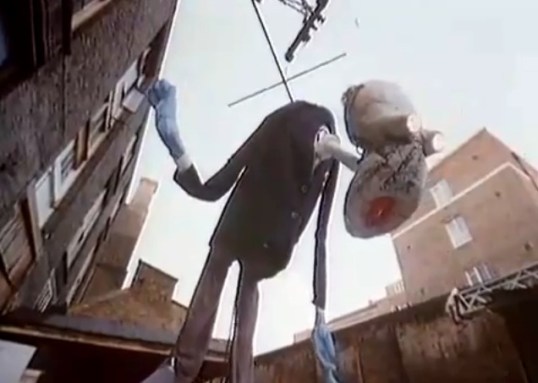
When most people think about the video for Another Brick In The Wall (Part 2), they probably remember the scenes from Alan Parker’s Pink Floyd — The Wall, with the school children marching into the tunnel and being dropped into the meat grinder. However, the “official” video came out shortly before the release of the Parker film. It was directed by Gerald Scarfe, who was responsible for the film’s animated scenes. (Clips from Scarfe’s animation for The Trial and Waiting for The Worms are prominently featured in the video.) It also features the teacher puppet that was used whenever The Wall was performed in concert.
The children in the video are not the same children who sang on the track. The children on the track were all students at Islington Green School. When the track, with its chorus of “we don’t need no education/we don’t need no thought control,” was released, it proved to be so controversial that the head teacher at Islington Green forbade the students from performing the song on Top of The Pops and from appearing in the video. In fact, the members of the chorus heard in the song did not even receive any royalties from its success until 2004.
Is Everything Zen by Bush the worst music video of all time? Let’s break it down:
0:06 — For some reason, this shot of the birds taking off from the rooftop was one of the most overused shots of the 90s. It means nothing. Birds perch on building and then they fly away. That’s what they do. In this case, I think the birds are saying, “Let’s get out of here before Gavin starts singing.”
0:20 — The only shot that was a bigger cliché than birds flying off a rooftop? The one of the woman standing at the end of a tunnel.
0:27 — Bush makes their first appearance and already they’re trying too hard. Bush was not the first band to rip off Nirvana and Pearl Jam, they were just the most obvious.
0:31 — Gavin Rossdale sang something about getting something to eat so here’s someone in a pig mask, holding a fork. Literal representations of Bush’s lyrics only serve to remind us of how stupid they are.
0:40 — In the video, Gavin sings “psycho brother.” In the actual song, he says “asshole brother.” I guess his asshole brother lives in Los Angeles and wears a pig snout. In real life, Gavin Rossdale doesn’t have a brother so already he’s lying to us.
0:46 — This is where I really get pissed off. There’s only one good lyric in this damn song and they stole it from David Bowie. And no, saying “Dave’s on sale again,” doesn’t make it okay.
0:53 — The woman’s being carried away by someone. We’re getting edgy now, folks.
1:00 — I can’t understand a word that Gavin’s singing and while I could look up the lyrics, I won’t. Compare this part of the song to literally any Nirvana song. Kurt Cobain’s lyrics were cryptic but still meant something. Bush’s lyrics sound like they were cribbed from a 9th grader’s notebook.
1:11 — One of Bush’s trademarks was that, whenever they couldn’t come up with any new lyrics, they would just repeat the song’s title. What does “Everything zen” even mean?
1:25 — Along with birds flying off of roofs and women standing at the end of tunnels, intense backlighting was another 90s music video cliché. This video makes sure to touch all the bases.
1:31 — A mask and an exposed rib cage? Is that zen?
1:35 — Gavin sings “demigod” as if he got the lyrics a half hour before recording the song.
1:45 — “There’s no sex in your violence.” We’re getting even more edgy here, folks.
2:05 — Gavin’s back to repeating “everything zen.”
2:10 — The birds are back, still trying to escape the band. That guitarist isn’t going to let them go that easy, though.
2:13 — Why were bands in the 90s always playing in abandoned warehouses?
2:24 — Leave Elvis out of this, you wanker!
2:34 — He really wants us to know that he doesn’t believe Elvis is dead.
3:06 — Back to “There’s no sex in your violence.” If he doesn’t believe that Elvis is dead, why should we listen to him about anything? Maybe there is sex in your violence.
3:28 — I always hear this lyric as “Trust you once, wagah.”
3:36 — Some dude wearing an animal skin. Does he think Elvis is dead?
3:48 — The woman is back but, in another 90s music video cliché, she disappears while running away.
3:53 — Chill out, Gavin.
4:06 — It’s that final, anguised “zen!” that makes me want to punch the wall.
One final note: Bush was British but they were never big in the UK. This is all on you, America!


 Through the Shattered Lens