Music Video of the Day: Robert De Niro’s Waiting… by Bananarama (1984, directed by Duncan Gibbins)


Robert De Niro might not seem as if he would be the most likely of subjects for a teenage love song but this song is hardly a traditional love song.  The song was originally conceived as being sung from the point of view of a girl who deals with the trauma of being raped by escaping into a pretend world where Robert De Niro is her boyfriend.  By the time the song was actually recorded, the rape angle had been dropped but this it’s still darker than your normal teen crush song.

Originally, the subject of the song was going to be Al Pacino, which might have made more sense.  (Remember that while Robert De Niro was shooting pimps in Taxi Driver, posters of Al Pacino as Serpico were decorating dorm rooms.)  However, it was decided that, musically, Robert De Niro sounded better than Al Pacino.

This video features the members of Bananarama being followed by two “gangsters” who could have stepped out of a De Niro film.  It was directed by Duncan Gibbins, a talented director who tragically died in 1993.  I wrote more about Gibbins and his career when I reviewed his video for Smuggler’s Blues.

Enjoy!

Music Video of The Day: I Want A New Drug by Huey Lewis and the News (1984, directed by David Rathod)


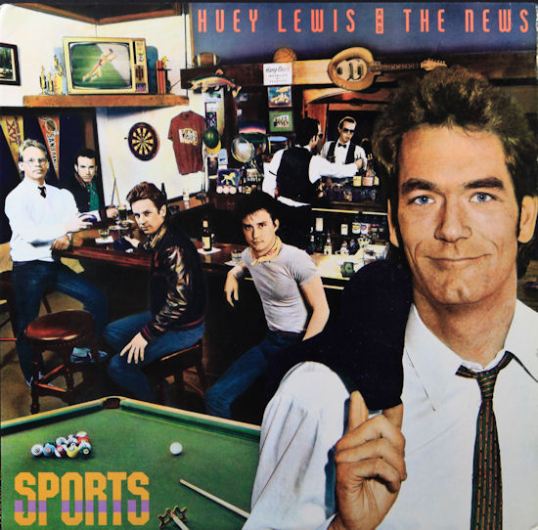
Despite what Patrick Bateman might try to tell you, Huey Lewis and the News has never been a band that most people would associate with drugs.  Instead, Huey Lewis and the News wrote and performed the type of songs that you might expect to hear in a sports bar (albeit a sports bar with an 80s theme).  If you need proof, just take a look at the cover of their third album, 1983’s Sports:

That cover sums up who Huey Lewis And The News were as a band.  While only the members of the band can say for sure what they did behind closed doors, most people would look at this cover and say that these weren’t the guys you’d find smoking weed and debating philosophy or doing coke and going crazy on Wall Street.  These were the guys who were waiting for you to come down to the local bar and shoot some pool, with the winner buying the next round.

Ironically, one of their biggest hits was so widely misinterpreted as being a pro-drug song that they actually made a music video with the expressed intent to show everyone that it wasn’t.  I Want A New Drug wasn’t about wanting a new drug.  It was about being so in love with a woman that the feeling was better than anything that any drug could provide.

The video features Huey waking up late and remembering that he has a show that night.  He races across San Francisco and, noticeably, he doesn’t do a single drug during the journey.  He does spot a woman played by Signy Coleman, whose mom was friends with Huey’s mom.

This video was directed by David Rathod, who also directed the videos for two other songs from Huey Lewis and the News, Heart and Soul and He Don’t Know.

Enjoy!

Music Video of the Day: All Hell’s Breakin’ Loose by KISS (1983, directed by Martin Kaban)


As you can tell from watching this video, this from the period of time where KISS was performing without their trademark makeup.  All Hell’s Breakin’ Loose was their second single from the album Lick It Up and, while the video itself got some airplay on MTV, the song failed to chart in the U.S.  Compared to their success in the 70s, KISS struggled through the 80s and the early 90s.  Taking off the makeup and essentially looking like every other hard rock band that was around at that time did not help.

Today, All Hell’s Breakin’ Loose is best-remembered as the song in which Paul Stanley raps.  The majority of the song was written by KISS’s then drummer, the late Eric Carr and Carr was initially not happy with the decision to have Stanley rap one of the verses.  However, later, Carr said that Stanley rapping was actually what the song needed to distinguish itself from the rest of the album and that the rap was probably the reason why All Hell’s Breakin’ Loose was eventually released as a single.

The video is a hard rock fantasy, with the members of KISS walking around a burned-out city and running into criminals, circus performers, and, of course, barely dressed women.  This was probably a video that KISS could only have made during the period when they weren’t wearing their makeup.  The Demon and the Starchild would have looked out-of-place wandering around the city but Gene Simmons, Paul Stanley, Eric Carr, and Vinny Vincent fit right in.

In retrospect, it’s hard not to be amused that, back in the 70s and 80s, so many parents groups viewed KISS as being a threat to young minds.  (There are people who still believe that KISS stands for Knights In Satan’s Service.)  I would guess that few of those concerned parents actually listened to any of the music that they were so concerned about.  Instead, they just saw songs with titles like All Hell’s Breakin’ Loose and jumped to their conclusions.

Enjoy!

Better Drugs and Bigger Parties: The Dirt (2019, directed by Jeff Tremaine)


If you want to experience the sex, drugs, and rock and roll lifestyle, you could start a band, play some clubs, get signed to a record deal, go on tour, and eventually burn yourself out.  Of course, if that’s too much trouble or if you’re already older than 30, I guess you can just watch The Dirt on Netflix.

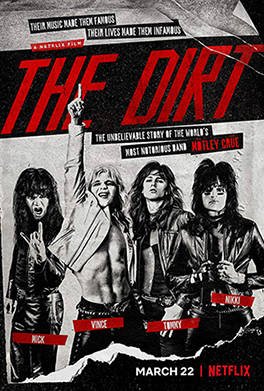
The Dirt is the latest band biopic.  This time the band is Mötley Crüe  and the film has all the usual VH1 Behind the Music style anecdotes.  Watch Nikki Sixx (Douglas Booth) nearly die of a heroin overdose!  Ponder how Tommy Lee (Chase “Machine Gun” Kelly) could have been stupid enough to cheat on Heather Locklear (Rebekah Graf)!  Listen as Mick Mars (Iwan Rhoen) refuses to tell how old he is!  Gasp as Vince Neil (Daniel Webber, giving the movie’s best performance) deals with tragedy after tragedy!  When you’re not watching Tommy Lee go down on a groupie or Nikki learning how to shoot dope, you can watch as Ozzy Osbourne (Tony Cavalero) snorts a line of ants and slurps up his own urine.  The movie is based on Mötley Crüe’s autobiography and the actors playing the members of the band take turns breaking the fourth wall and telling their story.  Nikki Sixx says, “We were a gang of fucking idiots!” and the movie seems to agree.  Nikki has always had a reputation for being the smartest member of Mötley Crüe.  Of course, when your main competition is Tommy Lee, that’s not too high of a bar to clear.

Especially when compared to other band biopics like Straight Outta Compton and Bohemian Rhapsody, The Dirt is shallow and overly episodic.  Nikki says that Mötley Crüe’s main concern was finding “better drugs and bigger parties,” and The Dirt is the same way.  It never digs too deep into the band’s music or the reasons why, for a period of time in the 80s, they were so popular.  The story is told by the members of the band so it often switches between being honest about the band’s history and making excuses for some of the members’s worst behavior, like when Tommy punches his first fiancee.  Fans of Mötley Crüe might enjoy seeing all of the stories about the band brought to life.  Meanwhile, those who didn’t care about Mötley Crüe before watching The Dirt will probably care even less after spending nearly two hours watching them act like self-destructive fools.  One thing that the movie gets undeniably correct: After all these years, Dr. Feelgood still rocks.


Music Video of the Day: Somebody Save Me by Cinderella (1986, directed by Mark Rezyka)


Today’s music video of the day comes from 1985, the year when anyone with big hair could be a rock star.

It starts with two women running down a hallway in Philadelphia.  Are they excited to see Cinderella, the generic glam rock band that had a few hits in the 80s just to be washed away, as so many similar bands were, by the arrival of grunge?

No, of course not!

The girls are excited because they’ve heard that Jon Bon Jovi and Richie Sambora are in the building!  Bon Jovi and Sambora’s cameos are significant because Jon Bon Jovi was the person who initially discovered Cinderella and convinced PolyGram Records to sign them.  So, basically, this is all Bon Jovi’s fault.

To be honest, this video would probably be totally forgotten if not for it’s appearance on an episode of Beavis and Butthead:

Enjoy!

Film Review: Firehouse (1973, directed by Alex March)


Firefighter Shelly Forsythe (Richard Roundtree) has just been assigned to a new firehouse and, from the minute he shows up, it’s trouble.  Not only is he resented for taking the place of a popular (if now dead) firefighter but he’s also the first black to have ever been assigned to that firehouse.  Led by angry racist Skip Ryerson (Vince Edwards), the other firemen immediately distrust Forsythe and subject him to a grueling hazing.  However, Forsythe is determined to prove that he’s just as good as any white firefighter and refuses to be driven out.  While the firehouse simmers with racial tensions, a gang of arsonists is setting buildings on fire.

Firehouse does not have much of a plot but what little it does have, it deals with in a brisk 72 minutes.  Forsythe shows up for his first day.  Everyone hazes him.  Forsythe gets mad.  There’s a big fire.  And then the movie ends, without resolving much.  Ryerson is still a racist and Forsythe is still mad at almost everyone in the firehouse.  The characters are all paper thin and most of the fire fighting scenes are made up of grainy stock footage.  What does make the film interesting is the way that it handles the causal racism of almost every white character.  Ryerson, for instance, comes across as being an unrepentant racist but the film suggests that this is mostly due to him being too stubborn to change his ways and that Ryerson’s not that bad once you get to know him.  When Andrew Duggan’s fire chief instructs Forsythe not to take any of the constant racial remarks personally, Firehouse portrays it as if Duggan is giving good and reasonable advice.  The mentality was typical for 1973 but wouldn’t fly today.

One reason why Firehouse ends so abruptly is because it was a pilot for a television series.  At the time Firehouse aired, it had been only two years since Roundtree starred as John Shaft and NBC hoped that to recapture that magic on a weekly basis.  However, it would take another year before the Firehouse television series went into production and, by that time, Roundtree had left the project.  In fact, with the exception of Richard Jaeckel, no one who appeared in the pilot went on to appear in the short-lived TV series.

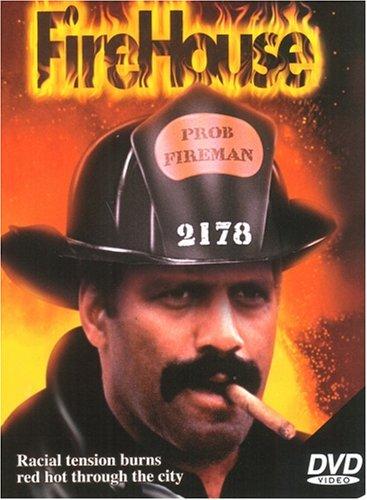
The DVD of Firehouse is infamous for featuring a picture of Fred Williamson on the cover, in which Williamson is smoking a cigar and wearing a fireman’s helmet.  Williamson does not appear anywhere in Firehouse and I can only imagine how many people have sat through Firehouse expecting to see a Fred Williamson blaxploitation film, just to discover that it was actually a Richard Roundtree television pilot.  Firehouse probably would have been better if it had starred Fred Williamson.  Roundtree’s good but sometimes, you just need The Hammer.

Music Video of the Day: Too Late For Goodbyes by Julian Lennon (1984, directed by Sam Peckinpah)


Not surprisingly, a lot of people have assumed that Julian Lennon was singing about his father, John Lennon, in this song.  Julian, himself, has denied that interpretation, saying that this song was just his way of dealing with a breakup and nothing more.

Like yesterday’s video, Too Late For Goodbyes was directed by Sam Peckinpah, the notorious director behind The Wild Bunch, Straw Dogs, and Pat Garrett and Billy The Kid.  It was directed at a time when Peckinpah’s Hollywood career was nearly over, having been sabotaged by too many fights with the studios and too many rumors about his drug and alcohol-intake.  His two videos for Julian Lennnon would be Peckinpah’s final work as a director.  He died just a few months after they were released.

In the UK, Too Late For Goodbyes was Julian Lennon’s first single and was followed by Valotte.  In the United States, the order was reversed and Too Late For Goodbyes came out after Valotte.  To date, Too Late For Goodbyes is the most successful single that Julian Lennon has ever released.  It reached #1 on the U.S. Adult Contemporary Chart and stayed there for two weeks.

Enjoy!

Film Review: Cocaine and Blue Eyes (1983, directed by E.W. Swackhamer)


When San Francisco-based private investigator Michael Brennen (O.J. Simpson) gives a ride to Joey Crawford (John Spencer) on Christmas Eve, he doesn’t know that it’s going to lead to the biggest case of his career.  When Joey asks Michael to help him track down his ex-girlfriend, Michael assumes that Joey would never be able to pay for his investigative services.  But one week later, Michael gets something in the mail from Joey.  Inside the envelope, there’s a picture of both Joey’s ex and a thousand dollar bill.  Ever after he discovers that Joey was mysteriously killed the night before, Michael decides to take on the case.  His investigation will take him not only to Joey’s ex but it will also lead to him uncovering a drug ring that involves one of San Francisco’s most prominent families.

Simpson not only starred in this made-for-TV movie but he also served as executive producer.  Watching the movie, it’s obvious that it was meant to serve as a pilot for a Michael Brennen TV series and it’s also just as obvious why that series never happened.  O.J. Simpson was not a terrible actor but, ironically for someone who set records as an NFL player, there was nothing tough about him.  Simpson may be playing a two-fisted, cash-strapped P.I. but, in every scene, he comes across like he can’t wait to hit the golf course.  Simpson’s pleasant demeanor may have served him well in other areas of his life but it didn’t help him with this role.  Whenever Simpson has to share a scene with John Spencer, Candy Clark, Cliff Gorman, or any of the other members of this film’s surprisingly talented supporting cast, Simpson’s bland screen presence and lack of gravitas becomes all the more apparent.

Of course, when seen today, the main problem with Cocaine and Blue Eyes is that it’s impossible to watch without thinking, “Hey, didn’t the star of this movie get away with killing his wife and an innocent bystander?”  Even the most innocuous  of lines take on a double meaning when they’re uttered by O.J. Simpson.  It doesn’t help that the movie opens with Michael visiting his estranged wife and their children on Christmas Eve and getting chased around the neighborhood by a guard dog.  When the movie was made, this scene was probably included so that O.J. could show off some of the moves that made him a star at UCLA and with the Bills.  Seen today, the scene takes on a whole different meaning.

Without O.J. Simpson, Cocaine and Blue Eyes could easily pass for being an extended episode of Magnum P.I., Simon and Simon, or any other detective show from the 80s.  With Simpson, it becomes a pop cultural relic.  I don’t think it’s ever been released on DVD but it is available on YouTube, where it can be viewed by O.J. Simpson completists everywhere.

Music Video of the Day: Vallotte by Julian Lennon (1984, directed by Sam Peckinpah)


I am as shocked as anyone to discover that this sedate video was directed by the director who was known (affectionately or not) as Bloody Sam but indeed it was.

Valotte was the first U.S. single from Julian Lennon, a musician whose talent was often overshadowed by the fact that he was the son of John and Cynthia Lennon.  John divorced Cynthia, leaving her for Yoko Ono, when Julian was only five years old and, by his own admission, Julian’s feelings towards his father have often been mixed.  (Paul McCartney reportedly wrote what would become Hey Jude in an attempt to console Julian after the divorce.)  When Julian Lennon pursued his own musical career, many reviewers spent more time discussing Julian’s physical and vocal resemblance to his father than his music.

As for the song, it was a ballad about finding love and not, as many have incorrectly assumed, a song about Julian’s relationship with John.  The song was initially written at a French chateau known as the Manor de Valotte, which is how the song got its name.  The single was subsequently recorded at Muscle Shoals Sound Studio in Alabama.  The line, “Sitting on a pebble by the river playing guitar” is a reference to the location of the studio.

As for Sam Peckinpah, both his career and his health were in decline when he directed this video.  Peckinpah made a huge impression in the late 60s and early 70s with films like The Wild Bunch and Straw Dogs but, by the time the 80s came around, the critics had turned on him and his abuse of drugs and alcohol had become so notorious that he couldn’t get a job in Hollywood.  Peckinpah directed both this video and Lennon’s follow-up, Too Late For Goodbyes.  His work on the videos was critically acclaimed but unfortunately, Peckinpah would pass away shortly after they were released.

Enjoy!

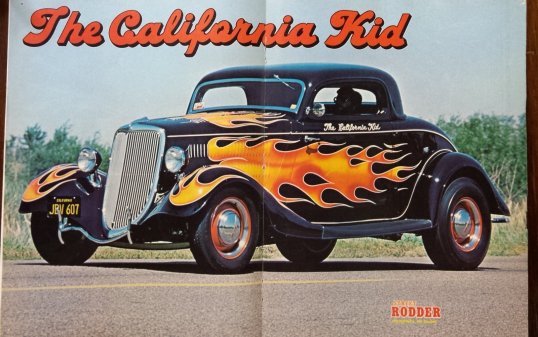
Automotive Stardom: The California Kid (1974, directed by Richard T. Heffron)


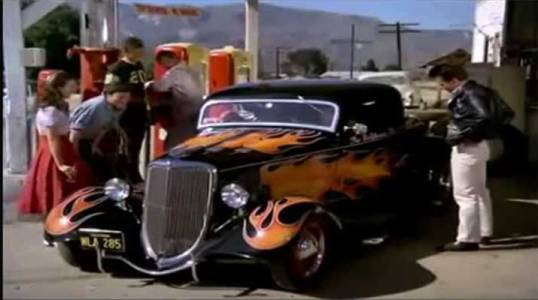
In 1973, a customized 1934 Ford three-window coup appeared on the cover of the November issue of Custom Rod.  The car had been created by legendary customizer Pete Chapouris and it was called The California Kid.  The cover caught the attention of television producer Howie Horowitz, who thought that maybe the car could become a star.

A year later, the car starred in it’s own made-for-TV movie.  Naturally, that movie was called The California Kid.
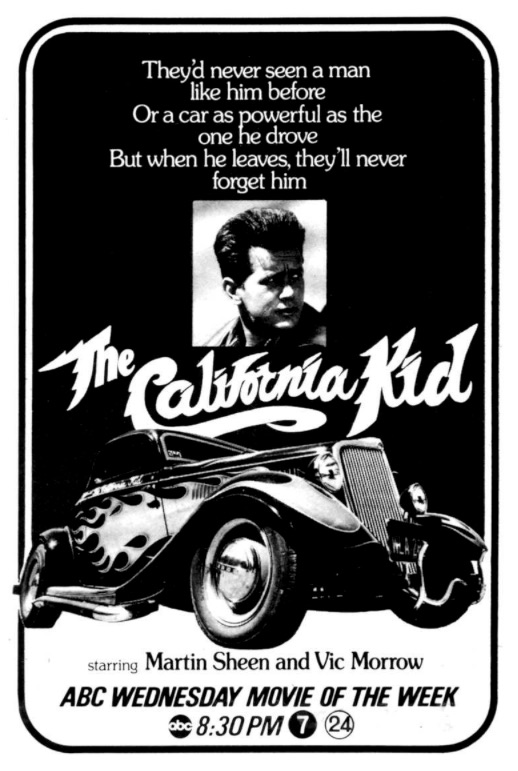
The California Kid takes place in 1958 in the small town of Clarksberg.  Clarksberg is known for being a town that does not tolerate speeders.  Sheriff Roy Childress (Vic Morrow) lost his wife and daughter to a speeder and, ever since, he’s become a fanatic about making sure that people respect the speed limits.  He’ll give a ticket to anyone who he sees going too fast.  He’ll even impound your car.  And if you don’t learn your lesson or if you try to outrun him, he’ll get behind your car, give it a push, and send both you and your vehicle plunging over the side of a mountain.

That’s what happens to Don McCord (Joe Estevez), a Marine who was just trying to get back to back to his base on time.  After Don and his car go over the side of a cliff, the official ruling is that it was an accident.  However, Don’s brother, Michael (Martin Sheen, real-life brother of Joe Estevez), doesn’t buy that.  Determined to prove that his brother was murdered, Micheal rolls into town, behind the wheel of the California Kid.

The California Kid is a typical 70s car chase movie.  There’s not much going on other than the sheriff chasing the Michael and the California Kid.  Martin Sheen coasts through the movie, doing the James Dean impersonation that he perfected in the previous year’s Badlands and Vic Morrow plays his thousandth sadistic authority figure.  The supporting cast is full of familiar names who don’t get to do much.  Michelle Phillips plays the waitress who falls in love with Martin Sheen.  (It’s always a waitress.)  Stuart Margolin is Morrow’s deputy and keep an eye out for Nick Nolte, playing a mechanic.  Interestingly, The California Kid was written by Richard Compton who, a year later, would direct Notle in his first starring role in the 1975 car chase film, Return to Macon County.  Of course, the real star of the movie is the car and the California Kid earns its star billing.  The movie might not be anything special but there’s no way you can watch it and not want to drive that car.

This is a made-for-TV movie so you won’t hear any profanity and the characters are all as simple can be.  However, there are enough shots of cars going over cliffs to keep chase enthusiasts entertained.