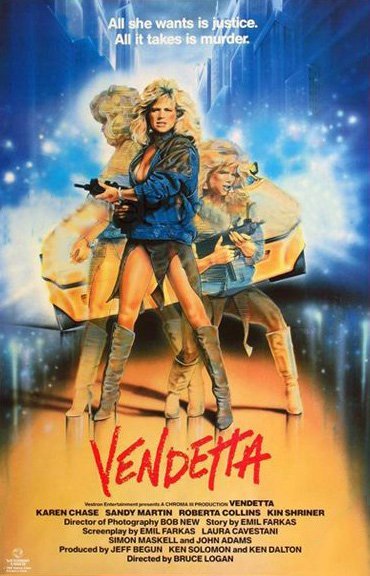
Vendetta (1986, directed by Bruce Logan)


After killing her rapist in self-defense, young and pretty Bonnie (Michelle Newkirk) is sentenced to two years in prison.  It’s one of those tough women’s prisons where all of the inmates dress like they’ve just come back from shooting an 80s music video and where the prisoners only have arcade games, a Olympic-size swimming pool, and a fully stocked gym to help them pass the time.  It’s so tough that, when it comes to conjugal visits, the prisoners have to settle for being driven to a nearby motel.  It’s the toughest prison since Leavenworth.

Because she’s blonde and innocent-looking, Bonnie is targeted by the predatory Kay Butler (Sandy Martin).  After Bonnie rejects Kay’s advances in the public shower room (while all of the other prisoners watch), Kay get her revenge by giving Bonnie a hot dose and then shoving her over a railing.  Even though all the evidence indicates that Bonnie was murdered, the official cause of death is ruled to be suicide.

What no one considered was that Bonnie’s older sister, a Hollywood stuntwoman named Laurie (played by real-life stuntwoman Karen Chase), would want revenge.  Determined to investigate the prison on her own, Laurie steals a judge’s car.  When that same judge attempts to suspend Laurie’s sentence, Laurie attacks him in the courtroom.  (Why would a judge be allowed to oversee a trial that directly involved him as a witness?)  Laurie finally gets her wish and is sentenced to prison.  Having now compiled the type of criminal record that will probably make her unemployable for the rest of her life, Laurie sets out to discover who is responsible for the death of her sister.  Soon, Laurie is tracking down and murdering every member of Kay’s gang, all the while trying to avoid getting caught by the head guard, Miss Dice (Roberta Collins).

In many ways, Vendetta is a typical 80s women-in-prison movie.  It has everything that you would expect to find in one of these movies: predatory lesbians, a victimized innocent, corrupt guards, and a gratuitous shower scene.  What sets Vendetta apart from similar films is that the prison is more of a health club than a prison and, while she’s hardly the world’s greatest actress, Karen Chase looks very credible when she’s beating the other inmates to death.  As a result, the fight scenes are more exciting than they usually are in a film like this and Karen Chase’s Laurie is a stronger heroine.  She can hold her own against anyone who comes at her.  Sandy Martin is also an effective villain and there’s actually some unexpected depth to her character.  She actually gets upset when her gang start to get killed, not just because she’s losing people who are willing to do her bidding but also because she’s losing the only people that she feels close to.  Thanks to Karen Chase’s fight skills and Sandy Martin’s unexpected performance, Vendetta is better the than the average 80s prison flick.
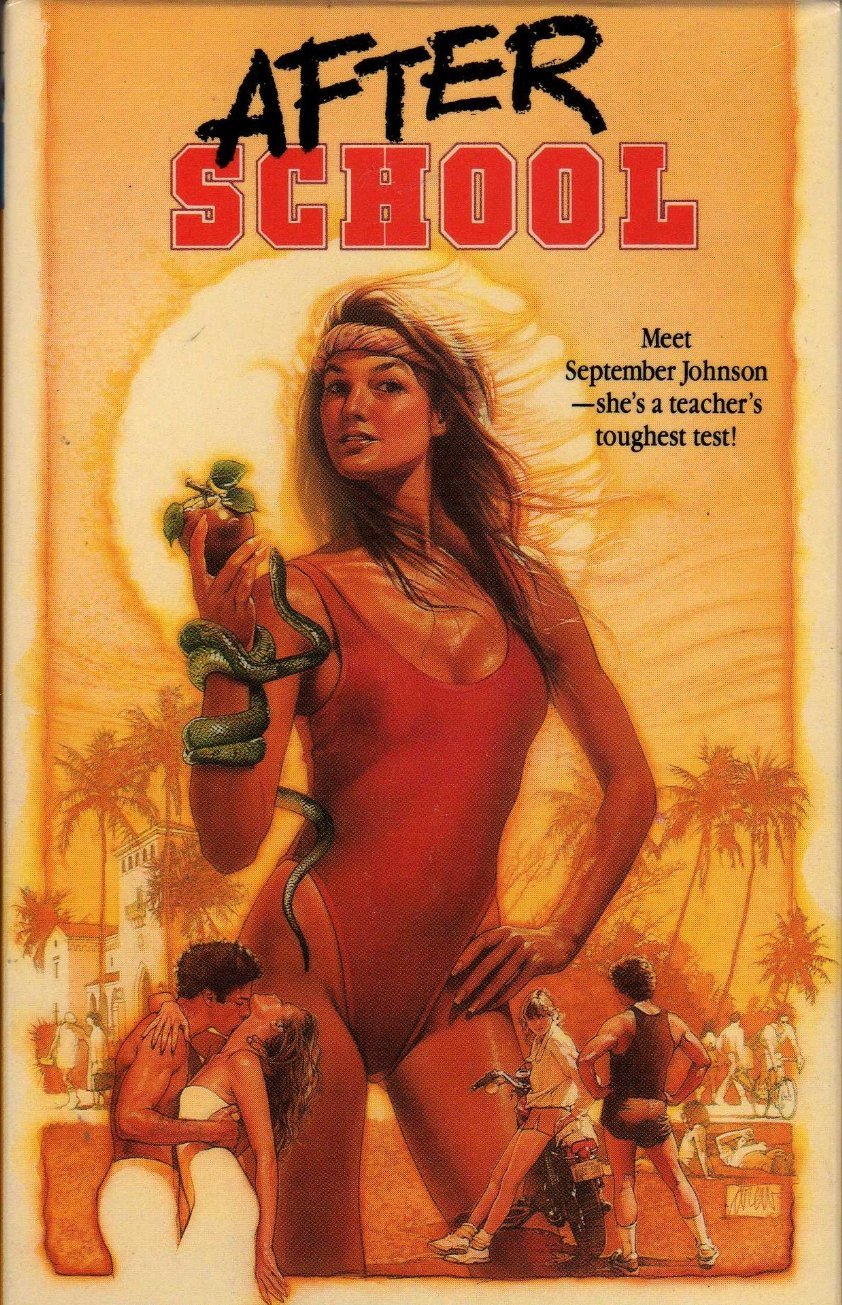
After School (1988, directed by William Olsen)


After School is a strange “what were they thinking?” type of movie.  It’s also probably the only movie to end with a religious debate that’s moderated by Dick Cavett.

Cavett plays himself.  In this film, he still has a talk show and one of his guests is going to be C.A. Thomas (Robert Lansing), a former priest who has written a novel claiming that man created God and not the the other way around.  Cavett has reached out to the Catholic Church to ask them to send someone to represent their views on the show.

For reasons that are never clear, the Church selects Father Michael McClaren (Sam Bottoms), who teaches at a college in Florida.  Father McClaren is youngish and he rides a motorcycle, which the monsignor thinks will appeal to younger viewers of Cavett’s show.  (Did The Dick Cavett Show have younger viewers?)  Because Dick Cavett is legendary for investigating the pasts of all of his guests (that’s what they say in the movie, anyway), another priest is sent down to Florida to make sure that Father McClaren does not have any skeletons in his closet.

At first, Father McClaren seems to be perfect but it turns out that he’s having a crisis of faith.  It’s not just that the local bikers don’t have much respect for a priest, even when who does ride a bike.  It’s also that he’s become attracted to one of his students, the improbably-named September Lane (Renee Coleman).  It doesn’t take the movie long to settle into a familiar pattern of September coming on Father McClaren and then Father McClaren having to run off so that he can pray for strength.

So far After School might sound like a typical movie about a priest being tempted to break his vows.  However, what sets After School apart from other films of its type is that there are frequent scenes featuring a group of cavemen living in prehistoric times.  It’s never really made clear why the cavemen are in the film.  The main caveman yells a lot and there’s a scene with a snake that suggests that he might live in the Garden of Eden.  (The movie was originally released under the title Return to Eden.)  There’s also several naked cavewomen who are in the film so that they can be ogled by the cavemen.  Oddly, the cavepeople scenes are full of broad comedy while the rest of the movie takes itself fairly seriously.

Why are the caveman there and what does it have to do with Dick Cavett?  Who knows?  That’s one of the many unanswered questions to be found in After School.  When C.A. Thomas and Father McClaren do finally meet on the Dick Cavett Show, they debate the origins of mankind.  Neither one has nothing new to say on the subject.  Even though everything that C.A. Thomas says sounds like New Age gobbledygook, Father McClaren proves himself to be incapable of countering him.

I don’t know what the point of After School was.  There were so any scenes, like one in which Father McClaren attends an aerobics class, that didn’t seem to have any purpose.  September’s lust for Father McClaren never makes any sense and his sudden declaration of love makes even less.  Even if you can make sense of all that, there’s still the cavemen and Dick Cavett to deal with.

After School thinks that it is about something but who knows what?

Missile to the Moon (1958, directed by Richard E. Cunha)


At a secret laboratory located just a few miles from the local prison, scientist Dirk Green (Michael Whalen) is working with Steve Dayton (Richard Travis) to build a missile that’s capable of flying to the Moon.  Dirk’s obsession about traveling to the moon is not just scientific.  Dirk is secretly from the Moon himself and is desperate to return.

Dirk gets his opportunity when two convicts escape from the prison and hide out in his rocket.  Dirk agrees not to turn Gary (Tommy Cook) and Lon (Gary Clarke) over to the authorities but only if they agree to help him fly the rocket to the Moon.  It turns out that it doesn’t take any special training to fly a rocket.  According to this film, you don’t even have to worry about oxygen in space.  Anyone can travel to the Moon, even two escaped convicts who have only had about an hour’s worth of instruction in how to pilot a rocket!  Gary and Lon agree because dying in space is preferable to serving out a prison sentence.

Once Dirk, Gary, and Lon are in space, they discover that Steve and his fiancee, June (Cathy Downs), have stowed away on the ship.  Gary takes a liking to June but Steve tells him to back off.  After a journey through a meteor field, the missile finally lands on the Moon, which is ruled over by The Lido (K.T. Stevens), a beautiful woman who enforces order through the help of a giant spider.

This afternoon, Lisa and I watched Missile to the Moon because today is May 4th, which is also known as Star Wars Day.  (May the 4th be with you, get it?)  Since every Star Wars film has already been reviewed on this site, I had to find a different science fiction film to review for today.  And because Lisa claimed Starcrash for herself, I got stuck with Missile to the Moon.

Missile to the Moon is science fiction with an emphasis on the fiction.  In this film, space travel is easy and certain parts of the moon have a breathable atmosphere.  Not to mention, of course, that there are all sorts of creatures living on the Moon.  It’s easy to laugh at Missile to the Moon today but this movie was made before anyone had ever set foot on the Moon so, for all people knew, there could have been aliens and giant spiders living underneath the surface.  In fact, maybe there still are.  It’s been a while since anyone went up there and checked.

The main thing I liked about Missile to the Moon was the implication that anyone, no matter how dumb, can learn how to fly a spaceship in under an hour.  That’s what we all believed when we were kids.  Want to go into space?  Just put me in the pilot’s seat, show me where the booster button is, and let’s go into hyperspace!  The other thing I liked about the movie is that the Moon was populated by attractive belly dancers.  That’s exactly what you want to find on another planet.  The paper mache spiders were pretty cool too.

It’s a dumb movie but I enjoyed it.  I’d rather go to the movie’s Moon than the real Moon.

May the 4th Be With You: Star Wars Thoughts


Today is May 4th, which is known to some people as being Star Wars Day.  (May the 4th be with you.  Get it?)  I love the original Star Wars movies, even if Return of the Jedi deserves its less than stellar reputation.  The first three prequels I could do without, even though Revenge of the Sith was actually fairly good.  Of the three sequels, The Force Awakens was good.  The Last Jedi and The Rise of Skywalker were both overstuffed and forgettable.  Solo was adequate.  I liked Rogue One.  It was the only one of the new films to really seem to get what Star Wars was all about.

If I had to rank them all, I think it would go something like this:

  1. The Empire Strikes Back
  2. Rogue One
  3. New Hope
  4. The Force Awakens
  5. Revenge of the Sith
  6. Return of the Jedi
  7. Solo
  8. The Rise of Skywalker
  9. The Last Jedi
  10. Attack of the Clones
  11. The Phantom Menace

I’m not going to rank the two Ewok movies or The Holiday Special.  You have to draw the line somewhere.

Looking over the franchise as a whole, I think Star Wars shows the danger of overexplaining.  In a New Hope, it didn’t matter whether or not we actually knew what the Kessel Run was or the exact details of The Clone Wars.  They just sounded cool and they sparked our imaginations.  We also didn’t know how the Empire came to exist or how Darth Vader could be both Luke and Leia’s father.  We didn’t know how the Force worked, exactly.  Nor did we know the exact details of how the Jedi were wiped out.  We really didn’t need to know.  We just accepted what the films told us and then let our imaginations fill in the missing pieces.

Then the prequels came along and suddenly, we discovered that everyone in the Star Wars universe was obsessed with trade routes and suddenly, The Clone Wars lost all of their mythic grandeur as we learned, in pain-staking details, every reason why the wars began and how they ended.  They just became another collection of CGI space battles.  And then Solo showed us the Kessel Run and we discovered that it really wasn’t anything that special.  Probably the only prequel (and sequel) that didn’t diminish the other films was Rogue One.  In fact, Rogue One brought some of that epic grandeur back to the films.  With its scenes of Death Star destroying entire cities and planets, it actually made A New Hope more effective.  After watching Rogue One, it’s not as easy to mock the Empire’s super weapon.

Today’s big news is that Taika Waititi will be directing the latest Star Wars film.  Waititi was the first director to actually understand what to do with Thor (who, up until Thor: Ragnarok, had been Marvel’s least interesting hero) and, of course, he also directed JoJo Rabbit.  My hope is that Waititi will be given the freedom to bring some new life to Star Wars.  I think he’s capable of bring some wonder back to a universe that could definitely use it.

May the force be with him.

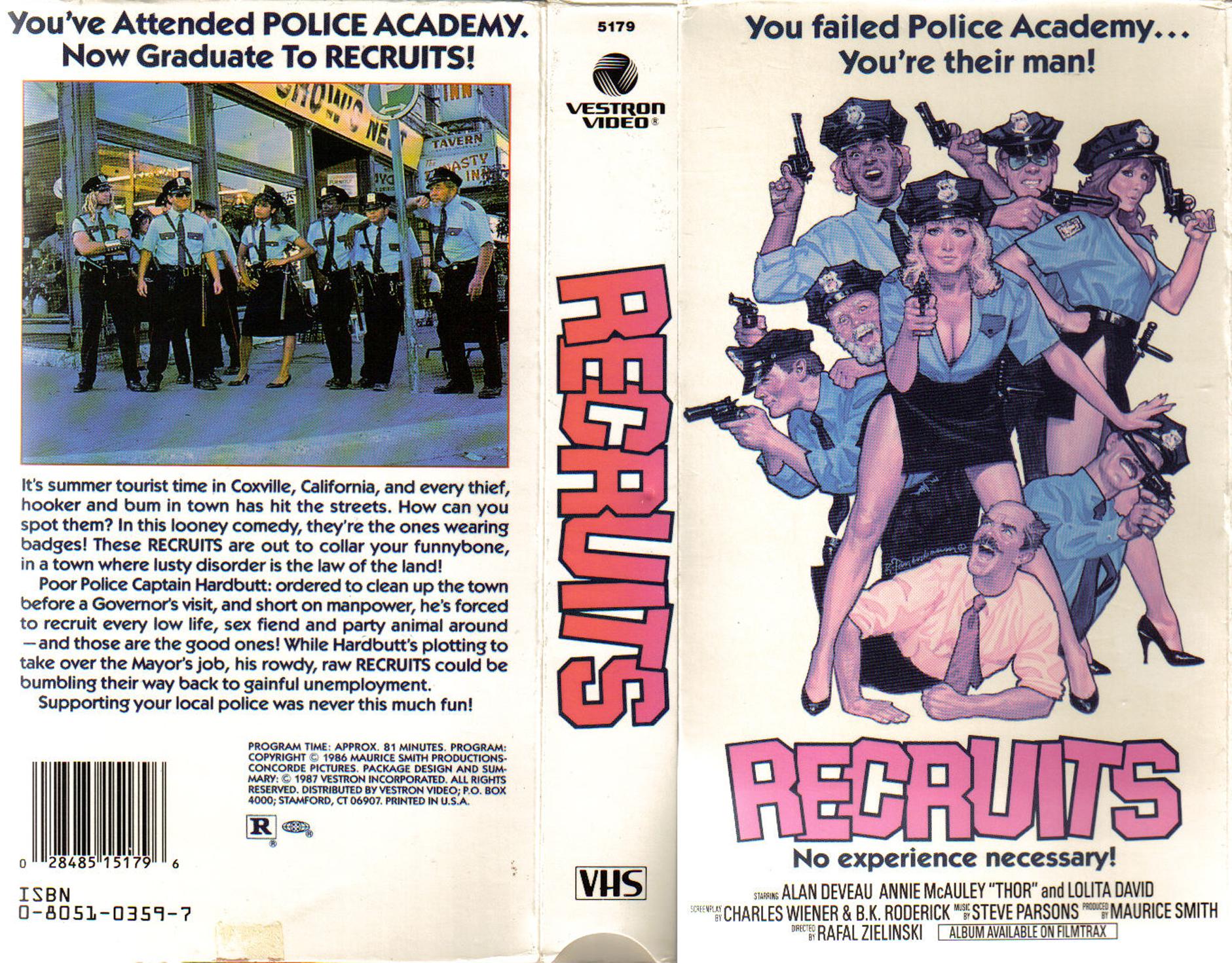
Recruits (1986, directed by Rafal Zielinski)


Stop me if this sounds familiar.

The governor of Californa is planning on visiting the small town of Corvette so that he can announce the opening of a new highway.  The mayor is concerned that the town’s small police force might not be big enough to handle all of the pomp and drama that goes along with an executive visit.  He orders Captain Magruder (Mike McDonald) to lower the department’s standards and to recruit civilians off the street so that they can quickly be trained to become police officers.  Magruder starts by going to down to the jail and recruiting for low-level offenders.

If you think this sounds a lot like Police Academy, you’re absolutely right.  Just as Police Academy was pretty much a rip-off of Stripes, Recruits is a rip-off of Police Academy.  Once again, the recruits are a lovable gang of misfits who screw up big time before getting a chance to prove that they have what it takes to be real cops.  There’s the usual beach patrol scenes, a lot of nudity, and one manic nerdy recruit whose antics would inspire even Jerry Lewis to say, “Tone it down a little.”  However, there is a major difference between Recruits and Police Academy.  In Recruits, there is no lovable Commandant Lassard.  Instead, Captain Magruder wants the recruits to fail because he’s hoping that the governor will fire the mayor and appoint Magruder in his place.  I’m not sure that’s how municipal politics actually works but maybe it’s just a California thing.

As far as brainless rip-offs of movies that weren’t particularly good to begin with go, Recruits isn’t that bad.  The humor is even more juvenile here than it was in Police Academy and trying to apply too much logic to the plot will make your brain hurt but it’s a breezy 90 minutes and it’s got a game cast, a few of whom went on to better things.  (Lolita Davidovich, for instance, is the recruit who ends up naked in a limo that turns out to belong to the governor.)  Jon Mikl Thor made his feature film debut as a recruit named Thunderhead and he gets to battle a bunch of outlaw bikers while one his songs plays in the background.  It’s a pretty cool scene.  If you’re nostalgic for these types of unapologetically dumb comedies, Recruits will satisfy that nostalgia.

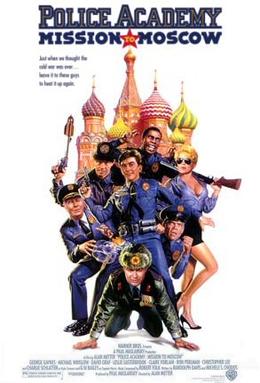
Police Academy 7: Mission to Moscow (1994, directed by Alan Metter)


Russia has a problem.  Mob boss Konstantine Konali (Ron Perlman, slumming) has created a video game so addictive that the people playing it don’t even realize that it’s actually a sophisticated computer virus that allows Konali to take control of almost any security system.  As a result, Moscow has been hit by a string of robberies.  The Moscow police commandant, Nikolaivich Rakov (Christopher Lee, slumming even more than Perlman) knows that he doesn’t have the resources to stop Konali so, as so many have done before him, he decides to contact Commandant Eric Lassard (George Gaynes) and asks for help.

In others words: Police Academy Goes To Russia!

Well, some of the Police Academy graduates get to go.  After the box office failure of City Under Siege, there was a five year hiatus between that movie and the latest (and last) installment in the Police Academy film saga.  During that time, the juvenile boys who made up the franchise’s target audience all grew up and became too cool to admit that they had ever seen a Police Academy film.  By the time Mission to Moscow went into production, most of the stars of Police Academy had also either moved on or desperately wanted to create the impression that they had something better to do than go to Russia to take part in the final stand of an aging franchise.

As a result, Lassard only takes Tacklberry (David Graf), Sound Effects Machine (Michael Winslow), Callahan (Leslie Easterbrook), Harris (G.W. Bailey), and Cadet Connors (Charlie Schlatter) with him to the Russia.  Cadet Connors is a computer expert and he is obviously meant to be the new Steve Guttenberg/Matt McCoy style wiseass.  He ends up falling for a pretty Russian translator (Claire Forlani).  Cadet Connors tries his best but he’s no Carey Mahoney.

Give Mission to Moscow some credit for predicting both the rise of the Russian Mafia and the danger of computer viruses.  Otherwise, Mission to Moscow ends the Police Academy franchise in a desultory manner.  The cast looks old and even the usually reliable Sound Effects Machine doesn’t bring much energy to his shtickPolice Academy: Mission to Moscow was one of the first American movies to be filmed in Moscow after the collapse of the Soviet Union and it even features an actor standing in for Boris Yeltsin.  In the tradition of a family sitcom doing a special episode of Epcot Center, there’s plenty of footage of the cast standing in front of all of the landmarks but otherwise, Mission to Moscow doesn’t do much with its setting.  It’s interesting as historical trivia but forgettable as a movie.

10 years after the series began, Mission to Moscow brought the Police Academy films to a close, not with a bang but with a very exhausted whimper.  There was a syndicated tv series featuring the Sound Effects Machine that aired in 1997 but I never saw an episode and I was surprised to lean that it even existed.  It’s on YouTube so, someday, I’ll try to watch it.  Not today, though.


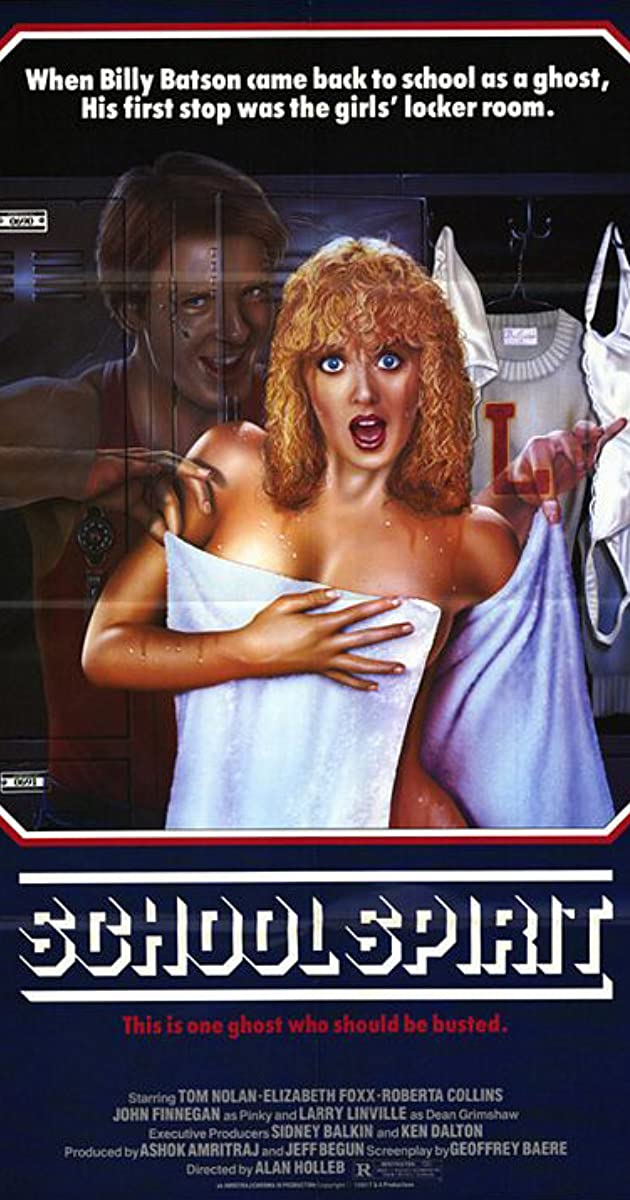
Cinemax Friday: School Spirit (1985, directed by Alan Holleb)


Though he’s clearly in his late 30s and doesn’t have much of a personality, Billy Batson (Tom Nolan) was the most popular student at Lavatoire University.  Not only did all of the ladies love him but Billy was also Hogmeister, the king of school’s annual Hog Day.  Everyone at the university loved Billy except for crusty old President Grimshaw (Larry Linville).  Sadly, Billy was killed in a traffic accident that was entirely his fault.  He had gone down to the local roadhouse to use their condom machine and he was so excited afterward that he dropped the condom while driving.  When he reached down to grab it, he took his eyes off the road and one thing led to another.  The lesson?  Safe sex kills.  That’s not a great lesson today and it was an even worse one in the 80s but what are you going to do?

Billy’s dead.

Or is he?

No, don’t worry, he’s dead.  At the hospital, his spirit rises out of his body and he’s greeted by his deceased Uncle Pinky (John Finnegan).  Pinky says that it’s time to go to Heaven but Billy wants just one more day so that he can oversee Hog Day and get laid.  Pinky says no way but then he gets distracted by a comely nurse.  Billy escapes from the hospital and returns to the campus.

Even though he’s dead, Billy still appears in corporeal form and everyone can talk to him.  The only special power that Billy has is that he can wave his hand over his head and turn invisible.  Billy uses his powers once or twice and there’s the expected trip to the girl’s shower but that’s really the extent of School Spirit‘s supernatural angle.  The movie doesn’t really seem to be committed to the idea of Billy being dead.  Also, at no point in the film does Billy Batson say “Shazam!,” and that really is unforgivable.

Billy wants to sleep with snooty Judith Hightower (Elizabeth Foxx) but then he gets distracted by Grimshaw’s wild daughter (Marta Kober) and also by Madeleine Lavatoire (Daniele Arnaud), who is visiting from France.  It doesn’t take long for Billy to realize that Madeleine is the one for him but how can he fall in love with anyone when he’s going to have to go to the afterlife at midnight.  Appropriately, it all ends with a case of deus ex machina.  The ending makes no sense but neither does the rest of the movie so give School Spirit some credit for being consistent.

School Spirit is a stupid movie and, with the exception of Larry Linville and Marta Kober, the cast is a forgettable.  This is the type of comedy that used to show up regularly on late night Cinemax.  What it lacked in laughs, it made up for in boobs and that was really what the majority of its audience was watching for.  People who stayed up late to watch Cinemax were not the most demanding viewers in the world.  Today, the film will mostly appeal to people nostalgic for 80s sex comedies.  Why they would watch School Spirit instead of something like Risky Business, I don’t know.  Maybe they needed a movie to review for a blog.

Tomorrow, I finish off my Police Academy reviews by taking a look at Mission to Moscow!

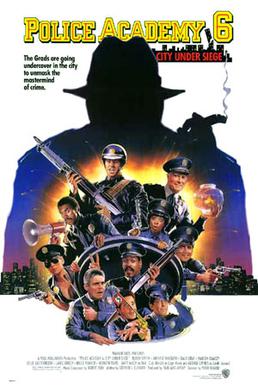
Police Academy 6: City Under Siege (1989, directed by Peter Bonerz)


The sixth Police Academy film opens with another crime wave.  Considering that the Police Academy Class of 1984 was supposedly the best to ever graduate, they don’t seem to have done much to clean up the city.  This time, a series of robberies are being committed in the Wilson Heights neighborhood.  Since Captain Harris (G.W. Bailey) and Lt. Proctor (Lance Kinsey) don’t seem to be capable of upholding the law in their precinct, the Mayor (Kenneth Mars) orders Harris to work with Commandant Lassard (George Gaynes) and the usual gang of Police Academy graduates.

Carey Mahoney is still missing in action but Nick Lassard (Matt McCoy) has transferred up from Miami and has taken Mahoney’s place as the resident smartass.  Also returning are Sound Effects Man (Michael Winslow), Hightower (Bubba Smith), Hooks (Marion Ramsey), Callahan (Leslie Easterbrook), Tackleberry (David Graf), and, after having been absent for the previous two films, Sgt. Fackler (Bruce Mahler)!

I cannot believe I’m saying this but Police Academy 6 turned out to be better than I remembered.  It’s just as stupid as all of the other Police Academy films but everyone seems to be having a good time and Matt McCoy no longer feels out of place as Mahoney’s replacement.  Bruce Mahler’s return as Fackler also means a return to the physical comedy that he excelled at in the first two films and the total incompetence of Harris and Proctor is handled better here than it was in the previous few films.  A welcome addition to the cast is Gerrit Graham, as the childish head of the robbers.  (Whereas the previous few films at least tried to pretend like the criminals were a potentially serious threat, City Under Siege presents them as being as clownish as everyone else in the film.  It’s a better approach because it’s not as if anyone watches a Police Academy film expecting to see something like The French Connection or Fort Apache, The Bronx.Police Academy 6 is a stupid, stupid movie and the jokes are as juvenile as ever but, along with Part 3, it’s still one of the better sequels.

Police Academy 6 was the first Police Academy film to not be a box office hit.  It would be followed by one final sequel, Mission to Moscow, which I’ll take a look at on Saturday.

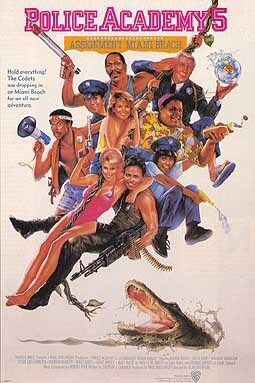
Police Academy 5: Assignment Miami Beach (1988, directed by Alan Myerson)


Police Academy 5 starts as so many Police Academy films have started.  Commandant Lassard (George Gaynes) is getting progressively more loopy and Captain Harris (G.W. Bailey) is plotting to take over the Academy.  This time, Harris thinks that he has come up with the perfect plan when he discovers that Lassard has reached the mandatory retirement age.

With retirement looming, Lassard attends one final law enforcement convention in Miami.  At the convention, Lassard is to be honored as “Police Officer of the Decade” because it was apparently a very slow decade.  Lassard decides to bring along his favorite academy graduates so that they can celebrate with him and meet his nephew, Sgt. Nick Lassard (Matt McCoy, who you may recognize as Seinfeld’s Lloyd Braun or maybe as the spokesman for Hartford Insurance).   The commandant invites Sound Effects Guy (Michael Winslow), Tackleberry (David Graf), Hightower (Bubba Smith), Hooks (Marion Ramsey), Callhan (Leslie Easterbrook), and House (Tab Thacker).  Notice who isn’t there?  This was the first Police Academy film without Steve Guttenberg’s Carey Mahoney and Commandant Lassard celebrating his career without inviting his most loyal graduate doesn’t seem right.

Once what is left of the old gang arrives in Miami, they get caught up in the usual Police Academy shenanigans.  Rene Auberjonois plays a jewel thief who accidentally switches bags with the Commandant and who has 24 hours to retrieve the stolen diamonds.  It’s Florida so there are women in bikinis and an Everglades boat chase.  Harris gets humiliated in every way possible.  The jokes are even more juvenile than usual.  Nick Lassard uses sunscreen to permanently label Harris as being a “dork” so everyone on the beach calls Harris a “dork.”  That’s as sophisticated as things get.

Unfortunately, there’s a Steve Guttenberg-shaped hole at the center of Police Academy 5 and not even as formidable a thespian as Matt McCoy can fill it.  Even though Guttenberg always seemed like he was miscast as both a cop and a former juvenile delinquent, Police Academy 5 shows how important he really was to the franchise.  Mahoney was the closest thing that the Police Academy films had to a fully developed character and, without him around, it’s even more obvious how thinly drawn all of the other characters were.  (Guttenberg was filming Three Man And A Baby while Police Academy 5 was in production though, in an A.V. Club interview a few years ago, Guttenberg said the real reason he wasn’t invited to Miami Beach was because the producers couldn’t afford to pay his salary.  “You’ve got to get paid!” Guttenberg explained.)

I will, however, give Police Academy 5 some credit.  Rene Auberjonois does what he can with his bumbling jewel thief and the scene where Tackleberry pulls a gun on a shark made me laugh.  Otherwise, Police Academy 5 is no Police Academy 3.

Tomorrow, it’s time for … you guessed it! …. Police Academy 6!

Police Academy 4: Citizens on Patrol (1987, directed by Jim Drake)


Long before the end credits of 22 Jump Street imagined Jonah Hill and Channing Tatum going to culinary school, the flight academy, and into outer space, the Police Academy films bravely tested just how far one already thin premise could already be stretched.

In Police Academy 4, Commandant Eric Lassard (George Gaynes) comes up with another plan to make the city safer.  (Since Lassard has been coming up with plans for three years without any success, it may be time to let the old man retire peacefully.)  This time, he wants to institute Citizens on Patrol, which would mean training citizens to act like cops.  It sounds like the type of terrible idea that could get a city sued into bankruptcy but considering that this is a city where a human sound effects machine and the former head of the 16 precinct’s biggest gang can become decorated police officers, I guess it’s as good an idea as any.

As usual, Carey Mahoney (Steve Guttenberg) and the gang are ready to help Lassard.  Bruce Mahler’s Fackler is no longer a part of the ensemble but Bubba Smith, Bobcat Goldthwait, Michael Winslow, David Graf, Tim Kazurinsky, Marion Ramsey, and Brian Toschi are all back.  Also returning, after skipping out on the first two sequels, is Capt. Harris (G.W. Bailey).  Harris wants to see Lassard fail so that he can take over the police academy.  It’s the same thing as the first three films.  As in previous Police Academy films, there’s a visit to the Blue Oyster leather bar and a last minute crime wave to give the Citizens on Patrol a chance to prove they belong in the program.  The Citizens on Patrol include Billie Bird, Brian Backer, David Spade, wrestler Tab Thacker, and Corrine Bohrer as a love interest for Bobcat Goldthwait.  Sharon Stone also makes an appearance, playing a journalist and improbably falling for Steve Guttenberg.  Watching the film, it is obvious that the idea was that, in future Police Academy films, the Citizens on Patrol could replace any of the regular cast members who wanted too much money to return.  As a result, almost every veteran of the cast has a doppelganger in the Citizens on Patrol.  Brian Backer could replace Steve Guttenberg.  Tab Thacker is there to put Bubba Smith on notice that no one is irreplaceable.  Is Bobcat Goldthwait being difficult?  Just remind him that David Spade can play a crazy eccentric too.

Police Academy 4 is the most crowded of the Police Academy films and, even by the franchise’s undemanding standards, most of the jokes fall flat.  Jim Drake took over as director after the director of the previous two films, Jerry Paris, died of a brain tumor and Drake struggles to balance low comedy with police action.  Guttenberg and company don’t have the same energy in this installment as they had in the previous three and the new cast members all feel as if they’re out place sharing scenes with the veterans, like a group of underclassmen who have been invited on the senior trip.

This would be the final Police Academy film for Steve Guttenberg.  Would the franchise be able to survive without him?  Check here tomorrow to find out with my review of Police Academy 5!