Originally broadcast in 1985, Into Thin Air is a made-for-TV movie that is based on a true story. It’s film that brings to life the horror of every family’s nightmare. Brian Walker (Tate Donavon) is an intelligent, soft-spoken, and somewhat naive college student in Ottawa. He’s been accepted into a summer writing program in Colorado. As he gets in the van that he will be driving to Colorado, he promises his mother, Joan (Ellen Burstyn), that he’ll call her when he reaches Nebraska and again when he reaches Colorado.
Brian drives away and that’s the last time that Joan ever sees her son. Brian calls from Nebraska and talks to his brother, Stephen (Sam Robards). Joan arrives home just as Stephen is saying goodbye. Brian never calls from Colorado. He has vanished, seemingly into thin air.
Joan, Stephen, and Joan’s ex-husband, Larry (played the great character actor Nicholas Pryor) travel to America to search for him. At one point, Stephen thinks that he’s spotted Brian’s van on the road and chase after it, just to discover that it’s a different van. Joan talks to cops in Nebraska and Colorado and discovers that different jurisdictions don’t work together or share information. As the days pass, Joan keeps hoping that Brian is somehow still alive….
I was about ten minutes into this film when I started sobbing. I pretty much cried through the entire film. Some of that was because I knew that they were never going to see Brian again. Some of that was because of the powerful, heartfelt performances of Ellen Burstyn, Nicholas Pryor, and Sam Robards. Most of it was because this film did such a good job of capturing the feeling of hopelessness and the dread that comes with not knowing what has happened to someone who you love. I found myself crying for Brian’s lost potential. He was a writer and he was engaging in a time-honored writing tradition. He was taking a road trip and he was discovering the world. He deserved better than whatever happened to him. He deserved see his novel sitting in a bookstore. Instead, he ran into the wrong people.
It’s the little details that really got to me. Stephen flies into a rage when he sees his younger brother wearing one of Brain’s sweaters. Joan momentarily gets her hopes up when she discovers that Brian reported some lost traveler’s checks, just to have that hope shot down when she’s told that the bank can’t reveal where Brian called them from unless Brian himself gives permission. When the van eventually turn up in Maine, it’s been totally trashed by whoever took it from Brian.
Eventually, Joan hires a private detective and Robert Prosky is well-cast as Jim Conway, a seemingly cynical ex-cop who dedicates himself to trying to provide closure for the Walkers. The scene where he finally discovers what happened to Brian is one of the strongest in the film and one of the most upsetting. So many people could have saved Brian if they only had the courage to speak up.
Into Thin Air is a powerful film. No one should ever be forgotten.
“You want to shoot me, go ahead. It won’t matter. I’ve seen things you wouldn’t believe.” — The Stranger
The Western Wound: Horror, History, and the Haunting of Frontier Mythology
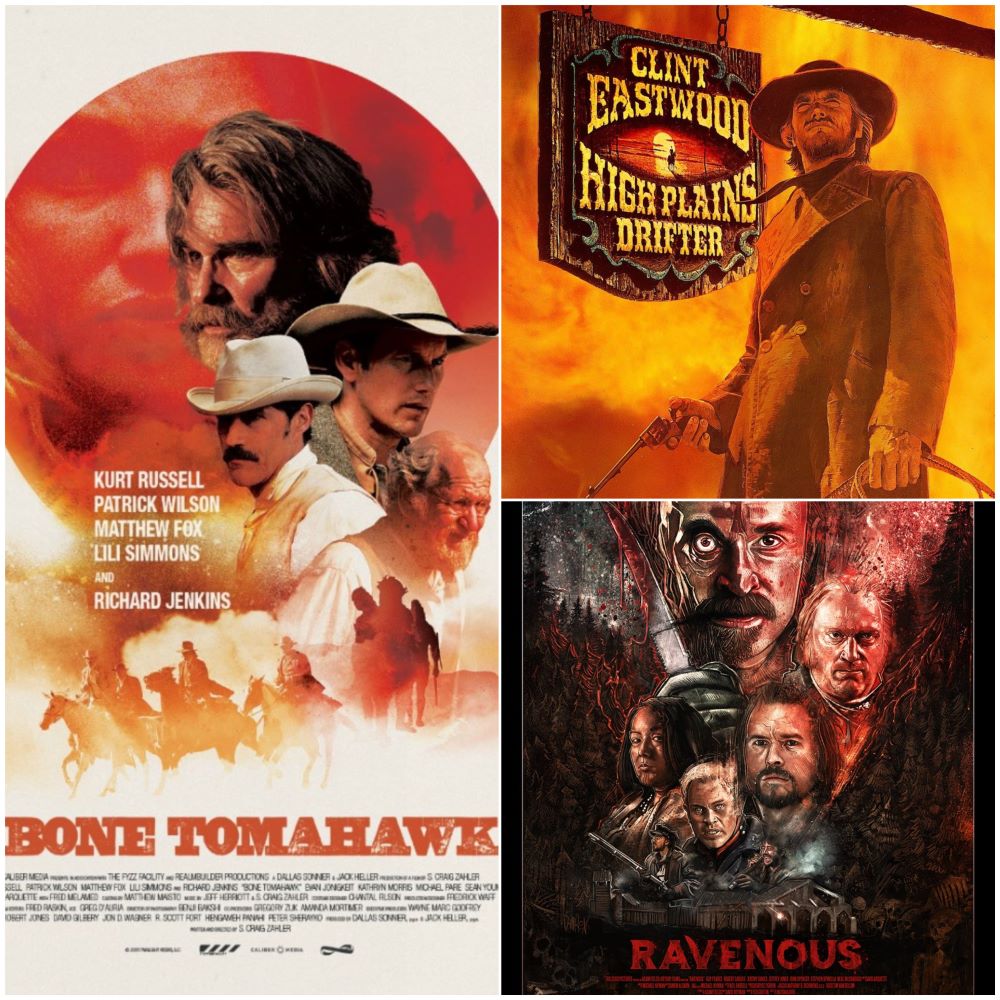
Horror profoundly shapes, distorts, and reframes the American Western, complicating familiar narratives of lawmen and outlaws with the uncanny specter of trauma, dread, and evil. Few films demonstrate this transformation more powerfully than Ravenous (1999), Bone Tomahawk (2015), and High Plains Drifter (1973). These three Westerns push beyond genre conventions, leveraging horror’s capacity to unsettle, destabilize, and haunt—creating experiences that are as philosophically provocative as they are viscerally unsettling. Rather than merely incorporating horror aesthetics into a Western setting, each film employs horror as a core thematic device to interrogate violence, community, morality, and the dark legacies of frontier expansion.
The Haunted Frontier: Atmosphere and the Specter of Evil
High Plains Drifter’s isolation in the arid Nevada desert is more than a physical setting; it externalizes the moral barrenness and guilt festering within the town of Lago. The oscillation between relentless sunlight and dense fog creates a hallucinatory space where natural laws are suspended, and supernatural retribution manifests. Central water imagery—the fog rolling off the lake, the lake itself—serves as a liminal zone, symbolizing the boundary between life and death, past and present, justice and vengeance. The Stranger’s spectral emergence from the desert heat haze hints at his otherworldly nature, turning the town’s landscape into a haunted battleground where redemption is elusive and suffering endemic.
Ravenous’s setting in the snowy Sierra Nevada mountains during the Mexican-American War imbues its horror with claustrophobic dread. Fort Spencer’s remoteness in the face of towering, hostile peaks and unrelenting winter transforms the natural environment into a gothic prison. This wilderness is both physical and psychological, oppressive in its vastness and merciless in its cold. The film uses this setting to amplify the existential terror wrought by cannibalism, suggesting an inescapable cycle of consumption where survival becomes monstrous. Deep shadows, filtered natural lighting, and long quiet scenes evoke dread as much as extreme violence.
In Bone Tomahawk, the stark, sunbaked deserts and towering rock formations of the American Southwest form an ominous landscape embodying ancient and unknowable horror. The frontier town is a fragile outpost at civilization’s edge, surrounded by a wild, menacing wilderness. The deep canyons serve as metaphorical gateways to past atrocities, echoing the silent histories of indigenous trauma and colonial violence. The oppressive silence and vastness underscore humanity’s diminutiveness and vulnerability, while the jagged terrain symbolizes the harshness of both nature and history’s brutal forces.
Monstrous Transformation: The Horror Within
The Stranger in High Plains Drifter manifests the blurring boundaries between justice and vengeance, heroism and monstrosity. His actions—including an unsettling rape scene—force a confrontation with the darkest aspects of human nature, showing how violence corrupts even those who claim righteousness. His ghostly status and ruthless methodology suggest he is a representation of collective guilt made tangible, punishing the town’s sins with otherworldly finality. The film invites viewers to question whether vengeance restores balance or merely perpetuates horror.
In Ravenous, cannibalism literalizes the primal urge to consume not only flesh but identity and sanity, transforming survivors into monsters. The character Ives, charismatic and terrifying, embodies this transformation, seducing others into a vortical descent of brutality. The film’s psychological horror arises from the contagion of hunger and madness, the breakdown of social and moral order amid desolation. It probes existential questions about survival, morality, and the dissolution of self.
Bone Tomahawk depicts transformation through the confrontation with an ancient, savage tribe whose brutality transcends ordinary human evil. The characters’ exposure to this primordial terror strips away civilized facades, forcing characters and viewers to acknowledge the latent barbarity within humanity. The film’s horror is both external—in the violent acts of the tribe—and internal—in the psychological unravelling of the rescue party. This duality highlights the wilderness as both physical terrain and psychic landscape of primal fear.
The Community and the Failures of Civilization
The communal failure in High Plains Drifter reveals how collective cowardice and betrayal corrupt society. Lago’s townsfolk enable the marshal’s murder and face the Stranger’s supernatural justice as a consequence. Their moral bankruptcy transforms the town into a cursed locus of horror, symbolizing how collective sin corrupts the social fabric and invites ruin.
Ravenous portrays community breakdown within the remote outpost, where isolation breeds paranoia, selfishness, and violence. The collapse of trust and order mirrors the broader failure of frontier society to contain human baseness under extreme conditions, suggesting society itself is a fragile construct vulnerable to collapse.
In Bone Tomahawk, the fragile rescue party embodies the precariousness of social cohesion facing profound evil. Their doomed mission stresses how thin the veneer of civilization is, shattering under pressure from ancient horrors. The film critiques assumptions of order and control, emphasizing the ease with which human society can crumble.
Violence, Justice, and the Ethical Horror
Violence in High Plains Drifter is unending, spectral, and morally ambiguous. The Stranger’s vengeance refuses neat closure, illustrating cycles of violence that leave deeper scars rather than justice. The film redefines violent retribution as torment, destabilizing conventional heroic narratives.
Ravenous entwines violence with survival horror and existential dread. The ritualistic cannibalism is a metaphor for moral and spiritual corrosion, forcing characters and audiences to face the horrors wrought by the primal fight for survival at civilization’s edge.
Bone Tomahawk presents violence as slow, ritualistic, and ancient—an elemental force indifferent to human ethics. Its stark, realistic depiction immerses viewers in fear and helplessness, rejecting conventional catharsis and highlighting the terror of primal brutality.
Subtext and Symbolism: Horror as the Depths of Humanity
High Plains Drifter blends ghostly and surreal imagery to explore unresolved sin and cultural guilt. The Stranger is both avenger and specter of collective trauma, with symbolic elements—such as the red-painted town and unmarked graves—that deepen the meditation on punishment and desolation.
Ravenous uses cannibalism and wilderness as symbols of consumption and destruction intrinsic to frontier expansion. Horror here reflects existential struggles with survival, cultural annihilation, and moral ambiguity, set against an environment of engulfing nature and history.
Bone Tomahawk evokes frontier horror as a metaphor for repressed histories and cultural erasure. The savage tribe symbolizes ancestral trauma, while the desolate landscapes underscore the lingering presence of buried horrors that haunt the Western imagination.
The Western Genre as a Wound Haunted by Horror
Ravenous, Bone Tomahawk, and High Plains Drifter deepen the Western genre’s reckoning with violence, morality, and civilization’s fragility. Ravenous allegorizes hunger and expansion’s destructive appetite through cannibalism, revealing survival’s costs to identity and culture. Bone Tomahawk exposes historical violence and trauma encoded in landscape and myth, demonstrating Western justice’s limits. High Plains Drifter dramatizes unresolved guilt and vengeance through spectral retribution, challenging sanitized Western heroism.
The films’ central horrors—the Stranger’s merciless vengeance, the cannibal’s transformative hunger, and the doomed rescue mission into darkness—serve as meditations on violence, communal complicity, and the absence of redemption. They unmask the American West and America itself as terrains haunted by deep, unresolved sins and moral ambiguity. In marrying supernatural and psychological horror, these films offer a complex, layered critique of frontier myth, turning the Western from a tale of conquest into a haunted narrative of trauma, survival, and moral reckoning.
Supernatural vs Psychological Readings
High Plains Drifter uniquely embodies ambiguity between supernatural revenge and psychological torment. The Stranger’s ghostlike qualities and resurrection to avenge his murder firmly anchor a supernatural interpretation. His eerie manifestations—such as the bullwhip’s sound triggering vivid nightmares and his mysterious appearance from the desert heat—signal a spectral force beyond human comprehension. Yet, on a psychological level, the Stranger can be viewed as the materialization of the town’s collective guilt and suppressed trauma. This duality enriches the narrative, allowing viewers to interpret the horror as either literal supernatural vengeance or a psycho-spiritual reckoning of internal moral collapse.
Ravenous blurs supernatural and psychological horror by mixing the tangible terror of cannibalism with metaphysical dread. The figure of Ives carries almost mythic qualities—his charismatic yet monstrous presence suggests an otherworldly evil, a contagion consuming the souls of men. The mountain wilderness functions as a liminal space transcending reality, where madness and primal urges surface. This ambiguity invites readings of the horror as both external supernatural curse and internal psychological disintegration, reflecting survival’s dehumanizing cost amidst isolation and guilt.
Bone Tomahawk grounds itself mostly in realistic terror but invokes mythic supernatural threads through the savage tribe’s almost fantastical menace. Their brutal, ritualized violence carries residues of ancestral curses and primal fears that exceed mere human malevolence. The film explores psychological horror through the characters’ terror and helplessness confronting an unknowable evil, making the wilderness and tribe a metaphor for the abyss of human and historical trauma. Thus, horror emerges as both a tangible threat and a psychological abyss threatening identity and sanity.
This interplay of supernatural and psychological horror amplifies these films’ thematic depth. By refusing to confine horror to one domain, they portray the Western frontier as a space haunted simultaneously by ghosts—whether spiritual, historical, or personal—and inner demons manifesting as guilt, fear, and madness.
Ultimately, horror in these Westerns is not merely a matter of frightening events but a profound engagement with unsettled histories and psyches. This dynamic makes their terror resonate long after the screen fades to black, marking the Western as a genre haunted not only by outlaws and the wilderness but by the specters within us all.
Horror profoundly alters the Western genre’s narrative, revealing it as a cultural wound, a landscape haunted by the ghosts of its own violent history and moral contradictions. By challenging sanitized myths and exposing the fragility beneath civilization’s veneer, Ravenous, Bone Tomahawk, and High Plains Drifter not only frighten but provoke deep reflection on the legacies of violence and the nature of justice itself—capturing the horror at the heart of the American story.
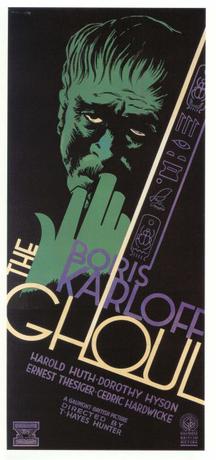
Some actors can make just about anything worth watching. That’s certainly the case with Boris Karloff and 1933’s The Ghoul.
In The Ghoul, Karloff plays Prof. Henry Moriant. The professor is an Egyptologist, a world-renowned expert on the dead. Moriant is now facing death himself, sick in bed and ranting about how he wants to be treated after he passes. Nigel Hartley (Ralph Richardson) stops by the mansion while pretending to be a vicar and offers to comfort Prof. Moriant in his last moments. The butler, Laing (Ernest Thesiger), explains that Moriant has never had much use for traditional religion. Instead, Moriant believes in the Gods of Egypt.
In death, Moriant wants to be buried with an Egyptian jewel in his hands. He believes that, after he dies, he will exchange the jewel with the Egyptian God Anubis and he will be reborn with amazing powers. However, when Moriant passes, Laing keeps the jewel for himself and attempts to hide it from the countess number of people who show up at the mansion, all seeking either the jewel or just information about Moriant’s estate. Moriant may not have been loved in life but everyone clearly loves his money.
Boris Karloff is not actually in that much of The Ghoul. He dominates the start of the film, ranting from his deathbed. And then, towards the end of the film, he rises from the dead and attacks those who he thinks have betrayed him and stolen the jewel. He’s only onscreen for a few minutes but he dominates those minutes. Karloff’s screen presence is undeniable. When he’s in a scene, he’s the only person that you watch. When he’s not in a scene, you find yourself wondering how long it’s going to take for Karloff to return.
That’s not to say that the other actors in The Ghoul aren’t good. The cast is full of distinguished names. Along with Richardson and Thesiger, Cedric Hardwicke, Anthony Bushnell, Dorothy Hyson, and Kathleen Harrison all wander through the mansion and try to avoid getting caught up in Karloff’s vengeance. Harrison provides the film’s comic relief and I actually enjoyed her flighty performance. The film itself is so darkly lit and full of so many greedy characters that it was nice to have someone on a totally different wavelength thrown into the mix. That said, the majority of the actors are stuck with paper-thin characters and aren’t really allowed the time to make much of an impression. This is Karloff’s film, from the beginning to end. And while the film itself is definitely a bit creaky, Karloff is always enjoyable to watch.
The Ghoul was made at a time when Karloff, having become a star with Frankenstein, was frustrated with the roles that he was being offered in America. He returned to his native UK and promptly discovered that he was just as typecast over there as he was in the United States. For a long time, The Ghoul was believed to be a lost film. However, in 1968, a copy was discovered in Egypt of all places. It’s unfortunate that the film itself isn’t better but there’s no denying the power of Karloff the performer.
1982’s Pink Floyd — The Wall is a film that I have mixed feelings about.
Some of that is due to my feelings about Pink Floyd. On the one hand, I can’t deny their talent and I do like quite a few of their songs, if they do all tend to be a bit on the portentous side. On the other hand …. Roger Waters! Bleh, Roger Waters. Waters was one of the founders of Pink Floyd and, for a while, the band’s de facto leader. He’s also a rabid anti-Semite and a defender of Vladimir Putin’s. That said, I’ve discovered that I can justify listening to Pink Floyd by remembering that the rest of the band hates Roger Waters as well and that Waters himself eventually left Pink Floyd. Waters’s bandmate, David Gilmour, has flat-out called Roger Waters an anti-Semite. Last year, when we had a total eclipse of the sun, I was happy to be able to play the last two tracks of Dark Side of the Moon while enjoying the early and temporary evening. It just felt appropriate.
Outside of Dark Side of the Moon, The Wall is probably Pink Floyd’s best-known work. (When I was younger, I can remember my Dad playing it whenever he was driving across the country.) A concept album about how much it sucks to be a wealthy Englishman, The Wall is one of those albums and films that are beloved by people who consider themselves to be alienated. Even more so than the average Pink Floyd album, The Wall was the brainchild of Roger Waters and, when the movie version was made in 1982, Waters wrote the screenplay. That said, I think you can argue that, much as with Tommy, The Wall was ultimately more about the vision of the film’s director than that of the man who wrote the songs.
The Wall is definitely an Alan Parker production. It’s big. It embraces the sordid. It’s stylish almost to the point of parody. Every image has been carefully constructed by a director who got his start doing commercials and whose main goal was to get an immediate audience reaction. Much like Parker’s Midnight Express or Evita, it’s a film that grabs your attention while you’re watching it and only afterwards do you stop consider that there really wasn’t much going on underneath the surface.
Pink (Bob Geldof) is a self-loathing rockstar who is haunted by his childhood in post-WWII Britain and whose marriage is failing. He’s building a wall, brick-by-brick, to keep himself separated from pain but the price of becoming comfortably numb is to be so alienated that you imagine becoming a neo-Nazi who orders his followers to follow the Worm. The imagery is powerful. The animated sequences by Gerald Scarfe still make quite an impression, especially the marching hammers. The score features songs like Another Brick In The Wall, Comfortably Numb, and Run Like Hell. The film is relentless, full of downbeat imagery that is often excessive but which Parker understood would appeal to the film’s target audience. Indeed, it’s such an overwhelming film that it’s easy to overlook the fact that, even before he transformed into a fascist, Pink is a drab character and his main problem seems to be that he can’t seem to find anything good to watch on television.
That said, I have to admit that, despite myself, I do like The Wall. It’s just so shameless that it’s hard not to enjoy the silliness of it all. Add to that, Comfortably Numb is a great song. (Another Brick In The Wall is also a great song though perhaps not for the reasons that Waters thought it was.) The Wall is a monument to the joys of cinematic excess.
“Don’t count on me to make you feel safe.” — The Stranger
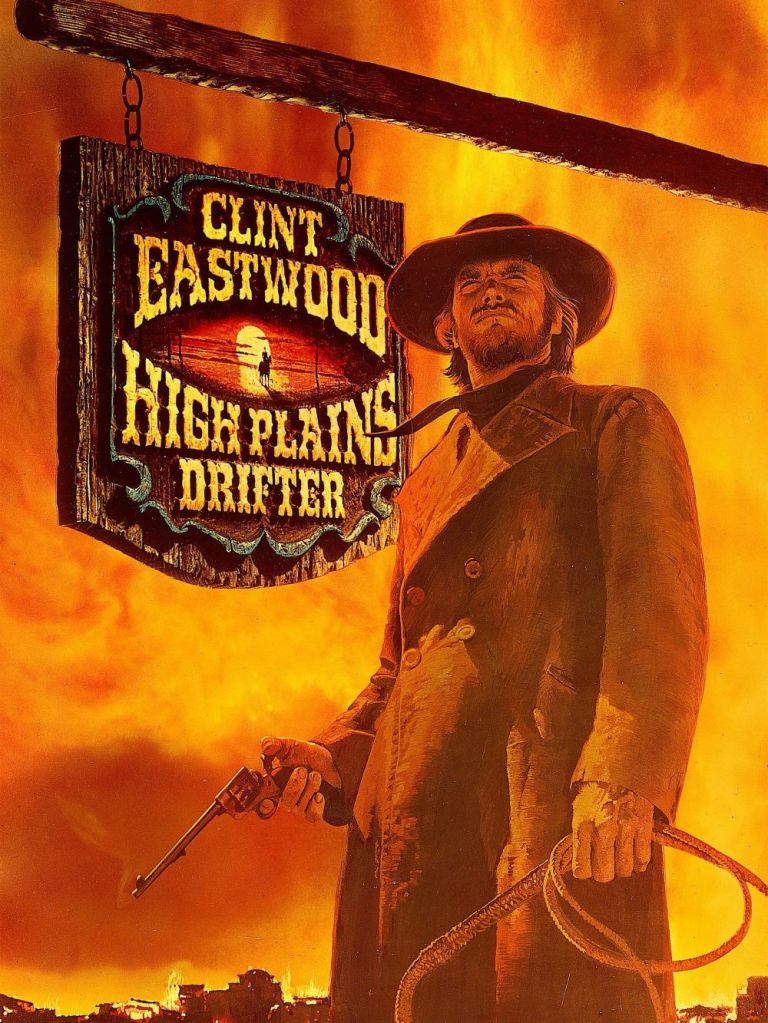
High Plains Drifter stands as one of the bleakest, most enigmatic entries in Clint Eastwood’s filmography—a Western that bleeds unmistakably into the realms of psychological and supernatural horror. This 1973 film is not just another dusty tale of lone gunfighters and frontier justice. It’s a nightmare set in broad daylight, a morality play whose hero is more monster than man.
Eastwood’s Stranger comes riding into the town of Lago from the shimmering desert, a silhouette both akin to and apart from his famed Man With No Name persona. The townsfolk are desperate, haunted by fear—less afraid of imminent violence, more of the sins they’ve half-buried. This is a place where a lawman was brutally murdered by outlaws while the townspeople looked away, their silence paid for with cowardice and greed. When the Stranger assumes command, he does so with often-gleeful sadism—kicking people out of their hotel rooms, replacing the mayor and sheriff with the dwarf Mordecai, and ordering that the entire town be painted red before putting “Hell” on its welcome sign.
There’s a surface plot: the Stranger is hired to protect Lago from the same three outlaws who once butchered its marshal. But he’s there for far more than that. The story unspools through dreamlike sequences, flashbacks that suggest the Stranger may well be an avenging spirit or a revenant—the dead lawman, spectral and merciless, returned to claim what the townsfolk owe to Hell itself.
The horror here isn’t about jump scares or gothic haunted houses. The supernatural lurks everywhere and yet nowhere. The Stranger moves with the implacable calm—and violence—of a slasher villain, transforming Lago into his personal stage for retribution. His nightmares, full of images of past atrocities, are painted with the same vivid brutality as the daytime violence. Eastwood’s use of silence, the squint of a face, the twitch of a pistol replaces musical cues in amplifying dread. The sound design evokes otherness—a howling wind, footsteps echoing across empty streets—that builds a shadow of terror around the Stranger’s presence.
This violence is hurried and brutal; its sexual politics unflinching. When the Stranger enacts revenge, he punishes not just the outlaws, but the townsfolk complicit in their crimes. There is little comfort in his sense of justice—the pleasures he takes border on sadistic. The film’s moral ambiguity cuts deeper than most Westerns or horrors: this is not a clear-cut tale of good versus evil, but a brutal reckoning of collective guilt, cowardice, and corruption.
Lago itself acts almost like a town stuck in purgatory—a holding pen between redemption and eternal damnation. The infamous “Welcome to Hell” sign the Stranger paints at the town’s entrance serves as a grim message. It’s no welcome to law and order, but a symbolic beacon to the very outlaws the Stranger is hired to confront, suggesting that Lago is a place where sin festers and punishes itself. The town’s dance with Hell is both literal and metaphorical. The inhabitants aren’t just awaiting judgment; they have invited it in their desperate attempts to hide their cowardice and greed under the guise of civilization.
This notion of Lago as purgatory stands in sharp contrast to other recent horror Westerns, which serve as prime examples of the genre’s thematic spectrum. These films tend to focus on the primal terror of nature barely held at bay by the fragile veneer of civilization the settlers claim. They pit human beings against the ancient, untamed forces of the wilderness—whether monstrous creatures or surreal phenomena—emphasizing that the supposed order and progress of the West remain fragile and constantly threatened. This dynamic symbolizes the uneasy balance between civilization’s reach and nature’s primal power, often revealing how thin and tenuous that barrier truly is.
Among these, Bone Tomahawk and Ravenous stand out as vivid examples. Bone Tomahawk confronts menacing cannibals lurking in the wild, reminding viewers that the West’s order is fragile and under perpetual threat from untamed wilderness. Ravenous uses cannibalism and survival horror as metaphors for nature’s savage predation hidden beneath the polite façade of civilization—nature’s horrors masked but not erased.
By contrast, High Plains Drifter directs its horror inward, exposing the corruption that manifest destiny imposed on settlers themselves. Instead of fearing nature as an external force, the film presents settlers as haunted by their own moral failures and complicity in violence and betrayal. The Stranger’s vengeance is a reckoning with the darkness festering inside the community, a brutal meditation on guilt, collective cowardice, and the price of greed disguised as progress.
Eastwood’s film strips away the mythic promises of the American West as a land of freedom and opportunity, revealing instead the brutal reality of communities locked in complicity, violence masquerading as justice, and the moral rot at the heart of manifest destiny. This moral ambiguity and psychological depth give High Plains Drifter a unique position in the horror Western subgenre, elevating it beyond simple scares to a profound exploration of American cultural myths.
The Stranger is not a traditional hero but a spectral judge, embodying divine or supernatural retribution. His calm yet ruthless punishment exposes the cruelty, cowardice, and malevolence within Lago’s population, meting out a justice that is neither neat nor forgiving. His supernatural aura and sadistic tendencies make him an unforgettable figure of terror and fate.
Visually, the film’s harsh daylight contrasts with the romanticized Western landscapes of earlier films. Instead of shadows hiding evil, blinding light exposes the town’s moral decay. Characters are reduced to symbols of greed, fear, and cruelty, highlighting that the true horror lies within human nature and the failure to uphold justice.
High Plains Drifter operates on multiple levels—a Western, a ghost story, a horror film, and a dark morality play. It is a relentless meditation on justice and punishment and a dismantling of the traditional Western hero myth. Through layered narrative, stark visuals, and Eastwood’s chilling performance, it remains an essential entry in the horror Western canon.
For those seeking a Western that doesn’t just entertain but unsettles and challenges, High Plains Drifter offers an unforgiving descent into darkness. It strips away the comforting myths of the frontier and exposes the raw, rotting core beneath. Unlike other modern horror Westerns such as Bone Tomahawk and Ravenous, which confront external terrors lurking in the wilderness, this film turns its gaze inward—on the moral decay, guilt, and violence festering within the settlers themselves. It’s a brutal, haunting reckoning, and Eastwood’s Stranger is the cold, relentless agent of that reckoning. This is a journey into a hell both literal and psychological, where justice is merciless and safety is a long-forgotten promise.
There’s one rule in life that should never be forgotten.
Any movie that opens with Susan Lucci casting a hex that causes a man’s head to explode is going to be worth watching.
That’s certainly the case with Invitation to Hell, a 1984 made-for-TV movie that was directed by Wes Craven and which casts Lucci as Jessica Jones, an insurance agent who lives and works in an upper class suburb in Southern California. Jessica not only sells insurance but she also runs the ultra-exclusive Steaming Springs Country Club! Anyone who is anyone in town is a member of Steaming Springs! That include Matt Winslow (Robert Urich) and his family. Matt soon comes to suspect that something strange might be happening at the club. Fortunately, Matt’s spacesuit comes with a flame thrower, a laser, and a built-in computer that can determine whether or not someone is actually a human being. (Wearing the space helmet means viewing the world like you’re the Terminator.) Soon, it’s science vs. magic as Matt dons the suit and tries to rescue his family from country club living!
Totally ludicrous and a lot of fun, this is a film that has a little bit for everyone — familiar television actors, flamethrowers, space suits, demonic possession, exploding cars, and even a little bit of social satire as the film suggests that living in the suburbs is a terror even without weird country clubs and chic spell casters.
Last night, around 3 in the morning, I watched the Lifetime film, Match, Meet, Murder!
Why Was I Watching It?
It was late, I had insomnia, and the title just spoke to me. What can I say? I had many reasons for my decision and I don’t regret it for a minute.
What Was It About?
Ruby (Stephanie Sy) is a lingerie designer who has been in a dating slump ever since ending her long-term relationship with independent journalist Luke (Erik Athavale). Ruby’s friend, photographer Ella (Amanda Austin), gives her a secret code for the very exclusive Rima dating app. Soon, Ruby is matched with Dylan (Jacob Blair).
Dylan, it turns out, is a bit of celebrity. He was the winning contestant on a reality show hosted by notorious matchmaker, Jules (Lisa Marie DiGiacinto). The season may have ended with Dylan getting engaged but his new fiancée mysteriously vanished. Now, Dylan is dating Ruby and he doesn’t seem to be quite stable. He still has his ex’s clothes hanging in his bedroom closet. Run, Ruby, run!
What Worked?
I absolutely loved the demented performance of Lisa Marie DiGiacinto, who played Jules the matchmaker. I can’t say too much about it without spoiling the film but I will say that DiGiacinto fully understood the importance of embracing the melodrama in a film like this.
Some of Ruby’s lingerie designs were cute. The black bralette was adorable. Of course, I’d never be able to wear it because I actually have boobs.
What Did Not Work?
I’m usually willing to suspend my disbelief when it comes to a Lifetime film because the melodrama is usually the point. That said, I had a hard time believing that any successful woman could be as clueless as Ruby. She acted as if the concepts of both dating apps and reality TV were entirely new to her. I could excuse her dating app confusion because her character was said to be coming out of a long term relationship. But, seriously — not knowing about a reality television show? The Bachelor and The Bachelorette are inescapable, whether you watch them or not. I haven’t been able to really sit down and watch Love Island but it only takes a few minutes of me scrolling twitter before I feel as if I have.
As well, it took Ruby way too long to figure out that there might be something strange about Dylan’s previous girlfriend disappearing. Discovering her clothes still hanging in his closet? That’s a bit too obvious of a red flag to be shrugged off for as long as she did.
“Oh my God! Just like me!” Moments
Lingerie designer is definitely one of my fallback options if the whole movie-watching writer thing doesn’t work out. I will also say that I related to the shock of the assistant who introduced Ruby to reality television and was shocked to discover just how little Ruby apparently knew about pop culture.
Lessons Learned
If a guy you barely know has all of his ex’s clothes still hanging in his closet, run! To be honest, you shouldn’t need a movie to learn that lesson.
“There are horrors beyond life’s edge that we do not suspect, and once in a while man’s evil prying calls them just within our range.” The Thing on the Doorstep (H.P. Lovecraft)
Hi, everyone! Tonight, on twitter, I will be hosting one of my favorite films for #MondayMania! Join us for Psycho Party Planner!
You can find the movie on Prime and then you can join us on twitter at 9 pm central time! (That’s 10 pm for you folks on the East Coast.) See you then!





 Through the Shattered Lens