Angel Maturino Resendiz, now there was a scary person.
Resendiz was a drifter who hitched rides on trains and who killed at least 15 people over the course of 13 years. Because he traveled by stowing away on trains, his first few crimes went undetected. Even when people realized that there was a serial killer haunting the nation’s railroads, no one knew exactly where Resendiz would next turn up. He committed the majority of his murders in Texas, killing random people and using whatever method happened to be most convenient at the time. However, he also killed people in Florida, Georgia, California, Kentucky, and Illinois. He would steal his victim’s jewelry but leave behind their money. (He would return to his home in Mexico to give the jewelry to his sister and mother, both of whom apparently had no idea where he was getting his gifts from.) After he was placed on the FBI’s Most Wanted List, Resendiz eventually surrendered himself in 1999. Resendiz was apparently under the impression that he would not be given the death penalty if voluntarily turned himself in. Resendiz was wrong about that and he was executed in 2006.
Until Resendiz surrendered himself, everyone living near a railroad track was nervous. I know this from personal experience because, in 1999, my family lived close enough to the tracks that I could lay in bed in the middle of the night and listen to the sound of the trains rumbling in the distance. Resendiz was a killer who targeted those who were smaller and weaker than him, which basically would have included me, my mom, and my sisters. Apparently, whenever he did a home invasion, he would also eat whatever food he could find in the refrigerator. Whereas most killers would probably want to get away from the scene as quickly as possible, Resendiz would sit down and eat leftovers. For whatever reason, that little detail is the one that creeps me out the most.
2020’s The Texas Railroad Killer is loosely based on the crimes of Angel Resendiz. The film features Resendiz (Lino Aquino) as he wanders around South Texas, randomly killing. As played by Aquino, Resendiz comes across as being a somewhat dazed, paranoid shell of a human being, a shadow of death who doesn’t seem to be aware of the difference between reality and what’s only happening in his mind. Does he really witness a group of strippers being gunned down by law enforcement or is it something that he only imagined? It’s hard to tell. After Resendiz commits a murder, he looks over his victim’s identification as if he’s trying to absorb the life that he just ended. And yes, he does eat in a victim’s house. Agck!
The Texas Railroad Killer is an extremely low-budget film. Lino Aquino is convincingly out-of-it as Resendiz but some of the other performers are noticeably less convincing in their roles. The film is largely plotless and the slow pace will be a turn-off for many viewers. And yet, there’s a disturbing power to the film’s sun-drenched visuals. The images of the sweaty Resendiz walking down broken streets or stumbling dazed out of someone’s home stick with you. Flaws and all, the film captures the soulless existence of a man who lives for no other reason than to kill.
“If it’s transgressive, addressing social or political ills, not pulling punches, and pushing the boundaries, then it’s Splatterpunk.” — Brian Keene
The Birth of Splatterpunk: A Rebellion Against Conventions
To understand splatterpunk, it’s important to grasp the context in which it arose. During the late 1970s and early 1980s, horror fiction was often pigeonholed within predictable tropes—haunted houses, vengeful spirits, and formulaic slasher stories. While these were popular, they had limited scope in pushing the boundaries of what horror might represent. Enter splatterpunk—a raw, unapologetic literary movement that sought to shatter expectations by depicting violence, depravity, and, crucially, sexual violence unmasked. Rather than hinting at horrors lurking in the shadows, splatterpunk authors chose to parade these monstrosities in graphic detail.
The term “splatterpunk” was adopted by writer David J. Schow during the 1986 Twelfth World Fantasy Convention, encapsulating the aesthetic of horror tales that embraced hyper-intense gore, moral extremity, and the inclusion of sexual violence as a core and unsettling element. But it is crucial to recognize that splatterpunk is much more than explicit depictions of blood and guts or sexual assault. At its core, it serves as a mirror reflecting society’s darkest anxieties—whether those arise from political corruption, existential dread, psychological disintegration, or the breakdown of human decency. The shock of violence and abuse serves a purpose beyond mere thrill—it demands readers confront the ugliness beneath civilization’s polished surface.
Philip Nutman’s Wet Work: Fusion of Espionage, Cosmic Horror, and Splatter
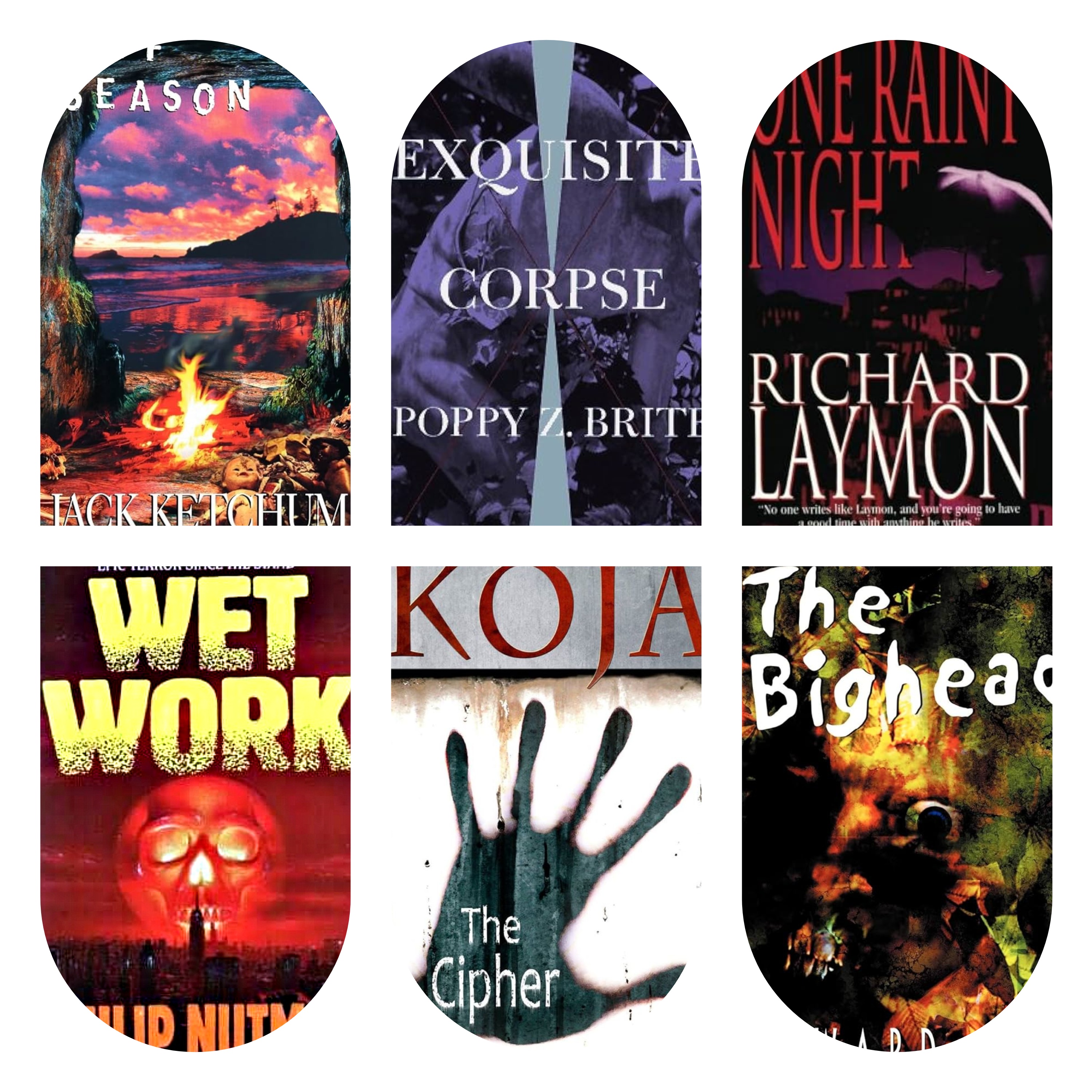
A prime example of splatterpunk’s genre-blurring capacity is Philip Nutman’s Wet Work (1993), a work that may be less known outside hardcore horror circles but exemplifies the subgenre’s versatility. What sets Wet Work apart is its remarkable weaving of government espionage thriller with apocalyptic zombie horror and an infusion of cosmic dread.
Originally appearing as a short story in the seminal 1989 collection Book of the Dead, Wet Work expanded into a novel that follows CIA operative Dominic Corvino and Washington D.C. cop Nick Packard as they navigate the chaos unleashed when a comet named Saracen passes close to Earth. The comet deposits a mysterious residue that triggers the rise of the dead, but Nutman’s zombies are not mere shambling corpses—they retain fragments of cognition, making them unpredictable threats.
What makes Wet Work an intriguing splatterpunk novel is how it weds the procedural authenticity of espionage with the surrealism of the undead outbreak. Nutman’s background as a journalist and film critic manifests in the meticulous detail of military operations, CIA bureaucracy, and police procedures, lending credibility even amid the nightmare. The narrative unfolds on two interwoven axes: Corvino’s obsessive quest to uncover betrayal within the CIA and Packard’s desperate, grounded attempts to save his wife amid an escalating societal breakdown.
Nutman’s writing style embodies splatterpunk’s hallmark—graphic, fast-moving, and unapologetically violent—while resisting descent into parody. The horror and violence, including underlying currents of sexual violence and abuse within the collapsing societal order, are not gratuitous but rather emphasize the erosion of social and moral codes. Unlike some zombie fiction limited to straightforward survival stories, Wet Work interrogates themes of loyalty, obsession, power, and the devastating consequences of moral decay when survival becomes personal.
Kathe Koja’s The Cipher: Psychological Abyss and Cosmic Terror
While Nutman’s warm-blooded action situates Wet Work within both thriller and horror traditions, Kathe Koja’s The Cipher (1991) takes splatterpunk into the realms of psychological fragmentation and cosmic existentialism. The Cipher is notable for its uncompromising dive into emotional and metaphysical abyss, presented through an experimental, impressionistic narrative voice that eschews linearity in favor of portraying the chaotic consciousness of protagonist Nicholas.
The story revolves around Nicholas and Nakota in a bleak urban environment, where they discover the Funhole—a nightmarish, reality-bending void with an unknowable malignance. Rather than external monsters, the book’s terror arises from the characters’ psychological unraveling, toxic relationships, and the Funhole’s corruptive influence. Koja’s prose often unfolds in long, surreal sentences that immerse readers in impressions, hallucinations, and emotional storms, demanding patience and openness to ambiguity.
This approach challenges traditional horror expectations by prioritizing atmosphere and mental disintegration over plot-driven scares. The horror here is symbolic and metaphysical—body horror and reality distortions become reflections of inner fragmentation and humanity’s insignificance before cosmic forces. While the novel largely focuses on psychological and existential themes, it does not shy away from portraying abusive and toxic dynamics, including sexual violence, as instruments of psychological torment and character breakdown. The Cipher’s bleak, ambiguous ending refuses comfort, emphasizing oppression, transformation, and loss, resonating profoundly with readers attuned to introspective and literary horror.
Jack Ketchum’s Off Season: Raw Human Horror and Primal Survival
In sharp contrast to Koja’s cerebral horror and Nutman’s hybrid apocalypse thriller is Jack Ketchum’s Off Season (1980), a foundational extreme horror novel that sinks its teeth into primal human savagery stripped of supernatural mediations. Loosely inspired by the legend of the Sawney Beane clan, Ketchum sets his story on the rugged Maine coast, depicting a group of urban friends facing a secluded clan of cannibals.
Off Season is known for its relentless pace and unapologetic portrayal of violence, sexuality, and survival instinct. Sexual violence and abuse permeate the narrative, presented in stark, unvarnished terms that are deeply disturbing yet integral to Ketchum’s exploration of human depravity. The horror stems from the inhumanity of other humans—feral descendants who embody basic drives like hunger, reproduction, and dominance without societal filters. Ketchum’s refusal to soften or sensationalize the unfolding carnage demands readers confront uncomfortable truths about violence, both physical and sexual, and regression. The victims are archetypal rather than deeply individualized, serving as symbolic representations of civilization confronting its darkest, hidden counterparts.
What sets Off Season apart is the absence of cathartic justice or narrative redemption. Survivors escape, but at immense psychological and physical cost, emphasizing that some horrors leave permanent scars rather than neatly tied endings. It is this brutal honesty—depicting horror not as spectacle but as unavoidable consequence—that cements Off Season’s legacy in splatterpunk and extreme horror.
The Broader Splatterpunk Landscape: Barker, Lee, Laymon, and Martin (aka Poppy Z. Brite)
A key progenitor of the splatterpunk aesthetic, Clive Barker’s Books of Blood (mid-1980s) was revolutionary in merging graphic, visceral horror with a literary sensibility that incorporated elements of dark fantasy and eroticism. Barker’s stories broke new ground by combining vivid, often grotesque imagery with profound explorations of human desire, morality, and the otherworldly. Sexual violence and transgressive sexuality appear throughout his work, often complicating the boundary between beauty and horror. In particular, Barker’s exploration of the sacred versus the profane is central, as the presence of sexual violence disrupts conventional moral frameworks and questions the nature of sin and desire. The collection’s influence was far-reaching, paving the way for horror fiction to be taken seriously as an art form capable of grappling with complex themes while delivering shocking, unforgettable scenes. Barker’s ability to balance poetic language with unsettling gore worked as a blueprint for many splatterpunk writers seeking depth beyond surface violence.
Edward Lee’s The Bighead epitomizes the extreme end of splatterpunk, reveling in unapologetically explicit violence, taboo subjects, and shock value. Lee’s storytelling mixes horror with dark humor and nihilism, pushing the boundaries of taste to explore the grotesque and the absurd. Sexual violence in Lee’s work is frequently explicit and controversial, serving to amplify the transgressive nature of his narratives. Furthermore, Lee uses sexual violence and deviancy as a way to examine the tension between the sacred and the profane—the clash between deeply ingrained cultural taboos and destructive carnal impulses. Though considered excessive by some, Lee’s books embody splatterpunk’s ethos of confronting the reader head-on with chaos and depravity. His work fuses visceral physical horror with nihilistic philosophical darkness, reflecting a world stripped of hope and full of monstrous extremes.
Richard Laymon’s One Rainy Night is notable for its blend of fast-paced plotting, graphic sexual and violent content, and elements of supernatural and psychological horror. Laymon’s work embodies a consistent use of sexual violence intertwined with sexual themes as part of the horror fabric, challenging readers with uncomfortable depictions of human depravity. His skillful pacing ensures that tension remains high, and his writing frequently navigates the intersection of splatterpunk gore with thrilling, page-turning storytelling. While his characters may sometimes function more as archetypes than fully nuanced figures, their plight against overwhelming horror rings true. Laymon’s stories helped solidify splatterpunk’s presence in mainstream horror by offering stories that are simultaneously intense, accessible, and relentlessly engaging.
William Joseph Martin (aka Poppy Z. Brite) stands apart for his elegant prose style and his exploration of identity, marginalization, and monstrosity through the lens of serial killers and dark romance. Martin (writing as Poppy Z. Brite) intertwines graphic violence with themes of homosexuality, queer identity, and sexual violence, challenging readers to consider the humanity amidst monstrosity. In doing so, Exquisite Corpse broadens splatterpunk’s thematic horizons, underscoring that horror’s most compelling stories often arise from complex characters whose transgressions are inseparable from their search for connection and self-understanding. Sexual violence in Martin’s work adds layers of suffering and violation that complicate the depiction of desire and identity, highlighting the fragile line between victim and monster. Martin’s fusion of stylistic beauty and bleak content enriches the genre’s emotional and intellectual depth.
Legacy and Impact of Splatterpunk Horror
A lasting impact of splatterpunk is evident in its refusal to compromise aesthetics for shock alone. Although its extreme visuals, sexual violence, and brutal thematic content led to limited mainstream acceptance, the genre’s influence persists. It demonstrated convincingly that graphic violence and sexual transgression could serve as a lens for social critique, psychological depth, and genre innovation. Works such as Wet Work exemplify its capacity for genre-blending; The Cipher exemplifies its introspective and cosmic depths; Off Season encapsulates its primal, uncompromising core. These stories continue to inspire writers who wish to push original boundaries, reshaping horror into a form that is as intellectually challenging as it is viscerally shocking.
Horror’s landscape has been irrevocably altered by splatterpunk. Its legacy persists not merely through the continued production of extreme horror but through its foundational principle—that horror is most potent when it does not flinch from the evils and truths of the human condition, including the often difficult subject of sexual violence. Its influence endures in the modern works that blend visceral impact with thematic richness, ensuring that horror remains a vital, evolving art form capable of confronting the darkest facets of existence while challenging cultural limits.
In embracing the fights, fears, and horrors that many shy away from, splatterpunk proves to be more than just a genre—it’s a bold call to confront the uncomfortable, an invitation to see horror not only as entertainment but as a mirror of our deepest truths. Its legacy remains a testament to the power of extremity paired with insight, forever pushing the boundaries of what horror can and should be.
Mike Oldfield didn’t write Tubular Bells specifically for The Exorcist but it’s a song that works perfectly for the film. Oldfield’s song, which was rumored to have originally envisioned as being a Christmas instrumental, become an iconic horror them.
This October, I’m going to be doing something a little bit different with my contribution to 4 Shots From 4 Films. I’m going to be taking a little chronological tour of the history of horror cinema, moving from decade to decade.
Hi, everyone! Tonight, on twitter, I will be hosting one of my favorite films for #MondayMania! Join us for Stalked By My Doctor: A Sleepwalker’s Nightmare! Dr. Beck is back!
You can find the movie on Tubi and then you can join us on twitter at 9 pm central time! (That’s 10 pm for you folks on the East Coast.) See you then!
2021’s Willy’s Wonderland takes place in an dilapidated restaurant.
Back in the day, Willy’s Wonderland was the ideal place to go if you were young and celebrating your birthday. The animatronic mascots would sing “Happy birthday” and maybe meet your parents. Willy Weasel, Arty Alligator, Cammy Chameleon, Ozzie Ostrich, Tito Turtle, Knighty Knight, Gus Gorilla, and Siren Sara promised fun and cheesy entertainment to anyone looking for a nice family meal!
Unfortunately, people stopped going to Willy’s once it was discovered that the owner was a serial killer. Jerry Robert Willis (Grant Cramer) and his seven friends were cannibals who regularly sacrificed families. Eventually, the police caught up to him but, even under new ownership, no one wanted to eat at Willy’s. There were rumors that Willis and his friends had transferred their souls into the animatronic figures but surely, that could not have been true!
Right?
Nicolas Cage plays a man with no name. When his car breaks down, the local mechanic agrees to fix the car if the man agrees to spend the night as the janitor at Willy’s. Apparently, it’s been a struggle to keep a night janitor at the place. People find the location to be creepy and, of course, the animatronic mascots keep killing anyone dumb enough to try to mop the floors. Cage’s man with no name silently agrees. Everything that Cage does, he does without a word. This is one of the rare films where Nicolas Cage, usually a champion talker, says absolutely nothing.
Now, I should mention that there actually is a plot to Willy’s Wonderland. Liv (Emily Tosta) and her friends are trying to burn the place down because, years ago, Liv’s parents were murdered by the mascots. Unfortunately, Liv and her friends aren’t that smart and they end up trapped in Willy’s Wonderland. The majority of them quickly fall victim to the mascots. The deaths are appropriately gruesome, though tinged with the dark humor that would come from essentially being killed by a knock-off version of Chuck E. Cheese.
But really, the plot isn’t important. This film is entirely about Nicolas Cage, playing a man with no name. Cage takes the janitorial job and, over the course of the night, he battles the mascots. At the same time, he also makes it a point to continue to do his job. Besieged or not, he agreed to clean the place up. He takes his breaks and plays pinball exactly as scheduled, even if that means abandoning Liv and her friends. Normally, you might think that this would be bad behavior on the part of Cage’s character. Abandoning someone in the middle of a battle is not usually encouraged. But Liv and her friends are very annoying. Cage is ultimately the hero by default. Yes, he’s fighting and killing the mascots but he’s really only doing it because they’re getting in his way while he’s trying to do his job. The fact that he helps out Liv is largely coincidental.
Willy’s Wonderland proves that Cage doesn’t need a lot of lines to be the center of a film. Even without speaking, he’s such a wonderfully eccentric presence that you can’t help but watch him and cheer him on. Admittedly, Willy’s Wonderland is never that scary, though the “Happy Birthday” song is definitely creepy. The mascots are a bit too cartoonish to be truly frightening. But, if the film doesn’t really work as a horror film, it does work as an adrenaline-fueled Cage match. And that’s nearly as good.
As some of our regular readers undoubtedly know, I am involved in hosting a few weekly live tweets on twitter and occasion ally Mastodon. I host #FridayNightFlix every Friday, I co-host #ScarySocial on Saturday, and I am one of the five hosts of Mastodon’s #MondayActionMovie! Every week, we get together. We watch a movie. We snark our way through it.
Tonight, for #MondayActionMovie, the film will be The Satanic Rites of Dracula! So, if you missed the #ScarySocial live tweet, I guess this is your second chance.
It should make for a night of fun viewing and I invite all of you to join in. If you want to join the live tweets, just hop onto Mastodon, pull up The Satanic Rites of Dracula on YouTube, start the movie at 8 pm et, and use the #MondayActionMovie hashtag!
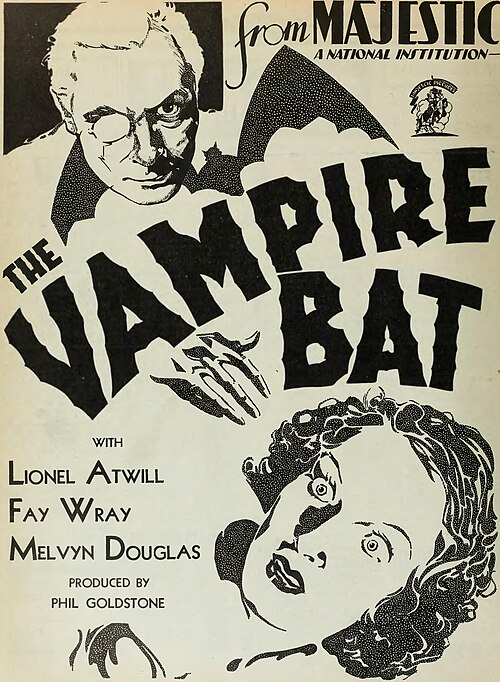
In 1933’s The Vampire Bat, people are dying in a small German village, victims of blood loss. A woman named Martha Mueller (Rita Carlisle) was recently attacked by a bat, leading to rumors of a vampire. When the local town eccentric, a twitchy man named Hermann Glieb (Dwight Frye), argues that bats are actually harmless and admits that he likes bats because they are “soft” and “nice,” people start to suspect that he might be the vampire. Another man named Kringen (George E. Stone) claims that he was attacked by a vampire and insinuates that it was Glieb. Glieb may seems like a strange man who likes to collect bats but could he be something even more sinister?
Two town leaders have opposite feelings about the claim that a vampire is attacking the town. Karl Brettschneider (Melvyn Douglas) is the local police inspector and he deals with facts. He doesn’t believe in superstition and he initially scoffs at the idea that a vampire is attacking the village. Meanwhile, Dr. Otto von Niemann (Lionel Atwill) is the town’s doctor. He’s been treating the victims of the bat attacks and he’s even be letting some of his patients live at his home. Everyone knows that Dr. von Neimann is a kindly man of science. Karl is even dating Ruth (Fay Wray), one of Otto’s boarders. But is the doctor as benevolent as everyone assumes?
When answering that question, consider these four facts:
Dr. von Neimann is the one who encouraged Kringen to spread stories about a vampire haunting the town, despite the fact that Kringen himself said that he didn’t want to start a panic.
Dr. van Niemann is played by Lionel Atwill.
Glieb is played by Dwight Frye.
Karl is played by Melvyn Douglas.
Indeed, for horror fans, the casting of Lionel Atwill gives the game away. Lionel Atwill appeared in a number of horror films and it was rare that he wasn’t cast as the villain. (One of his non-villainous role was as the one-armed Inspector Krogh in The Son of Frankenstein.) From the minute the viewer sees Atwill, he seem to give off sinister vibes and it’s not really a surprise when he turns out to be less than trustworthy.
As for Dwight Frye, horror fans love him for playing a number of unhinged weirdos, like Renfield in the Lugosi-version of Dracula and the torch-bearing servant in Karloff’s Frankenstein. Frye was good at playing twitchy types but one thing that all of Frye’s characters had in common is that they were pretty much destined to be victims. Even when Frye played an unlikeable character, like in Frankenstein, it was obvious that he was going to end up getting killed at the hands of the Monster.
Finally, Melvyn Douglas was the epitome of propriety in every film in which he appeared. If Douglas thinks that there is something more going on than just a vampire attacking people, there probably is. And since we know Douglas can’t be the main bad guy, that pretty much just leaves Lionel Atwill.
The Vampire Bat is a short and enjoyable B-movie that puts an interesting spin on the typical vampire legend. Though the budget may be low, the cast of Atwill, Douglas, Frye, and Wray can’t be beat and all of them give fully committed performances. Dwight Frye, in particular, gives one of his best performance as the unfortunate Glieb. As always, Lionel Atwill makes for an entertaining villain. At its best, The Vampire Bat comments on the power of hysteria. Convinced that there is a vampire in their midst, the town goes mad and it directs its anger towards those who are seen as being on the outside, men like Glieb.
The Vampire Bat is more than worthy of your Halloween viewing.
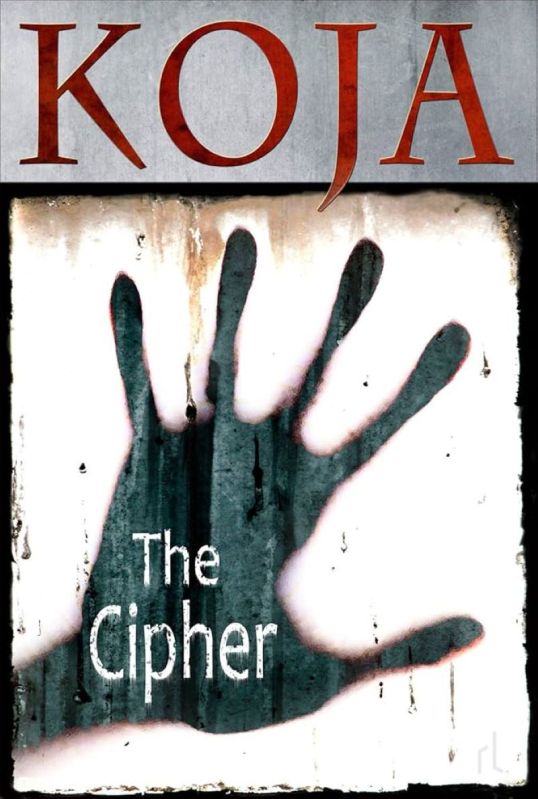
Kathe Koja’s The Cipher stands as a landmark achievement in splatterpunk and psychological horror, noted for its unapologetic dive into existential dread, fragmented narrative, and raw emotional landscape. Its reputation as a genre-defining work is well-earned, yet it also represents a demanding reading experience that diverges sharply from more traditional horror novels. For readers looking for straightforward thrills or clear-cut storytelling, Koja’s novel may feel opaque or even impenetrable. However, for those willing to engage deeply, The Cipher offers a poetic and unsettling exploration of alienation, obsession, and the unknowable.
At the heart of the novel’s challenge is Koja’s distinctive writing style. Eschewing conventional chapter structures or linear storytelling, The Cipher operates as an immersive psychological tapestry woven through the fragmented consciousness of its protagonist, Nicholas. The prose flows in long, often unruly sentences filled with impressionistic and surreal imagery that echo Nicholas’s damaged, chaotic inner world. His thoughts, memories, and anxieties drift in and out of focus, making the narrative feel like a fever dream or an inside-out nightmare. For readers new to literary horror or those more comfortable with clear plots and defined characters, this style can seem alienating and difficult to parse. The book frequently moves between blurred timelines, hallucinations, and raw emotional bursts, challenging the reader to accept ambiguity and psychological discomfort rather than easy narrative anchors.
The story revolves around Nicholas and Nakota, a dysfunctional and toxic couple trapped in a bleak urban environment that acts almost as a third character. This grim unnamed city, reminiscent of the American Rust Belt in decay during the early 1990s, exudes a cold, oppressive atmosphere that mirrors the emotional desolation of its residents. The setting’s grime and desolation bolster the novel’s themes of hopelessness and fragmentation, with Koja’s spare prose turning every scene into a sensory experience of discomfort and decay.
Central to the plot—and the horror—is the discovery of the Funhole, a mysterious and unnaturally black void located in a storage room of the apartment building. Hardly celebrated for whimsy, the Funhole is a locus of enigmatic and malevolent power that both fascinates and consumes. Nicholas and Nakota’s experiments with the Funhole—dropping insects, animals, and eventually cameras—reveal its capacity to distort and corrupt physical reality in grotesque ways, leading to disturbing mutations and aberrations. However, the real horror lies not just in these transformations but in the obsessive pull the Funhole exerts on the characters, particularly Nakota’s increasingly toxic fixation and Nicholas’s reluctant fascination.
Rather than relying on external action or traditional plot progression, The Cipher roots its terror in the psychological and emotional unraveling of its characters. The story is less about what happens and more about how it feels to fall apart in the face of an unknowable force. The degradation of Nicholas and Nakota’s relationship—marked by manipulation, dependency, and alienation—is the emotional thread binding the novel’s narrative chaos. This internal focus demands patience and a willingness to sit with discomfort from the reader; those unaccustomed to introspective or experimental fiction might find the experience frustrating or exhausting.
Overlaying all this is a strong vein of cosmic horror. The Funhole is presented as an unknowable abyss, an entity without explanation, echoing the eldritch voids found in the works of Lovecraft, Blackwood, and Machen. It refuses to comply with human curiosity or understanding, warping reality and identity in ways that defy definition. Unlike classic monster tales, the horror here is existential and diffuse, manifesting as a dark reflection of humanity’s inability to grasp the true nature of the universe or even themselves. In this respect, Koja’s work is a meditation on obsession and transformation, where the boundary between cosmic indifference and personal disintegration disappears.
While The Cipher has been celebrated for its ambition and literary risks, it offers little reprieve in terms of character likability or narrative closure. The protagonists are deeply flawed, often unlikable people caught in spirals of self-destruction. The novel’s resolution is ambiguous and bleak, leaving the audience with more questions than answers, emphasizing themes of loss, transformation, and the unknowable. It challenges standard genre expectations and eschews easy emotional satisfaction, positioning itself as a novel that unsettles rather than comforts.
Readers familiar with the edgier corners of horror fiction—fans of Clive Barker’s visceral fantasies or Poppy Z. Brite’s explorations of identity and desire—will find much to admire in Koja’s approach. The novel’s body horror is not gratuitous but symbolic, a metaphysical cracked mirror reflecting profound anxieties about embodiment, control, and alienation. Its grim realism and morally complex characters resonate alongside challenging literary experiments such as Fight Club and House of Leaves, where mental and existential crises are front and center.
In sum, Kathe Koja’s The Cipher stands as a bold, uncompromising exploration of despair, obsession, and cosmic terror wrapped in a chaotic, poetic narrative. It demands engagement on a deep level, rewarding readers with a unique experience that expands the scope of horror fiction. This is a novel best suited for those who prize atmosphere, psychological depth, and existential questioning over conventional scares or plot-driven horror. While it may prove inaccessible or taxing for some, for others it offers a transformative journey into the dark, tangled spaces of the mind and the universe—an unsettling masterpiece that lingers long after the final page is turned.
In the creepy 1974 film, Peter Graves plays a father who goes on a camping trip with his two teenage children (one of whom is played by Kathleen Quinlan). A sudden earthquake and a solar flare causes the trio to try to return to civilization, where they discover that almost everyone has been reduced to a powdery substance and there are only a few crazed survivors. They try to make their way back to their home in Malibu, facing danger at every leg of their journey.
(It’s almost a low-budget and far more dramatic version of NightoftheComet.)
Effective despite its made-for-TV origins, WhereHave All The People Gone? was obviously mean to serve as a pilot for a television series. The series didn’t happen but, even with a somewhat open-ended conclusion, the movie still works.




 Through the Shattered Lens