The forces of the evil Lord Arrakur (Arman Chapman) raid a peaceful Barbarian village, disrupting the wedding of Queen Amethea (Lana Clarkson) and Prince Argan (Frank Zagarino). Along with slaughtering almost the entire village, Arrakur also kidnaps Amethea’s sister, Taramis (Dawn Dunlap). Amethea survives the attack and, with her handmaiden Estrild (future director Katt Shea) and the warrior Tiniara (Susana Traverson), sets out for Arrakur’s realm to rescue her sister and to take vengeance on him.
In Barbarian Queen, there’s much violence, much nudity, and much time spent in a dungeon with a pool of acid. This may sound like pretty standard fantasy stuff and it is, except for the fact that almost all of the warriors are women and Arrakur and his forces are even nastier than the typical sword-and-sorcery villain. Arrakur uses rape to terrorize his enemies and his subjects and, while that may be historically correct, it’s not easy to watch. By the time Arrakur and Amethea are facing off in the gladiatorial arena, most viewers will be ready to see Arrakur defeated in the most extreme way possible.
BarbarianQueen was released by Roger Corman’s Concorde Picture and it was filmed in Argentina. Today, it is best-remembered for the presence of the tragic Lana Clarkson in the role of Amethea. Lana Clarkson starred in several Corman-produced fantasy films before she was murdered by Phil Spector in 2003. At the time of her death, the media often dismissively described Clarkson as being a “former B movie starlet” but anyone who caught Clarkson’s movies on late night Cinemax knows that she was always the best thing about the films she was in and that she had a likable and sincere screen presence that made you root for her, whether she was fighting off an army with a sword and hiding in a tree with a bow-and-arrow. Lana Clarkson’s performance in Barbarian Queen is always strong and sympathetic. She endures even the movie’s most exploitive scenes without sacrificing her dignity and when she fights back, she refuses to surrender. Her determination to have her vengeance and to free the people from a tyrant is the thing that makes Barbarian Queen worth watching.
RIP, Lana Clarkson. She was so much more than just “a B movie starlet.”
Welcome to Retro Television Reviews, a feature where we review some of our favorite and least favorite shows of the past! On Tuesdays, I will be reviewing the original Fantasy Island, which ran on ABC from 1977 to 1984. The show is once again on Tubi!
Smiles, everyone, smiles!
Episode 7.13 “Ladies Choice/Skin Deep”
(Dir by Don Weis, originally aired on January 28th, 1984)
The highlight of this week’s episode is Mr. Roarke beating someone up.
The person on the other end of the beating is John McDowell (Lloyd Bochner), who owns a winery on the Island and who, for reasons that aren’t particularly clear, hates Mr. Roarke. When McDowell discovers that Fancy Summerfield (Kim Lankford), who grew up at the winery when it was owned by her father, is in love with Mr. Roarke, McDowell decides to manipulate her to hurt Roarke. Fancy, who is upset that Mr. Roarke doesn’t return her romantic feelings, allows herself to fall for McDowell but then realizes that McDowell is a jerk.
A party at McDowell’s mansion leads to a fist fight between Roarke and McDowell. McDowell starts it but Roarke ends it. He beats up McDowell with such ease that McDowell surrenders. Fancy realizes that McDowell is not the man for her and she also realizes that Roarke does care about her, even if he’s not in love with her. (This episode implies that Roarke does not allow himself to fall in love with mortal women. It’s understandable when you consider what happened when he got married.)
And let’s give credit where credit is due. Ricardo Montalban looked good beating up Lloyd Bochner. Admittedly, it was obvious that the majority of the fight was filmed using stunt doubles but, in those rare occasions where we saw Roarke’s face as he threw a punch, Montalban looked like he knew what he doing.
(Lawrence, needless to say, did not come to Mr. Roarke’s aid during the fight. In fact, Lawrence was barely in this episode.)
As for the other fantasy, it was pretty stupid. Joe (Michael Lembeck) comes to the Island with his loudmouth buddy, Vinnie (Fred Travalena). They are attending a sports expo. Vinnie is all about hitting on the models but Joe falls for Paula Santino (Donna Pescow), who is pretty but definitely not glamorous. The main problem with this fantasy was that both Joe and Paula were neurotic quip machines so listening to them have a conversation made me want to rupture my ear drums. Vinnie, for his part, said some pretty bad things about Paula. Roarke was too busy beating up John McDowell to do anything about it.
This episode was …. actually, not quite as bad as some of the other season seven episodes that I’ve recently watched. The second fantasy got old pretty quickly but the first fantasy featured Roarke beating someone up and there’s something to be said for that. The main problem with this episode is that none of the Island guests were particularly likable but I still appreciated that Roarke was willing to go to all of that trouble for them.
Then again, without Tattoo around, Roarke really doesn’t have any choice but to take on all the trouble himself. What else is he going to do? Depend on Lawrence?
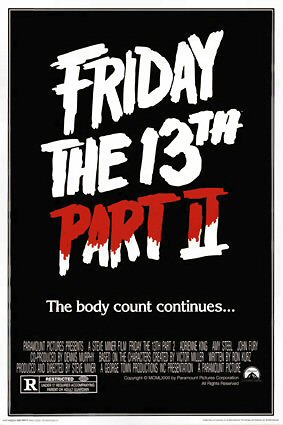
Today is a significant day for fans of Friday the 13th Part II. Today is the birthday of both Warrington Gillette and Tom McBride. Gillette was one of two actors to play Jason Voorhees in that film (he plays Jason without the mask while stuntman Steve Daskewisz played Jason whenever he was wearing a mask) and he is 65 years old today. Tom McBride, who passed away in 1995, played Mark, whose death was one of the films most shocking moments. Today, he would have been 72 years old.
Today’s scene that I love comes from Fridaythe13thPartII, which I think is a genuinely underrated horror film. Whenever I see this scene, I roll my eyes at Vicki (Lauren-Marie Taylor) running outside in her underwear just to look for something in her car but then I remember all of the times that I’ve done the exact same thing and I realize that I probably wouldn’t survive a horror film.
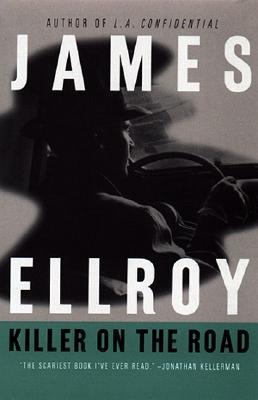
First published in 1986 and considerably shorter than the typical James Ellroy novel, Killer On The Road takes the form of the memoirs of Martin Plunkett, a child genius who grew up to be a prolific serial killer.
The book starts with Plunkett already serving a life sentence at Sing Sing. He’s a killer who is now off the road and his memoirs are less about his plans and more about his own struggle to understand how he became the killer that he became. There are plenty of possible explanations, going all the way back to his dysfunctional childhood and the trauma of his parent’s divorce. He may be brilliant but he spends all of his time wishing that he could turn invisible like a comic book character and spy on people in their homes. He comes to idolize Charles Manson but is disappointed when, while in prison, he meets the actual Manson and discovers that he’s just a rambling loser. The book is written in Plunkett’s own words and, in typical sociopath fashion, he thinks very highly of himself but careful readers will look between the lines and see someone who is just as confused by what he became as everyone else. For all of his intelligence and his nonstop speculation about the human condition, Plunkett ultimately seems like an empty vessel. Plunkett’s years on the road are full of unexpected detours. A meeting with a cop definitely do not go the way that anyone would probably expect it to go. Even though the story is narrated Plunkett, people like FBI agent Dusenberg come across as fully developed characters as well.
It’s a disturbing and sad but compulsively readable book. It may have been written before Ellroy developed his signature style but it stills shows his strengths as a storyteller. Interestingly enough, Ellroy later stated in My Dark Places that he based Martin Plunkett’s dysfunctional youth on his own, which definitely leaves one happy that James Ellroy discovered writing as an outlet for his emotions. Unlike Martin Plunkett, James Ellroy went on to become one of the best writers of our current era.
On July 10th, 1981, Kenneth Rex McElroy was gunned down in Skidmore, Oklahoma. He was shot while sitting in his truck. Over 40 bullets were fired into the truck but only two actually hit McElroy. His fourth wife, Trena (who Kenneth first met when she was 12 and he was 35), was sitting beside him at the time but was not hit by any bullets. McElroy was 47 years old when he was gunned down in broad daylight. There were reportedly 46 witnesses who saw the shooting occurred. When interrogated by the police, not a single one said that they saw anything. Quite a few did mention that Ken McElroy had gotten exactly what he deserved.
Ken McElroy was a high dropout, a barely literate career criminal who rustled cattle, burned down houses, raped his fourth wife when she was just 12, and then killed her family’s dogs in order to intimidate them into not pressing charges against him. He was known as the town bully, a surly man who had 17 children with 6 different women and who would shoot anyone who disagreed with him. Whenever he was charged with a crime, he would intimidate the witnesses into not testifying against him. In 1980. he got angry at a store owner after one of his kids was accused of shoplifting candy. McElroy shot the man and was put on trial for attempted murder. For once, he was convicted but he was freed on bail while awaiting appeal. When it become apparent that McElroy would not be going to prison for a while, the citizens of Skidmore….
Well, I should probably chose my words carefully. The truth of the matter is that no one has even been charged with or convicted of killing Ken McElroy. It is known that several citizens did have a meeting a few night before McElroy’s death and that they discussed what they could best do to keep McElroy from hurting anyone else. It’s also knoqn that, a week before he was shot, McElroy walked into the local bar with his rifle and dared anyone who wanted him dead to come get him. Does that mean that a group of concerned citizens took it upon themselves to dispense vigilante justice? That’s what Trena always claimed but again, no one was every charged, indicted, or convicted. The death of Ken McElroy remains officially unsolved.
Perhaps that’s why the names were changed for the 1991 made-for-television movie InBroadDaylight. Brian Denney may be playing a character named Len Rowan but, for anyone familiar with the case, it’s obvious that he’s playing Ken McElroy just as Marcia Gay Harden is obviously playing Tena McElroy, even if her character is called Adina. The film doesn’t change the name of the town and it doesn’t change the circumstances that led to McElroy’s death. W watch as McElroy intimidates the owners of a grocery store (played by Cloris Leachman and John Anderson) and even attempts to bully the local police (represented here by Chris Cooper). The film features a gun-toting crowd surrounding Len Rowan’s vehicle but it’s shot in such a way that their faces are blurry.
InBroadDaylight was filmed in Texas and it definitely captures both the beauty and the potential danger that comes with living in a rural community. Everyone in town knows everyone else. There’s a strong sense of community but, because the community is so small and isolated, it’s easy for a man like Len Rowan to bully the entire town. Some of the actors lean a bit too hard into their country accents. (Lord protect us from Yankees trying to sound Southern.) But the main members of the supporting cast — Cloris Leachman, John Anderson, Chris Cooper, Marcia Gay Harden — all give convincing performances. As for Brian Dennehy, he’s absolutely horrifying as the astoundingly cruel Len Rowan. Dennehy plays Len as being a man who might not exactly intelligent (the real Ken McElroy dropped out of school early) but who is positively brilliant at intimidating people. Dennehy plays Rowan as if he has a death wish. All of his threats and his speeches make it clear that he’s just daring someone to shoot him. Even when he realizes he’s about to get shot while sitting in his truck, he sit there and accepts the inevitable. Perhaps even he was getting sick of dealing with himself.
After watching In Broad Daylight, it’s easy to understand why no one came forward as a witness. By his own actions, Ken McErloy was destined to die violently. A few people just decided to speed things up a little. Who knows who?
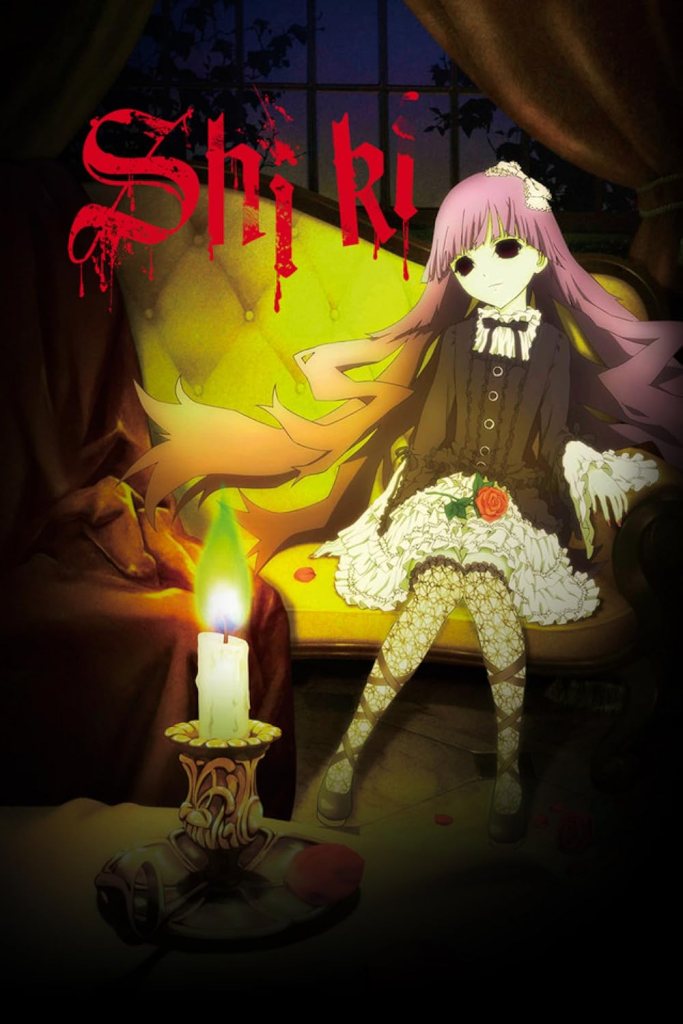
The anime adaptation of Shiki, based on Fuyumi Ono’s acclaimed horror novel and directed by Tetsurō Amino, stands as a rare specimen in the horror genre. Rather than relying on quick shocks, excessive gore, or typical jump scares, Shiki unsettles its audience through atmosphere, moral erosion, and the slow, relentless unraveling of human conscience. Premiering in 2010, the series unfolds at a measured, almost meditative pace, transforming what could have been a simple vampire tale into a profound meditation on survival, faith, fear, and the delicate boundary between life and death when everything is pushed to the brink.
The story is set in Sotoba, a small, isolated village nestled precariously near a larger modern metropolis. The residents of Sotoba live tightly woven lives, their routines and social bonds preserved with careful attention over generations. This fragile peace shatters when a mysterious wave of deaths begins sweeping through the population. At first, these fatalities are dismissed as consequences of the harsh local climate—heatstroke, seasonal illnesses, and the inevitable toll of old age. Yet, as the body count rises, the truth reveals itself to be much darker: the deceased are rising as vampires, known locally as “shiki” or “corpse demons,” creatures that survive by feeding on the living.
What distinguishes Shiki from many other vampire narratives is its refusal to paint the conflict in stark black-and-white terms of good versus evil. The shiki are portrayed not as mindless monsters but as tormented souls, burdened by memories, emotions, and guilt over what they have become and the horrors they must commit to survive. Conversely, the human villagers—once caring and close-knit neighbors—succumb to suspicion, fear, and eventually cold-hearted survival instincts. The real horror emerges as morality frays and the line between human and monster becomes irrevocably blurred.
Unlike classic horror tales set in small towns—such as Stephen King’s ’Salem’s Lot, where a seemingly idyllic village hides sinister supernatural forces—Shiki offers a nuanced inward gaze. For instance, the novel They Thirst situates vampirism within a sprawling urban landscape, where anonymity accelerates chaos and alienation. In contrast, Shiki uses the microcosm of Sotoba to emphasize intimate, communal decay. The focus is not just on the physical threat, but on the erosion of social bonds and moral fabric, revealing how fragile human civility truly is under stress.
While ’Salem’s Lot depicts vampires as a pure evil contaminating a tight-knit community—highlighting themes of moral corruption and contamination—Shiki explores moral ambiguity with far greater depth. The vampires, including the enigmatic Sunako Kirishiki, retain their memories, emotions, and even remorse. Both vampires and humans carry guilt and anguish, complicating simplistic notions of villainy. The villagers—their friends, family, and neighbors—begin to see the suffering of the vampires while realizing their own brutal deeds. The narrative challenges viewers to question whether survival excuses the loss of morality or if it is possible to retain one’s spirit even amid brutal chaos.
At the heart of the series are characters who embody competing moral philosophies. Natsuno Yuki, a cynical teenager newly transplanted to Sotoba from the city, provides both an insider and outsider’s perspective. His disillusioned view highlights how fear, suspicion, and grief can unravel even the most intimate relationships. Natsuno serves as a rational voice within a community unraveling into paranoia and despair, offering a reflection of the audience’s own struggle to comprehend the incomprehensible.
Dr. Toshio Ozaki exemplifies the desperate human desire for order amid chaos. Initially, he seeks to explain away the deaths with rational, scientific explanations grounded in medicine. However, when superstition and supernatural realities intrude, Ozaki is compelled to confront truths beyond his understanding. His leadership in trying to save Sotoba begins with scientific resolve but soon descends into moral compromise. As hysteria spreads, the villagers’ collective violence explodes into ruthless slaughter, justified as necessary to preserve survival. Ozaki’s internal conflict—balancing ethical convictions against brutal necessity—reflects the series’ central question: at what point does the will to survive erode the soul?
Set against this turmoil is Sunako Kirishiki, the quiet yet profoundly troubled leader among the shiki. Though she has lived for centuries and suffers deeply from a sense of divine rejection—believing God has forsaken her—Sunako retains a core spirituality that anchors her sense of morality. Even as she is forced to kill in order to survive, she wrestles with guilt and her faltering faith. Her belief that divine rejection is not synonymous with divine abandonment acts as a form of moral defiance, preserving her fragile humanity amid brutal circumstances.
This spiritual resilience is deepened through her relationship with Seishin Muroi, a local junior monk and published author. Muroi, gentle and introspective, offers a unique perspective on the tragedy unfolding in Sotoba. His dual roles as a religious figure and a thoughtful writer allow him to interpret the crisis with spiritual depth and philosophical insight. His literary works—admired by the Kirishiki family, especially Sunako—explore mortality, suffering, and the search for meaning beyond pain. As a monk, Muroi embodies faith and compassion; as an author, he grapples with existential ambiguities, granting him a rare wisdom in navigating the village’s descent.
Muroi’s role makes him both observer and actor in Sotoba’s unraveling. His spiritual duties compel him to provide comfort and guidance, while his writings deepen his understanding of human and supernatural suffering. This duality shapes his interactions with Sunako and others, serving as a pathway for faith and empathy to endure amid horror and despair.
Sunako’s friendship with Muroi becomes central to her moral endurance. In contrast to Tatsumi, the Kirishiki family’s pragmatic and ruthless jinrō guardian who views survival through a cold, utilitarian lens, Muroi offers a moral counterpoint grounded in mercy and hope. Through his compassionate presence and reflective insights, Sunako finds a way to renew her faith. Although she feels forsaken, Muroi’s influence rekindles the fragile spark of belief in her that prevents her humanity from being swallowed by despair.
The thematic contrast between Muroi and Tatsumi becomes a fulcrum for Shiki: survival devoid of soul versus survival with spirit. Muroi’s continuing faith—soft, tentative, but persistent—demonstrates that even in the bleakest conditions, moral conviction need not fade entirely. His dual lens as monk and author enriches the narrative, bridging theology and philosophy while threading through the story’s core existential dilemmas.
Amino’s direction amplifies these themes through patient pacing and subtle storytelling. The mounting tension grows slowly through quiet, contemplative moments and lingering visuals—the hum of cicadas, shifting light through leaves, the barely audible footsteps in the dark. Ryu Fujisaki’s stylized character designs convey unease with elongated features and a surreal sheen, while Yasuharu Takanashi’s sparse, mournful score melds choral lamentations with haunting silences. Together, these elements create an immersive atmosphere steeped in dread and melancholy.
By the series’ climax, the distinction between human and shiki dissolves into near indistinguishability. Both sides bear the scars of survival—physical, psychological, and spiritual. The violence ceases, but the damage lingers, leaving survivors hollow, burdened by guilt and loss. Yet amidst the ruins of a shattered community, Sunako’s renewed faith, forged under Muroi’s guidance, flickers faintly—an emblem of hope that refuses to be extinguished.
The final scene distills this weighty truth without grandiosity or closure. There are no victors, no absolutes—only profound loneliness in survival. The living bear wounds deeper than any inflicted by fang or bullet. But in this quiet aftermath, Sunako’s fragile faith, buoyed by Muroi’s steadfast compassion, pulses as the last vestige of what it means to remain human: choosing faith and empathy even when everything else seems lost.
Shiki closes not with resolution but with a haunting reminder: survival is incomplete without humanity, and faith—however delicate—is the courage to hold onto that humanity when all else has fallen away.
For today’s horror song of the day, we have Demon, a track from the soundtrack for the 1985 film, Demons. This song was composed and performed by Claudio Simonetti, who is best known as the keyboardist of Goblin.
The music video, incidentally, was directed by Michele Soavi, who also appeared in Demons as the mysterious masked man handing out free movie tickets.
This October, I’m going to be doing something a little bit different with my contribution to 4 Shots From 4 Films. I’m going to be taking a little chronological tour of the history of horror cinema, moving from decade to decade.
Today, we continue with the 1930s.
4 Shots From 4 Horror Films
La Llorona (1933, dir by Ramon Peon)
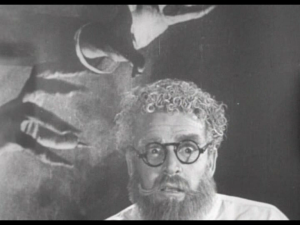
The Invisible Man (1933, dir by James Whale)
Maniac (1934, dir by Dwain Esper)
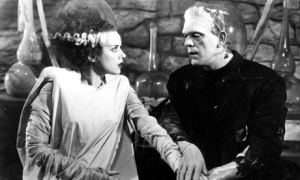
The Bride of Frankenstein (1935, dir by James Whale)
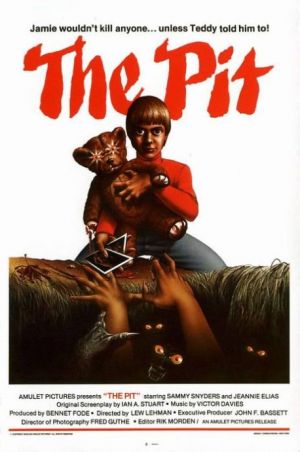
The 1981 Canadian film, ThePit, tells the story of a creepy little jerk named Jamie Benjamin (Sammy Snyders).
Now, admittedly, Jamie is only twelve years old and, usually, I make allowances for bad behavior from people who aren’t old or mature enough to know better. But there’s just something off about Jamie. He comes across as creepy from the first minute he shows up, with his intense stare and his blonde bowl cut. He spends a lot of time in the woods, where he has discovered a hole in the ground. The hole is full of hungry creates that Jamie calls Trogs. Jamie regularly takes raw meat to the hole and tosses it in. Unlike all of the kids at school and his own parents, the Trogs are always happy to see Jamie.
It may sound like a bad idea to give meat to a bunch of monsters that you just happened to find in the woods but Teddy thinks it’s a good idea. Teddy is Jamie’s teddy bear. Teddy talks. Teddy has all sorts of ideas for how Jamie can get back at everyone who has ever made fun of him or left him feeling insecure. Why not just toss them into the pit? Is Teddy real or is he just in Jamie’s mind? The film tries go for some ambiguity. That said, the Trogs are definitely real so it’s not that difficult to go from accepting the idea of carnivorous monsters to buying into a talking teddy bear.
Jamie is entering puberty and his hormones are going crazy. When his parents leave for a trip, they hire a psychology student named Sandy O’Reilly (Jeannie Elias) to keep an eye on Jamie. Jamie develops a crush and soon becomes obsessed with Sandy. Jamie is the type of kid who pretends to drop something just so he can look up Sandy’s skirt. (Bad Jamie!) Despite Jamie’s crush on Sandy, he still steals money from her so that he can buy raw meat for the Trogs. When he can’t get any more meat, he starts tempting real people out to the woods and pushing them in. When he tells Sandy about the Trogs, she doesn’t believe him. He takes her to the pit and that’s when things really start to get bad….
ThePit is an odd little film, one that never quite settles on a tone. In the original script, the Trogs and Teddy’s advice were all meant to be in Jamie’s head and Jamie himself was only meant to be 9 years old. The horror elements were meant to be products of Jamie’s disturbed imagination and one can still see elements of that in the completed film. However, director Lew Lehman decided to make Jamie older, to leave no doubt that the Trogs were real, and to add a small amount of humor. As such, The Pit is a film that veers from being a horror film to being a somewhat depressing coming-of-age film to a somewhat mean-spirited comedy. Sammy’s behavior, which might have been understandable for a 9 year old, becomes even more creepy now that he’s a twelve year-old who still takes orders from a teddy bear.
It’s a confused film but Sammy Snyders gives one of the best creepy kid performances of all time and there’s something undeniably satisfying about the ending. As Jamie discovers, he’s not the only kid with a pit and teddy bear can only protect him for so long.
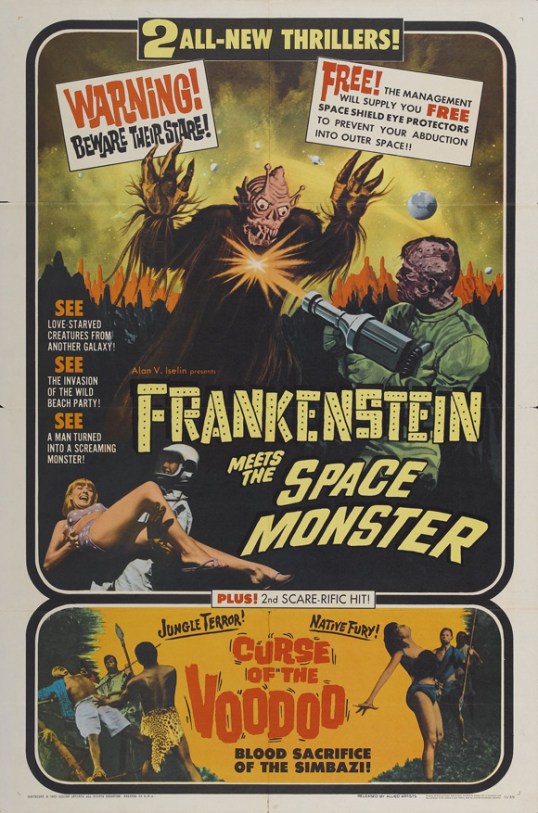
Despite the title, 1965’s Frankenstein Meets The Space Monster is not actually about Frankenstein or his monster.
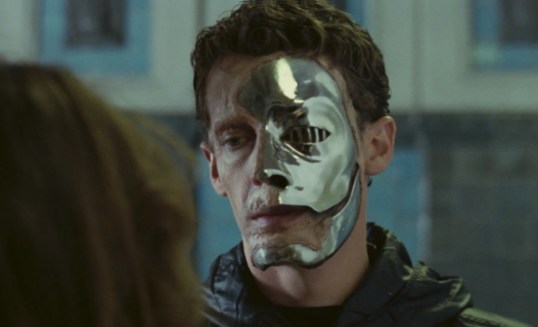
Instead, the Frankenstein of the title is Frank Saunders (Robert Reilly), an astronaut who happens to be an android. Frank was created by Dr. Adam Steele (James Karen, in one of his first film roles). Frank is designed so that he can go into space without making any of the mistakes that a human astronaut might make. He’s the next stage in the space program! With Frank sitting in a rocket, America will have rightfully conquered the Moon in no-time flat!
(Don’t waste my time with any of the international treaty crap. I don’t care how many other countries go to the Moon, it belongs to America because we landed their first. It’s the 51st State and someday, we’ll probably end up moving the federal government to the moon. Hopefully, we’ll just leave it there.)
Unfortunately, no sooner has Frank gone into space then he gets shot down by the Martians. Frank crashes in Puerto Rico and, with his face horrifically disfigured, starts to malfunction, Soon, he’s creating chaos all over the island and it’s up to Dr. Adam Steele — what a name! — to put a stop to it. However, before Frank is deactivated, he needs to meet the Space Monster (a mutant named Mull) and defeat the Martians.
Why are the Martians on Earth? According to a short, pointy-eared dwarf Martian named Dr. Nadir (Lou Cutell), an atomic war has led to the death of all the women on Mars. Personally, I think Dr. Nadir is lying because he came to Earth with a Martian woman named Princess Marcuzan (Marilyn Hanold). I think it’s more a case of almost all of the Martian women faking their own deaths so that they could get out of having to talk to Dr. Nadir. Seriously, Dr. Nadir is a little creep. Add to that, his Martian name actually sounds like an insult in English. Personally, I think he should come up with a new name if he wants people to listen to him. I would suggest calling himself Adam Steele but that name is already taken.
Soon, Martians are abducting bikini-clad women off of beaches in Puerto Rico. Can the Martians be stopped? Can Frank be restored? Will James Karen go on to have a distinguished career as a beloved character actor? Spoiler alert: the answer to the third question is yes. Indeed, one of the joys of this film is getting to see James Karen in a rare leading role. He commits to giving as good performance, even though the film itself is pretty silly.
Another joy of this film is the soundtrack, which is surprisingly good for a film of this budget and caliber. Just try to get That’s The Way It’s Got To Be out of your head! (In the film, this song plays as Frank prepares to go into space.)
That’s the way it’s got to be!
As for Frankenstein Meets The Space Monster …. I just can’t help it. I like the damn thing. It’s just so ludicrous and silly that it’s impossible for me not to enjoy. The film’s producers decided that they didn’t just want a robot terrorizing an island. They also wanted Martians and a mutant, as well! And we’re all better off for it.
 The forces of the evil Lord Arrakur (Arman Chapman) raid a peaceful Barbarian village, disrupting the wedding of Queen Amethea (Lana Clarkson) and Prince Argan (Frank Zagarino). Along with slaughtering almost the entire village, Arrakur also kidnaps Amethea’s sister, Taramis (Dawn Dunlap). Amethea survives the attack and, with her handmaiden Estrild (future director Katt Shea) and the warrior Tiniara (Susana Traverson), sets out for Arrakur’s realm to rescue her sister and to take vengeance on him.



 Through the Shattered Lens