Welcome to Retro Television Reviews, a feature where we review some of our favorite and least favorite shows of the past! On Saturdays, I will be reviewing The American Short Story, which ran semi-regularly on PBS in 1974 to 1981. The entire show can be purchased on Prime and found on YouTube and Tubi.
This week, we have an adaptation of a Stephen Crane short story.
Episode 1.8 “The Blue Hotel”
(Dir by Jan Kadar, originally aired in 1977)
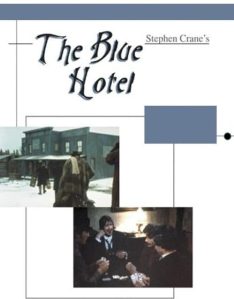
In the dying days of the Old West, a train pulls into a station in a small frontier town. Getting off the train, a Cowboy (John Bottoms), an Easterner (Geddeth Smith), and a Swede (David Warner) head to the town’s only hotel. A blizzard is coming and the three men are seeking shelter for the night. The owner of the hotel, Scully (Rex Everhart), is happy to provide it. As the men wait for dinner to be served, they play a card game with Scully’s son, Johnnie (James Keach).
At first, the game plays out without incident. The men are all friendly, with the exception of the Swede. The Swede remains quiet and seems distrustful. After a few hands of the game, the Swede accuses Johnnie of cheating. Over the next few hours, as the wind howls outside, the Swede rants and raves. Convinced that the wild west is truly full of outlaws and that it’s all exactly like the dime-store novels that he read before boarding the train, he cannot bring himself to accept that the men mean him no harm. It all leads to violence and tragedy.
This episode made excellent use of the shadowy Blue Hotel and the desolate wind blowing outside. Over the course of an hour, the hotel went from being a friendly shelter to an ominous location that seemed to pulse with paranoia. David Warner gave a strong performance as the unstable Swede and the final act of violence (which was changed slightly from the short story’s original conclusion) comes as a genuine shock as does the final twist in the tale. TheBlueHotel becomes a look at how people unknowingly shape their own destiny, for better or worse.
As some of our regular readers undoubtedly know, I am involved in a few weekly live tweets on twitter. I host #FridayNightFlix every Friday, I co-host #ScarySocial on Saturday, and I am one of the five hosts of #MondayActionMovie! Every week, we get together. We watch a movie. We tweet our way through it.
Tonight, at 9 pm et, Deanna Dawn will be hosting #ScarySocial! The movie? 2013’s You’reNext!
If you want to join us this Friday, just hop onto twitter, start the movie at 9 pm et, and use the #ScarySocial hashtag! It’s a friendly group and welcoming of newcomers so don’t be shy.
For today’s song of the day, we have the title tune to Stanley Kubrick’s The Shining. The Shining is a classic horror film and one that I look forward to revisiting on this site for our annual October Horrorthon.
For now, enjoy the greatest road trip music ever recorded.
Stanley Kubrick would have been 97 years old today!
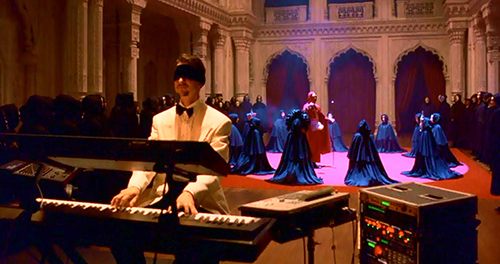
In honor of this visionary and his career, here is a wonderful scene from his final film, 1999’s Eyes Wide Shut. Like so many of Kubrick’s films, it took a while for people to really appreciate Eyes Wide Shut. It’s an odd and, at times, frustrating film but still a film touched by Kubrick’s unique genius. It’s also a Christmas film and one that I plan to revisit for the site in December.
In this scene, Tom Cruise discovers that it’s not quite as easy to crash a super secret party as he thought it would be.
4 Or More Shots From 4 Or More Films is just what it says it is, 4 shots from 4 of our favorite films. As opposed to the reviews and recaps that we usually post, 4 Shots From 4 Films lets the visuals do the talking!
On this date, 97 years ago, Stanley Kubrick was born in New York City. The rest, as they say, is history.
In honor of one of the world’s greatest directors, here are….
6 Shots From 6 Stanley Kubrick Films
The Killing (1956, dir by Stanley Kubrick, DP: Lucien Ballard)
Paths of Glory (1957, dir by Stanley Kubrick, DP: Georg Kraus)
Dr. Strangelove or: How I Learned to Stop Worrying and Love the Bomb (1964, dir. Stanley Kubrick, DP: Gilbert Taylor)
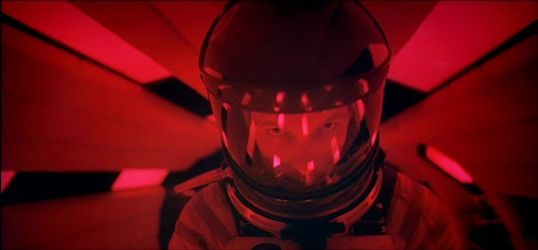
2001: A Space Odyssey (1968, dir by Stanley Kubrick, DP: Geoffrey Unsworth)
Barry Lyndon (1975, dir by Stanley Kubrick, DP: John Alcott)
The Shining (1980, dir by Stanley Kubrick, DP: John Alcott)
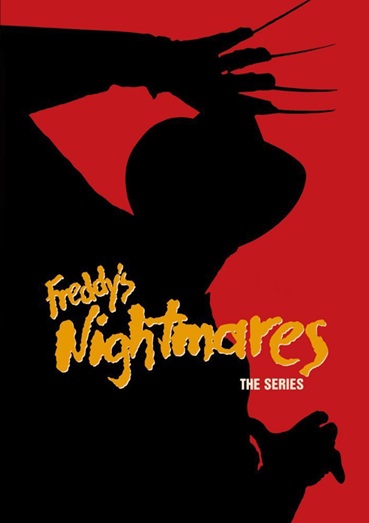
Welcome to Late Night Retro Television Reviews, a feature where we review some of our favorite and least favorite shows of the past! On Fridays, I will be reviewing Freddy’s Nightmares, a horror anthology show which ran in syndication from 1988 to 1990. The entire series can be found on Plex!
Having finished up Friday the 13th, I’m not going to take a look at another syndicated horror show that aired around the same time. Freddy’sNightmares was an anthology show hosted by Robert Englund, in character as Freddy Krueger. Each story would take place in Freddy’s hometown of Springwood, Ohio. Would the show be a dream or a nightmare? Let’s find out!
Episode 1.1 “No More Mr. Nice Guy”
(Dir by Tobe Hooper, originally aired on October 9th, 1988)
Freddy Krueger has become such a familiar and popular figure that I think it’s sometimes forgotten that, when he first appeared, he was truly a horrifying character. He was a child molester and a serial killer, one who escaped legal justice only because someone forgot to read him his rights when he was arrested. He was killed by the citizens of Springwood, Ohio, set on fire in the same boiler room where he killed his victims. Yes, he was brutally murdered and yes, the respectable people who murdered him covered up their crime. At the same time, what would you do if a monster like Freddy was loose in your town and stalking your children? “I’m burning in Hell,” Freddy says and that’s exactly what he deserved.
How did Freddy Krueger then become an oddly beloved pop cultural icon? Some of that was undoubtedly due to his one-liners, which tended to be a slightly better than the typical slasher film banter. If Freddy was pure evil in the first three NightmareonElmStreet films, he became more a homicidal prankster as the series continued. I think another reason why Freddy became popular is because the actor who first played him, Robert Englund, himself always comes across as being such a nice guy. Unlike the personable but physically intimidating Kane Hodder, who looked like he could kill you even when he wasn’t playing Jason Voorhees, Englund always comes across as being slightly nerdy and very friendly. He’s the neighbor who you would trust to get your mail while you’re on vacation. If Englund hadn’t been cast as Freddy Krueger in 1984, he probably would have spent the 90s playing quirky programmers and hackers in tech thrillers. The thing with Robert Englund is that seems to have a good sense of humor, he’s at peace with his place in pop culture, and he always seem to be having fun. (In his autobiography, he even jokes about something that fans had been laughing about for years, the fact that the female lead in A Nightmare In Elm Street 2 looked almost exactly like Meryl Street.) Those are qualities that bled over into Freddy.
As a result, Freddy became popular enough to host his own horror anthology. The premiere episode of Freddy’sNightmares open with Englund, in full Freddy makeup, telling us that we’re not about to see one of our nightmares. Instead, we’re going to see his nightmare. The episode gives us Freddy’s origin story, starting with Freddy getting off on a murder charge on a technicality and ending with Freddy getting bloody revenge of the police chief (played by Ian Patrick Williams) who set him on fire.
By almost any standard, it’s a disturbing story. We open with Freddy on trial and we hear details about an 8 year-old boy that he left in a dumpster. After the charges against Freddy are dismissed (damn those Carter judges!), Freddy happily gets into an ice cream truck and later, the police chief has a vision of the same truck coming straight at him. After getting set on fire, Freddy doesn’t waste any time coming back and using his razor-blade gloves to slash his way to vengeance. I think what’s particularly disturbing about this episode is that the police chief is not a bad guy. He arrested Freddy as Freddy was trying to attack his twin daughters. Throughout the episode, Freddy — in both life and death — makes it clear that he’s coming for the man’s daughters. And in the end, Freddy will probably get them because their father fell asleep in a dentist’s chair and got his mouth drilled by Dr. Krueger.
Agck! That’s disturbing stuff. Of course, it would be even more disturbing if the show’s special effects and gore were anywhere close to being a realistic as what was present in the movies. The show itself looks remarkably cheap. I would say it almost looks like a community theater production of A Nightmare on Elm Street. Director Tobe Hooper (of TexasChainsawMassacre fame) manages to wring a few jump scares out of the material and a scene where we see one of Freddy’s courtroom fantasies is genuinely horrifying but, for the most part, the budget is low enough that the viewer can safely say, “It’s only a TV show, it’s only a TV show….” In the end, it’s very much an 80s TV show, right down to the oddly gratuitous scene where the police chief suddenly imagines the dental hygienist in her underwear.
Where will Freddy’sNightmares lead us? We’ll find out. I’m sure it will be bloody, wherever it is!
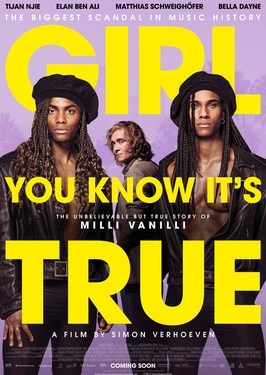
In 1988, a German music producer named Frank Farian (Matthias Schweighofer) has already recorded and produced a song called Girl You Know Its True. He just needs to find two performers who are more photogenic than the middle-aged studio musicians who actually sang it. Frank discovers Rob (Tijan Njie) and Fab (Elan Ben Ali), two friends who are trying to make it as dancers. Rob is German and biracial. Fab is French. Frank tells them that all they have to do is lip-synch along with the record whenever they’re “performing” the song. After Frank assures them that this type of thing is done all the time, they agree. Frank also tells them that they will be known as Top Shelf.
The song becomes a hit and Rob and Fab become stars but they’re not known as Top Shelf, a name that is dismissed as being too German. Instead, they find superstardom as Milli Vanilli. With their popularity comes money, groupies, and drugs. But when word gets out that neither Rob nor Fab actually sang on their record, everything collapses into one of the biggest entertainment scandals of the past 40 years.
I never would have guessed that a good movie could be made about the fall of Milli Vanilli but Girl You Know Its True is a surprisingly compelling and well-acted retelling of the familiar story. The movie is as much as about the business of fame as it is about the band itself with Frank realizing and explaining that a band’s image is much more important than the music itself. Rob and Fab are presented as being incredibly naive and trusting when it comes to Frank and his promises, with Rob also sabotaged by a need for acceptance that came out of his troubled childhood. The villain in this story is not the band but instead a music industry that knowingly looked the other way on Frank’s deception and then scapegoated Rob and Fab when the truth came out. Rob and Fab each deal with going from being superstars to being pariahs in their own individual way. It leads to tragedy for one and regret for the other.
Even though I was familiar with the story, Girl You Know It’s True took me by surprise. It’s a genuinely good film.
Welcome to Retro Television Reviews, a feature where we review some of our favorite and least favorite shows of the past! On Fridays, I will be reviewing St. Elsewhere, a medical show which ran on NBC from 1982 to 1988. The show can be found on Hulu and, for purchase, on Prime!
This week, everyone’s got the blues.
Episode 2.8 “All About Eve”
(Dir by David Anspaugh, originally aired on December 14th, 1983)
What a depressing episode!
With tension rising between Boston’s Catholics and its Protestants, threats are being called into the hospital because young Protestant Eddie Carson (Eric Stoltz) is still a patient. (Last week, I assumed Eddie was Catholic but apparently, he’s supposed to be a Protestant. I also assumed his parents were blown up in the pub bombing. In this episode, it was made clear that the victims were his aunt and uncle.) A group of masked, IRA-style terrorists break into Joan Halloran’s home. Joan’s gone at the time but Bobby Caldwell is in the shower and he ends up getting beaten into unconsciousness.
(Wow, did someone on the writing staff have an issue with Irish Catholics?)
Meanwhile, Dr. Westphall has to explain to his several autistic son Tommy (Chad Allen) that their beloved housekeeper has quit and moved away. Westphall’s daughter says she’s going to skip college and stay home to help take care of her brother. While I’ve always known that the widowed Westphall had an autistic son, this was the first episode to actually show us Westphall interacting with Tommy. And, with no disrespect meant to the autistic community, I can understand why Westphall always seems so depressed. Tommy runs and hides in a corner. Tommy hits his father. Tommy demands to know if everyone is going to leave him. By the end of the episode, Westphall was exhausted and I was even more exhausted from watching him.
But Westphall’s angst was not the most depressing thing about this episode. On top of everything else, Eve Leighton died! She didn’t die as a result of the heart that Dr. Craig transplanted into her. The heart was working fine. Instead, the rest of Eve’s body gave out. Being in the hospital initially saved her life but it also shut her off from everything that inspired her to keep living. Dr. Craig was in surgery when Eve coded. By the time he was able to get to her room, she was already gone. And with Eve’s death, that also means that the heart that once belonged to Morrison’s wife is gone as well.
I mean, seriously …. GOOD LORD! It was a well-acted episode. Both William Daniels and Ed Flanders broke my heart. But I seriously had to rewatch HappyGilmoreafter watching this show. That’s how depressed it left me!
But that’s life and death in a hospital. Every hospital is home to hundreds of different stories and the majority of them do not have happy endings.




 Through the Shattered Lens