Today’s song of the day comes from Duke Ellington’s classic score for 1959’s Anatomy of a Murder.

In honor of James Stewart’s birthday, our scene that I love comes from one of my favorite Stewart films, 1959’s Anatomy of a Murder.
In today’s scene that I love, James Stewart explains to his client (played by Ben Gazzara) that there are four ways that he can defend a murder charge. The contrast between Stewart’s classic style and Gazzara’s intense method style makes for an intense scene between two very talented and unique actors.
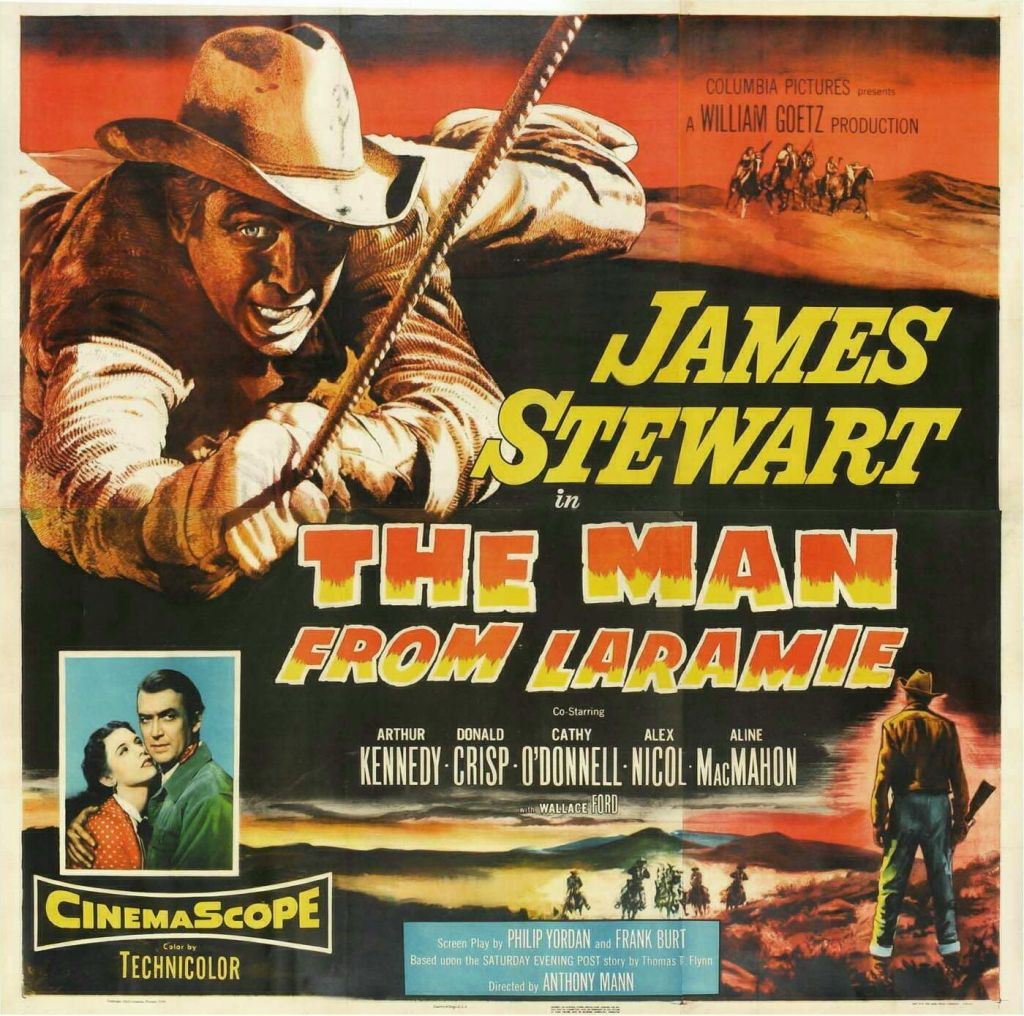
Happy Birthday, Jimmy Stewart!
I’m celebrating Jimmy Stewart’s birthday by watching his western THE MAN FROM LARAMIE! Stewart plays Will Lockhart, a man who has run into some bad luck. His brother, a U.S. cavalryman, was recently killed in an attack by Apaches using repeating rifles outside of the town of Coronado, New Mexico. In an attempt to track down the man who sold the rifles to the Indians, Lockhart has come to Coronado from Laramie, WY, to snoop around. He’s welcomed to town by Dave Waggoman (Alex Nicol), we’ll call him “Crazy Dave,” the son of powerful local rancher Alec Waggoman (Donald Crisp). Accusing Lockhart of stealing salt off of their land, Crazy Dave proceeds to drag him with a rope, burn his wagons and shoot his mules. Before he can do even more damage to Lockhart, the foreman of the Waggoman ranch Vic Hansbro (Arthur Kennedy) comes along and stops him. Vic seems like a reasonable man, but he does ask Lockhart to move on down the trail before there’s any more trouble. Lockhart isn’t leaving until he finds out more about those rifles so he politely declines by going back into town, finding Crazy Dave, and kicking his ass. He then goes to see Alec and asks to be paid back for the wagons and mules that crazy Dave destroyed. Alec pays Lockhart back and then calls Vic in to come see him. Here’s where we start to get a feel for Waggoman family dynamics. You see, Alec loves his son no matter how crazy he is, and he expects Vic to keep him out of trouble. He even takes the cost of the destroyed wagons and dead mules out of Vic’s pay instead of Crazy Dave’s. We find out that Crazy Dave is jealous of Vic, and that Vic feels underappreciated by a man he has treated like a father for many years. Against this backdrop of family jealousy and insanity, Lockhart will continue to dig around until he finds out who sold the rifles that killed his brother. Could it be Vic or Crazy Dave?
THE MAN FROM LARAMIE is the last of five westerns that Stewart worked on under the direction of Anthony Mann. Their work is legendary, including the western classics WINCHESTER ‘73 (1950), BEND OF THE RIVER (1952), THE NAKED SPUR (1953), and THE FAR COUNTRY (1954). In my opinion, they may have saved their best for last. Jimmy Stewart gives a masterful performance in the role of Will Lockhart. Stewart was very smart in the way he played his parts in westerns. Tall and gangly, he would never have been a believable western star if he had played his roles more like a John Wayne or Gary Cooper. Rather, his character here is driven by an uncontrollable desire for revenge, so no matter what happens to him, outside of being killed, he’s going to keep on coming. In this movie, he’s dragged, beaten and even has his hand shot from point blank range, but that doesn’t stop him. And every so often he flashes that Jimmy Stewart smile and you can’t help but have complete sympathy for him. The supporting performances are good as well, especially from Donald Crisp as Alec Waggoman and Arthur Kennedy as Vic Hansbro. Neither are completely bad men, but they make bad decisions based on emotions that most of us can completely understand. They’re so good in the roles that we can’t help but kinda like them in spite of those bad decisions. One of the things I love about old westerns is the way they deal with honest emotions and universal truths. At one point in the film, after discovering that Vic has lied to him about something, Alec tells him, “Once you start lying, there’s no way to stop!” If you’ve ever lied about something before, you know that one lie always leads to another, and then to another. The drama in THE MAN FROM LARAMIE centers around what happens to the characters when the truth finally comes to light. In my opinion it’s great stuff, and produces one of my very favorite westerns!
On a side note, I love this movie so much that I demanded that my wife and I stop and eat in Laramie a couple of years ago when we were visiting family in Wyoming. Here’s a pic from that wonderful day. I wanted to make sure we got the sign in the back that said Laramie!

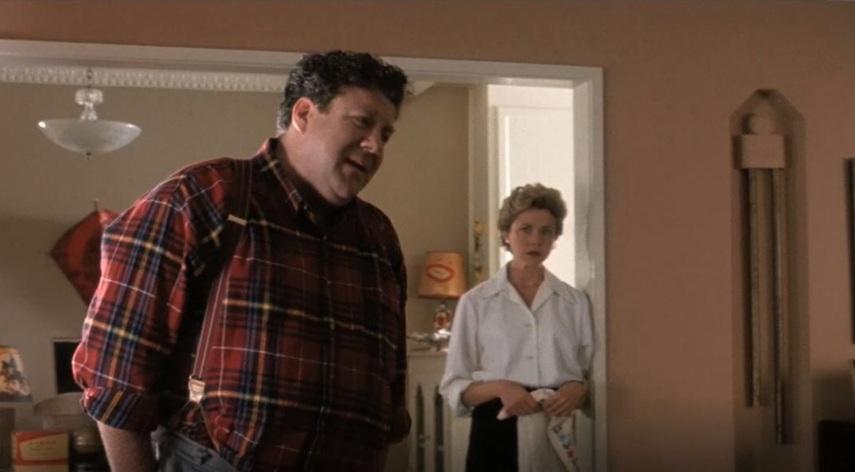
George Wendt passed away in his sleep earlier today. He was 76 years old.
If you’re old enough to have watched Cheers when it originally aired or to have caught it in reruns, George Wendt will always be Norm Peterson, the beer-drinking accountant who spent all of his time at the show’s titular bar. One of the show’s trademarks was that, whenever he entered the bar, everyone greeted him by shouting, “Norm!” “How’s the world treating you?” a bartender would ask. “It’s a dog eat world and I’m wearing milkbone underwear,” Norm once replied.
(One of my favorite joke from the series was when Norm went into a steakhouse and everyone inside was heard to yell, “Norm!” as the door closed behind him.)
If we’re going to be really honest, Norm was probably a high-functioning alcoholic and terrible husband. (Wife Vera was often-mentioned but never seen.) Wendt was so likable in the role and was so good at delivering those one-liners that it didn’t matter. Watching the show, you never wondered why Norm was in the bar. You were just glad he was.
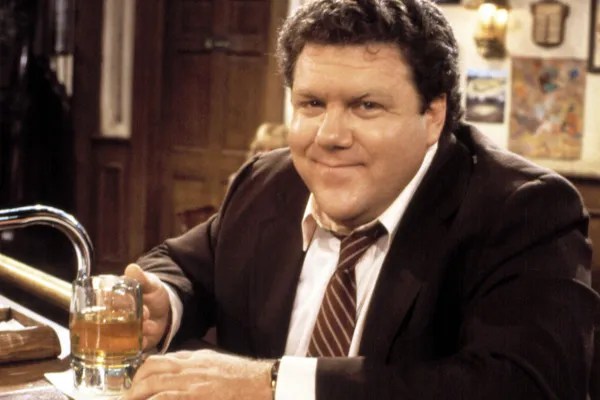
George Wendt was also an accomplished stage actor. (I saw him on stage when he was co-starring with Richard Thomas in 12 Angry Men.) He appeared in several movies, usually playing the comedic sidekick or the hero’s best friend. His film roles often didn’t ask him to do much other than be likable but one exception was his performance in 1991’s Guilty By Suspicion.

Guilty By Suspicion is a film about the McCarthy era, starring Robert De Niro as film director David Merrill, who is threatened with being blacklisted unless he names four of his colleagues as being communists. George Wendt plays screenwriter Bunny Baxter, a childhood friend of David’s who attended a few communist rallies when he was younger, failed to mention it to the FBI, and who is now being investigated as a subversive. The studio argues that David should name Baxter because his name is already out there. When David refuses, he finds himself blacklisted and unable to make a living. Bunny Baxter, meanwhile, is offered a similar deal. Baxter can save his own career but only if he names David as a communist. Unlike David, Baxter considers betraying his friend because it’s the only way that he can ever hope to work again. “Your dead anyway,” Baxter says to David.
Guilty By Suspicion suffers from Irwin Winkler’s plodding direction but De Niro gives a good performance, as does Martin Scorsese who is cast as a director based on Joseph Losey. The film is full of actors who would later become better-known, like Chris Cooper, Tom Sizemore, and Annette Bening. Wendt, however, gives the film’s best performance as the screenwriter who is torn between protecting his career and maintaining his integrity. The scene where he asks permission to name Merrill as a communist is powerful and it shows how good an actor George Wendt could be. Bunny Baxter is asking his best friend to allow himself to be stabbed in the back. Baxter is that desperate. That he’s played by George Wendt, an actor who was everyone’s favorite likable barfly in the 80s, makes the scene all the more powerful.
George Wendt, RIP. Thanks for the memories.
Welcome to Retro Television Reviews, a feature where we review some of our favorite and least favorite shows of the past! On Tuesdays, I will be reviewing the original Fantasy Island, which ran on ABC from 1977 to 1984. Unfortunately, the show has been removed from most streaming sites. Fortunately, I’ve got nearly every episode on my DVR.
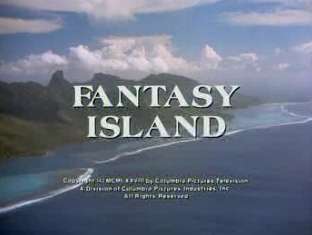
“Smiles, everyone, smiles!” It’s time for another two fantasies.
Episode 6.17 “King of Burlesque/Death Games”
(Dir by Cliff Bole, originally aired on March 12th, 1983)
I’m going to deal with the first of this week’s fantasies very quickly because, quite frankly, it’s not every interesting. Rich Little is Tom Vail, a wall street accountant who wants to be a burlesque comedian. He gets his fantasy. He performs at the Fantasy Island Burlesque Revival. He wears a hideous suit with a big bowtie. He falls in love with a dancer. The always likable Red Buttons appears as a Burlesque veteran. It’s not a bad fantasy but it’s not terribly interesting.
Meanwhile, Vanessa Walgren (Joanna Pettet) has come to the Island to compete in the “First Annual Fantasy Island Pentathlon.” However, Mr. Roarke knows that she’s there for another reason. She wants to kill him! A year ago, Vanessa’s husband was lost at sea while on his own fantasy. (He wanted to retrace the route of the Kon Tiki.) Vanessa blames Roarke and she’s put a bounty on his head. Roarke sighs and says, “Fine, but if you don’t kill me by the end of the weekend, you have to leave the Island and never bother me again.” Vanessa agrees….
WHAT!? What type of vengeance is that!? Seriously, if you’re obsessed with vengeance, you don’t just shrug and accept an arbitrary rule from the person you’re trying to kill.
Anyway, Roarke is the judge for the Pentathlon so he’s got various athletes trying to kill him over the course of the entire weekend. He even gets cut during a fencing match! (“If you can bleed, you can die!” Vanessa declares in a wonderfully over-the-top moment.) Whenever anyone fails to kill him, Roarke says, “Get off my Island!,” which is rally cool. Tattoo wonders why Roarke is allowing this to happen. Why doesn’t Roarke order Vanessa to get off the Island. Roarke is all like, “I can’t tell you, just trust me.” The final event is a skydiving competition and I’m not really sure how you compete at that but whatever. Despite Vanessa’s efforts to sabotage his parachute, Roarke lands safely.
Vanessa then offers him two glasses of wine. One glass is poisoned! Can Roarke pick the right glass? Roarke is like, “Screw this,” and finally reveals that Vanessa’s husband is not dead. Instead, he’s a secret agent who had to fake his own death but who is now ready to be reunited with Vanessa….
Again, WHAT!? Seriously, that came out of nowhere.
Reunited with her husband, Vanessa apologizes for trying to murder Roarke. Roarke says it’s fine because Mr. Roarke is very forgiving.
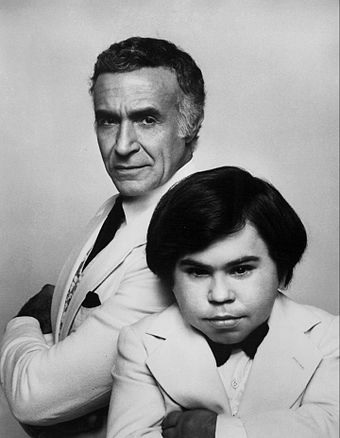
The burlesque fantasy was boring (loved the costumes, though!) but the revenge fantasy made up for it. I love it when Fantasy Island embraces the melodrama. Plus, this fantasy actually gave Ricardo Montalban and Herve Villechaize quite a bit to do. All in all, this was a good trip to the Island!

Charles Bronson began acting in movies and on TV shows in 1951. Through the mid-fifties, he established himself as a solid character actor with a strong physical screen presence. Beginning in October of 1958, he was given the opportunity to headline his own TV show, MAN WITH A CAMERA. The show, which ran for 29 episodes, features Bronson as a freelance photographer from New York named Mike Kovac, a guy who specializes in the difficult and dangerous assignments that his peers stay away from. Always on the side of truth and justice, Kovak will do anything to get the picture.
In the first episode of the series, Mike Kovac (Charles Bronson) wants to get a picture of his old neighborhood pal, Joey Savoyan (Tom Laughlin). Joey has risen in the boxing ranks, and is getting a title shot at the champ, Sal Benning (Don Kennedy). But it seems that success has changed Joey from the guy Mike knew, and there have been many reports that he’s turned into a jerk who’d rather punch a reporter or photographer than look at them. When Mike goes to Joey’s training camp, and proceeds to tell him that his attitude is an embarrassment to the people pulling for him back home, Joey gets pissed and the two men end up in the ring. Apparently Mike could whip him back in the day, but times have changed and after absorbing a few of Mike’s jabs, Joey lays his ass out cold with one punch. The photograph that makes the papers that night is Mike laying flat on his back with the headline “Joey Savoyan puts ace photographer in darkroom!” Licking his wounds with spare ribs at a local restaurant that night, another pal from the old neighborhood shows up to see him. This time it’s Dolly (Ruta Lee), Joey’s main squeeze, who’s there on his behalf. Joey’s in trouble and needs Mike’s help. Mike goes out to Joey’s cabin where he’s filled in on the truth. The reports of his punching photographers and reporters were all made up to create his “killer” image. What’s even worse is the fact that Joey had found out the day before that the fights he had won to get the title shot were all fixed. Now, gangster Willie Fletcher (Theodore Marcuse) is putting the pressure on him to take a dive. Joey doesn’t want to do it, so he asks Mike to get a picture of him, Willie, and the champ planning the fix that night. He believes he can use this picture as leverage to turn the dangerous mobster down. It wouldn’t be much of a show if things went exactly as planned, and the fun is seeing how it all plays out!
The series MAN WITH A CAMERA stretches our ability to suspend our disbelief right off the bat, when it asks us to accept that anyone, including Billy Jack himself, could lay out Charles Bronson with one punch. The fact that Bronson is shirtless, revealing muscle on top of muscle, makes it that much harder to believe. That lack of realism aside, I really did enjoy this first episode. Bronson plays Mike Kovac with a determination and uncompromising integrity that lets us know right off the bat that he will do whatever it takes to get to the truth, and that he doesn’t care who he has to piss off to accomplish that goal. He seems fearless and very tough. When the gangster Willie Fletcher, who’s known for using his gun, threatens Mike, he responds with “Boy, you talk tough… you scare me, Willie” in a way that would indicate it’s impossible to scare him and you get the feeling he can back it up. As a lifelong fan of Bronson, it’s nice seeing his powerful screen charisma and toughness come across so easily at this early point in his career. It’s also fun seeing Bronson and Tom Laughlin on screen together, even if the writers came up with the unrealistic scenario that I discussed earlier. I have to admit I would love to see Billy Jack take on Chaney from HARD TIMES. I think that would be one hell of a show!
This is a solid first episode, and I’m looking to see where the show heads from here. I’ve watched various episodes of MAN WITH A CAMERA over the years, but this will be first time I’ve ever started from the beginning and watched and reviewed each episode. Although he’s only talked about in episode 1, I remember Mike’s dad being a fairly big part of the series. Father/son relationships on TV and in movies are my favorites, so I’m looking forward to seeing that play out. If Tom Laughlin is any example, I’m also looking forward to the quality of guest stars we’ll be seeing. A quick look on IMDB reveals actors like Don Gordon, Angie Dickinson, Gavin McLeod, and Lawrence Tierney will be showing up throughout the series. This should be a lot of fun!
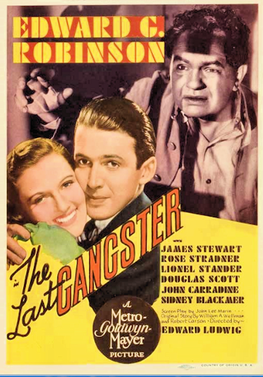
In 1937’s The Last Gangster, Edward G. Robinson plays Al Capone.
Well, actually, that’s not technically true. The character he’s playing is named Joe Krozac. However, Joe is a ruthless killer and gangster. He’s made his fortune through smuggling alcohol during prohibition. Despite his fearsome reputation, Joe is a family man who loves his wife Tayla (Rose Stradner) and who is overjoyed when he learns that she’s pregnant. To top it all off, Joe is eventually arrested for and convicted of tax evasion. He gets sent to Alcatraz, where he finds himself being bullied by another inmate (John Carradine) and waiting for his chance to regain his freedom.
In other words, Edward G. Robinson is playing Al Capone.
Krozac does eventually get out of prison but, by that point, Tayla has moved on. She’s married Paul North (James Stewart), a former tabloid reporter who was so outraged by how his newspaper exploited Tayla’s grief that he resigned his position. Joe Krozac’s son has grown up with the name Paul North, Jr. and he has no idea that his father is actually a notorious gangster.
Krozac wants to get his son back but his gang, now led by Curly (Lionel Stander), has other ideas. They want Krozac to reveal where he hid the money that he made during his gangster days. As well, an old rival (Alan Bazter) not only wants to get revenge on Krovac but also on Krovac’s son. Joe Krovac, fresh out of prison, finds himself torn between getting his revenge on his wife and protecting his son. This being a 30s gangster film, it leads to shoot-outs, car chases, and plenty of hardboiled dialogue.
Edward G. Robinson and Jimmy Stewart in the same movie, how could I n0t watch this!? I was actually a bit disappointed to discover that, even though both Robinson and Stewart give their customarily fine performances, they don’t spend much time acting opposite each other. Indeed, it sometimes seem like the two men are appearing in different pictures.
Robinson is appearing in one of the gangster films that made him famous. (Indeed, the film’s opening credits feature footage that was lifted from some of Robinson’s previous films.) He gives a tough and snarling performance but also one that suggests that, as bad as he is, he’s nowhere near as bad as the other gangsters that are working against him. His gangster is ultimately redeemed by his love for his son, though the Production Code still insists that Joe Krozac has to pay for his life of crime.
Stewart, meanwhile, plays his typical romantic part, portraying Paul as being an incurable optimist, a happy go-getter who still has a sense of right-and-wrong and a conscience. Stewart isn’t in much of the film. This is definitely Robinson’s movie. But still, there’s a genuine charm to the scenes in which Paul romances the distrustful Tayla. Not even being forced to wear a silly mustache (which is the film’s way of letting us know that time has passed) can diminish Stewart’s natural charm.
If you like 30s gangster films, like I do, you should enjoy The Last Gangster. I would have liked it a bit more if Robinson and Stewart had shared more scenes but regardless, this film features these two men doing what they did best. This is an offer that you can’t refuse.
1936’s Speed takes place in Detroit, at the home of Emery Motors.
When Joan Mitchell (Wendy Barrie) shows up to start her new job in the PR department, one of the first things she sees is a car being driven around a race track at a high speed until eventually it crashes. Automotive engineer Frank Lawson (Weldon Heybourn) explains that it’s all a part of making sure the car is safe. At Emery Motors, they crash cars on a daily basis to make sure that both the car and the driver will survive.
Terry Martin (James Stewart), the driver of the crashed car, proceeds to give Joan a tour of the factory. There’s an obvious attraction between the two of them but Joan also seems to have feelings for Frank. Terry and Frank are rivals. Terry may not have Frank’s education but he has instincts and he has common sense. He and his friend, Gadget Haggerty (Ted Healy), have an instinctive understanding of cars. They know how to drive them. They know how to fix them. They know how to make them go really fast.
In fact, Terry is working on a new carburetor, one that he says will increase the speed of Emery’s cars. Frank is skeptical but Terry knows that, if he can enter his car into the Indianapolis 500, he’ll be able to prove that he knows what he’s talking about. Joan comes to believe in Terry and his carburetor. And, fortunately, Joan has a secret of her own that will be very helpful to Terry’s ambitions.
Speed was not Jimmy Stewart’s first feature role but it was his first starring role. 28 years old when he starred in Speed, Stewart is tall, a little bit gawky, and unbelievably adorable. From the minute that Terry climbs out of that wrecked car and introduces himself to Joan, Stewart’s a true movie star. He and Wendy Barrie have a lot of chemistry and are a truly cute couple but Stewart is the one who dominates the film with his straight-forward charisma. Terry may not be the best educated engineer at Emery Motors but he is determined to prove himself and Stewart does a great job of portraying that determination.
As for the film itself, it’s low-budget and it’s short. Automotive enthusiasts might enjoy seeing all of the old cars and getting a chance to see what a car race was about in the days when cars themselves were still a relatively new invention. The film itself starts out as almost a documentary, with Stewart (as Terry) explaining how each car is manufactured on the assembly line. He points out all the machinery that goes into making the car in an almost-awed tone of voice. If the information is a bit dry, it doesn’t matter because it’s impossible not to enjoy listening to Jimmy Stewart speak. In his pre-WWII films, Stewart was the voice of American optimism and that’s certainly the case with Speed.
Speed was not a huge box office success but, in just two years, Stewart would be working with Frank Capra on You Can’t Take It With You, the first Stewart film to be nominated for (and to win) the Oscar for Best Picture of the year.
4 Shots From 4 Films is just what it says it is, 4 shots from 4 of our favorite films. As opposed to the reviews and recaps that we usually post, 4 Shots From 4 Films lets the visuals do the talking!
Today, we celebrate the birthday of one of the greatest American actors of all time, the wonderful James Stewart! It’s time for….
4 Shots From 4 James Stewart Films
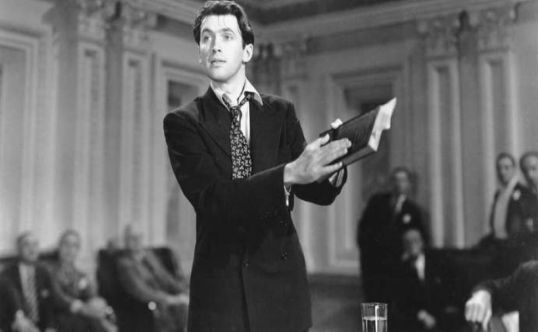
Mr. Smith Goes To Washington (1939, dir by Frank Capra, DP: Joseph Walker)
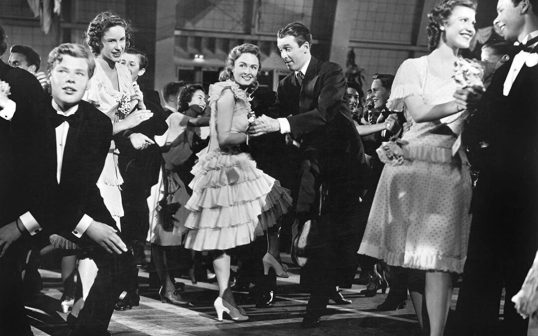
It’s A Wonderful Life (1946, dir by Frank Capra, DP: Joseph Walker and Joseph Biroc)

Rear Window (1954, dir by Alfred Hitchcock, DP: Robert Burks)
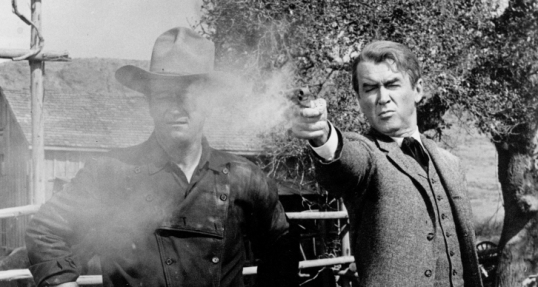
The Man Who Shot Liberty Valance (1962, dir by John Ford. DP: William H. Clothier)
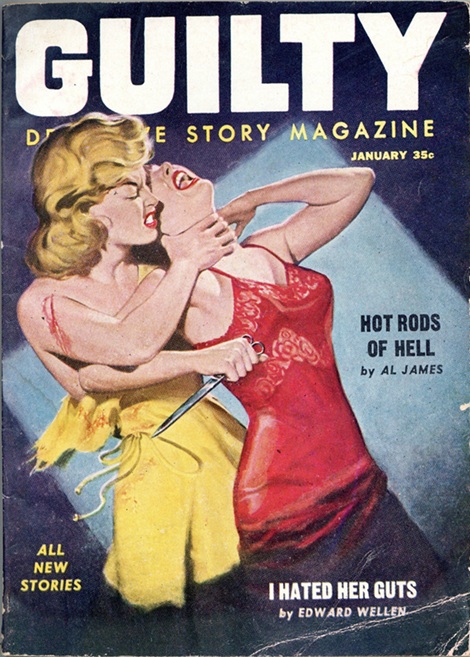
by Wil Hulsey
I’ve got three sisters, I can relate.
 Through the Shattered Lens