My favorite movie weapon is the shotgun. There’s something I’ve always loved about watching my movie heroes shotgun blast their way to justice and glory. I award extra points for sawed off shotguns! Eastwood doesn’t get awarded the extra points for this scene in BLOOD WORK, but for 72 years old, the man still looked like a badass!
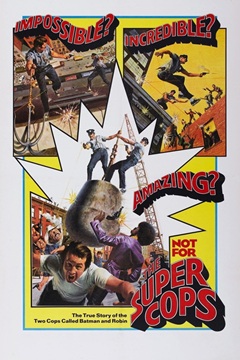
David Greenberg (Ron Liebman) and Robert Hantz (David Selby) are two tough and smart New York City cops who become detectives and play by their own rules. They make arrests off-duty. They drive their lieutenants crazy. They bust drug dealers and prostitutes and single-handedly clean up their police precinct. They’re the Super Cops and they’re even nicknamed Batman and Robin. When they throw punches, a graphic “POW” appears on screen with a sound effect.
There’s an old saying about how, when the truth is different from the legend, always print the legend. That’s certainly the case here. The real-life David Greenberg went into politics and ended up doing time for mail fraud, insurance fraud, and obstruction of justice. Robert Hantz was busted for possessing marijuana while he was on vacation in the Bahamas. The arrest led to a demotion and Hantz quit the force as a result. The film hints at Greenberg and Hantz’s involvement with the Knapp Commission, which investigated police corruption in the 70s. (Lisa wrote about it when she reviewed Serpico.) But the film does not mention that the Knapp Commission suspected that Greenberg and Hantz murdered two drug dealers.
You don’t get any of that with TheSuperCops, which tries to mix the grittiness of films like The French Connection, The Seven-Ups, and Serpico with moments of cartoonish comedy and it really doesn’t work. (Years after The Super Cops was released, Hill Street Blues proved that gritty drama and dark comedy could be mixed but it has to be done just right.) Ron Liebman overacts while David Selby doesn’t seem to be acting at all. (Liebman and Selby are both good actors but you wouldn’t know that from this movie. For Liebman, I suggest checking out his performance in Night Falls On Manhattan. For Selby, I recommend an overlooked dark comedy called Headless Body in Topless Bar.) It’s hard to believe that Gordon Parks went from doing Shaft to doing this. Shaft would have tossed the Super Cops through a window. Popeye Doyle would have given him an assist.
There is one good thing to note about The Super Cops. Edgar Wright is a fan of this film and it partially inspired the far superior HotFuzz.
Here at The Shattered Lens, we’re celebrating Clint Eastwood’s 95th birthday on May 31st. As part of that celebration, I decided to revisit his 2002 film, BLOOD WORK.
BLOOD WORK finds Clint Eastwood as retired FBI profiler, Terry McCaleb (Clint Eastwood), a man who has recently had a heart transplant. Despite the wishes of his doctor Bonnie Fox (Angelica Huston), the beautiful Graciella Rivers (Wanda De Jesus) is able to guilt McCaleb into investigating the death of her sister, Gloria, when she reveals to him that it’s her sister’s heart that is now beating in his chest. Unable to drive due to his heart condition, McCaleb hires his goofy next-boat neighbor Buddy (Jeff Daniels) as his driver. The two set out to find any clue or follow any lead they come across. Eventually McCaleb is able to uncover that Gloria’s killer may be the “Code Killer,” the very same killer that he was after when his heart gave out on him, forcing his retirement. He’s going to do everything he can to catch the killer this time, even if it kills him in the process!
BLOOD WORK puts Clint Eastwood smack dab in the middle of one of my favorite genres, the serial killer film, and the result is somewhat of a mixed bag. On the positive side, it contains a really good performance from a 72 year old Clint Eastwood as the retired FBI guy and recent heart transplant recipient. This character trait strips away Eastwood’s ability to be a Superman as he has been so many times before in his career. As a matter of fact, we feel his pain when a big Russian throws him down, or when he has to dive out of the way of a car trying to run him over. We worry for him when he gets a fever, which could actually kill him. But even in his fragile state, every so often he’ll grab a shotgun and start blasting away at the inhabitant of a car he sees watching him. His character has to rely on his intellect more than his strength and Eastwood is fun to watch in the role, with his performance the highlight of the movie. Of the other performances, I really like Angelica Huston in the relatively small role of his doctor. You believe that she really wants him to get better, and she’s pissed off that he’s gotten himself involved in this murder investigation. I’m not that impressed with Jeff Daniels here. I normally like his work, so I think the problem is that his character isn’t written that well. Wanda De Jesus is a lovely woman, and she has some good moments, but there are a couple of times that she’s way over dramatic, and I couldn’t help but roll my eyes.
As I mentioned earlier, I usually enjoy serial killer movies, and I did enjoy BLOOD WORK. It hits most of the expected notes of the genre… the serial killer taunting the lawman, the visits to the family members of the victims, the sudden discovery of clues / evidence, the eleventh hour reveal of the killer, etc. With Eastwood at the center of it all as both actor and director, you can’t really go wrong even if the movie does drag some during its middle portion. And even though it’s presented as a whodunit, there’s not a lot of mystery to the identity of the killer. I suspect most filmgoers will figure it out before the final reveal. But at the end of the day, BLOOD WORK is definitely worth a viewing for fans of Clint Eastwood and fans of serial killer movies. Not his best work, but still better than most!
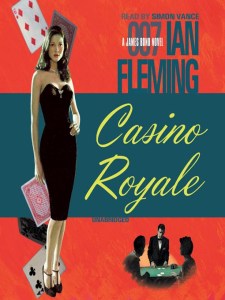
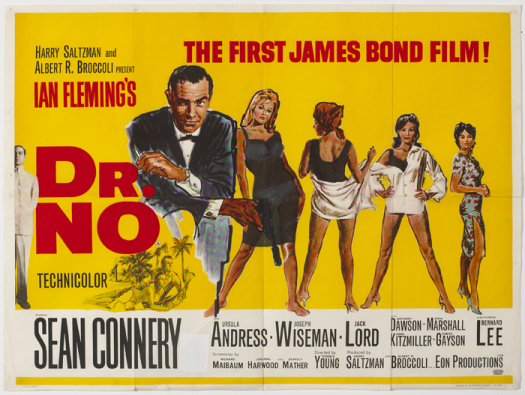
Everyone knows that Sean Connery made his debut of James Bond in 1962’s Dr. No but what they may not know is that Sean Connery was not the first actor to play James Bond. James Bond made his first appearance 8 years earlier when an American television show called Climax! presented a 48-minute adaptation of Ian Fleming’s first Bond novel, Casino Royale.
In this version of Casino Royale, James Bond was known as Jimmy Bond and he was about as American as you can get. (Felix Leiter, meanwhile, was now English and named Clarence Leiter). Jimmy Bond was played by Barry Nelson, an actor who is probably best known for playing the blandly friendly hotel manager in Stanley Kubrick’s The Shining. Casino Royale’s villain, Le Chiffre, was played by none other than Peter Lorre.
This version of Casino Royale was initially meant to serve as a pilot for a weekly television series but, perhaps fortunately, the Climax version of Casino Royale didn’t get much attention when it was originally aired. According to Sinclair McKay’s authoritative Bond book, The Man With The Golden Touch, this version of Casino Royale was forgotten about until a copy of it was discovered in the 1980s. By that time, of course, everyone knew that James Bond was English and that Felix Leiter was American.
Thanks to YouTube, I’ve seen the Climax! Casino Royale and it’s definitely a curiosity. If Dr. No hadn’t launched the James Bond film franchise, there would be little reason to watch this version of Casino Royale. It moves a bit slowly, is way too stagey, and it reveals that, contrary to what we’ve all heard, live television was not always the greatest thing on the planet. Not surprisingly, this adaptation contains none of the brutality or the moral ambiguity that makes Fleming’s novel such a fun read. American television audiences would not see Jimmy Bond strapped naked to a chair and an American television show would never end with the hero saying, “The bitch is dead.” The best you can say about this version of Casino Royale is that Peter Lorre makes for a good villain (in fact, of the three versions of Casino Royale, the television version is the only one to feature an effective Le Chiffre) and Barry Nelson would have made a good Felix Leiter.
That said, I still find the television version of Casino Royale to be fascinating from a historical point of view. This is the type of show that you watch for curiosity value. This is the type of show that you watch so that you can think about how different things could have been.
So, presented for your viewing pleasure, here’s the original version of Casino Royale:
117 years ago today, Ian Fleming was born in Mayfair, London. A member of British Intelligence during World War II, Fleming is today best-remembered as the creator of James Bond.
Today’s scene that I love comes from 1962’s Dr. No. Here is Sean Connery, in his first appearance as Fleming’s iconic secret agent. Eunice Gray was cast as Sylvia Trench, who was originally envisioned as being Bond’s permanent “London” girlfriend. She also appeared in From Russia With Love before the idea was abandoned. We all know that Bond’s true love was Tracy di Vincenzo.
4 Or More Shots From 4 Or More Films is just what it says it is, 4 shots from 4 of our favorite films. As opposed to the reviews and recaps that we usually post, 4 Shots From 4 Films lets the visuals do the talking!
Today the Shattered Lens celebrates what would have been the 94th birthday of the great cinematographer, Gordon Willis. Willis was the master of using shadow and underexposed film to create some of the most haunting movie images of the 70s and 80s. He was also one of the first cinematographers to take advantage of the so-called “magic hour,” that moment when the sun is setting and everything is bathed in a golden glow. Today, everyone does that but Willis was the first.
Willis has often been cited as one of the most influential cinematographers of all time but, amazingly, Willis would receive only two Academy Award nominations (for Zelig and The Godfather Part III) and he would never win a competitive Oscar.
In memory of Gordon Willis, here are….
6 Shots From 6 Gordon Willis Films
End of the Road (1970, dir by Aram Avakian, Cinematography by Gordon Willis)
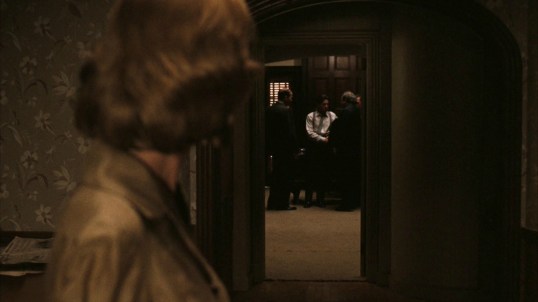
The Godfather (1972, dir by Francis Ford Coppola, Cinematography by Gordon Willis)
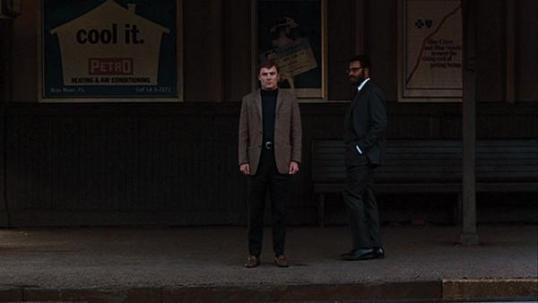
The Parallax View (1974, dir by Alan J. Pakula, Cinematography by Gordon Willis)
The Godfather Part II (dir by Francis Ford Coppola, Cinematography by Gordon Willis)
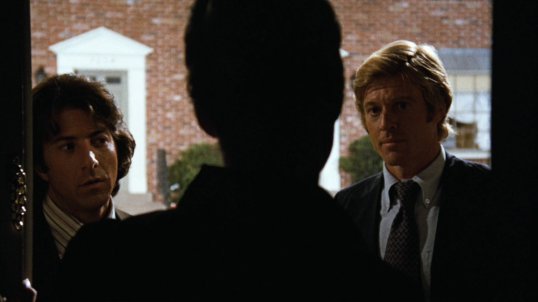
All The President’s Men (1976, dir by Alan J. Pakula, Cinematography by Gordon Willis)
Manhattan (1979, dir by Woody Allen, Cinematography by Gordon Willis)
When today’s music video was first released, it was banned by MTV. MTV claimed that the song and the video glorified suicide, which was certainly not the case when it came to either one. As Dave Mustaine explained in interviews at the time, the song was about what Mustaine would say to his friends if he learned that he only had a few minutes left to live. Mustaine sings that he would want to say, “I love you all and now I must go.”
(Some of the misunderstanding probably came from the song appearing on an album entitled Youthanasia. Megadeth’s lyrics could certainly be dark and serious but they were just as often misunderstood, even by people who should have known better.)
Most only sources list Justin Keith as the director of this video. In an interview with a German site, Mustaine explained that Justin Keith was actually the incredibly prolific Wayne Isham and that MTV apparently told Megadeth not to use Isham as their director because the channel was already “saturated” with videos that Isham had directed. So, when Megadeth submitted the video, the listed Isham as being “Justin Keith.” According to Mustaine, this — and not the the video’s content — is what actually caused MTV to ban the music video.
Mustaine later rerecorded this song for 2007’s UnitedAbominations.




 Through the Shattered Lens