Late Night Retro Television Review: Check It Out! 3.9 “Bannister & Dale”


Welcome to Late Night Retro Television Reviews, a feature where we review some of our favorite and least favorite shows of the past!  On Saturdays, I will be reviewing the Canadian sitcom, Check it Out, which ran in syndication from 1985 to 1988.  The entire show is currently streaming on Tubi and Peacock!

I guess Howard’s a TV star now.

Episode 3.9 “Bannister & Dale”

(Dir by Alan Erlich, originally aired on November 14th, 1987)

Mr. Dale (Paul Soles) is an old vaudevillian who now shops at Cobb’s.  He doesn’t have enough money to pay his rent so Howard gives him a job working at the store.  He doesn’t have enough money to keep his retirement home running so Howard gets Mr. Dale booked on a television show.  Mr. Dale’s old partner died in 1952 so Howard agrees to step in and….

Wait.  Howard’s a talent agent now?

Seriously, how does a grocery store manager have the connections necessary to get an obscure vaudevillian booked on a national talk show?  I mean, I get that they’re all up in Canadas and it’s a simpler place but still, it just seems like a stretch.  And really, how popular was vaudeville in the 80s?  I always see all of these old TV shows, where the characters are doing a fundraiser or something and they recreate a vaudeville act or they put on clown makeup and sing Bring In The Clowns but it never feels very realistic.

Anyway, most of the show is made up of Howard and Mr. Dale recreating Mr. Dale’s old vaudeville routines and it’s all pretty dumb.  But I will say that it was a lot easier for me buy Don Adams as an old man who remembered and loved vaudeville than as the swinging 40-something store manager that the show usually presents him as being.  Still, it’s a bit strange to imagine a national talk show setting aside time for an act featuring an old vaudevillian and a grocery store manager.  I guess that’s Canada for you.
Lisa Marie’s Week In Television: 3/2/25 — 3/8/25


I watched the Oscars on March 2nd.  I originally intended to watch it on Hulu but Hulu struggled, just as Netflix did during its first time out, with streaming such a large event and I ended up just watching the ceremony on boring old ABC.  I liked the Oscars this time around.  Conan O’Brien was a good host.  The politics were kept to a minimum.  The ceremony moved along efficiently and it was hard not to get caught up in Sean Baker’s enthusiasm.  I cheered when Flow won.  I groaned when the Best Documentary winners started their long ramble.  The ceremony felt like a throwback to the old Oscars.  The ratings were not good, regardless of how they’ve been spun.  Eventually, the Oscars will be something that will be exclusively streamed on Hulu and that’s it.  Hopefully, Hulu will get the bugs out of the system before next year.

Before I watched the Oscars, I watched Devil In The Family: The Fall of Ruby Franke, the latest creepy true crime docuseries on Hulu.  I watched as Ruby went from a successful mommy vlogger to a convicted felon.  Interestingly, most of the people hurt by Ruby went on to become influencers themselves.  The docuseries was an intense look at just how crazy people can get in a world where everyone is famous.

Also on Sunday, I watched Gordon Ramsay rescue a gastropub on Kitchen Nightmares.  Come Thursday, I watched another episode of Dark with Case.

Throughout the week, I watched my usual shows for my Retro Television Reviews.  I didn’t watch a lot and I need to get caught up on Abbott Elementary, Survivor, and a few others.  But this week was still an improvement over last week!

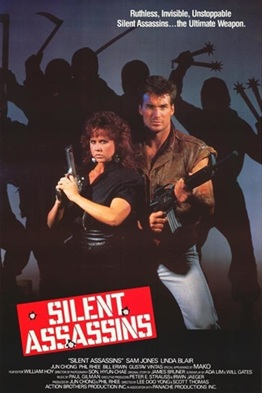
Silent Assassins (1988, directed by Lee Doo-yong and Scott Thomas)


Elite cop Sam Kettle (Sam J. Jones) just wants to get out of Los Angeles and live a peaceful life with his girlfriend, Sara (Linda Blair), but the streets have other plans.  The evil Kendrick (Gustav Vintas) has kidnapped Dr. London (Bill Erwin) and is determined to get the code for a deadly bioweapon.  For reasons that are never made clear, Kendrick has also kidnapped young Joanna (Joanna Chong).  Backing Kendrick up is the evil Miss Amy (Rebecca Ferrati).  Backing up Kettle is Joanna’s uncle, Jun Kim (Jun Chong) and Bernard (Phillip Rhee), the son of Oyama (Mako), the owner of the local dojo.  Can Sam save the world, saved the doctor and the girl, and also save his relationship with Sara?

Silent Assassins is a terrifically fun martial arts movie.  The action is well-choreographed.  The film’s plot doesn’t make a bit of sense.  The movie is full of weird throw-away dialogue, like an offended Ms. Amy announcing that she’s “a biochemist too.”  Chong shows off his moves, Rhee plays his character as a playboy having the time of life, and Jones glowers at the camera as only Sam J. Jones can.  There’s an army of loud ninjas (so much for the silent part) and Vintas is so villainous that he even carries around a red rose as some sort of strange trademark.  The movie is full of weird details and no one seems to be taking any of it too seriously.  Movies like this are why people like me always went straight for the direct-to-video releases when we went to Blockbuster back in the day.

Linda Blair is second-billed.  When Lisa and I watched this movie, she kept track of Linda’s screentime.  Linda’s onscreen for a total of ten minutes and she spends most of that time doing the worried girlfriend thing.  It’s a sad waste of Linda Blair, the one misstep of an otherwise great experience.

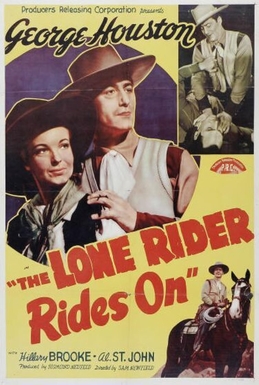
The Lone Rider Rides On (1941, directed by Sam Newfield)


In the days of the wild west, Tom Cameron (George Houston) rides the range alone, seeking vengeance for the murder of his family.  They were killed when their wagon train was ambushed by the same outlaws who has previously sold them a plot of land.  Tom was a child at the time and he only remembers that the leader of the outlaws had a distinctive facial scar.  Tom Cameron is The Lone Rider.

No, not the Long Ranger.  The Lone Rider!  George Houston was an opera star who made for a surprisingly convincing gunslinger and the movie opens with him singing I Am The Lone Rider, just to make sure that it was understood that his vengeance-driven vigilante was a completely different character from that other vengeance-driven vigilante.  The Lone Rider is looking to avenge his family and, with the help of store keeper “Fuzzy” Jones (professional sidekick Al St. John), the Lone Rider does just that.  Though this is a standard B-western, the plot is a little more serious than most other B-movies.  This was the first of several Lone Rider movies and, despite the obviously low budget, there’s some emotional heft to its story.  Tom discovers that his brother (Lee Powell), who he thought had died in the attack, actually survived and joined up with the gang.  The story is about both Tom’s vengeance and his brother’s redemption.  Fans of the genre will enjoy the film’s classic western story and George Houston’s convincing performance as a gunslinger on a mission.

The Lone Rider would ride on for 16 more movies, the last one being released in 1944.  In 1942, George Houston was replaced in the lead role by Robert Livingston.  Houston went from starring in westerns to becoming one of Hollywood’s most respected vocal coaches.  (Howard Keel was one of his students.)  Shortly after the Lone Rider road for the last time, George Houston died while planning his musical comeback.  He had a heart attack and the police, thinking he was just intoxicated, tossed him in the drunk tank where he subsequently died.  He was only 48 years old.

4 Shots From 4 Films: Special 1985 Edition


4 Shots From 4 Films is just what it says it is, 4 shots from 4 of our favorite films. As opposed to the reviews and recaps that we usually post, 4 Shots From 4 Films lets the visuals do the talking!

Today, let us take a look back at a classic cinematic year.  It’s time for….

4 Shots From 4 1985 Films

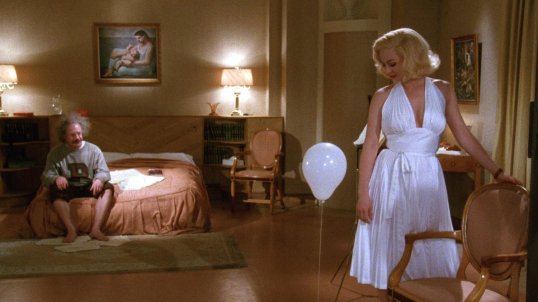
Insignificance (1985, directed by Nicolas Roeg, DP: Peter Hannan)

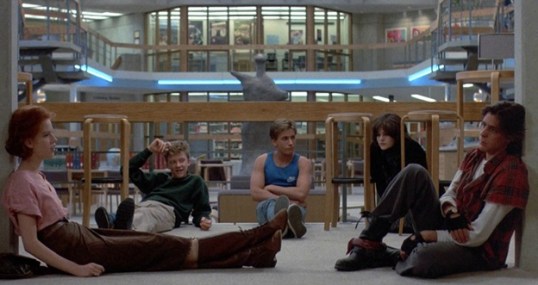
The Breakfast Club (1985, dir by John Hughes, DP: Thomas Del Ruth)

Rambo: First Blood Part II (1985, dir by George Pan Cosmatos, DP: Jack Cardiff)

Brazil (1985, dir by Terry Gilliam, DP: Roger Pratt)

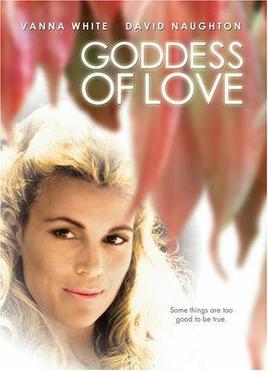
Goddess of Love (1988, directed by Jim Drake)


On Mount Olympus, “ages ago” according to a title card, Zeus (John Rhys Davies) is displeased with his daughter Aphrodite (Wheel of Fortune letter turner Vanna White).  Aphrodite, who insists on being called Venus, has refused to marry every man or God that Zeus has found for her and she even started the Trojan War.  Zeus says that Venus must learn what love means before she can rejoin the Gods.  He then turns her into a statue (!) and sends her down to Earth.

How is she going to learn what love means as a statue?  It’s obviously a pertinent question because, thousands of years later, she’s still set in marble and standing in a museum.  Two thieves wheel her out to a courtyard and leave her there so they can pick her up later.  Before the thieves return, Ted Beckman (David Naughton) and his womanizing friend, Jimmy (David Leisure), wander by.  For some reason, Ted slides an engagement ring on Venus’s finger.  Venus comes to life.  She and Ted must now fall in love for real in order for Venus to return to Mount Olympus.  The only problem is that Ted is a hairdresser and he’s already engaged to marry Cathy (Amanda Bearse).

A made-for-TV movie that unsuccessfully tried to revive the acting career that Vanna White abandoned for Wheel of Fortune, Goddess of Love is a spectacularly stupid movie that attempts to disguises its threadbare plot by being extremely busy.  Not only do Ted and Venus have to overcome a lack of romantic chemistry and fall in love but the two thieves are also still looking for Venus and even Little Richard shows up as one of Ted’s employees.  Venus not only accidentally burns down Ted’s business but also maxes out his credit cards.  Philip Baker Hall plays the detective investigating the theft of the statue and gives a performance reminiscent of his classic Bookman turn from Seinfeld.  It’s dumb but Vanna herself gives a far more engaging performance than the material requires or deserves.  Some of her line deliveries are a little wooden but she still radiates the natural likability that made her an unlikely celebrity in the 80s.  Goddess of Love should have cast Pat Sajak as Ted.  Then it would have been a classic.

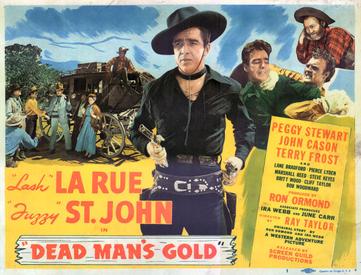
Dead Man’s Gold (1948, directed by Ray Taylor)


Jim Thornton (Britt Wood) has discovered a gold mine so he writes to his old friends, Lash LaRue (Lash La Rue) and Fuzzy (Al St. John), asking them to come help him guard it.  When Lash and Fuzzy arrive, Jim is nowhere to be found.  With the help of Jim’s niece (Peggy Stewart), they discover that Jim’s been murdered.  It doesn’t take a genius to realize that the murder was carried out by Conway (Jason Cason) and his men and that’s a good thing because a genius is something you will never find in a Lash La Rue western.  However, Lash suspects that Conway was following someone else’s orders.  He and Fuzzy set up a trap to reveal the true identity of the mastermind.

Lash dresses in all black and often uses a whip instead of a gun but this is still a standard B-western.  Historically, it’s important because it was the first movie that La Rue made with producer Ron Ormond.  Ormond later went from producing Lash La Rue films to directing them and Lash’s career never really recovered.  (Ormond, whose non-Lash LaRue films included Mesa of Lost Women and If Footmen Tire You, What Will Horses Do?, was never much of a director.)  Fortunately, Dead Man’s Gold was directed by the dependable Ray Taylor, who keeps the action moving and crafts an adequate if not exactly memorable western.

There is one cool scene in Dead Man’s Gold, in which Lash uses his whip to knock a shot glass out of a bad guy’s hand.  Let’s see The Lone Ranger do that!

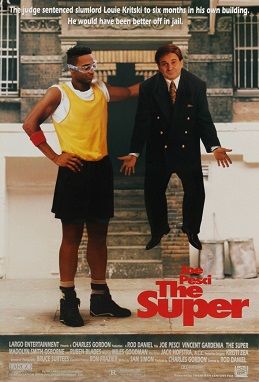
The Super (1991, directed by Ron Daniel)


You’ve just won a Best Supporting Actor Oscar for playing a psychotic gangster and you’re worried that it’s going to lead to you getting typecast as a villain.  What do you do?

If you’re Joe Pesci, you follow-up playing Tommy DeVito in Goodfellas by agreeing to play Louie Kritski, Jr. in The Super.  Louie is the son of a slumlord (Vincent Gardenia) and he’s eager to follow his old man into the family business.  But when Louie is arrested for failing to keep his buildings up to code, he’s sentenced to actually live in one of them.  Louie has to stay in a rat-infested apartment.  He has to repair the rest of the building and will not be allowed to do any work on his apartment until everyone else’s apartment is up to code.  Louie thinks that his father will use his influence to get his son out of this mess.  It turns out that Big Lou just wants to set the building on fire and be done with it.  Louie isn’t down with that.  He may be a loud-mouthed slumlord but he has his standards.

Louie becomes a better person as a result of living in a slum.  All of the tenants, from Marlon (Ruben Blades) to Tito (Kenny Blank), come to respect him.  He even plays basketball with them.  Louie finds a new girlfriend (Madolyn Smith) in the court officer who is sent to check on his progress.  Louie is still Joe Pesci, though.  He’s still a loud mouth who is quick to lose his temper and there’s always a feeling that Louie is about to snap and blow the entire building away.  Joe Pesci was always a good actor and skilled at comedy but The Super doesn’t make good use of his talents in the way that My Cousin Vinny did.  My Cousin Vinny worked because it put Joe Pesci in a place where you wouldn’t expect to find Joe Pesci, the genteel South.  The Super is a New York movie and Pesci’s wiseguy intensity means that his sudden redemption doesn’t feel true.

The Super was a box office flop and briefly derailed Pesci’s attempts to show his range.  Luckily, My Cousin Vinny was right around the corner.