Whoa! Hold your horses! This isn’t the only review for The Hunger. Take a look at Lisa’s Review and if you’re so inclined, feel free to double back here.
It seems fitting that we start our descent towards Halloween with Tony Scott’s first feature film, The Hunger. As a fan of Vampires in general, it may not be a great film, but I feel like it does have a place in history where creatures of the night are concerned.
When I think of Whitley Streiber, Wolfen comes to mind and anyone who knows me also knows how much I adore that film. I don’t usually associate him with Vampires, but 1983’s The Hunger is pretty interesting. To me, there’s a nice beauty and mystery to the film as the undead involved could just be regular people asking the same questions about mortality we do, all to some beautiful movie throughout. They are practical vampires. There’s no real explanation as to how John and Miriam move about through the day. Rather than biting, they use small knives to acquire blood. The powers they wield are subtle, putting the story on par with Kathryn Bigelow’s Near Dark when it comes to avoiding vampire cliches. Additionally, this film also never mentions the word ‘vampire’.
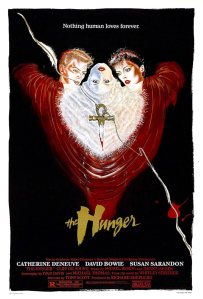
Miriam (Catherine Deneuve, Belle de Jour) and John Baylock (David Bowie, Labyrinth) are vampires living in present day Manhattan. Enjoying their existence as any member of the undead would, they spend their nights mingling among the living and discarding bodies by dawn. What seems like a great unlife takes a turn when John finds himself unable to sleep. This restlessness escalates as he finds he’s losing his hair and gaining more wrinkles. The pair stumble on the Park West Sleep Clinic, and Dr. Sarah Roberts’ (Susan Sarandon, Blue Beetle) studies on sleep and aging. For me, one of the best scenes of the film was a parallel between John’s rapid aging while waiting in the Clinic alongside a lab monkey that is also suffering a similar issue. Sarah doesn’t really get to check in on John (who ages a quick 15 years during the wait), but their meeting does eventually introduce her to Miriam.
Miriam eventually loses John after he falls into a near mummified state. Although he becomes incredibly old, he’s still far from death’s touch. I love her explanation for him: “Humankind die one way, we another. Their end is final. Ours is not. In the earth, in the rotting wood, in the eternal darkness, we will see and hear and feel.” We also learn that this has happened with all of Miriam’s former lovers over the ages. Miriam then turns her sights on Sarah, which blossoms into a mix of a romance at first. Trivia fans will recognize the piano piece Miriam plays for Sarah (Lakme by Delibes), which Scott reused for True Romance. That was a nice touch. Needing a new partner, Miriam’s approaches become more predatory after Miriam’s true nature is revealed.
The cast in The Hunger all do well, but let’s face it, the real draw here was always Bowie (at least for me, anyway). It’s a shame his character doesn’t stay on screen for long, but he makes good use of the scenes he has and he’s there for at least half the movie. The film essentially belongs to Deneuve, who brings some charisma to Miriam’s character. Whether she’s being playfully flirtatious or deadly serious, she seems to be in control. I don’t have anything particular against Susan Sarandon as an actress. She’s quite good in this, but part me kind of imagined Lesley Ann Warren (Clue) doing all this a bit better.
Tony’s directing style is beautiful but slightly disjointed, with flashbacks giving an idea to Miriam’s past. On the one hand, they aren’t enough to be too revealing, but they’re also accompanied with some strange sound zingers that could be a bit off-putting. He moves quickly between scenes, but the general ideas of immortality and her longevity are suggested. Cinematographer Stephen Goldblatt (Outland) would go on to work on the Lethal Weapon films and Schumacher’s Batman films. There are some good uses of shadow and light here.
The music a mix of classical pieces, mixed with what sounds like either wind chimes and synth keyboards. The classical music stands out. The score, not so much. It’s not a terrible thing by any means, but it’s a strange selection of sounds. Other than the music, I was bothered by the film’s ending. What occurs seems like it could have happened at any time, and why it does is never explained in any way. I guess it worked. By the end, though, I felt like I watched something where the first 3 acts were fully thought out and the production team threw a dart at a board full of possible endings.
Overall, The Hunger is a interesting film to watch if you catch it late at night. Every director has to start somewhere, and while it’s a little sketchy in the end, there’s some style and grace to it all.
 Through the Shattered Lens
One of the most sensual, visually-stunning vampire films. I never tire of watching it.
LikeLike