October True Crime: Easy Prey (dir by Sandor Stern)


The 1986 film, Easy Prey, tells the story of Tina Marie Riscio (Shawnee Smith), a 16 year-old who was approached in a mall by man (Gerald McRaney) who claimed to be a photographer looking for models.  The man told the insecure Tina that he wanted to take her picture but that he needed her to come out to his car and sign a release.  At first, Tina was reluctant to follow the man out to his car but when he acted embarassed and apologized for making her feel uncomfortable, Tina decided to sign the release.  Later, she would say that the man reminded her of her father.

The man, however, was Christopher Wilder.  At the time that he approached Tina, Wilder was already a suspect in several murders and had been placed on the FBI’s Most Wanted List.  In many ways, Wilder did not seem to fit the typical profile of a serial killer.  Born in Australia, he was a naturalized American citizen who had started his own business and lived what seemed to be a glamorous lifestyle.  He was a millionaire.  He owned a Porsche.  He was a race car driver who competed in races across the country.  Even with his receding hairline, he was considered to be charming and handsome.  It was only under a close examination that cracks started to appear on his perfect surface.  He had a criminal record in Australia.  His girlfriends described him as being paranoid, insecure, and abusive.  His business partners said that, despite his apparent wealth, Wilder was always one step away from financial ruin.

Because Wilder was killed by the police while resisting arrest, it’s not known how many women he murdered over the course of his six-week crime spree in 1984.  It is believed that he definitely murdered eight but the actual number is thought to be much higher.  (He’s a suspect in the disappearance of actress Tammy Lynn Lepert, who appeared in Scarface as the woman who distracted Steven Bauer while the latter should have been keeping track on what was happening with Tony’s meeting with the Colombians.)  However, he did not kill Tina Marie Riscio.  Instead, after kidnapping and assaulting her, he drove across the country with her.  After using her to lure victims in both Indiana and New York, Wilder eventually drove Tina to Boston and bought her an airplane ticket home.  While Tina was flying back to Los Angeles, Wilder was heading for Canada.  (He would be shot and killed by police near the border, in New Hampshire.)

Easy Prey follows Wilder and Tina as they drive from location-to-location.  Along the way, Tina is shown to develop a case of Stockholm Syndrome.  As much as she hates Wilder, she still fails to take advantage of many chances to escape from him.  Unfortunately, the film’s script itself doesn’t provide much insight into how this happened, beyond the fact that Wilder reminded Tina of the father who earlier abandoned her.  The film does feature two strong performances, from Shawnee Smith and Gerald McRaney.  Smith gets a a powerful monologue, in which she talks about how easy it was for Wilder to take advantage of her insecurity.  Meanwhile, McRaney plays Wilder as being a pathetic man who is desperate to convince the world that he is actually a dynamic businessman and adventurer.  If he were alive today, there’s little doubt Christopher Wilder would be on twitter, siding into people’s DMs and posting a bunch of “alpha male” nonsense.  Wilder was a monster who still feels very familiar.
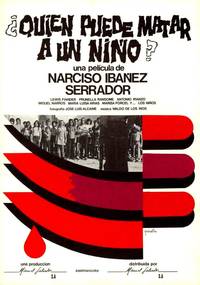
Horror Film Review: Who Can Kill A Child? (dir by Narciso Ibáñez Serrador)


The 1976 Spanish film, Who Can Kill A Child?, opens with a series of documentary clips, all detailing the world’s inhumanity to children.  We hear about how children were experimented upon in Auschwitz.  We see displaced refugees from the Korean War.  We saw the famous footage of a naked Vietnamese child running down a road after her village has been napalmed by American forces.  We see footage of Nigerian children being forced to serve as soldiers.  The footage is disturbing but it’s also a necessary reminder that, as much as everyone claims to love children, they are often those most harmed by the wars that are waged by adults.

The film then segues into the story of Tom (Lewis Fiander) and Evelyn (Prunella Ransome), an English couple who are vacationing in Spain.  Evelyn is pregnant with their third child and this vacation is their last getaway before they have to focus on raising a child.  (It is mentioned that this is their third child.  Presumably, they left their other two children behind in the UK while they jetted off to Spain.)  Finding the beaches to be too crowded and loud, Tom and Evelyn head off to a nearby island in hopes of having some time to themselves.  When they arrive at the island’s main village, they find it to be populated almost entirely by children.  At first glance, there doesn’t appear to be any adults around.

As Tom and Evelyn explore the village, they discover that almost all of the buildings appear to be abandoned.  They also can’t help but notice that the children seem to be watching their every move.  Eventually, Tom does spot one adult but that adult is quickly attacked by a group of children who beat him to death.  Tom realizes that the children have killed the adults in the village and now, they’re planning on killing him and his pregnant wife.

There have been many films made about killer kids but it’s hard to think of any of them that are as grim and downbeat as Who Can Kill A Child?  There’s really not a moment of humor to be found in the film and even the movie’s most infamous scene, in which an unborn child rebels against his mother, is played with total seriousness.  The children are frightening not just because they’re adorable kids but because they’re relentless in their violence and their determination to kill every adult in their path.  In many ways, they’re like the fast zombies from Umberto Lenzi’s Nightmare City.  The main difference is that, because their children, they’re given a benefit of the doubt that would not be given to older homicidal maniacs.  Even as the children attempt to use a battering ram to burst into the room in which they’ve locked themselves, Tom and Evelyn are still hesitant to fight back because their attackers are just children.  When Tom does fight back, it backfires on him because, to the rest of the world, he’s not a man fighting for his life but instead a man attacking innocent children.  Even when a four year-old aims a gun at Evelyn’s head, his playful smile leaves the viewers wondering if he truly understands that guns kill or if he just thinks he’s playing a game.

Who Can Kill A Child? plays out at its own deliberate pace.  It’s nearly two hours long and there’s a lot of footage of Tom and Evelyn walking around the deserted village but director Narciso Ibáñez Serrador does such a good job of creating and maintaining an atmosphere of impending doom, the film itself never feels slow.  The deserted village is a wonderfully creepy location and Serrador makes sure that the viewers realize just how many spaces there are where the killer children could be hiding and waiting for someone to walk by.  When the children suddenly show up in a group, coldly watching as Tom and Evelyn explore the island, it’s a truly chilling scene.  The film also benefits from the performances of Lewis Fiander and Prunella Ransome, who are well-cast as Tom and Evelyn.  At first, both characters seem to be a bit too complacent to be sympathetic but, as the film progresses, both Fiander and Ransome win the viewers over.  Ransome, in particular, will break your heart.

The film’s conclusion is appropriately downbeat but one can’t help but feel that the children are merely doing what they’ve seen adults do for years.  The children may be dangerous, violent, and ruthless but the film suggests that they learned from the best.

Moments #8: The Woman In the Hallway (by Lisa Marie Bowman)


I don’t believe in ghosts but I may have seen one when I was 18.

It was the summer after I graduated high school and I was in Italy, discovering what the world outside of both high school and America looked like.  That night, my sisters and I were staying at a hotel in Rome.  I had a room to myself.  The Vatican was nearby.  At two o’clock in the morning, I could still hear the sound of motor scooters roaring past on the streets below my window.  I naturally wanted to go outside and see what was happening but I had promised my sisters that I would not leave the hotel and wander around Rome late at night.  As they pointed out, I didn’t speak Italian so, if I got lost or into any sort of trouble, there would be no way for me to ask for help.  As well, we were visiting the Vatican tomorrow morning.  I didn’t have to sleep, they knew better than to ask me to do that.  But I did need to stay in the hotel.

So, I took a shower, I put on my usual late night outfit of a t-shirt and underwear, and I lay in bed and I listened to the scooters outside.  When I got bored with the scooters, I turned on the TV and I watched an episode of an American soap opera that had been dubbed into Italian.  I could follow the plot just fine and I found myself wondering if maybe my sisters had been exaggerating the language difference.

Finally, I decided that, even if I couldn’t go outside, there was no reason why I couldn’t step outside of my room and walk up and down the hotel hallway.  It would give me a chance to stretch my legs and work off my restlessness.  Plus, it was two in the morning.  Every other guest at the hotel was probably asleep.  I’d have the hallway to myself.

I stood up and walked over to the door of my hotel room.  As I approached, I felt a chill in the air and I shivered a bit.  At the time, I didn’t think much of it, figuring it was due to me being underdressed and that maybe there was just a random cold spot in the room.  I put my hand on the door knob, turned it, and slowly opened my door.

There was a woman standing directly across the hall from my room.  She appeared to be in her forties, short and slightly heavy-set with long, jet black hair.  She was wearing a shapeless brown dress and her dark eyes narrowed at the sight of me.  What I immediately noticed about her was that her skin was an ashen gray.

I stared at her for a few seconds, not knowing what to say but fully aware that she was glaring at me.

Slowly, she asked, in perfect English that carried not a trace of an accent, “What are you doing here?”

I still didn’t know what to say.

“WHAT ARE YOU DOING HERE!?” she snapped.

I tried to say something but the words wouldn’t come.

“I OWN THIS HOTEL!” she yelled, “WHAT ARE YOU DOING HERE!?”

She started to move towards my room.  I slammed the door shut and locked it.

I stood there for what seemed to be an eternity, listening for her.  I was expecting her to start pounding on the door and screaming at me to come out but she didn’t.  Instead, after I shut the door, I didn’t hear anything in the hallway.  I didn’t hear her breathing.  I didn’t hear her walking away.  I didn’t hear anything.

Finally, after what seemed like an hour but was probably just a few minutes, I open the door a crack and peeked outside.  The hallway was empty.  The woman, whoever she had been, was gone.  Still, I wasn’t going to take a risk.  I closed the door again, got back in bed, and I didn’t get out of bed until the next morning.

When I asked my sisters if they had seen the woman, they had no idea who I was talking about.  They hadn’t any seen any woman fitting the description at the hotel.  They told me that I should have called them or the front desk for help and they were probably right but, at that moment, I had been too frightened to do anything.  I had seen enough horror movies to know that calling for help was usually the least effective thing you could do when confronted by a maniac.  It was my sister Erin who told me that the woman was probably a ghost, maybe the former owner of hotel demanding to know why I was in her home at two in the morning.  Maybe she was.  I don’t believe in ghosts but if I ever did see one, it was probably her.

Previous Moments:

  1. My Dolphin by Case Wright
  2. His Name Was Zac by Lisa Marie Bowman
  3. The Neighborhood, This Morning by Erin Nicole
  4. The Neighborhood, This Afternoon by Erin Nicole
  5. Walking In The Rain by Erin Nicole
  6. The Abandoned RV by Erin Nicole
  7. A Visit To The Cemetery by Erin Nicole

6 Shots From 6 Films: Special Clive Barker Edition


4 (or more) Shots From 4 (or more) Films is just what it says it is, 4 (or more) shots from 4 (or more) of our favorite films. As opposed to the reviews and recaps that we usually post, 4 (or more) Shots From 4 (or more) Films lets the visuals do the talking.

Today, we wish a happy 71st birthday to writer and occasional director Clive Barker!  Barker’s stories have provided the basis for several films and Barker himself attempted to build a career of his own as a filmmaker.  Though he pretty much retired from directing after the box office failure of Lord of Illusions, he still has a better directorial track record than Stephen King and his films (along with his stories and his novels) continue to influence new horror storytellers.

Today, we honor both the birthday and the cinematic career of Clive Barker with….

6 Shots From 6 Clive Barker Films

Salome (1973, dir by Clive Barker)

The Forbidden (1978, dir by Clive Barker)

Hellraiser (1987, dir by Clive Barker, DP: Robin Vidgeon)

Nightbreed (1990, dir by Clive Barker, DP: Robin Vidgeon)

Candyman (1992, dir by Bernard Rose, DP: Anthony B. Richmond, based on a short story by Clive Barker)

Lord of Illusions (1995, dir by Clive Barker, DP: Ronn Schmidt)

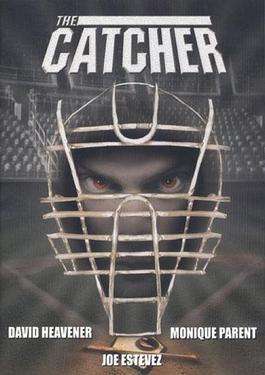
So, I Watched The Catcher (1999, dir. by Guy Crawford and Yvette Hoffman)


I should have known what I was getting into as soon as my sister told me, “You’ll like this, it’s a baseball movie!”

The Catcher is a movie about a little boy who goes crazy when his baseball-obsessed Dad makes fun of his swing.  The boy beats his father to death with a baseball bat.  Years later, catcher David Walker (David Heavener) is told that his contract with the Devils baseball team will not be renewed.  Someone dressed as a catcher starts to murder players, coaches, and one commentator, using baseball equipment as his weapon.  I could have gone my entire life without seeing the scene where one player is sodomized with a baseball bat.  But even if that’s your thing, The Catcher is slow and the acting’s terrible.  I had a hard time buying the idea of a killer catcher.  Outfielders move a lot quicker.  Why does my sister recommend these films to me and why do I watch them?

One thing that I did appreciate about this movie is that, for once, it was only men being killed by the masked maniac.  I get so tired of horror movies that were obviously made by men who never got over being turned down for a date in high school.  The Catcher was a change of pace as far as that’s concerned but otherwise, I wish I had not watched this film.

Horror Film Review: Elevator Game (dir by Rebekah McKendry)


If nothing else, Elevator Game does open with a truly chilling sequence.

A teenage girl named Becki (Megan Best) boards an elevator in an office building.  She’s playing a game, one that, if played correctly, will lead her to the spirit world but, if played incorrectly, will lead to her being torn apart by the spirit of an evil woman.  Why exactly anyone would want to play this type of game, I’m not sure.  I mean, I wouldn’t play it and I don’t even believe in ghosts or spirit worlds.

Anyway, Becki travels from floor to floor, in a specific, pre-determined order.  When she reaches the 5th floor, she is to keep her eyes shut from the moment the elevator doors open until they close.  When she opens her eyes, she is not to look to see if anyone is standing behind her.  It’s on the fifth floor that the game player is supposedly joined by the Fifth Floor Woman.  The Fifth Floor Woman apparently doesn’t have anything better to do than to kill anyone who fails to follow the rules of the game.  It seems like kind of a boring existence.  I mean, if I was the Fifth Floor Woman, I would have an existential crisis about having to spend my entire “life” enforcing the arbitrary rules of an elevator game but again, some people are just really into rules.  Some people have a panic attack if there isn’t a clearly defined rule book for them to follow and I guess that’s just as true among the dead as among the living.  As for Becki, she does keep her eyes closed on the fifth floor but then she makes the mistake of using her phone to check over her shoulder, which gets her in trouble with the Fifth Floor Woman.

Again, the entire opening sequence is very well-done and suspenseful, with Megan Best immediately earning our sympathy as Becki.  The scene where she reaches the fifth floor is genuinely scary, as is the moment when we realize that she is no longer alone on the elevator.  Unfortunately, the opening is so strong that the rest of the film has a difficult time topping it.

After Becki disappears, her brother Ryan (Gino Anania) gets an internship with a group of streamers who film themselves investigating paranormal rumors and visiting places that are supposedly haunted.  They play “scary games in scary places,” but they’ve also managed to tick off their only advertiser and now they desperately need to film something quick and on the cheap.  Ryan, without bothering to share his personal connection to the case, tells them about what happened to Becki and he encourages them to film themselves playing the elevator game.  Ryan is hoping that they can help him find Becki and, it’s hinted, he also wants revenge against of the streamers, Kris (Alex Russo), because Kris is the one who told Becki about the elevator game in the first place.  The streamers play the game but, instead of finding Becki, they instead bring the Fifth Floor Woman into their world.  Death follows.

Elevator Game suffers from a lack of compelling characters.  The streamers are all clichés and not even Ryan is a particularly likable character.  I mean, you really do have to wonder just what exactly Ryan thought would happen when he tricked a bunch of other people into playing the same stupid game that Becki played.  Why did he believe that dragging all of them into it would somehow make it easier to him to find Becki?  Once people start dying, it’s pretty much Ryan’s fault and it’s hard not to get annoyed with the fact that no one really seems to call him out on it.  If anything, Ryan’s actions were so selfish that one could argue that he’s as much of a villain as the Fifth Floor Woman, despite the film’s attempts to portray him as being a loving brother.

That said, there are a few effectively creepy sequences and the scene where Ryan visits the so-called “Red World” was extremely well-done and vividly visualized.  Even though the film tests just how many times a viewer can be expected to watch people ride an elevator from one floor to another, I’ll admit that my heart started to beat a little bit harder whenever anyone stopped at the fifth floor.  “You forgot to shut your eyes!” I yelled at the screen at one point.  Of course, it didn’t do any good.  Rules are rules.

Elevator Game is currently streaming on Shudder.

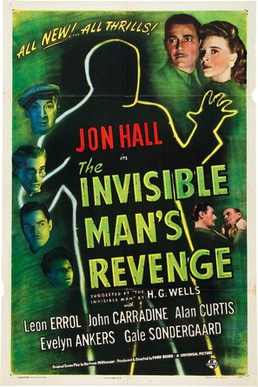
Horror Film Review: The Invisible Man’s Revenge (dir by Ford Beebe)


1944’s The Invisible Man’s Revenge opens with Robert Griffin (Jon Hall) arriving in England.

Despite his last name and the fact that he’s played by the star of Invisible Agent, this Robert Griffin would not appear to be in any way related to the previous invisible men.  Instead, he is someone who has just escaped from a mental institution in South Africa.  He has already murdered two orderlies and now, he’s come to England to take vengeance on Sir Jasper Herrick (Lester Matthews) and his wife, Lady Irene (Gale Sondergaard), two old friends who the paranoid Robert thinks tried to kill him in Africa so that they could steal his money.  When Robert sees Sir Jasper and Lady Irene, he informs them that they can either give him half of their fortune or they can allow him to marry their daughter, Julie (Evelyn Ankers).  Lady Irene responds by drugging Robert and having him kicked out of the house.

Dejected, Robert eventually comes across the cottage of Dr. Peter Drury (John Carradine, giving a surprisingly low-key performance in the mad scientist role).  Dr. Drury reveals to Robert that he has developed a serum that can turn living things invisible.  Drury goes on to “show” Robert all of the invisible pets that he has hanging out around the cottage, from an invisible dog to an invisible parrot.  When Robert asks how long the invisibility lasts, Drury says that it will last until the invisible person dies.  That sounds pretty good to Robert so he volunteers to be Drury’s latest test subject.

Soon, Robert is invisible and going out of his way to haunt that Herrick family.  Some of Robert’s antics are merely playful.  He helps a cobbler (Leon Errol) win a game of darts and later turns the man into his personal servant.  Robert’s other actions are a bit more destructive.  Robert, after all, was a murderer to begin with and using a serum that cause additional insanity is definitely not helping him with his temper.  When Robert decides that he wants to be visible again, he discovers that there’s only one temporary way to do it and it involves a lot of blood.

After being portrayed as being a hero in Invisible Agent, The Invisible Man is once again a villain in The Invisible Man’s Revenge and it just feels right.  There’s just something inherently sinister about the idea of someone being invisible.  Jon Hall, who was so boring in Invisible Agent, is far more compelling here, playing Robert as a paranoid megalomaniac who has so convinced himself of his own cleverness that he can’t even understand that he’s writing the script for his own downfall.  This is a good, solid Universal horror movie.  The true hero of the movie is Drury’s dog, played by a talented canine actor named Grey Shadow.  It takes more than invisibility to fool that dog!

Previous Universal Horror Reviews:

  1. Dracula (1931)
  2. Dracula (Spanish Language Version) (1931)
  3. Frankenstein (1931)
  4. Island of Lost Souls (1932)
  5. The Mummy (1932)
  6. The Invisible Man (1933)
  7. The Bride of Frankenstein (1935)
  8. Dracula’s Daughter (1936)
  9. Son of Frankenstein (1939)
  10. The Invisible Man Returns (1940)
  11. The Wolf Man (1941)
  12. Ghost of Frankenstein (1942)
  13. Invisible Agent (1942)
  14. Frankenstein Meets The Wolf Man (1943)
  15. Son of Dracula (1943)
  16. House of Frankenstein (1944)
  17. House of Dracula (1945) 
  18. Creature From The Black Lagoon (1954)

Horror on the Lens: Phantom Ship (dir by Denison Clift)


In December of 1872, a sailing ship called the Mary Celeste was found adrift and deserted in the Atlantic Ocean.  When the ship left New York in October, it had a captain and a full crew.  The captain’s wife was among the passengers sailing on the ship.  When the Mary Celeste was discovered, not only was no one on board but there was no evidence as to where everyone had gone or what caused them to abandon the ship in the first place.  The crew of the Mary Celeste appeared to have vanished into thin air and none of them were ever seen again.

As you might guess, this led to years of speculation about what happened.  Some people blamed pirates.  Some blamed food poisoning.  Some blamed ghosts and sea monsters.  More modern theorists have blamed UFOs.

First released in 1935 and originally entitled The Mystery of the Mary Celeste, Phantom Ship offers up a theory of its own.  It speculates about what happened during the final voyage of the Mary Celeste and why its crew vanished.  One of the members of the crew is played by Bela Lugosi.  Lugosi was still riding high from his starring role in Dracula when he starred in Phantom Ship and, playing a veteran sailor who appears to be a bit unstable, Lugosi gives an enjoyably over the top performance.  Admittedly, Phantom Ship has its slow spots and, at times, it threatens to get bogged down in a subplot about the love triangle involving the Captain, his wife, and the Captain’s best friend.  But Lugosi makes the film worth watching and, towards the end, there are some wonderfully atmospheric shots of the nearly deserted ship.

Along with being one Lugosi’s non-Dracula horror films, Phantom Ship is also well-known for being one of the first films to be produced by the British film company that would eventually become known as Hammer Pictures.

Enjoy!

Music Video of the Day: Devil Woman by Cliff Richard (1976, directed by ????)


In a song that was a definite change of pace from his usual work, Cliff Richard sings about how he became cursed after seeing a black cat with yellow eyes.  Cliff went to a fortune teller, asking her to lift the curse but it turned out that the fortune teller was the one who cursed him in the first place!

This song was Cliff Richard’s biggest hit in the U.S.  It undoubtedly helped that the song came out while America was still in the grips of Exorcist fever.

The ultimate message is that if it can happen to Cliff Richard, it can happen to anyone.

Enjoy!