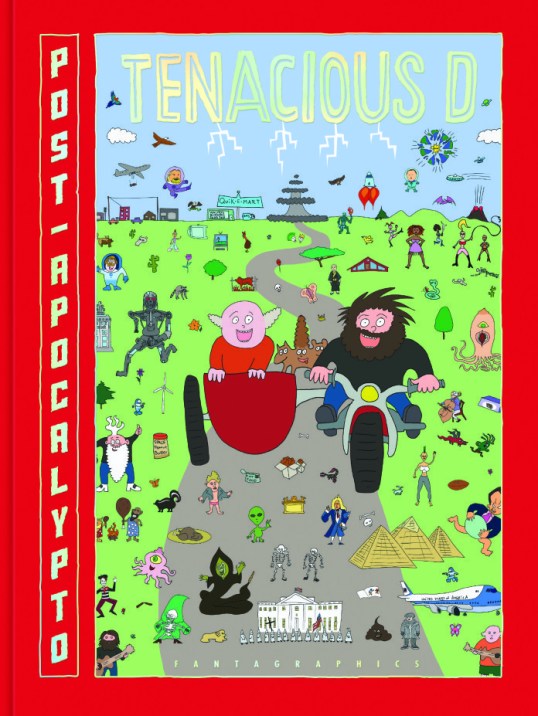
Tenacious D’s “Post- Apocalypto” : Dude, Was That An H-Bomb?


Ryan C. (fourcolorapocalypse)'s avatarRyan C.'s Four Color Apocalypse

Maybe it’s not fair to review Post-Apocalypto as a comic alone, since this latest effort from Jack Black and Kyle Gass in their Tenacious D roles is actually a multi-media event of sorts, encompassing a six-episode animated You Tube series, an audiobook, a musical album. and the hardback graphic novel published by Fantagraphics that’s under our metaphorical microscope here, but hey — I don’t want to be at this all night, and since comics is what we do here, we’re gonna keep it to that. Which pleases me to no end.

Even still, before any fans of Black, Gass, or their ostensible “band” jump down my throat, understand this : it’s not that I actively disliked this in and of itself so much as I have no patience for “edgelord” crap in a more general sense. There’s certainly a place in this world for such things, and there’s a strong…

View original post 628 more words

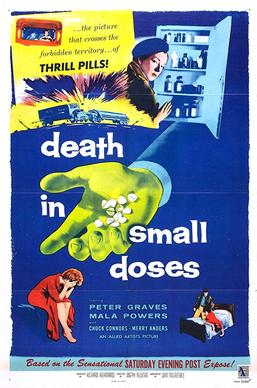
30 More Days of Noir #10: Death in Small Doses (dir by Joseph M. Newman)


Ah, speed.

I have to admit that I always find films about amphetamines to be fascinating because I take them for my ADD.  I’ve been taking Dexedrine since I was in middle school and it has always amused me how people who don’t have ADD seem to think that the meds will give you super powers.  For instance, every season of Big Brother, there’s people online who get outraged over certain houseguests taking Adderall.  “She had an unfair advantage!” someone will say, “Because she’s taking Adderall!”  What can I say?  People who don’t have ADD just don’t get it.  Yes, if you have ADD, the meds can help you focus but it’s not like they’re going to give you any sort of special power that’s not available to any other person.

(I will admit that there is a slight difference between me on my meds and me off my meds.  Actually, my family says that there’s a huge difference but I think they’re exaggerating.  It is true that I’m a lot more focused when I take my Dexedrine.  My mind wanders a bit less than usual and I’m also usually in better control of my frustrations.  When I take my meds, I can finish any project.  When I don’t take them, I can talk about finishing any project.)

Dexedrine focuses me but apparently, it does the opposite for those who don’t have ADD.  The 1957 film, Death in Small Doses, features a truck driver named Mink Reynolds who, despite not having ADD, pops too many capsules and ends up playing really loud music and trying to force a waitress to dance with him.  He also hallucinates seeing a car and then grabs a knife and tries to kill another truck driver.  To be honest, that seems a bit extreme to me.  In fact, I’d almost argue that Mink’s behavior would indicate that the filmmakers really didn’t know much about amphetamines.  Making things even stranger is that Mink is played by Chuck Connors, who was a remarkably inexpressive actor.  Watching Connors, with his stone face, trying to dance and jump around is an interesting experience.  Mink is supposed to be a jazz-crazed, speed-abusing hepcat but instead, he comes across like an animatronic mannequin.  You can almost hear the gears shifting whenever he has to move across the screen.

Mink’s fellow truck driver is Tom Kaylor (Peter Graves), a seemingly upright man who is usually seen wearing a tie and who looks like he would be more comfortable working behind a desk than driving a truck.  Of course, that’s because Tom is actually an FBI agent!  He’s working undercover, pretending to be a truck driver so that he can smash a ring of drug dealers!  Of course, the problem here is that everything about Peter Graves’s screen presence shouts out, “Narc!”  With his square jaw and his perfect haircut and his stiff but authoritative delivery of his dialogue, he seems like he was created in a lab that specifically set out to develop the most stereotypical FBI agent imaginable.  There’s not a single rough edge to him and it’s hard to buy that the other truck drivers wouldn’t see straight through him.

While Tom tries to bust the ring, he also finds time to possibly fall in love with two different women, both of whom seem as if they might know more than they’re letting on.  Amy (Merry Anders) is the waitress who has developed a drug habit of her own.  Val (Mala Powers) owns the boarding house when Tom and Mink live.  Can Tom trust either one of them?  And will Tom not only undercover the identity of the head of the drug ring but also survive long enough to bring the dealers to justice?

So, here’s the thing.  During its worst moments — i.e., whenever Chuck Connors is jumping all over the place and talking about how much he loves his friend “benny” — this is a campy and rather silly film that makes Reefer Madness look subtle by comparison.  However, during its best moments, this is a tough and entertaining noir that features good performances from Merry Anders and Mala Powers.  Both Anders and Powers manage to transcend the film’s sillier moments and they actually bring a charge of reality to the story.  And while director Joseph M. Newman may not have known much about drugs, he did know how to shoot a fight scene.  Making good use of its desolate locations (the truck drivers spend a lot of time driving through the desert) and setting many of the film’s best moments at night, Newman overcomes some of the script’s weaker moments.  In the end, it makes for a rather uneven but entertaining viewing experience.  Despite the film’s cluelessness about drugs and the miscasting of both Graves and Connors, this lesser-known noir is worth tracking down.

Artist Profile: John Fernie (1919 — 2001)


John Fernie was born in Dundee, Scotland and received his first formal training in art at Manchester University and Glasgow University.  After serving in World War II and spending five years as a pilot in the Royal Air Force, Fernie embarked on his career as an illustrator.  He began his career in Canada before eventually moving to New York City and then, in his later years, to Vermont.  Along with being a popular illustrator, Fernie was also an acclaimed painter and raced in Alfa Romeo with Sports Car Club of America.  You can find more information about the life and work of John Fernie at his website.

Here is a small sampling of the work of John Fernie:

Music Video of the Day: Slow Dance by Saint Motel (2020, dir by ????)


Another music video from my favorite band in the world, Saint Motel.  Today, we find the boys performing on a baseball field!

I saw Saint Motel live in January.  It’s an experience that I recommend to everyone.

Enjoy!

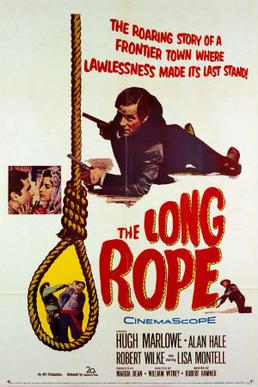
The Long Rope (1961, directed by William Whitney)


The time is the late 19th century and there’s been a murder in the territory of New Mexico.  Someone has gunned down Jim Matthews (Steve Welles) and store owner Manuel Alvarez (John Alonzo) has been arrested.  Everyone in town says that Jim was fooling around with Manuel’s beautiful wife, Alicia (Lisa Montell).  Manuel insists that he’s innocent but Jim was the brother of the town’s most powerful and richest land owner, Ben Matthews (Robert J. Wilke).  Ben is already having a gallows built so that Manuel can be hanged in the town square and it doesn’t look like there’s anything that Sheriff John Millard (Alan Hale, Jr. — yes, the Skipper) can do to stop him.

However, Federal Judge Jonas Stone (Hugh Marlowe) is determined to make sure that Manuel gets a fair trial.  When it becomes obvious that the Matthews family has no intention of letting that happen, Judge Stone launches his own investigation.  Believing Manuel to be innocent, Stone knows that he has to find the real killer before the gallows are built and Manuel is lynched by the mob.

A low-budget western with a 61-minute running time, The Long Rope is a surprisingly adult western, one that comes out strongly and directly against both lynching and the town’s racism.  With the Matthews family representing the brutal “old ways,” and Judge Stone representing a more enlightened and fair system of justice, it’s up to the town to decide who they will follow.  Hugh Marlowe brings a lot of gravitas to his role as the stern but compassionate Judge Stone while Lisa Montell makes a strong impression as Manuel’s rebellious wife.  Robert J. Wilke is an effective villain and even Alan Hale, Jr. gives a good performance once you stop thinking of him as being the Skipper.

One final note of interest: John A. Alonzo, who played Manuel in The Long Rope, went on to become an award-winning cinematographer.  Among Alonzo’s credits, as a cinematographer: Harold and Maude, Chinatown, The Bad News Bears, Black Sunday, Scarface, Norma Rae, and Close Encounters of Third Kind.

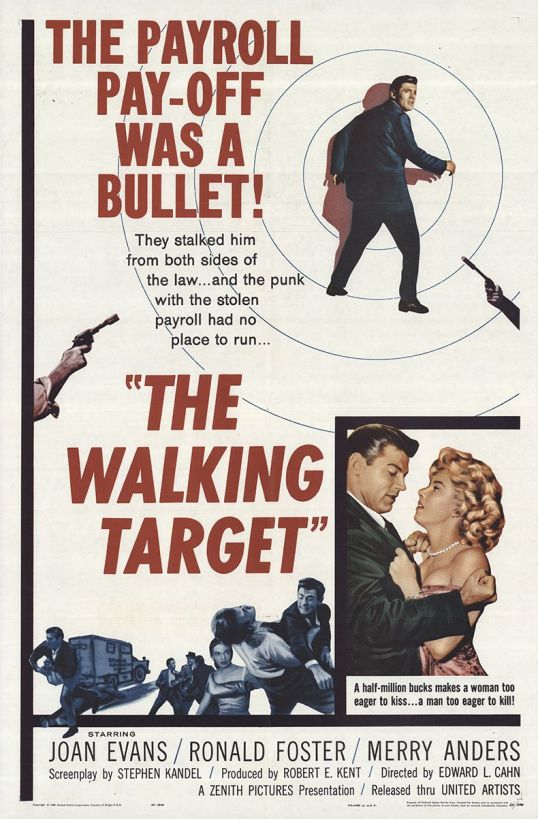
30 More Days of Noir #9: The Walking Target (dir by Edward L. Cahn)


In this 1960 noir, Nick Harbin (Ronald Foster) is a walking target!

That’s because he’s just been released from prison.  As the only survivor of a gang that pulled off a daring payroll robbery, Nick has done his time and he’s ready to get on with his life.  He even got himself an education while he was behind bars.  He’s decided to reform and no longer be the angry criminal that he once was.

But first, there’s a little matter of some money.

Only Nick knows where he buried the loot from the robbery.  Everyone wants it.  The press wants to know because it’ll make a great story.  A nosy detective wants to know because he’s convinced that Nick hasn’t changed his ways.  Susan (Merry Anders), who used to be involved with one of Nick’s criminal associates, wants to know because she’s only in it for the cash.  Susan’s current boyfriend, Dave (Robert Christopher) wants to know because …. well, again, it all comes down to greed.  Greed is also what’s motivating a local gangster to provide backing for Susan and Dave in their quest to find the money.  Dave is even willing to send Susan to seduce Nick.

However, all Nick wants to do is find the money and then split it with Gail (Joan Evans).  Gail is the widow of one of the robbers and Nick wants to do the right thing for her.  Of course, Nick is himself kind of in love with Gail.  Can Nick get the money, find love with Gail, and avoid slipping back into his criminal ways?  It won’t be easy.  Life is never easy when you’re….

THE WALKING TARGET!

Okay, that was a little bit melodramatic on my part but then again, it’s a melodramatic film.  Everyone is constantly plotting and double-crossing.  Appropriately, it all leads to a battle in the desert as modern-day outlaws prove themselves to be no more trustworthy than their vintage ancestors.

The Walking Target is a low-budget noir, one that clocks in at only 70 minutes and which, as a result, doesn’t waste much time when it comes to jumping into its story.  That’s one good thing about these B-movies.  They had neither the budget nor the time for red herrings.  As a result, you pretty much know what you’re going to get before the movies even begins.  The Walking Target features all of the usual tough dialogue and morally ambiguous characters that you would expect to see in a noir.  Merry Anders is an adequate femme fatale, though I do wish that Susan had been a smarter character.  (Nick sees through her way too easily.)  The film opens with the prison’s warden telling Nick that, even though he’s done his time, he’ll always be a no-good crook and that’s the perfect way for a noir to open.  Unfortunately, the film’s cinematography doesn’t really have the right noir look.  There aren’t enough shadows and the film often looks like it could just be an episode of an old TV show.  I guess that’d due to the budget but it really does keep the film from making the transition from being good to being great.

The Walking Target is a diverting-enough film.  I liked Ronald Foster’s uneasy performance as Nick and it was enjoyable to watch everyone plotting and scheming.  The Walking Target is currently available on Prime and I recommend it to anyone looking for a good, if lesser-known, B-noir.

Catching Up With Alex Nall’s “Kids With Guns”


Ryan C. (fourcolorapocalypse)'s avatarRyan C.'s Four Color Apocalypse

You can’t keep a good cartoonist down, and Alex Nall is considerably more than that, so when we all went into “lockdown mode” he continued releasing his ongoing Kids With Guns series online, with the most flexible payment terms I believe anyone’s every offered : if you read it and liked it, he just asked you to pay whatever you could afford for it. Now that we’re pretending the pandemic is over, though, the siren call of self-publishing has once again called out to him, and actual, physical copies of issues three and four are finally available — and it’s now incumbent upon me to tell you why you should buy them.

I’ve already reviewed the first two installments of this quiet, human-scale epic, but for those unfamiliar with the particulars, the most basic distillation I can offer is that what we’ve ostensibly got here is the story of an…

View original post 857 more words