Enjoy!
Enjoy!
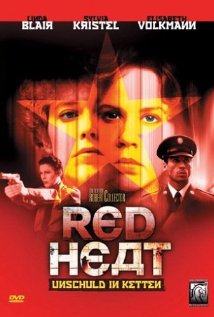 At the height of the cold war, college student Christine Carlson (Linda Blair, of course) travels to West Germany to marry her fiancée, Lt. Mike Grainger (William Ostrander). Mike has spent the last few years in West Berlin but, with his time in the army coming to an end, that means that he will be able to return to the United States with Christine. The only problem is that Mike doesn’t want to do that. Instead, Mike has decided to spend a few more years in the army and to put the marriage off for a while.
Christine is so upset that she goes for a walk to clear her head. Unfortunately, while walking around West Berlin, she witnesses a defector being abducted by the Stasi. For unclear reasons, the Stasi decided to kidnap Christine as well. Soon, Christine is in East Berlin, where she’s forced to falsely confess to being a CIA agent. Christine is sentenced to three years in prison and finally, after 20 minutes of build-up, Red Heat settles into being a typical Women In Prison film.
All of the usual WIP tropes are present. Sylvia Kristel plays Sofia, the lesbian gang leader who immediately targets Christine. The political prisoners (like Christine) are preyed upon by the common criminals, some of whom work with crooked guards to maintain order in the prison. There’s the usual collection of fights, shower scenes, and suicides, all mixed with scenes of Mike trying to get a group together to sneak across the border and rescue his fiancée. The only thing that really distinguished Red Heat from every other WIP film ever made is that it takes place in a communist-controlled prison so, in between fighting off Sofia and her crew, Christine has to watch propaganda films.
Linda Blair appeared in a lot of films like this and, by the time she made Red Heat, she was clearly getting bored with the genre. Both Blair and Kristel go through the motions and supply the obligatory nudity but neither one of them really seems to be that into the movie, with Sylvia Kristel especially appearing to be bored. Both Blair and Kristel were better in other films and, despite the uniqueness of the cold war angle, Red Heat is never as strange or as memorable as Blair’s best WIP film, Chained Heat. Red Heat is ultimately for Blair and Kristel completists only.
(In a perfect world, Red Heat would have been made in the 70s with Pam Grier in Blair’s role, Glynn Turman as Mike, Barbara Steele as Sofia, and Sid Haig as one of the guards. Now that would have been something to see!)

This 1955 film tells the story of a murder.
When we first meet Carolyn Elleson Grant (Marie Windsor), she refuses to give her husband, Harlow Grant (John Archer) a divorce, despite the fact that they’ve been separated for several years and Harlow now wants to marry Louise Nelson (Nancy Gates) and Carolyn is now involved with an art critic named Wayne Vincent (Patrick Knowles). Carolyn only married Harlow for his money and, while she has other rich lovers, she just enjoys making Harlow’s life as difficult as possible. It’s hard to blame her because Harlow is kind of whiny.
However, Carolyn has grown bored with Wayne Vincent and she’s now decided that she would rather get involved with Dick Sawyer (Richard Crane), who is rich and owns a boat. However, Dick is engaged to Carolyn’s personal assistant, Betty (Jill Jarmyn). Carolyn thinks it would be perfectly amusing to not only seduce Dick but to also destroy Betty’s happiness.
Why?
As one character put it, Carolyn is “a witch!”
(Someone then adds that Carolyn is a word that “rhymes” with witch. They don’t actually say the word because this film was made in 1955 but still….)
With Carolyn casually trying to destroy everyone’s lives and happiness, is it really a shock when some unseen person shows up at her art studio late at night and shoots her?
With Carolyn dead, it falls to Detectives Colton (Louis Jean Heydt) and Wells (John Gallaudet) to figure out the identity of the murder. They immediately suspect that it had to have been Harlow Grant. Not only does he have the motive and the opportunity but his name is Harlow Grant and I defy you to find anyone named Harlow Grant who hasn’t subsequently turned out to be involved in something shady. Harlow, however, insists that he’s innocent and the investigation is about to get a lot more complicated….
Well, okay, maybe not a lot more complicated. To be honest, it’s really not that difficult to figure out who the murderer actually is No Man’s Woman but that’s okay. The investigation itself only takes the last third of this 70-minute film. No Man’s Woman is a like a low-budget version of Gosford Park. The murder is less important than all of the drama surrounding it.
And make no mistake, there’s a lot of drama! This is a fun movie, specifically because Carolyn is such a wonderfully evil character and Marie Windsor has so much fun playing her. Carolyn doesn’t really have any deep motivation for why she does the terrible things that she does. She just does them because she can and she believes that she can get away with it. A good deal of the film’s entertainment comes from just seeing how bad Carolyn can be. In fact, you’re a bit disappointed when she’s murdered because Carolyn is the most enjoyable character in the movie. She’s someone who is literally willing to do and say anything and she makes an apologies for her actions. You wouldn’t necessarily want to work with her but she’s fun to watch.
The rest of the cast is adequate. John Archer and Nancy Gates are a bit on the dull side as the “good” characters but I liked the performances of the other suspects. Richard Crane and Jill Jarmyn, in particular, are memorable as Dick and Betty. I loved how going out on someone’s boat was apparently the height of decadence in 1955.
No Man’s Woman is an entertaining mix of noir and soap opera. Find it on Prime!


Forgive me in advance for broaching the subject, but — is there anything you’re going to miss about the pandemic when it’s over? Go on, act as incensed at the question as you wish, but I’ll bet you it’s something you’ve asked yourself at least once, even if you felt guilty that it even so much as entered your mind. Come on, be honest here : less traffic, quiet neighborhood streets at night, no waiting for tables at restaurants, being able to work from home — all of these things are, well, kinda nice. Not to say that they’re worth hundreds of thousands dead, millions more infected, and probably very nearly the same number of people out of work either temporarily or permanently — just saying, these are things that are not bad, in and of themselves, even if we arrived at them via the most fucked-up means possible…
View original post 694 more words

by Pino Daeni
Enjoy!

There’s been a murder!
Another one?
Yes, indeed. It would seem that during the 1940s and the 1950s, people were just dropping left and right. Mysterious murders were just a part of everyday life and you can be sure that every murder would bring with it an effort would be made to frame an innocent man. The 1947 British noir, The Mysterious Mr. Nicholson, opens with Peggy Dundas (Lesley Osmond) stumbling across a dead body. The body belongs to a man who was planning on changing his will and disinheriting his nephew. It seems like the nephew should be the obvious suspect, right?
Except …. the dead man has a letter pinned to his chest! And the letter is signed by VLS, a notorious cat burglar who, in the days before World War II, was famous for robbing the French and then sending the authorities taunting letters. So, obviously, VLS must be back and he must now be a murderer!
Except …. why would you kill a man and then leave behind a note letting everyone know that you did it? That makes no sense at all. Especially since VLS is actually a man named Mr. Nicholson (Anthony Hulme) and this mysterious Mr. Nicholson not only helped the British defeat the Germans but he also has a solid alibi for where he was on the night of the murder. Obviously, VLS is innocent!
Except …. Peggy says that she saw a man who looked exactly like Mr. Nicholson at the scene of the crime!
Could the Mysterious Mr. Nicholson have a look-alike? Yes, actually, he does. We learn this very early in the film so it doesn’t count as a spoiler. The murderer is man named Raeburn (also played by Anthony Hulme). Raeburn just happens to look exactly like Mr. Nicholson and he figured he would use that resemblance to his advantage by framing Nicholson for the crime!
So now, Nicholson has to not only prove his innocence but also track down the man who looks exactly like him!
That’s a lot of plot for a low-budget, 78 minute film. What’s odd is that, even with all of that scheming and the short running time, The Mysterious Mr. Nicholson still has some odd moments of blatant padding. In the middle of the film, all of the action comes to a halt so that we can watch a lengthy dog act. This is followed by a musical interlude. Why? Who knows? Neither adds much to the plot.
Anyway, I was actually kind of hoping that The Mysterious Mr. Nicholson would turn out to be one of those really fun, old movies that you just happen to stumble across on Prime or on TCM late at night. But it’s actually pretty boring. There’s only a handful of locations in the film, which gives the whole thing a stagey feel and, though short, the movie often seems to drag. Another huge problem is that Hulme plays Nicholson and Raeburn the exact same way, so it’s often difficult to keep track of which is which. I was hoping for at least some split photography so Hulme could act opposite himself but we don’t even get that. Instead, Nicholson and Raeburn are rarely on screen at the same time and, whenever they are, it’s obvious that a stand-in was used for the other man.
From a historical point of view, the film is interesting in that it was obviously made while London was still rebuilding from World War II. The few location shots reveal a city that’s in the process of being recreated. Nicholson is presented as being someone who was basically reformed as a result of fighting on the side of the good guys during World War II. As one Scotland Yard inspector explains it, Nicholson may have been a criminal before the war but, once the war started, he remembered that was British first and he did what had to be done to help defeat Germany. It’s a nice touch.
The historical aspect aside, The Mysterious Mr. Nicholson is pretty forgettable. When it comes to British noirs, I’ll take The Criminal.

by Harry Barton
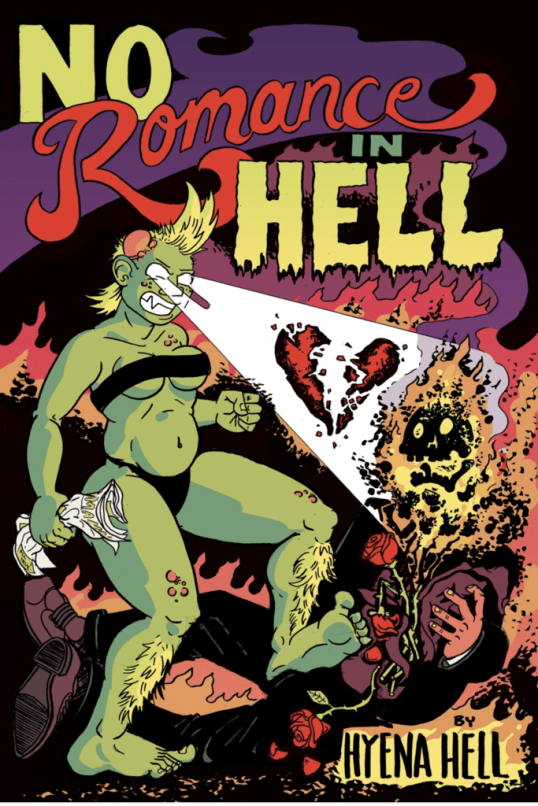
Look, we all know dating is hell, but what’s dating like in hell? And who better to let us know than Hyena Hell?
As it turns out, things aren’t easy for a single demon on the prowl, so for our frustrated protagonist in No Romance In Hell, published at the tail end of 2019 (I know, I know — I’m a little late to the party) by Silver Sprocket Bicycle Club, the only place to go is up — as in to Earth. But is that really a step in the right direction? And do you really need me to answer that question? Shake your head “no” to both and we’ll move along —

If you’re familiar with the work of Ms. Hell, you know what to expect here in a general sense : audacious humor, lots of attitude, a decidedly punk sensibility, feminist themes, and no fucks given…
View original post 514 more words
Enjoy!
 Through the Shattered Lens