Julius Caesar (1970, directed by Stuart Burge)


In ancient Rome, under the direction of Cassius (Richard Johnson), several members of the Senate conspire to kill Julius Caesar (John Gielgud), believing that his death is the only way to preserve the Republic.  Even Caesar’s longtime friend, Brutus (Jason Robards), is brought into the conspiracy.  Unfortunately for the conspirators, after Caesar’s murder, Mark Antony (Charlton Heston) gives his famous speech asking the Romans to lend him their ears and the Roman citizens turn against Caesar’s murderers and instead look to Antony and Octavius (Richard Chamberlain) to lead them.

This was the first adaptation of William Shakespeare’s play to be filmed in color and the assassination of Caesar was portrayed much more graphically than in previous productions.  By the end of the attack, Caesar has been stabbed so many times and there’s so much blood on screen that it doesn’t seem like he should even have the strength to say, “Et tu, Brute?”  Despite the then-modern innovations, this version still feels creaky and stiff.  When Caesar makes his appearance on the Ides of March, all of the conspirators actually stand in a neat line while Caesar enters the Senate.  When Mark Anthony and Brutus make their speeches, the extras playing the Roman citizens looked bored and disinterested.

For most viewers, the appeal of this version of Julius Caesar will be for the cast, which was considered to be all-star in 1970.  Along with Gielgud, Robards, Heston, Johnson, and Chamberlain, the cast also features Robert Vaughn as Casca, Christopher Lee as Artemidorous, Jill Bennett as Calpurnia, and Diana Rigg as Portia.  Surprisingly, it’s Jason Robards, the Broadway veteran, who struggles with Shakespeare’s dialogue, delivering his lines flatly and without much emotion.  Meanwhile, Charlton Heston steals the entire film as Mark Antony, nailing Antony’s funeral oration and proving himself to be much more clever than the conspirators had originally assumed.  (Of course, Mark Antony was the Charlton Heston of his day so I guess it shouldn’t be too much of a surprise that Heston is perfect in the role.)  I also liked Diana Rigg’s performance in the small role of Portia and Robert Vaughn’s devious interpretation of Casca.

Though he plays Caesar here, John Gielgud previously played Cassius in the 1953 version of Julius Caesar, the one with James Mason and Marlon Brando.  That is still the version to watch if you want to see the definitive adaptation of Julius Caesar.
Music Video of the Day: Signs, covered by Tesla (1990, directed by ????)


Tesla did not come up with this song on their own.  Instead, Signs was written by Les Emmerson in the late 60s and it was a hit for Five Man Electrical Band in 1970.  The song was inspired by a trip Emmerson took down Route 66.  While driving, Emmerson noticed that there were a lot of … you guessed it … signs!  Embraced by the “long-haired freaky” people mentioned in the opening lyrics, Signs became a surprise hit.

Twenty years later, the song was revived when Tesla performed an acoustic version of the song.  At the time, Tesla was the opening act for Motley Crue’s Dr. Feelgood tour but, because they had an off-day, the band booked an acoustic show.  Each member of the band picked a different song to perform.  Signs was selected by lead singer Jeff Keith, who grew up in Oklahoma and, as you can see in the video, had some definite thoughts when it came to signs blocking out the scenery (or “fucking up the scenery” as the band put it in the uncensored version of the song).

Signs is a good example of song that probably would have been forgotten if not for MTV.  When the song was originally released, it didn’t get much attention but the subsequent video proved to be popular and the song eventually became a hit.  The success of Signs led to other bands do acoustic shows and eventually MTV launching Unplugged.

Enjoy!

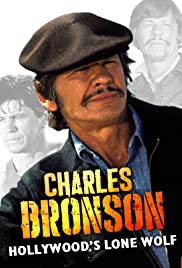
Charles Bronson, Hollywood’s Lone Wolf (2020, directed by Jean Lauritano)


How did a former Pennsylvania coal miner who was born Charles Buchinsky eventually transform himself into Charles Bronson, one of the world’s biggest movie stars?

That’s the question that’s examined in this short documentary.  Filled with scenes from Bronson’s films and clips of the tight-lipped interviews that he gave throughout his career, Charles Bronson, Hollywood’s Lone Wolf takes a look at Bronson’s life and film persona.  It attempts to explain the appeal of a notoriously inexpressive actor who, unlike many of his contemporaries, never went out of his way to win any popularity contests.  Unfortunately, the documentary struggles to tell us much that we didn’t already know about Bronson.  Even when, after years of trying, he finally became a Hollywood superstar, Bronson was still known for keeping to himself.  Much like the characters that he played, Bronson was someone who kept his feeling under wrap.  Lacking any contemporary interviews with the people who knew Bronson and who worked with him, the documentary often has to rely on what Bronson said and, unfortunately, Bronson never said much.

Another problem with the documentary is that it doesn’t seem to have been made by people who actually liked Charles Bronson’s films.  While Once Upon A Time In The West, The Mechanic, and Rider on the Rain are all rightfully praised, Death Wish is dismissed as reactionary and many of the films that he made in the 70s — including some of his best, like From Noon Till Three, Raid on Entebbe, and Telefon — are ignored all together.  While it’s true that Bronson’s films were rarely critically acclaimed, doesn’t it seem like a documentary about Charles Bronson should be made by people who actually dig his movies?

The documentary is at its best when it examines how much of Bronson’s career was fueled by his own bitterness towards his poverty-stricken childhood and the many years in which Hollywood refused to give him decent roles.  Bronson comes across as being surly, a little bit mean, and not someone to mess around with.  At the same time, when he’s with his second wife, Jill Ireland, Bronson seems like a totally different man.  He actually smiles!  Ireland brought out Bronson’s nice side.  With Ireland, Bronson relaxes in a way that most of the characters that he played would never have allowed himself to.  After Ireland’s death in 1990, Bronson is described as having been devastated but he subsequently used that pain to give one of his best performances, in Sean Penn’s The Indian Runner.

The documentary ends by noting that Quentin Tarantino dedicated Kill Bill Volume 1 to his memory.  No one, we’re told, knows how Bronson would have felt about it.  That sounds about right.  I think that really was what made Charles Bronson a superstar.  No one knew what he was thinking but everyone wanted to find out.

Music Video of the Day: Down by 311 (1996, directed by Josh Taft)


This video is probably about as 90s as you can get but the 1990s were a cool decade and this video introduced a generation to meditation.  According to the band itself, this song was written as a way to thank the fans who were “down” with them before 311 ever found any sort of mainstream success.

This video was directed by Josh Taft, who also directed Plush and Sex Type Thing for Stone Temple Pilots.

Enjoy!

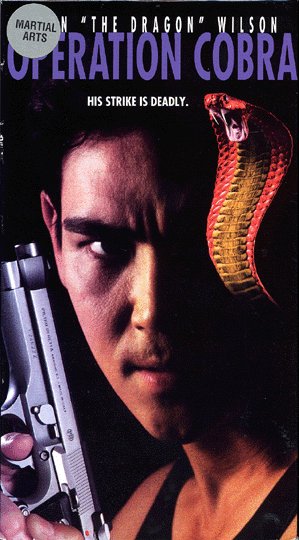
Cinemax Friday: Operation Cobra (1997, directed by Fred Olen Ray)


Interpol agent Kyle Connors (kickboxing legend Don “The Dragon” Wilson) is sent into a tailspin when his partner, Trevor (Rick Hill), is apparently killed during a failed operation.  Connors’s boss (played by the film’s director, Fred Olen Ray) orders Connors to go on leave so Connors promptly heads over to India.  Connors is planning on capturing Daveed (Evan Lurie), the drug dealer who Kyle blames for murdering Trevor.

While searching for Daveed with the help of an honest (and obviously doomed) cop named Ravi (R. Madhavan), Connors has several battles with a group of Indian ninjas who are intent on capturing a mysterious woman named Shallimar (Deepti Bhatnagar).  Connors also meets yet another mysterious woman, Callista (Tane McClure), who claims to be an intelligence agent and who tells him that Daveed’s boss is actually the enigmatic Victor Grayson (Michael Cavanaugh).  While Connors is tracking down Grayson, he finds out about yet another shadowy crime boss known as The Hydra and a computer disk that can apparently be used to hack into computer in the known world.

Can you guess who The Hydra actually is?

As any aficionado of late night Cinemax can tell you, Don “The Dragon” Wilson and Fred Olen Ray are a match made in heaven.  If you were growing up in the 90s, you knew Don “The Dragon” Wilson was cool because everyone who talked about him used both his given name and his nickname.  He was never just “Don Wilson” or “The Dragon.”  Instead, he was Don “The Dragon” Wilson.  Though Wilson never had much screen presence, he was a good on-screen fighter and the fact that he wasn’t a typically muscle-bound action hero made him more interesting than an ‘actor” like Steven Seagal.  Fred Olen Ray, meanwhile, was smart enough to get out of the way and let Wilson kickbox his way through the movie.  Though the story is nearly impossible to follow, a few good fight scenes more than make up for it.  Ray understands that is what most of his audience (maybe all of his audience) is going to be watching for.

Though the plot of Operation Cobra never makes any sense, most people will know what they’re going to get when they see who directed it and who is starring in it.  Even though the film wasn’t shot in the most photogenic areas of India (because that would have cost too much money), it still makes good use of its location footage and it’s hard not to be entertained by a film features Don “The Dragon” Wilson, Tane McClure, Rick Hill, and Evan Laurie.  That’s B-action movie nirvana.  I also liked that it was never entirely clear what the computer disk actually did but that it was extremely important than it not fall in the wrong hands.  It was the ultimate MacGuffin and because the film was made in 1997, it wasn’t necessary to go into details.  All that had to be said was that it had something to do with computers and that automatically made it a big deal.  That’s just the way things were in the 90s.

4 Shots From 4 Films: Special Brian De Palma Edition


4 Shots From 4 Films is just what it says it is, 4 shots from 4 of our favorite films. As opposed to the reviews and recaps that we usually post, 4 Shots From 4 Films lets the visuals do the talking!

Today, we wish a happy 80th birthday to director Brian De Palma with….

4 Shots From 4 Films

Carrie (1976, dir by Brian De Palma)

Scarface (1983, dir by Brian De Palma)

Body Double (1984, dir by Brian De Palma)

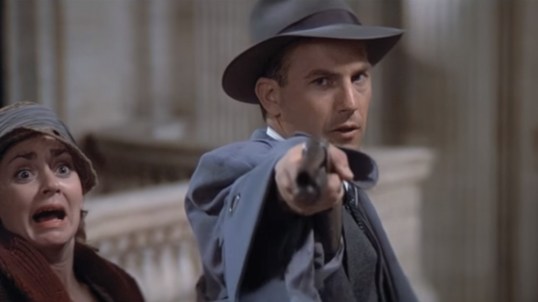
The Untouchables (1987, dir by Brian De Palma)