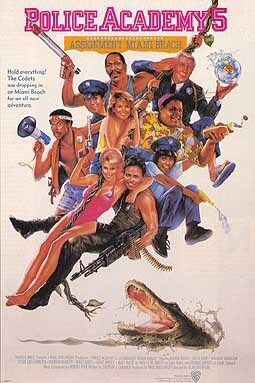
Police Academy 5: Assignment Miami Beach (1988, directed by Alan Myerson)


Police Academy 5 starts as so many Police Academy films have started.  Commandant Lassard (George Gaynes) is getting progressively more loopy and Captain Harris (G.W. Bailey) is plotting to take over the Academy.  This time, Harris thinks that he has come up with the perfect plan when he discovers that Lassard has reached the mandatory retirement age.

With retirement looming, Lassard attends one final law enforcement convention in Miami.  At the convention, Lassard is to be honored as “Police Officer of the Decade” because it was apparently a very slow decade.  Lassard decides to bring along his favorite academy graduates so that they can celebrate with him and meet his nephew, Sgt. Nick Lassard (Matt McCoy, who you may recognize as Seinfeld’s Lloyd Braun or maybe as the spokesman for Hartford Insurance).   The commandant invites Sound Effects Guy (Michael Winslow), Tackleberry (David Graf), Hightower (Bubba Smith), Hooks (Marion Ramsey), Callhan (Leslie Easterbrook), and House (Tab Thacker).  Notice who isn’t there?  This was the first Police Academy film without Steve Guttenberg’s Carey Mahoney and Commandant Lassard celebrating his career without inviting his most loyal graduate doesn’t seem right.

Once what is left of the old gang arrives in Miami, they get caught up in the usual Police Academy shenanigans.  Rene Auberjonois plays a jewel thief who accidentally switches bags with the Commandant and who has 24 hours to retrieve the stolen diamonds.  It’s Florida so there are women in bikinis and an Everglades boat chase.  Harris gets humiliated in every way possible.  The jokes are even more juvenile than usual.  Nick Lassard uses sunscreen to permanently label Harris as being a “dork” so everyone on the beach calls Harris a “dork.”  That’s as sophisticated as things get.

Unfortunately, there’s a Steve Guttenberg-shaped hole at the center of Police Academy 5 and not even as formidable a thespian as Matt McCoy can fill it.  Even though Guttenberg always seemed like he was miscast as both a cop and a former juvenile delinquent, Police Academy 5 shows how important he really was to the franchise.  Mahoney was the closest thing that the Police Academy films had to a fully developed character and, without him around, it’s even more obvious how thinly drawn all of the other characters were.  (Guttenberg was filming Three Man And A Baby while Police Academy 5 was in production though, in an A.V. Club interview a few years ago, Guttenberg said the real reason he wasn’t invited to Miami Beach was because the producers couldn’t afford to pay his salary.  “You’ve got to get paid!” Guttenberg explained.)

I will, however, give Police Academy 5 some credit.  Rene Auberjonois does what he can with his bumbling jewel thief and the scene where Tackleberry pulls a gun on a shark made me laugh.  Otherwise, Police Academy 5 is no Police Academy 3.

Tomorrow, it’s time for … you guessed it! …. Police Academy 6!

Artist Profile: Hubert Rogers (1898 — 1982)


Born into a prominent family in Ablerton, Price Edward Island, Canada, Hubert Rogers went on to become one of the most influential artists of the pulp era.  While he worked in all genres, Rogers was best known for his illustrations and cover work for Astounding Science Fiction.  Rogers’s portraits of aliens, astronauts, and especially his spaceships all influenced how a generation grow up thinking about space exploration, extraterrestrial life, and the future.

Rogers, whose grandfather was governor of Prince Edward Island, served in the Canadian army during World War I and trained at the Massachusetts Normal Art School.  After retiring from working as an illustrator, he devoted himself to landscapes and commissioned portraits of historic Canadian and American politicians, justices, celebrities, businessmen, and Commissioners of the Royal Canadian Mounted Police.

Here’s a small sampling of his work:

Music Video of the Day: Sleepwalking by Lindsey Stirling (2020, dir by Lindsey Stirling and Graham Fielder)


Are your dreams your dreams or are they messages from the dead?  It’s something to think about.

Lindsey Stirling is one of my favorite performers and this is another great video from her.  During this stressful time, it’s good to know that Lindsey is out there, creating music.

I should also note that I usually get by on two to three hours of sleep a night.  If I could, I’d get by on absolute zero but I’m not allowed do that anymore.  *le sigh*  Oh well!  I’ve never actually sleepwalked, though I find the phenomena of it to be fascinating.  I do usually have some great dreams, though.  Do people have dreams while they’re sleepwalking?  I would hope so.

Enjoy!

Police Academy 4: Citizens on Patrol (1987, directed by Jim Drake)


Long before the end credits of 22 Jump Street imagined Jonah Hill and Channing Tatum going to culinary school, the flight academy, and into outer space, the Police Academy films bravely tested just how far one already thin premise could already be stretched.

In Police Academy 4, Commandant Eric Lassard (George Gaynes) comes up with another plan to make the city safer.  (Since Lassard has been coming up with plans for three years without any success, it may be time to let the old man retire peacefully.)  This time, he wants to institute Citizens on Patrol, which would mean training citizens to act like cops.  It sounds like the type of terrible idea that could get a city sued into bankruptcy but considering that this is a city where a human sound effects machine and the former head of the 16 precinct’s biggest gang can become decorated police officers, I guess it’s as good an idea as any.

As usual, Carey Mahoney (Steve Guttenberg) and the gang are ready to help Lassard.  Bruce Mahler’s Fackler is no longer a part of the ensemble but Bubba Smith, Bobcat Goldthwait, Michael Winslow, David Graf, Tim Kazurinsky, Marion Ramsey, and Brian Toschi are all back.  Also returning, after skipping out on the first two sequels, is Capt. Harris (G.W. Bailey).  Harris wants to see Lassard fail so that he can take over the police academy.  It’s the same thing as the first three films.  As in previous Police Academy films, there’s a visit to the Blue Oyster leather bar and a last minute crime wave to give the Citizens on Patrol a chance to prove they belong in the program.  The Citizens on Patrol include Billie Bird, Brian Backer, David Spade, wrestler Tab Thacker, and Corrine Bohrer as a love interest for Bobcat Goldthwait.  Sharon Stone also makes an appearance, playing a journalist and improbably falling for Steve Guttenberg.  Watching the film, it is obvious that the idea was that, in future Police Academy films, the Citizens on Patrol could replace any of the regular cast members who wanted too much money to return.  As a result, almost every veteran of the cast has a doppelganger in the Citizens on Patrol.  Brian Backer could replace Steve Guttenberg.  Tab Thacker is there to put Bubba Smith on notice that no one is irreplaceable.  Is Bobcat Goldthwait being difficult?  Just remind him that David Spade can play a crazy eccentric too.

Police Academy 4 is the most crowded of the Police Academy films and, even by the franchise’s undemanding standards, most of the jokes fall flat.  Jim Drake took over as director after the director of the previous two films, Jerry Paris, died of a brain tumor and Drake struggles to balance low comedy with police action.  Guttenberg and company don’t have the same energy in this installment as they had in the previous three and the new cast members all feel as if they’re out place sharing scenes with the veterans, like a group of underclassmen who have been invited on the senior trip.

This would be the final Police Academy film for Steve Guttenberg.  Would the franchise be able to survive without him?  Check here tomorrow to find out with my review of Police Academy 5!

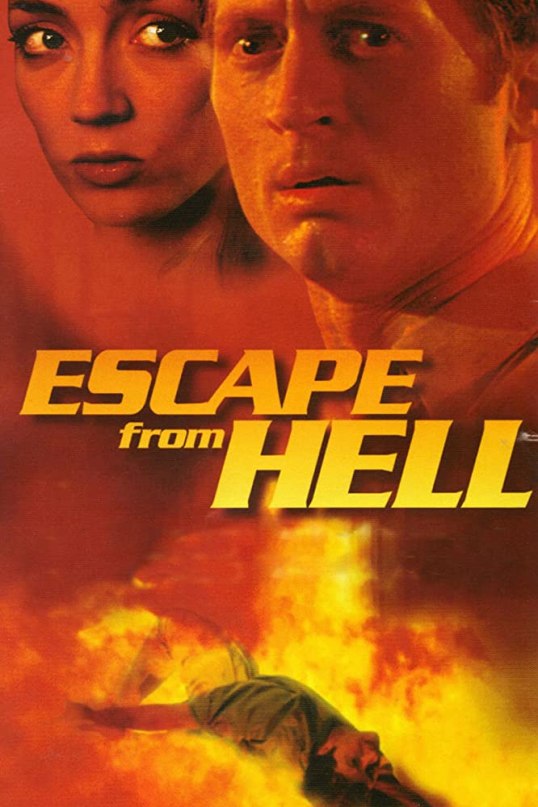
Film Review: Escape From Hell (dir by Danny Carrales)


The 2000 film, Escape From Hell, tells the story of two doctors.

Dr. Marissa Holloway (Emily Jo Tisdale) believes that there is a Heaven and that there is a Hell and that, at the end of your life, you go to one of them.  The film lets us know, early on, that she’s right by letting us into the mind of a good but irreligious family man who is on the verge of death.  At first, the man sees himself heading into a shining light but then, suddenly, he’s plunging into flames!  That’s right.  The good man who loved his family and helped people out and who never did anything wrong to anyone still went straight to Hell.

Dr. Eric Robinson (Daniel Kruse) doesn’t believe that there’s an afterlife.  He believes that everyone who says that they’ve seen either a light or a glimpse of Hell was suffering from a hallucination.  He’s hostile to Marissa’s beliefs.  Could it have something to do with his difficult relationship with his estranged father?  Who knows?

Together, Dr. Holloway and Dr. Robinson solves crimes!

No, actually, they don’t.  Instead, they star in a low-budget, evangelically-themed remake of Flatliners.  After his father dies, Dr. Robinson is more determined than ever to prove that there’s no afterlife so he decides that the smartest thing to do would be to die for a few minutes and then be brought back to life by another doctor.  Like I said, it’s basically Flatliners all over again.  The main difference, of course, is that Flatliners imagined a New Agey afterlife with no God while Escape From Hell leaves little doubt that there’s a Heaven and a Hell and just about everyone’s going to the second place.

Dr. Robinson does originally go to Heaven and it’s a nice-looking meadow.  (Apparently, he just gets to skip Purgatory so lucky him.)  However, the doctor is soon informed that he doesn’t belong in Heaven so bang!  It’s down to Hell that he goes.  Hell is essentially a rocky place with constantly burning fires.  The whole place is tinted red and looks like something you might expect to find in an old video game.  Unfortunately, Dr. Robinson doesn’t get to talk to the five people you meet in Heaven but he does get to talk to a handful of people in Hell, the majority of whom are confused as to why they’re down there but who also realize that they somehow massively screwed up and will never get a chance to escape.  One of the people that Robinson meets turns out to be a demon.  There’s a lot of really cheap CGI that looks kind of silly but, at the same time, still possesses a certain low-rent charm.

While Dr. Robinson is learning about the afterlife, his colleagues are trying to bring him back to life.  If they don’t bring him back quickly enough, Robinson, much like Franklin Delano Roosevelt will be stuck in Hell in forever!

(I should admit that we don’t actually see FDR in Hell.  I just assume he’s down there.)

If you haven’t picked up on it by now, I have a weakness for achingly sincere films that feature primitive CGI.  It’s easy to make fun of movies like Escape from Hell but I tend to view them as being examples of outsider art.  Yes, it’s a flawed film that was apparently made by people who weren’t really sure what they were doing but that’s actually the film’s charm.  The bad acting, the melodramatic dialogue, the cheap CGI, the extremely literal definitions of Hell and Heaven, and the final message that almost everyone on the planet is destined to suffer eternal torment; all of it contributes to make a film unlike almost any other (except, of course, for the original Flatliners)  It’s silly, preachy, and entertaining in its own bizarre way.  It’s the cinematic equivalent of the school prayer advocate who says that children who don’t want to pray can, “Simpy lower their heads and think about how they’ve got it all figured out.”  It may not be good but it’s always watchable in its own twisted way.

Film Review: Peter: The Redemption (dir by Leif Bristow)


I have two main thoughts on the 2016 religious film, Peter: The Redemption.

First off, John Rhys-Davies is a treasure.  The veteran actor plays the role of Peter, the rock of the Church.  The film focuses on Peter’s final days, locked away in a Roman prison and suffering torture at the hand of the Romans.  He’s told repeatedly that all he has to do to win his freedom (and his life) is to publicly renounce his beliefs and confess that the Christians were behind the plot to set Rome on fire.  While Peter waits for death, he is haunted by memories of the night that he denied knowing Jesus.  He feels that he is not worthy to be crucified.  He worries if he’s done enough to atone for his mistakes.  Rhys-Davies gives a powerful performance, capturing both Peter’s anguish and his inner strength.  This is probably one of the best performances that you’ll ever find in a low-budget religious film.

My other thought is that you really haven’t lived until you’ve seen Stephen Baldwin plays the Emperor Nero.  Baldwin plays Nero as being something of a wannabe hipster, desperately trying to convince everyone that he’s more interesting than he actually is and dreaming of rebuilding Rome in his own image.  Baldwin’s Nero is a crazy conspiracy theorist, the type who often seem to be struggling to follow his own line of thought.  There’s not a subtle moment to be found in Baldwin’s performance as Nero but, interestingly, his interpretation of the role is probably fairly close to being historically correct.  By the account of most of the Roman historians who lived through and actually managed to survive his reign, Nero considered himself to be an artist and an intellectual and his dream was to be as acclaimed as a performer as he was an emperor.  It’s been said that Nero was killed as much for his artistic pretensions as his administrative mistakes and that his final words were, “What an artist dies within me!,” and one can certainly believe that while watching Baldwin’s performance.

Unfortunately, Peter: The Redemption gets distracted by a subplot involving the blossoming relationship between a servant in Nero’s court and one of Peter’s guards.  It’s the same basic story as Quo Vadis?, just told in a lot less time and on a much smaller budget.  To be honest, I kind of liked the film’s low-rent version of Rome.  Rome is usually presented as being this glamorous and impressive city but most historians of the era tend to emphasize the fact that the streets of Rome were often dirty and the walls were covered with frequently obscene graffiti.  (In fact, graffiti was the main form of political protest in the Roman Empire.)  No wonder Nero wanted to burn the place down.

Anyway, Peter: The Redemption is okay.  It tells its story effectively enough and the performance of John Rhys Davies elevates every scene in which he appears.  The film gets bogged down whenever it concentrates on the romance in Nero’s court but Baldwin and Rhys Davies keep things watchable.

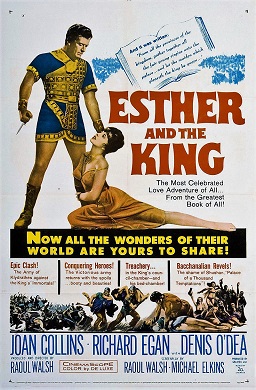
Film Review: Esther and the King (dir by Raoul Walsh)


The 1960 Italian-American co-production, Esther and the King, opens in ancient Persia.  King Ahasuerus (Richard Egan) has just returned from conquering Egypt and he is angered to discover that his wife, Vashti (Daneila Rocca), has been cheating on him with not just his main advisor, Haman (Sergio Fantoni), but also with the entire palace guard as well.  After the Queen shows her further displeasure with the King by doing a topless dance in front of the entire royal court, the King banishes her from his life.

Since the king now needs a new wife, every attractive woman in the land is dragged off to the palace so that she can audition for the role.  Among those forcibly recruited is the strong-willed Esther (Joan Collins), who was previously engaged to a rebel named Simon (Rick Battaglia).  What the king doesn’t know is that Esther is both Jewish and the cousin of Mordecai (Denis O’Dea), who has recently offended Haman by refusing to bow down before him.  Haman and his wife (Rosalba Neri) are now plotting to execute all of the Jews is Persia.  Despite her love for Simon, Esther remains in the competition to become the Queen so that she can save her people….

There are a few things that you immediately notice about Esther and the King.

First off, it’s an extremely loose adaptation of the story of Esther, one that is designed to make the King out to be a far more sympathetic figure than he actually was.  Whereas the King actually banished his wife after refused to attend a banquet where the drunken King wanted her to pose naked, Esther and the King presents the King as being the wronged party as his wife is literally cheating with every available man in the kingdom.  (Ironically, the film actually presents the King as being forced to banish his wife after she removes her top during a banquet whereas, in actuality, it was her refusal to do so that led to be her being exiled.)  The film also adds in considerably more battles and a lot more court intrigue as all of the king’s potential wives compete for his attention.  And, of course, then there’s Esther’s fiancee, Simon, who does not appear anywhere in the original text.

The other thing that you immediately notice about Esther and the King is that ancient Persia apparently looked a lot like ancient Rome.  That’s not surprising when you consider that this was an Italian co-production and that Esther and the King is as much of an old school peplum film as a biblical adaptation.  This is a biblical adaptation that is as concerned with sword fights and banquets as it is with prayer and religion.

Regardless of whether it’s historically accurate or not, it’s an entertaining film.  Admittedly, Richard Egan is a bit of a stiff as the King and Joan Collins really doesn’t bring much beyond beauty to the role of Esther.  But the sets are properly ornate and the costume are to die for.  Mario Bava was the film’s cinematographer (and some sites credit him as being the film’s co-director as well) and Esther and the King is gorgeous to look at.  This is one of those historical epics where almost everything feels appropriately big, from the palaces to the emotions to the melodrama.  The supporting cast is largely made up of Italian actors who all appear to be having a great time playing up the drama of it all.  Sergio Fantoni is wonderfully hissable as the evil Haman.  (Boo!  Haman!  Boo!)  Rosabla Neri also has some memorably manipulative moments as Zeresh, the wife of Haman (boo!)  For those of us who like big and not necessarily historical accurate epics about the ancient world, Esther and the King is a lot of fun.