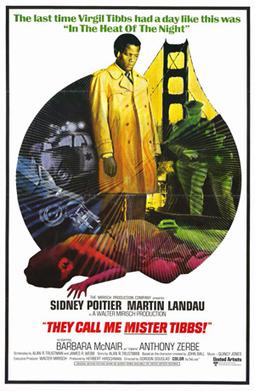
The 1970 police procedural, They Call Me Mister Tibbs!, opens with a murder in San Francisco.
A prostitute has been found dead in a sleazy apartment building and, according to witnesses, she was visited, shortly before her death, by the Reverend Logan Sharpe (Martin Landau). Rev. Sharpe is a prominent civic leader, an outspoken liberal who is a friend of the civil rights movement. Sharpe is currently at the forefront of a campaign to pass a city referendum that will add a “mini city hall” to every neighborhood and will help to fight against the gentrification of San Francisco. If Sharpe’s guilty, it will mean the death of the referendum.
Despite the fact that there’s a ton of evidence piling up against him and he kind of comes across as being a little bit creepy (he is, after all, played by Martin Landau), Rev. Sharpe insists that he’s innocent. Yes, he’s been visiting prostitutes but he’s not a client. No, of course not! Instead, Sharpe explains that he’s simply counseling them and praying for their souls. In fact, as far as Sharpe is concerned, this whole thing is just an attempt by the establishment to discredit his efforts to help the poor and underprivileged.
Heading up the investigation is a friend and supporter of Sharpe’s, Detective Virgil Tibbs (Sidney Poitier). That may seem like a good thing for Sharpe, except for the fact that Tibbs is an honest cop and he’s not the type to let friendship stand in the way of doing a thorough investigation. Tibbs admits that he supports Sharpe’s campaign and he wants the reverend to be innocent. But Tibbs is all about justice. Whether it’s teaching his son an important lesson about smoking or tracking down a potential serial killer, Virgil Tibbs is always going to do the right thing.
There are other suspects, all of whom are played by suitably sinister character actors. Anthony Zerbe plays a criminal who lived near the prostitute. Ed Asner plays her landlord, who may have also been her pimp. Is Sharpe being set up by the powers that be or is Tibbs going to have to arrest a man whom he admires?
They Call Me Mister Tibbs! was the second film in which Sidney Poitier played Virgil Tibbs. The first time he played the role was in 1967, when he co-starred with Rod Steiger in the Oscar-winning In The Heat of the Night. In that film, Poitier was a Philadelphia cop in the deep south who had to work with a redneck sheriff. In They Call Me Mister Tibbs!, Virgil is now working in San Francisco and he has to work the case on his own.
They Call Me Mister Tibbs! is a far more conventional film than In The Heat of the Night. Whereas In The Heat of the Night had a wonderful sense of place and atmosphere, They Call Me Mister Tibbs! could just as easily have taken place in Los Angeles, Phoenix, or even Philadelphia. With the exception of some slight profanity, They Call Me Mister Tibbs! feels more like a pilot for a TV show than an actual feature film. Perhaps the biggest problem with the film is that there’s no real surprises to be found within the film. You’ll guess who the murderer is within the first 10 minutes of the film and you’ll probably even guess how the movie will eventually end.
On the plus side, just as he did in In The Heat of the Night, Sidney Poitier brings a lot of natural authority to the role of Virgil Tibbs. He’s actually allowed to show a sense of humor in this film, which is something that the character (understandably) couldn’t do while he was surrounded by bigots and rednecks during his previous adventure. Virgil gets a few family scenes, where we watch him interact with his wife and his children. The scenes feel out of place but, at the same time, Poitier plays them well.
With Sharpe attempting to get his referendum passed and the possibility that riots could break out if Sharpe is indeed guilty of murder, there’s a slight political subtext to They Call Me Mister Tibbs! Sharpe’s argument that he was being set up by the establishment undoubtedly carried a lot of weight in 1970. Still, this is ultimately a shallow (if adequately entertaining) film that, for the most part, is only made memorable by Poitier’s commanding performance.
Other Entries In The 18 Days Of Paranoia:
 Through the Shattered Lens
Pingback: 18 Days of Paranoia #14: The Organization (dir by Don Medford) | Through the Shattered Lens
Pingback: 18 Days of Paranoia #15: Marie (dir by Roger Donaldson) | Through the Shattered Lens
Pingback: 18 Days of Paranoia #16: Lost Girls (dir by Liz Garbus) | Through the Shattered Lens
Pingback: Lisa’s Week In Review: 3/23/20 — 3/29/20 | Through the Shattered Lens
Pingback: 18 Days of Paranoia #17: Walk East On Beacon! (dir by Alfred L. Werker) | Through the Shattered Lens
Pingback: 18 Days of Paranoia #18: Nineteen Eighty-Four (dir by Rudolph Cartier) | Through the Shattered Lens