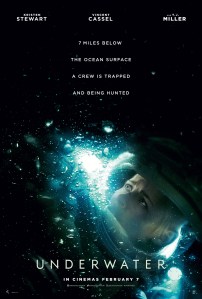
Quick Review: Underwater (Dir. by William Eubank)


Underwater-movie-poster

“There is no such thing as a new idea. It is impossible. We simply take a lot of old ideas and put them into a sort of mental kaleidoscope. We give them a turn and they make new and curious combinations.” – Mark Twain

I wasn’t entirely sold on William Eubank’s Underwater after leaving the theatre.

I’d seen that kind of film before in movies like Alien, Resident Evil, The Abyss, Leviathan, Deep Rising and Deep Star Six. It didn’t feel like it was giving me too much of anything new (especially when compared to last year’s genuinely jumpworthy Crawl), but I have to admit I did spent quite a bit of the film watching it from between my fingers. I’ll give it that. Additionally, I have to give the movie credit for taking no time to get things moving and staying pretty even throughout. Within 5 to 10 minutes of the movie’s start, you’re thrust right into a mix of terror from the unknown and claustrophobic environments. For someone with an attention span as short as mine, it’s impressive to see a film hit the ground running like that. It’s the kind of opening one would expect from one of the John Wick films. Longtime readers here on the Lens know that January really isn’t the month for the greatest films, though every once in a while, you’ll have one or two that dowell.

I think enjoying Underwater may be dependent how much comparing is done between it and older films. If you walk in blind, not expecting anything and are just looking to be entertained, you may enjoy the film more than I did. Do you absolutely have to rush to a movie theatre to see it? No, I don’t feel you do. Give it 3 months and you’ll have it on Digital/Blu-Ray. Would I run back to it in the theatre? Nah. If you’re a Kristen Stewart fan, or if the film’s something you’re genuinely interested in, have at it.

A group of miners find themselves struggling to survive after their rig suffers intense damage. Their goal is to reach a set of escape pods that can take them to the surface, but reaching it poses a set of challenges. The team comes to find that they may not be alone in the depths, which adds to their problems.

underwater-trailer

Kristen Stewart navigates the ocean depths in William Eubank’s Underwater.

The cast does well as can be expected, with Kristen Stewart (Charlie’s Angels) taking the lead as Norah, the team’s engineer. Joining her are Vincent Cassel (Eastern Promises) as the Captain, Jessica Henwick (Marvel’s Iron Fist) as  the biology scientist, John Gallagher, Jr. (Hush), Mamoudou Athie (The Get Down), and JT Miller (Deadpool) as the comic relief.  JT Miller in particular voices what would be the audience’s take as a fellow who just wants to get out of the situation. It’s Stewart and Henwick that carry the most weight with the film, and they handle it well. Their characters are smart and try their best to make it through the situations presented to them.

Visually, Underwater’s deep sea sequences have an interesting feel to them. Some of them feel more like the shaky cam shots from As Above So Below. There’s a bit of claustrophobia with watching certain scenes from behind the helmets. The monsters themselves are reminiscent of the ones you’d find in Cloverfield or The Mist with a number of jumpscares throughout. There’s very little in the way of blood and gore, since the film is PG-13.

I would have liked a larger body count. For the size of the rig, part of me expected to see more then just the 6 or 7 characters we have. Seeing more individuals face the creatures or the crumbling buildings could have added a bit of weight. That’s just a nitpick. The Nostromo was huge, yet only had a crew of seven.

Overall, I enjoyed Underwater more than I thought I would. It spends a lot of time doing things that other films already did, but does so in such a way where it’s not entirely wasted.

 

Music Video of the Day: Living Dead Girl by Rob Zombie (1998, dir by Joseph Kahn and Rob Zombie)


It’s Rob Zombie’s birthday so happy birthday, Rob and let’s all enjoy Living Dead Girl!

Myself, I’ve always assumed that this song was named after the classic Jean Rollin film, The Living Dead Girl.  Admittedly, I haven’t been able to find any specific proof of that but I’m still going to choose to believe it.  The song, after all, is full of references to films like Lady Frankenstein, Daughters of the Darkness, Last House On The Left, and at least one of the Dr. Goldfoot films.  So why not borrow the title from Jean Rollin?

Living Dead Girl was the 2nd single to released off of Hellbilly Deluxe, which was Rob Zombie’s first solo album after originally coming to fame as the co-founder of White Zombie.  White Zombie broke up around the same time that Living Dead Girl came out.  Why did White Zombie break up?  Nobody’s saying.

As for the video, it’s an homage to The Cabinet of Dr. Caligari, with Rob Zombie playing the Doctor and Sheri Moon Zombie playing the Living Dead Girl.  The video does a pretty good job of capturing the feel of Caligari, which is one of the most effective of the old silent films.  (I actually had a nightmare after I watched The Cabinet of Dr. Caligari for the first time.  I dreamt that the doctor was trying to break into the house.)

Both Rob Zombie and Joseph Kahn are credited with co-directing this video.  Kahn is an amazingly prolific video director who has done videos for just about everyone, including Britney Spears, Jennifer Lopez, The Chemical Brothers, and …. just about everyone!

Rob Zombie, of course, has gone on to direct several horror films.  There’s a tendency among a certain snobbish type of horror fans to be dismissive of Zombie’s films but I’ve always felt that his film was undeniably effective and, if nothing else, they stayed true to his own vision.  I mean yes, Halloween II was disappointing but 31 was better than many give it credit for being.

Anyway, happy birthday, Rob Zombie!

And enjoy!

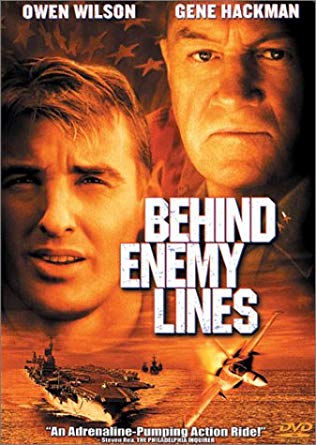
Behind Enemy Lines (2001, directed by John Moore)


When hotshot Navy flight officer Chis Burnett (Owen Wilson) is shot down while doing a reconnaissance mission over Bosnia, he finds himself stranded behind enemy lines.  While Burnett tries to avoid being captured by a Serbian general and find evidence of illegal military operations in yje demilitarized zone, Admiral Leslie Reigart (Gene Hackman) tries to mount a rescue operation.  Standing in his way are the NATO bureaucrats who would rather just leave Burnett to his fate than run the risk of disrupting the peace process.

Behind Enemy Lines was released early in Owen Wilson’s acting career and, after years of watching him in buddy comedies and eccentric character roles, it can be strange to see him playing a traditional leading man, much less an action hero.  Burnett has his goofball moment but, for the most part, this is probably as dramatic a role as you’re ever going to see Owen Wilson perform.  Once you get over the fact that he’s Owen Wilson and still speaking in the same stoner cadences that he’s used in everything from Bottle Rocket to Inherent Vice, Wilson actually gives a decent performance as Burnett.  The fact that he’s not a traditional leading man actually makes the film’s action scenes more exciting.  If Burnett had been played by someone like Brad Pitt or Tom Cruise, you would never have any doubt about his survival.  With Owen Wilson in the role, you’re no longer quite as sure that he’s going to be able to make his way to safety.

Gene Hackman also gave a good performance, even if he didn’t really do anything with the role that he hadn’t already done with all of the other authority figures that he played from Unforgiven on.  Hackman’s intimidating as Reigart.  When Burnett says that he wants to retire from the Air Force, Reigart looks like he’s about to reach over and rip off his face.  But Hackman has so much natural authority that you understand why his men automatically respect Reigart and follow his every order.  Burnett is lucky to have him on his side because there’s no way Reigart’s going to let someone from NATO push him around.

When Behind Enemy Lines first came out, it was not loved by the critics.  They complained that the movie was heavy-handed and predictable.  They were right but it really didn’t matter.  Behind Enemy Lines made a lot of money because it was a legitimate crowd pleaser.  I remember seeing it when it first came out.  This was less than month after 9-11 and the theater was packed with people who, like me, were still dealing with the greatest national trauma of our lifetime.  When Owen Wilson killed the men who were trying to kill him, the audience cheered.  When Reigart said that there was no way he going to abandon an American behind enemy lines, the audience applauded.  By the time the film ended, everyone was on their feet and chanting “USA!  USA!”  (At least, that’s the way I remembered it.)  Critics be damned, at that time, Behind Enemy Lines was the movie that we needed.

Behind Enemy Lines was a huge box office success so, of course, it got a sequel that wasn’t as good.  I’ll review Behind Enemy Lines: Axis of Evil tomorrow.

Lisa Reviews An Oscar Nominee: The Snake Pit (dir by Anatole Litvak)


The 1948 film, The Snake Pit, tells the story of a writer named Virginia Cunningham.

Virginia (Olivia de Havilland) is a patient at the Juniper Hill State Hospital, a psychiatric hospital that only treats female patients.  Some days, Virginia knows where she is and some days, she doesn’t.  Some days, she knows who she is and other days, she doesn’t.  Sometimes, she hears voices and other times, the silence in her head is her only companion.  Sometimes, she’s paranoid and other times, she’s quite lucid.

Virginia has been admitted against her will.  Her husband, Robert (Mark Stevens), visits frequently and sometimes, she knows him and sometimes, she doesn’t.  Through flashbacks, we see how Virginia and Robert first met.  Robert worked at a publishing house.  Virginia was a writer whose work kept getting rejected.  Robert and Virginia fell almost immediately in love but Virginia always refused to consider marrying him.  In fact, she even disappeared at one point, because things were getting too serious.  However, one day, Virginia suddenly declared that she wanted to get married.  Afterwards, her behavior became more and more erratic.

In the hospital, Virginia is treated by Dr. Kik (Leo Genn), who is depicted as being a compassionate and progressive psychiatrist, even as he puts Virginia through electroshock treatment.  (Remember, this film was made in 1948.)  With Dr. Kik’s guidance, Virginia starts to piece her life together and get to the cause of nervous breakdown.  Unfortunately, it often seems like every step forward leads to two steps back and Virginia still reacts to every bit of pressure by acting out, even biting one unhelpful doctor.

The hospital is divided into levels.  With each bit of progress that a patient makes, she’s allowed to move to a new level that allows her just a bit more freedom.  Everyone’s goal is to make it to the final level, Level One.  Unfortunately, Level One is run by Nurse Davis (Helen Craig), a tyrant who is in love with Dr. Kik and jealous of the amount of time he spends on Virginia.  Davis starts to goad Helen, trying to get her to lose control.  And what happens if you lose control?  You end up in the Snake Pit, the dreaded Level 33.  Being sent to Level 33 means being abandoned in a padded cell, surrounded by patients who have been deemed untreatable.

At the time that it was released, The Snake Pit was a groundbreaking film, the first major American studio production to deal seriously and sympathetically with mental illness.  Seen today, it’s still effective but you can’t help but cringe at some of the techniques that are used in Virginia’s treatment.  (Electroshock treatment, for instance, is portrayed as being frightening but ultimately necessary.)  The film works best as a showcase for Olivia de Havilland, who gives an absolutely brilliant and empathetic performance as Virginia.  Neither the film not de Havilland shies away from the reality of Virginia’s condition nor does it make the mistake of sentimentalizing her story.  For me, de Havilland’s best moment comes when she learns that she bit another doctor.  At first, she’s horrified but then she starts to laugh because the doctor in question was such a pompous ass that he undoubtedly deserved it.  de Havilland handles the character’s frequent transitions from lucidity to confusion with great skill, without indulging in the temptation to go over-the-top.  Arguably, The Snake Pit features de Havilland’s best lead performance.

(Olivia de Havilland is, at 103 years old, still with us and living, reportedly quite happily, in France.)

Olivia de Havilland was nominated for Best Actress but she lost to Jane Wyman in Johnny Belinda.  (A year later, De Havilland’s won an Oscar for The Heiress.)  The Snake Pit was also nominated for Best Picture but ultimately lost to Laurence Olivier’s adaptation of Hamlet.

“Opal Fruit” Is More Than A Little Delicious


Ryan C. (fourcolorapocalypse)'s avatarRyan C.'s Four Color Apocalypse

Another one I’m a little bit “late to the party” in terms of getting around to reviewing is cartoonist Kat Rose’s self-published 2016 mini Opal Fruit, a challenging, bemusing, sometimes bewildering 10-page assemblage of figure (for the most part) drawings that cleverly uses its own simplicity to obfuscate what appears, after multiple “read”-throughs, to actually be a tightly-structured “suite” designed to elicit a particular set of reactions and interpretations not unlike, say, Nick Thorburn’s much longer — though equally wordless — Penguins. There’s one key difference, though : whereas Thorburn’s constructs hew much closer to a linear start-to-finish “strip” configuration, this is a legit “free-for-all” that follows a rhythm, to be sure, but nothing so conventional as an actual structure.

That makes it perplexing at times, I’ll grant you, but it also means it’s never less than thoroughly intriguing and engrossing — provided you’re the sort…

View original post 591 more words

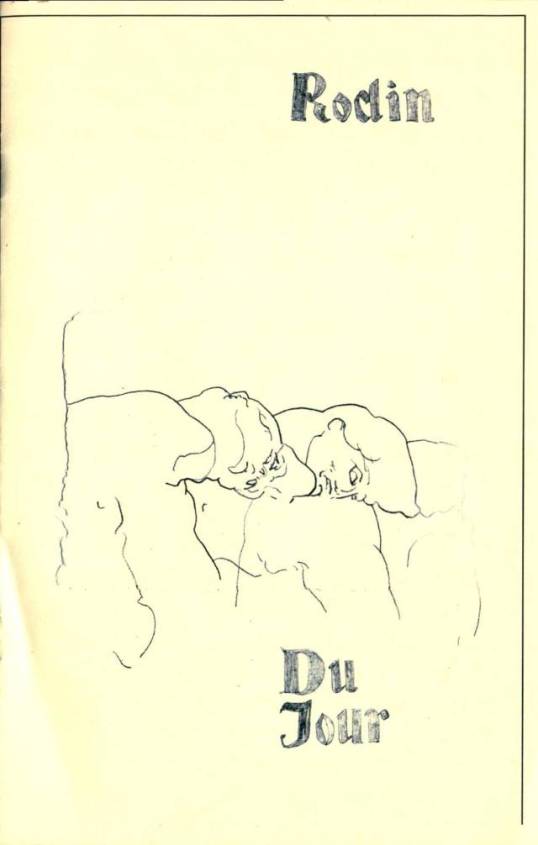
We Left Avant-Garde In The Dust A Long Time Ago : Diana Chu’s “Rodin Du Jour”


Ryan C. (fourcolorapocalypse)'s avatarRyan C.'s Four Color Apocalypse

Does great art need to have point? Or, more precisely, does it need to have a point beyond an artist exploring an idea by visual means — for its own sake, theirs, or both?

Diana Chu’s 2017 short (as in eight pages) self-published mini, Rodin Du Jour, certainly has me asking those questions — and it’s had me asking them for some time, truth be told, hence this review coming along so “late in the game,” as the expression goes. I offer no excuse beyond “it took me some time to figure out how to approach this work,” but hey — does it even qualify as an “excuse” when you’re telling the truth?

Saying Chu’s ‘zine has a “premise” might be putting things in overly-concrete terms, but as a visual experiment it definitely has a specific set of self-imposed rules in place : she uses each two-page spread to…

View original post 532 more words

Make Time For “Making Time”


Ryan C. (fourcolorapocalypse)'s avatarRyan C.'s Four Color Apocalypse

I’ve really been digging Elise Dietrich’s self-published minis lately, and it’s not hard to see why : meticulous in her attention to detail and determined to pack as many visual “goodies” into every panel as possible, her cartooning nevertheless seems to easily dodge the pitfalls of rigid formality and instead expresses itself as a kind of fluid, nearly spontaneous, quiet series of expertly-communicated mediations on the little things that make life — well, life, I guess. Which probably seems like a counter-intuitive thing for me to say given that in last year’s small diary comics collection, Making Time, she adheres fairly strictly to four-panel grids, hits a requisite narrative “beat” in the middle of each strip, and generally ends ’em all on something that could at least be loosely interpreted as a “punch line.” But there you go — comics, especially good comics, can be kinda weird like that.

View original post 562 more words