30 Days of Noir #8: The Red Menace (dir by R.G. Springsteen)


The 1949 film, The Red Menace, starts in the same manner as many film noirs.

It’s night.  It’s dark.  A car speeds through the desert.  Inside the car are Bill Jones (Robert Rockwell) and Nina Petrovka (Hannelore Axman).  When they stop at a gas station, the owner asks too many questions and gets a phone call.  Bill and Nina get paranoid and speed off.  What are they running from? we wonder.

We’re not the only ones wondering.  Soon a narrator starts to speak.  “What are they running from?” the narrator asks.  The narration is supplied by Lloyd G. Davies, who was apparently a members of the Los Angeles city council at the time this film was made.

It’s flashback time!  We discover that Bill is an ex-GI, recently returned from World War II.  Haunted by the death and destruction that he saw in Europe, Bill is now questioning everything that he once believed about America.  One day, a man overhears Bill yelling at a bureaucrat at the VA.  The man approaches Bill and tells him that he can help.  The man leads Bill to a hidden bar and introduces Bill to the sultry Mollie O’Flaherty (Barbara Fuller).  Mollie invites Bill back to her apartment.

Are we in Double Indemnity territory?  Is she going to convince him to murder her husband?

Are we heading down the same path that doomed Lawrence Tierney in The Hoodlum?  Is Mollie going to trick Bill into serving as the fall guy for a bank robbery?

Or …. is she going to show him a book?  In fact, not just one book but …. SEVERAL BOOKS!

Bill is actually quite shocked to discover that Mollie not only has a large collection of books but that she’s actually read some of them.  He’s even more shocked when he discovers that most of them are books about communism!  Mollie admits that yes, she is a communist.  She goes on to explain that communism isn’t what Bill has been led to believe it to be.  She argues that the communists just want the best for the workers and that the communists were the first group to fight for civil rights.  Bill says that he doesn’t care about causes anymore but he soon starts to hang out with Mollie and the members of the local communist cell.

While Mollie may have been the one assigned to bring Bill into the cell, it’s Nina who is instructed to teach Bill about Marx.  (Of course, she can’t just educate him at a school.  Instead, she has to do stuff like speak to him while they’re going in circles on a ferris wheel.)  At first, Bill is a happy communist, helping to organize labor protests and attending all of the right meetings.  However it doesn’t take long before both Bill and Nina start to realize that not everything is perfect in the aspiring worker’s paradise.  For one thing, the heads of the cell look, act, and speak more like gangsters than revolutionaries.  Disagreeing with the party line can lead to everything from a beating to a murder to a denouncement in the local communist newspaper, The Toiler.  Even the party’s commitment to civil rights turns out to be a lie as the party leaders curse the only black member of the cell behind his back.

When Mollie’s lover, the poet Henry Solomon (Shepard Menken), makes the mistake of writing a poem that suggests that Marx was inspired by Hegel, he’s told that the official party position is that no one inspired Marx but Marx.  Henry is told to either denounce his poem or be cast out of the movement.  After Henry tells off the leaders of the cell, he is denounced in The Toiler.  Henry finds himself cast out by all of his friends, sentenced to wander the dark streets of Los Angeles alone.  Even though Henry made a point of tearing up his communist membership card, it turns out that the party has several copies of every card.  Whenever Henry gets a new job, his employer is mailed a copy of Henry’s card and Henry finds himself unemployed again.  As for Mollie, she’s visited by not only her mother but also by her priest, all of whom tell her that the communists are no good.  Can a trip back to church save Mollie’s soul?

Meanwhile, Bill and Nina find themselves being targeted by one of the leaders of the cell, Yvonne Kraus (Betty Lou Gerson). Yvonne is so evil that, when she’s confronted by U.S. immigration officers, she immediately launches into a bizarre and rather incoherent monologue.  Drums start to play in the background as she speaks, letting us know that she’s totally sold her soul to the communists.  It’s suggested that Yvonne wants Bill to herself but Bill has fallen in love with Nina and Nina with him.  This is despite the fact that no one in the cell is allowed to all in love without prior permission.

Definitely a film of its time, The Red Menace takes all of the usual gangster film clichés and uses them to tell a story not about the Mafia but instead about the Marxists.  Instead of greed, the film’s femme fatales are motivated by Das Kapital.  Speaking of which, the film features a bit more ideology than you might expect.  Mollie, Nina, and Solomon are all given scenes where they explain the philosophy behind communism and in which they explain why an otherwise decent American might turn against their own government.  The film suggests that Yvonne and her cohorts are evil not so much because they believe in communism but because they’re hypocrites who don’t practice what they preach.

Which is not to say that The Red Menace is a particularly nuanced film.  Especially when Gerson’s delivering her dialogue, The Red Menace is a frequently over-the-top melodrama.  This is a movie in which Bill and Nina are fortunate enough to meet a folksy and patriotic sheriff named Sam.  “We just call him Uncle Sam!” a nearby child cheerfully exclaims.

The Red Menace is a film that’s occasionally silly and occasionally effective.  It can make for a disjointed viewing experience, as harrowing scenes of Henry being shunned by former comrades are followed up by scenes of folksy old Uncle Sam talkin’ about how everyone gets a second chance in ‘Merica.  It’s a film that begins with a picture of an octopus with the face of Karl Marx and ends with a shot of the Statue of Liberty.  The Left will hold the film up as being a campy document of American paranoia while the Right will just enjoy watching a bunch of commies get what they deserve.

And then there’s the unapologetic history nerds, like me.  I enjoyed the movie.  It’s a document of its time.

Music Video of the Day: Death No More by IC3PEAK (2018, dir by Nick and Nastya)


Some things that just have to be seen because they really can’t be described.  That’s certainly the case with today’s music video from the day.

Coming from Russia, it’s IC3PEAK with the sublimely creepy music video for Death No More!

Enjoy!

30 Days of Noir #7: The Sniper (dir by Edward Dmytryk)


Halfway through the chilling 1952 film, The Sniper, there’s a scene in which a woman is seen standing on the rooftop of a San Francisco apartment building.  She’s nonchalantly hanging laundry.  When she steps to the side, we suddenly see that there’s a man standing on the next rooftop over.  And he’s holding a rifle.

Fortunately, in this case, the man is a policeman.  He’s one of several cops who have been ordered to stand on rooftops with their weapons drawn and to keep an eye on the city below.  There’s a killer on the loose and the city is demanding that the police capture him.  And yet, even with a city that’s caught in the grip of fear and even with heavily armed men watching everything going on in the streets, life goes on.  People go to bars.  People go to work. Couples stroll in the park.  And one woman hangs her laundry to dry on the rooftop of an apartment building.

Suddenly, the policeman spots someone on another rooftop, a man who isn’t supposed to be there.  He’s a young guy, carrying what looks like a rifle.  The police quickly rush to the rooftop where they arrest the young man.  Have they caught the sniper who has been terrorizing San Francisco?

The police think that they have their man but we know that they don’t.  We know that the sniper is a guy named Eddie Miller (Arthur Franz).  Eddie is a delivery man.  He’s handsome but, from the minute we first see him, we can tell that there’s something off about him.  He stumbles through life, keeping his head down and rarely speaking to anyone.  The few times he does attempt to smile, it’s painfully awkward.  He’s someone who is struggling to convince the people of San Francisco that he’s one of them but the more he tries, the more of an outsider he seems to be.  In fact, the only time that we see Eddie truly happy is when he goes to a carnival and comes across a dunk tank.  Over and over again, he throws a baseball and cause the woman inside to be submerged in cold water.

At first, Eddie tries to deal with his bad thoughts by deliberately burning his hand on an electric stove.  When he goes to the emergency room, he asks the attending doctor why he would do something like that but the doctor is soon distracted by another patient.  With his hand bandaged, Eddie goes on a shooting spree, targeting brunette women.

This dark film is fairly evenly divided, between Eddie, the cops that are trying to catch him, and the psychiatrist who tries to explain him.  Not surprisingly, the cops, led by the appropriately named Lt. Kafka (Adolphe Menjou), aren’t particularly interested in what makes the sniper tick.  They just want to get him off the street.  However, Dr. James Kent (Richard Kiley) is convinced that the only way to stop not only this killer but others is to understand what’s going on inside of his mind.  The differences between Kafka and Kent’s approaches are most obvious in a scene in which every registered sex offender in San Francisco is paraded into a squad room full of jeering cops.  While the detectives taunt the offenders that they know, the offender that they don’t know prepares to kill yet again.

The Sniper was directed by Edward Dmytryk, who previously directed the Oscar-nominated (and superficially similar) Crossfire.  This was Dmytryk’s first film after his career was temporarily derailed by his refusal to testify before the House Unamerican Activities Committee.  (He later changed his mind and named names while testifying about his time as a member of the Community Party.)  Interestingly enough, top-billed Adolphe Menjou was one of the leaders of the anti-communist Motion Picture Alliance for the Preservation of American Ideals, a prominent supporter of the blacklist that Dmytryk had narrowly escaped.

Filmed in a black-and-white, documentary style, The Sniper is a chilling and disturbing film.  When Eddie stalks through the city at night, the dark shadows that he casts against the walls of empty alleyways and closed storefronts serve to remind us that men like Eddie could be lurking anywhere, unseen and unknown.  During the day scenes, the harshly bright lighting reminds us of just how vulnerable we are.  If the night provides too many places to hide, the day provides too few.  Arthur Franz gives a disturbingly credible performance as Eddie.  While he plays Eddie as being obviously troubled, he also suggests how someone like Eddie has managed to survive without getting exposed.  Menjou is properly cynical as the world weary Kafka while Richard Kiley brings some needed passion and anger to the film’s most talky scenes.  The film ends on a note of melancholy ambiguity, leaving it to us to make up our own mind about how to deal with the Eddie Millers of the world.

Music Video Of The Day: We Are Never Ever Getting Back Together by Taylor Swift (2012, dir by Declan Whitebloom)


This is a fun video and a fun song, which is why I picked it for today.  I always think it’s a good idea to start the day after any election with something positive.

(Of course, not everyone agrees.  I made the mistake of selecting Everything Is Awesome for my song of the day for November 9th, 2016 and there are people who still refuse to talk to me as a result.  Even though I like picked and scheduled the song way back in October and I had absolutely no way of knowing that it was going to be the first thing those people would see the morning after Donald Trump was elected president.  Anyway….)

(Seriously, I always tell people not to read too much into the songs and the music videos that I pick.)

The plot here is that Taylor is never ever getting back together with her ex, who is played by Noah Mills.  Personally, I always thought that was wishful thinking on her part.  You always get back together at least a handful of time before a breakup really becomes official.

Anyway, enjoy!


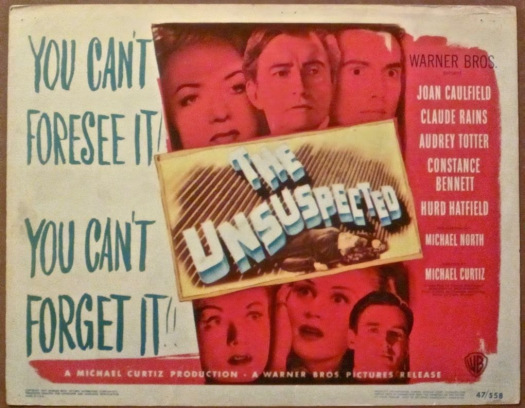
Claude Reigns Supreme: THE UNSUSPECTED (Warner Brothers 1947)


gary loggins's avatarcracked rear viewer

As a classic film blogger, I’m contractually obligated to cover film noir during the month of “Noirvember”, so every Tuesday this month I’ll be shining the spotlight on movies of this dark genre!


Claude Rains  received second billing in 1947’s THE UNSUSPECTED, but there’s no doubt who’s the star of this show. Nobody could steal a picture like Rains, as I’ve stated several times before – his sheer talent commands your attention! Here, he gives a chilling portrayal of a cold, calculating murderer in a Michael Curtiz noir based on a novel by Edgar Award-winning mystery writer Charlotte Armstrong, and runs away with the film. Joan Caulfield gets top billing, but let’s be honest – it’s Claude’s movie all the way!

The film begins with a frightening scene played mostly in shadow, as a figure creeps into the office of Victor Grandison (Rains) and murders his secretary Robyn Wright while…

View original post 608 more words

30 Days of Noir #6: Walk The Dark Street (dir by Wyott Ordung)


The 1956 film noir, Walk The Dark Street, opens with a platoon of soldiers fighting in the Korean War.

Dan Lawton (Don Ross) has been promoted to lieutenant and Sgt. Tommy Garrick (Eddie Kafafian) isn’t happy about it.  Despite the fact that he and Dan were once good friends, Tommy now is openly insubordinate.  Dan claims that Tommy is just jealous that Dan got promoted while Tommy didn’t.  Tommy, however, claims that Dan is too incompetent to lead the men.  He writes a letter to his older brother, Frank (Chuck Conners).  In the letter, Tommy says that, if he dies, Dan is to blame.  Shortly after sending the letter, Tommy is killed in battle.

After the war, Dan returns to the United States.  When he enlisted in the army, he left behind a small hardware store and now he’s returned to discover that the store’s insurance has lapsed and that he’ll need several thousand dollars to renew it.

While Dan tries to come up with a way to save his store, he also decides to pay a visit to Tommy’s brother.  Why does Dan drop by Frank’s apartment?  It’s difficult to say.  When Dan first shows up in Frank’s doorway, you assume that he’s going to praise Tommy or maybe seek some sort of forgiveness for Tommy’s death.  Instead, Dan just tells Frank that Tommy wouldn’t have gotten killed if he had followed orders (!) and then mentions that he and Tommy didn’t always get along (!!).  Like, seriously, what’s the point of telling Frank any of this?  What does Dan think that he’s accomplishing?

Frank doesn’t seem to be too upset over Tommy’s death.  In fact, Frank is actually a lot more interested in talking about his love of hunting.  Frank even shows Dan some film that he shot during his last safari, which means that those of us in the audience get to spend four minutes watching nature documentary stock footage that has little to do with the rest of the movie.  Frank explains that he has a heart condition so he can’t go abroad to hunt anymore.  Poor Frank!  But, hey, Dan’s going to be in Los Angeles for the next two days and Frank does still own a gun so maybe Frank could just hunt him!

At first, Dan’s not too enthusiastic about the idea of being hunted by Frank.  Frank, however, assures him that they won’t be using real bullets.  Instead, they’ll hunt each other with “camera guns.”  Apparently, you pull the trigger and, instead of firing a bullet, the gun fires a cartridge that takes a picture.  Dan’s still reluctant but then Frank offers to pay him $10,000.  You can renew a lot of insurance for $10,000!

Quicker than you can say “Most Dangerous Game!,” Frank is stalking Dan through Los Angeles.  What Dan doesn’t realize is that Frank was lying about using a camera gun.  He wants revenge for his brother’s death so he’s hunting Dan with live ammunition!

This is one of those films that probably sounds more interesting than it actually is.  After setting up an intriguing premise, Walk The Dark Street doesn’t really do much with it.  It turns out that neither Dan nor Frank is particularly clever so nearly the entire movie is just footage of them walking down various streets in Los Angeles.  If you’re a history nerd like me, you might get a kick out of seeing what the streets of Los Angeles looked like in the mid-50s but otherwise, there’s not much excitement to be found in this movie.

The film stretched its credibility to the breaking point when Dan, while trying to hide from Frank, just happens to randomly run into Tommy’s ex-girlfriend, Helen (Regina Gleason).  Whereas Frank is stoic to a fault and Dan is just an incredible dumbass, Helen at least gets to tell everyone off.  She’s not impressed with either Frank or Dan, which makes her the default audience surrogate.  Helen figures out what Frank is planning but Dan refuses to believe her because, again, Dan’s not very smart.  While it may not have been the film’s intention, it’s hard not to feel that Tommy had a point about Dan being incredibly incompetent.

Aside from offering a chance to see what Los Angeles looked like back in the 50s, Walk The Dark Street is largely forgettable.

Music Video of the Day: The Business of Emotion by Big Data featuring White Sea (2015, dir by ????)


Eventually, all words will be replaced by emojis.

Hopefully, it won’t be as bad as The Emoji Movie.

This song is from Big Data, who put on a great show at the House of Blues in Dallas last week!

Enjoy!