30 Days of Noir #22: Woman On The Run (dir by Norman Foster)


Like many film noirs, this 1950 film opens with a murder.

On a dark night in San Francisco, a man attempts to blackmail an unseen person called “Danny Boy” and gets shot for his trouble.  The gunshot is heard by a frustrated painter, named Frank Johnson (Ross Elliott), who is out walking his dog.  Frank sees the dead body being pushed out of a car and then catches a shadowy glimpse of the killer.  When the killer open fires on him, Frank runs for it.

Like a good citizen, Frank goes to the police but, when he learns that the victim was due to testify against a local gangster, Frank panics and vanishes.  When Inspector Ferris (Robert Keith) goes to see Frank’s wife, Eleanor (Ann Sheridan), he’s shocked to discover that Eleanor isn’t shocked by Frank’s disappearance and that she doesn’t seem to care one way or the other.  As Eleanor explains it, Frank is a notorious coward and, years ago, their once strong marriage became a loveless charade.  Frank’s vanished and Eleanor doesn’t care.

Or does she?

While it quickly becomes obvious that Eleanor is telling the truth about not knowing where Frank is, she’s not being totally honest about no longer caring about him.  For instance, when she learns that Frank has been hiding a heart condition from her, Eleanor goes to the doctor to pick up his medicine, just in case he should happen to come by the house.  Of course, it’s not always easy to get out of the house, especially now that the police are watching Eleanor.

Eleanor wants to track down Frank without involving the police and it seems like there’s only one person who is interested in helping he do that..  Played by Dennis O’Keefe, this person is a tough reporter and he says that he wants to do an exclusive story on Frank.  He offers to help Eleanor track him down and he even says that he’ll pay $1,000 for the chance to interview Frank.  The reporter and Eleanor are soon searching San Francisco, retracing Frank’s day-to-day life and discovering that Frank loved Eleanor more than she ever realized….

What’s that?  Oh, did I forget to mention the reporter’s name?

His name is Danny.

That’s right.  Eleanor is trying to find Frank so that she can save his life and working with her is the one man who wants to kill him!

Needless to say, this leads to a great deal of suspense.  On the one hand, you’re happy that Eleanor is rediscovering how much she loves Frank.  On the other hand, you spend almost the entire movie worried that Eleanor is going to lead Danny right to him.  Shot on location in San Francisco and featuring all of the dark shadows and tough dialogue that one could possibly hope to get in a film noir, Woman On The Run is an underrated suspense gem.  Full of atmosphere and steadily building suspense, Woman on the Run features a great and acerbic performance from Ann Sheridan and a genuinely exciting climax that’s set at a local amusement park.  Seriously, roller coasters are super scary!

Woman on the Run was directed by Norman Foster.  If you’ve recently watched The Other Side of the Wind on Netflix, you might recognize the name.  A longtime friend of Orson Welles, Foster played the role of Billy Boyle in Welles’s final film.

Thanksgiving Greetings From The Shattered Lens!


From all of us at the Shattered Lens to everyone who will be observing and celebrating the holiday today, Happy Thanksgiving!

When the citizens of Jamestown, Virginia celebrated their first Thanksgiving in 1610, they had no way of knowing what the future would hold for not only America but also the rest of the world.  In fact, they had no way of knowing that we would someday have movies, music, television, social media, Netflix, dark web paranoia, and hungry kitten videos on YouTube.  If you had told them that the United States would someday have a literacy rate of 77%, they would have laughed at you.  If you had told them that, at some point in the future, a black cat would send holiday greetings to humans, they probably would have accused you of practicing witchcraft.  Silly pilgrims!

But today is Thanksgiving.  It’s not only a time for giving thanks but also a time for appreciating not only what you love but also what loves you.  Be kind to your family, your friends, your cats, and even your dogs.  As for those of us at the Shattered Lens, we are thankful to you for reading and commenting.  The flame-haired one tells me that, in another month, we will be coming up on the 9th anniversary of the founding of this site!  We’re thankful for those 9 years and even more thankful for the years to come!

Thank you for reading and Happy Thanksgiving!

A Thanksgiving Without Turkey? Say It Ain’t So!


gary loggins's avatarcracked rear viewer

Yet that’s what the Johnson family faces in this corny time capsule “A DAY OF THANKSGIVING”, made in 1951 by the Centron Corporation of Lawrence, Kansas, purveyors of educational and industrial films from the late 40’s up until the 1990’s:

You know something? Maybe those Johnsons aren’t so corny after all!

HAPPY THANKSGIVING

FROM

CRACKED REAR VIEWER!

View original post

Music Video of the Day: Cold Turkey by John Lennon (1969, directed by ????)


Happy Thanksgiving!  It is surprisingly difficult to find any good music videos about Thanksgiving so I decided to go with a video for a song that has nothing to do with Thanksgiving.  It’s called Cold Turkey.  Whether it has anything to do with turkey depends on who you ask.

When it comes to Cold Turkey, the official and most-accepted story is that John Lennon wrote it after a brief addiction to heroin and the song was inspired by the pain and difficult of quitting “cold turkey.”

Believe it or not, though, there are Cold Turkey truthers out there.  Fred Seaman, who was Lennon’s personal assistant in the late 70s, wrote in his book, The Last Days of John Lennon, that Lennon confessed to him that Cold Turkey was actually written after a bout of food poisoning and that he allowed people to believe that it was inspired by heroin withdrawal because the food poisoning story was too silly.  (Lennon claimed the poisoning was the result of eating a “cold turkey” on the day after Christmas.)  Personally, I think this sounds more like an example of Lennon’s famously sarcastic sense of humor than anything else.

Regardless of what inspired the song, Cold Turkey was Lennon’s second single away from the Beatles and the first song on which he was credited as being the sole songwriter.  (Even Give Peace A Chance was originally credited to Lennon-McCartney.)  Lennon originally wrote the song to be included on Abbey Road but, when the rest of the Beatles showed little interest in the song, Lennon instead recorded it with the Plastic Ono Band.

In 1969, when Lennon returned his MBE to the Queen, he wrote, “I am returning this MBE in protest against Britain’s involvement in the Nigeria-Biafra thing, against our support of America in Vietnam and against ‘Cold Turkey‘ slipping down the charts.”

Go Buy “Go-Bots”


Ryan C. (fourcolorapocalypse)'s avatarRyan C.'s Four Color Apocalypse

Even by the low standards of licensed toy properties, the Go-Bots don’t get much respect. Yeah, sure, they’ve had some animation revivals (even, I think, a feature-length film or two of the straight-to-video variety) and some comic books here and there, but a lot of that — while no doubt making their diminished fan base happy —was probably more about keeping IP rights semi-active on the part of Hasbro. No billion-dollar live action blockbusters for these guys. What can you get from them that you can’t get from the Transformers, right?

Leave it to Tom Scioli, one of the most innovative and distinctive cartoonists working today, to give the best answer as to what makes the Go-Bots different from their more celebrated —- uhhmmm — peers : “The Go-Bots bleed,” Scioli tells us on this month’s IDW promotional blurb page. And if you need any more reason than that to…

View original post 488 more words

30 Days of Noir #21: For You I Die (dir by John Reinhardt)


The 1947 film, For You I Did, opens with what would be the finale of many other crime movies, a daring prison break.

The psychotic Matt Guber (Don C. Harvey) has managed to escape from prison, along with a younger prisoner named Johnny Coulter (Paul Langton).  From listening to their dialogue as they flee the cops, it quickly becomes obvious that the escape was Guber’s idea and that Johnny is something of an unwilling accomplice.  Johnny only had a year left in his sentence but now, thanks to Guber, he’s a wanted man.  Making matters even worse is the fact that Guber killed a guard during the escape.  Johnny knows that if he turns himself in or if he’s captured, he’ll be considered an accessory to murder.

Guber tells Johnny to go to a nearby roadside diner and deliver a message to his girlfriend, Hope (Cathy Downs).  Guber says that he’ll come to the diner in a week to get them.  Johnny follows Guber’s orders but, when he reaches the diner, he discovers that Hope has changed her ways and no longer wants anything to do with Guber.  Using an assumed name, Johnny gets a job at the diner and soon, he and Hope are falling love.

Johnny gets to know the other workers and customers at the diner.  They include Hope’s kind but no-nonsense aunt, Maggie (Marion Kerby), and Hope’s flirtatious cousin, Georgie (Jane Weeks).  Working in the kitchen is Smitty (Roman Bohnen), an alcoholic with a tragic backstory.  There’s also Alec Shaw (Mischa Auer), a flamboyant con man, and two slow-witted cops (Charles Waldron, Jr. and Rory Mallinson) who always mention that Johnny looks familiar but they just can’t figure out where they’ve seen him before.  Johnny gets to know all of them as, for the first time in his life, he finds himself accepted as a part of a community.  However, even as Johnny finds happiness, he knows that the clock is ticking.  There’s only so long that he can hide his identity and Guber is due to show up at any moment….

Poverty Row is a term that was often used to describe the low-budget B-movies of the 40s and 50s and it’s certainly an apt description of For You I Die.  It’s not just the fact that the film is about poor and often desperate characters.  It’s also that the film itself looks like it was made for next to nothing.  However, the film’s cheap look is actually one of its greatest strengths.  Visually, the grainy black-and-white lends the film a gritty atmosphere and the limited and sparsely decorated sets serve to play up not only Johnny’s claustrophobia but to also remind us that, even if Johnny does find some temporary happiness, he still has nowhere to go.  That diner is both the beginning and the end of Johnny’s freedom.

Character actor Mischa Auer was probably the biggest name in the cast.  He was a well-known screen comedian, one who specialized in playing over-the-top eccentrics.  His comedic presence in this relatively somber film feels rather odd.  As well, Paul Langton is convincingly sullen in the role of Johnny but he’s not particularly compelling.  Far more impressive are Marian Kerby, Cathy Downs, and especially Jane Weeks.  As the gleefully amoral Georgie, Weeks steals almost every scene in which she appears while Marion Kerby is everyone’s ideal aunt.  Finally, Cathy Downs plays Hope and brings a poignant sense of regret to a role that, as written, could have just been a stereotypical “good girl.”  Hope is someone who has made her mistakes but who refuses to be defined for them.  In the end, Hope epitomizes …. well, hope.

For You I Die is a taunt and effective film noir and a reminder not to dismiss a film just because it came from Poverty Row.

Music Video of the Day: Once In A Lifetime by Talking Heads (1981, directed by David Byrne and Toni Basil)


Once In A Lifetime has since become one of the signature tunes of the ’80s but, when the song was first released in 1981, it didn’t even manage to break the top 100 on the US charts, peaking at 103.  (The song did find more success in the UK, where it reached #13.)  At the time, the song was not considered to be “radio friendly.”  Not even the fact that the video was put into heavy rotation during the early days of MTV could change the minds of stubborn programmers who were convinced that the sound of David Byrne considering his life would lead to listeners switching the channel.

The video, which features multiple David Byrnes performing against a white backdrop, was directed by Byrne and the famous dancer/choreographer Toni Basil.  (Basil, of course, had her own hit around the same time with her video for Mickey.)  In the book, MTV Ruled the World – The Early Years of Music Video, Basil discussed making the video with Byrne:

“He wanted to research movement, but he wanted to research movement more as an actor, as does David Bowie, as does Mick Jagger. They come to movement in another way, not as a trained dancer. Or not really interested in dance steps. He wanted to research people in trances – different trances in church and different trances with snakes. So we went over to UCLA and USC, and we viewed a lot of footage of documentaries on that subject. And then he took the ideas, and he ‘physicalized’ the ideas from these documentary-style films … David kind of choreographed himself. I set up the camera, put him in front of it and asked him to absorb those ideas. Then I left the room so he could be alone with himself. I came back, looked at the videotape, and we chose physical moves that worked with the music. I just helped to stylize his moves a little.”

As for the song, Byrne has said that he came up with most of the lyrics while listening to radio evangelists and the song’s plaintive cry of “How did I get here?” should sound familiar to anyone who has ever heard any of the old style preachers going at it.  The song’s signature bassline was developed by Tina Weymouth, who has said that she based it on the sound of her husband (and Talking Heads drummer) Chris Frantz yelling.

As for the song, it may not have charted but it has gone on to become one of the defining songs of the 80s.  The song would also be one of the highlights of the greatest concert film ever made, Stop Making Sense.

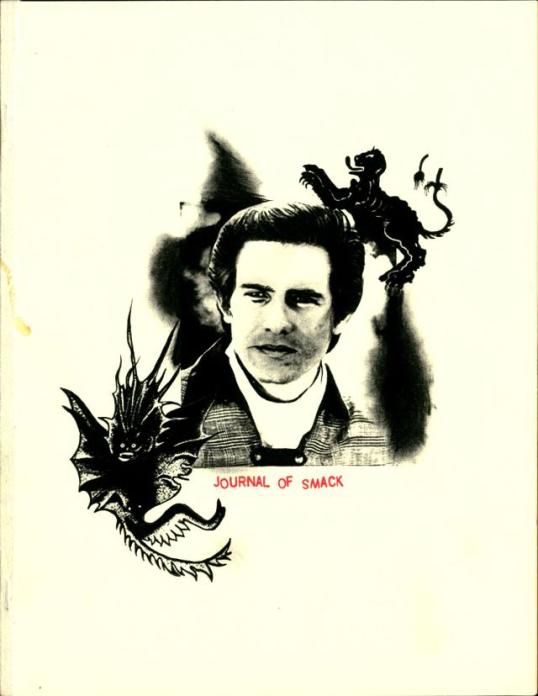
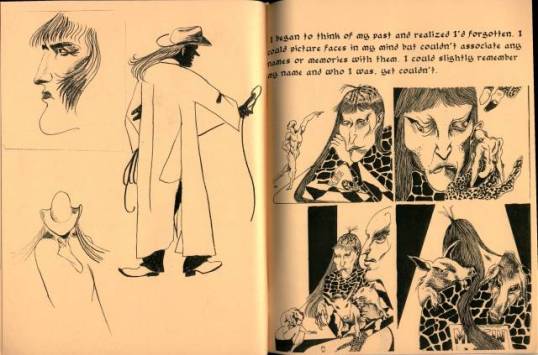
The Undiscovered Country : Andrea Lukic’s “Journal Of Smack” (2018)


Ryan C. (fourcolorapocalypse)'s avatarRyan C.'s Four Color Apocalypse

There’s no adequate way to describe the contents of Canadian cartoonist/fine artist/musician Andrea Lukic’s latest Journal Of Smack (she self-publishes one of these every year or thereabouts) without reaching deep into the stores of one’s own vocabulary and dusting off any number of little-used gems grown atrophied and covered in cobwebs. I determined I was going to resist the urge to go down that road and concentrate on immediate, visceral impressions, but we’ll see how well I do holding to that vow. If you hear me using terms like “abstract singularity” or somesuch, you’ll know I failed.

And with that, it’s down to business —

Lukic’s book has all the aesthetics of a “found object,” its pages somewhat-unevenly glued within one of those cheap DIY quasi-“bindings,” and that’s as it should be : it looks and feels old, haphazard, random. Where does one find something like this? I dunno, but my…

View original post 753 more words