Artist Profile: The Hard Case Crime Covers of Chuck Pyle


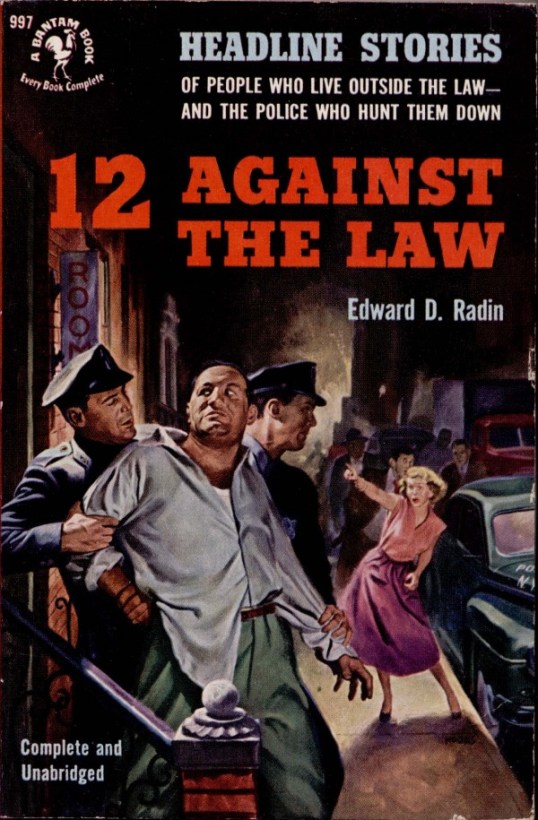
I’ve always liked the covers of the Hard Case Crime paperbacks.  Hard Case Crime is mix of reprints of classic pulp novels and new works written in the hardboiled style of old.  Each novel features a cover painted in the retro style of the pulps, by artists like Michael Koelsch, Robert McGinnis, Glen Orbik, and Greg Manchess.

All of the covers below were done for Hard Case Crime by Chuck Pyle, who along with being an illustrator is also a beloved instructor at San Francisco’s Academy of Art University.  Click here to read a good profile of him from 2015.  He sounds like the type of instructor that every artist should be lucky enough to study under.

To find out more about the Hard Case Crime imprint, click here.

Music Video of the Day: ZOOM! by Alvin Risk (2014, created by Chris Torres)


When the 8-bit world is being invaded by a bunch of spiders wearing sombreros, who else can you depend on to save the day other than Alvin Risk and everyone’s favorite internet meme, Nyan Cat?  Of course, it’ll also involve a lot of heart, a lot of dancing, and a spinning pizza.  No one should be surprised.

This video was created by Nyan Cat’s creator, Chris Torres.  I think it’s kind of adorable.

Enjoy!


A Movie A Day #127: Brass Target (1978, directed by John Hough)


Everything’s a conspiracy!

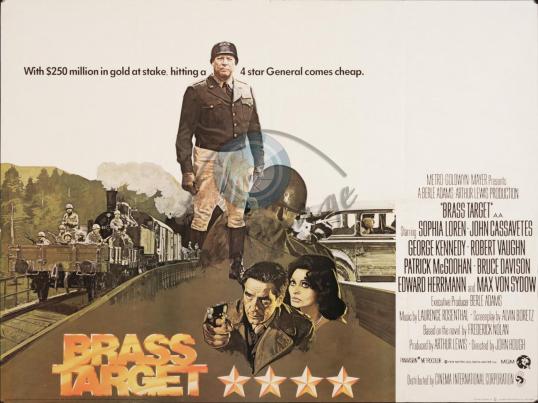
At least, that is the claim made by Brass Target, a twisty and unnecessarily complicated thriller that argues that General George S. Patton (played here by George Kennedy, who is even more blustery than usual in the role) did not, as widely believed, die as the result of a car accident but was actually killed by an assassin using rubber bullets.  Why was Patton targeted for assassination?  Was he targeted by Nazis angered by Germany’s defeat or maybe Russians who knew that Patton had argued in favor of invading the Soviet Union towards the end of the war?  Would you believe it was all because Patton was investigating the theft of Nazi gold and his subordinates, the flamboyantly gay Colonel Donald Rogers (Robert Vaughn) and Rogers’s always worried lover, Colonel Walter Gilchrist (Edward Herrmann), were fearful that he was getting too close to discovering the truth?

John Cassevetes, who hopefully used part of his paycheck to fund either The Killing of a Chinese Bookie, Opening Night, or Gloria, plays Joe De Lucca, the burned out OSS colonel who is assigned to track down the Nazi gold but who really just wants to go back home to New York.  Patrick McGoohan, sporting an accent that is supposed to be American, plays De Lucca’s former friend and colleague, Colonel Mike McCauley, who now lives in a German castle.  Max von Sydow is the assassin, who also has a day job as the chairman of a refugee relocation committee.  Sophia Loren plays Mara, a Polish war refugee who, by pure coincidence, has slept with not just De Lucca but almost everyone involved with the conspiracy.  Bruce Davison is the young colonel who acts as Du Lucca’s supervisor.  Even Charles “Lucky” Luciano (played by the very British Lee Montague) is featured as a minor part of the conspiracy.

That is an impressive cast for a less than impressive movie.  Brass Target never provides a convincing reason as to why the conspirators would decide that killing Patton was their only option and, once the conspiracy gets underway and the movie starts to follow around Von Sydow for some Day of the Jackal/Black Sunday-style preparation scenes, the search for the Nazi gold is forgotten.  For some reason, though, I have a soft spot for this frequently ridiculous movie.  There are enough weird moments and details, like Vaughn’s twitchy performance, McGoohan’s accent, the way Kennedy blusters about the Russians being rude to him, and glamorous Sophia Loren’s miscasting, that Brass Target is always watchable even if it is never exactly good.

Music Video of the Day: Mother, Mother by Tracy Bonham (1996, dir by Jake Scott)


Happy Mother’s Day.

For many of us, today is a bittersweet day.  My sisters and I lost our mom nearly nine years ago and today reminds us of how much we miss her and will always miss her.  At the same time, today is also my niece’s ninth birthday and I know mom would be so proud of how her granddaughter has been raised.

Our music video of the day is also bittersweet.  Tracy Bonham’s Mother, Mother imagines a mother/daughter phone conversation in which the daughter assures her mom that life is great while secretly wishing that she could admit that it’s not.  I don’t think there’s anyone alive who can’t relate to Bonham’s desperation as she shouts, “Everything’s fine!”

There are actually two videos for Mother, Mother, both of which were directed by Jake Scott.  The first one features Tracy Bonham singing on television while her mother (played by Bonham’s real-life mother) cleans up around the house.

The second version is a bit more positive.  To be honest, despite my instinct to naturally embrace the darker version of any work of art, I actually prefer the second video.  Maybe it’s because I like playing dress up and I can relate to screaming while jumping around in a closet.  Who knows?

Anyway … enjoy!


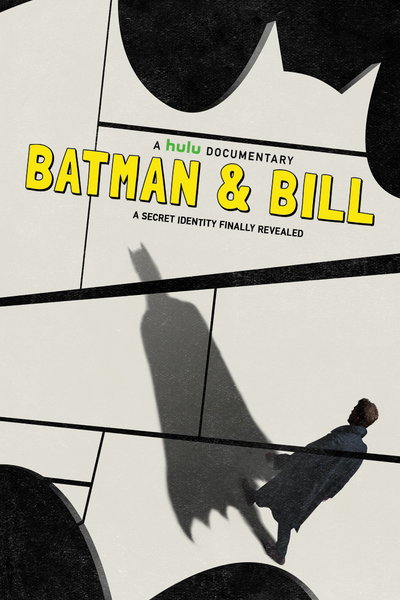
Documentary Sidebar : “Batman & Bill”


Ryan C. (fourcolorapocalypse)'s avatarTrash Film Guru

Odds are pretty good that the 50%- or- so of my regular readers (not that there’s anything “regular” about any of us, of course!) who speak fluent “comic book-ese” are well aware of the industry’s sorry ethical history, but for the other half who are blissfully unaware of how badly outfits like Marvel and DC have put the screws to the creative geniuses who dreamed up their billion-dollar properties, the reality can be shocking : Jerry Siegel and Joe Shuster selling away the rights to Superman in perpetuity for the princely sum of $130 just before they were shipped off to war because they wanted to provide a little something for their families in case they didn’t come back home; Jack Kirby’s struggles just to get back the thousands of pages of original art he drew of the hundreds of characters he invented and his family’s subsequent legal battles after…

View original post 922 more words

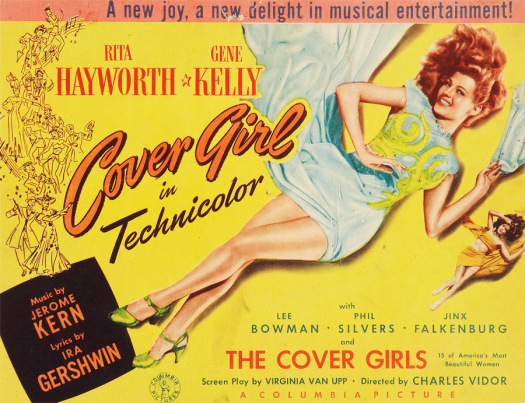
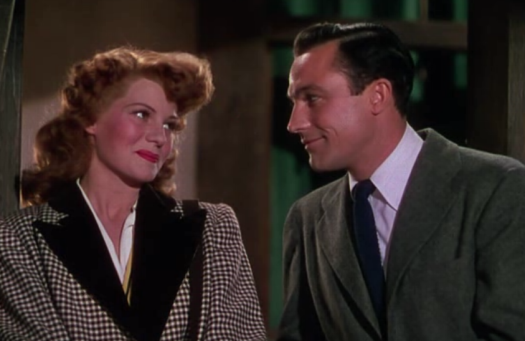
She Was Never Lovelier: Rita Hayworth in COVER GIRL (Columbia 1944)


gary loggins's avatarcracked rear viewer

Bright, bold, and bouncy, COVER GIRL was a breakthrough film for both Rita Hayworth and Gene Kelly. Sultry, redheaded Rita had been kicking around Hollywood for ten years before Columbia Pictures gave her this star-making vehicle, while Kelly, on loan from MGM, was given free rein to create the memorable dance sequences. Throw in the comedic talents of Phil Silvers   and Eve Arden , plus a bevy of beauties and songs by Jerome Kern and Ira Gershwin, and you have what very well may be the quintessential 40’s musical.

Rusty Parker (Rita) is a hoofer at Danny McGuire’s (Kelly) joint in Brooklyn (where else?). She enters a contest sponsored by Vanity Magazine to find a new cover girl for their 50th anniversary issue. Editor John Coudair ( Otto Kruger ) spots her and is reminded of the girl he once loved and lost (who turns out to have been…

View original post 696 more words

A Movie A Day #126: Baby Face Nelson (1957, directed by Don Siegel)


The place is Chicago.  The time is the era of Prohibition.  The head of the Chicago Outfit, Rocca (Ted de Corsia), has arranged for a career criminal named Lester Gillis (Mickey Rooney) to be released from prison.  A crack shot and all-around tough customer, Gillis has only two insecurities: his diminutive height and his youthful appearance.  Rocca wants to use Gillis as a hit man but Gillis prefers to rob banks.  When Rocca attempts to frame Gillis for a murder, Gillis first guns down his former benefactor and then goes on the run with his girlfriend, Sue Nelson (Carolyn Jones).  Because they are both patients of the same underworld doctor (played by Sir Cedric Hardwicke), Gillis eventually meets public enemy number one, John Dillinger (Leo Gordon).  Joining Dillinger’s gang, Gillis becomes a famous bank robber and is saddled with a nickname that he hates: Baby Face Nelson.

While it is true that Lester “Baby Face Nelson” Gillis was an associate of John Dillinger’s and supposedly hated his nickname, the rest of this biopic is highly fictionalized.  The real Baby Face Nelson was a family man who, when he went on the run, took his wife and two children with him.  While he did get his start running with a Chicago street gang, there is also no evidence that Nelson was ever affiliated with the Chicago Outfit.  (The film’s Rocca is an obvious stand-in for Al Capone.)  In real life, it was Dillinger, having just recently escaped from jail, who hooked up with Nelson’s gang.  The film Nelson is jealous of Dillinger and wants to take over the gang but, in reality, the gang had no leader.  Because Nelson killed three FBI agents (more than any other criminal), he has developed a reputation for being one of the most dangerous of the Depression-era outlaws but, actually, he was no more violent than the typical 1930s bank robber.  Among the era’s outlaws, Dillinger was more unique for only having committed one murder over the course of his career.  In this film (and practically every other film that has featured Baby Face Nelson as a character), Nelson is a full on psychopath, one who even aims his gun at children.

Baby Face Nelson may be terrible history but it is still an excellent B-movie.  Don Siegel directs in his usual no-nonsense style and Mickey Rooney does a great job, playing Baby Face Nelson as a ruthless but insecure criminal with a perpetual chip on his shoulder.  As his fictional girlfriend, Carolyn Jones is both tough and sexy, a moll that any gangster would be lucky to have waiting for him back at the safe house.  B-movie veterans like Thayer David, Jack Elam, Elisha Cook Jr., and John Hoyt all have colorful supporting roles but the most unexpected name in the cast is that of Cedric Hardwicke, playing an alcoholic surgeon with broken down dignity.

Don’t watch Baby Face Nelson for a history lesson.  Watch it for an entertaining B-masterpiece.