by Paul Rader
by Paul Rader
It can’t ever be simple, can it?
There’s either different versions, different edits, and sometimes censored and uncensored versions of a video. Err….
Anyhow, there are two different versions of the video for Minogue’s cover of The Loco-Motion. This is the video that was done for the original 1987 release. The differences between the two videos are enough that I want to post them separately.
The song is different. It’s more danceable in this version, than in the 1988 version. It also goes by Locomotion instead of The Loco-Motion.
If you play the two videos side-by-side, then you’ll notice they go out of sync almost immediately. They seem to be composed of mostly the same footage, but edited together differently, with a few parts I didn’t see in both.
A small example is when Kylie knocks the widescreen back to fullscreen. In this version it only happens once. In the other version it happens twice, back-to-back.
Thank you, Kylie Minogue and anyone else who helped to make the following video on her official YouTube page:
Without that retrospective, I wasn’t positive this version was officially made. There’s plenty of videos out there that have had the sound replaced and/or the video altered. Thanks to that video, I know that this is official.
I wasn’t sure about the director. Chris Langham is credited with doing seven of her videos. They are all from 1988-1989. He could have simply re-edited that earlier version. I don’t think he did though because Wikipedia lists him as having directed the 1987 version of the video for I Should Be So Lucky. That’s good enough for me.
The video itself is a mix of Minogue in music-video, behind-the-scenes, and studio-recording mode.
Enjoy!
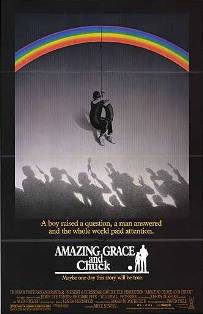
Amazing Grace and Chuck has a heartfelt message but it ultimately trips over its own good intentions.
Chuck (Joshua Zuelkhe) is a 12 year-old boy who lives in Montana and who is the best little league pitcher in the state. Because a field trip to a missile silo causes him to have nightmares, Chuck announces that he will not play baseball until the world agrees to nuclear disarmament. Chuck’s team ends up having to forfeit a game because Chuck refuses to play. In the real world, this would lead to Chuck enduring 6 years of ridicule and bullying until he was finally old enough to change his name and go to college in a different state. In the world of the movies, it leads to Chuck becoming a hero.
A basketball player named Amazing Grace (Alex English) reads a news story about Chuck’s protest and he decides to protest as well. He announces that he will not play basketball until there are no more nuclear missiles. Before you can say “Colin Kaepernick,” hundreds of other sports stars are following Amazing Grace’s lead. Of course, if any group of people is well known for their willingness to give up a huge payday for a quixotic and largely symbolic protest, it’s America’s professional athletes. Amazing Grace and the athletes even move out to Montana, so that they can be closer to Chuck.
Because they do not appreciate his efforts to put all sporting events (and all betting on sporting events) on hold, the Mafia makes plans to assassinate Amazing Grace. Chuck protests this by taking a vow of silence. By now, it is hard to keep track of what Chuck is protesting and how. Is he still trying for world disarmament or has he moved on to getting the Mob out of professional sports? All the other children of the world follow Chuck’s example, refusing to speak. In the real world, children taking a vow of silence would lead to parents celebrating in the street but, in the movie, it leads to panic and causes the Soviets to assume they have the upper hand over the west. The President (Gregory Peck) ruins it all by inviting Chuck to the White House. When President Peck explains that people are not allowed to shout fire in a crowded movie theater, Chuck breaks his vow of silence to ask, “But what if there’s a fire?”
There are many problems with Amazing Grace and Chuck, including the dumb Mafia subplot that seems like it should be in a different movie and Chuck coming across as being a smug little creep. Joshua Zuehlke made his film debut as Chuck and, on the basis of his performance, it is not surprising that he has never appeared in another film since. By the end of the movie, even Gregory Peck is sick of Chuck and his demands. It’s obviously a heartfelt film, which is probably why actors like Peck, Jamie Lee Curtis, and William L. Petersen all appeared in it despite presumably having a hundred better things to do, but a nuanced look at détente and the arms race, Amazing Grace and Chuck is not.
Back when AM Radio ruled the airwaves, before the onset of polarization, you could hear everything from rock and pop, to soul and jazz, to country and folk all on your favorite local station. Frequently sandwiched in with the hits were novelty tunes, like “They’re Coming to Take Me Away, Ha-Haaa!” by Napoleon XIV, which reached #3 on the Billboard Top 100:
Napoleon XIV didn’t really exist. The record was the brainchild of one Jerry Samuels, a recording engineer who used a Variable-Frequency Oscillator to create the vocal effects and manipulated the tape speeds to get his desired results. Samuels didn’t exactly sing the ditty as much as use a poetic cadence, which makes him a pioneer of early rap music!
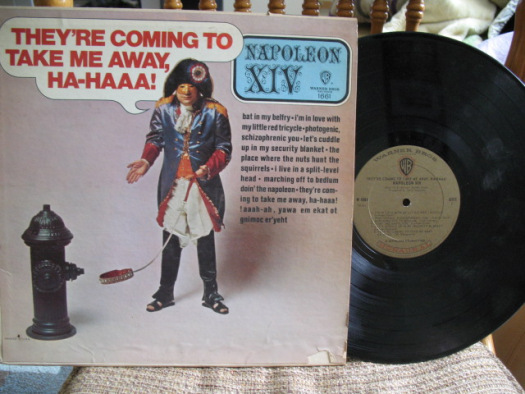
“They’re Coming to Take Me Away, Ha-Haaa!” plummeted down the charts as quickly as it rose. A controversy had ensued regarding the song making fun of the mentally ill, and the…
View original post 52 more words
by Robert Bonfils
Yes, I am aware of some of Rick Derringer’s recent exploits–in real life and on Wikipedia (article | talk page | edit history). I didn’t know about them until I started looking into this video. If I were to take that kind of thing into account on every video I spotlighted, then I would be unable to do these posts at all.
That being said, I would be fascinated to find out how Derringer supposedly carries a gun on a plane 30-50 times a year. That sounds like Kevin Mitnick territory, where he should help the airlines to close up the gaps in their security that allowed that to happen.
The only reason I even came across this stuff was because I was trying to confirm something that a bunch a people have been trying to figure out about this video:
Who is the girl?
There seems to be two theories:
As for the date, I came up with 1975 based on two things:
Enjoy the song and video. And unless you have to, don’t go don’t the Wikipedia-talk-pages rathole.
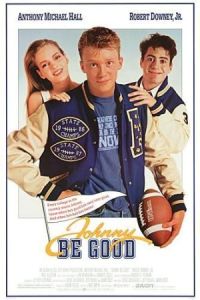 Johnny Walker (Anthony Michael Hall) may be the best high school quarterback in the country but he has a difficult choice to make. He promised his girlfriend, Georgia (Uma Thurman), that he would go to the local state college with her but every other university in the country wants him. (Even legendary sportscaster Howard Cosell calls Johnny and advises him to go to an Ivy League college.) As Johnny tours universities across the country, he faces every temptation. By the time he makes his decision, will Johnny still be good?
The main problem with Johnny Be Good can be found in the first sentence of the above synopsis. Anthony Michael Hall plays the best high school quarterback in the country. By taking on the role of Johnny Walker, Hall was obviously attempting to prove that he was capable of more than just playing nerds for John Hughes. But Hall is never convincing as a quarterback, much less the best in the country. Though he bulked up for the role, it is impossible to imagine Hall in a huddle, coming up with the big play that wins the game. It’s easier to imagine Johnny getting shoved in a locker and left there until the school year ends. Hall seems to be lost in the role and the movie never seems to be sure who Johnny Walker is supposed to be. (Two years later, Hall would again play a jock and give a far better performance in Edward Scissorhands.)
As for the rest of the cast, Robert Downey, Jr., who plays Johnny’s teammate and best friend, is even less convincing as a football player than Hall. In the 1980s, Downey could play a quirky sidekick in his sleep but not a wide receiver. Paul Gleason also shows up in the movie, basically playing the same role that he played in The Breakfast Club. Uma Thurman is sweet and pretty in her film debut but it’s a nothing role. Fans of Cannon Picture will want to keep an eye out for Steve James, in a small role as a coach.
Poorly written and slackly directed with few laughs, Johnny Be Good fails to take its own advice.
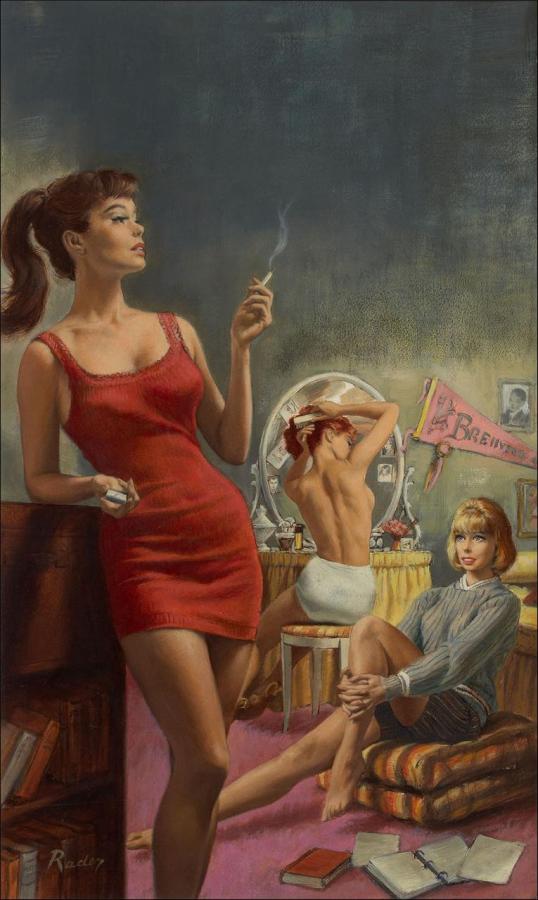
by Paul Rader
Sorry if this is short, but I’ve spent the past week watching all 65 episodes of Jem, so that I could properly “enjoy” the 2015 live-action adaptation.
Short version: The movie is awful.
Long version: Fans of the series are going to be incredibly disappointed because huge things are taken out, and many things are gutted. They won’t like it.
People who aren’t fans of the series are not going to like it either. It tries to graft elements of a show that would require quite a lot of money to do with special effects as well as more shooting time. The movie is very low budget. As a result, those things will only confuse this audience. It also causes the movie to make huge leaps, plot and character-wise. It’s always nice when a character talks about a bunch of time that has passed when we just saw it a few minutes ago.
The movie is for no one.
On the series, Jerrica created the alternate identity of Jem because she was clever business-wise, and used the money to fund a home for foster girls.
In the movie, Jerrica gets noticed on YouTube and becomes an overnight success that is taken advantage of, but ends up coming out on top.
Funny enough, that kind of has to do with this music video.
Back in 1984, a movie called Streets Of Fire was released. They wanted Hartman to do a song for it, so he gave them I Can Dream About You. They were going to have someone else sing it, and have a fictional group called The Sorels, lip-sync it in the movie.
Hartman told them that they could do that so long as if they ever decided to release the song as a single or on the soundtrack, that they would use his voice. They did just that, and the song did very well. It helped make him an overnight success, even though he had been around since the early-70s.
That brings us to the video.
Our avatar into the video is a woman played by Joyce Hyser. You remember her, right? She played the lead in Just One Of The Guys (1985).
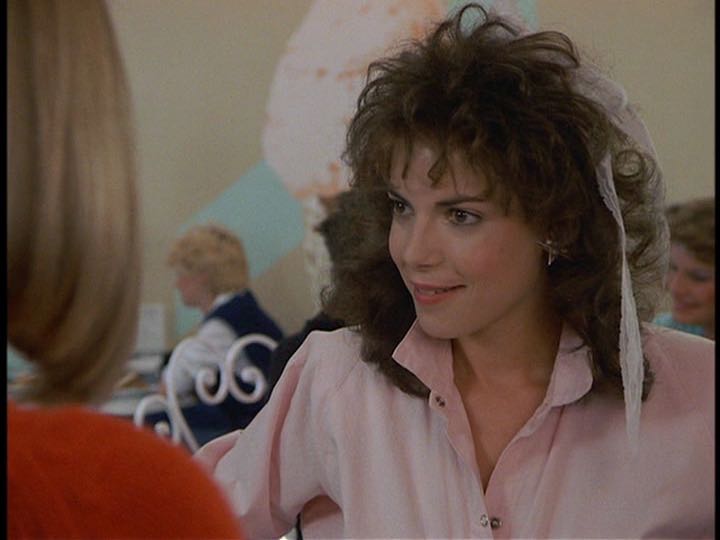
Just One Of The Guys (1985, dir. Lisa Gottlieb)
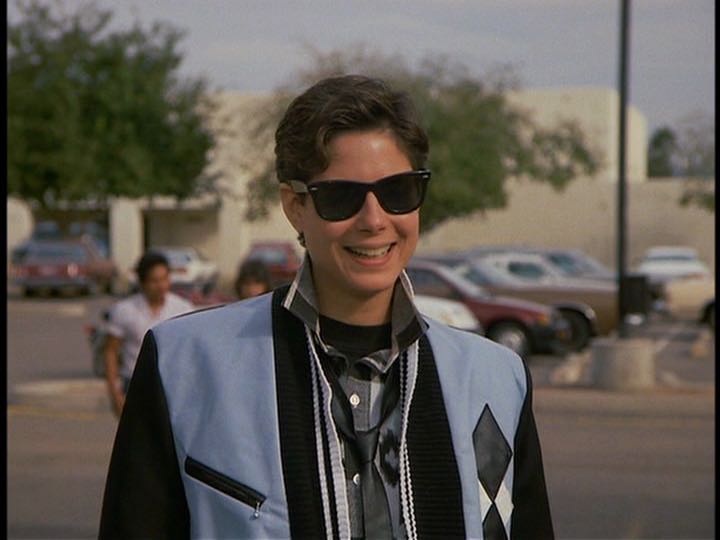
Just One Of The Guys (1985, dir. Lisa Gottlieb)
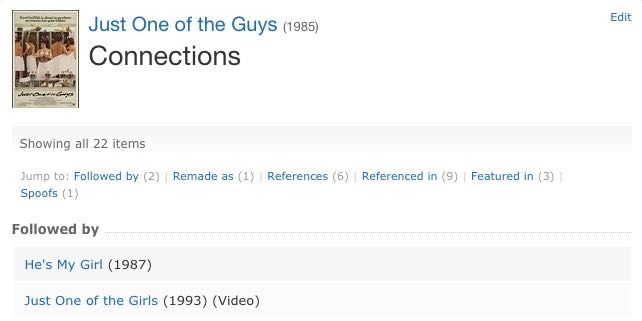
That isn’t a thing? Darn you, IMDb! You are usually so perfect.
It was also refaked in 2006 as She’s The Man. A movie insultingly inferior to the original.
She enters the bar and puts the the section of the film where The Sorels are sining the song on a jukebox. This sets us in the mindset of someone watching the movie. They think that The Sorels are really singing the song.
Slowly but surely she begins to realize that while their performance is excellent, the song is actually coming from the nondescript bartender.
In the end, we get a really clever bit. We keep cutting back to The Sorels, which reminds us why they were in the movie. Then Hartman gets up on the bar, and does a lame little dance that is nothing next to what the actors are doing that are playing The Sorels. It doesn’t matter though, because you are now seeing and hearing the person who wrote the song. Despite his performance abilities, they are his words, and are being sung with his voice.
It’s a nice little condensed way of starting the audience with the performance from the film that they are familiar with, and slowly inching us over to the person behind The Sorels.
They shot the video at the Hard Rock in London.
Technically, the version performed in the movie was sung by a guy named Winston Ford. But you get the idea.
If you want to hear the other version, then you can either watch the movie, or the other video that I swear doesn’t use Hartman’s voice. It’s close, but doesn’t sound like it matches up exactly. It is the one that uses the performance from the film, with some other footage from the movie cut into it.
Only ten years after this, Hartman died of an AIDS-related brain tumor at the age of 43.
Enjoy!

 Through the Shattered Lens