Back in the 1970’s, Boston’s WCVB-TV Channel 5 ran a weekend late-nite movie series called “The Great Entertainment”. For 18 years, host Frank Avruch did Robert Osbourne-like introductions to the station’s library of MGM films, way before the advent of cable. This is where I first saw and fell in love with many of the classic movies and stars of the 30’s and 40’s. When TCM recently aired CHINA SEAS, I hadn’t seen the film in decades, and knew I had to DVR it. It had made an impression on me, and while rewatching I was not disappointed; it’s still a rousing piece of entertainment!
Clark Gable is rugged sea captain Alan Gaskill, carrying a quarter million British pounds worth of gold as cargo aboard his liner heading from Hong Kong to Singapore. Jean Harlow plays ‘China Doll’ Portland, Gaskill’s in-port squeeze who comes along against his wishes. Gaskill’s former flame…
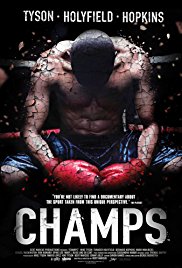
Bernard Hopkins. Evander Holyfield. Mike Tyson. Three men who came from similar backgrounds and who eventually became three very different heavyweight champions. Bernard Hopkins was the ex-con who transformed himself through boxing. Mike Tyson was the ferocious and self-destructive fighter whose legendary career eventually became a cautionary tale. Evander Holyfield was the underrated fighter, whose discipline and self-control made him a champ but also ensured that he would never get as much attention as the other boxers of the era.
Featuring extensive interviews with these three fighters, Champs is a documentary that not only follows their careers but also tries to place boxing within a greater sociological framework. As several people in the film state, rich kids do not grow up to become professional boxers. Instead, they are the ones who grow up to charge people $100 to watch Mayweather vs McGregor on Pay-Per-View. Boxing has always been a sport that has been dominated by men who grew up poor and marginalized. That was certainly true for Hopkins, Tyson, and Holyfield. For all three of them, boxing provided an escape but it also provided temptation. Unlike players in other sports, boxers rarely have anyone looking out for their best interests. Tyson’s career was derailed by a prison sentence and he has struggled with both financial and mental issues. Holyfield made millions for promoters but still ended up declaring bankruptcy. Champs does not shy away from examining the physical and metal toll of boxing.
As a documentary, Champs is sometimes too slick. There are too many interview with celebrity boxing fans. Ron Howard may be a good director but he does not have much to add to a discussion about the correlation between poverty and boxing. Champs works best when it allow Hopkins, Holyfield, and Tyson to tell their own stories. Hopkins speaks movingly about how the experience of being in prison not only changed him but ultimately made him a better person. Mike Tyson is candid about his own demons. Meanwhile, Holyfield talks about what it was like to always be underestimated and underrated by the boxing world. All three of them are compelling in their own different way. For fight fans, Champs has much to offer.
Way back in January, when I first heard about To The Bone, I had high hopes for it.
After all, To The Bone was the directorial debut of Marti Noxon, who is well-known both for her work on Buffy the Vampire Slayer and for co-creating Unreal. To The Bone was reportedly based on Noxon’s own struggle with an eating disorder and it was said to feature an outstanding lead performance from Lily Collins as an artist struggling with anorexia. Even the casting of Keanu Reeves as a doctor sounded intriguing.
And, to me, it didn’t matter that To The Bone got mixed reviews at Sundance. Who would seriously expect critics, especially male critics, to understand a movie about body issues and eating disorders? When I heard that To The Bone had been purchased by Netflix, I did sigh a little. Far too often, Netflix is where good films end up getting lost in a sea of mediocre offering. But then again, perhaps To The Bone was exactly the type of intimate character study that would actually benefit from being viewed on a small screen. After all, it’s not a film about a bunch of space lizard attacking the great wall of China. It’s a film about a young woman struggling with an eating disorder.
When Netflix finally released To The Bone back in July, I was excited.
Then I actually watched the movie.
To The Bone actually gets off to a pretty good start. The first 20 minutes or so are dedicated to establishing who Ellie (Lily Collins) is. She’s 20 years old. She’s smart. She’s sarcastic. She’s an artist. She’s a college dropout who apparently used to have a very popular tumblr that dealt with being thin. She’s also anorexic and, from the first minute that we see her, Ellie looks like she’s on the verge of death. (To the film’s credit, it makes clear that there is a huge difference between being naturally thin and being anorexic. That’s a distinction that is far too often overlooked.) We meet Ellie’s dysfunctional family: her frustrated stepmother (Carrie Preston), the father who often can’t be bothered, and the half-sister (Liana Liberato) who both loves and resents her. The relationship between the two sisters is especially well-handled. Even if it takes a while to get used to Keanu Reeves playing a compassionate but tough-talking doctor, the film still works during his first few scenes.
Then, Ellie joins Reeves’s inpatient program and moved into a house with six other patients and this is where the film started to annoy me. Ellie is such a well-drawn and well-acted character that it makes it all the more obvious that the rest of the patients are not. Instead, the rest of the patients are all easily identifiable types. As soon as they show up on screen, you know everything about them and you know exactly what is going to happen to each and every one of them. From the minute that Ellie reluctantly steps into that house, To The Bone starts to feel less like an honest look at anorexia and more like a well-meaning and predictable PSA. One of the patients is pregnant and always talk about how worried she is that her eating disorder is going to lead to her losing the baby. Can you guess what happens?
And then there’s Luke (Alex Sharp). Luke is the ballet dancer who is recovering from a knee injury. As soon as I saw that Luke was the only male in the house, I knew that he was destined to eventually declare his love for Ellie. But my problem with Luke has less to do with his predictable character arc and more to do with just how annoying a character he is. Luke is relentlessly upbeat. Luke constantly tells corny jokes. Luke just will not stop talking! When Luke leaves a room, he starts singing a song called Sugar Blues. When Luke reenters a room, he is still singing Sugar Blues. SHUT UP, LUKE!
(Whenever Ellie would visit Luke in his room, I would find myself distracted by the posters on his wall. The majority of them said “Jazz Festival” and featured some saxophone clipart. As strange as it may sound, it really started to annoy me that there was no date or location listed. Why would you go through all the trouble of making — or buying, for that matter — a poster for a jazz festival and then not bother to include a date or a location? That may sound like a minor thing but, as I watched the film, that inauthentic poster came to represent everything that felt inauthentic about Luke as a character.)
I guess the main problem with To The Bone is that it never succeeds in convincing us that the inpatient program is actually going to do any good for Ellie. It’s not for lack of trying. However, the scenes in the house are too overwrought and predictably scripted. There’s a scene where Reeves takes the patients on a field trip and it’s supposed to be inspiring but it doesn’t work because, as a first-time director, Noxon doesn’t trust her material enough to allow us to draw our own conclusions. Instead, she beats us over the head with her message. For To The Bone to work, it needed a director like Andrea Arnold, someone who specializes in a naturalistic performances and who is willing to embrace ambiguity and take the time to let a scene play out. Noxon makes the mistake of not trusting her audience to draw the right conclusion and, as a result, To The Bone goes from being an intriguing character study to being the cinematic equivalent of the last 15 minutes of an episode of Intervention.
Though it all, Lily Collins continues to give a good performance. Even when she’s forced to deliver some unfortunate dialogue, she’s the best thing about To The Bone. Unfortunately, the rest of this movie just collapses around her.
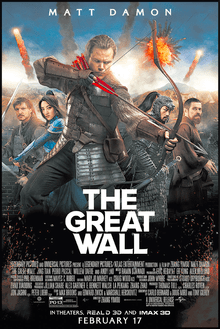
The Great Wall came out in February. Before it was released, I saw the trailer and I thought, “Well, that looks like it might be fun.” However, I never actually saw the film when it was in theaters. I think I was still recovering from Fifty Shades Darkerwhen The Great Wall was released so I put off going to see it. I thought to myself, “That’ll be around for a while.” Of course, I was wrong. The Great Wall played for two weeks and then it was gone.
That may not sound like a big deal when you consider the reviews that The Great Wall received. If not for the fact that Fifty Shades Darker was released a week earlier, The Great Wall would have been the first critical disaster of 2017. Seriously, the critics hated The Great Wall with a passion that took even me by surprise. The comments went beyond the usual snarkiness to outright hatred. Suddenly, The Great Wall — which, to judge from the trailer, looked like a harmless little monster movie — was being held up as an example of everything wrong with modern filmmaking.
The film was even attacked for starring Matt Damon. As I said before, I thought the trailer looked like fun but, apparently, other critics watched that trailer and found themselves asking, “How dare Matt Damon appear in a movie that’s set in eleventh century China!?” And you know what? I get it. Whenever I’m watching a movie about aliens invading the 11th Century, my immediate concern is whether or not the film is historically accurate. It’s bad enough that Americans are being taught that Matt Damon could survive on Mars. Do they also have to be told that Matt Damon saved China from the space lizards!?
Even though I missed The Great Wall when it was playing in theaters, I knew that it was a film that I would see eventually. Whenever a film gets totally slaughtered by the critics, I feel like I have almost a duty to watch the film and judge for myself. Some of that’s because I don’t trust the majority of critics. And some of it’s because, as a natural born contrarian, I’m always hopeful for any chance to go against the consensus. Last month, I finally watched The Great Wall and you know what?
It’s not that bad.
Now, it should be understood that being not that bad doesn’t necessarily mean that The Great Wall is a good movie. It’s a deeply silly movie and, occasionally, it’s also a profoundly dumb one. Matt Damon plays a European mercenary who is sneaking around China, searching for gunpowder. After he is captured by the Chinese and brought to the Great Wall, he is enlisted to help battle a bunch of space lizards. Apparently, the space lizards attack the wall every 60 years but, this year, they’re arriving early. Or something like that. I really couldn’t follow the mythology of the space lizards and that’s probably for the best. The Great Wall is not a film that demands or benefits from a good deal of deep thought. This is one of those films where the best plan is to not ask too many questions because the answers probably won’t make any sense anyway.
As dumb as The Great Wall may be, it’s an undeniably entertaining movie. Under the direction of Zhang Yimou, The Great Wall is a visual feast, full of epic landscapes and swooping cameras. When a seemingly limitless number of space lizards appear out of nowhere and suddenly charge the wall, it’s impossible not to get caught up in the exciting silliness of it all. When the Chinese army takes their positions on the Great Wall and prepare to repel the invasion, it doesn’t matter that none of the characters are particularly fleshed out. Instead, you’re just overwhelmed by the vibrant colors of their armor and the determined fierceness of their expressions. The Great Wall is shamelessly over the top and nicely self-aware. This a movie that knows that it is ludicrous and occasionally incoherent and you know what? The Great Wall is perfectly fine with that.
For all the criticism that he received for appearing in the movie, Matt Damon is ideally cast. Whenever Damon is on screen, it’s as if he’s entered into a conspiracy with the viewer. Matt Damon is one of the few actors who can maintain his balance while walking that thin line between drama and parody. With every arched eyebrow and slightly sarcastic line reading, Damon is saying, “Sure, this is all kind of stupid. But aren’t we having fun?”
When The Great Wall eventually shows up on the SyFy channel, it’s going to be fun movie to live tweet. Some films were just meant to be watched and appreciated with a group of your snarkiest friends. The Great Wall is one such film.
There’s either different versions, different edits, and sometimes censored and uncensored versions of a video. Err….
Anyhow, there are two different versions of the video for Minogue’s cover of The Loco-Motion. This is the video that was done for the original 1987 release. The differences between the two videos are enough that I want to post them separately.
The song is different. It’s more danceable in this version, than in the 1988 version. It also goes by Locomotion instead of The Loco-Motion.
If you play the two videos side-by-side, then you’ll notice they go out of sync almost immediately. They seem to be composed of mostly the same footage, but edited together differently, with a few parts I didn’t see in both.
A small example is when Kylie knocks the widescreen back to fullscreen. In this version it only happens once. In the other version it happens twice, back-to-back.
Thank you, Kylie Minogue and anyone else who helped to make the following video on her official YouTube page:
Without that retrospective, I wasn’t positive this version was officially made. There’s plenty of videos out there that have had the sound replaced and/or the video altered. Thanks to that video, I know that this is official.
I wasn’t sure about the director. Chris Langham is credited with doing seven of her videos. They are all from 1988-1989. He could have simply re-edited that earlier version. I don’t think he did though because Wikipedia lists him as having directed the 1987 version of the video for I Should Be So Lucky. That’s good enough for me.
The video itself is a mix of Minogue in music-video, behind-the-scenes, and studio-recording mode.


 Bernard Hopkins. Evander Holyfield. Mike Tyson. Three men who came from similar backgrounds and who eventually became three very different heavyweight champions. Bernard Hopkins was the ex-con who transformed himself through boxing. Mike Tyson was the ferocious and self-destructive fighter whose legendary career eventually became a cautionary tale. Evander Holyfield was the underrated fighter, whose discipline and self-control made him a champ but also ensured that he would never get as much attention as the other boxers of the era.
 Through the Shattered Lens