For many of us, October doesn’t just mean Halloween and all things horror, it also means playoff baseball. Unfortunately, my Boston Red Sox were eliminated last night by the Cleveland Indians. Fenway Park has locked its gates for the winter, but the Boys of Summer will return next April. Only there will be something missing in 2017. There will be no more Big Papi.
David Ortiz has decided to call it a career after nineteen glorious seasons as the best Designated Hitter in baseball. The 40-year-old slugger gave us his all, but the wear and tear on his body told him to make this season his last. And what a tremendous final season it was: .315 Batting Average, 38 Home Runs, 127 RBI, and he led the American League in OPS (1.021), Doubles (48), Slugging Percentage (.620), and Intentional Walks (15). Not bad for an old geezer, and Papi will…
I guess I could have done the music video for The Witch since there is that movie called The Witch that came out this year. I could have also done Love Removal Machine considering I plan to review the late night cable movie called The Love Machine (2016). However, I saw “Devil” in the title, and figured why not do it for October. I’ll get around to those music videos eventually. Plus, this one is timely for a good reason–much to my surprise. I didn’t know that till I sat down to write this post.
I cannot find any information on the music video itself beyond some of the people who worked on it. I can tell you that it is in that glorious 80s purple tinted black and white making it very much a music video of its’ time. The rest of it might as well be just one of those early 80s stage performance music videos. Speaking of which, there is a second version of this music video I found that appears to be entirely undocumented. But let’s first talk about the people who worked on this one.
Larry Williams was the director, and seems to have done at least 25 music videos in the 1980s. I say “at least” because I can find him on IMDb listing some music video credits that don’t appear in the usual places. He died in 1999 at the age of 48. I have seen one of his few directing credits other than this music video. He directed the 1998 TV Movie adaptation of Brave New World. There is one other thing of note with Larry Williams. I can find a Larry Williams II who works on music videos today. I have no idea if there is any relation.
Francie Moore produced this music video. I can find credits for her having worked mostly on either Larry Williams or Leslie Libman music videos. There is one that stands out. She produced Manic Monday for The Bangles.
June Guterman produced this music video too. I can only find a handful of credits for her as well, but she managed to do two well-known ones. She produced The Perfect Drug for Nine Inch Nails and Foolish Games for Jewel.
I can find a few more credits for Guterman such as producing Dice Rules (1991) and working on Prince of the City (1980) as well as Raging Bull (1980). However, I would bet that both her and Moore are two of those people who have a lot more credits in the music video department than I can find. I think this is especially true since there is a decade gap between Guterman producing this and The Perfect Drug.
With that done, here is the different music video I found for this same song
I could not find any information on this one. I kind of like both of them. This one is closer to the kind of music video I expect from The Cult, but you can see in the first one why remaining members of The Doors would have lead singer Ian Astbury stand-in for Jim Morrison more than a decade later.
Speaking of Ian Astbury, while looking for information on this music video, I came across a performance and interview they did on The Late Show Starring Joan Rivers back on May 14th, 1987. They arranged to have Ian’s father call him on the show in order to wish him a happy birthday.
The reason I said doing this post now turned out to be timely is because the company easyJet is currently using it in one of their ads.
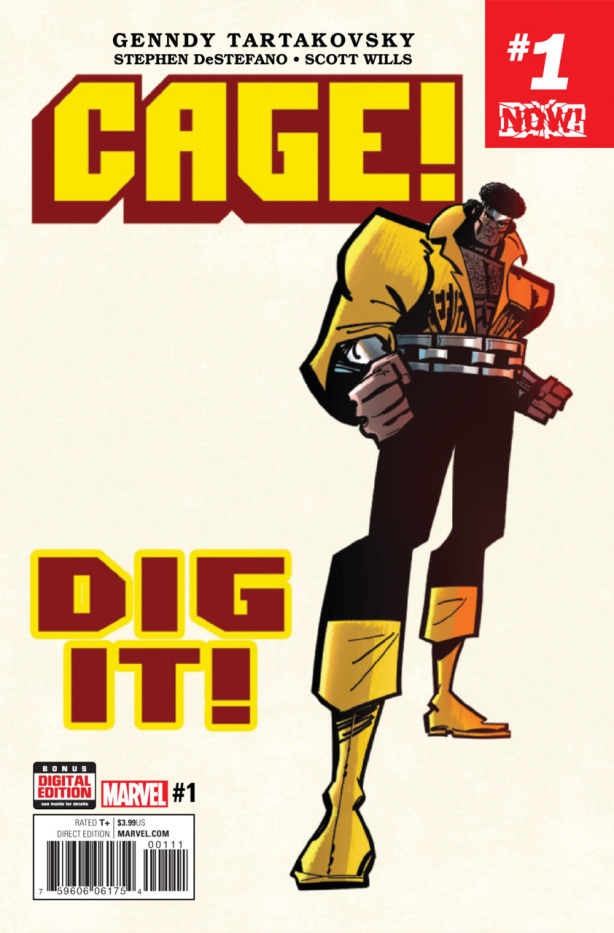
Obviously, Luke Cage is the man of the hour at Marvel right now thanks to the tremendous success, both critical and commercial, of the Netflix series bearing his name, so it’s only logical that their editorial brain trust would be ready in advance to capitalize on his small-screen superstardom with a solo series featuring the Hero for Hire on the printed page, as well. Unfortunately for us all, David Walker and Sanford Greene’s usually-awesome Power Man And Iron Fist monthly has been hijacked, like so many other titles at the moment, into the dull and derivative Civil War II fold, but fear not — while we’re all anxiously waiting for that crossover debacle to mercifully limp to its conclusion so that we can finally have our books back, the latest (and fourth, by my count) Marvel Now! initiative has kicked off with Cage!, a new four-parter from the mind…
For tonight’s excursion into televised horror, we have the 8th episode of the 3rd season of HBO’s Tales From The Crypt!
Easel Kill feels a bit like a remake of Color Me Blood Red. Tim Roth plays a painter who appears to have lost his talent. Apparently, he has recently stopped drinking and he’s just not that inspired when he’s sober. (However, he’s just as angry as he’s always been. He’s the type of neighbor who will push someone off of a fire escape if they’re playing their music too loud.) Fortunately, once he starts painting with blood, people are suddenly interested in his paintings.
The 1983 film Scalps answers the following question:
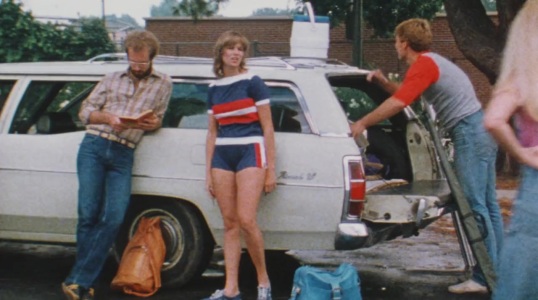
What happens when these grad students…
…dig up a sacred Native American burial ground and consider stealing some of the artifacts for themselves?
These grad students right here!
Well, they upset this lion…
…and this woman…
…and this guy, as well!
Needless to say, things don’t end well for anyone involved.
As for why those students were out digging for artifacts in the first place, the blame rests with Prof. Machen. At first, Machen didn’t go with the students. He had to take care of stuff back at the university. When he finally did show up, it was a little bit too late. Prof. Machen is played by an actor named Kirk Alyn, who was the first actor to play Superman back in the 1940s.
In the picture below, you can tell Prof. Machen is an explorer because of the pith helmet that he’s carrying:
Scalps is about 80 minutes long. Most fans of low-budget horror will not be shocked to learn that Scalps is about 60 minutes of filler and 20 minutes of actual action. Seriously, it takes forever for those grad students to actually reach the site of the dig and then, once they start digging, it seems to take even longer for anything to actually happen. Occasionally, we get a quick flash forward of someone getting scalped or an insert of either the lion, the witch, or the warrior looking upset.
The grad students themselves are pretty much interchangeable. As far as the men go, two of them have beards and another likes to drink beer. As far as the women are concerned, two of them are blonde and one of them is slightly less blonde. D.J. (Jo-Ann Robinson) is kind of a hippie and she has a bad feeling about everything.
(Stupid hippies! Bleh!)
What’s odd is that, in the end, the film’s glacial pace actually works to its advantage. Combined with an 80s synthesizer-of-doom score and some ragged but still effectively desolate shots of the desert, the slow pace actually gives Scalps something of a dream-like feel. Like a filmed nightmare, the film is suffused with a feeling of impending doom. Once the killings start, Scalps also makes good use of the slo-mo of doom. Even the most rudimentary of scenes can be scary when they’re filmed in slow motion.
Scalps has been described as being one of the most censored films in cinematic history. If you listen to Fred Olen Ray’s director’s commentary (more on that below), you’ll learn that it was largely censored due to the behavior of an unethical producer. That said, it is a remarkably gory little film. It may take a while for the blood to start flowing but once it starts, it doesn’t stop. Admittedly, some of the gore effects worked better than others. The arrow to the eye didn’t seem authentic. The scalping, on the other hand, seemed far too authentic. As for the decapitation …. well, I’d put that somewhere in the middle.
Scalps is something of a historical oddity, because it was one of the first films to be directed by the incredibly prolific Fred Olen Ray. If you’re lucky enough to find the out-of-print Retromedia DVD, you can listen to a commentary track from Fred. He’s remarkably honest about the film’s flaws and also discusses how he feels that the film’s producers ruined the film by adding random insert shots and flash forwards. (“That’s not us doing that!” Fred says during one insert of the lion.) Fred also points out that he made the mistake of actually shooting some of the night scenes at night. It’s always interesting listening to a veteran director talk about his first film. Since they have nothing to lose by openly discussing the mistakes that they made, their commentaries become a sort of a mini-film school.
Scalps is not a lost masterpiece but it is oddly watchable. Somehow, it manages to be both silly and surprisingly effective at the same time.
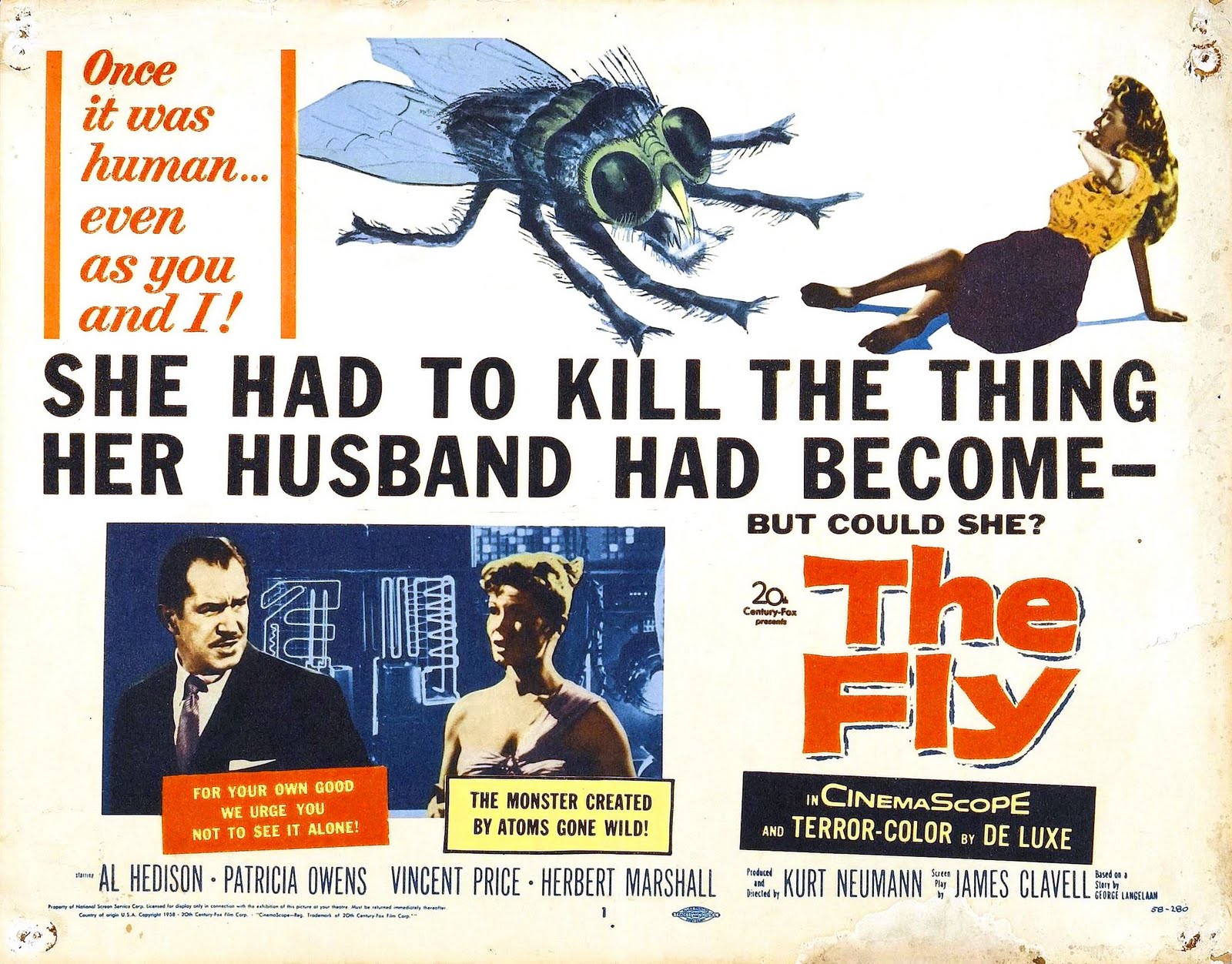
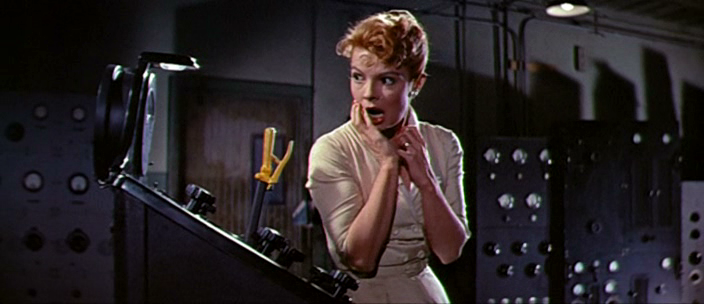
THE FLY is one of those films you’re probably familiar with if you’re a horror/sci-fi fan. I’ve seen it many times, but was under the impression it was a black & white movie (probably due to early viewings as a young’un, deprived of color TV). So when I rewatched it again in glorious Technicolor, I was pleasantly surprised. This tale of science gone wrong has held up well, and its iconic scene of The Fly’s unmasking still manages to jolt the viewer (even if you know it’s coming!).
The film’s framing device finds us witnessing Helene Delombre murdering her husband Andre by squishing his head and arm under a huge hydraulic press (and it’s a pretty gruesome demise), then calling her brother-in-law Francois to tell him. Francois is stunned, to say the least, and gets ahold of his friend Inspector Charas. They drive over to the Delombre Freres (the movie’s set in Montreal)…
Johnny Craig was a writer and artist who worked for EC Comics in the 1950s. His covers were considered to be so shocking and horrifying that they were actually investigated by Congress. (And you think your tax money is wasted today!) Here’s just a few of them:
Well, maybe he did or maybe he didn’t. It all depends on how you interpret the 1943 film, Son of Dracula. In Son of Dracula, Lon Chaney, Jr. plays a vampire named Count Alucard. I get the feeling that it’s supposed to be a shocking moment when it’s pointed out that Alucard is Dracula spelled backwards but, since the movie is called Son of Dracula, I would think that most people would have already figured out the connection.
That said, when Alucard reveals that his true name is Dracula, he seems to be suggesting that he is the original Count Dracula. And yet the name of the film is Son of Dracula. At one point, two characters speculate that Alucard is a descendant of the original, just to be corrected by his bride. “He is Dracula!” she announces. Then again, she could just be bragging. If you’re going to marry a Dracula, wouldn’t you rather marry the original than a descendant?
If he is the original Dracula, you do have to wonder why he’s still alive. Since the film is a part of the Universal Dracula series, you have to wonder how he managed to survive being both staked by Van Helsing and having his body cremated by his daughter in Dracula’s Daughter. You also can’t help but notice that Alucard doesn’t bear much of a resemblance to Bela Lugosi. nor does he have a European accent. Instead, Alucard looks a lot like Lon Chaney, Jr. Chaney does not make for the most convincing vampire. As an actor, Chaney tended to project a certain “likable but dumb lug” quality that worked well for The Wolf Man and as Lenny in Of Mice and Men but it doesn’t quite work when he’s cast as a suave, Hungarian vampire.
Anyway, Son of Dracula finds Count Alucard in New Orleans at the turn of the century. He has specifically moved to the Deep South so that he can be with Katherine Caldwell (Louise Allbritton), a young woman who is obsessed with the occult. Katherine secretly marries Alucard. When her former boyfriend, Frank (Robert Paige), finds out about the marriage he decides that the best way to handle way things would be to get drunk and shoot the count. Unfortunately, since the Count is a vampire, the bullet passes through him and kills Katherine instead.
Or does it!?
Probably the most interesting thing about Son of Dracula is that it presents Alucard as being manipulated by a mortal. Usually, Dracula is the one doing the manipulating but in Son of Dracula, it’s suggested that a clever mortal can manipulate the undead jut as easily. GO KATHERINE!
Anyway, Son of Dracula is okay. It has some steamy deep south atmosphere and it’s fun in a campy, Universal sort of way. It has some historical significance because it was apparently the first film to actually feature a vampire transforming into a bat onscreen. For the most part, though, it’s a film that will best be appreciated by Universal horror completists.
That said, I kind of like the fact that nobody in the film could figure out that Alucard is Dracula spelled backwards. That was cute.
This October, I’m going to be doing something a little bit different with my contribution to 4 Shots From 4 Films. I’m going to be taking a little chronological tour of the history of horror cinema, moving from decade to decade.
Today, we continue our look at the 1940s.
4 Shots From 4 Films
House of Frankenstein (1944, dir by Erle C. Kenton)
The Uninvited (1944, dir by Lewis Allen)
House of Dracula (1945, dir by Erle C. Kenton)
The Picture of Dorian Gray (1945, dir by Albert Lewin)









 Through the Shattered Lens