So, I’m looking around online for an image of the poster for director Iain Softley’s 2015 Blumhouse-distributed horror flick Curve and I notice that all of them have that little “bonus : a twisted alternate storyline” blurb on them, which tells me that not only was this thing released straight to video (since I’m assuming the “bonus alternate storyline” is some sort of Blu-ray/DVD extra), but that there was never even any intention of giving it any sort of theatrical play, even as a limited release or a one-off screening, given that a “proper” movie poster, complete with credits, is usually done up for films that are going to get some action on the festival circuit or, at the very least, a single-showing “premier” at a rented theater in LA. Hell, poster mock-ups of some sort are usually done even for films where the distributor/production company might be considering having…
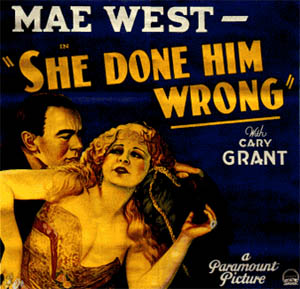
When watching the 1933 film She Done Him Wrong, it helps to know a little something about American history.
It helps to know that the film was made at the tail end of the failed progressive experiment known as prohibition, an attempt to ban liquor in the U.S. which only served to make people idolize criminals and feel nostalgic for the time when you could just safely hang out in a saloon and get drunk with bunch of shady characters.
It helps to know that this film was made at a time when America was struggling through the Great Depression and, more than ever, movies were seen as an escape from reality. The Depression also created a situation where, much like today, most Americans felt as if they were on the outside of the good life and, as a result, the most successful films of the time deal with outsiders getting something over on the smug and judgmental insiders.
It also helps to know that She Done Him Wrong was one of the last of the pre-Code films. Though, by modern standards, the film may seem outwardly tame, the innuendo and subtext is anything but. In fact, She Done Him Wrong was considered to be so racy that some people were actually scandalized when it became the biggest box office success of 1933. (These were largely the same people who, 13 years before, celebrated the passage of prohibition.) The infamous production code was largely instituted to make sure that a film like She Done Him Wrong could never be given another chance to corrupt filmgoers.
What exactly made She Done Him Wrong so controversial?
Well, it took place in a saloon in 1890s. The saloon is owned by Gus (Noah Beery), who uses it as a front for prostitution and counterfeiting. This is a film that features a lot of people drinking a lot of alcohol and it’s also a film that goes so far as to suggest that having a drink or two is not necessarily the worst thing in the world. Captain Cummings (Cary Grant) runs a city mission that has opened up next to the bar and the film devotes a lot of time to poking fun at Cummings’s upright morality. (Of course, Cummings has a secret of his own, one which suggests that his crusading attitude is just a convenient disguise.) Though it would be repealed by the end of the year, Prohibition was still the law of the land when She Done Him Wrong was released and it’s fun to see how much the film has at the law’s expense. That’s the type of fun that would basically be banned by the Production Code.
The Production Code would also require that all criminals be punished for their crimes by the end of a film. In She Done Him Wrong, singer Lady Lou (Mae West) stabs to death the viscous Russian Rita (Rafaela Ottiano) and basically gets away with it. It’s true that Lou was acting in self-defense but what makes She Done Him Wrong unique (for its time) is that Lou shows no remorse and that the killing is handled rather flippantly. When the police, who have been searching the saloon for another criminal, burst into the room after Rita has been stabbed, Lou fools them by placing Rita’s corpse in a chair and combing her hair. (“Haven’t you ever seen anyone comb someone’s hair before?”) After the police leave, Lou has her bodyguard dispose of the body and Rita is never mentioned again. Again, this is something that would never be allowed happen under the Production Code.
And then there’s the naked painting of Lou that hangs in the saloon. Whenever it’s shown a screen, a man in a hat happens to be standing in just the right position to block the viewer from seeing the entire portrait. Again, this would never have been allowed to happen under the Production Code.
And perhaps the biggest indication that this is a Pre-Code film is Mae West herself. Reportedly, She Done Him Wrong was an extremely toned down version of West’s stage act but what was heard on-screen would certainly be enough to throw the guardians of decent society into a panic. Nearly every line that she utters in this film is a double entendre but it’s not only what Mae West says. It’s the way that she says it. West may not have been a great actress but she had enough attitude that she didn’t need to be. With every line, with every glance, with every movement, Mae West announces that she not only has sex but she enjoys it too. In the Pre-Code days, that was unusual. Once the Production Code went into effect, such a portrayal would be impossible.
As for the film itself — well, it’s pretty much just an excuse for Mae to be Mae. There’s a plot, of course. Lady Lou has many suitors and they all converge on the saloon at the same time. However, Lou’s got her eye on the upstanding Captain Cummings. (He’s a man in uniform, after all.) It’s not a great film by any stretch of the imagination but, if you’re into film history or if you’re curious to see how American social mores have changed (and occasionally, not changed) over the years, She Done Him Wrong is a must see.
She Done Him Wrong is only 66 minutes long and it’s the shortest film to ever receive an Oscar nomination for best picture. It received no other nominations and lost to Cavalcade.
Reportedly, Ernest Hemingway hated the 1932 film adaptation of his great novel, A Farewell To Arms. The novel, of course, tells the story of ambulance driver Frederic Henry (played in the film by Gary Cooper), his service in World War I, and his doomed love affair with an English nurse named Catherine (played by the very American Helen Hayes). The novel was acclaimed for being tough and unsentimental. The film is the exact opposite, revealing itself to be more typical of the work of director Frank Borzage than Ernest Hemingway.
How romantic was Borzage’s adaptation of A Farewell to Arms? It was so romantic that it even changed the novel’s famous ending. The novel ended with Catherine dying and Frederic Henry walking away, alone and in the rain. The film, however, ended with Catherine miraculously recovering. Never mind, of course, that having Catherine survive pretty much defeated the entire purpose of the story. What was important was to give American audiences a happy ending!
However, European audiences got a more downbeat ending. In the European version, Catherine does die. After she dies, Frederic picks up her body and looks up into heaven, which is certainly far more dramatic (and, in its way, sentimentally spiritual) than anything to be found in Hemingway’s novel. If, like me, you see A Farewell To Arms on TCM, you’ll see the European ending.
So, yes, I can understand why Hemingway would have hated this film. But I have to admit that I rather enjoyed it. The film adaptation makes for terrible Hemingway but it’s great Borzage. Borzage specialized in making grand, lyrical, and sweeping romantic melodramas and that’s what his version of A Farewell To Arms truly is. Helen Hayes may not be convincingly English and Gary Cooper may be a bit overly earnest for a Hemingway hero but they both look good together and they have great chemistry. (Plus, Adolphe Menjou gives a good supporting performance as Frederic’s best friend.) As a director, Borzage keeps the story moving at a steady pace and plays up the romance in every single scene. There’s a great sequence that’s filmed entirely from the wounded Frederic’s point-of-view as he’s brought into a hospital and looked over by a series of officious nurses. We see everything through Frederic’s eyes until Catherine finally enters the room and kisses him. Only then do we see Frederic and Catherine together, leaving us with no doubt that these two belong together. A Farewell To Arms may not be a great literary adaptation but it is a great cinematic romance.
A Farewell To Arms was nominated for best picture but it won to a largely forgotten film called Cavalcade.
Last year, at this time, we shared some classic romance comic book covers. Starting in the late 1940s, many comic book companies tried to broaden their audience by publishing romance comic books. These comics told dramatic love stories in which young women had to deal with issues of cheating, divorce, jealousy, heartache, and the search for the one.
By Gene Colan
Because it’s Valentine’s Day, here’s more love and romance.
By Bob Oskner
By Bob Oskner
By Jay Scott Pike
By Nick Cardy
By Nick Cardy
And remember, while you’re searching for love, be careful and don’t accept a ride from the first guy who offers. Or you could end up with a bad reputation like Toni!
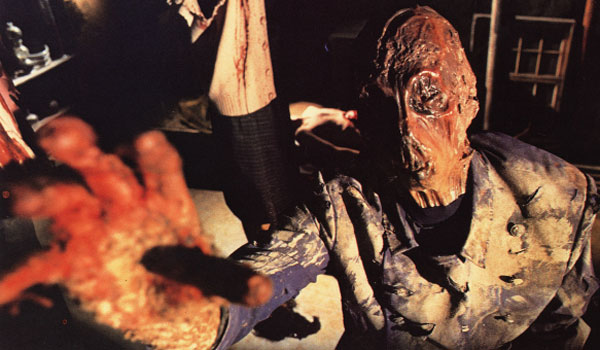
As many of you Dear Readers know by now, classic horror has always been my favorite genre. From the Universal Monsters to Bug-Eyed Aliens to Freddie Krueger and friends (fiends?), a good scary movie is a good time! Even a bad scary movie can be fun, if I’m in the right mood. So here are six (count ’em), yes six horror films I’ve recently watched, with some great horror actors and directors at their best (and worst!):
MIRACLES FOR SALE
(MGM 1939, D: Tod Browning)
The first great horror director, Browning teamed with Lon Chaney Sr. in the silent era to shock audiences with films like LONDON AFTER MIDNIGHT and THE UNHOLY THREE. He kicked off the Golden Age of Sound Horror with DRACULA, followed by the controversial FREAKS. MIRACLES FOR SALE was his last film, and while it’s more of a locked-room mystery, it’s loaded with those bizarre Browning…
Just in time for Valentine’s Day weekend, it’s Cowgirl Romances! Between 1950 and 1952, Fiction House published 12 issues of Cowgirl Romances and told stories about women in the old west who searched for love while shooting rustlers and other varmints.
I haven’t been able to discover who did the covers below but if any of our readers know, please let us know in the comments.
(The A.N.C. at the top of each cover stands for American News Company.)
(Update: After Gary identified issue 12 as being the work of Maurice Whitman, I did some research and discovered that all 12 of these covers were done by Whitman. Thanks, Gary!)
Recently, as a part of TCM’s 31 Days of Oscar, I watched the 1929 musical The Love Parade.
Now, I have to admit that this was one of those movies that I started watching with a lot of pre-conceived notions. While I happen to enjoy movies from all eras, I sometimes have a hard time adjusting to the style of the films that were made in the early days of the sound era. Often times, it’s obvious that these films were made by directors and actors who were still struggling to make the transition from silent to sound cinema. As a result, it’s not uncommon for films of this era to come across as being stiff and stagey.
But I needn’t have worried. While The Love Parade does have its occasionally stagey moments, it actually holds up remarkably well. For a film that was made 89 years ago, The Love Parade is still a lot of fun and surprisingly entertaining. It helps, of course, that The Love Parade was made before the adoption of the infamous Production Code and, as such, it’s allowed to show off a racy sense of humor that keeps the film from feeling too dated.
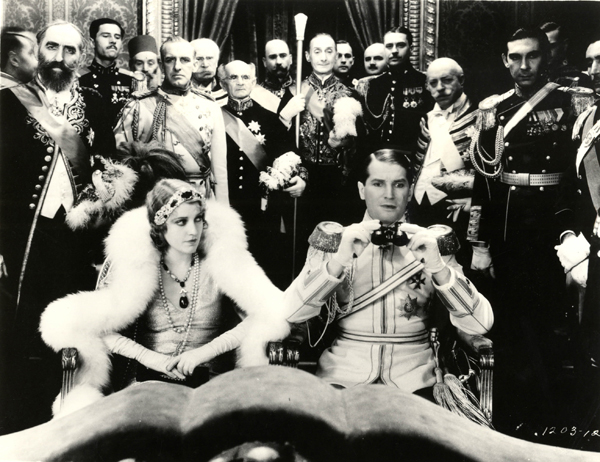
As for the film itself, it deals with Queen Louise (Jeanette MacDonald), the young ruler of the European kingdom of Sylvania. Despite the fact that Louise is a capable ruler, her subjects worry that she has yet to get married. When her advisors inform her that she is running the risk of never marrying, Louise dismisses their concerns in a very Pre-Code way. She lifts up her skirt, shows off her left leg, and says that there’s only one other leg as perfect as her left leg. She then extends her right leg. Since I basically do the same thing every single day, that was the moment when I realized that she might be the Queen and I might just be an outspoken redhead but I could still totally relate to Louise.
After showing off her legs, Louise deals with the issue of Count Alfred (Maurice Chevalier), a diplomat at Sylvania’s Paris embassy. Apparently, Alfred ended up having an affair with every woman at the embassy (including the ambassador’s wife) and he has been recalled to Sylvania. After reading the details of his sexual exploits, Louise decided that she has to meet Alfred for herself.
(And again, we’re reminded that this is a Pre-Code film.)
Alfred and Louise meet, fall in love, and marry. However, Alfred has a hard time dealing with the fact that, as Queen, Louise has all the power in their marriage. Even his attempts to draw up an economic plan are dismissed by the Queen’s advisors. Feeling emasculated, Alfred sings a song called Nobody’s Using It Now.
Three guess what “it” is.
Can this marriage be saved? Louise’s maid (Lillian Roth) and Alfred’s servant (Lupino Lane) are determined to make sure that it can be!
If the plot description and my review of The Love Parade sounds in any way similar to my review of The Smiling Lieutenant, that’s because both films were directed by Ernst Lubitsch. In fact, The Love Parade was Lubitsch’s first sound film and, in many ways, his assured direction here played a huge role in helping Hollywood make the transition from the silents to the talkies. Both Jeanette MacDonald and Maurice Chevalier give assured (and sexy) performances that hold up well today and the film’s opulent sets and costumes remain a visual delight. The end result feels like a wonderfully entertaining fairy tale.
The Love Parade was nominated for best picture but it lost to the far more grim All Quiet On The Western Front. But, regardless of what awards it won or did not win, The Love Parade is a delightful little film that works both as a historical document and a terrifically entertaining musical comedy.







 Through the Shattered Lens